Pass Your ITIL Foundation Test Exam: A Practical Guide
Mastering the ITIL 4 Foundation Exam: Your Essential Guide to Success
For IT professionals aiming to elevate their service management expertise, earning the ITIL 4 Foundation certification is a pivotal step. It’s more than just accumulating IT knowledge; it’s about strategically understanding the exam's unique landscape—its format, time constraints, and scoring methodology. At MindMesh Academy, we believe that grasping these 'rules of the game' provides a significant competitive edge, allowing you to approach your studies with clarity and confidence, even before diving into the core curriculum.
The ITIL 4 Foundation exam itself follows a clear structure: 40 multiple-choice questions to be completed within 60 minutes. To pass, you'll need to achieve a 65% passing score, meaning at least 26 correct answers. This is a closed-book examination, emphasizing your internalized understanding and application of concepts without external resources. Consider this less a test of abstract IT theory and more a precise evaluation of your ability to recall and appropriately apply specific ITIL terminology and principles under pressure. This precision is crucial, akin to knowing the exact syntax for a cloud CLI command (e.g., AWS CLI or Azure CLI) – close isn't good enough.
Understanding The ITIL Foundation Exam Blueprint
Before immersing yourself in the extensive study materials, it's paramount to first comprehend the exam's architectural blueprint. This strategic overview, much like an architect reviewing plans before construction, prevents wasted effort and ensures your foundational knowledge is robust. Understanding the logistical framework of the ITIL Foundation exam equips you with a strategic advantage. Let's outline the essential details:
ITIL Foundation Exam At A Glance
| Exam Component | Details |
|---|---|
| Question Format | 40 multiple-choice questions |
| Time Limit | 60 minutes (1.5 minutes per question) |
| Passing Score | 65% (26 out of 40 correct) |
| Exam Style | Closed-book (no notes or resources allowed) |
| Delivery | Online proctored via PeopleCert |
| Renewal | Required every 3 years to maintain certification |
Key Details for the ITIL 4 Foundation Exam
Notice the strict time limit: just 90 seconds per question. This necessitates not only knowing the material cold but also developing efficient test-taking strategies. There's little room for hesitation, making a deep, confident understanding of each concept absolutely critical.
Since 2023, PeopleCert has mandated the renewal of all its certifications, including ITIL 4 Foundation, every three years. This policy ensures your skills remain current and aligned with evolving industry standards. Proactively familiarizing yourself with the ITIL certification renewal requirements from the outset is a smart professional practice, much like understanding the continuing education units (CEUs) required for a PMP or AWS certification.
Expert Insight: The closed-book nature of this exam is a critical aspect. Your success hinges entirely on your ability to internalize and recall information. True mastery means not just memorizing definitions, but deeply understanding the interconnectedness of ITIL concepts, processes, and how they collectively contribute to service value.
This underscores why passive learning, such as merely reading through textbooks, is insufficient. Effective preparation demands active learning methodologies that compel you to retrieve, apply, and integrate information, cementing knowledge rather than just recognizing it.
Syllabus Domains and Knowledge Weighting
With the logistical framework understood, let's pivot to the core content. The ITIL 4 Foundation exam syllabus is strategically segmented into several key domains, each assigned a specific weighting by PeopleCert. An intelligent study strategy will invariably align with these priorities. Here's an essential overview of the knowledge areas you must master:
- Service Management Key Concepts (5-10% weighting): This domain establishes your foundational vocabulary. Fluency in core terms such as value, outcomes, costs, and risks is non-negotiable, as these principles underpin the entire ITIL framework. Think of it as mastering the basic data types and control structures before writing complex code.
- The Four Dimensions of Service Management (15-20% weighting): This section emphasizes a holistic perspective. You must comprehend how Organizations and People, Information and Technology, Partners and Suppliers, and Value Streams and Processes collaboratively interact to co-create and deliver value. This integrated understanding is crucial, similar to how a cloud architect must consider compute, storage, networking, and security as interconnected components in a solution.
- The ITIL Service Value System (SVS) (25-30% weighting): The SVS is unequivocally the core of ITIL 4. You must demonstrate a comprehensive understanding of how its interconnected components—the Guiding Principles, Governance, the Service Value Chain, and Practices—integrate to transform demand into tangible value. This is where the 'system' aspect of ITIL truly comes alive.
- ITIL Management Practices (30-45% weighting): While the Foundation exam doesn't delve into the deep operational mechanics of all 34 ITIL practices, it requires a robust foundational understanding of key practices such as Incident Management, Change Enablement (formerly Change Management), and Service Desk. Focus on their purpose, how they contribute to value, and their interaction within the SVS, rather than intricate procedural steps.
The objective is not to become a deep subject matter expert in every single practice overnight. Rather, it's to cultivate a broad, confident comprehension across the entire syllabus, empowering you to effectively address any of the 40 questions presented on exam day. Focus on the relationships between concepts, not just isolated definitions.
Building A Realistic And Effective Study Plan
For IT professionals, cramming for the ITIL 4 Foundation exam is a recipe for frustration, not success. Passing demands a strategic, structured approach that leverages how your brain optimally processes and retains information. A well-crafted study plan meticulously breaks down the syllabus into digestible segments, mitigates burnout, and instills the confidence needed for exam day. Drawing from extensive experience guiding professionals to certification, the optimal preparation window is typically 3 to 4 weeks of focused, consistent effort. This duration allows for genuine absorption and comprehension of concepts, moving beyond rote memorization, and realistically integrates into a busy professional and personal life. View this certification journey as a marathon, not a sprint, unfolding through distinct, progressive phases.
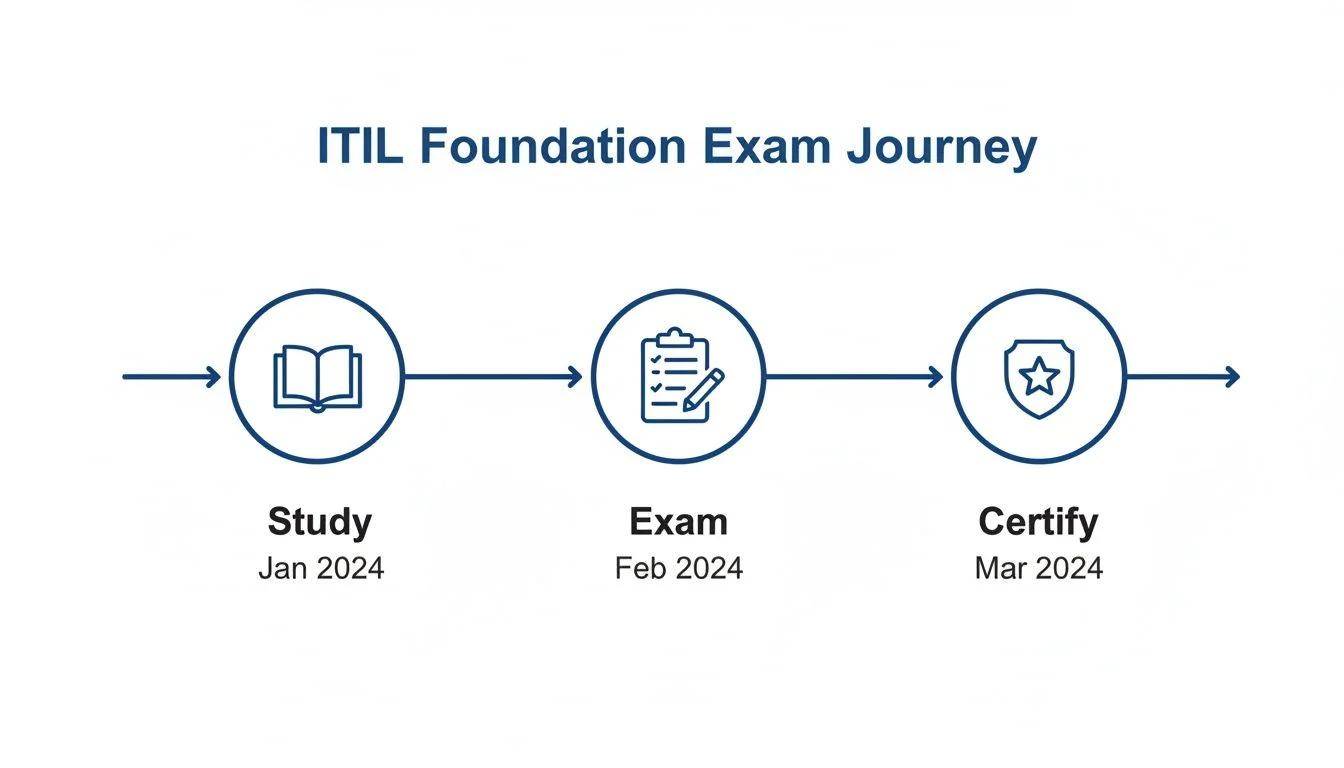
A visual roadmap for your ITIL Foundation certification journey, spanning study, exam, and certification phases.
Your Four-Week Phased Study Approach
Here’s a detailed breakdown of a highly effective four-week study plan for the ITIL 4 Foundation exam. The underlying strategy is to first establish an unshakeable foundational understanding, then progressively build upon it with more complex topics, before finally transitioning into intensive practice and review. While flexibility is key to accommodate your individual schedule, adhering to this phased progression is strongly recommended for optimal results.
Weeks 1-2: Mastering Foundational Knowledge and Core Concepts
These initial two weeks are dedicated to constructing a robust groundwork. Resist the urge to rush this phase; a solid understanding here ensures all subsequent ITIL 4 concepts seamlessly integrate.
- Your Goal: Achieve proficiency with core ITIL terminology and grasp the framework's overarching structure. The emphasis is on comprehending what each concept signifies and why it holds practical relevance in service management.
- Key Topics: Immerse yourself in the Service Management Key Concepts (e.g., value, outcomes, costs, risks), thoroughly explore The Four Dimensions of Service Management, and gain a high-level appreciation for the Service Value System (SVS).
- MindMesh Pro Tip: Develop comprehensive flashcards for every new term. Beyond just copying definitions, enrich each card with a concise, real-world application. For example, for "utility," consider adding, 'Our SaaS application consistently delivers expected performance, maintaining 99.9% uptime.' This transformation from abstract definition to tangible example is crucial for retention.
Reflection Prompt: As you learn these foundational terms, how do they relate to the challenges or successes you've encountered in your own IT career? Can you identify situations where understanding 'value' or 'risk' could have significantly altered an outcome?
Week 3: Deep Dive into the ITIL Service Value System (SVS) and Key Practices
Having established your foundational vocabulary, this week shifts focus to the operational mechanics of ITIL. The objective is to connect disparate concepts, understanding how the various components of the framework interact synergistically to co-create value.
- Your Goal: Synthesize a holistic view by linking the Guiding Principles to the Service Value Chain and integrating the individual ITIL Management Practices.
- Key Topics: Delve into the seven Guiding Principles, analyze the six activities of the Service Value Chain (Plan, Engage, Design & Transition, Obtain/Build, Deliver & Support, Improve), and understand the purpose of crucial practices such as Incident Management, Change Enablement, and Service Level Management.
- MindMesh Pro Tip: Engage in active visual learning. Sketch the Service Value Chain in your notebook and systematically trace the flow of common IT scenarios, such as provisioning a new cloud resource in Azure or resolving a critical production incident. This active recall technique profoundly reinforces knowledge beyond passive reading.
Reflection Prompt: Consider a recent IT project or service delivery challenge. How might applying the Guiding Principles or understanding the Service Value Chain activities have improved the outcome or identified potential bottlenecks earlier?
Crucial Clarification: A frequent pitfall for candidates is attempting to memorize the intricate operational details of all 34 ITIL practices. For the Foundation exam, your focus should strictly be on understanding the purpose and key activities of the most prevalent practices, and how they contribute to value within the SVS. Prioritize your study energy accordingly, rather than getting lost in excessive detail.
Week 4: Intensive Review and Practice Exam Simulation
This concluding week serves as your critical dress rehearsal. The primary objective is to achieve complete familiarity with the exam's format, internalize effective time management, master question styles, and precisely identify and remediate any remaining knowledge gaps.
- Your Goal: Consolidate accumulated knowledge, cultivate exam-taking stamina, and refine your timing to a scientific precision.
- Key Topics: Absolutely no new material should be introduced. This week is exclusively dedicated to comprehensive review of your notes, systematic flashcard drills, and, most critically, engaging in multiple full-length, timed ITIL Foundation practice exams.
- MindMesh Pro Tip: Implement an "error log" immediately after each practice test. For every incorrect answer, meticulously record: the associated ITIL topic, your reasoning for selecting the incorrect option, and a clear articulation of the correct answer's rationale. This targeted analytical process is arguably the most potent study hack for certification success, echoing the iterative feedback loops common in Agile project management.
Reflection Prompt: As you review your error log, what recurring patterns emerge in your incorrect answers? Are they primarily knowledge gaps, misinterpretations of questions, or time management issues? How will you specifically address your top three areas for improvement before exam day?
To truly excel in the ITIL 4 Foundation exam, you must transcend mere memorization of definitions. The fundamental secret lies in grasping how all core components of the ITIL 4 framework seamlessly integrate into a cohesive, dynamic system—a system explicitly engineered to co-create value. At its heart, the entire framework revolves around the ITIL Service Value System (SVS). Envision the SVS as the comprehensive operating model for any contemporary, IT-driven organization. It meticulously delineates all the interconnected components and activities that must function in harmony to transform customer demand or business opportunities into tangible, genuine value. It is not a linear process, but rather an adaptive, continually evolving ecosystem.
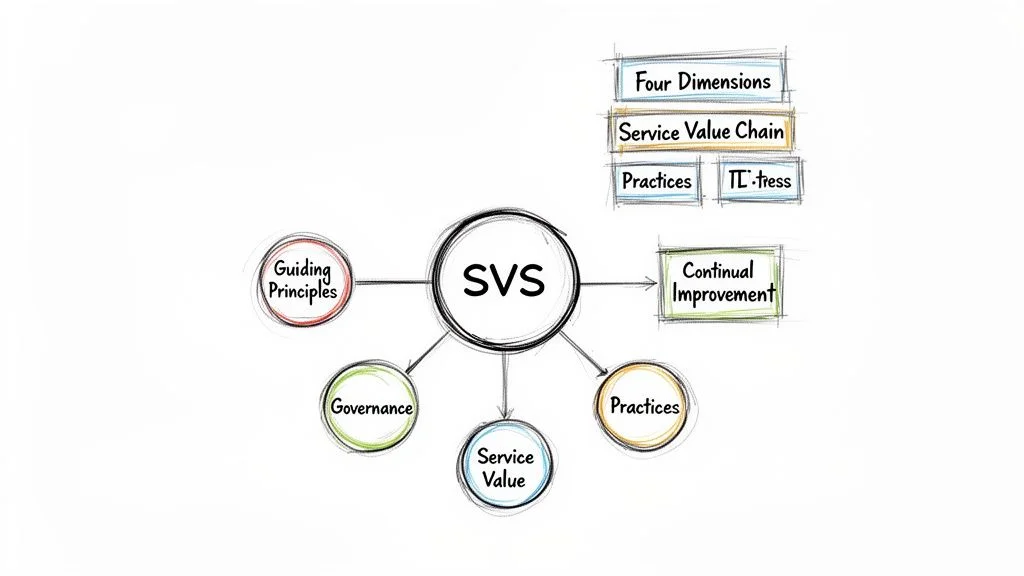
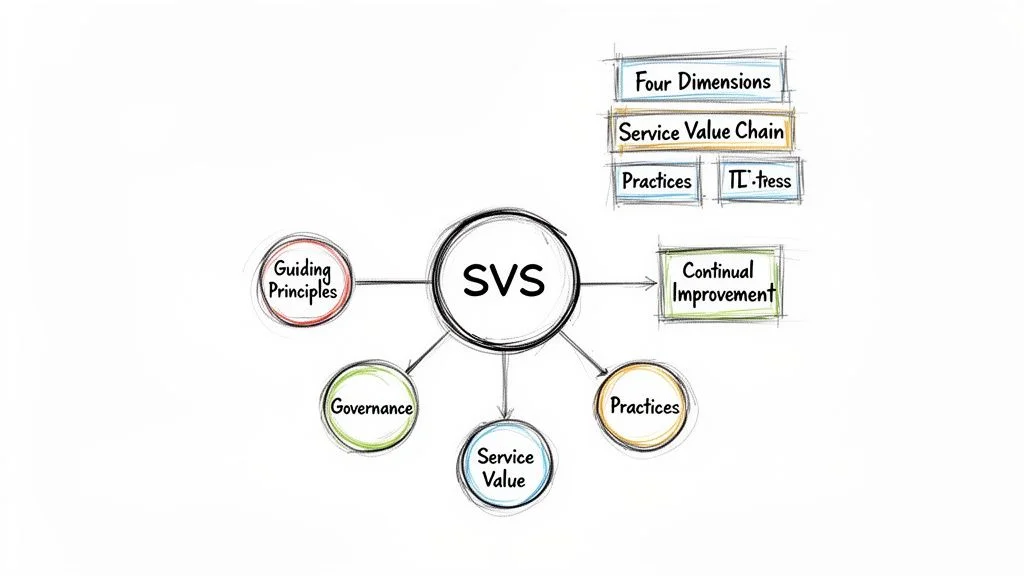
An overview of the ITIL Service Value System (SVS), highlighting its core components and the principle of continual improvement.
Unpacking The ITIL Service Value System
The ITIL Service Value System (SVS) comprises five interdependent core components, each performing a distinct function in the overarching process of transforming demand into realized value. A thorough understanding of each is essential.
- Guiding Principles: These embody the universal recommendations and shared beliefs that steer an organization through all circumstances. They act as the organizational conscience, profoundly influencing every strategic and operational decision. They are akin to the fundamental tenets of a DevOps culture: collaboration, automation, and continuous improvement.
- Governance: This component defines the mechanisms by which an organization is directed and controlled. It establishes the robust framework ensuring all activities, from strategic planning to day-to-day operations, consistently align with the overarching business objectives and compliance requirements.
- Service Value Chain: Considered the operational engine of the SVS, the Service Value Chain (SVC) is a flexible sequence of interconnected activities that an organization undertakes to co-create valuable products and services with its consumers. It outlines how value streams are realized.
- Practices: Functioning as specialized toolkits, practices represent bundles of organizational resources—encompassing people, processes, information, and technology—meticulously designed to execute specific work or achieve particular objectives, such as Incident Management or Change Enablement. They provide the practical means to achieve the Service Value Chain activities.
- Continual Improvement: Far from being a mere final phase, continual improvement is an embedded mindset, deeply woven into every fiber of the SVS. It mandates that the organization consistently strives for enhancement and optimization across all its services, processes, and products. This is comparable to the iterative feedback loops in Lean IT or continuous delivery pipelines.
Exam Strategy: A critical insight for the exam is to move beyond viewing these components as a mere checklist. Instead, you must master their interconnectedness. Comprehending how a Guiding Principle such as 'Focus on value' directly informs and shapes the activities within the Service Value Chain, which subsequently influences the execution of a practice like Service Level Management, is fundamental to success.
The Seven Guiding Principles In Action
The seven ITIL Guiding Principles are far more than aspirational statements; they represent actionable philosophies designed to steer effective service management. The ITIL Foundation exam will rigorously test your capacity to apply these principles to diverse real-world scenarios, demanding more than just rote memorization.
- Focus on value: This principle is the bedrock. Always ask: 'Who is the service consumer? What do they perceive as value? How does this specific action or service truly deliver that value?' For instance, an IT department implementing a new monitoring tool should ensure it directly contributes to improved service availability or faster incident resolution, not just collect more data.
- Start where you are: Resist the urge for wholesale change. Instead, objectively assess existing services, processes, people, and tools. Leverage what currently works and build iteratively upon successful elements. A global enterprise migrating to a hybrid cloud environment, for example, would analyze its current on-premise virtual infrastructure and adapt existing management practices rather than starting from scratch.
- Progress iteratively with feedback: Abandon 'big bang' transformations. Deliver changes and improvements in small, manageable increments, actively soliciting and incorporating feedback at each stage. This Agile approach, common in software development, minimizes risk and allows for rapid course correction, ensuring the solution remains aligned with evolving needs.
- Collaborate and promote visibility: Actively dismantle organizational silos. Foster cross-functional teamwork and ensure transparent communication, so all stakeholders understand current activities, progress, and strategic rationale. A DevOps team, for instance, requires close collaboration between development, operations, and security to achieve continuous delivery.
- Think and work holistically: Recognize that no service, team, or technological component operates in isolation. Understand that any change in one area will inevitably ripple across other parts of the system. Implementing a new security patch on a critical server, for example, requires assessing its potential impact on dependent applications, network performance, and user access.
- Keep it simple and practical: Prioritize efficiency by striving for the minimum viable number of steps or components required to achieve an objective. Complexity is a direct adversary of efficiency and value realization. Automating a routine task, like user onboarding, should focus on straightforward workflows, not adding unnecessary approval layers.
- Optimize and automate: Systematically leverage automation for routine, repetitive tasks. This strategic move frees up your skilled human talent to concentrate on more intricate, high-value strategic initiatives and problem-solving. Consider the benefits of automating cloud infrastructure provisioning (e.g., using Terraform or AWS CloudFormation) compared to manual configuration.
A profound understanding and application of these ITIL Guiding Principles are distinguishing characteristics of leading IT professionals. It's compelling to note that by 2023, over 1 million individuals globally had attained ITIL certification. A significant 40% of these certified professionals operate in highly demanding sectors such as banking and healthcare, where uninterrupted, reliable service delivery is absolutely non-negotiable. This statistic powerfully affirms that these principles are not mere theoretical constructs but essential operational imperatives for modern digital service management.
Connecting The Four Dimensions of Service Management
To genuinely deliver and sustain value, a comprehensive, holistic perspective extending beyond pure technology is indispensable. ITIL 4 introduces The Four Dimensions of Service Management as a framework to ensure a balanced and integrated approach. For every service you manage, from design to delivery, all four dimensions must be thoughtfully considered.
| Dimension | Description | Practical Example |
|---|---|---|
| Organizations and People | The company culture, roles, skills, and team structures. | Training your service desk team on how to use a new CRM. |
| Information and Technology | The data, applications, and infrastructure needed for the service. | The CRM software itself, along with its database and the network. |
| Partners and Suppliers | The third-party vendors and partners you rely on. | The cloud provider that hosts your CRM application. |
| Value Streams and Processes | The specific workflows and procedures that guide the work. | The step-by-step process for logging a customer issue in the CRM. |
The Four Dimensions of Service Management with Practical Examples.
On the ITIL 4 Foundation exam, you can anticipate scenario-based questions describing a service failure. Your task will be to pinpoint which dimension was overlooked or inadequately addressed. For instance, if a digital transformation initiative deploys a sophisticated new CRM system (Information and Technology) but neglects to adequately train the sales team on its usage (Organizations and People), the entire endeavor is likely to falter. Systematically applying these four dimensions is fundamental to understanding the core concepts and foundational terminology for value within the ITIL framework.
Using Practice Tests To Diagnose And Improve
Let’s be unequivocal: ITIL Foundation practice tests are far more than mere score checks; they are your most potent diagnostic instruments. A common misstep is for candidates to prematurely engage in full-length simulations, leading to discouraging scores and significant demotivation. This approach is counterproductive. Consider the analogy of a startup developing a new SaaS product: they don't launch the entire platform without iterative testing of features and user feedback. Adopt this experimental mindset. Each practice test offers an invaluable opportunity to collect precise data on your performance and meticulously fine-tune your study strategy. For instance, just as you'd use integration tests for a new microservice, practice questions test specific ITIL knowledge components.
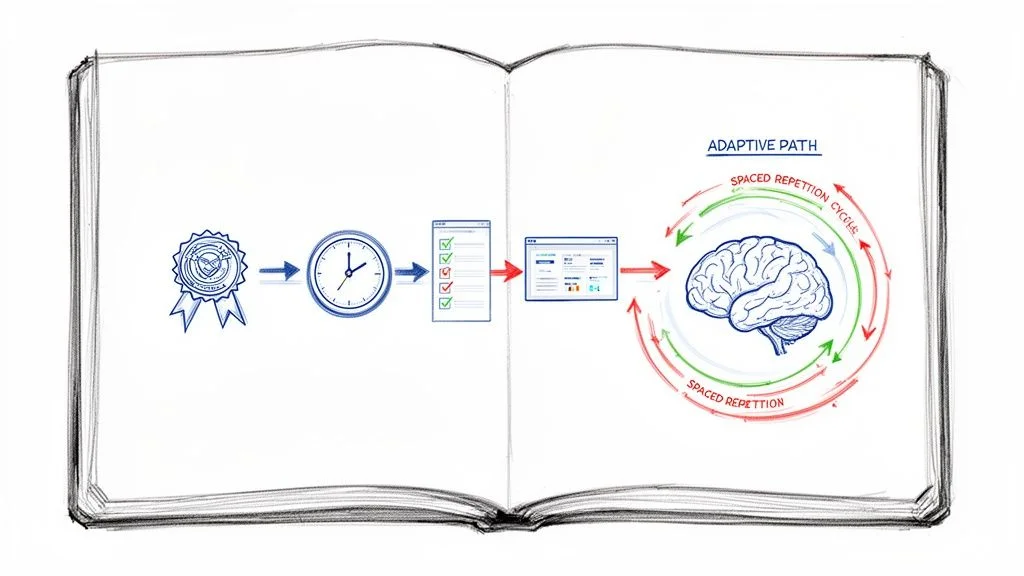
Visualizing practice test analysis: a magnifying glass for details, a bar chart for performance, a clock for time management, and a broken chain for knowledge gaps.
Start Small Then Scale Up
Do not, under any circumstances, commence your practice with a full 40-question, 60-minute simulation. This is akin to attempting a full marathon on your initial training day. The primary objective in the early stages is knowledge reinforcement, not endurance testing. A far more intelligent, phased approach is outlined below:
- Early Stages (Weeks 1-2): Targeted Micro-Quizzes Focus on short, targeted quizzes—approximately 10-15 questions—that are laser-focused on a single, recently studied topic. For instance, if you've just reviewed the ITIL Guiding Principles, take a quiz exclusively on those principles. This strategy effectively solidifies understanding before introducing additional complexity.
- Mid-Stage (Week 3): Mixed Topic Assessments Begin integrating questions from several different syllabus areas into 20-25 question assessments. This phase is crucial for training your cognitive flexibility, simulating the context-switching demands of the actual exam.
- Final Stage (Week 4): Full-Length Mock Exams This is the period to engage in full-length, timed mock exams. Aim for a minimum of 3-4 complete simulations. This phase is entirely dedicated to building exam stamina, refining your time management, and accurately gauging your readiness for the ITIL 4 Foundation exam.
This systematic ramp-up strategy proactively prevents burnout and incrementally builds confidence. By the time you engage in a full simulation, it will feel manageable, having already mastered its constituent parts.
Reflection Prompt: What is your current comfort level with ITIL concepts? Based on that, what type of practice test (micro-quiz, mixed, or full-length) will you prioritize in your next study session?
Analyze Your Results Like A Detective
Receiving your practice test score marks only the commencement of the diagnostic process. The true learning and improvement occur during the meticulous review. For every single practice test, you must establish and rigorously maintain an "error log," dissecting precisely what went wrong and, critically, why.
Your comprehensive analysis for each incorrectly answered question should address the following:
- What was the specific ITIL topic? Pinpoint the exact ITIL concept, principle, or practice (e.g., a specific Guiding Principle, an activity within the Service Value Chain, or the purpose of Incident Management).
- Was it a knowledge gap? Did you genuinely lack familiarity with the definition or context of a term like Change Enablement? This is a factual deficiency.
- Was it a comprehension issue? Did you misinterpret the scenario, overlook a crucial detail, or fundamentally misunderstand the core demand of the question?
- Was it a time pressure mistake? Did the clock induce panic, leading to a rushed, unconsidered selection, analogous to making a hasty decision under pressure in a critical production incident?
This granular level of detail transforms a raw score into an actionable remediation plan. If your error log reveals a recurring pattern of missed questions concerning the Service Value Chain, you gain precise intelligence on exactly where to focus your subsequent study efforts. For a more detailed exploration of this methodology, refer to our comprehensive guide on how to ace ITIL practice exams.
Common Pitfall: A prevalent challenge arises with questions employing qualifiers such as "best," "most likely," or "primary." Candidates often possess accurate definitional knowledge but falter when required to apply that knowledge to a scenario and discern the most appropriate answer among several plausible options. This demands nuanced judgment and a deep understanding of ITIL's practical application.
Identify And Correct Your Error Patterns
Following a few mock examinations, your meticulously maintained error log will begin to reveal distinct performance narratives. Perhaps you consistently conflate the distinct purposes of Incident Management and Problem Management, or you routinely sacrifice valuable points in the final minutes due to rushed decisions. Once these patterns are identified, you can implement targeted remediation strategies:
- For Knowledge Gaps: Revisit primary source materials. Re-read relevant chapters, review video lectures, and intensively drill flashcards pertaining to that specific topic until the concepts become intrinsic.
- For Comprehension Issues: Cultivate a deliberate, methodical approach. During subsequent practice runs, actively highlight keywords within the question. Mentally or physically rephrase the question in your own terms before examining the answer choices, much like a solutions architect meticulously breaks down complex requirements.
- For Timing Problems: Deconstruct the exam into smaller, manageable segments. Employ a mini-timer for every 10 questions, ensuring a consistent pace and mitigating the detrimental effects of a last-minute scramble. This mirrors the sprint planning in an Agile environment.
By systematically isolating and rectifying your specific weaknesses, each practice test evolves into a highly productive stride forward. You transition from speculative guessing to deliberately engineering your success on the ITIL 4 Foundation exam.
Getting Ready for Exam Day and What's Next
You've diligently invested the effort, rigorously absorbing weeks of new information. Now, as you approach the final stages, success on the **ITIL 4 Foundation exam** transcends further learning; it hinges on cultivating the optimal mindset and executing a meticulously planned strategy for exam day.The 24 hours preceding your examination should be exclusively dedicated to knowledge consolidation, emphatically not to cramming. While the impulse to ingest last-minute details is compelling, it is almost invariably counterproductive. Instead, engage in a light review of your summary notes, perhaps quickly review flashcards on key topics like the Guiding Principles or the Service Value System. Your objective is to enter the exam environment feeling confident, rested, and mentally clear, rather than fatigued or anxious from an all-nighter.
Final Preparations for a Smooth Exam Experience
Your examination environment is a critical factor, particularly for online proctored exams. Ensure your testing space is impeccably clear, quiet, and completely free from any unauthorized materials. A disorganized physical space can readily translate into cognitive clutter, which is precisely what you want to avoid when under timed pressure. Dedicate ample time the day prior to meticulously organize all logistical aspects. A few minutes of proactive preparation can circumvent significant stress and unforeseen issues.
Essential Checklist for Your ITIL 4 Foundation Exam Day
| Checklist Item | Status |
|---|---|
| Confirm Your Tech: | |
| Computer & Webcam Functioning | |
| Stable Internet Connection | |
| Met all PeopleCert Requirements | |
| Prepare Your ID: | |
| Government-issued Photo ID Ready | |
| Easily Accessible | |
| Personal Prep: | |
| Got a Good Night's Sleep | |
| Ate a Balanced Meal | |
| Mentally Ready & Calm |
By taking care of these details ahead of time, you eliminate surprises and can dedicate all your mental energy to the 40 questions you've prepared so hard for.
Strategic Advantage: The paramount objective is to systematically eliminate every potential point of friction. When all practical and logistical details are proactively managed, your cognitive resources are liberated to concentrate solely and completely on the complex demands of the exam content.
On the morning of your exam, consume a balanced meal, but consider abstaining from excessive caffeine, which can induce unnecessary jitters. Prior to logging in, engage in a few deep breathing exercises or a brief moment of quiet reflection; these mindfulness techniques can remarkably calm nerves and enhance focus, much like preparing for a high-stakes technical presentation.
Turning Your Certification Into a Career Advantage
Passing the ITIL 4 Foundation exam is a significant professional milestone, yet it is fundamentally a new beginning. The profound value of this certification is realized through its strategic application to advance your career trajectory.
Immediately upon certification, proactively update your professional profiles. Add "ITIL® Foundation Certificate in IT Service Management" to your LinkedIn and resume without delay. Crucially, move beyond a mere listing. In your summary and experience descriptions, articulate how this certification empowers you to create demonstrable business value by optimizing IT services and rigorously aligning them with overarching organizational objectives. This contextualization elevates the credential from a line item to a strategic, in-demand skill set, much like an AWS Solutions Architect certification signifies practical cloud design expertise.
This certification consistently captures the attention of prospective employers. It is well-documented that ITIL-certified professionals frequently command 10-20% higher salaries than their non-certified counterparts. Indeed, approximately 70% of recruiters regard ITIL certification as a substantial advantage in candidate evaluation. For a granular analysis of potential earnings, you can explore detailed ITIL salary breakdowns.
Furthermore, the ITIL 4 Foundation serves as an invaluable launchpad for specialized expertise. Once you have solidified your foundational understanding, consider pursuing advanced certifications within the ITIL 4 Managing Professional (MP) or Strategic Leader (SL) streams. These progressive pathways enable you to deepen your knowledge, cultivate specialized skills, and position yourself to resolve increasingly complex service management challenges, evolving into a highly valuable, strategic expert. To visualize your complete ITIL career roadmap, check out our comprehensive guide on how to get ITIL certified.
Answering Your Top ITIL Foundation Exam Questions
Even with a meticulously crafted study plan in place, it's natural for lingering questions about the ITIL 4 Foundation exam to arise. Addressing these proactively is essential for approaching your preparation with confidence and minimizing anxiety. Consider this section a direct FAQ from seasoned mentors who have navigated this path successfully.
How Challenging Is the ITIL 4 Foundation Exam, Truly?
To be explicit: the ITIL 4 Foundation is an entry-level certification, intentionally designed to be challenging yet entirely attainable with appropriate preparation. Its true difficulty does not stem from solving abstract, complex problems, but rather from the precise mastery of ITIL's specific terminology and the interconnectedness of its framework concepts. You won't be tasked with designing a complex cloud architecture (like in an Azure Architect exam) or building a service desk from the ground up during the examination.
The primary area where candidates often falter lies in the nuances of multiple-choice questions. You'll frequently encounter options where two or even three answers appear plausible. This is precisely where a granular understanding of the precise definitions, purposes, and interrelationships of the 34 ITIL practices becomes absolutely critical. Success correlates less with years of IT experience and more directly with the diligence and fidelity applied to studying the official syllabus. With focused effort, you will find it to be a rigorously fair assessment.
What is the Optimal Study Time Commitment for the ITIL 4 Foundation Exam?
While no single 'magic number' exists, the optimal range for most professionals falls between 20 to 40 hours of dedicated, focused study. For individuals balancing a full-time career, this typically translates into approximately three to four weeks of consistent effort.
Crucially, resist the temptation to cram all your study into a single weekend. Daily, incremental study—for example, one to two hours—is exponentially more effective for long-term information retention. This approach facilitates deeper cognitive processing, utilizing active recall and spaced repetition to embed knowledge durably.
Your individual timeline will naturally adapt based on several factors:
- Your Professional Background: If your current role already immerses you in service management principles (e.g., as an IT Operations Manager or a Project Manager handling IT projects), your preparation might lean towards the lower end of the 20-hour spectrum.
- Individual Learning Style: Some individuals assimilate information rapidly through reading, while others require iterative review, practical application, and time for concepts to fully integrate.
- Realistic Lifestyle Integration: Be candid about the maximum number of hours you can realistically commit each day without risking burnout. Remember, consistent effort unequivocally surpasses sporadic, intense bursts.
What Happens if I Don't Pass the ITIL 4 Foundation Exam?
First and foremost, understand that exam failures are a common rite of passage for many professionals in the technology sector; do not allow the apprehension of failure to impede your progress. This is by no means the culmination of your ITIL journey. PeopleCert, the official examination institute, permits retakes, though a new exam voucher purchase will be required.
MindMesh Pro Tip: When selecting your training provider, inquire about "pass guarantees" or discounted Take2 Exam Retake Vouchers. This seemingly minor consideration can significantly mitigate financial risk and alleviate stress should a second attempt be necessary.
In the event of an unsuccessful attempt, your detailed score report immediately transforms into your most valuable diagnostic asset. This report meticulously itemizes your performance across each syllabus area, precisely highlighting where your knowledge fell short. Utilize this as a strategic diagnostic tool, enabling you to laser-focus on identified weaknesses rather than indiscriminately re-studying the entire curriculum. Crucially, reframe an unsuccessful attempt not as a failure, but as an exceptionally detailed, personalized study guide, precisely charting the optimal course for your subsequent, successful endeavor.
Is Pursuing the ITIL 4 Foundation Certification a Worthwhile Investment?
Unequivocally, yes. The ITIL 4 Foundation is a globally recognized and highly respected credential, serving as a critical key to unlock diverse career opportunities. It frequently constitutes a baseline requirement for pivotal roles in IT service management, IT operations, and even interdisciplinary fields such as project management (e.g., PMP-certified individuals managing IT projects) and cybersecurity that interface with IT services. This certification equips you with a universal language and a globally proven framework adopted by thousands of the world's leading enterprises.
When a hiring manager encounters ITIL 4 Foundation on your resume, it signals a clear understanding of how to strategically connect IT services with tangible business value. With over 2 million ITIL-certified professionals worldwide, the industry's valuation of this expertise is self-evident.
Beyond a mere line on your LinkedIn profile, the concepts you internalize are profoundly practical for your daily professional responsibilities. You will gain enhanced capabilities in process optimization, effective communication with business stakeholders, and more strategic, holistic thinking. This frequently translates into access to more advanced roles, demonstrably higher salaries, and a far more lucid career trajectory within the dynamic IT landscape.
Ready to transition from contemplation to concrete preparation? Book through an accredited training organisation, sit PeopleCert's official sample papers under timed conditions, and read back into the syllabus wherever you guessed. MindMesh Academy does not publish ITIL material — but if this exam is groundwork for administering an ITSM platform, our free ServiceNow CSA study guide covers incident, problem and change from the platform side.

Written by
Alvin Varughese
Founder, MindMesh Academy
Alvin Varughese is the founder of MindMesh Academy and an enterprise architecture leader. An electrical engineer by training, he moved from factory automation in South Africa to cloud architecture at GE Appliances and Humana (Fortune 50), and holds 20 professional certifications including AWS Solutions Architect Professional, Azure DevOps Engineer Expert, and Microsoft Agentic AI Business Solutions Architect. He built MindMesh Academy after interviewing too many highly certified candidates who couldn't answer basic questions: the goal is prep that makes you better at the job, not just able to pass the exam.