How to Get ITIL Certified: Your Career Guide
How to Get ITIL Certified: Your Essential Career Guide for IT Professionals
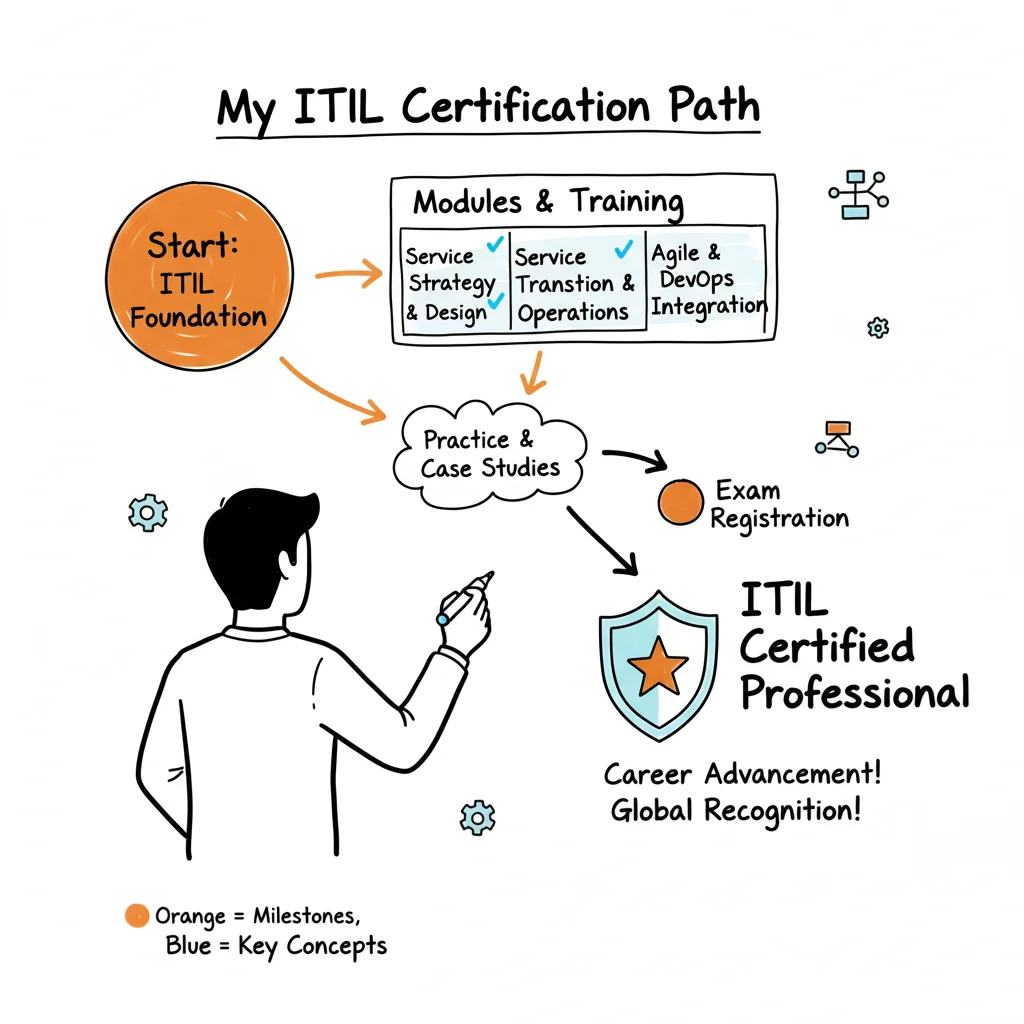
Embarking on your ITIL certification journey is a strategic career move for any IT professional. It's a pathway to not just validating your expertise, but also to enhancing your ability to drive tangible value in your organization. The process, while structured, can feel complex. Fundamentally, it involves three core steps: choosing the ITIL certification level that aligns with your career goals, completing the necessary training through an Accredited Training Organization (ATO), and successfully passing the official PeopleCert exam.
Everyone begins at the same crucial starting line: the ITIL 4 Foundation certificate. This entry-level certification is designed to be accessible, requiring no prerequisites, making it the perfect gateway into the world of IT Service Management (ITSM). At MindMesh Academy, we believe in equipping you with the clearest possible roadmap for this journey.
Your Starting Point for ITIL Certification
 Caption: Strategically planning your ITIL certification journey is key to long-term career success.
Deciding to pursue an ITIL certification is more than just adding a line to your resume; it's a powerful signal to employers globally. It demonstrates a recognized understanding of how to effectively manage and deliver IT services that directly contribute to business objectives. The Information Technology Infrastructure Library (ITIL) is not merely a collection of guidelines; it's a comprehensive framework of best practices that has earned its reputation as the gold standard in the IT industry. Consider it your essential playbook for seamlessly aligning IT functions with overarching business needs.
This credential validates your proficiency in IT Service Management (ITSM). With the advent of ITIL 4, the framework has evolved significantly, incorporating modern approaches like Agile, Lean, and DevOps. This ensures that IT professionals are equipped to help organizations remain competitive and innovative in today's rapidly changing digital landscape.
Why ITIL Matters Today
The fundamental power of ITIL lies in its ability to establish a common language and standardized processes within IT departments. This consistency is crucial for efficient and reliable service delivery, which directly translates into improved customer satisfaction, reduced operational costs, and ultimately, a healthier bottom line.
For you, as an IT professional, this certification provides a structured methodology for problem-solving and continuous service improvement. You'll gain skills in managing risk proactively, cultivating stronger customer relationships, and clearly demonstrating the strategic value IT brings to the business. These are universal competencies, applicable across diverse industries and roles, from a junior support specialist to a seasoned CIO.
The ultimate goal of ITIL is to elevate how IT supports the business. It’s about creating measurable value, not just managing technology. This value-driven perspective is precisely what makes ITIL certified professionals so indispensable to modern enterprises, much like a PMP-certified manager brings structure to projects, an ITIL professional optimizes service delivery.
Reflection Prompt: Think about a recent IT challenge you faced. How might a standardized framework like ITIL have helped you diagnose and resolve it more efficiently?
Understanding the Certification Process
The entire ITIL certification ecosystem is meticulously managed by PeopleCert on behalf of AXELOS, the owner and intellectual property rights holder of the ITIL framework. This means that every step, from your choice of training provider to the official exam, adheres to stringent standards set by organizations accredited by PeopleCert.
Here’s a clear breakdown of the journey ahead:
- Get the Basics Down: Your first step is to build a solid understanding of what ITIL encompasses. If you're new to the core concepts, our comprehensive guide explaining what ITIL Service Management is is an excellent resource to establish your foundational knowledge.
- Choose Your Level: Everyone starts with the ITIL 4 Foundation certification. It serves as the prerequisite and essential entry point to all subsequent advanced certifications within the ITIL scheme.
- Find Accredited Training: For nearly all ITIL exams beyond Foundation, attending an official course from a PeopleCert Accredited Training Organization (ATO) is a mandatory prerequisite. This ensures a consistent, high-quality learning experience, similar to how many professional certifications (e.g., some AWS specialty exams or PMP) recommend or require specific training paths.
- Register and Prepare: Once your training is complete, you'll register for your official exam. This is the stage for focused final study sessions and mock exam practice to solidify your knowledge.
This guide will meticulously walk you through each of these critical stages, providing a clear, actionable plan to navigate your ITIL certification journey from start to finish.
Choosing the Right ITIL Path for Your Career
So, you're committed to getting ITIL certified – an excellent decision for career progression. However, it's crucial to understand that ITIL is not a one-size-fits-all credential. Think of the ITIL framework as a modular system, offering distinct pathways tailored for various roles, from frontline IT service delivery professionals to strategic leaders shaping digital transformation initiatives. Selecting the appropriate path from the outset is paramount to ensuring your investment in time and effort translates into meaningful career advancement.
For virtually every professional, the journey commences with the ITIL 4 Foundation certification. This is a non-negotiable first step, establishing your grasp of the core concepts, terminology, and guiding principles of the entire framework. Just as you learn the alphabet before constructing sentences, ITIL Foundation provides the essential building blocks for deeper specialization. It is the mandatory prerequisite for all advanced ITIL certifications.
Decoding the ITIL 4 Certification Scheme
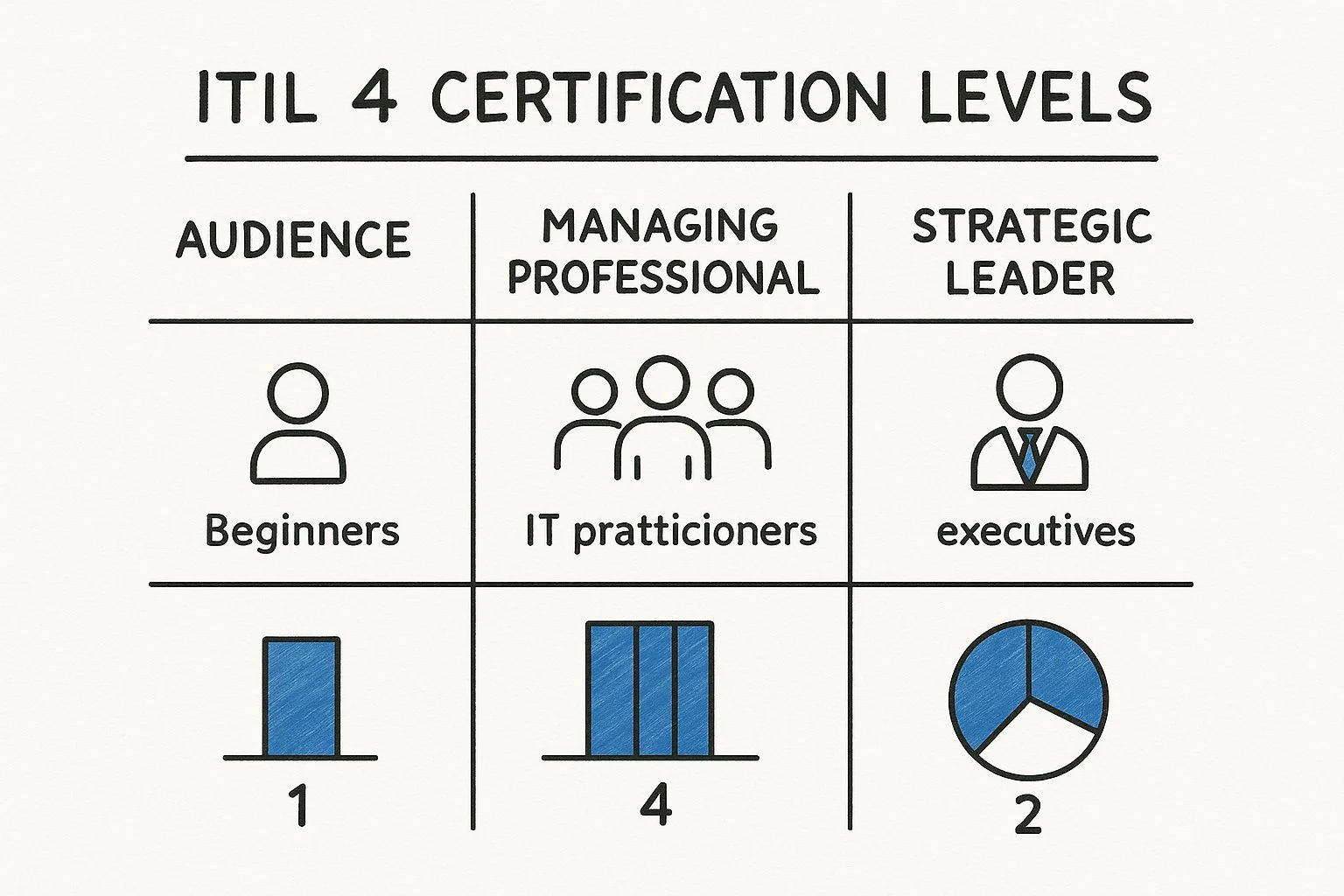
Once you've successfully obtained your Foundation certificate, the ITIL 4 scheme diversifies into specialized streams designed to meet different professional aspirations. The two primary advanced designations you'll encounter are the ITIL Managing Professional (MP) and the ITIL Strategic Leader (SL).
- ITIL Managing Professional (MP): This track is meticulously designed for hands-on IT practitioners – individuals actively involved in technology and digital teams daily. It equips you with the practical, technical, and organizational knowledge required to run successful IT-enabled services and manage teams and workflows effectively. This path is ideal for roles focused on operational excellence and value delivery.
- ITIL Strategic Leader (SL): This stream is focused on the executive-level connection between IT and broader business strategy. It's tailored for current and aspiring IT leaders who need to comprehend how technology drives, rather than merely supports, business objectives. Professionals on this path learn to shape digital strategy, manage enterprise-wide risk, and foster a culture of continual improvement aligned with organizational goals.
This infographic provides a clear visual breakdown of the ITIL 4 certification landscape, outlining target roles and required modules for each level.
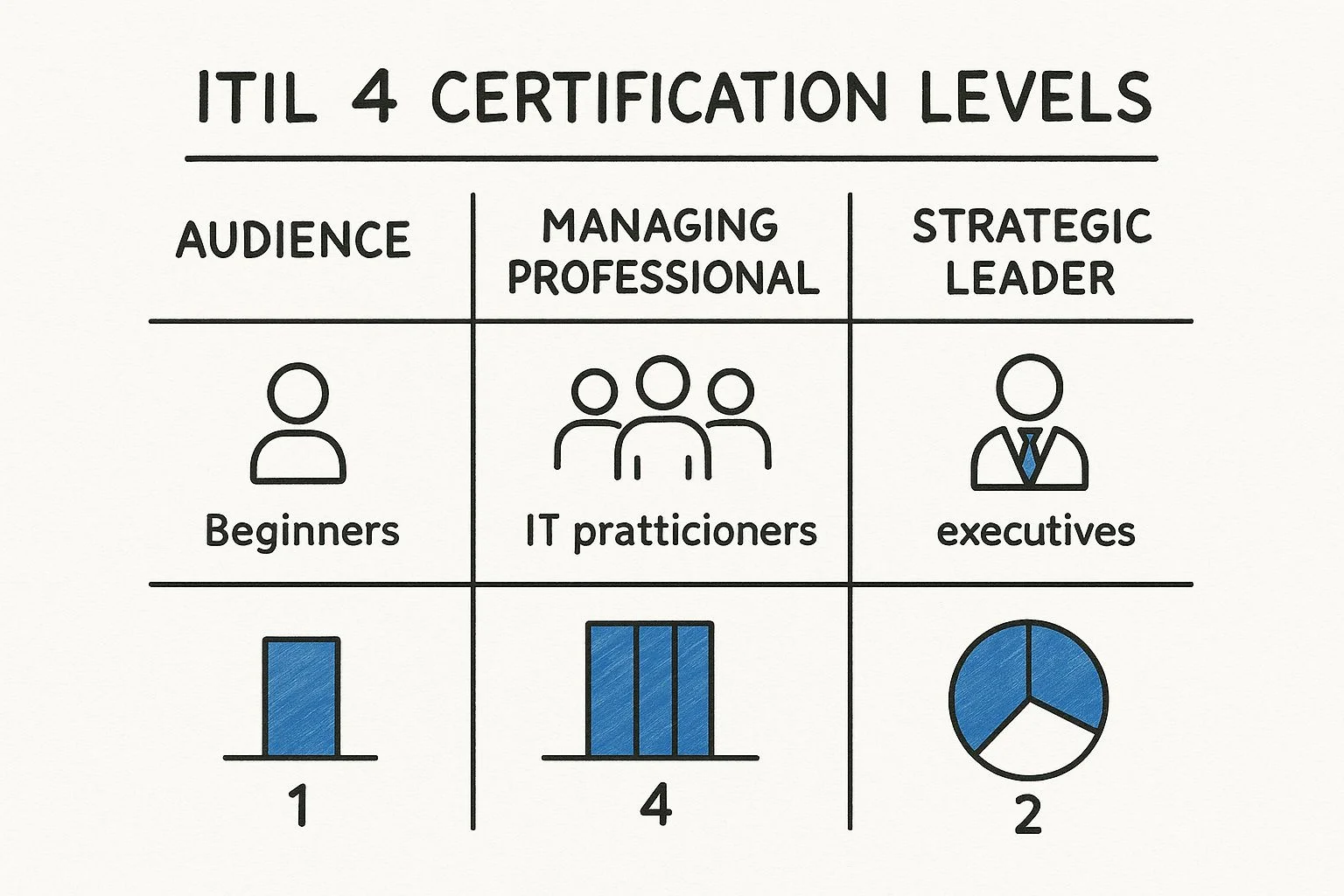 Caption: The ITIL 4 certification scheme offers distinct paths for operational managers and strategic leaders.
As you progress through the scheme, you'll observe a significant increase in complexity and a shift in focus, moving from foundational concepts to specialized, multi-module tracks that demand a deeper, integrated understanding of service management.
Matching Your Role to a Certification Path
To determine the optimal ITIL path for your career, it's essential to critically assess your current responsibilities and your five-year career aspirations.
For instance, if you are a Service Desk Manager aiming to significantly reduce incident response times, enhance team efficiency, and optimize daily IT operations, the ITIL Managing Professional (MP) track is likely your ideal fit. Its modules, such as "Create, Deliver and Support," directly address the operational challenges and value stream optimization you encounter daily.
Conversely, if you're a CIO or an IT Director tasked with leading a company-wide digital transformation initiative, the ITIL Strategic Leader (SL) path will yield far greater professional dividends. This designation focuses on building the competencies to craft IT strategy, manage enterprise-level risk, and cultivate a culture of innovation that directly impacts the company's bottom line.
Choosing your ITIL path isn't just about accumulating certificates; it's about deliberately building a specific, high-demand skill set. The MP path sharpens your operational and practical expertise, while the SL path cultivates your strategic foresight and leadership capabilities.
To further clarify these distinctions and help you visualize where you might fit, we've compiled a comparison table below.
ITIL 4 Certification Paths Compared
| Certification Path | Ideal For | Key Focus Areas | Example Role |
|---|---|---|---|
| ITIL Foundation | Anyone in IT or working closely with IT services | Core concepts, common terminology, the four dimensions of service management, the service value system (SVS) | Junior IT Support Specialist, Business Analyst, Project Coordinator, IT Administrator |
| ITIL Managing Professional (MP) | IT practitioners involved in managing and running technical and digital teams and services | Service creation, delivery, support, stakeholder value, high-velocity IT, practical application of ITIL practices | Service Desk Manager, IT Operations Lead, DevOps Engineer, Release Manager |
| ITIL Strategic Leader (SL) | IT and business leaders focused on strategy and digital transformation, driving organizational change | IT's impact on business strategy, creating a digital vision, managing enterprise-level risk, directing and improving across the organization | CIO, IT Director, Head of Digital Transformation, IT Service Portfolio Manager |
This table illuminates the core differences, enabling you to effectively map your current role and future career ambitions to the most relevant ITIL learning journey. The ITIL 4 framework has adeptly integrated modern practices like Agile principles and cloud computing, ensuring its continued relevance. Its tiered system allows you to start with foundational knowledge and then advance to certifications that demonstrate highly sought-after strategic and practical skills.
The most effective way to decide how to get ITIL certified is to honestly evaluate your long-term career goals against this detailed certification scheme. Once you’ve mastered the basics – the official ITIL 4 Foundation guidance is the place to do that – you'll be perfectly positioned to select the advanced track that will propel you toward your professional aspirations.
Finding the Best Accredited Training Provider
 Caption: Choosing the right Accredited Training Organization (ATO) is vital for effective ITIL exam preparation and practical application.
Obtaining your ITIL certification represents a significant investment in your career, and the quality of your training provider can profoundly influence your success. This decision is absolutely critical, especially since for any ITIL certification beyond the Foundation level, you are mandated to complete a course through a PeopleCert Accredited Training Organization (ATO) before you are eligible to sit for the official exam.
While it is technically possible to self-study for the ITIL 4 Foundation exam, we strongly advise against it. Partnering with a reputable ATO from the very beginning is the smarter, more efficient approach. ATOs are the only organizations officially approved by PeopleCert – the governing body for ITIL certifications. This accreditation signifies that their instructors, course materials, and teaching methodologies consistently meet rigorous quality standards.
Choosing an ATO is not merely fulfilling a bureaucratic requirement; it's a direct investment in a quality education that will not only help you pass the exam but, more importantly, enable you to confidently apply ITIL principles in your day-to-day role, much like choosing a reputable training provider for your AWS or Azure certifications ensures you're learning from verified experts.
What to Look for in a Training Provider
It's important to recognize that not all ATOs offer the same level of quality. It's easy to be enticed by a low price point, but a cheap course with a poor pass rate and substandard materials will ultimately cost you more in terms of failed exams, wasted time, and significant frustration.
When evaluating your options, delve deeper than just the price tag and look for these key indicators of a high-quality provider:
- Instructor Experience: Do the instructors merely read from a script, or do they possess genuine, real-world experience applying ITIL in practical scenarios? You want trainers who can share insightful stories, practical examples, and industry context, not just theoretical concepts.
- Official Materials: A legitimate ATO must provide you with the official PeopleCert course materials, including the essential e-book. If they are relying on homemade or unapproved third-party content, consider that a major red flag.
- Proven Pass Rates: Reputable providers are proud of their students' success and are transparent about sharing their pass rates. A consistently high pass rate is a strong indicator of effective teaching methods and comprehensive course content.
- Flexible Learning Styles: Does the format accommodate your schedule and preferred learning style? Look for various options, such as live online classes, traditional in-person workshops, or self-paced video courses, to find what works best for you.
To further ensure the credibility of your certification, it's wise to consult accreditation resources that can help you verify a provider's standing and confirm they adhere to recognized quality standards.
Reflection Prompt: Beyond passing the exam, what practical skills or insights are you hoping to gain from your ITIL training? How would you verify a provider can deliver these?
Questions to Ask Before You Sign Up
Don't hesitate to ask direct, probing questions before committing to a training provider. A little due diligence upfront can save you considerable headaches later. You're seeking a collaborative partner in your learning journey, not just a vendor.
A truly exceptional training provider does more than just prepare you for an exam; they instill the confidence and practical ability to leverage ITIL principles to solve complex real-world business problems. The quality of your training directly elevates the enduring value of your ITIL certification.
Here’s a checklist of crucial questions we always recommend asking potential ATOs:
- Is the official PeopleCert exam voucher included in the price? Aim for a single, all-inclusive cost that covers both the training and the exam. This avoids hidden fees and simplifies your budgeting.
- What kind of post-class support is offered? Do they provide continued resources, such as office hours with the instructor, access to a student forum, or supplementary materials to reinforce learning?
- What practice materials do you provide? You should receive official PeopleCert sample exams. Mock tests that accurately replicate the real exam environment, including timing and question style, are invaluable for preparation.
- Do you include an exam retake voucher (Take2)? Many leading providers bundle this in as a safety net, offering a huge confidence boost by allowing a free second attempt if needed.
Taking the time to thoroughly vet your training provider is one of the most critical steps in your ITIL certification journey. A strong educational foundation is what truly differentiates merely passing an exam from profoundly mastering the material and applying it effectively.
Building a Study Plan That Actually Works
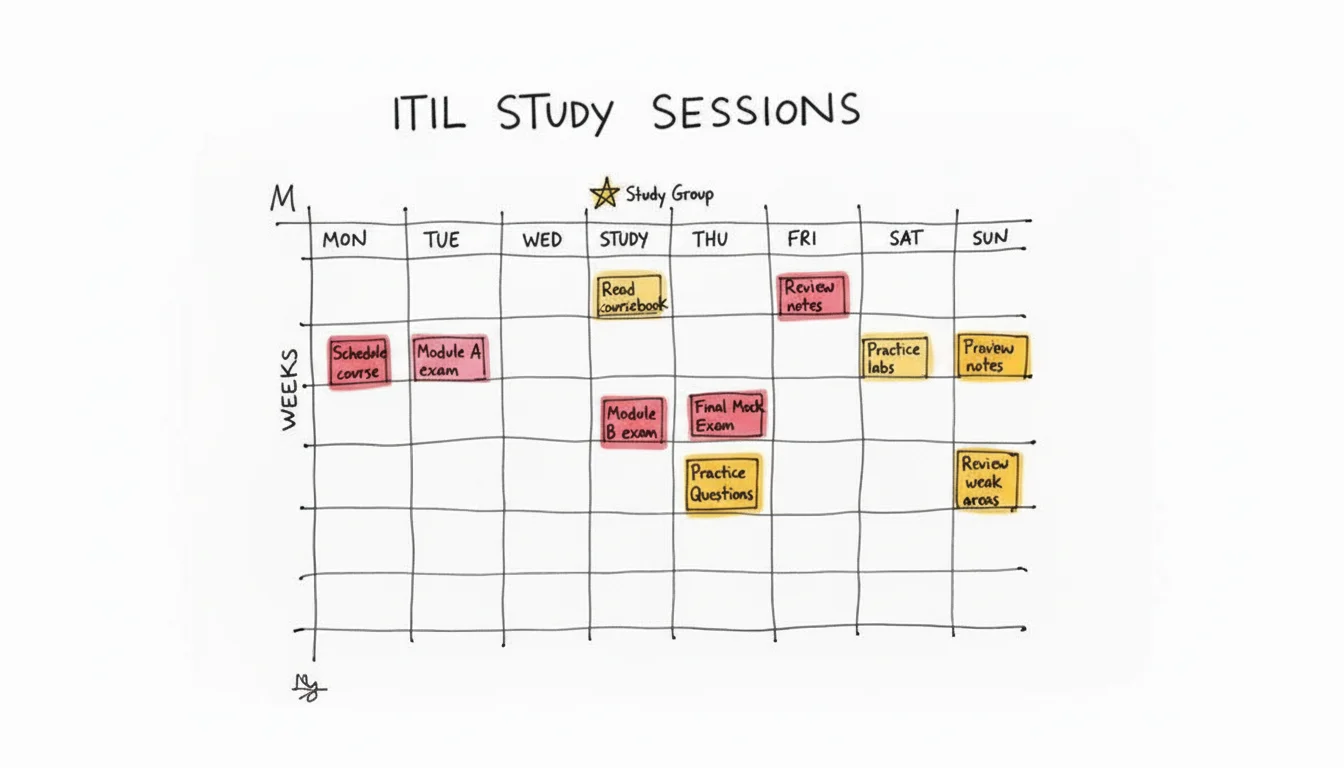
 Caption: A structured study plan is essential for transforming course knowledge into exam-passing mastery.
Completing your accredited ITIL training course is a significant achievement, but it's important to be realistic: it doesn't automatically mean you're fully prepared to ace the exam. From our experience, the single most critical factor in achieving a first-attempt pass is implementing a smart, structured study plan. Trust us, attempting to "wing it" is a common pitfall that often leads to disappointment and wasted effort.
A robust study plan is the bridge between absorbing course material and confidently demonstrating exam-passing mastery. It compels you to break down the often-dense ITIL syllabus into manageable, focused chunks, effectively preventing those stressful, ineffective last-minute cramming sessions. This isn't about exhausting yourself with all-nighters; it's about studying smarter, not just harder. A consistent routine that fits your lifestyle and leverages your preferred learning methods will steadily build both your knowledge base and, equally important, your self-assurance. By exam day, you should feel prepared for a victory lap, not a trial by fire.
Deconstruct the Syllabus
Your first step is to obtain the official ITIL syllabus and treat it as your ultimate roadmap. Don't let its overall size intimidate you. Instead, view it as a collection of distinct topic areas, such as the four dimensions of service management, the service value system, or specific ITIL practices like incident management or change enablement.
Now, strategically allocate dedicated time blocks to each section. Be brutally honest with yourself: How much weight does each topic carry on the exam (often indicated in the syllabus)? And how comfortable are you with the material right now? If you've mastered the guiding principles but find the intricacies of certain practices (like problem management or service request management) fuzzy, prioritize those areas. This targeted approach ensures you get the maximum return on your study investment.
The core goal here is to transition from passive learning (e.g., re-reading the textbook repeatedly) to active recall. Actively forcing your brain to retrieve information without external prompts is the most effective way to build strong, lasting memory and deep understanding. Techniques like flashcards, self-quizzing, and explaining concepts aloud are invaluable for this.
Mix Your Study Resources
While the official textbook and course materials form your foundational knowledge, don't limit your entire study process to them. Incorporating a variety of resources keeps your brain engaged and often presents concepts from different perspectives, which can be crucial for complex ideas to truly click.
Here’s a look at an effective, well-rounded study toolkit:
- Official Mock Exams: Your training provider should grant you access to official PeopleCert sample exams. These are gold standards, showing you precisely what to expect in terms of question style, wording, and time constraints.
- Online Communities: Avoid studying in isolation. Forums like Reddit's r/ITIL, active LinkedIn groups, or professional communities are excellent for asking challenging questions, observing common sticking points for others, and discovering shared resources.
- Study Guides and Articles: Sometimes, a well-written blog post or a concise guide can offer a practical shortcut, a clarifying analogy, or a mnemonic that makes a complex idea more memorable. For more on this, our guide to ITIL certification exam study tips is packed with proven techniques to optimize your learning.
Simulate Exam Conditions
As your official exam date draws nearer, your focus must shift from pure learning to performing effectively under pressure. The ITIL 4 Foundation exam, for example, is a timed sprint: you're given 60 minutes to answer 40 multiple-choice questions. To pass, you need a score of 65%, which means correctly answering at least 26 questions.
Find a quiet, distraction-free environment, set a timer for the full 60 minutes, and complete a practice exam. This exercise accomplishes two critical objectives. Firstly, it familiarizes you with the required pace, helping you manage your time effectively. Secondly, it builds the mental stamina necessary to maintain focus and sharpness throughout the entire test duration.
Once the timer signals the end, the real analytical work begins: a thorough review. Don't just glance at the questions you missed. Dive deep into why you missed them. Was it a concept you genuinely misunderstood, or a tricky question you misinterpreted? Crucially, don't skip the questions you got right – verify that it wasn't just a lucky guess. Truly understanding the underlying logic and rationale behind every correct answer is what genuinely separates confident success from potential failure.
The Real-World Value of Your ITIL Certification
*Caption: Discover the tangible benefits an ITIL certification can bring to your career and earning potential.*Let's be unequivocally clear: obtaining an ITIL certification transcends merely passing a test and adding another bullet point to your resume. It represents a strategic, long-term investment in your professional career, and the tangible returns are substantial. Beyond the theoretical knowledge, this credential unlocks concrete advantages, beginning with a noticeable impact on your earning potential.
Industry data consistently corroborates that IT professionals holding ITIL certifications are among the highest earners. A significant analysis revealed that ITIL and ITSM-certified professionals in North America command an average salary of $93,601. The same report highlighted ITIL's pervasive influence, noting that a remarkable 21% of all certified individuals surveyed held an ITIL credential, solidifying its status as one of the most recognized and respected certifications globally. This widespread adoption underscores its universal value.
However, the benefits extend far beyond monetary compensation. In today's highly competitive job market, your ITIL certification makes you a standout candidate. Recruiters and hiring managers instantly recognize its significance – it communicates a distinct level of professionalism, a structured understanding of service management, and a commitment to best practices that they are actively seeking.
Unlocking New Career Opportunities
When a potential employer encounters "ITIL Certified" on your profile, they don't just see a technically proficient individual. They perceive someone who grasps the bigger picture – a professional who intuitively understands how to align IT services with actual business objectives. You transcend the realm of pure technology discussions and begin speaking the crucial language of business value and strategic contribution.
This fundamental shift in perception is precisely what opens doors to more senior, strategic, and leadership-oriented roles. We're talking about positions such as:
- IT Service Manager: Leading teams to deliver high-quality, reliable services that ensure business continuity and operational excellence.
- Change Manager: Guiding the entire organization through complex technological and procedural transitions with minimal disruption and maximum adoption.
- IT Project Lead/Manager: Applying proven, structured ITIL frameworks to manage and deliver high-stakes projects, ensuring they meet scope, budget, and time objectives while providing real business value.
- IT Strategist/Architect: Connecting diverse IT initiatives with the company's long-term vision, ensuring technology investments actively support and drive strategic business growth.
A core component of excelling in these roles involves a deep understanding of the daily IT support structure. Fully grasping the distinctions between a Service Desk and a Help Desk, for instance, is a perfect example of the foundational ITIL concepts you'll be expected to master and implement effectively.
An ITIL certification doesn't just impart knowledge of processes; it cultivates a powerful problem-solving mindset. It equips you with the ability to identify systemic inefficiencies, propose actionable improvements, and clearly demonstrate how well-managed IT services directly contribute to organizational success and resilience.
From Knowledge to Practical Application
Consider a real-world scenario: a rapidly growing company is constantly plagued by recurrent service outages, causing widespread frustration and significant business disruption. An ITIL-certified professional doesn't merely engage in reactive firefighting. Instead, they step in with a strategic plan, leveraging their expertise.
Utilizing their knowledge of Incident Management and Problem Management, they first work to restore services swiftly. But their work doesn't stop there. They dig deeper, initiating a Root Cause Analysis (RCA) to identify the underlying reasons for the outages, implementing preventive measures to ensure they don't recur. They can map out the entire Service Value Chain to pinpoint how different IT activities interlink and where the critical weak points lie.
This capability to diagnose and resolve systemic issues with structured, repeatable, and proactive solutions is what makes you an indispensable asset. You become the individual who brings order to chaos, driving continual improvement – an essential contribution for any team committed to enhancing its performance, reliability, and ultimately, its value to the business.
Got Questions About ITIL Certification? Let's Clear Things Up.
As you prepare to immerse yourself in the world of ITIL, it's natural to have questions. Navigating the costs, timelines, and specific requirements is a crucial part of planning your successful journey. As experts in IT professional development, we often encounter similar queries from those embarking on their ITIL path. Let’s tackle some of the most common questions to provide clarity and confidence.
Getting these answers solidified upfront will save you considerable time and potential headaches, allowing you to plan your next steps with unwavering confidence.
What’s the Real Cost of Getting Certified?
This is invariably the first question on most aspiring professionals' minds, and the answer isn't a single fixed number. The total investment for your ITIL certification is typically a comprehensive package deal, encompassing both the mandatory accredited training and the official exam voucher. These two components are almost always bundled together by legitimate Accredited Training Organizations (ATOs).
A critical word of caution: if you encounter a website advertising an ITIL 4 Foundation exam for an unusually low, "too good to be true" price, exercise extreme skepticism. Official exam vouchers from PeopleCert typically cost ATOs between $310 and $405, depending on the region and currency fluctuations. Therefore, a price tag of $150 for the exam alone is a significant red flag, almost certainly indicating an unofficial or illegitimate offering.
For a legitimate ITIL 4 Foundation package, which bundles the accredited training with the official exam voucher, you should realistically anticipate an investment somewhere between $600 and $1,300 USD. This range accounts for variations in ATO offerings, instructor experience, and included extras like retake vouchers or extensive study materials. This is comparable to the overall investment for other entry-level professional certifications like CompTIA A+ or AWS Cloud Practitioner when considering both training and exam fees.
How Much Prep Time Should I Plan For?
The ideal preparation time for your ITIL certification largely depends on your existing IT experience and familiarity with service management concepts. However, a deliberate and structured approach is always recommended. Most accredited courses for the ITIL 4 Foundation are intensive, typically spanning two to three full days (or equivalent hours spread over several weeks).
Crucially, your study should not conclude with the end of the course. After the training wraps up, you absolutely need to allocate at least another 15-20 hours for dedicated self-study. Use this vital time to thoroughly review the official materials, diligently work through practice questions, and take multiple mock exams until you feel truly comfortable and confident with both the content and the exam format. Rushing this final crucial stretch is a classic mistake and a frequent cause of disappointing exam results. Think of it like training for a marathon: the race day performance is a culmination of consistent, focused preparation, not just the final sprint.
Can I Just Self-Study and Skip the Training?
This is a very common and critical question. For the ITIL 4 Foundation exam, you can technically purchase an exam voucher directly and opt for a self-study route. However, we strongly advise against this approach. The contextual understanding, interactive learning, and structured insights you gain from an accredited course are invaluable for truly grasping the ITIL framework's nuances and applying its principles, rather than merely memorizing terms for the test. An ATO provides the "why" and "how" that self-study often misses.
For any certification beyond the Foundation level—such as the ITIL 4 Specialist modules (e.g., Create, Deliver and Support) or the Strategic Leader stream (e.g., Direct, Plan and Improve)—accredited training isn't just a good idea; it is absolutely mandatory. You will not be permitted to register for these higher-level exams without providing verifiable proof that you have completed an official course with a PeopleCert Accredited Training Organization (ATO).
I Passed! Now What?
First and foremost, congratulations! Passing your ITIL exam is a significant accomplishment and a testament to your dedication. However, your ITIL journey doesn't end there. To ensure your certification remains current and relevant, PeopleCert requires renewal every three years through their continuing professional development (CPD) program. This mechanism ensures that ITIL-certified professionals stay abreast of evolving industry best practices and maintain their expertise.
You have several flexible options for renewal:
- Retake the Exam: You can simply retake the same certification exam again before your renewal date.
- Level Up: Earning a higher-level ITIL certification (e.g., moving from Foundation to a Specialist module, or achieving MP/SL) will automatically renew all your existing ITIL certifications. This encourages continuous learning and career progression.
- Log CPD Points: You can collect and log professional development points through a MyAxelos subscription. These points are earned through various activities like attending relevant training, publishing articles, mentoring, or participating in ITIL-related projects, demonstrating your ongoing engagement and development in the field.
This renewal system is thoughtfully designed to ensure your skills remain sharp and that your ITIL certification continues to be a credible, up-to-date credential that reflects your active professional growth in the dynamic world of IT Service Management.
PeopleCert is the accrediting body for ITIL, so its own sample papers and an accredited training organisation are the two things that matter most for this exam — book the course and the voucher together where you can, since bundled vouchers are usually cheaper than buying the exam separately. MindMesh Academy does not publish ITIL material. If ITIL Foundation is a step toward running an ITSM platform rather than an end in itself, our free ServiceNow CSA study guide covers the same incident, problem and change ground from the platform side.

Written by
Alvin Varughese
Founder, MindMesh Academy
Alvin Varughese is the founder of MindMesh Academy and holds 20 professional certifications including Microsoft Agentic AI Business Solutions Architect, AWS Solutions Architect Professional, and Azure DevOps Engineer Expert. He's held senior engineering and architecture roles at Humana (Fortune 50) and GE Appliances. He built MindMesh Academy to share the study methods and first-principles approach that helped him pass each exam.