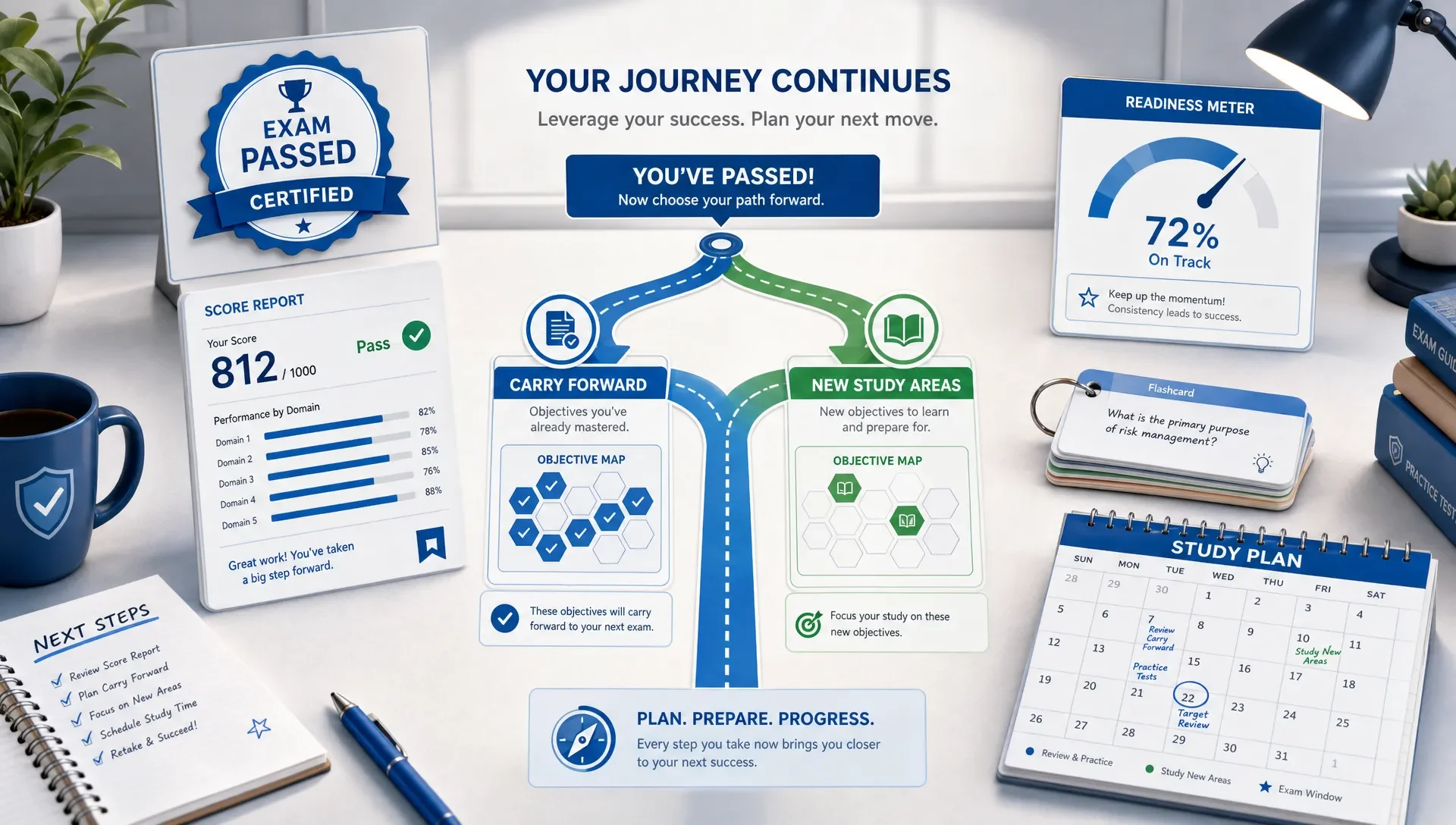
How to Turn Passed Exams Into Your Next Study Plan
How to Turn Passed Exams Into Your Next Study Plan
Passed exams offer some of the most valuable study data you'll ever get. Before you move on, take time to capture what worked, what almost tripped you up, and what you can reuse for your next certification. This approach saves time by building on real performance data, not just an empty calendar.
Your goal is straightforward: turn the exam you just passed into three concrete outputs. First, a brief debrief. Second, a map showing the overlap between your old exam and the next one. Third, a study schedule that dedicates less time to topics you've mastered and more time to weak, higher-value objectives.
What to Capture From Passed Exams Before You Forget
Don't wait until the badge email arrives and the details fade. Within 24 to 48 hours, gather the information from your preparation process. Some certification vendors provide detailed domain feedback after an exam, while others offer only limited pass information. Either way, you still have useful evidence in your practice test results, flashcard history, notes, and study calendar.
Be careful about what you record. Don't write down live exam questions or share exam content. Many certification programs prohibit disclosing exam items, and the AWS Certification Program Agreement is one official example of this rule. Your debrief should focus on topics, skills, timing, and preparation methods, not remembered questions.
| Evidence from the passed exam | What to record | How it shapes your next plan |
|---|---|---|
| Official score report or domain feedback | Strong and weak domains, if the vendor provides them | Decide which areas transfer confidently and which need a refresh |
| Final timed practice tests | Score trend, timing, low-confidence correct answers, repeated misses | Set a realistic baseline for your next certification |
| Flashcard or recall history | Cards you missed repeatedly and cards you mastered quickly | Build a carry-forward deck for shared terms, commands, or concepts |
| Study calendar | Actual study hours per week, skipped days, final-week pressure | Create a schedule you can actually sustain |
| Final notes and cheat sheets | Concepts you reviewed just before the exam | Flag fragile knowledge that might decay quickly |
| Hands-on or scenario practice | Tasks you could perform without notes and tasks you only recognized | Separate real skill from multiple-choice familiarity |
Honesty is key here. A pass doesn't mean you mastered every objective equally. It means you met the exam standard on that attempt. Your next plan should protect the parts that are strong and expose the parts that were barely strong enough.
How to Run a 30-Minute Post-Pass Debrief
A post-pass debrief doesn't need to become a research project. Set a timer for 30 minutes and write short, direct answers. If you studied with a group, do this alone first so you can capture your own, unfiltered experience.
Start with four questions: What felt automatic during the exam? What did you answer through elimination rather than confidence? Which study methods clearly paid off? Which parts of your prep created friction, procrastination, or shallow memorization?
Then, turn those answers into decisions. If flashcards helped you retain acronyms, keep using them. If your practice scores improved only after you reviewed explanations in detail, make explanation review part of your next weekly routine. If you crammed an entire domain in the final week, don't call that a strategy; call it a planning risk.
| Debrief field | What to write | Next-plan decision |
|---|---|---|
| Strongest domain | The area you could explain or apply without guessing | Start with a light retention check, not a full restudy |
| Fragile domain | The area you passed but still don't trust | Schedule early review and more practice questions |
| Best study method | The activity that improved recall or accuracy the most | Reuse it in week one of the next plan |
| Worst study habit | The activity that consumed time without improving performance | Remove it or limit it sharply |
| Timing issue | Where you rushed, slowed down, or second-guessed | Add timed sets earlier in the schedule |
| Confidence mismatch | Topics you got right in practice but didn't truly understand | Use explanation-based review and teach-back exercises |
![Desk with a study report, debrief notebook, objective cards, flashcards, and a study calendar for planning.]](https://storage.googleapis.com/mindmeshacademy.firebasestorage.app/blog/how-to-turn-passed-exams-into-your-next-study-plan/image-1.webp)
How to Identify Which Skills Transfer to the Next Certification
The fastest way to waste time after passing exams is to restudy everything because it feels safer. The second fastest way is to assume everything transfers because you passed once. Use official exam objectives to find the middle ground.
Open the objective list for the exam you passed and the objective list for the next exam. Vendor study guides and exam pages are the source of truth, such as the Microsoft Learn AZ-900 study guide and the AWS Certified Cloud Practitioner certification page. Compare verbs as much as topics. "Describe" isn't the same as "configure," and "identify" isn't the same as "troubleshoot."
If Azure fundamentals are your next step, you can use the MindMesh Academy AZ-900 Microsoft Azure Fundamentals study guide to organize that comparison by exam objectives instead of starting from scattered notes.
| Next certification direction | What usually transfers | What usually changes in the study plan |
|---|---|---|
| Same provider, higher level | Core terminology, service categories, identity basics, billing concepts | More scenario practice, deeper troubleshooting, less time on definitions |
| Different cloud provider | General cloud models, shared responsibility ideas, networking vocabulary | New service names, governance models, portals, and provider-specific limits |
| Security-focused certification | Identity, networking, risk awareness, basic controls | More threat analysis, incident response, governance, and control selection |
| Networking certification | Protocol basics, subnetting exposure, troubleshooting discipline | More command interpretation, topology analysis, and performance-based practice |
| Project management or IT service management | Exam discipline, process thinking, stakeholder awareness | More scenario judgment, terminology precision, and process sequencing |
This overlap map becomes your first draft plan. Mark each objective as carry forward, refresh, relearn, or new. Carry-forward topics need short retrieval checks. Refresh topics need explanations and a few practice sets. Relearn and new topics deserve scheduled study blocks.
How to Convert a Passed Exam Into Proof You Still Understand It
Passing can create a confidence bump, but confidence isn't the same as durable recall. Before you carry knowledge into the next exam, test whether you can retrieve it without prompts.
That approach is supported by learning science research. A major review by Dunlosky and colleagues identified practice testing and distributed practice as high-utility learning techniques in Psychological Science in the Public Interest. Karpicke and Roediger also showed the value of repeated retrieval for long-term retention in their Science study on retrieval practice.
For certification prep, that means you shouldn't just reread your old notes. Try to recall and use the knowledge. Explain a concept aloud. Work a short scenario. Answer a closed-book question set. Rebuild a process from memory. Then, check your explanation against the objective or official documentation.
| Label | What it means | What to do next |
|---|---|---|
| Carry forward | You can explain or apply it without notes | Review briefly once per week until the next exam |
| Refresh | You understand it after seeing a hint | Use flashcards, short explanations, and targeted questions |
| Relearn | You recognized it on the exam but can't explain it now | Rebuild from the study guide and practice until accurate |
| New | It wasn't part of the passed exam | Schedule full study blocks and objective-based practice |
| Retire | It mattered for the old exam but not the next one | Archive it so it doesn't clutter your plan |
This is where passed exams become useful instead of nostalgic. You're not asking, "Did I pass?" You're asking, "What can I still prove under exam-like conditions?"
How to Build Your Next Study Plan Around Gaps, Not Hours
A study plan built only around hours might feel productive, but often misses critical areas. A better plan starts with identifying gaps. Use your debrief, overlap map, and a short baseline assessment to decide where to focus the next week's effort.
If you're moving toward security, a targeted CompTIA Security+ practice exam can help reveal whether your current networking, identity, and risk knowledge is ready for security-style questions. If you're designing the whole schedule from scratch, adapt the structure in MindMesh Academy's learning plan template for IT certification exams so each week has objectives, recall practice, and review time.
| Signal from the passed exam | What it probably means | Next study-plan move |
|---|---|---|
| You passed but rushed the final section | Timing needs earlier attention | Add timed question sets in week one, not just at the end |
| You got practice questions right with low confidence | Recognition is ahead of understanding | Review explanations and write one-sentence rules for each miss |
| You improved only after mixed practice | You benefit from switching between objectives | Avoid studying one domain for too long without interleaving |
| You missed the same topic repeatedly | The issue is conceptual, not accidental | Relearn the topic before adding more questions |
| You skipped hands-on or scenario work | You might be exposed on performance-based formats | Add task-based practice and scenario walkthroughs |
| You burned out near exam day | The schedule was too compressed | Add buffer days and reduce late-week overload |
The plan should also include a readiness checkpoint. Decide in advance what evidence will tell you to schedule, delay, or adjust. That evidence might include stable practice scores, fewer repeated misses, better timing, and the ability to explain missed concepts without reading the explanation back word for word.
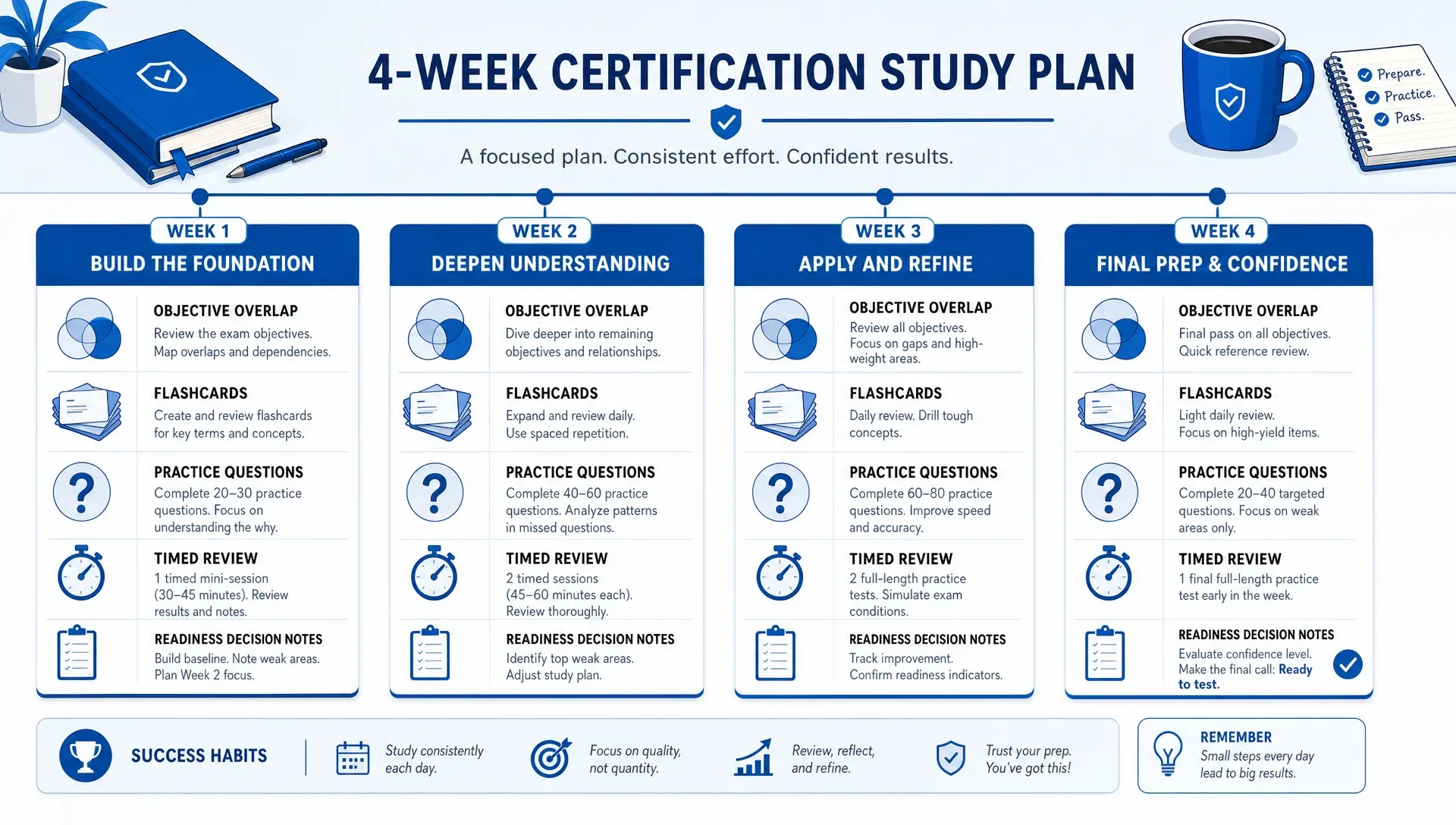
A 4-Week Transfer Sprint You Can Reuse After Any Passed Exam
Not every next certification can be prepared for in four weeks. Some need much longer, especially advanced, hands-on, or experience-based exams. Think of this as a transfer sprint, not a full, universal plan. It helps you turn passed exams into a clean starting point before deeper preparation begins.
| Week | Main focus | What you should produce |
|---|---|---|
| Week 1 | Debrief and objective overlap | A carry-forward, refresh, relearn, and new-topic map |
| Week 2 | Refresh fragile knowledge | Flashcards, short notes, and targeted question sets for weak shared topics |
| Week 3 | Build new exam-specific skills | Practice on new objectives, scenarios, and performance-based formats if relevant |
| Week 4 | Test readiness and adjust | A timed practice result, review notes, and a decision to continue, schedule, or reset |
During this sprint, don't chase perfect notes. Your deliverable is decision quality. By the end, you should know whether your passed exam gives you real momentum or just a credential on the wall.
How to Decide Whether to Advance, Broaden, or Pause
The next exam isn't always the next level. Sometimes the smart move is to broaden into a related skill area. Sometimes it's better to pause for two weeks, reinforce what you passed, and avoid carrying burnout into the next plan.
Use your passed exam as a signal, not a command. A strong pass with high confidence and relevant job goals may support advancing. A narrow pass with lots of guessing may call for consolidation. A foundational pass may be the right launch point into cloud, security, networking, project management, or IT service management, depending on your role.
| Your situation after passing | Best next move | Why it works |
|---|---|---|
| You passed with strong recall and clear career alignment | Advance in the same certification track | You can build on momentum without restudying fundamentals |
| You passed but felt unsure on core topics | Refresh before advancing | It prevents weak foundations from becoming expensive later |
| You passed a broad fundamentals exam | Broaden into a role-relevant specialization | You turn general knowledge into marketable direction |
| You passed after heavy cramming | Pause and consolidate | It protects retention and reduces burnout |
| You passed but changed career goals | Re-map certifications to the new role | It keeps your plan aligned with actual outcomes |
A useful rule: don't choose your next certification just because it's adjacent on a vendor chart. Choose it because it matches a role, validates a skill you need, and has enough overlap to make your previous work useful.
How MindMesh Academy Supports a Post-Pass Study Plan
MindMesh Academy is built around the kind of connected workflow that simplifies post-pass planning. You can move from study guides organized by exam objectives into practice questions, explanations, flashcards, and readiness tracking without treating each tool as a separate project.
This matters after passing exams because your next plan should be adaptive. If a topic is already strong, you don't need to reread it for three nights. If a topic keeps producing misses, you need weakness-based practice and explanations that help you rebuild the concept. Flashcards with spaced repetition help keep older knowledge active while you study new objectives.
The most valuable habit is to track progress by topic, not just by total score. Total score tells you whether you're close. Topic progress tells you what to do tomorrow.
Frequently Asked Questions
How soon should I make a study plan after passing an exam? Capture your debrief within 24 to 48 hours while the prep process is still clear. You don't have to start heavy studying immediately, but you should record what worked, what felt weak, and what you would change.
Can passed exams reduce how long I need to study for the next certification? Sometimes, but only when the objectives overlap and you can still retrieve the knowledge. Use a baseline practice set and an objective comparison before cutting study time.
What if I passed but don't have a detailed score report? Use your own information instead. Final practice tests, missed-question logs, flashcard history, notes, and study calendar data can still show your strengths and weak spots.
Should I keep studying the exam I already passed? You don't need to keep doing full prep for it, but you should review transferable concepts with spaced repetition if they matter for your next certification or job role.
How do I know if I should advance to a harder exam or switch tracks? Compare your career goal, current confidence, objective overlap, and available study time. If the next exam builds directly on skills you can still explain and apply, advancing may make sense. If your goal has shifted, broadening may be smarter.
Is it okay to write down questions I remember from the exam? No. Focus on topics and skills, not live exam content. Record broad areas like "identity scenarios" or "subnetting under time pressure" rather than specific questions.
Turn Your Last Pass Into Your Next Plan
A passed exam should give you more than a certificate. It should give you a sharper way to study next time. Capture the evidence, map the overlap, test your recall, and build a plan that targets gaps instead of repeating everything.
When you're ready to move from debrief to execution, start preparing for your next challenge with our AZ-900 Microsoft Azure Fundamentals practice exam. MindMesh Academy provides objective-based study guides, practice questions with explanations, flashcards, and readiness tracking to keep your next plan focused and help you pass with confidence.

Written by
Alvin Varughese
Founder, MindMesh Academy
Alvin Varughese is the founder of MindMesh Academy and an enterprise architecture leader. An electrical engineer by training, he moved from factory automation in South Africa to cloud architecture at GE Appliances and Humana (Fortune 50), and holds 20 professional certifications including AWS Solutions Architect Professional, Azure DevOps Engineer Expert, and Microsoft Agentic AI Business Solutions Architect. He built MindMesh Academy after interviewing too many highly certified candidates who couldn't answer basic questions: the goal is prep that makes you better at the job, not just able to pass the exam.