How to Study for a Certification Exam: 5 Proven Steps
How to Study for a Certification Exam: 5 Proven Steps
You probably already know more than you think.
Most certification candidates don't fail because they never opened the material. They fail because they studied in a way that felt productive but didn't match the exam. They reread notes, watch another video, highlight key terms, and walk into the test center with recognition-based familiarity instead of recall, speed, and decision-making.
That gap matters. Certification exams don't reward vague comfort with a topic. They reward fast retrieval, clean reasoning, and the ability to work under pressure when two answer choices both look plausible.
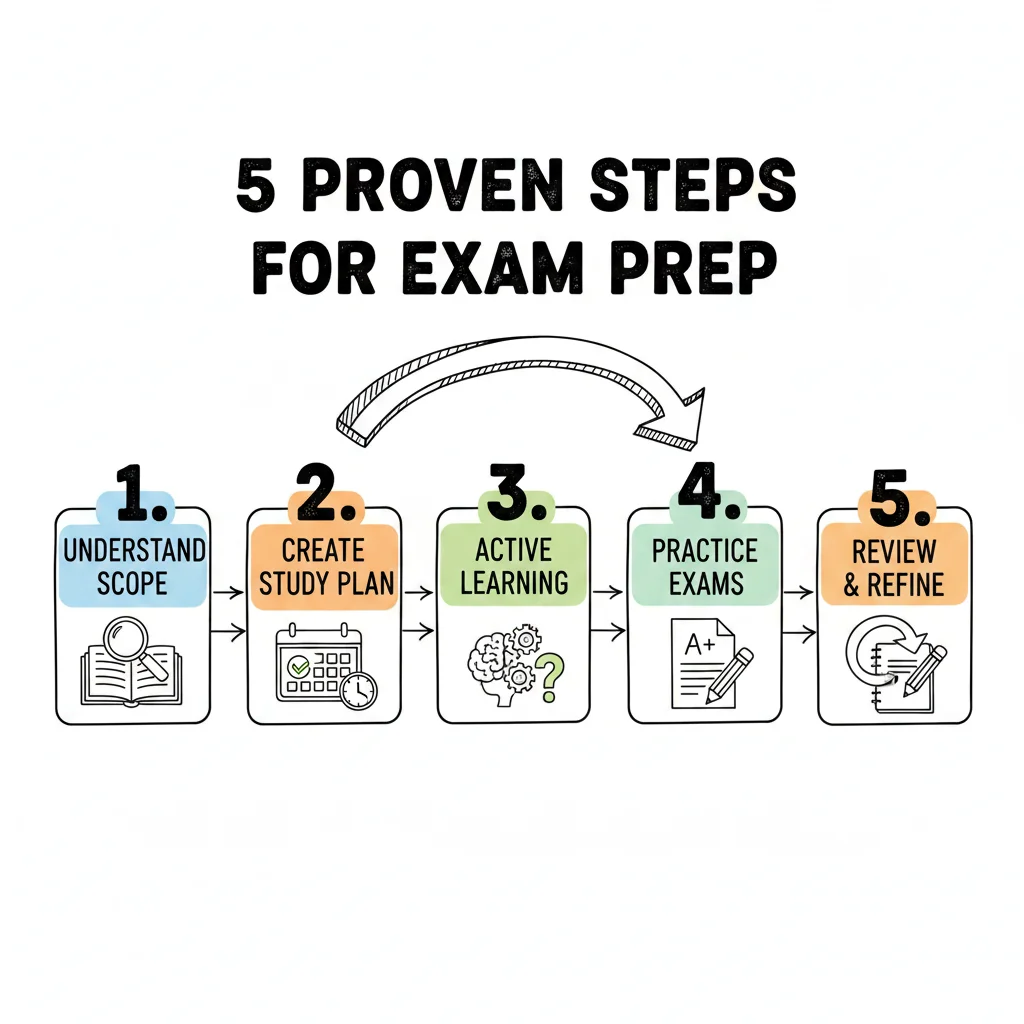
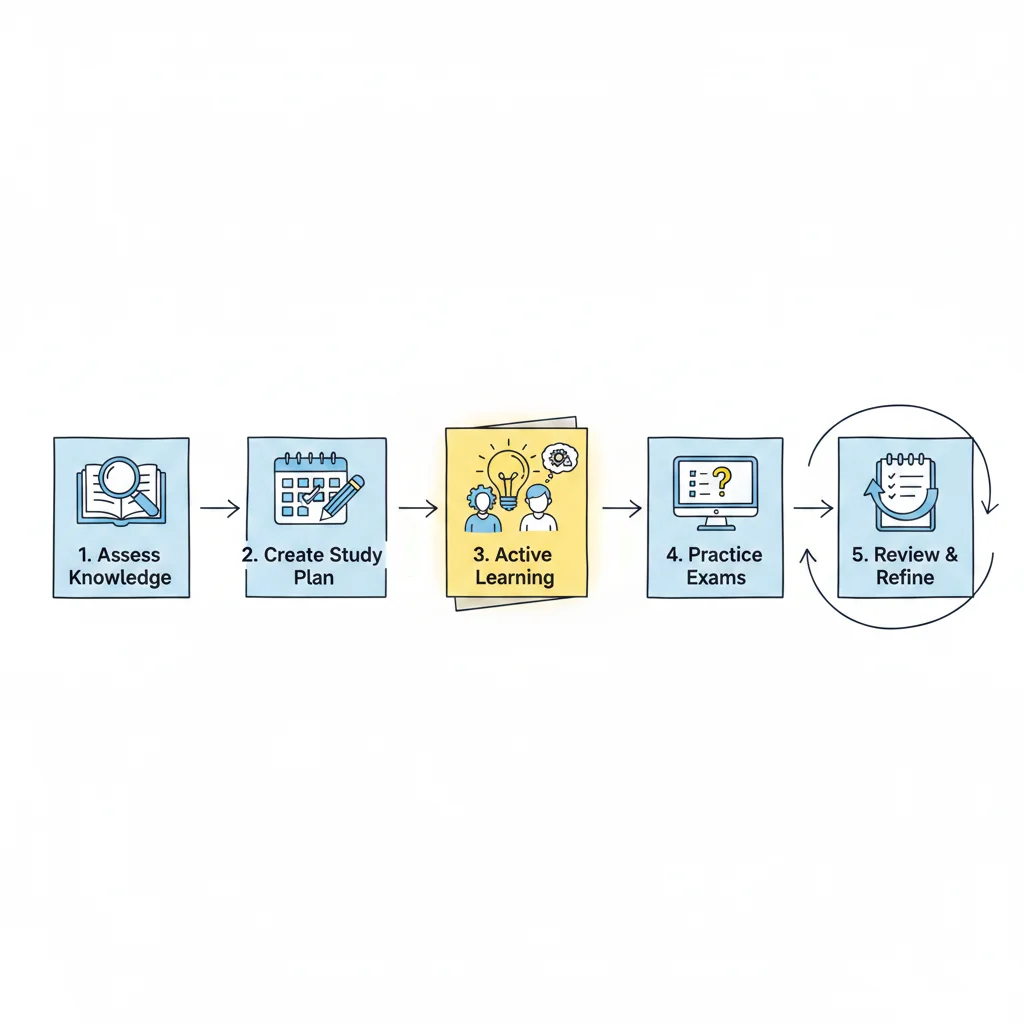
The good news is that how to study for a certification exam isn't a mystery. The system that works is repeatable. It starts with the blueprint, uses active methods instead of passive review, treats practice exams as diagnostics, and trains exam-day performance as a separate skill. If you build your prep that way, your study time starts producing something useful: a passing score.
Deconstruct the Exam Blueprint Before You Study Anything
The official exam blueprint is the only study document that tells you what the exam is trying to measure. Start there, not with a random video course and not with a pile of notes.
Guidance on certification prep consistently points to the same high-yield workflow: start with the exam objectives, turn them into a checklist, and only then schedule practice testing. The blueprint also reveals topic weighting, which lets you allocate time proportionally instead of studying every domain equally, as explained in this certification exam study guidance.
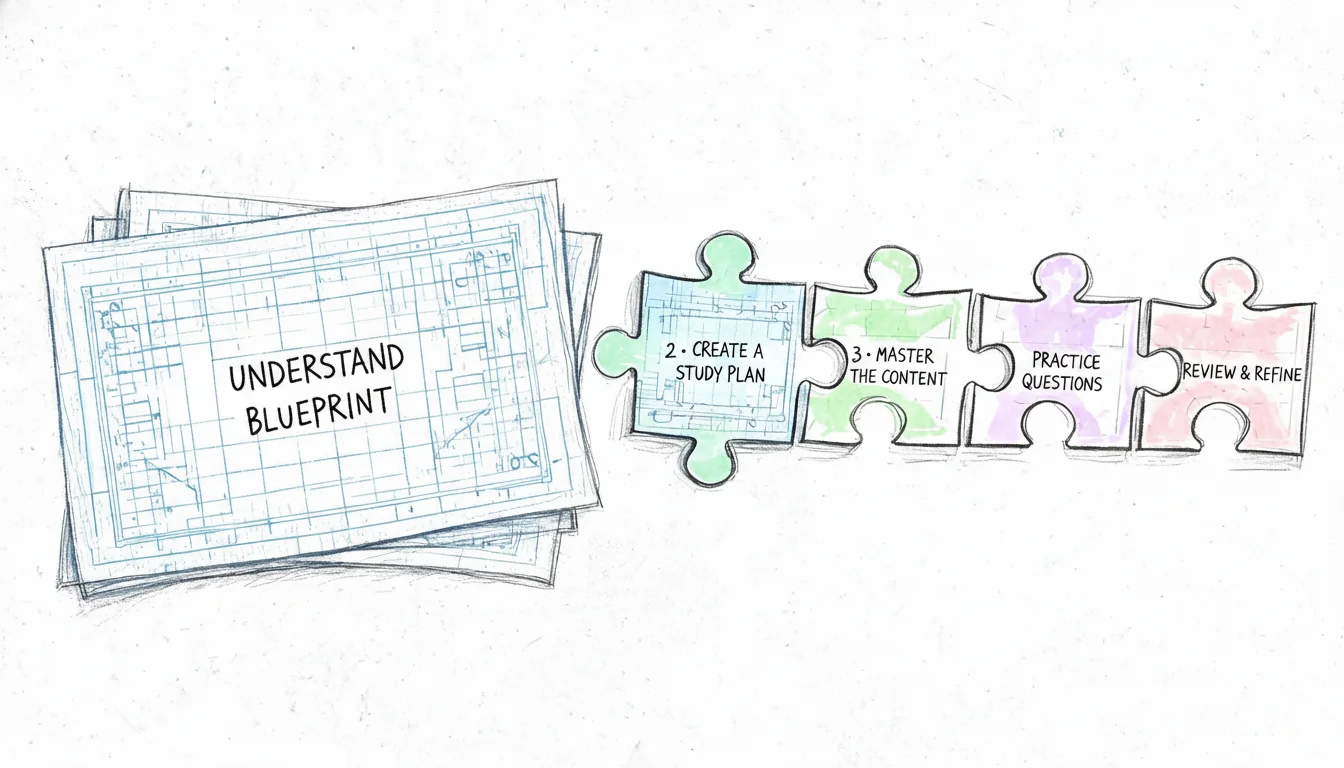
Turn broad domains into a working checklist
A blueprint usually looks clean on paper and messy in practice. “Identity and access management” or “risk response planning” sounds like a topic. It isn't. It's a container holding definitions, decision rules, exceptions, workflows, and likely traps.
Break every objective into items you can verify. For an AWS exam, that might mean splitting one domain into IAM policies, roles, federation basics, least privilege scenarios, and troubleshooting access failures. For PMP, one objective may need to be divided into inputs, outputs, sequencing logic, and situational judgment.
Use a simple checklist structure:
- Objective statement: Copy the blueprint language exactly.
- Sub-skills: List the concepts, commands, formulas, or decisions hidden inside it.
- Confidence level: Mark each item as strong, shaky, or unknown.
- Evidence: Note whether you can explain it from memory, solve a scenario, or only recognize it when prompted.
Practical rule: If an objective can't be turned into a yes-or-no checklist item, it's still too vague to study efficiently.
Study by weighting, not by mood
Most candidates overstudy what feels interesting and understudy what carries exam weight. That's how someone spends a week polishing a favorite topic and then gets exposed by a heavily tested domain they “planned to review later.”
A better approach is to rank your checklist by two filters:
| Priority factor | What to ask |
|---|---|
| Exam weight | Does this domain appear to matter more on the blueprint? |
| Personal weakness | Do you struggle to recall, apply, or distinguish it under pressure? |
Anything that scores high on both goes to the front of the line.
That single move cuts a lot of wasted effort. Instead of saying, “I studied for three hours,” you can say, “I closed two weak, high-weight objectives.” That's what progress looks like.
Build the roadmap before you touch practice questions
Practice questions make sense only after your checklist exists. Otherwise, every wrong answer feels random. With a checklist, each miss maps back to a domain, sub-skill, or pattern.
Use your blueprint to create a study map with three buckets:
- Core domains you must revisit every week
- Secondary domains that need periodic review
- Low-return topics that get lighter coverage unless they're personal weaknesses
That structure turns overwhelm into sequence. You stop asking what to study next, because the blueprint already answered it.
Implement Evidence-Based Active Study Methods
Passive review feels smooth because it asks very little of you. You read a page, nod along, and mistake familiarity for mastery. Then the exam asks you to retrieve a definition, apply a rule to a scenario, or distinguish between near-identical options, and the answer won't come fast enough.
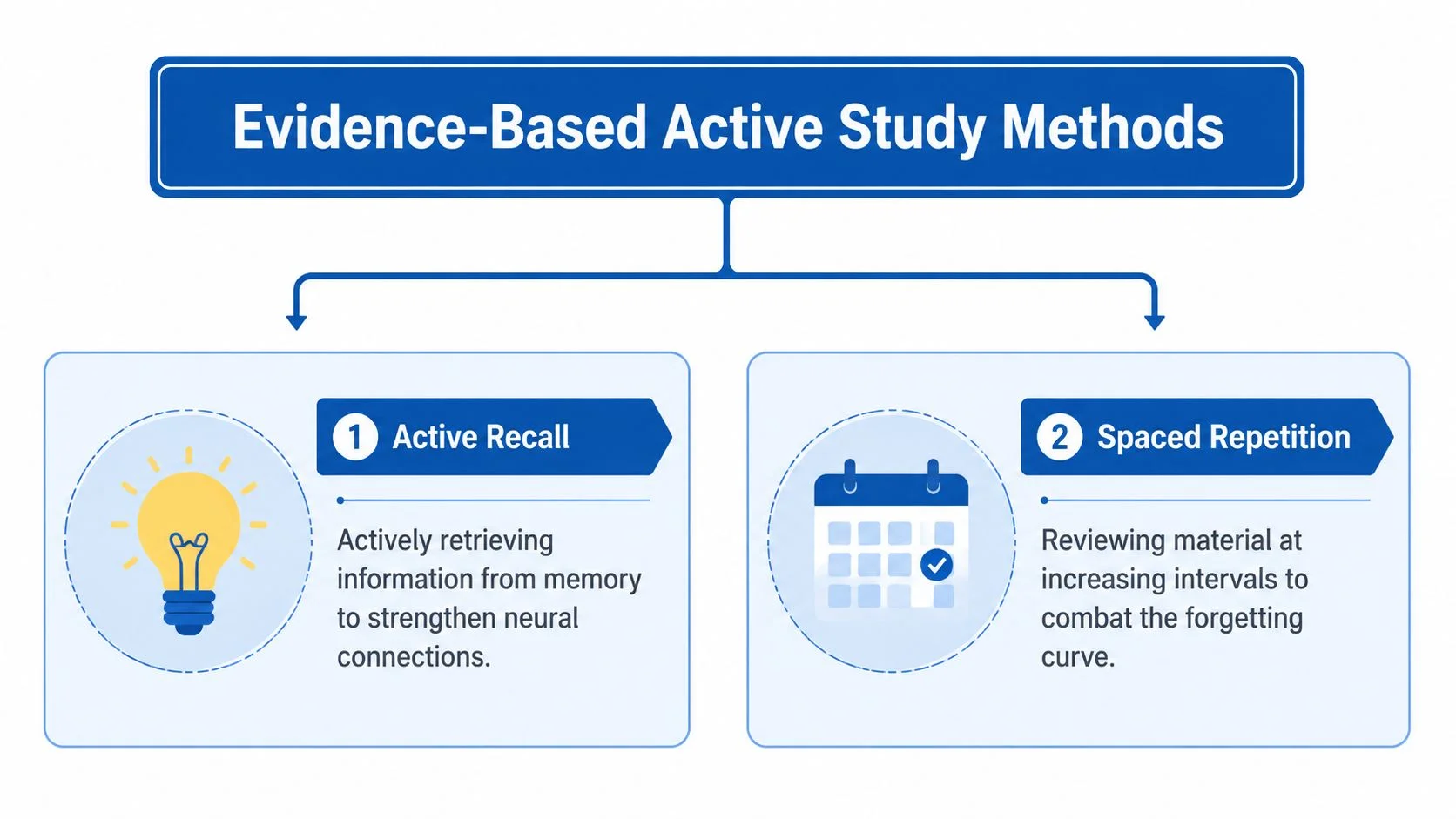
That's why the most effective study methods for certification prep are active. They force retrieval and revisit material over time instead of in one concentrated burst.
A large meta-analysis of 118 studies found that retrieval practice produced measurable learning gains, with an average effect size of g = 0.50 compared with control conditions, according to one summary of research on active recall. Separately, a 2008 meta-analysis found that spacing study sessions improves memory, with the best interval depending on how long you need to retain the material, as outlined in this review of spaced repetition for study retention.
What active recall looks like in real exam prep
Active recall means pulling information out of memory without looking at the answer first. That sounds simple, but most candidates rarely do it.
If you want a practical primer, Active Recall gives a solid explanation of why retrieval changes the quality of learning.
For certification prep, active recall looks like this:
- Closed-book quizzing: Answer domain questions before opening your notes.
- Flashcards with actual friction: Don't flip early. Force the answer first.
- Blank-page summaries: Write everything you remember about a topic, then compare it to the source material.
- Teach-back practice: Explain a concept aloud as if you're coaching a junior teammate.
The point isn't to feel fluent while studying. The point is to discover what disappears when the material is no longer in front of you.
Rereading has a place for first exposure and quick refreshers. It's weak as a core method because recognition is easier than recall. Exams don't care which one felt better during study.
Why spaced repetition fixes the forgetting problem
Cramming works just well enough to tempt people into using it again. Then the exam lands after a delay, and the material has faded.
Spaced repetition solves that by reviewing topics after some forgetting has happened. That small struggle is useful. It forces reconstruction, and reconstruction strengthens memory more than massed repetition.
A practical schedule looks like this:
- First pass: Learn the concept and test yourself immediately.
- Short revisit: Return within a few days and self-quiz again.
- Wider review: Recheck over the following weeks.
- Targeted recycling: Bring weak topics back more often than strong ones.
Build sessions around retrieval, not content consumption
A strong study block is rarely “watch a lesson for an hour.” A better pattern is learn, retrieve, check, and revisit.
Here's a workable session template:
- Review one checklist objective
- Study the minimum needed to understand it
- Do retrieval work without notes
- Record misses and confusion points
- Schedule that objective for another pass later
This is also where platforms can help if they support the method instead of just storing content. Mindmesh Academy offers blueprint-aligned materials, spaced-repetition flashcards, adaptive learning paths, and progress tracking, which fits this style of prep because weak topics can resurface at useful intervals instead of getting buried under whatever you feel like studying that day.
Use Practice Exams for Diagnosis Not Just Validation
A candidate finishes a practice exam with a 78%, feels relieved, and goes back to reading. Then the actual test forces harder judgment calls, the timing gets tight, and that 78% turns out to be a weak predictor.
Practice exams earn their place when you use them to find failure patterns early enough to correct them. The score matters, but the pattern behind the score matters more. Certification exams do not reward recognition alone. They reward recall, discrimination between close answer choices, and steady reasoning under time pressure.
Start with a better post-test review.
After each practice exam, answer these questions:
- Which blueprint domains are still unstable
- Which misses came from a knowledge gap
- Which misses came from misreading the prompt
- Which correct answers were guesses
- Which distractors keep pulling you toward the wrong choice
- Which questions took too long even when you got them right
That last point is easy to miss. On many certification exams, timing problems show up before content problems. You may know the material well enough to answer correctly in review mode and still lose points in a live exam because your decision process is too slow.
Review every question, including correct answers
Candidates who only review missed questions leave a lot of signal behind. Correct answers can be fragile. If you got the item right because you eliminated two options and guessed between the last two, that topic is not done. It belongs back in rotation.
I use a simple review standard:
| Question result | What to do next |
|---|---|
| Wrong and confident | Correct the concept and the reasoning rule you applied |
| Wrong and unsure | Rebuild the topic from fundamentals, then test it again |
| Right but guessed | Mark it as unstable and revisit it within a few days |
| Right and certain | Confirm your reasoning matched the official rationale |
Exam design plays a critical role here. Many certification items are built to trap partial knowledge. If your reasoning is sloppy, practice conditions may let you get away with it once. Exam pressure usually exposes it.
Use simulations to expose pressure failures
Short quizzes help with topic checks. Full-length, timed exams show whether your method survives real conditions.
Run practice exams to answer three concrete questions:
- Can you hold focus for the full testing window?
- Do you know when to cut your losses and move on?
- Does your accuracy drop in specific domains once the clock starts to matter?
Those are test-taking problems, not just study problems. They decide a surprising number of pass or fail outcomes.
If you need a quick baseline on what is a practice exam, that overview is useful. The key point is simple. A practice exam is a diagnostic tool, not a confidence ritual.
Mindmesh Academy fits well here because the work should not stop at the score report. Use the results to feed weak objectives back into your study queue, track recurring error types, and retest under timed conditions after you fix them. That closes the loop between knowledge review and exam performance, which is the gap that trips up otherwise capable candidates.
Keep two records side by side. One log tracks scores across attempts. The other tracks error types, weak domains, timing issues, and guessed answers. Scores tell you whether performance is improving. The error log tells you what to change.
Design a Sustainable Study Routine That Prevents Burnout
A candidate with a full-time job can study hard for four days and still fail because week five falls apart.
That pattern is common. The problem is rarely effort alone. It is a routine that only works during a perfect week. Certification prep has to survive meetings that run late, family responsibilities, and the nights when your brain is done after 8 p.m. If your plan depends on constant high motivation, it breaks before exam day.
Build a routine around repeatability
Use a weekly structure you can maintain for two or three months, not just one ambitious weekend.
A workable schedule for many professionals looks like this:
- Two to four short weeknight sessions: One objective or question type per block
- One longer session: Harder domain review, labs, or scenario work
- One review session: Flashcards, notes from misses, and spaced recall
- One lighter block or recovery day: Keep the habit without draining yourself
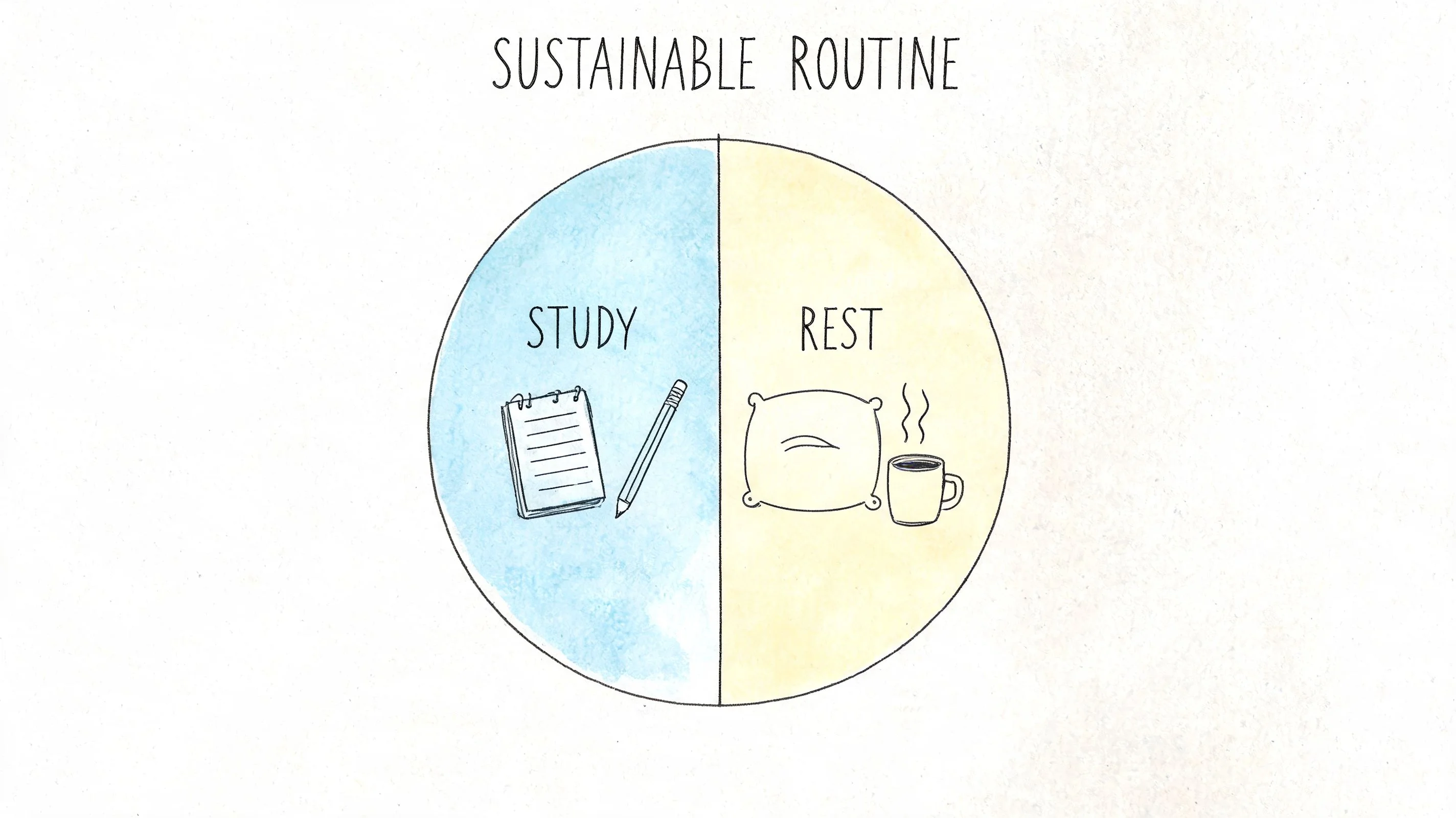
That last part matters. Recovery is part of the system. Candidates who treat every study block like a sprint often lose consistency right when retention should be improving.
I prefer setting a minimum and a stretch target. The minimum keeps momentum on a bad week. The stretch target gives you room to do more when your schedule opens up. That trade-off beats an aggressive plan you abandon after ten days.
Match the session to the job
Burnout often starts when every block feels the same. Reading, note-taking, self-testing, and scenario practice place different demands on attention. Mixing them on purpose keeps the week more sustainable and gives each session a clear objective.
| Mode | Best use |
|---|---|
| Learning mode | First pass through a new objective or concept |
| Recall mode | Self-quizzing, flashcards, blank-page recall, teach-back |
| Application mode | Scenario questions, labs, case work, and decision-making practice |
Short sessions work well for recall. Longer blocks are better for application and harder topics. Use that split instead of forcing every study period into the same format.
Mindmesh Academy supports this well because you can track progress by objective, revisit weak areas without rebuilding your plan from scratch, and keep your study queue focused on what still needs work. That helps on low-energy days. You do not waste half the session deciding what to study.
Protect consistency before intensity
One missed session is recoverable. Three weeks of erratic study usually means relearning the same material.
Track a few process measures each week:
- Hours studied
- Objectives reviewed
- Retrieval sessions completed
- Weak areas revisited
- Rest days taken
These signals catch problems earlier than a final practice score. If review sessions keep disappearing, retention will slide. If every session turns into content consumption, recall will lag. If you have been tense for two weeks straight, exam pressure will hit harder than it should.
Mindset matters here too. Anxiety pushes candidates toward cramming, resource-hopping, and longer sessions that feel productive but are hard to sustain. Mindmesh Academy's guide to beating exam anxiety is useful if stress is starting to distort your plan.
A good routine should feel steady, not heroic. That is how you cover the blueprint, revisit weak domains, and arrive at the exam with enough mental bandwidth to perform.
Master the Final Week and Manage Exam Day Pressure
The final week is where many candidates sabotage good preparation. They panic, add new resources, and turn a structured plan into frantic review.
That's a mistake. The last stretch is about converting knowledge into performance. That requires different work: pacing, familiarity with the exam format, calm execution, and confidence built on repeated simulation.
Guidance on certification prep often misses this gap. Many candidates know the material but still struggle because of exam design and time pressure. Advice in this discussion of passing certification exams highlights the need for pacing, elimination strategies, and exam-format familiarity, while also warning that practice tests can create false confidence when they're used badly.
What to do in the last week
Your final week should get narrower, not broader.
Focus on:
- High-yield review: Revisit your error log, weak objectives, and scenario patterns
- Light retrieval: Use short recall sessions instead of cramming full new chapters
- One or two realistic simulations: Enough to keep timing sharp without exhausting yourself
- Logistics: Confirm exam time, ID requirements, environment, and route if you're testing in person
Avoid collecting fresh resources from forums and social posts. New material this late often creates noise, not advantage.
Use a pacing strategy on purpose
Time pressure changes decision quality. Candidates who know the content still lose points because they linger too long on one question, break rhythm, and rush the end.
A cleaner approach:
- Answer the clear questions first
- Mark and move when a question starts draining time
- Use elimination aggressively on scenario items
- Return with a calmer head on the second pass
This works because difficult questions often become easier once the easy points are secured.
If you're stuck between two answers, don't ask which one sounds more familiar. Ask which one the exam writer is more likely to reward based on the scenario details.
Train pressure before the exam, not during it
Anxiety gets worse when the exam environment feels unfamiliar. That's why timing, interface familiarity, and question style need rehearsal.
If pressure is part of your problem, Mindmesh Academy's guide to beating exam anxiety is a useful complement to content review because it addresses confidence and control rather than just memorization.
On exam day, keep your process simple. Read carefully. Manage the clock. Don't let one ugly question convince you that the whole exam is going badly. Certification exams are designed to test judgment under strain. Treat that as part of the task.
Your Next Step Toward Certification Success
The candidates who pass consistently usually aren't the ones who studied the longest. They're the ones who studied in a way that matched the exam.
That means using the blueprint to set priorities, building recall instead of relying on recognition, spacing review over time, treating practice exams as diagnostic tools, and preparing for pressure as a skill in its own right. That system works whether you're aiming at AWS, Azure, CompTIA, ITIL, PMP, or ServiceNow.
If you also want external accountability, a structured coaching platform can help some learners stay on pace with their plan. The key is choosing tools that reinforce deliberate practice rather than just giving you more content to consume.
For people building a focused path toward their next credential, Mindmesh offers comprehensive IT certifications available in a format that supports blueprint-based study, adaptive review, and progress tracking.
The important part is to stop treating certification prep like a motivation problem. It's a system problem. Fix the system, and your odds improve.
If you're ready to turn scattered study sessions into a clear exam plan, explore Mindmesh Academy. It gives you a structured way to study, practice, and track progress so your effort translates into exam-day performance.

Written by
Alvin Varughese
Founder, MindMesh Academy
Alvin Varughese is the founder of MindMesh Academy and holds 20 professional certifications including Microsoft Agentic AI Business Solutions Architect, AWS Solutions Architect Professional, and Azure DevOps Engineer Expert. He's held senior engineering and architecture roles at Humana (Fortune 50) and GE Appliances. He built MindMesh Academy to share the study methods and first-principles approach that helped him pass each exam.