
Ace Your ITIL Certification Exam: Proven Study Tips & Guide
Ace Your ITIL Certification Exam: Proven Study Tips & Guide
Embarking on the ITIL certification journey is a strategic career move for any IT professional. At MindMesh Academy, we recognize ITIL as the globally recognized standard for excellence in IT Service Management (ITSM). Earning your ITIL 4 Foundation certification doesn't just add a credential to your resume; it signifies your proficiency in the universal language of modern IT operations, value delivery, and how to effectively align IT services with business objectives. It’s a foundational step that will resonate whether you're managing cloud infrastructure, leading a development team, or optimizing help desk operations.
What To Expect From The ITIL Certification Exam
 ITIL principles foster collaboration and a shared understanding of service delivery across IT teams.
The ITIL framework isn't a rigid set of rules, but rather a comprehensive playbook for designing, delivering, and improving top-notch IT services. It provides a common vocabulary and a shared set of best practices that bridge the gap between IT and business goals, ensuring technology truly enables organizational success. The ITIL certification exam is your opportunity to demonstrate that you understand this playbook and can articulate its core strategies.
For IT professionals, this certification is a significant career accelerator. It’s proof that you possess the knowledge to help an IT organization operate efficiently, enhance service quality, and manage complex IT environments effectively. Companies actively seek ITIL-certified individuals because they trust them to build, deliver, and support IT services in a way that generates tangible business value.
Why Is This Exam a Game-Changer for Your Career?
In today's competitive IT landscape, an "ITIL Certified" designation helps you stand out. It signals to employers a commitment to your craft and a solid grasp of service management principles that are transferable across various roles, from Cloud Operations Specialist to Project Manager. This often leads to increased interview opportunities, stronger salary negotiations, and a clearer career trajectory within the IT sector.
The concepts you master through ITIL aren't purely theoretical; they offer immediate, practical applications on the job. The framework focuses on enhancing service delivery, which directly contributes to customer satisfaction, operational stability, and risk reduction. For example, understanding how to streamline business processes for peak efficiency is central to ITIL, making certified professionals invaluable assets to any organization.
Reflection Prompt: Consider your current role or a recent project. Where could a deeper understanding of IT Service Management principles have made a difference in delivering value or resolving an issue?
If you're still new to the topic, we have a detailed guide that breaks down what ITIL service management is.
A Quick Look at the Exam Structure
For most individuals, the journey begins with the ITIL 4 Foundation exam. This is a closed-book test consisting of 40 multiple-choice questions, with 60 minutes allotted for completion. It's a straightforward assessment designed to test your understanding of core ITIL concepts, not to trick you with complex scenarios.
To pass, you need to answer at least 26 questions correctly, which translates to a 65% score. The exam emphasizes fundamental ITIL concepts, focusing on your comprehension rather than rote memorization of obscure details.
Here’s a simple table providing a quick overview of the ITIL 4 Foundation exam:
ITIL 4 Foundation Exam at a Glance
| Exam Aspect | Details |
|---|---|
| Exam Name | ITIL 4 Foundation |
| Question Format | 40 Multiple-Choice Questions |
| Time Allotted | 60 Minutes (Closed-Book) |
| Passing Score | 65% (26 out of 40 correct) |
| Prerequisites | None |
This structure is similar to many foundational IT certifications (e.g., AWS Cloud Practitioner, CompTIA A+), emphasizing a broad understanding of the domain. If you dedicate time to mastering the core ideas, you'll be well-prepared to confidently pass and earn this valuable credential.
Decoding the ITIL 4 Foundation Syllabus
Attempting to memorize every single topic in the ITIL 4 Foundation syllabus in isolation can feel like trying to drink from a firehose—overwhelming and ineffective. A more strategic approach is to understand the overarching framework that connects everything: the ITIL Service Value System (SVS).
Imagine the SVS as the comprehensive operating system for a high-performance IT organization, much like a meticulous blueprint for a successful restaurant. It encompasses the entire process designed to transform raw "demand" (e.g., a business need for a new application or a user reporting an issue) into tangible "value" (e.g., a deployed, stable application or a swiftly resolved incident). Once you grasp the SVS as this holistic system, every individual part of the syllabus naturally falls into place, making recall significantly easier during the actual exam.
At a high level, the official syllabus is structured into several key areas that assess how well you understand the interconnectedness and functionality of these concepts.
This infographic gives you a quick visual rundown of the exam format itself.
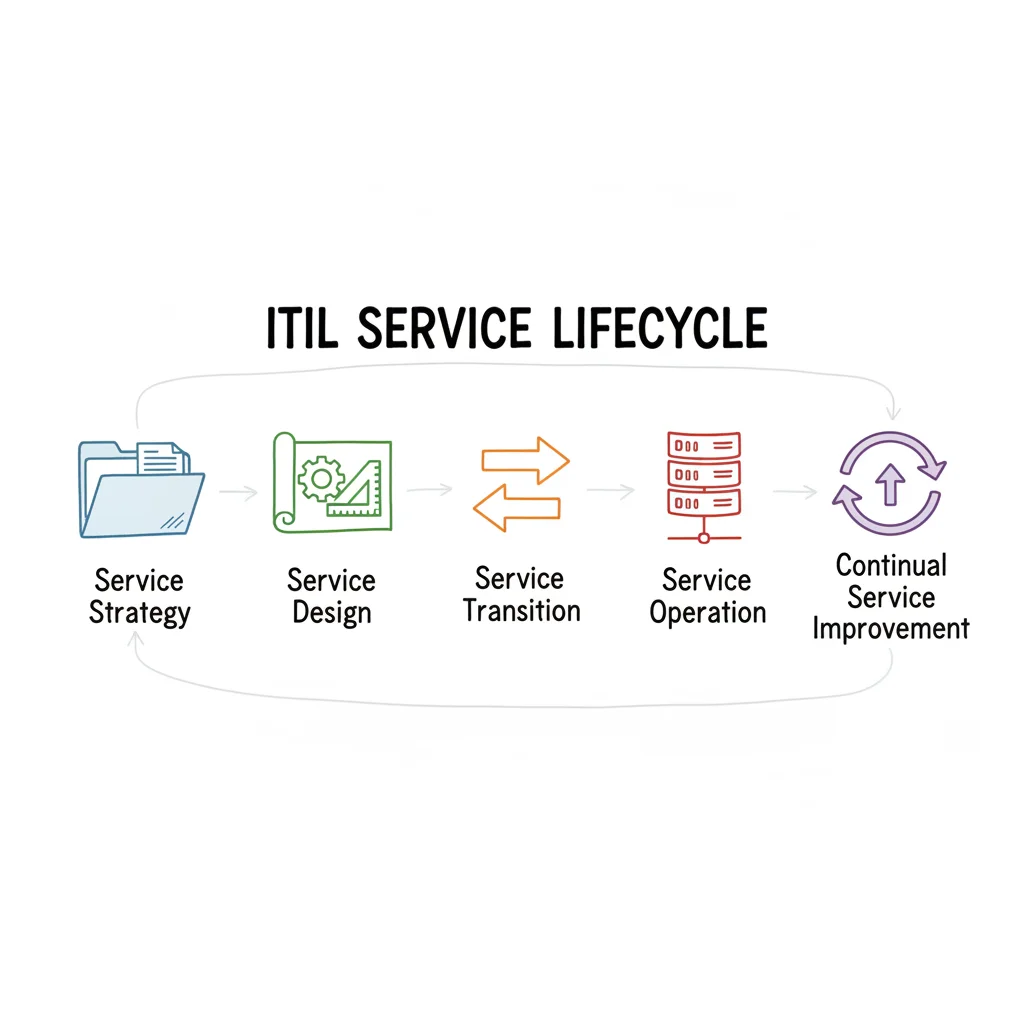 A visual summary of the ITIL 4 Foundation exam structure, highlighting the number of questions and passing score.
As you can see, the structure is quite straightforward: 40 questions with a 65% passing score. It's a manageable challenge, but success hinges on proper preparation and conceptual understanding.
The Guiding Principles: Your Core Values
The entire SVS is anchored by the seven Guiding Principles. Continuing our restaurant analogy, these are the head chef's fundamental beliefs—the non-negotiable values that influence every decision, from ingredient selection to customer interaction. In the IT world, they are universal truths that guide an organization through any service management situation, from adopting new cloud technologies to responding to a critical incident.
For the ITIL exam, you need to know not only what these principles are but, crucially, how they apply to real-world IT service management scenarios.
- Focus on value: Every action, service, or process must contribute, directly or indirectly, to creating value for stakeholders. For an AWS architect, this means designing solutions that optimize cost-efficiency and performance for the business, not just using the latest tech.
- Start where you are: Don't overhaul existing, functional systems unnecessarily. Evaluate your current state, leverage what's working, and build incrementally. This principle encourages pragmatic improvements rather than disruptive "rip and replace" strategies.
- Progress iteratively with feedback: Avoid large, risky Big Bang deployments. Implement changes in small, manageable steps, gather feedback (e.g., from user acceptance testing or post-deployment monitoring), and then adapt. This mirrors Agile development and DevOps practices.
- Collaborate and promote visibility: Silos hinder value delivery. Encourage transparent communication and shared understanding across teams (DevOps, SecOps, Support). For a PMP-certified project manager, this means fostering clear communication channels and shared project dashboards.
- Think and work holistically: IT services are interconnected. A fantastic application (product) can be undermined by poor network performance or inadequate support. Consider the end-to-end service experience and all its contributing components, including people, processes, partners, and technology.
- Keep it simple and practical: Use the fewest steps necessary to achieve desired outcomes efficiently. Overly complex processes often lead to errors and inefficiencies. This encourages automation of repetitive tasks and clear, concise documentation.
- Optimize and automate: Leverage technology and process improvements to maximize efficiency and reduce human error, freeing up skilled personnel for more strategic and creative work. Think Infrastructure as Code (IaC) in Azure or automated incident response workflows.
The Service Value Chain: The Master Recipe
If the guiding principles are the chef's core values, then the Service Value Chain (SVC) is the master recipe—the specific set of interconnected activities that transform demand into value.
The SVC is the operational engine of the Service Value System. It illustrates the step-by-step journey from an opportunity or demand through the creation and delivery of something truly valuable. Mastering this concept is paramount for passing the exam and excelling in an ITSM role.
The six core activities of the Service Value Chain are:
- Plan: Establishing a shared understanding of the vision, current status, and direction for products, services, and the entire organization. This involves strategic alignment of IT capabilities with business goals, much like defining a cloud adoption strategy.
- Improve: Continuously enhancing products, services, and practices across all value chain activities. This is the heart of continuous improvement, analogous to sprint retrospectives in Agile or post-incident reviews in an SRE team.
- Engage: Fostering strong, transparent relationships with all stakeholders, including customers, partners, and suppliers. Effective communication and understanding needs are crucial here, especially in managed service provider (MSP) environments.
- Design & Transition: Ensuring new or changed products and services meet expectations for quality, cost, and time-to-market. This stage covers everything from solution architecture (e.g., designing a highly available Azure solution) to testing and deployment strategies.
- Obtain/Build: Sourcing and creating the components and resources required for services. This could involve procuring cloud resources, developing custom software, or acquiring commercial off-the-shelf (COTS) applications.
- Deliver & Support: Providing services to users, managing service performance, and handling ongoing support. This is where operations, monitoring, and user support teams shine, ensuring services run smoothly and users receive timely assistance.
Key ITIL Practices: The Tools and Techniques
Finally, the syllabus delves into the ITIL practices. In our restaurant analogy, these are the specific skills and tools in the chef’s arsenal—things like expert knife skills, the art of sautéing, or knowing how to properly use a convection oven. In ITIL, a practice is a set of organizational resources (people, processes, information, technology) designed to perform work or accomplish an objective.
The Foundation exam doesn't test you on all 34 practices, but it does focus on a critical few that are essential for any IT professional, including:
- Continual Improvement: The ongoing effort to enhance service value and efficiency (e.g., automating manual tasks in an Azure DevOps pipeline).
- Service Level Management: Defining, agreeing, and monitoring the quality of services with customers (critical for setting SLAs in SaaS applications).
- Change Enablement: Minimizing the risk and impact of changes to services (e.g., a well-managed change control board for a critical production system).
- Incident Management: Restoring normal service operation as quickly as possible (think rapid response for a system outage).
- Problem Management: Identifying the root causes of incidents to prevent recurrence (deep diving into recurring errors, like a PMP project post-mortem analysis).
- Service Desk: The single point of contact between the service provider and the users (your front-line support for all IT issues).
- Service Request Management: Handling predefined user requests efficiently (e.g., password resets, software installations).
Reflection Prompt: How do these ITIL practices intersect with your daily responsibilities? Can you identify specific tools or processes you use that align with any of these practices?
When you frame the syllabus using this connected narrative, it transforms from a disparate list of terms into a logical, functional system. For a much deeper dive, the official ITIL 4 Foundation guidance breaks down every one of these components. This integrated understanding is precisely what the ITIL certification exam is designed to test.
Getting to Grips with the ITIL Exam Format and Questions
 Dedicated focus and strategic preparation are key to mastering the ITIL certification exam.
Knowing the syllabus material is one crucial step, but walking into the exam with a clear understanding of its format and question styles provides an immense advantage. Familiarity with the test structure eliminates the element of surprise, allowing you to channel all your focus into accurately answering the questions.
The ITIL 4 Foundation exam is a straightforward, closed-book assessment. You will face 40 multiple-choice questions and have exactly 60 minutes to complete them. To pass, you must correctly answer 26 questions, achieving a score of 65%. While the multiple-choice format might seem simple, these questions are crafted to test your application of understanding, not just your ability to recall definitions.
Understanding the Question Styles
Most questions you encounter will be standard "choose one from four" multiple-choice options (A, B, C, D). These are the core of the exam, designed to assess your grasp of fundamental ITIL concepts, key definitions, and the underlying purpose of various practices.
However, ITIL questions rarely demand a simple regurgitation of a definition. They are cleverly designed to evaluate your ability to apply what you've learned to practical situations. You'll often be presented with a brief scenario or a descriptive statement and asked to identify the best description, the primary purpose, or the most appropriate action based on ITIL principles.
For example, instead of a direct question like "What is an incident?", the exam might describe a situation: "A critical production server suddenly becomes unresponsive, impacting multiple users. Which ITIL practice is primarily responsible for restoring service as quickly as possible?" This focus on practical application is a consistent theme throughout the test, mirroring real-world IT challenges.
How to Approach Exam Questions
Acing the ITIL exam isn't just about knowledge; it's about employing a robust test-taking strategy. You need to develop skills in identifying keywords, discerning the core intent of a question, and systematically eliminating incorrect options (often called "distractors") that are designed to seem plausible to those with only a superficial understanding.
A crucial piece of advice: resist the urge to overthink. The Foundation exam isn't attempting to trick you with complex phrasing. The correct answer is almost always the most direct and logical application of the ITIL principles you've studied within the official syllabus.
Here’s a simple, yet highly effective, approach to tackling each question:
- Read the question slowly and carefully: Pay close attention to keywords such as "purpose," "role," "benefit," "primary," or "best." These words serve as vital signposts, guiding you toward precisely what the question is asking for.
- Review all the options thoroughly: Even if the first option seems correct, always read through every single choice (A, B, C, D) before making your decision. Often, there might be a more complete or better-fitting answer listed further down.
- Eliminate obvious distractors: You can typically rule out one or two answers immediately. This process significantly improves your odds of selecting the correct response from the remaining choices.
- Lean on ITIL principles for guidance: When uncertain, revert to the core ITIL ideas. Does one answer align more strongly with "focus on value," "collaborate and promote visibility," or "keep it simple and practical"? This often provides a strong hint towards the correct answer.
Reflection Prompt: Think about a time you've taken a challenging multiple-choice exam. Which of these strategies have you found most effective, and which could you practice more for the ITIL exam?
In-Person vs. Online Proctored Exams
When it's time to actually take the exam, you typically have two main options: attending a physical test center or taking it online from your preferred location. Both routes lead to the same official certification, but they offer distinct experiences.
- Test Center Exam: This is the traditional method. You travel to an authorized testing facility where you're provided with a computer in a quiet, controlled environment, with an on-site proctor. This is an excellent choice if you perform best in a structured setting free from potential home distractions.
- Online Proctored Exam: This option provides the flexibility to take the exam from your own space. You'll need a stable internet connection, a functioning webcam, and a microphone. A remote proctor will monitor you via your webcam to ensure the integrity of the exam process. It offers convenience and comfort, but you are responsible for guaranteeing a quiet testing environment and perfectly working technology.
Regardless of your choice, the best preparation involves simulating the actual exam experience. Taking an ITIL 4 Foundation practice exam is the single most effective way to become comfortable with the question styles, time constraints, and overall testing environment. It builds the critical confidence you need to approach exam day with composure.
How ITIL Certification Can Accelerate Your Career
*Learn how ITIL certification can propel your career forward in the dynamic world of IT Service Management.*Passing the ITIL exam is more than just adding a line to your resume; it's a strategic investment in your professional development. Earning this certification tells employers you're not merely a technical resource, but a professional who understands how to align IT services directly with business goals and drive tangible value.
This elevated perception has a measurable impact on your earning potential. The ITIL framework is the global benchmark for IT Service Management (ITSM), and organizations are actively seeking professionals who possess the skills to apply its principles. They are willing to offer a premium because you bring proven methodologies for boosting efficiency, managing risk, and delivering highly reliable services that contribute directly to the bottom line.
Boosting Your Earning Potential
Let's discuss the financial benefits, as they often represent one of the most immediate returns on your certification investment. Data consistently demonstrates a strong correlation between ITIL certification and higher salaries. In the United States, for instance, ITIL Foundation certified professionals can command an average annual salary often exceeding $100,000.
Similar trends are observed in other major global markets. This data underscores that businesses highly value the structured, methodical approach that certified ITIL professionals bring—an approach that helps optimize processes, mitigate risks, and reduce operational costs. This value proposition is comparable to the salary premiums seen with other high-demand certifications like PMP, AWS Solutions Architect, or Azure Administrator.
From Theory to Tangible Impact
Beyond the salary bump, ITIL equips you with a practical toolkit for navigating the complex, real-world problems that arise daily in IT operations. It provides a common language and a proven methodology for managing services, which is exactly the kind of expertise needed to climb the career ladder.
Imagine you're an IT team lead. Your team is perpetually engaged in reactive "firefighting," incident resolution times are unacceptably high, and user satisfaction is dwindling. Armed with your ITIL knowledge, you now possess a clear framework to systematically address these challenges.
The true power of ITIL lies in its practical application. It offers a blueprint for transforming chaotic IT operations into a predictable, value-driven service engine—a critical skill set that gets you noticed, promoted, and leads to greater professional impact.
Here’s a practical example of how this plays out in a common IT scenario.
Scenario: The Promotion Path
An IT team lead, having recently earned her ITIL certification, decides to leverage the Continual Improvement model to address her team's persistently slow incident response times.
- Identify the Vision: She sets an ambitious yet clear goal: reduce average incident resolution times by 30% in the next quarter to significantly boost user satisfaction across the organization.
- Assess the Current Situation: Employing ITIL practices, she meticulously analyzes incident data and discovers a pattern: 45% of all tickets are related to a specific legacy application with severely outdated or nonexistent documentation.
- Define Measurable Targets: The team agrees on a concrete plan: build a comprehensive knowledge base for the problematic application and conduct targeted training for service desk staff. They set specific KPIs for knowledge base article creation and staff training completion.
- Execute the Improvement Plan: The team actively documents common fixes, creates step-by-step troubleshooting guides, and conducts weekly training sessions. This involves collaboration between application owners, service desk agents, and the documentation team, embodying the "Collaborate and promote visibility" principle.
- Review and Adapt: After the first month, they review performance metrics. Resolution times for incidents related to the legacy application have already decreased by 20%. They identify new recurring patterns, incorporate user feedback, and continuously refine the knowledge base, demonstrating "Progress iteratively with feedback."
By the end of the quarter, the team not only meets but exceeds their goal, achieving an overall reduction in resolution times by 38%. This measurable success directly demonstrates strategic thinking and effective problem-solving, leading to the team lead's recognition and subsequent promotion to Service Delivery Manager.
Reflection Prompt: How could you apply the "Continual Improvement" model to a challenge in your current role or a personal project? What would be your vision, and how would you measure progress?
This is the essence of career acceleration driven by ITIL. The certification provides the framework not just to pass a test, but to instigate meaningful, measurable change that propels your career forward.
Building Your Winning ITIL Exam Study Plan
 A structured study plan, combining resources and practice, is essential for ITIL exam success.
Let's be realistic: simply reading the ITIL book from cover to cover isn't sufficient to guarantee passing the exam. You need a well-defined strategy. A thoughtfully designed study plan breaks down the extensive information into smaller, manageable segments, transforming a daunting task into a series of achievable daily victories.
Consider this your personalized playbook for exam day. The objective is to seamlessly integrate the official manual, structured training, and hands-on practice, ensuring you don't merely memorize terms but truly internalize how they apply in real-world IT scenarios. That deeper understanding is precisely what the exam assesses.
Of course, even the best plan requires consistent execution. Sharpening your study habits and learning how to increase focus and concentration while studying can significantly enhance your preparation efficiency.
The Core Components of an Effective Plan
The most successful study plans are built upon a foundation of diverse, high-quality resources. Relying solely on a single source can be risky, potentially leading to missed perspectives or frustrating knowledge gaps.
A winning strategy almost invariably incorporates these three essential components:
- The Official ITIL 4 Foundation Manual (or official training material): This is your ultimate source of truth. Every concept tested on the exam originates from this material, so treat it as your primary reference for definitions and core understanding. Engage with it actively by highlighting, summarizing, and creating mind maps.
- An Accredited Training Course: A reputable course provides structure, expert insights, and often scenario-based learning that a book alone cannot offer. Whether online or in-person, an experienced instructor can help clarify complex concepts, connect the dots between principles and practices, and offer real-world context. This is where MindMesh Academy excels, providing structured pathways to understanding.
- High-Quality Practice Exams: These are absolutely non-negotiable. They are invaluable for identifying your areas of strength, pinpointing your weaknesses, and acclimatizing you to the specific phrasing and style of ITIL questions. Think of them as dress rehearsals for the main event.
Don't underestimate the market value of this certification. In a recent survey of over 14,300 IT professionals, a significant 21% reported holding ITIL certifications. This statistic clearly indicates that the industry views ITIL as a foundational and highly relevant skill set.
A Sample 4-Week Study Timeline
Consistency consistently outperforms last-minute cramming. A four-week timeframe generally provides ample opportunity to learn the material, review it thoroughly, and practice until you're genuinely confident. Feel free to adapt this schedule to fit your personal commitments, but the underlying structure represents a proven path to success.
Here's a practical roadmap to guide your preparation for the ITIL certification exam:
Sample 4-Week ITIL Foundation Study Plan
A structured plan to guide your preparation for the ITIL certification exam over four weeks.
| Week | Focus Topics | Key Activities |
|---|---|---|
| Week 1 | Introduction to ITSM, Core Concepts, Four Dimensions of Service Management | Read initial chapters/modules. Define key terms in your own words. Relate "Four Dimensions" to your organization (e.g., "Partners and Suppliers" could be your cloud vendor). Reflection: Create flashcards for critical definitions. |
| Week 2 | The Seven Guiding Principles, The ITIL Service Value System (SVS) | Deep dive into the SVS and Guiding Principles. Use the restaurant analogy (or create your own) to cement understanding. Actively apply principles to real IT scenarios (e.g., "Progress iteratively" in a new software rollout). Activity: Explain each principle aloud without looking at notes. |
| Week 3 | The Service Value Chain, General & Service Management Practices | Focus on the flow and interconnections of the Service Value Chain activities. Dedicate time to key practices: Incident, Problem, Change Management. Take your first full practice exam under timed conditions to identify weak areas. Review: Analyze incorrect answers and revisit corresponding syllabus sections. |
| Week 4 | Final Review and Practice | Prioritize reviewing topics where you scored low on practice tests. Take 2-3 more mock exams, strictly adhering to the time limit. Focus on understanding why an answer is correct. Get ample rest leading up to exam day. Preparation: Develop a quick mental checklist for exam day strategies. |
This timeline is designed to build your knowledge systematically, starting with fundamental concepts before progressing to the more complex, interconnected elements of the framework. During that final week, your primary goal is not to learn new information but to solidify your existing knowledge and build the confidence necessary to excel on exam day.
Answering Your Top ITIL Certification Questions
As you near the point of scheduling your exam, you're bound to have some practical questions. Let's address the most common inquiries from aspiring candidates to help you move forward with confidence and clarity.
How Long Does It Take to Prepare?
This is perhaps the most frequent question, and the honest answer is: it varies based on your prior experience and learning style. However, a reliable rule of thumb for self-study is to allocate 1-2 hours per day for approximately 3-4 weeks. This pace generally allows for thorough learning without the stress of intense cramming.
If you opt for an accredited training course—many of which are intensive 2-3 day workshops—you could technically be ready for the exam in under a week. However, even with a fast-paced course, dedicating additional time for personal review and practice is highly recommended. The ultimate key, regardless of your chosen path, is to use practice exams to validate your understanding. Your goal is to genuinely grasp the ITIL concepts, not merely memorize terms.
Should I Focus on ITIL 4 or ITIL v3?
ITIL 4. Without hesitation.
Released in 2019, ITIL 4 represents the current, most up-to-date iteration of the framework. It was specifically designed to integrate seamlessly with modern IT operating models, including methodologies like Agile, DevOps, and Lean, and to address the complexities of cloud-native and hybrid IT environments.
While existing ITIL v3 certifications remain valid for those who already hold them, all new training, certifications, and exams are exclusively based on ITIL 4. If you're embarking on your certification journey today, ITIL 4 is the only relevant and career-enhancing path.
This isn’t simply about obtaining the latest version; it's about aligning your skills directly with the evolving demands and strategic priorities of the contemporary IT service management industry. An ITIL 4 certification holds significantly more value on your resume in today's market.
Do ITIL Certifications Expire?
Yes, they do now. This is a relatively recent change implemented by PeopleCert, the organization responsible for administering ITIL exams. Starting in 2023, a renewal policy was established for all ITIL 4 certifications. Your certificate is now valid for three years from its issue date.
To maintain an active certification status, you have a couple of options before your renewal date:
- You can retake the same exam (e.g., the ITIL 4 Foundation exam).
- Alternatively, you can earn another certification within the broader ITIL certification scheme (e.g., ITIL 4 Managing Professional or ITIL 4 Strategic Leader).
- Collect 20 Continuing Professional Development (CPD) points annually through PeopleCert's professional development program.
This policy ensures that ITIL-certified professionals continually keep their knowledge current and aligned with the latest best practices in the dynamic world of IT service management.
What Should I Do If I Fail the Exam?
First and foremost, do not panic. Failing an exam is a setback, not a career-ending event. Many successful IT professionals, across various disciplines like PMP or AWS, did not pass their certification exams on the first attempt. The encouraging news is that you can absolutely retake the ITIL certification exam.
Your immediate next step should be to thoroughly review the performance report provided with your exam results. This report will precisely highlight the areas and syllabus topics where you struggled, offering invaluable insights for your next attempt. Many accredited training providers, including MindMesh Academy, often include a free retake voucher (sometimes called a "Take2" option) with their courses. If you don't have one, you'll need to purchase a new exam voucher. Regardless, utilize the time before your next attempt to diligently focus on the specific syllabus areas that proved challenging. Develop a targeted study plan for these topics, use practice questions for them, and build confidence before scheduling your retake.
These habits are not ITIL-specific — spacing your review, testing yourself before you feel ready, and reading back into the syllabus wherever you guessed will carry across any certification you sit. MindMesh Academy does not publish ITIL material, but we do apply exactly these methods across the certifications we cover, and for ITSM practitioners the nearest one is the free ServiceNow CSA study guide.
Ready to Get Certified?
Prepare with expert-curated study guides, practice exams, and spaced repetition flashcards at MindMesh Academy:

Written by
Alvin Varughese
Founder, MindMesh Academy
Alvin Varughese is the founder of MindMesh Academy and holds 20 professional certifications including Microsoft Agentic AI Business Solutions Architect, AWS Solutions Architect Professional, and Azure DevOps Engineer Expert. He's held senior engineering and architecture roles at Humana (Fortune 50) and GE Appliances. He built MindMesh Academy to share the study methods and first-principles approach that helped him pass each exam.