
How to Become a Cloud Architect: Your 2026 Roadmap
How to Become a Cloud Architect: A Practical Roadmap
With over 38,000 U.S. job listings and a median annual salary of $155,000, cloud architecture represents a clear growth area in infrastructure today, according to CompTIA's cloud architect career data. In major markets, total compensation often exceeds $200,000, as bonuses can significantly raise the overall package.
This promising outlook can also create misconceptions. Many people hear "cloud architect" and assume the job is simply about passing one certification and drawing diagrams in Lucidchart. That's not the full picture.
If you're seeking a practical answer to how to become a cloud architect, consider it a progression from builder to decision-maker. You begin by operating systems, then design them, and finally, defend your design choices based on business priorities: reliability, security, delivery speed, and cost control. Engineers who make this jump typically don't do it by collecting badges. They succeed by learning to connect technical trade-offs to business outcomes and consistently proving that connection in real environments.
The Modern Cloud Architect Beyond the Code
This role commands high salaries because the work intersects risk, scale, and business strategy. Companies need someone who can decide whether a platform should run in one region or several, when a migration should occur, if a managed service offers sufficient operational value, and how to prevent security from becoming an impediment.
A cloud architect remains technical. You need to understand networking, IAM, infrastructure as code, observability, and platform services well enough to make the right call. However, the job extends beyond implementation. You're the person who translates "we need to launch faster" into deployment patterns, "we need to reduce exposure" into security guardrails, and "we need predictable spend" into architectural constraints.
This is why junior engineers often misunderstand the path. They focus on service memorization, while hiring managers seek judgment.
Practical rule: If you can explain a design only in platform terms, you're still thinking like an engineer. If you can explain why that design protects uptime, controls spend, and reduces operational risk, you're starting to think like an architect.
The fastest way to grasp this shift is to study real transformation work, not just exam objectives. For instance, this piece on modernizing IT operations in the UAE offers insights by framing cloud and service operations as an organizational change problem, rather than solely a tooling one.
You also need a path that aligns with how real careers unfold. The Mindmesh Academy career roadmap serves as a valuable reference because it approaches cloud progression as staged skill development, not a single leap.
What the role actually looks like
On a typical week, a cloud architect might:
- Review solution designs for resilience, security boundaries, and future scale.
- Resolve trade-offs between managed services and team control.
- Set standards for Terraform modules, tagging, logging, and identity patterns.
- Work with leadership on migration sequencing and platform investment.
- Coach engineers to ensure architecture doesn't remain confined to slide decks.
This highlights why the title matters less than the function. If you're already making technical decisions with operational and business consequences, you're progressing toward architecture.
Your Career Roadmap From Engineer to Architect
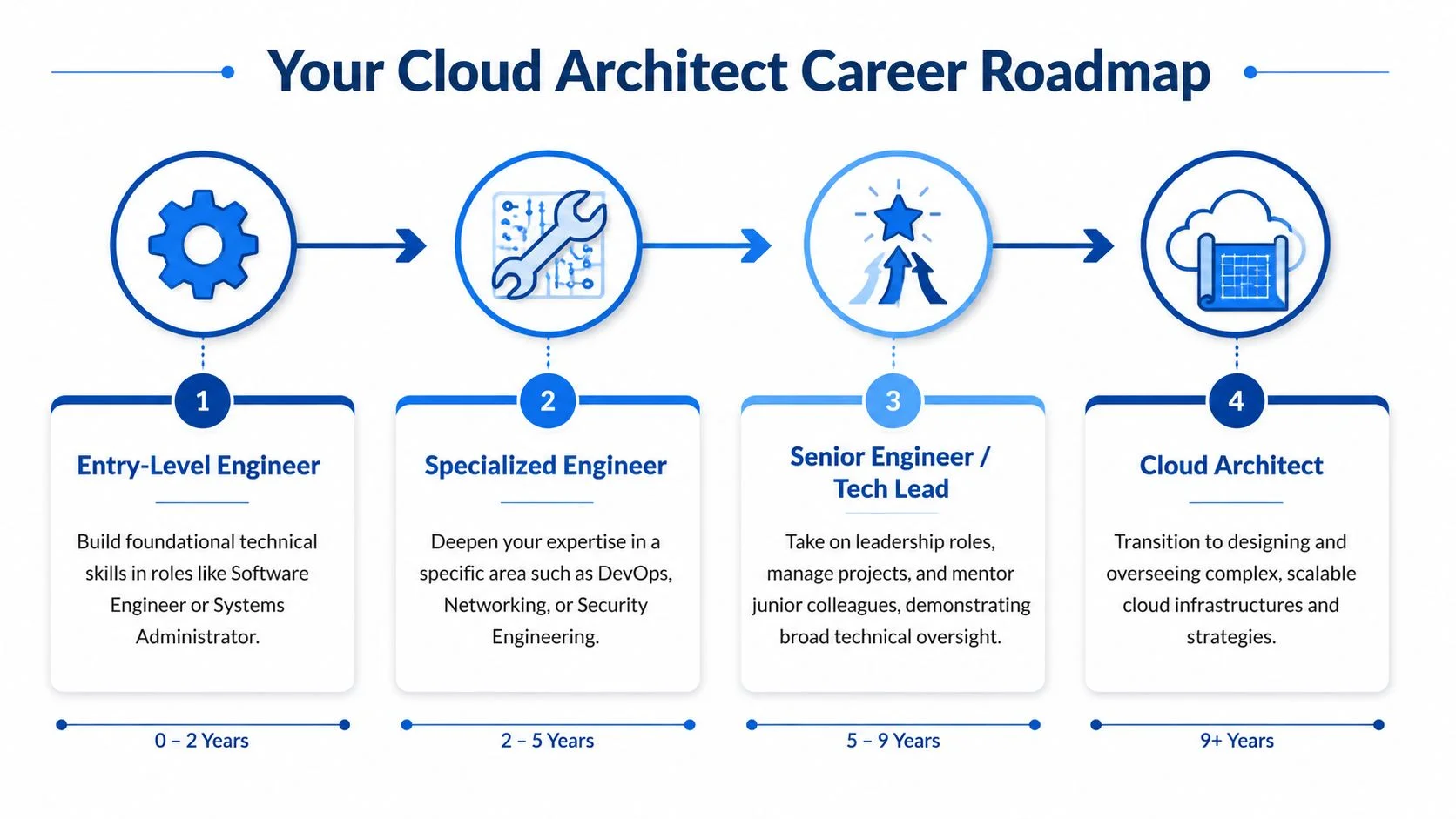
Individuals typically don't start as architects, nor should they. Architecture without delivery experience quickly becomes theoretical. The usual route involves operational experience first, design second, and strategic ownership third.
The market supports this progression. The U.S. Bureau of Labor Statistics projects 13% employment growth for computer network architects from 2023 to 2033, signaling durable demand for those who can design and guide infrastructure decisions, as noted in Coursera's overview of the cloud architect path.
A realistic timeline
A common career arc spans 6 to 10 years. This may sound long until you break it down into job functions instead of titles.
| Stage | Typical focus | What you should be learning |
|---|---|---|
| Entry-level engineer | Support, operations, troubleshooting | Linux or Windows administration, networking basics, scripting, tickets, incident handling |
| Cloud or DevOps engineer | Build and automate infrastructure | Terraform or CloudFormation, CI/CD, IAM, observability, deployment patterns |
| Senior engineer or tech lead | Own systems and guide others | Design reviews, reliability, security trade-offs, mentorship, standards |
| Solutions architect to cloud architect | Set direction across teams | Business alignment, governance, migration strategy, executive communication |
The first 3 to 12 months
If you're early in your career or switching from another IT role, your first year should focus narrowly, not broadly.
-
Months 3 to 6 Pick one cloud platform. Learn core services, IAM, networking, compute, storage, and logging. Build simple environments manually first so the abstractions make sense later.
-
Months 6 to 9 Start automating. Rebuild what you created manually with infrastructure as code. Add version control and a basic CI/CD workflow.
-
Months 9 to 12 Shift from deployment to design. Write short design notes. Explain why you chose a load balancer, a managed database, or a serverless pattern. This habit is more significant than commonly realized.
The multi-year progression
A typical sequence from verified career data looks like this:
- Junior cloud support or junior cloud engineer for early hands-on experience.
- Cloud engineer where you build and operate real infrastructure.
- Senior cloud engineer where you lead projects and shape implementation standards.
- Solutions architect where design becomes the primary responsibility.
- Cloud architect where enterprise strategy, governance, and cross-team alignment become central.
If you're changing fields, your resume needs to show transferable evidence, not just aspiration. This guide for career changers on resumes helps reframe prior work into capability instead of highlighting a job-title mismatch.
For Azure-focused engineers, a practical midpoint involves preparing for Azure infrastructure certification, but only after you've built enough hands-on fluency to understand why the patterns exist.
The career mistake I see most often is trying to skip the ownership phase. If you haven't carried a system through failure, change, and recovery, your architecture instincts are still immature.
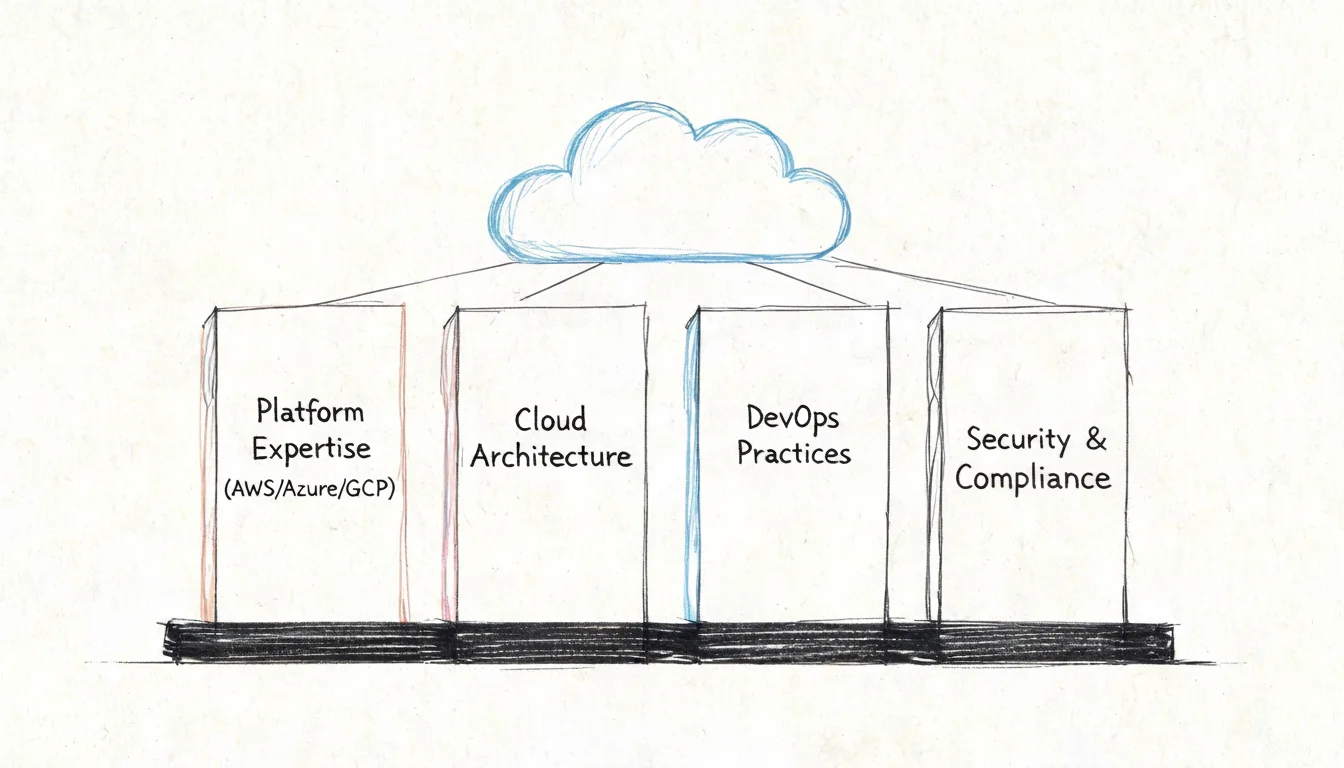
The Four Pillars of an Architect's Skillset
Cloud architecture appears broad because it is. The key is to organize it into a few reinforcing capabilities.
Deep platform expertise
You don't need to know every cloud on day one. You do need one platform you understand well enough to design confidently under pressure.
This means more than knowing service names. You should grasp native identity models, networking primitives, storage behavior, scaling patterns, and where managed services reduce toil versus where they introduce lock-in or operational blind spots.
An architect proficient in AWS can explain when ECS better fits a specific team than EKS, or when a managed database justifies reduced control. The same applies to Azure and GCP. The goal is judgment, not trivia.
Enterprise networking and security
Weak architects quickly expose themselves. If you don't understand traffic flow, segmentation, identity boundaries, encryption choices, and egress implications, your designs will look tidy on paper but fail in production or during an audit.
You should be able to reason through questions like these:
- How does this application communicate across tiers?
- Where do we terminate access and enforce policy?
- What's the blast radius if a role or key is misconfigured?
- How do we isolate environments without hindering delivery?
Most cloud incidents stem not from a lack of services, but from weak boundaries and poor operational assumptions.
Infrastructure as code and automation
Manual infrastructure doesn't scale. Worse, it conceals drift and complicates recovery.
Architects don't just write Terraform or review pipelines for style points. They use automation to make systems repeatable, auditable, and safe to change. If your architecture relies on tribal knowledge and console clicks, it's not truly architecture yet; it's a temporary setup.
A solid baseline includes:
- Reusable modules that encode standards.
- Version control workflows that support review and rollback.
- Deployment pipelines that make changes visible and consistent.
- Policy checks that catch obvious mistakes before production.
Here's a useful technical refresher before you go deeper into design patterns:
Business acumen and communication
This pillar often gets overlooked because it feels less concrete. It is not less important.
An architect must persuade product leaders, security teams, finance stakeholders, and engineers, all of whom have different priorities. You need to explain trade-offs in plain language. "This design reduces operational burden" is a stronger argument than "this uses a managed service." "This lowers recovery complexity" is more impactful than "this is cloud native."
Good architects don't win arguments by sounding technical. They win by making the trade-off obvious.
For a self-check, ask whether your design documents clearly answer four questions: what problem you're solving, what options you considered, why you chose this path, and what risks remain. If they don't, keep refining.
A Smart Approach to Certifications and Study
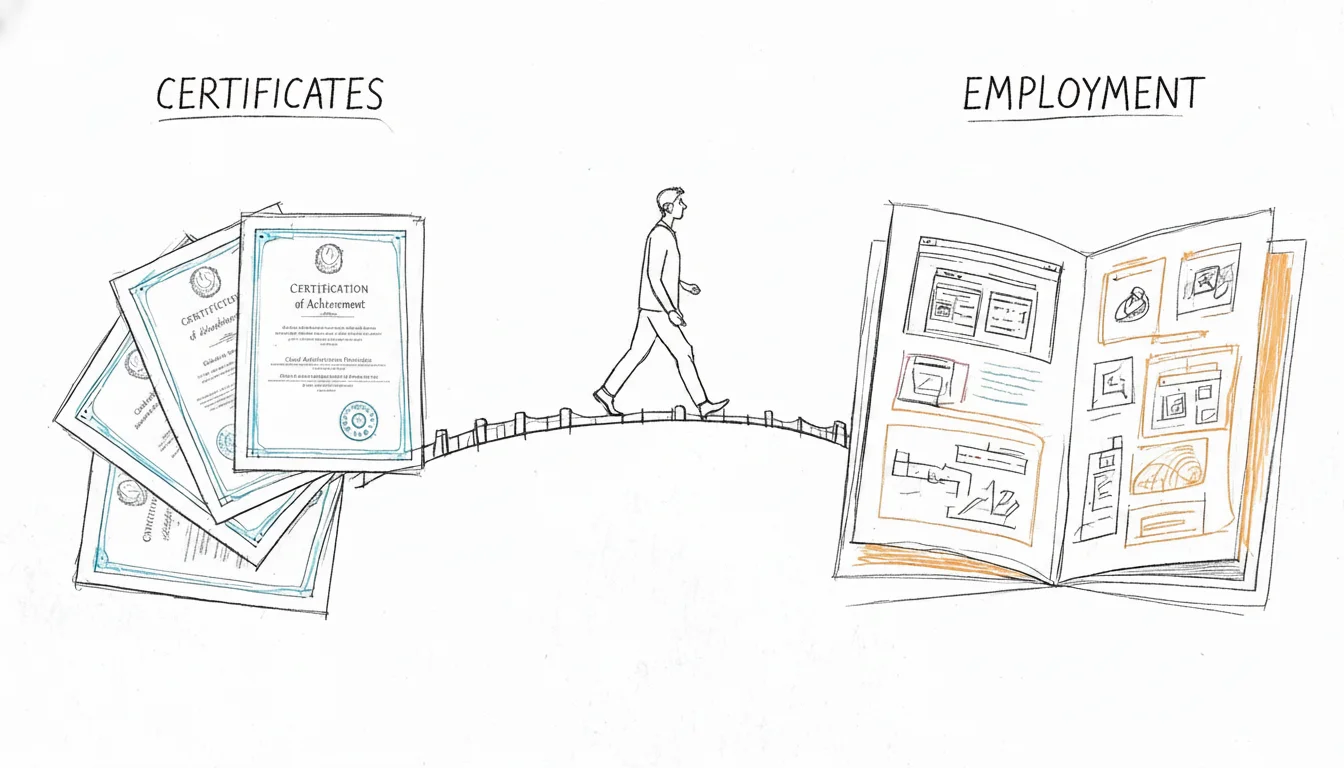
Certifications matter. They help structure your learning, signal competence, and clear resume filters. But they only help when grounded in real practice.
The trade-off is straightforward: A certification path provides coverage; hands-on work provides judgment. You need both.
Coursera's cloud architect guidance notes that professional-level certifications can lead to a 25 to 30% salary boost, but also that 40% of candidates fail their initial professional exams, often due to insufficient lab experience, as described in Coursera's guide on becoming a cloud architect. This aligns with what most experienced mentors observe: people fail because they study services as facts instead of systems.
Cloud Architect Certification Paths
| Platform | Associate Certification | Professional/Expert Certification | Best For |
|---|---|---|---|
| AWS | AWS Solutions Architect Associate | AWS Solutions Architect Professional | Engineers seeking deep architecture credibility in the broadest cloud ecosystem |
| Azure | Azure-focused architecture associate path | Azure Solutions Architect Expert | Teams working in Microsoft-heavy enterprise environments |
| GCP | Foundational cloud path on GCP | Google Professional Cloud Architect | Data-heavy and platform teams operating in Google Cloud |
What works and what doesn't
The wrong way to study is common:
- Cramming video courses without building anything.
- Memorizing service lists instead of design patterns.
- Taking practice tests too early and mistaking recognition for mastery.
- Skipping weak domains because they feel uncomfortable.
The right approach is slower initially and faster later.
A timeline you can actually follow
Months 3 to 4
Choose one platform and one target exam. Do not mix AWS, Azure, and GCP unless your day job requires it. Your goal is conceptual clarity.
Focus on:
- Core services you'll use repeatedly.
- Identity and access because architecture breaks quickly when permissions are vague.
- Networking basics including isolation, routing, and exposure patterns.
- Storage and compute choices with trade-off notes, not just definitions.
Use flashcards for facts that need repeated recall, such as service fit, architectural constraints, and common failure modes. Spaced repetition works well here because cloud study often involves material with a high forgetting rate.
Months 4 to 6
Build labs that force design decisions.
Examples:
- A three-tier application with private and public boundaries.
- A serverless workflow with event-driven components.
- A logging and alerting setup that helps you trace failures.
- A Terraform deployment with reusable modules and environment separation.
Document each project in a short architecture note. Write what you built, why you chose those services, what you would change, and what risks remain. These notes help with both interviews and exam scenario questions.
Months 6 to 9
Start testing readiness. Do not use a single score as your only signal. Use a basket of indicators:
- Can you explain your architecture choices without opening documentation?
- Can you rebuild your core lab from scratch?
- Can you identify weak points in your own design?
- Can you compare two valid approaches and defend one?
Adaptive study helps. A tool that guides you back toward weak domains is more useful than one that simply tells you your average score. One option is the advanced AWS architecture certification path, which includes study materials built around spaced repetition and domain coverage. Use this kind of system as a complement to labs, not a replacement.
Months 9 to 12
Transition to architect-level thinking. Practice scenario analysis instead of isolated facts. Review designs for resilience, security, failure handling, and cost behavior. Learn to ask what happens during scale spikes, dependency failures, and rollback events.
Study heuristic: If your prep contains more notes than deployments, you're under-practicing.
Choosing between AWS, Azure, and GCP
Pick the platform that aligns with your current work or target employers. If your company runs Microsoft identity and enterprise tooling, Azure is usually the practical choice. If you want the broadest market exposure, AWS is a common first path. If your environment is analytics-heavy or already built around Google services, GCP can make more sense.
What doesn't work is chasing every badge at once. Depth beats scattered familiarity.
Building Your Portfolio and Nailing the Interview
At some point, certification stops moving the needle. Portfolio work starts doing the heavy lifting.
This is especially true because verified data shows 85% of cloud architects transition from DevOps roles, and a portfolio with at least 5 projects can boost hiring chances by as much as 50%, according to ControlMonkey's cloud architect career guide. That should tell you something important: Employers trust demonstrated systems thinking more than passive credentials.
Five portfolio projects that actually help
You don't need novelty. You need projects that reveal architectural judgment.
-
A multi-region serverless application Show routing, failure handling, identity boundaries, logging, and deployment strategy.
-
A secure three-tier web architecture in Terraform Publish the module structure and explain how you handle reuse, environment separation, and secret management.
-
A migration blueprint Take a simple on-prem-style application and design a phased cloud migration with rollback and operational considerations.
-
A cost-aware observability setup Build logs, metrics, and alerting with clear retention decisions and operational trade-offs.
-
A platform baseline Create reusable IAM, networking, tagging, and policy patterns that a team could adopt as a starting point.
How to present those projects
A weak resume says, "Built cloud infrastructure on AWS."
A strong one says, "Designed and deployed a fault-tolerant cloud environment with infrastructure as code, documented security boundaries, and created repeatable deployment workflows for team use."
That wording matters because it showcases architecture, not button-clicking.
Use this formula on resumes and in interviews:
- Problem the system had to solve.
- Constraints you had to respect.
- Decisions you made and why.
- Operational outcome the design enabled.
Do not invent impact metrics if you don't have them. State the design value qualitatively and specifically.
What interviewers are really testing
Interviewers usually care about three things:
- Can you reason through trade-offs?
- Can you communicate clearly to different audiences?
- Have you operated systems, not just studied them?
If you're targeting distributed teams, examine hiring patterns among remote companies. Remote cloud roles often place even more weight on written communication, design documents, and asynchronous decision-making.
In architecture interviews, “I'd need to confirm a few assumptions before deciding” is often a stronger answer than pretending there's one perfect design.
Bring diagrams if allowed. Bring repo links. Bring concise design write-ups. The candidate who can calmly walk through trade-offs typically stands out more than the candidate who recites the most services.
Frequently Asked Questions
Do I need to be a great coder?
You don't need to be a software engineer first, but you do need enough scripting and automation fluency to work comfortably with infrastructure as code, deployment pipelines, and operational tooling. If you avoid code entirely, you will struggle to design systems that teams can implement and maintain.
Do I need a degree?
A bachelor's degree in computer science or a related field is commonly expected, especially by larger employers, but it isn't the only signal that matters. Strong experience, credible certifications, and a portfolio of real design work can carry a lot of weight. The farther you progress, the more employers care about judgment and delivery history.
Which platform should I start with?
Start with the platform that matches your current environment or target job market. Don't choose based on internet arguments. Choose based on where you can get real usage, real repetition, and real context.
How do I know when I'm ready to apply for architect roles?
Readiness is measurable. You're getting close when you can do most of the following consistently:
- Explain a design clearly to both engineers and non-technical stakeholders.
- Build and review infrastructure as code without needing step-by-step guidance.
- Identify security and networking weaknesses in common architectures.
- Defend trade-offs between cost, complexity, speed, and resilience.
- Show a portfolio with multiple projects that reflect system design, not just deployment.
- Write concise architecture notes that record assumptions, risks, and decisions.
If you can do that, start applying, even if you don't yet have the final title on your resume.
Is DevOps the best background for becoming a cloud architect?
It's one of the strongest backgrounds because it forces you to think about automation, reliability, deployment, and operations together. But it's not the only one. Strong systems, networking, security, and software backgrounds can also lead into architecture if you deliberately expand the missing areas.
What should I avoid?
Avoid certification collecting without implementation. Avoid trying to learn every cloud at once. Avoid architecture content that stays abstract and never touches failure, cost, identity, or operations. And avoid waiting until you feel perfectly ready. Aspiring professionals often cross into architecture by taking on architectural work before they get the title.
If you want a structured way to study for cloud certifications while retaining what you learn, MindMesh Academy offers exam prep built around practice questions, flashcards, adaptive review, and spaced repetition. Used alongside hands-on labs and portfolio projects, preparing for your AWS Solutions Architect Professional exam with our practice tests can help you move from memorizing cloud services to thinking like an architect.

Written by
Alvin Varughese
Founder, MindMesh Academy
Alvin Varughese is the founder of MindMesh Academy and an enterprise architecture leader. An electrical engineer by training, he moved from factory automation in South Africa to cloud architecture at GE Appliances and Humana (Fortune 50), and holds 20 professional certifications including AWS Solutions Architect Professional, Azure DevOps Engineer Expert, and Microsoft Agentic AI Business Solutions Architect. He built MindMesh Academy after interviewing too many highly certified candidates who couldn't answer basic questions: the goal is prep that makes you better at the job, not just able to pass the exam.