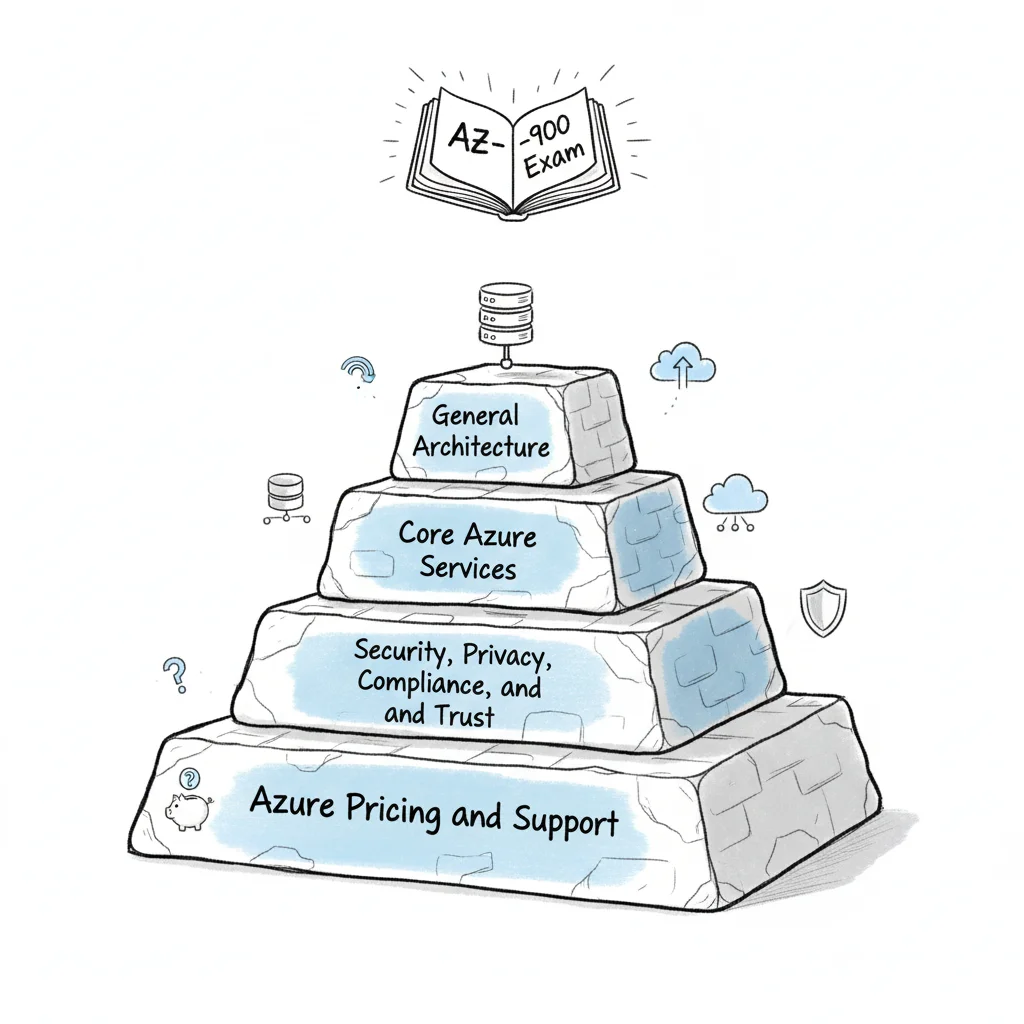
AZ-900 Guide: Pass the Azure AZ-900 Exam Easily
Your Expert Guide to Acing the Azure AZ-900 Certification: Cloud Fundamentals for IT Pros
Pursuing the AZ-900 certification is a strategic choice for modern professionals. IT professionals, students, and business stakeholders use this credential to validate foundational cloud knowledge. This guide from MindMesh Academy provides the technical context needed to be well-prepared for the exam. You will gain a functional understanding of how Azure operates rather than just memorizing a list of definitions.
Engineers shifting to cloud services, project managers communicating with technical teams, and students starting new careers can all benefit from this overview. We break down the exam structure and the specific question types used by Microsoft. Our focus remains on the core Azure services, security protocols, and pricing models required for a passing score. Follow this outline to enter the testing center with the confidence needed to succeed.
Your Complete Roadmap to AZ-900 Certification
 A focused IT professional studies for the AZ-900 certification using digital tools and official documentation.
Traditional textbooks often rely on abstract theory. To succeed, you need a practical plan that links these ideas to how cloud technology works in production. This guide covers the basics, starting with core cloud concepts like scalability and high availability. We then move through specific Azure services, security protocols, and the financial side of cloud management, including pricing and support models.
The objective is to give you the clarity and knowledge required to pass with confidence. This certification acts as a gateway to Microsoft Azure. Taking this step helps you build a solid base for any career involving cloud infrastructure. You will gain a technical foundation that supports more advanced roles later in your career.
AZ-900 Exam at a Glance
Before looking at the technical details, look at the logistics of the AZ-900 exam. These details will help you create a study schedule and set expectations for the test day.
| Exam Feature | Details |
|---|---|
| Exam Name | Microsoft Azure Fundamentals (AZ-900) |
| Number of Questions | 40-60 questions |
| Time Allotted | 60 minutes |
| Passing Score | 700 / 1000 |
| Question Types | Multiple choice, drag-and-drop, case studies |
| Prerequisites | None |
| Recommended Experience | Basic IT knowledge, but no Azure experience required |
Knowing these numbers is a vital part of your strategy. You are not just learning facts; you are training to answer questions accurately and quickly. Time management is often the biggest hurdle for new test-takers. Keep the 60-minute limit in mind during your practice runs to ensure you do not rush or leave questions unanswered.
Understanding the Exam Structure
The AZ-900 is the entry point for Microsoft's cloud platform. It validates your grasp of cloud basics and how Microsoft applies them. It serves as the foundation for more advanced or specialized certifications later.
Expect to see 40 to 60 questions during your 60-minute session. You must score at least 700 points out of 1000 to pass. While people call this an entry-level test, it requires real preparation. You cannot rely on memorizing definitions. You must understand how different services interact.
The exam uses a variety of question formats. You will see traditional multiple-choice questions, but you should also prepare for drag-and-drop tasks where you must match a cloud service to its correct definition. Some sections might include case studies that describe a business problem and ask you to select the best Azure solution.
To master this content, you should look at how to learn effectively. Focus on comprehension rather than repeating words from a page. This allows you to apply what you know to different business scenarios during the exam.
Reflection Prompt: How might understanding the specific number of questions and time limit influence your pacing strategy during the actual exam?
Who Should Take This Exam?
The AZ-900 certification is for many different professional roles. It is a great credential for people in non-technical positions. Sales representatives, marketing professionals, and project managers often take it to communicate better with technical teams. A project manager with a PMP who manages a migration project, for example, needs to understand cloud terminology to set realistic deadlines.
Individuals working in sales or marketing find this certification helpful when discussing service level agreements or pricing with potential clients. The AZ-900 provides the technical context required to manage resources and risks effectively.
It is also a starting point for IT professionals who are new to cloud environments. Specialists transitioning from on-premises hardware or those moving from other platforms like AWS use this as a first step. Even if you hold certifications in ITIL or other frameworks, this exam helps align those practices with Azure's specific tools. It confirms you understand the shared responsibility model, which is a core part of cloud security. If your work involves cloud technology or you want to move into that field, the AZ-900 provides the vocabulary you need to advance.
Why an AZ-900 Certification Can Kickstart Your Career
Deciding to earn a professional certification is a major commitment. It requires you to dedicate your time and focus to learning a specific set of skills. Because cloud computing is now a standard part of modern business, the AZ-900 is more than a line on a resume. It serves as a clear and verifiable signal to recruiters. It shows that you have a firm grasp of cloud computing basics and can participate in technical discussions about Microsoft Azure services.
The physical and digital scale of Microsoft Azure is massive. Its large market share translates to a high demand for people who can use the platform. Companies in many sectors, such as finance, healthcare, retail, and government, use Azure for their daily operations. This widespread use creates a constant need for workers who understand Azure services and the cloud principles that keep these systems running.
The First Step to Bigger Things
The AZ-900 is your foundational entry point. It proves you understand cloud concepts and how Microsoft applies them. This first step makes you ready for specialized roles that often come with higher pay. The progression mirrors general IT support paths. For instance, a CompTIA A+ (220-1201/220-1202) certification provides the baseline for hardware and software support. That baseline then prepares you for more specific areas like networking with CompTIA Network+ (N10-009) or cybersecurity.
After you earn your AZ-900 certification, you are ready to choose a more advanced track. You can build your expertise by moving toward these specialized roles:
- Azure Administrator (AZ-104): This role is for people who want to implement, manage, and monitor cloud environments. It is a practical role that focuses on day-to-day operations and resource management.
- Azure Developer Associate (AZ-204): This path is for developers who want to design, build, and deploy cloud-based applications. It covers topics like storage, security, and integration with third-party services.
- Azure Security Engineer (AZ-500): This is a specific track for professionals who protect data, applications, and networks. It focuses on identity management and threat protection in a cloud environment.
This clear progression lets you build your knowledge one step at a time. It turns a single certification into a long-term career path. Hiring managers look for this kind of dedication to professional development.
Having the AZ-900 on your resume helps you stand out in a crowded job market. It shows that you have the skills needed to contribute to a cloud team immediately.
Proving You Have In-Demand Skills
This certification carries weight all over the world. Microsoft Azure holds a dominant position in the global market, especially in sectors like finance and public administration. Industry data shows that the AZ-900 remains a valuable asset for career growth. Some experts suggest it is one of the most useful certifications Microsoft offers. Its focus on the basics often gives it more longevity than specialized credentials in areas like AI or specific administration tasks. You can read more about the value of Azure certifications on datacamp.com.
Earning the AZ-900 is about more than just reading a book. It gives you professional credibility. It tells employers that you are serious about working in the cloud and that you have the evidence to prove your skills. This initial investment in your education can lead to better job opportunities and career stability for many years.
Decoding the Core AZ-900 Exam Domains
To maximize your chances of passing the AZ-900 exam, you need a strategy that centers on the official exam structure. This certification does not test your ability to click buttons in the portal as much as it tests your understanding of why certain cloud configurations exist. Microsoft organizes the exam into specific knowledge areas, often called domains. Each domain carries a specific weight, and mastering these segments is the only way to earn your certification.
We will examine these domains by looking at the practical logic behind the cloud. You do not need to spend hours memorizing every possible Azure SKU. Instead, you should focus on the purpose of these services and how they solve specific business problems. If you understand why a company would choose a serverless function over a full virtual machine, you are already halfway to passing.
The first step is to look at the official blueprint provided by Microsoft to see how they distribute the questions across the various topics.
AZ-900 Exam Domain Weighting
The topics on the AZ-900 exam are not weighted equally. Microsoft assigns a percentage range to each domain to show you where to focus your study time. A domain with a higher percentage will have more questions. If a domain is weighted at 40%, you can expect roughly 16 to 20 questions out of a 40-50 question exam to come from that single area.
The current AZ-900 exam blueprint follows this distribution:
| Exam Domain | Percentage Weight |
|---|---|
| Describe Cloud Concepts | 25–30% |
| Describe Azure Architecture and Services | 35–40% |
| Describe Azure Management and Governance | 30–35% |
Azure Architecture and Services represents the largest portion of the test. However, the margins are tight. You cannot skip the management section or the conceptual section and expect to pass. A balanced study plan that covers all three areas is the most reliable way to ensure you are ready for any question the exam throws at you.
 This infographic illustrates how the AZ-900 certification serves as a launchpad, enabling professional growth through enhanced skills, new career opportunities, and increased earning potential.
This certification validates the foundational cloud knowledge that hiring managers look for when filling entry-level cloud roles or sales and management positions that interact with technical teams.
Domain 1: Cloud Concepts
This domain covers the fundamental principles of cloud computing. It acts as the basis for everything else. If you do not understand the difference between vertical scaling and horizontal scaling, the specific features of Azure App Service will not make sense. Microsoft recently updated the weighting of this domain to 25-30% to ensure that every certified professional has a strong theoretical base.
Cloud computing is often categorized by its service models. The "pizza as a service" analogy remains one of the most effective ways to distinguish between these models:
- Infrastructure as a Service (IaaS): This model is similar to buying the raw ingredients for a pizza. You have the dough, sauce, and cheese, but you must provide the oven and do the cooking. In Azure, this means you rent the virtual servers, storage, and networking. You are responsible for installing the operating system, managing updates, and configuring the applications. Example: Moving a physical server from an office to an Azure Virtual Machine.
- Platform as a Service (PaaS): This is like ordering a pizza for pick-up. The shop provides the ingredients and the oven. Your job is just to choose the toppings and eat. In the cloud, the provider manages the hardware, the operating system, and the scaling tools. You only manage your application code and your data. Example: Using Azure App Service to host a website without worrying about Windows or Linux updates.
- Software as a Service (SaaS): This is the delivery model. You call a restaurant, and the pizza arrives ready to eat. You do not manage the kitchen or the driver. You simply use the software through a web browser. Example: Using Microsoft 365 for email. Microsoft manages the servers, the software, and the security updates.
You must also be able to distinguish between public, private, and hybrid clouds. A public cloud is a multi-tenant environment where resources are shared among different organizations. It is highly scalable and requires no hardware investment. A private cloud is dedicated to a single organization, often located in a local data center. It provides more control but requires significant capital investment. A hybrid cloud combines both. It allows a company to keep sensitive data on-premises while using the public cloud for high-demand tasks that require extra computing power.
Another important concept is the shift from Capital Expenditure (CapEx) to Operational Expenditure (OpEx). CapEx involves spending money on physical assets up front, like buying a rack of servers. OpEx is the "pay-as-you-go" model where you pay for services as you use them. This allows companies to try new ideas without a massive initial cost.
Reflection Prompt: Can you identify a scenario in your current workplace where switching from an IaaS model to a PaaS model would save time or money?
Domain 2: Azure Architecture and Services
This domain is the core of the exam, accounting for 35-40% of the total score. This is where the theory becomes practical. You will be asked about the physical structure of Azure and the specific tools available to build solutions.
Azure's global infrastructure is built on Regions and Availability Zones. A Region is a geographic area that contains at least one, but usually multiple, data centers connected by a low-latency network. Availability Zones are physically separate data centers within an Azure region. Each zone has its own independent power, cooling, and networking. By deploying your services across multiple Availability Zones, you protect your application from a single data center failure.
You do not need to be an expert in every one of the 200+ Azure services, but you must understand these core offerings:
- Azure Virtual Machines (VMs): These are on-demand computing resources. Use these when you need total control over the operating system or when you are running software that requires specific manual configurations.
- Azure App Service: This allows you to build and host web apps, mobile back-ends, and RESTful APIs in the programming language of your choice without managing infrastructure. It handles the scaling and high availability automatically.
- Azure Storage: This is the umbrella term for several data services. Blob Storage is used for massive amounts of unstructured data like videos or log files. File Storage provides managed file shares for the cloud or on-premises. Table Storage is a NoSQL store for structured data.
- Azure SQL Database: This is a relational database service based on the Microsoft SQL Server engine. It is a PaaS product, meaning Microsoft handles the patching and backups, while you focus on your tables and queries.
- Azure Virtual Network (VNet): This service enables Azure resources to communicate with each other, the internet, and on-premises networks. It provides the isolation and security necessary for a cloud environment.
To pass this section, focus on use cases. If a question asks how to host a simple website with minimal management, you should think of App Service. If the question asks how to run a legacy application that requires a specific version of Windows Server, you should think of a Virtual Machine. Understanding the "best tool for the job" is the primary goal here.
The exam also covers the organizational hierarchy of Azure. You should know that Resources sit inside Resource Groups. Resource Groups sit inside Subscriptions. Subscriptions can be organized into Management Groups. This structure helps companies manage access and track costs across large departments.
Key Takeaway: Success in this domain depends on your ability to categorize services. Group them by their function: Compute, Networking, Storage, or Database. Once you see the categories, the differences between individual services become much easier to identify.
Domain 3: Azure Management and Governance
The final domain focuses on how to keep your cloud environment secure, organized, and within budget. It makes up 30-35% of the exam. In a cloud environment, it is very easy for costs to spiral out of control if you do not have proper governance in place. Microsoft focuses on the tools that provide visibility and control.
You will need to identify the following management tools:
- The Azure Portal: This is the web-based console where you can manage your resources through a visual interface. It is great for beginners but less efficient for large-scale changes.
- Azure PowerShell and Azure CLI: These are command-line interfaces. Use these when you want to automate repetitive tasks. PowerShell is common for Windows users, while the CLI is popular in Linux environments, though both are now cross-platform.
- Azure Policy: This tool helps you stay compliant with corporate standards. For example, you can create a policy that prevents anyone in the marketing department from creating expensive, high-powered virtual machines.
- Role-Based Access Control (RBAC): This is how you manage permissions. Instead of giving everyone "Owner" access, you give them specific roles like "Reader" or "Contributor" based on what they actually need to do. This follows the principle of least privilege.
- Azure Monitor: This service tracks the health and performance of your resources. It can send you an alert if a server goes down or if your CPU usage is too high.
Cost management is a major focus in this domain. You must know the difference between the Azure Pricing Calculator and the Total Cost of Ownership (TCO) Calculator. The Pricing Calculator helps you estimate your monthly bill for services you plan to use. The TCO Calculator helps you compare the cost of running your own data center versus moving to Azure.
You will also see questions about Service Level Agreements (SLAs). An SLA is a formal agreement that defines the performance standards Microsoft commits to. It usually involves a percentage of uptime, such as 99.9% or 99.99%. If Microsoft fails to meet these standards, you may be eligible for service credits.
Finally, you should understand Azure Resource Locks. These prevent accidental deletion or modification of critical resources. Even if you have full admin rights, a "CanNotDelete" lock will stop you from deleting a production database until the lock is removed.
Reflection Prompt: If you were the administrator for a large company, which tool would you use to ensure that every resource created in the cloud includes a "Department" tag for billing purposes? (Hint: Think about Azure Policy.)
Your Actionable Four-Week Study Plan
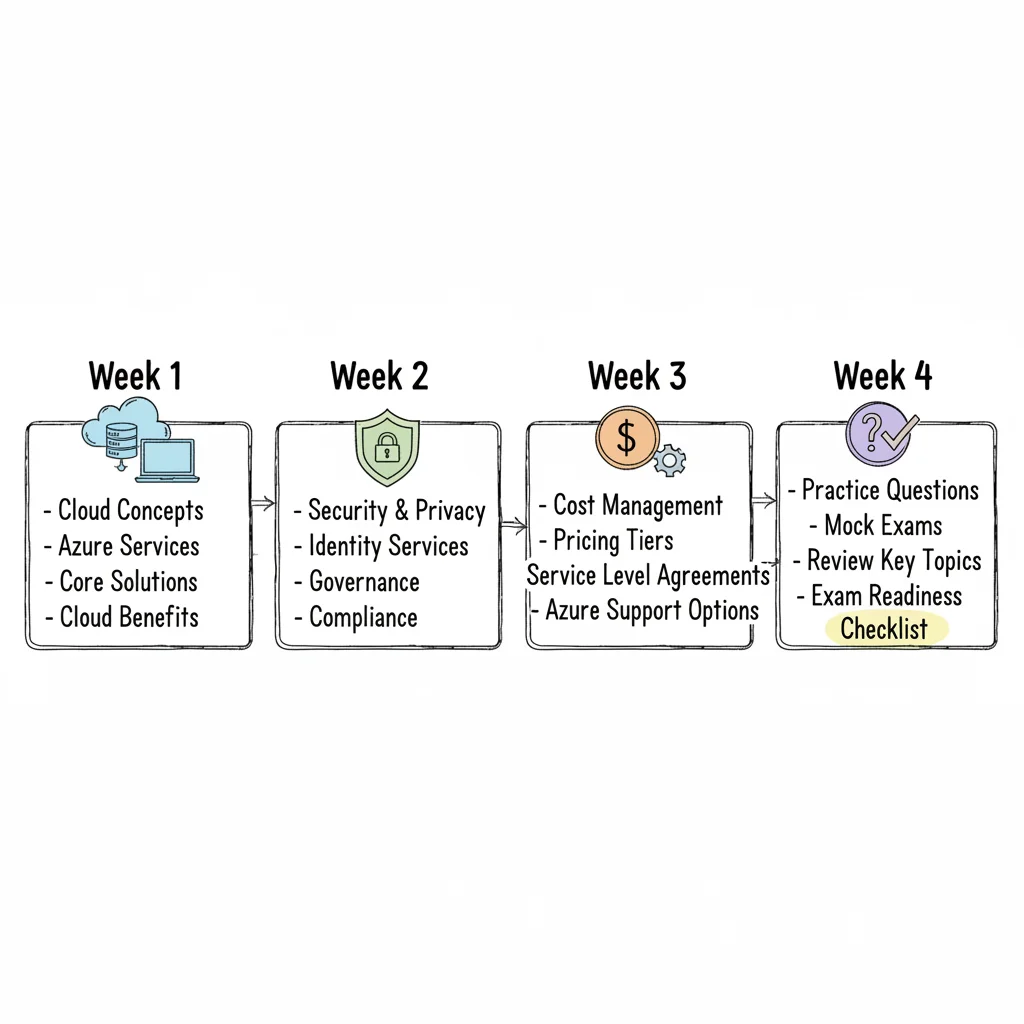 A structured four-week calendar visualizes a methodical approach to AZ-900 exam preparation, emphasizing consistent progress.
The sheer amount of information required for the AZ-900 can feel overwhelming. However, a structured study plan is far more effective than trying to memorize everything in a single weekend. This four-week schedule breaks the curriculum into manageable segments, helping you build knowledge and confidence through daily progress.
You should treat this schedule as a flexible guide. You may need to spend more time on certain topics depending on your background in IT or finance. Success comes from consistent engagement with the material rather than the total number of hours spent reading. By spreading your preparation over twenty-eight days, you can process complex architectural details without the stress associated with high-pressure cramming.
Week 1: Laying the Foundation with Cloud Concepts
The first week is about building a stable base of knowledge. Do not rush through these initial topics. Every service and management tool you learn about later depends on your understanding of these core principles. Your goal is to understand the logic of cloud computing before looking at specific technical implementations in the Microsoft environment.
The primary focus this week is the first domain of the exam, which covers cloud concepts. You must be able to describe the benefits and considerations of using cloud services. By the end of this week, you should be prepared to discuss these topics:
- Cloud Models: Explain the differences between public, private, and hybrid clouds. A public cloud involves resources shared across various organizations, while a private cloud is dedicated to a single entity. Hybrid models combine these environments, allowing for greater flexibility and data mobility.
- Service Models: Define Infrastructure as a Service (IaaS), Platform as a Service (PaaS), and Software as a Service (SaaS). Use a management-based approach to differentiate them. In IaaS, you manage the operating system and applications. In PaaS, you focus on the application code while Azure handles the underlying platform. In SaaS, you simply use the software provided by the vendor.
- Economic Principles: Describe the shift from Capital Expenditure (CapEx) to Operational Expenditure (OpEx). CapEx requires spending money on physical infrastructure upfront, while OpEx allows you to pay for services as you use them. This consumption-based model is a fundamental shift in how businesses handle their technology budgets.
You should also spend time this week learning about the shared responsibility model. This model dictates which security tasks are handled by Microsoft and which tasks remain your responsibility. In a local data center, you are responsible for everything. In the cloud, that responsibility shifts depending on the service model you choose. If you can explain these concepts to someone with no technical background, you are ready to move on.
Week 2: Diving into Azure Architecture and Services
Week two moves from general theory to the specific architecture of the Microsoft platform. This section is the largest part of the exam. You will begin to see how the theoretical concepts from the first week translate into actual products and global infrastructure.
This week focuses on the "Describe Azure Architecture and Services" domain. You need to understand how Azure is organized physically and logically. Focus on the following areas:
- Understand the Global Infrastructure: Learn about Regions, Availability Zones, and Region Pairs. Regions are geographic areas containing at least one data center. Availability Zones provide high availability by protecting your applications from data center failures. Region Pairs ensure that your data stays within the same geography for disaster recovery purposes, typically separated by hundreds of miles.
- Master Core Compute Services: Identify the differences between Virtual Machines, App Services, and Container Instances. Virtual Machines offer the most control as an IaaS offering. App Services are optimized for hosting web applications without managing servers. Containers provide a lightweight, isolated environment for running applications consistently across different platforms.
- Explore Storage and Databases: Understand the specific uses for Blob Storage, File Storage, and Disk Storage. Blobs are for unstructured data like images or logs, while File storage is used for managed file shares. You should also recognize the basic functions of Cosmos DB for non-relational data and Azure SQL Database for relational data management.
Do not try to memorize every configuration setting for these services. Instead, learn which service fits a specific business need. The exam tests your ability to choose the right tool for a given scenario. If a company needs to move a legacy server to the cloud with minimal changes, a Virtual Machine is likely the answer. If they want to build a new web app without managing the OS, App Service is the better choice.
Week 3: Mastering Management and Governance
The third week focuses on operational control. Once you know what services are available, you must learn how to manage them effectively. This domain, "Describe Azure Management and Governance," covers the tools used to monitor performance, control costs, and maintain security standards. Proper management and governance prevent unexpected bills and security gaps.
Prioritize these specific tools and concepts:
- Management Tools: Get comfortable with the Azure Portal and understand when to use the Command Line Interface (CLI) or PowerShell. While the portal is visual, the CLI and PowerShell are used for automation. You should also understand the role of Azure Resource Manager (ARM) templates in deploying resources consistently using code.
- Security and Identity: Study the basics of identity management. Azure Active Directory, which is now part of Microsoft Entra ID, is the primary service for managing user access. Learn about Role-Based Access Control (RBAC), which ensures users have only the permissions they need. Understand how Multi-Factor Authentication (MFA) adds a necessary layer of protection by requiring more than just a password.
- Governance Features: Examine how Azure Policy and Resource Locks protect your environment. Azure Policy enforces rules on your resources to ensure compliance with corporate standards. Resource Locks prevent the accidental deletion of critical infrastructure, such as production databases or virtual networks.
This week is less about hardware and more about policy. You should understand how a company stays organized by using Management Groups and Subscriptions to create a hierarchy. This structure allows for better billing visibility and administrative control across a large organization.
Week 4: Final Review and Practice
The last week is for bringing all the separate topics together. Use this time to fill in any gaps in your knowledge and get used to the exam format. Your goal is to move from understanding individual services to seeing how they function as a single system.
Follow this checklist to prepare for test day:
- Pricing and Support: Review the different support plans (Developer, Standard, Professional Direct) and what they offer. Use the Azure Pricing Calculator to estimate monthly costs and the TCO (Total Cost of Ownership) Calculator to compare cloud costs against on-premises environments. Familiarize yourself with Service Level Agreements (SLAs) and how they define uptime commitments.
- Comprehensive Review: Look back at the official exam objectives. If there is a term or service you cannot explain in two sentences, go back and read the documentation for that specific item. Focus on the "Describe" verbs in the objective list, as the AZ-900 is a foundational exam that tests recognition and description rather than deep configuration skills.
- Take Practice Tests: Testing your knowledge in a timed environment is a vital study method. Use a high-quality AZ-900 practice exam to get used to the phrasing of the questions. You can also create effective practice tests from your notes to challenge yourself on specific areas where you feel weak.
Pay attention to why a wrong answer is incorrect during your practice sessions. Understanding the "distractors" (the wrong options) is just as useful as knowing the right answer. By the end of the fourth week, you should feel ready to handle the exam questions with speed and accuracy. Review the current exam requirements on the official Microsoft site to ensure you are prepared for the latest version of the test.
Essential Resources and Smart Study Techniques
*Learn effective study strategies that can dramatically improve your retention and understanding for certification exams.*Preparing for the AZ-900 certification requires more than just logging hours in front of a textbook. You need to use study techniques that focus on efficiency and long-term memory. Reading through long chapters until you lose focus is a common mistake. It often leads to burnout rather than a clear understanding of the material. The most effective strategy is to use active learning methods that force your brain to process information deeply.
Try this method: instead of just highlighting text about Infrastructure as a Service (IaaS), explain the concept out loud. You can talk to a coworker or explain it to yourself without checking your notes. This method of pulling information from your brain is called active recall. It creates stronger memory links than passive reading. These strong links are exactly what you need to recall facts when you are under the pressure of the exam clock.
Theoretical knowledge is only half of the requirement. You must spend time working within the cloud environment to see how these services function in a real setting. It is the difference between reading a list of ingredients and actually cooking a meal from scratch. When you see how the services interact, the concepts become much easier to remember.
Use the Azure Free Tier
Microsoft provides a specific way to get this hands-on experience without charging you immediately. The Azure Free Tier is a sandbox environment for new users. It provides free access to many popular services for 12 months. It also includes a credit that you can use to test almost any Azure service during your first 30 days of membership. This allows you to explore the platform without any financial risk while you study.
Do not stop at reading about Azure Virtual Machines. Log in, create a virtual machine, and try to connect to it using a remote desktop or SSH. Instead of just memorizing what Blob Storage does, create your own storage account and upload several different files. This type of practical work changes abstract ideas into skills you can demonstrate. This experience is useful for the AZ-900 exam and helps you perform better in a professional cloud role.
Here are several specific tasks you should try with your free account:
- Deploy a simple web app using Azure App Service. This helps you see how Platform as a Service (PaaS) works in a live environment. You will notice that you do not have to manage the underlying servers or operating systems.
- Create a Virtual Network (VNet) and a subnet. This provides a clear understanding of how Azure networking is organized. You can see how resources communicate and how to keep them secure from outside traffic.
- Set up an Azure SQL Database. This task allows you to see the benefits of using a fully managed database service. Compare the ease of setting this up to the effort required to install and maintain a database on your own hardware.
- Configure Role-Based Access Control (RBAC) on a resource group. This is a great way to understand how to give specific permissions to users. It teaches the principle of least privilege by showing you how to limit access to only what is necessary.
Why this matters: Your goal is not to become a high-level architect immediately. You want to feel comfortable navigating the Azure Portal and recognize the main services. This practical exposure makes the exam questions feel less like a test of vocabulary and more like a test of real-world logic.
Curated Library of Study Materials
Using only one study guide is like trying to fix a car with only one wrench. You need a variety of tools to be successful. By combining different types of resources—like official documentation, video lessons, and practice tests—you create a thorough study plan. This variety keeps your brain engaged and helps you see the same concepts from different perspectives.
Different formats have different strengths. Microsoft Learn is the primary source for technical facts. Their modules align directly with the topics you will see on the exam. High-quality video instructors often use helpful analogies and live demonstrations to explain hard topics clearly.
Practice exams are a mandatory part of your preparation. They help you get used to the way questions are phrased. They also teach you how to manage your time so you do not run out of minutes during the actual test. Most importantly, practice tests show you exactly which topics you still need to study.
Top Resources for AZ-900 Preparation:
- Microsoft Learn: This should be your starting point. The official Azure Fundamentals learning path is free. It covers every objective listed for the AZ-900 exam. It is the most accurate resource because it comes directly from the creators of the exam.
- Video Courses: If you prefer visual learning, check out Coursera, Pluralsight, or the many tutorials available on YouTube. These courses often show live demos that make it easier to understand how different Azure services fit together.
- Practice Exams: These are essential for success. Taking a few practice tests helps you understand the exam format and improves your speed. It also highlights the gaps in your knowledge. You can find more advice in our guide on the best study methods for exams to make sure your study time is effective.
- Community Forums: Do not ignore the help available from other students. Sites like Reddit's r/Azure or the Microsoft Tech Community are full of people who have already passed the test. You can find study partners there, ask questions about difficult topics, and read about what the current exam experience is like.
By using these resources and focusing on active study habits, you will build a system that helps you pass with confidence.
The Home Stretch: Exam Day and What Comes Next
You have put in the hours and finished the prep work. Now the AZ-900 exam is close. This final stage is not about trying to cram new facts into your head. Instead, focus on logistical and mental readiness. You do not want a small, avoidable mistake to ruin your focus on the actual day of the test.
A basic pre-exam checklist helps quite a bit. Confirm your scheduled time and double-check your location or your virtual testing requirements. Make sure your government-issued identification is valid, unexpired, and matches the name on your registration exactly. If you take the test from your home, verify that your space is quiet and organized. Ensuring your desk is clear and your internet connection is stable will prevent technical or proctor-related interruptions. Removing these distractions ahead of time reduces stress and helps you stay calm while you work through the questions.
When the timer starts, pay close attention to your pace. You have 60 minutes to answer between 40 and 60 questions. This means you must move steadily, spending about one minute on each item. If a question is confusing or you are unsure of the answer, do not stay stuck on it for too long. Mark it for review and move to the next one. Getting the easy answers finished first helps you build a rhythm. It also ensures you have enough time to look at the harder problems before the clock runs out.
Passing is Just the Beginning
Seeing the word "Pass" on your screen is a great achievement. It provides proof that you understand the basics of cloud computing. However, keep in mind that the AZ-900 is not the end of your education. It is a starting point. This credential verifies your basic knowledge and helps you move toward specific roles or more technical Azure certifications.
Your work with Azure is just starting. This certification acts as a base for pursuing advanced credentials that fit your specific professional goals. It serves as a necessary step for building more complex skills later on.
The AZ-900 certification provides the base for your technical skills. It is essential for future growth. The real value comes from deciding which advanced skills you want to build on top of this basic knowledge.
Validating your cloud knowledge gives you the chance to plan your next move with clarity. You might decide to become an administrator who manages infrastructure or a developer who builds applications that run in the cloud. Each path requires different skills, but they all start with the same basic concepts you have just proven you know. Having this foundation allows you to decide which direction your career should take based on what you enjoy most.
Charting Your Course in Azure
The AZ-900 leads naturally into specialized tracks within the Microsoft environment. Each path uses the cloud concepts you just studied and adds more technical detail to turn that knowledge into practical, job-ready skills.
Here are some common next steps for professionals:
- For the Hands-On Administrator: The AZ-104 Azure Administrator Associate is a standard next step for many. This certification requires you to manage real Azure environments. You will learn how to implement, monitor, and maintain resources like virtual machines, storage, and virtual networks.
- For the Code-Driven Developer: If you prefer writing software, look at the AZ-204 Developing Solutions for Microsoft Azure. This track focuses on the design and maintenance of cloud-native services. You will learn to work with Azure Functions, Cosmos DB, and containerized solutions.
- For the Data-Obsessed Professional: If you want to work with data, the DP-900 Azure Data Fundamentals is a useful addition. It applies your cloud basics to specific data services. You will learn about relational and non-relational databases, analytics, and big data within the Azure platform.
Deciding on your next certification is an important step. To see more options, look at the various Azure learning paths and certifications available. Seeing the different possibilities helps you choose a credential that matches what you want to do in your career.
Got Questions About the AZ-900? We've Got Answers.
Even with a well-built study plan, a few common questions usually arise during your preparation. We have gathered the most frequent queries from students to help you prepare. Addressing these details now will allow you to approach your AZ-900 exam feeling ready and clear.
How Many Questions Are on the AZ-900 Exam?
Expect to see between 40 and 60 questions on the exam. The test does not rely on a single format. While you will see standard multiple-choice questions, Microsoft also uses other ways to test your knowledge. You might find drag-and-drop items where you move terms into the correct category. Other questions use matching exercises or small case studies that ask you to solve a problem for a fictional company.
You have exactly 60 minutes to finish the entire exam. This time limit makes your pacing vital. Being able to recall information quickly is just as necessary as knowing the technical details. If you spend too long on one difficult item, you may lose the chance to answer easier ones later. Most successful students track their progress to ensure they spend about one minute per question.
What’s the Passing Score for the AZ-900?
To pass the AZ-900, you need a score of 700 out of 1000 points. Note that this is not a straight percentage. You do not simply need to answer 70% of the questions correctly. Microsoft uses a scaled scoring system to calculate your final result. This system is slightly complex because it considers the difficulty of each question. A very hard question might be worth more than a very basic one.
Do not worry about the exact math of the scoring. Instead, focus on learning the core concepts in each exam domain. If you understand the cloud models and security basics, your score will reflect that effort. Focus your energy on the areas where you feel the least confident during your practice tests.
Do I Need Any Prior Experience to Take This Exam?
No. This is one of the best features of the AZ-900 certification. It is a true entry-level credential with no official prerequisites. You do not need an IT degree or years of technical work to start. You also do not need previous hands-on Azure experience to register for the test.
While a basic understanding of computer hardware and software is helpful, the exam is built for everyone. It serves as a starting point for people who are new to cloud technology. It does not matter if you are coming from a non-technical field; the material covers the basics from the ground up.
The AZ-900 is accessible. It is built for everyone—technical professionals who want to move into cloud roles and business managers who need to speak the language of Azure with their teams.
Does the AZ-900 Certification Expire?
The AZ-900 certification does not expire. Once you pass the test, the credential is yours for the rest of your career. It serves as a permanent record of your understanding of cloud basics.
This policy is different from many other Microsoft exams. More advanced certifications, like the Associate or Expert levels, usually require you to renew them every year. Those renewals keep your skills current as technology changes. However, because the AZ-900 covers fundamentals, your certification remains valid forever without any extra fees or renewal tests.
What Happens If I Fail the Exam?
Failing happens, and it is not the end of your career path. Test-taking is stressful, and you might simply have a bad day. Microsoft provides a clear retake policy to help you try again:
- First Retake: If you do not pass on your first attempt, you must wait 24 hours before you can take the test again.
- Subsequent Retakes: If you need more than two tries, you must wait 14 days between each additional attempt.
Use this time to review your score report. The report shows which cloud concepts you struggled with. Study those specific areas before you schedule your next session. You must pay the exam fee for each new attempt (verify current pricing on the vendor site).
Ready to move from studying to mastering Azure cloud concepts? The MindMesh Academy platform helps you pass the AZ-900 certification with confidence. Our study tools and practice exams map directly to the official exam objectives. We ensure you are ready for every part of the test. Explore our AZ-900 resources today.
Ready to Get Certified?
Prepare at MindMesh Academy with expert-curated study guides, practice exams, and spaced repetition flashcards to pass with confidence:

Written by
Alvin Varughese
Founder, MindMesh Academy
Alvin Varughese is the founder of MindMesh Academy and holds 20 professional certifications including Microsoft Agentic AI Business Solutions Architect, AWS Solutions Architect Professional, and Azure DevOps Engineer Expert. He's held senior engineering and architecture roles at Humana (Fortune 50) and GE Appliances. He built MindMesh Academy to share the study methods and first-principles approach that helped him pass each exam.