
Google Cloud Certification Path: Your Roadmap to a Cloud Career
Building a career in cloud computing requires a clear strategy. Rather than following a generic plan, your Google Cloud certification path depends on specific goals and your current technical background. If you want a hands-on role, start with the Associate Cloud Engineer (ACE) certification. This technical credential prepares you for advanced, professional-level roles like the Professional Cloud Architect or Professional Data Engineer. Following these tracks ensures you develop skills in a structured way. MindMesh Academy provides the resources to support this strategic approach to your professional development and technical growth, helping you meet the practical demands of current cloud systems.
Why a Google Cloud Certification Path Matters Now
Starting with cloud computing without a clear strategy often leads to confusion and stalled progress. A defined Google Cloud certification path provides a necessary guide for your career development. It breaks down an ambitious professional goal into a series of reachable milestones that you can track over time. In a competitive market, these credentials have moved beyond simple resume additions. They represent a direct, high-impact investment in your technical expertise and your long-term career health.
Market demand for people proficient in Google Cloud Platform (GCP) is growing at a rapid pace. This need is strongest in fields like Artificial Intelligence (AI) and data analytics, where Google offers unique, industry-leading capabilities. Organizations look for certified professionals who can deploy, manage, and fix these cloud services. These skills turn certified individuals into valuable assets. By following a path, you ensure your skills match what companies are actually hiring for right now.
Reflection Prompt: Consider your current career goals. How might a structured certification path help you bridge the gap between your present skills and your desired future role?
Charting Your Expedition
View your certification progress as a planned series of technical gains. Each certificate you earn establishes a new level of skill and competence. These credentials provide the validated ability and confidence required to move toward more difficult technical tasks. This structured method ensures you have a strong base of knowledge and practical skills before you move to complex architectural designs or large-scale deployments. You won't find yourself struggling with advanced concepts because you skipped the fundamentals.
A defined path does more than teach technical skills; it builds professional momentum. Every certification you earn validates your expertise and signals to hiring managers that you are committed to mastering the Google Cloud Platform. This commitment is a key part of learning how to future-proof your career.
The Tangible Rewards of a Clear Path
Following a logical Google Cloud certification path produces specific, measurable career benefits. This process is about professional growth and higher earning potential. Industry data shows that IT professionals with Google Cloud certifications often see significant salary increases and faster promotions. Certifications provide clear, third-party proof of your hands-on abilities. They function like a PMP for project managers or an AWS Solutions Architect certificate for designers, giving employers confidence in your talent.
A planned sequence of exams also prevents wasted time. It focuses your study hours on the most important topics, which stops you from missing critical information. Instead of learning random services in isolation, you concentrate on the skills needed for your specific job role and the exam requirements. This direct approach prepares you for actual cloud problems you will face in production environments. You will be ready to work as a capable and confident cloud professional from the first day on the job.
Understanding the Google Cloud Certification Levels
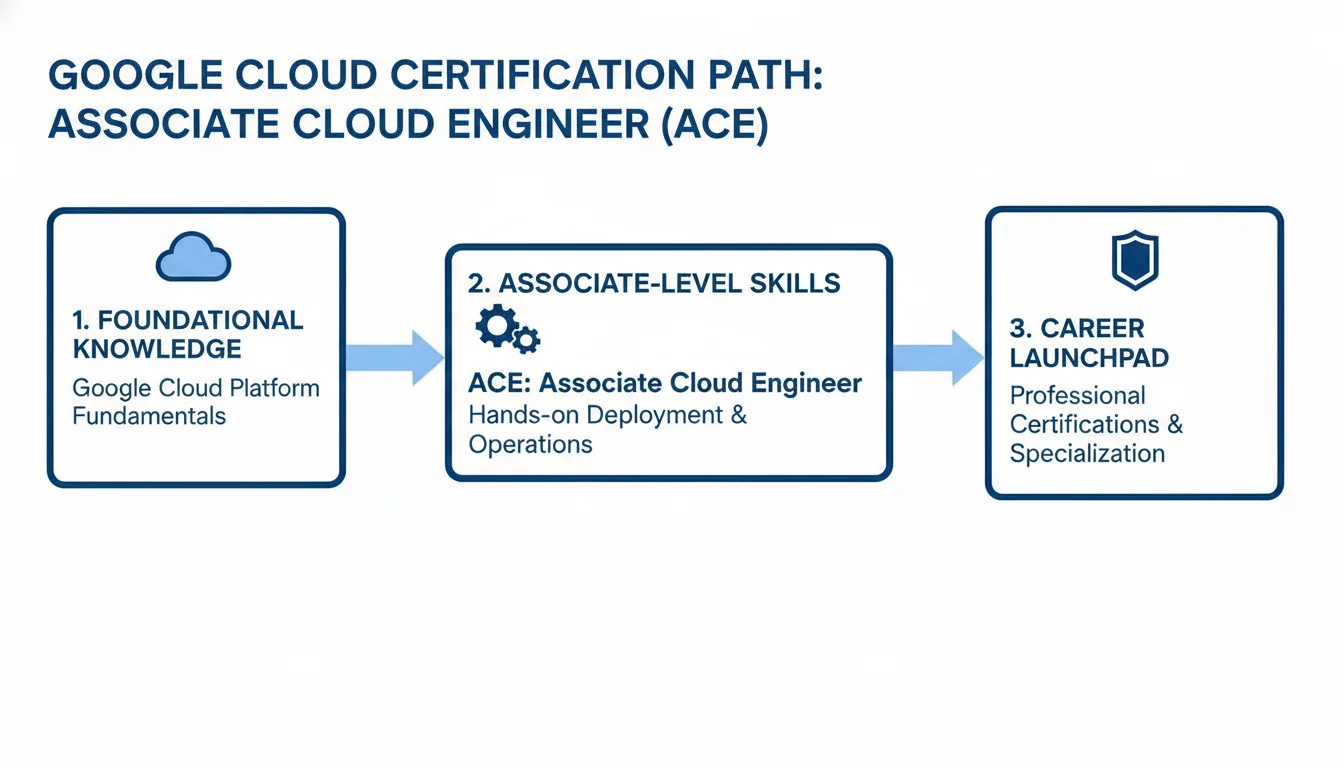
Google Cloud organizes its certification programs into three distinct tiers. This structure provides a visible path for your professional growth. You can view this progression as a construction project. You do not start with the roof. Instead, you build a strong base, then put up the frame, and finally finish the building with specialized features. Google’s levels follow this same logical order. Each stage builds on the one before it to ensure you gain a strong command of the platform. This tiered architecture helps prevent gaps in your knowledge. It focuses on preparing you for actual work on the job and high-level problem-solving rather than just helping you pass a test.
The Ground Floor: Foundational Level
Your work begins at the Foundational level with the Cloud Digital Leader certification. This credential is the first stage of your technical expertise. Google designed this exam for broad accessibility. People without a heavy technical background can take this exam and succeed. It works well for professionals in sales, management, or legal roles who need to understand how the cloud functions. Much like the ITIL 4 Foundation validates your knowledge of IT service management, the Cloud Digital Leader focuses on the "what" and the "why" of Google Cloud.
This certification does not require you to write code or set up complicated network hardware. Instead, the curriculum focuses on the business value of the platform. You will learn how Google Cloud helps a company reach its goals and how it changes business operations. This is the right starting point for anyone who needs to discuss cloud concepts in executive meetings. It covers how a company can use technology to move faster and save money.
The Foundational tier is a strategic entry point for your career. It shows that you can explain cloud capabilities in terms of business goals. This skill is useful for leaders in every department. You will learn how to describe the benefits of different cloud models and how they compare to traditional data centers.
Cloud skills are becoming more important every year as the industry grows. The global cloud computing market was valued at USD 676.29 billion in 2024. Market experts expect this number to reach USD 2,291.59 billion by 2032. Because of this massive growth, companies want workers who can prove they understand the technology. The Cloud Digital Leader certification proves you have a base of knowledge in storage, machine learning, and data analytics on the Google Cloud Platform (GCP). It validates that you understand how these tools help a business analyze data and store information safely.
The Structural Frame: Associate Level
After you have a solid base, you move to the Associate level. This is like putting up the frame of a house. The Associate Cloud Engineer (ACE) is the primary certification at this level. This tier is for people who do the actual daily work. You will need hands-on skills to deploy applications and manage infrastructure on Google Cloud. This level is where you move from reading about the cloud to actually using the tools.
The ACE exam tests your ability to set up a cloud environment and keep it running. You must show that you can manage core resources like virtual machines and storage buckets. Many people starting as cloud engineers or system administrators take this exam to prove they can handle the workload. It is comparable to the AWS Certified Solutions Architect - Associate (SAA-C03) or the Azure Administrator Associate (AZ-104). The focus here is on the tasks you do every day to keep a cloud system healthy. You will learn how to monitor your applications to make sure they are running correctly and how to fix problems when they occur.
Reflection Prompt: If you are already working in a technical role, how might earning your ACE validate your existing skills and open doors to more cloud-specific responsibilities?
This certification also teaches you how to manage identity and access. You will learn how to give people the right permissions so they can do their jobs without putting the company's data at risk. This practical knowledge is essential for anyone who wants to work in a modern IT department. Employers look for the ACE because it shows you can jump into a project and start contributing immediately.
The Specialized Blueprint: Professional Level
The Professional level is the highest stage. These certifications show you are an expert in a specific job role. They prove you can design and manage large systems from the ground up. These advanced certifications show you can handle the entire lifecycle of a cloud project. You will move from simple management to high-level architecture and security.
This tier includes several specialized tracks that are in high demand:
- Professional Cloud Architect: This role involves making sure a cloud system is stable and can handle lots of traffic. You must design systems that are secure and always available. This job requires a lot of planning and strategy. It is similar to what a person with a PMP certification does for a large project, but with a focus on cloud technology.
- Professional Data Engineer: These experts build systems that collect and process data. They also work with machine learning and automated data pipelines. This role is for people who want to help companies turn raw data into useful information.
- Professional Cloud Security Engineer: These specialists focus on keeping data safe and meeting legal requirements. They set up security rules and protect the cloud environment from attacks. This work is similar to what you might find in a CompTIA Security+ certification but applied to deep cloud systems.
These certifications are very valuable to employers. They show that you can lead projects and solve hard business problems using the platform. Getting a professional certification can help you get a better job or a higher salary. It is a key step if you want to earn one of the top-paying IT certifications in 2025. This level signifies that you have the skills to innovate and lead. You will be able to take a business problem and build a technical solution that solves it efficiently.
Google Cloud Certification Levels at a Glance
The following table provides a quick look at how these levels differ. This summary helps you choose the right path for your goals. Use this information to decide where you should start based on your current job and where you want to go next.
| Certification Level | Focus Area | Ideal Candidate | Exam Cost (USD) |
|---|---|---|---|
| Foundational | Core cloud concepts and business value | Business professionals, managers, non-technical staff | $99 (verify current pricing on the vendor site) |
| Associate | Hands-on deployment and management | Aspiring cloud engineers, developers, administrators | $125 (verify current pricing on the vendor site) |
| Professional | Advanced design and implementation skills | Experienced architects, data engineers, security experts | $200 (verify current pricing on the vendor site) |
You can use this table as a quick reference guide. It helps you see the different requirements and costs for each level. By choosing the right starting point, you can build your skills in a logical way that fits your career path. Whether you are starting in a business role or already working in IT, there is a level that fits your current experience. As you progress through these stages, you will gain the confidence and the credentials needed to succeed in the growing cloud industry.
The Essential Starting Point: The Cloud Digital Leader
Every significant professional path requires a clear starting point. For those looking at a career with Google Cloud, that first step is the Cloud Digital Leader certification. This credential acts as an official gateway into cloud computing by providing a high-level view centered on business outcomes.
This certification is accessible to everyone. Google did not build it only for technical specialists. It also works for people in sales, marketing, product management, or leadership roles. These professionals often need to discuss cloud strategy with technical staff or senior executives. You do not need to be a software developer or network engineer to understand the business value of these technologies. That understanding is exactly what the exam tests. Just as CompTIA Cloud Essentials+ provides a vendor-neutral understanding of cloud fundamentals, this certification offers a business perspective focused on Google Cloud.
The Cloud Digital Leader focuses on the why behind Google Cloud rather than the technical how-to steps. It provides the vocabulary needed for discussions about digital transformation, adoption, and strategic initiatives. It remains one of the most practical entry-level IT certifications for anyone entering the field today.
Who Should Start Here
This certification works well for anyone who must view cloud computing through a business lens. It is a strong fit for several specific professional roles:
- Project Managers who direct cloud migrations or development. They need to speak effectively with technical teams and business stakeholders to keep projects on schedule.
- Sales and Marketing Professionals who explain the benefits of cloud solutions to prospective clients. They must describe the business value of the cloud without getting lost in technical jargon.
- Business Leaders and Analysts who decide on technology investments and organizational changes. Understanding the cloud helps them choose the right investments for sustainable growth.
- Aspiring Cloud Practitioners with non-technical backgrounds who want a structured way to build confidence in the cloud space.
Earning this credential proves you can connect Google Cloud products to actual business challenges. It bridges the gap between technical departments and business leadership. When both sides speak the same language, projects move faster and stay aligned with company goals.
The Cloud Digital Leader is more than a list of products. Its value comes from knowing how to use cloud technology to drive business growth and modernize operations.
Reflection Prompt: How often do communication issues happen between your technical and business teams? Consider how a shared understanding of cloud concepts could improve those interactions.
A Practical Study Plan for the Cloud Digital Leader
Advanced certifications often require months of intense work, but this exam is different. Most people can finish their preparation in two to four weeks of focused study without feeling overwhelmed.
Follow this four-week schedule to organize your preparation:
- Week 1: Cloud Fundamentals & Business Value: Start with general cloud concepts and what digital transformation means for a modern company. Study the basic benefits of moving to the cloud, including cost savings, scalability, and better agility.
- Week 2: Core Google Cloud Services (Overview): Start learning about specific Google Cloud tools. You should know that Compute Engine provides virtual servers and Cloud Storage holds data. BigQuery is used for large-scale data analysis. Avoid getting stuck in technical configuration details right now; just learn what they do for a business.
- Week 3: Innovation & Strategic Use Cases: See how Google Cloud helps companies innovate. Look at tools for data analytics and artificial intelligence. Find examples of how companies use these tools to create new products or improve their customer service.
- Week 4: Security, Compliance, Cost & Exam Prep: Finish by looking at security and costs. Learn how Google keeps data safe and how companies can control their cloud spending. Use the rest of the week to take practice tests. This helps you get comfortable with the exam style and helps you pass with confidence.
This targeted plan makes the Cloud Digital Leader an achievable goal. It prepares you for more technical certifications later and helps you find new opportunities in the cloud market.
Key Takeaway: The Cloud Digital Leader exam focuses on concepts and business value. Focus on what the services do and why they matter to a company, not the technical setup.
Building Your Core Skills With The Associate Cloud Engineer
While the Foundational certification explains the business logic and strategic value of Google Cloud, the Associate Cloud Engineer (ACE) is the stage where you move from conceptual understanding to practical, hands-on application. This credential marks the functional start for technical cloud roles. It shifts the focus from theoretical knowledge to operational proficiency.
The ACE is designed for practitioners who deploy applications, monitor infrastructure, and manage cloud solutions at scale. Passing this exam demonstrates your ability to do more than just talk about the cloud. It validates your skills in configuring, launching, and maintaining Google Cloud environments. You will show that you can troubleshoot issues and keep cloud resources running effectively.
From Concepts to Command Line
The Cloud Digital Leader teaches you the rules of the road and how to read traffic signs. The Associate Cloud Engineer puts you in the driver’s seat. You learn how to operate the vehicle, manage different road conditions, and reach your destination safely. This change in focus emphasizes deployment and everyday management.
The ACE is a common entry point for technical professionals. It provides a base of skills that apply to many different roles, such as:
- Cloud Engineers: These professionals manage and maintain core infrastructure components. They are responsible for the daily health and availability of the cloud environment.
- Developers: These workers deploy and configure their applications. They need to know how to troubleshoot their code within a cloud-native setup.
- System Administrators: These experts move their on-premises server management skills to the cloud. They apply their knowledge of networking and security to modern platforms.
The ACE exam is not an exercise in memorization. It is a practical assessment of your ability to set up a functional cloud environment. You must prove you can ensure correct operations and implement access controls. It validates the "muscle memory" needed for routine administration tasks. For example, you might need to deploy a containerized application to Compute Engine or configure a basic VPC network. You could also be asked to manage IAM roles for a project team. These scenarios test how you apply knowledge in real-world situations.
Reflection Prompt: How comfortable are you with command-line tools and cloud consoles? What steps can you take to gain more hands-on experience before you start your formal study for the ACE?
Experience and Preparation
Google Cloud does not have strict prerequisites for the ACE exam. However, the company suggests that candidates have at least six months of hands-on experience with the platform. You should take this suggestion seriously. The exam asks you to solve practical problems rather than just repeat facts. You cannot gain this skill by only reading documentation.
Genuine proficiency comes from spending time in the GCP console. You also need to execute commands using the gcloud command-line interface. Tools like Qwiklabs provide sandboxes where you can practice without risking a live environment. This practice is what makes ACE-certified professionals valuable to employers. It proves they can manage projects and provision resources like virtual machines or container clusters. Companies want to hire people who have these demonstrable skills.
Your 3-Month ACE Study Blueprint
Passing the ACE exam requires a structured plan to avoid feeling overwhelmed. A three-month timeline is usually best. This gives you enough time to learn the concepts and get the necessary hands-on practice.
Here is a milestone-based approach for your study:
Month 1: Foundational Services and IAM
- Weeks 1-2: Core Infrastructure & Compute Engine. Spend this time learning the basic building blocks of Google Cloud. Your focus should be on setting up projects and managing billing. You must become comfortable with Compute Engine. Practice creating and managing various virtual machine instances. Learn how to use
gcloud compute instances createto automate these tasks. Understanding machine types and persistent disks is essential during these first two weeks. - Weeks 3-4: Identity and Access Management (IAM). This topic is a large part of the ACE exam. You must practice assigning roles to users and service accounts. Use commands like
gcloud projects add-iam-policy-bindingto test your skills. It is important to know the difference between primitive, predefined, and custom roles. You should always follow the principle of least privilege when setting up permissions for a project.
Month 2: Storage, Databases, and Containers
- Weeks 5-6: Storage Solutions. Study the different storage options Google Cloud provides. You need to know when to use each service based on the specific needs of a project. Get hands-on experience with Cloud Storage for object data. Learn how to use
gsutilto move files and manage buckets. You should also understand how to use Persistent Disks for virtual machines and when to choose file storage options like Cloud Filestore. - Weeks 7-8: Containerization with GKE. Managing containers is a vital skill for modern cloud engineers. Your study here should focus on Google Kubernetes Engine (GKE). Learn how to create a cluster and deploy an application using
kubectl. You need to understand the basics of GKE networking and how to scale your clusters. Practice deploying a simple web server to see how the system handles traffic and resource management.
Month 3: Networking, Monitoring, and Exam Prep
- Weeks 9-10: Cloud Networking. You must be proficient in networking concepts to pass the ACE. Spend time configuring Virtual Private Clouds (VPCs) and subnets. Learn how to create firewall rules using
gcloud compute firewall-rules createto secure your resources. You also need to understand how Cloud DNS works to manage domain names within your network. Practice connecting different resources to ensure they can communicate securely. - Weeks 11-12: Cloud Operations & Exam Simulation. Focus on monitoring and logging with the Cloud Operations suite. This was formerly known as Stackdriver. Practice setting up alerts so you know when a service fails. Learn how to use Cloud Logging to find errors and Cloud Monitoring to build performance dashboards. Spend the final week taking official practice exams. These tests help you find the topics you still need to study. They also get you used to the style of the actual exam questions.
If you follow this plan, you will do more than just memorize facts. You will build the practical skills needed for a successful career in the cloud. Consistent practice ensures you are ready for the challenges of the exam and the demands of the job.
Key Takeaway: Regular practice with the GCP console and the
gcloudCLI is the best way to prepare for the ACE. For every new topic you read about, you should perform a practical task in a free-tier environment.
Charting Your Course: From Associate to Professional
After you have established your core cloud engineering skills by earning the ACE, you can move into the specialization phase. This stage is where your specific career goals determine your Google Cloud certification track. The period of following a general path ends here. You now have the ability to select a direction that leads directly to a high-demand technical role.
The Associate Cloud Engineer (ACE) certification functions like a central airport hub. Once you secure that credential, you gain clearance for a direct flight to a specialized destination. Those who want to design large systems, manage data, or defend digital assets will find a Professional-level certification to guide them. These credentials confirm the specific skill sets that companies are looking for in the current market. Each professional track requires a different set of technical abilities and focuses on a different part of the cloud environment.
Reflection Prompt: Based on your interests and career vision, which of the professional specializations (Architect, Data, DevOps, Security, Network) resonates most strongly with you, and why?
The Cloud Architect Path: Designing Resilient Systems
The path toward becoming a Professional Cloud Architect is a popular choice for those seeking high-level roles. This role involves planning the Google Cloud environment. You design, build, and manage solutions that are secure and can grow as the business grows. It requires a deep understanding of how different services work together to solve complex business problems. This role is similar to a Solutions Architect in AWS, where a professional might progress from the Associate level to the Professional level. It also compares to the Azure Solutions Architect Expert (AZ-305).
The Cloud Architect track builds on the foundation you built during the ACE:
- Foundation with ACE: You will start by solidifying your skills in deploying resources and managing cloud operations.
- Ascension to Professional Cloud Architect: This becomes your main goal. The exam tests your ability to design systems that prioritize security and compliance. You must demonstrate that you can analyze technical processes and optimize them for better performance. The exam also requires you to ensure that the solutions you build are resilient and can handle unexpected failures without going offline.
This progression from an operational base to an advanced architectural role is a standard way to reach senior technical positions. Architects do more than just click buttons in a console; they create the blueprints that whole engineering teams follow. They must balance the cost of services with the performance needs of the application. This requires a broad knowledge of compute, storage, and networking products across the entire Google Cloud platform.
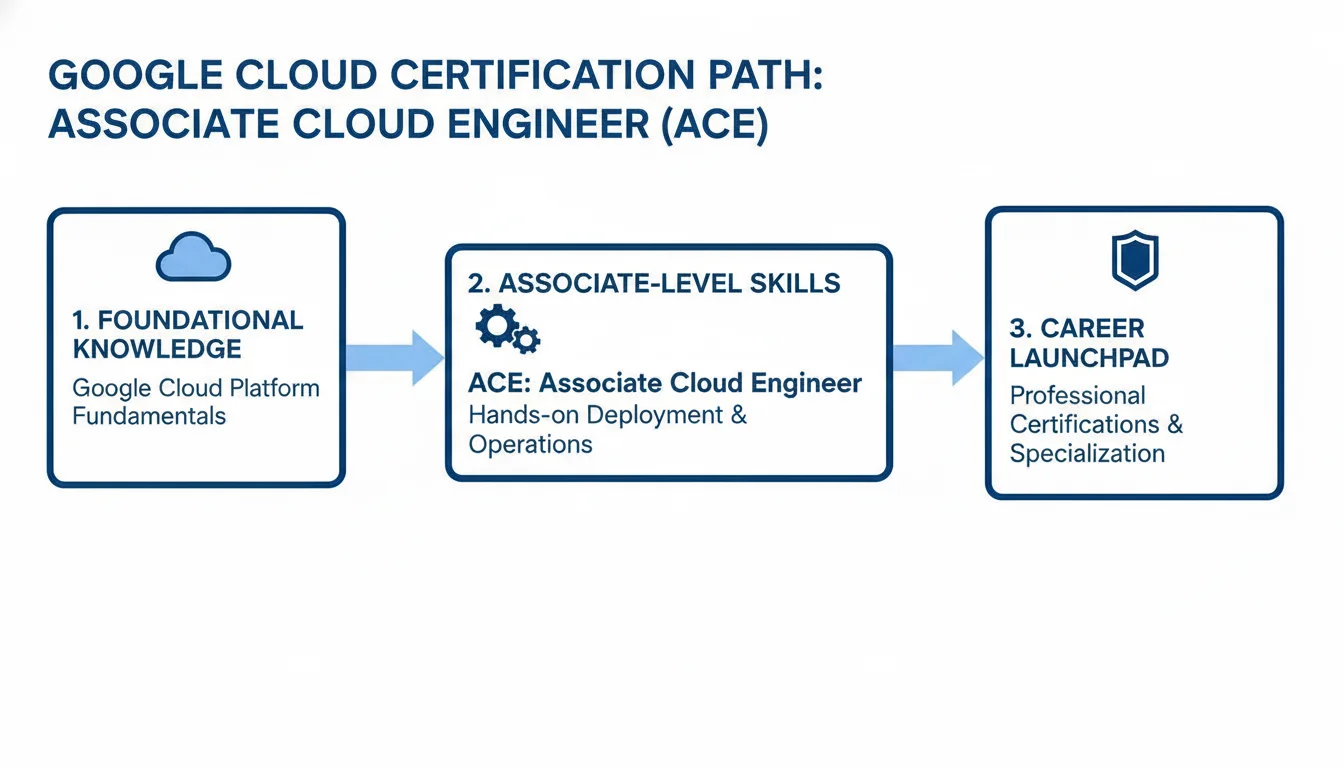 Caption: The ACE certification acts as a crucial stepping stone, validating core hands-on skills before advancing to specialized professional roles within Google Cloud.
The diagram shows how the process works. You begin with general knowledge, move to the hands-on operational skills of the ACE, and then use that experience to launch into a professional specialization. This structure ensures that every professional has a strong understanding of how the cloud works before they start designing complex systems.
The Data Engineer Path: Building Intelligent Pipelines
For professionals who enjoy working with data, the Professional Data Engineer path offers a strong career track. Data engineers build the systems that collect, transform, and analyze data at a large scale. They create the pipelines that send data to business intelligence dashboards, machine learning models, and real-time analytics tools. Without these engineers, companies would have massive amounts of data but no way to use it to make decisions.
This specialization requires you to have a practical command of several key Google Cloud services. You will work with BigQuery to manage analytical data warehousing. You will use Dataflow to handle both stream and batch data processing. You will also use Pub/Sub to manage real-time messaging between different parts of your system.
- Core Focus: Your primary goal in this track is to earn the Professional Data Engineer certification.
- Key Skills: You must show that you can design data processing systems that are reliable and can scale up as data volume increases. You will also need to show how to move machine learning models from the training phase into a live production environment. This includes monitoring those models to ensure they stay accurate. Finally, you must ensure that all data is handled securely and follows governance rules.
This role is essential for any company that wants to use data to stay competitive. It is a stable career choice because the amount of data that companies need to process is only growing.
The DevOps Engineer Path: Automating and Optimizing
The Professional Cloud DevOps Engineer path is for those who like to use automation to make software development more efficient. DevOps professionals work to bridge the gap between the people who write code and the people who manage the servers. They focus on building Continuous Integration and Continuous Delivery (CI/CD) pipelines. They also use infrastructure as code (IaC) to set up environments using scripts instead of manual configuration. This helps ensure that software is delivered quickly and without errors.
This role is about a specific mindset focused on collaboration and continuous improvement. The Professional Cloud DevOps Engineer certification proves that you can apply Site Reliability Engineering (SRE) principles. Google created the SRE methodology to improve how services perform and how stable they stay under pressure. This is similar to how an Agile certification proves a structured way to run a project, but it is applied to the entire life of the software.
The impact of this specialization is clear. Google's data shows that 85% of Google Cloud learners say their certifications gave them the skills to get in-demand roles. These credentials are more than just items for a resume. They act as a way to speed up your career and get recognition for your technical skills. A DevOps engineer helps a company move faster while making fewer mistakes, which is a high-priority goal for most modern businesses.
The Security and Network Engineer Paths: Securing the Cloud
In cloud computing, security and networking work together. You cannot have a secure environment without a well-configured network, and you cannot have a reliable network without security controls. Google offers two different professional certifications to cover these areas.
- Professional Cloud Security Engineer: This path is for people who design and maintain secure systems on Google Cloud. You need to know a lot about identity and access management (IAM). This involves setting up rules so that only the right people can access certain data. You also need to configure network defenses like firewall policies and VPC Service Controls. These tools create a perimeter around your resources to keep attackers out. This certification is the cloud version of a high-level cybersecurity credential like the CISSP or CySA+.
- Professional Cloud Network Engineer: This certification focuses on designing and managing the network architecture. You will learn how to configure Virtual Private Clouds (VPCs) and connect them to on-premises offices. This might involve using Cloud VPN for connections over the public internet or Cloud Interconnect for a private, dedicated line. You will also work with load balancing to distribute traffic and Cloud DNS to manage domain names. This is the right choice for someone who might otherwise look for a CCNA or CCNP in a traditional IT setting.
Your choice between these two should depend on what you enjoy doing. Do you want to focus on security policies and stopping threats? Or do you want to build the physical-to-virtual connections that make the network run fast? Both paths lead to important roles that pay well and offer long-term stability in the industry.
Role-Based Google Cloud Certification Paths and Salaries
The table below shows the different roles you can pursue after getting certified. It includes the recommended certification, the skills you will need to prove, and the average salary you might expect in North America. These salary figures can vary based on your location and total years of experience, so you should verify current local data during your job search.
| Career Role | Recommended Professional Certification | Core Skills Validated | Average North American Salary |
|---|---|---|---|
| Cloud Architect | Professional Cloud Architect | Designing for scalability, security, and reliability; optimizing technical and business processes. | $175,000 – $210,000 |
| Data Engineer | Professional Data Engineer | Building data pipelines; operationalizing ML models; ensuring data quality and security. | $160,000 – $195,000 |
| DevOps Engineer | Professional Cloud DevOps Engineer | Implementing CI/CD pipelines; applying SRE principles; managing service incidents. | $155,000 – $190,000 |
| Security Engineer | Professional Cloud Security Engineer | Configuring access controls; defining security policies; managing incident response. | $165,000 – $205,000 |
| Network Engineer | Professional Cloud Network Engineer | Designing VPC networks; implementing hybrid connectivity; configuring network services. | $150,000 – $185,000 |
This comparison shows that every specialized path leads to a role that is highly valued. By looking at your own strengths and your long-term goals, you can pick the certification that will help you access these opportunities. Each track provides a different way to contribute to a technical team while building a sustainable career.
Reflection Prompt: Review the core skills listed for each professional role. Which set of skills aligns best with your existing strengths and desired areas of growth?
Creating Your Strategic Study and Exam Plan
Choosing a Google Cloud certification path is a vital first step, but passing the exam requires a deliberate, functional strategy. A solid study plan acts as the deciding factor between someone who wants a certification and someone who earns one. This structure helps you avoid exhaustion, improves how much you remember, and ensures you feel ready when you enter the testing center. This process is not about shallow, last-minute memorization. Instead, you build a set of skills that will help you solve problems at work long after you get your results.
The most effective way to prepare for any Google Cloud certification is through consistent hands-on practice. Reading about cloud architecture is a good start, but it only gives you a partial view of how these systems work. You need to spend time using the Google Cloud console, writing and running gcloud commands in your terminal, and learning how to fix systems when they stop working. This is why the GCP Free Tier is such a useful tool for your training. It allows you to build and test without immediate financial pressure.
Building Your Personal Lab Environment
Google provides a Free Tier that includes a variety of services you can use for free every month, as long as you stay within the usage caps. This acts as a safe space where you can test the practical skills required for your Google Cloud certification path. You need this experience because many exam questions use scenarios that require you to solve real problems. You cannot rely on theory alone when the exam asks you how to fix a connectivity issue or a resource conflict.
Setting up your own lab is simple and provides a direct way to learn:
- Sign Up for a Free Trial/Credits: If you have never used GCP before, the free trial often includes a set amount of credit. These credits allow you to test larger services or more complex configurations that might go over the standard free limits. Use this time to experiment with data warehouses or complex networking setups.
- Concentrate on Core Services: Direct your lab time toward the specific objectives listed in the exam guide. If you are going for the Associate Cloud Engineer, practice deploying virtual machine instances with Compute Engine. Work on setting up managed clusters in Google Kubernetes Engine (GKE) and creating Virtual Private Clouds (VPCs) with specific subnets.
- Intentionally Introduce Failures (and Fix Them): Do not just follow tutorials step-by-step. Try to break your setup. Change a firewall rule so traffic cannot get through, or set an IAM permission that is too restrictive. The time you spend figuring out why a service failed and then fixing it will teach you more than a perfect deployment ever will. This builds the problem-solving skills you need during the exam.
This type of active practice builds the technical intuition that Google Cloud exams are meant to measure. It prepares you for the reality of the job, where things rarely go exactly according to the documentation.
Reflection Prompt: What is one specific GCP service you find challenging? How could you use the Free Tier this week to experiment with it and deepen your understanding?
Using Official Resources and Practice Exams
While labs are necessary for building skill, you should also connect that practice to official documentation and structured study materials. Google provides high-quality resources, such as official guides and free training modules through Google Cloud Skills Boost. These materials should be the foundation of your entire study plan.
Your study plan should work like a feedback loop. Start by learning a new concept from the official documentation. Next, go to your GCP Free Tier lab and try to build what you just read about. Finally, use practice exams to find out what you still do not understand, and then go back to the start of the loop for those specific topics.
The key is to find a rhythm that you can keep up for several weeks or months. You might set aside two days a week to read documentation and watch videos. Then, spend two days doing hands-on work in the console. On the fifth day, take practice exams to see how much you have learned. This structured approach helps you see your progress and keeps you from feeling like the amount of information is too much to handle. By breaking the exam requirements into smaller pieces, you can master one topic at a time before moving on.
Creating a Realistic Schedule
Professional Google Cloud certifications require a serious time commitment because they prove a high level of expertise. According to the Skillsoft 2023-2024 IT Skills and Salary Report, Professional Cloud Network Engineers earn an average global salary of $163,198 (verify current pricing and salary data on the vendor site). Security specialists in North America can earn an average of $201,687 (check recent salary surveys for current data). These high numbers reflect the technical difficulty of the exams and the value of the skills they validate.
Because these exams are difficult, you need a schedule that you can actually follow without burning out. A steady pace makes your progress through the Google Cloud certification path more effective. It turns a massive task into a series of small, manageable steps. The goal is to gain technical mastery that helps your career in the long term, rather than just getting a passing score. For more information on how these certifications affect pay, you can look at Google Cloud certification salaries on Coursera.org.
Reflection Prompt: Given your personal and professional commitments, how many hours per week can you realistically dedicate to focused study and hands-on practice without compromising other responsibilities? Be honest with yourself!
Your Google Cloud Path Questions Answered
When you map out your specific Google Cloud certification path, several practical questions will inevitably come up. Answering these early helps you manage your schedule and focus your study efforts. We want to help you prepare for a strong start by clearing up any confusion before you begin. Below, we address the most common questions regarding exam prerequisites, how long your credentials stay active, and how these certifications affect your professional career.
Do I Have to Take the Foundational Exam First?
Google Cloud does not enforce a strict order for its certifications. If your professional history gives you enough confidence to attempt an Associate or Professional-level exam right away, you are allowed to do so. There are no gatekeeping requirements that force you to take one test before another. You can jump directly to the level that matches your current skill set.
However, most successful students begin with the Cloud Digital Leader or the Associate Cloud Engineer. This strategy helps you establish the basic technical knowledge needed for more complex tasks later. Starting here ensures you grasp the underlying concepts and practical commands that appear on later tests. It is more about creating a logical learning sequence than following a formal rule. If you skip these basics, you might find yourself struggling with advanced topics because you missed a core concept. This approach leads to more consistent results as you move through the program and tackle specialized exams.
Reflection Prompt: Honestly assess your current cloud knowledge. Would starting with an Associate or Professional exam use your existing expertise effectively, or might it reveal gaps that a foundational cert would fix?
How Long Are Google Cloud Certifications Valid?
Associate and Professional Google Cloud certifications remain valid for two years starting from your exam date (verify current policy on the Google Cloud website). Because cloud technology changes quickly, these credentials must be renewed to stay relevant. To keep your certification active, you must sit for and pass the current version of the exam before your window closes.
You do not have to worry about tracking the exact date yourself. Google sends out notification emails well before your certification is set to expire. These alerts give you several months to review new features and prepare for the recertification test. Staying certified shows employers that your skills are up to date with the tools and services available on the platform. This regular renewal process helps maintain the value of the credential in the eyes of hiring managers.
Which GCP Certification Leads to the Highest Salary?
Many things influence pay, such as your years of experience, where you live, and your specific job title. However, data shows that Professional-level Google Cloud certifications lead to the highest salary ranges. The Professional Cloud Architect and Professional Cloud Security Engineer credentials often appear at the top of salary surveys.
In North America, it is common for senior-level staff with these certifications to earn over $200,000 annually (verify current market rates for your specific location). This high pay exists because these exams prove you can solve difficult business problems. They show you can design systems that handle large amounts of traffic and keep data safe from threats. Organizations pay a premium for these skills because they directly protect the company’s revenue and keep the technical infrastructure running smoothly.
Key Takeaway: The highest-paying Google Cloud certifications demand technical skill alongside the ability to translate that skill into strategic business value, complex problem-solving, and risk mitigation.
Ready to build a study plan that sticks? MindMesh Academy uses methods like spaced repetition and adaptive learning paths to help you master concepts, not just memorize them. Visualize your progress and follow your Google Cloud certification path at Explore IT Certification Practice Exams.

Written by
Alvin Varughese
Founder, MindMesh Academy
Alvin Varughese is the founder of MindMesh Academy and holds 20 professional certifications including Microsoft Agentic AI Business Solutions Architect, AWS Solutions Architect Professional, and Azure DevOps Engineer Expert. He's held senior engineering and architecture roles at Humana (Fortune 50) and GE Appliances. He built MindMesh Academy to share the study methods and first-principles approach that helped him pass each exam.