
Free Tests: How to Check Quality Before You Use Them
Free Tests: How to Check Quality Before You Use Them
Free tests can be useful, but only if they measure the right things.
Before you spend a weekend answering 200 free questions, do a quick quality check: compare the test to the official exam objectives, inspect the explanations, and look for signs that the content is current.
Use free tests as filters, not final proof that you're ready. A strong free test can reveal weak domains, timing problems, and concepts you only recognize superficially. A weak one can teach bad facts, reward memorization, and give you a confidence score that doesn't match the real exam.
Why Free Tests Can Help or Hurt Certification Prep
Practice testing is one of the most effective study methods when it forces recall and gives useful feedback. In a major review published in Psychological Science in the Public Interest, Dunlosky and colleagues rated practice testing as a high-utility learning technique because it improves later performance across many learning conditions (source).
That doesn't mean every free test is worth your time. The benefit comes from being challenged on exam-relevant knowledge, then correcting your understanding. If the questions are outdated, vague, copied from unreliable sources, or missing explanations, the test can make your prep worse.
The biggest risk is hidden quality failure. A free test may look polished, have a timer, and give you a percentage score, but still fail to match the exam blueprint. For certification exams, that matters because the real test is built around published objectives, domains, task statements, or skills measured. If your practice test doesn't map to those, your score is just a number.
A simple rule works well: don't trust a free test until it has earned your trust. You don't need to audit every question, but you should inspect enough of the test to decide whether it belongs in your study plan.
Check Free Tests Against the Official Exam Blueprint
Start with the exam blueprint because it's the closest thing you have to the test maker's contract with candidates. Depending on the vendor, it may be called an exam guide, skills measured page, objectives document, or exam topics list. It tells you what the exam is supposed to cover and often shows domain weightings.
For example, AWS publishes certification exam guides through its certification pages, Microsoft lists skills measured on Microsoft Learn certification pages, CompTIA provides exam objectives for its certifications, and Cisco publishes topic lists for exams such as CCNA. These official pages should be your reference point before you trust any third-party or free test.
If you're studying Azure fundamentals and want an objective-organized reference while checking coverage, the AZ-900 Microsoft Azure Fundamentals study guide is a practical way to keep your review tied to exam objectives.
| Quality check | What to look for | Why it matters |
|---|---|---|
| Exam code match | The free test names the current exam version or code | Old codes often mean old objectives |
| Domain coverage | Questions cover all major domains, not just easy topics | A high score on narrow coverage can mislead you |
| Objective wording | Questions use concepts that appear in the official outline | It reduces the chance of studying off-target material |
| Weight balance | Heavier domains get more practice attention | You avoid overstudying low-weight trivia |
| Missing topics | The test doesn't skip major areas such as security, troubleshooting, or governance | Gaps create false readiness |
A fast audit is enough. Open the official blueprint and sample 15 to 20 questions from the free test. For each question, ask: which objective does this measure? If you can't map several questions to the blueprint, that's a warning sign. Some broad conceptual questions are fine, but most certification practice should have a clear objective connection.
Score the Questions Before You Trust the Score
Good practice questions don't just ask what a term means. They test whether you can apply a concept in the kind of context the certification expects. For many IT and cloud exams, that means scenarios, constraints, tradeoffs, troubleshooting steps, and best-answer decisions.
Weak questions usually have obvious wrong answers, grammar that changes the meaning, or answer choices that don't belong in the same category. They may reward keyword matching instead of understanding. If you get these questions right, you might feel progress, but you're not necessarily building exam readiness.
The same standards instructors use to make practice tests can help you judge free ones. Look for a clear objective, one defensible correct answer, plausible distractors, and an explanation that teaches the underlying concept.
| Strong free test question | Weak free test question |
|---|---|
| Maps to a specific exam objective | Tests a random fact with no blueprint connection |
| Uses realistic wording and constraints | Uses vague wording or trick phrasing |
| Includes plausible wrong answers | Has two silly choices and one obvious answer |
| Requires reasoning, not just recognition | Can be answered by spotting a keyword |
| Has a defensible single best answer | Could reasonably have multiple correct answers |
| Explains why each major option is right or wrong | Gives only the correct letter |
If you're auditing a test, don't begin with the score report. Begin with 10 individual questions. Ask whether each one is something the real exam would reasonably test. If more than a few feel like trivia, filler, or copied glossary definitions, use that free test only for light review or skip it.

Read the Explanations Before You Answer the Whole Test
Explanations are where most free tests reveal their quality. A good explanation should do more than say the answer is correct. It should make you better at the next similar question.
Look for explanations that identify the tested concept, explain the correct answer in plain language, and address why tempting distractors are wrong. For technical exams, strong explanations often reference the correct service behavior, command logic, security principle, networking rule, or project management process. They don't need to be long, but they need to be useful.
A weak explanation has one of these problems:
- It repeats the answer choice without adding reasoning.
- It says the answer is obvious or simply correct.
- It doesn't explain why the other options are wrong.
- It uses outdated terms without context.
- It contradicts official documentation or the exam blueprint.
- It teaches a shortcut that only works for that exact question.
Answer-only free tests can still have a place. You can use them for quick vocabulary checks or warm-ups. But don't use them as your main prep tool, especially late in your study plan. As you get closer to test day, explanations matter more because your goal is not to collect questions. Your goal is to fix the thinking that led to wrong or lucky answers.
Verify the Test Is Current for Your Exam Version
Certification exams change. Cloud services evolve, security standards shift, project management terminology gets updated, and vendors revise exam objectives. A free test that was solid two years ago may now be partly wrong or incomplete.
Before using any free test seriously, compare it with the current official exam page. This is especially important if the test doesn't show a publication date, last updated date, or exam code.
| Certification area | Official page to check | What to compare |
|---|---|---|
| AWS Cloud Practitioner | AWS Certified Cloud Practitioner | Exam guide, domains, services, and exam code |
| Microsoft Azure Fundamentals | Microsoft Azure Fundamentals | Skills measured, study guide sections, and retirement notes |
| CompTIA Security+ | CompTIA Security+ | Exam objectives, exam code, and domain percentages |
| Cisco CCNA | Cisco CCNA exam topics | Topic list, automation topics, IP services, and security topics |
Current doesn't always mean new. A free test can be older and still useful if the exam hasn't changed much and the questions still match the official objectives. But if the test references retired exam codes, discontinued terminology, or services that no longer behave as described, don't use it for scoring readiness.
Also watch for copied update claims. A page that says updated for the current exam but still includes old objectives has not been meaningfully updated. Trust the content, not the label.
Avoid Free Tests That Look Like Exam Dumps
If a free test promises real exam questions, exact certification exam answers, or a promised match to the live exam, walk away. That isn't a quality signal. It's a risk signal.
Certification vendors protect exam content, and candidates are typically bound by exam agreements. For example, the AWS Certification Program Agreement covers rules around certification exam content and candidate conduct. Other vendors have similar policies.
Beyond ethics, dumps are bad study tools. They train recognition of leaked wording instead of transferable understanding. If the exam changes wording, order, scenario details, or answer choices, dump-based prep collapses quickly. Worse, you may pass a practice set without being able to do the job-related tasks the certification is supposed to represent.
A legitimate free test should help you practice the exam objectives. It should not claim to be the exam.
Use This 15-Minute Audit Before a Free Practice Test
You don't need a full content review to decide whether a free test is worth using. A short audit can save hours of wasted study time.
Use the table below before you commit to a full test. Give each category 0, 1, or 2 points. A test scoring 12 or higher is usually worth using as a supplement. A test below 8 should not influence your readiness decisions.
| Audit category | 2 points | 1 point | 0 points |
|---|---|---|---|
| Source transparency | Author, provider, or reviewer is clear | Source exists but expertise is unclear | No clear source |
| Blueprint alignment | Most sampled questions map to objectives | Some questions map clearly | Questions feel random |
| Exam version clarity | Current exam code or version is named | Version is implied | No version details |
| Question quality | Scenarios and plausible distractors appear | Mixed quality | Mostly trivia or vague questions |
| Explanation quality | Correct and incorrect answers are explained | Correct answer is explained only | No useful explanation |
| Freshness signals | Recent update or current references | Date exists but may be old | No date or old exam references |
| Scoring usefulness | Results break down performance by topic | Only total score is shown | Score is unclear or misleading |
| Integrity | No dump claims or real-exam promises | Marketing is aggressive but not suspicious | Claims exact real exam questions |
This audit is intentionally simple. You're not trying to prove the test is perfect. You're deciding whether it deserves a role in your prep.
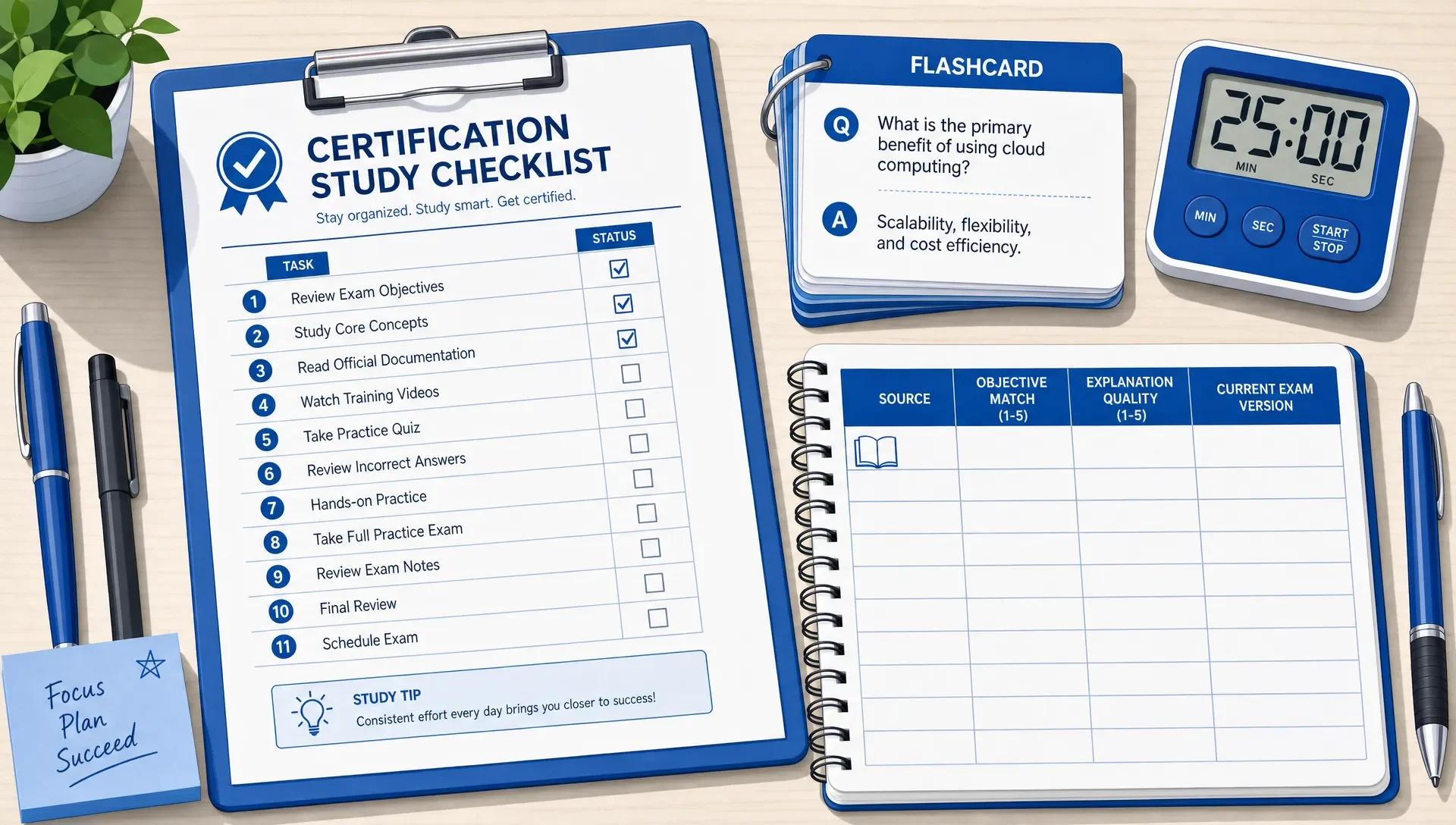
How to Use Good Free Tests Without Overrating Them
Once a free test passes your audit, use it strategically. Don't burn through every question in one sitting and call it done. Start with a small diagnostic set, review every missed and guessed question, then return to the related study objectives.
Your review process matters more than the raw score. After each test, separate mistakes into categories such as knowledge gap, misread question, weak scenario reasoning, timing issue, or overconfidence. If you need a repeatable review method, this guide on how to review an exam practice test the right way walks through what to track after each attempt.
A strong workflow looks like this: take a focused set, review explanations, study the weak objective, drill related flashcards, then retest with fresh questions. That cycle is more useful than taking five full tests without review.
MindMesh Academy helps you with this connected workflow, offering study guides tied to exam objectives, practice questions with detailed explanations, spaced repetition flashcards, adaptive practice focusing on your weak areas, and readiness tracking. For an entry-level cloud exam, the AWS Certified Cloud Practitioner practice exam helps you practice by exam-relevant topics. If you're studying security fundamentals, the CompTIA Security+ practice exam provides another structured path to turn missed questions into targeted review.
Free tests are best used alongside a system that tracks what you know, what you're guessing, and what still needs practice. Without that system, free questions can become activity instead of progress.
When a Free Test Is Still Worth Using Despite Limits
Not every useful free test has to be comprehensive. Some free resources are short by design, especially official sample questions or vendor demos. Those can still be valuable because the wording, scope, and style may be closer to the real exam than a long unofficial question bank.
Use short free tests for narrow purposes. A 10-question sample can help you understand question style. A topic-specific quiz can check one weak domain. A flashcard-style test can reveal vocabulary gaps. The problem starts when you treat a limited test as a full readiness measure.
A free test with only 20 questions cannot prove you're ready for a broad certification exam. It can only provide evidence about those 20 questions. Keep the claim proportional to the sample.
Red Flags That Mean You Should Skip a Free Test
Some problems are serious enough that you don't need a full audit. If you see these signals, move on:
- The page promises exact real exam questions or verified live answers.
- The test uses an old exam code without explanation.
- The questions don't map to the current exam objectives.
- Several answers conflict with official vendor documentation.
- Explanations are missing, circular, or copied from the answer choice.
- The test is mostly definition recall for an exam that emphasizes scenarios.
- The same question appears repeatedly with slight wording changes.
- The score report gives a pass prediction without showing topic-level evidence.
One red flag may be manageable if the test is only a quick warm-up. Multiple red flags mean it shouldn't shape your study plan.
Frequently Asked Questions
Are free tests enough to pass a certification exam? Usually not by themselves. Free tests can diagnose weak areas and build recall, but most candidates need objective-based study, explanation review, spaced repetition, and enough varied practice to handle new scenarios.
How many questions should I audit before using a free test? Sample 15 to 20 questions if the test is long. For a short test, inspect every question. You're looking for blueprint alignment, current terminology, plausible answer choices, and useful explanations.
Should I trust a free test that gives me a passing score? Treat the score as one data point. A passing score matters only if the test is current, balanced across exam domains, and similar in difficulty to the real exam. Topic-level performance is more useful than one percentage.
What is the biggest warning sign in a free certification test? The biggest warning sign is a claim that the questions are real exam questions. That suggests dump content, creates ethical risk, and doesn't build the transferable understanding you need.
Are official sample questions better than long free tests? Often, yes for understanding style and scope. Official samples are usually limited, so they shouldn't be your only practice, but they can be high-quality references for how the vendor frames questions.
How should I use a free test after I find mistakes? Review every missed and guessed question, map each error to an exam objective, study that objective, then practice related questions later. Don't just reread the correct answer and move on.
Build a Practice Routine You Can Trust
Free tests are useful when they earn a place in your plan. Check the source, map questions to the blueprint, inspect explanations, verify the exam version, and avoid anything that looks like a dump. Then use the test to guide targeted review, not to chase a flattering score.
To truly connect your practice with your study plan, find tools that track your progress by topic and identify weak areas for focused improvement. This transforms free questions from a study-time gamble into a smart diagnostic. If you're preparing for Azure fundamentals, put your knowledge to the test and assess your readiness with the AZ-900 Microsoft Azure Fundamentals practice exam.

Written by
Alvin Varughese
Founder, MindMesh Academy
Alvin Varughese is the founder of MindMesh Academy and an enterprise architecture leader. An electrical engineer by training, he moved from factory automation in South Africa to cloud architecture at GE Appliances and Humana (Fortune 50), and holds 20 professional certifications including AWS Solutions Architect Professional, Azure DevOps Engineer Expert, and Microsoft Agentic AI Business Solutions Architect. He built MindMesh Academy after interviewing too many highly certified candidates who couldn't answer basic questions: the goal is prep that makes you better at the job, not just able to pass the exam.