Free Practice Quiz Checklist Before You Trust Results
Before You Trust a Free Practice Quiz: A Checklist
Don't blindly trust a free practice quiz result. Before you do, check three critical things: whether the questions truly align with your current exam, if the explanations hold up against official documentation, and if you answered without any help. A high score means little if the quiz covers outdated objectives or you've already memorized the answers.
First, identify the exam name, version, and specific objectives the quiz aims to cover. Then, inspect a few explanations before attempting the full quiz. If you can't figure out what the quiz truly measures, use it for extra practice, but don't use it to decide if you're ready to book your certification exam. This checklist will help you make that distinction.
Check the Quiz Against Current Exam Objectives
A quiz can feature technically correct questions yet prepare you for the wrong exam. Certification objectives change, and a general label like "cloud fundamentals" doesn't guarantee alignment with a specific credential.
Find the official page for your target exam and compare its objectives with the quiz's stated coverage. For instance, the AWS Certified Cloud Practitioner page links directly to the exam guide. Always use the vendor's current guide as your primary reference, not just the quiz publisher's description.
A good free practice quiz identifies the exam it supports and provides enough detail for you to verify that match. Look for objective references, topic labels, or a clear outline of what it covers. A publication date is helpful, but a recent date doesn't automatically mean the questions are updated.
Also, check if the quiz tests the skills mentioned in the objectives. Simply recognizing a service name isn't the same as choosing that service based on cost, security, or operational constraints.
For Azure fundamentals preparation, an objective-organized resource such as MindMesh Academy's AZ-900 study guide can help you structure your learning. Always treat the official objectives as the ultimate authority for exam scope.
It's fine if a quiz only covers one domain, provided that's clearly stated. It becomes misleading when a narrow sample is presented as evidence of readiness for the entire exam.
Inspect Question Quality Before Completing the Quiz
Before you spend time on a free practice quiz, review several questions from different topics. You're looking for questions with defensible answers, not just professional formatting.
A helpful question provides enough context for you to choose an answer. If it asks for the "best" solution, the scenario should explain what "best" means in that context: lowest cost, least administrative effort, strongest access control, or another relevant constraint.
Distractors (the incorrect answer options) should be plausible but wrong for an identifiable reason. Obviously unrelated options might make your score seem strong without requiring deep understanding. Conversely, if two options seem equally defensible, it might point to missing context in the question, rather than a gap in your knowledge.
Pay close attention to explanations. A strong explanation identifies the core concept behind the correct answer and clarifies why a tempting alternative doesn't fit the scenario. An explanation like "B is correct because B is the right answer" teaches you nothing.
Verify any disputed technical claims against official vendor documentation. If an explanation cites documentation, follow the link and confirm it supports the specific claim. A link to a vendor's homepage doesn't serve as evidence for a detailed configuration rule.
One questionable item doesn't automatically invalidate an entire quiz. Set it aside and inspect more questions. Repeated ambiguity, unsupported explanations, or obsolete terminology are stronger reasons to stop trusting the quiz's score.
What a Free Practice Quiz Score Actually Tells You
Your percentage score shows how many answers the quiz marked correct under the conditions of that specific attempt. It doesn't automatically predict your probability of passing a certification exam.
Consider a hypothetical 20-question quiz. If you answer 17 correctly, you get an 85% score. Each question changes that score by five percentage points, meaning a small number of items can significantly shift the result.
Now, imagine three of those correct answers were guesses you couldn't actually explain. You still scored 85%, but you only demonstrated reasoning for 14 out of 20 items. This distinction matters when you plan your next study session. It's not a replacement scoring system or an estimate of your real exam result.
Also, don't directly translate a practice percentage into a vendor's passing score. Microsoft's exam scoring documentation explains that its technical certification exams use scaled scores, so a score of 700 doesn't necessarily mean 70% correct.
Treat a short quiz as a sample of your performance on those specific questions. Stronger readiness evidence comes from new questions, broader objective coverage, and your ability to explain your choices without assistance.

Separate Independent Attempts from Helped Attempts
Before you start a quiz, decide if you're learning or measuring. Both activities are useful, but they produce different kinds of evidence.
In learning mode, you can consult documentation, use hints, and review explanations right away. The result shows what you could complete with support. In measurement mode, answer without those aids and review explanations only after submitting your attempt.
Record whether the questions are new to you. Recognizing an answer from a previous session can lead to a correct response without showing you could solve a new scenario. Simply changing the option order doesn't make a familiar question fresh.
A free practice quiz provides more useful information when you label the attempt honestly: "first attempt," "repeated questions," "open-book," or "closed-book." This context prevents you from comparing unlike results as if they measured the same thing.
You don't need elaborate tracking. A quick note like "first attempt, no notes, four guesses, timing recorded" is enough to preserve essential context. If you checked documentation midway through, record that too, rather than treating the whole session as independent performance.
When familiar answers become a problem, apply the quiz bank rules that prevent answer memorization. The goal isn't to make practice harder for its own sake. It's to keep correct answers tied to real understanding.
Use This Checklist Before Relying on the Result
Use the following checks to decide how much weight a free practice quiz result deserves. These aren't a validated scoring model, and you shouldn't combine them into a new "readiness percentage." Each check addresses a different limitation.
| Check | Evidence to Look For | What to Do If It's Missing |
|---|---|---|
| Exam Identity | Exact certification and applicable exam version | Verify the match before using the score |
| Objective Alignment | Topic labels or a coverage outline that matches official objectives | Treat coverage as uncertain |
| Question Clarity | Enough context for a defensible answer | Set ambiguous items aside |
| Explanation Quality | Reasoning for the answer and relevant alternatives | Verify claims with official documentation |
| Attempt Independence | No notes, hints, or previously seen answers during measurement | Label the attempt as learning or repeated practice |
| Topic Coverage | Questions across the areas you intend to assess | Limit conclusions to sampled topics |
| Format Coverage | Practice relevant to the target exam's question formats | Assess untested formats separately |
| Score Interpretation | Clear limits on what the result means | Ignore unsupported pass predictions |
Start by checking alignment and question quality. A polished score report can't make up for questions aimed at the wrong objectives.
Next, check the conditions of your attempt. Even a well-written quiz provides weak readiness evidence when you've just reviewed its answer key. Finally, look at coverage: you can trust a result as evidence of performance on a narrow topic without trusting it as evidence for the entire exam.
Check What the Quiz Leaves Untested
Two quizzes can both report 80% but measure different skills. One might focus on terminology, while another asks you to choose between plausible solutions in a scenario. Compare what the quizzes ask you to do, not just the percentages.
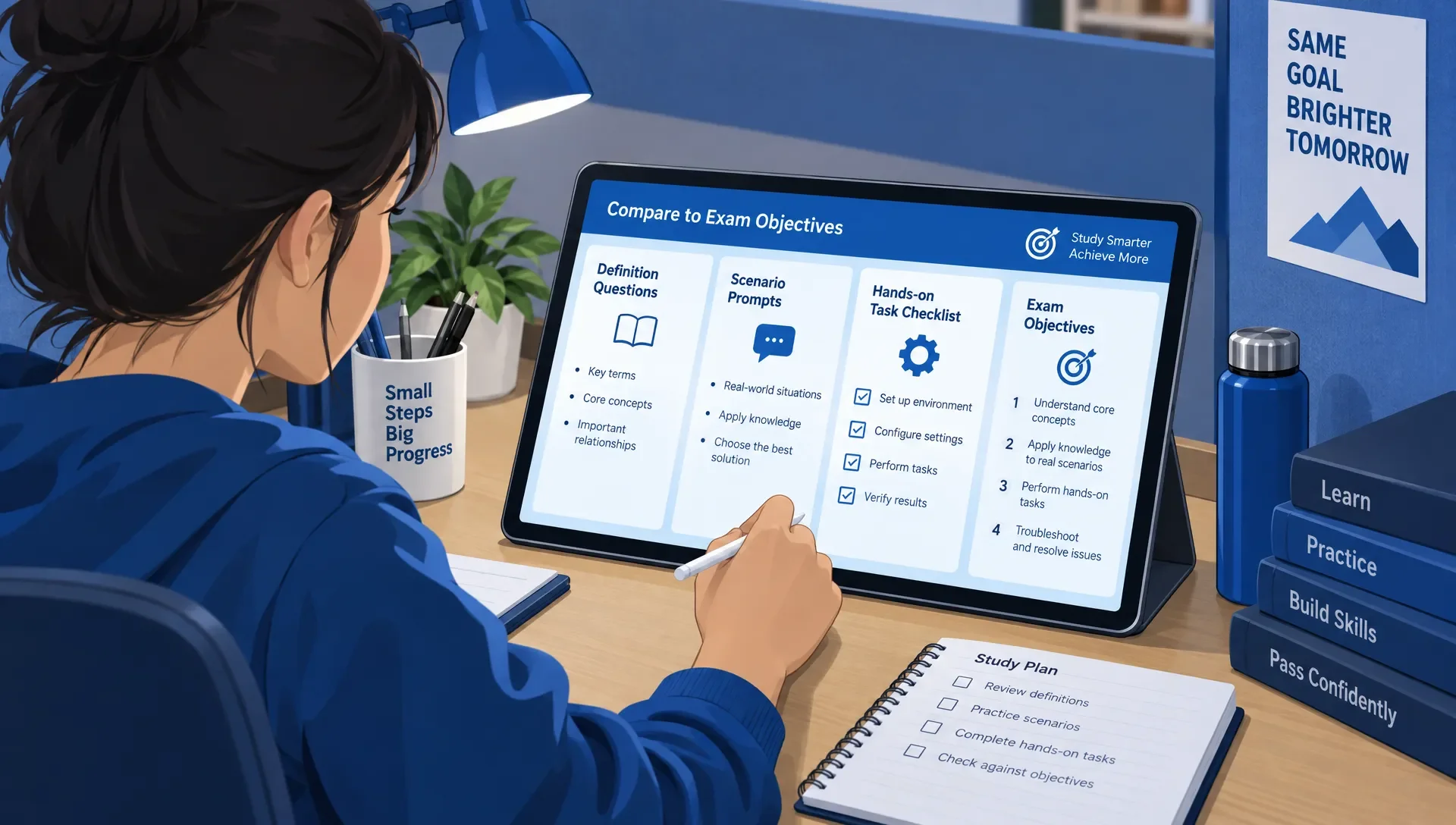
A free practice quiz made entirely of definition questions can't confirm you're ready for configuration tasks or performance-based questions. Check the official description of your target exam's formats, then identify which formats your practice hasn't covered.
Coverage also matters within multiple-choice questions. Look for application, constraints, and tradeoffs, especially if those skills appear in the objectives. Repeatedly identifying a security control by name doesn't necessarily show that you can select it for a particular threat.
Even official practice resources have limits. Microsoft's Practice Assessments guidance explains that its assessments don't necessarily represent the length or complexity of the certification exams. Official provenance makes a resource worth considering, but it's not an exact exam simulation.
A useful result should support a bounded conclusion: "I handled these identity questions independently" is defensible. Saying "I'm ready for everything on the exam" requires evidence from the rest of the objectives and any relevant hands-on or scenario-based work.
Decide Whether to Use, Limit, or Reject the Quiz
After checking a free practice quiz, make one of three decisions rather than treating it as simply trustworthy or worthless.
- Use it as supporting readiness evidence: The questions match current objectives, explanations are defensible, and you completed a fresh attempt independently. Keep its coverage limits in mind.
- Limit it to learning or topic checks: The material is useful, but the sample is narrow, familiar, or you completed it with assistance. Use it to guide your study, not to justify booking an exam.
- Reject its score as evidence: The exam match is wrong, ambiguity is widespread, or explanations repeatedly contradict authoritative documentation. Don't let the percentage drive your study plan.
Be cautious about unsupported claims, such as "this score guarantees a pass." Ask what evidence links that quiz result to the actual certification outcome. Without a credible basis, it's a marketing claim, not a readiness measure.
Also, avoid resources that claim to reproduce live exam questions. Choose legitimate practice material that helps you learn the objectives, not supposed leaked items.
Once a resource passes these checks, move on to reviewing an exam practice test effectively. Resource quality comes first; reviewing a flawed quiz more carefully won't fix its underlying problems.
Frequently Asked Questions
Can a free practice quiz tell me whether I'll pass? It can contribute evidence, but it can't establish that outcome by itself. Check alignment, coverage, question quality, and whether you completed a fresh attempt independently. Use the result alongside performance across the full exam scope.
Are official practice questions always enough preparation? No. Official questions are useful references, but a small sample may leave objectives or question formats untested. Follow the vendor's guidance about the resource's purpose and compare its coverage with the complete exam outline.
What score should I aim for before booking an exam? There's no universal practice percentage that signals guaranteed readiness. A publisher's recommended threshold is only meaningful if it has a credible basis. Look for consistent performance on fresh, relevant material and investigate weak topics before booking.
Should I count guessed answers as wrong? Keep the quiz's reported score, but flag guesses separately. A lucky correct answer is weaker evidence than an answer you can explain. Review both incorrect responses and correct guesses before drawing conclusions about your understanding.
What should I do when I disagree with an explanation? Check the relevant official documentation and revisit the scenario's constraints. If the answer remains unsupported or ambiguous, exclude that item from your readiness judgment. Repeated problems are a reason to find a better resource.
Choose Your Next Practice Attempt Deliberately
Don't just chase a higher percentage on the same questions. Choose an aligned resource, protect your first attempt, and record the conditions that make its result meaningful.
If you're preparing for AWS fundamentals, explore MindMesh Academy's AWS Certified Cloud Practitioner practice exam. We combine practice questions and explanations with objective-based study guides, spaced-repetition flashcards, and mastery and readiness tracking. Use this connected workflow to address weak topics, then assess what you can explain independently.

Written by
Alvin Varughese
Founder, MindMesh Academy
Alvin Varughese is the founder of MindMesh Academy and an enterprise architecture leader. An electrical engineer by training, he moved from factory automation in South Africa to cloud architecture at GE Appliances and Humana (Fortune 50), and holds 20 professional certifications including AWS Solutions Architect Professional, Azure DevOps Engineer Expert, and Microsoft Agentic AI Business Solutions Architect. He built MindMesh Academy after interviewing too many highly certified candidates who couldn't answer basic questions: the goal is prep that makes you better at the job, not just able to pass the exam.