Flashcards for Exams That Make Facts Stick
Flashcards That Make Facts Stick for Certification Exams
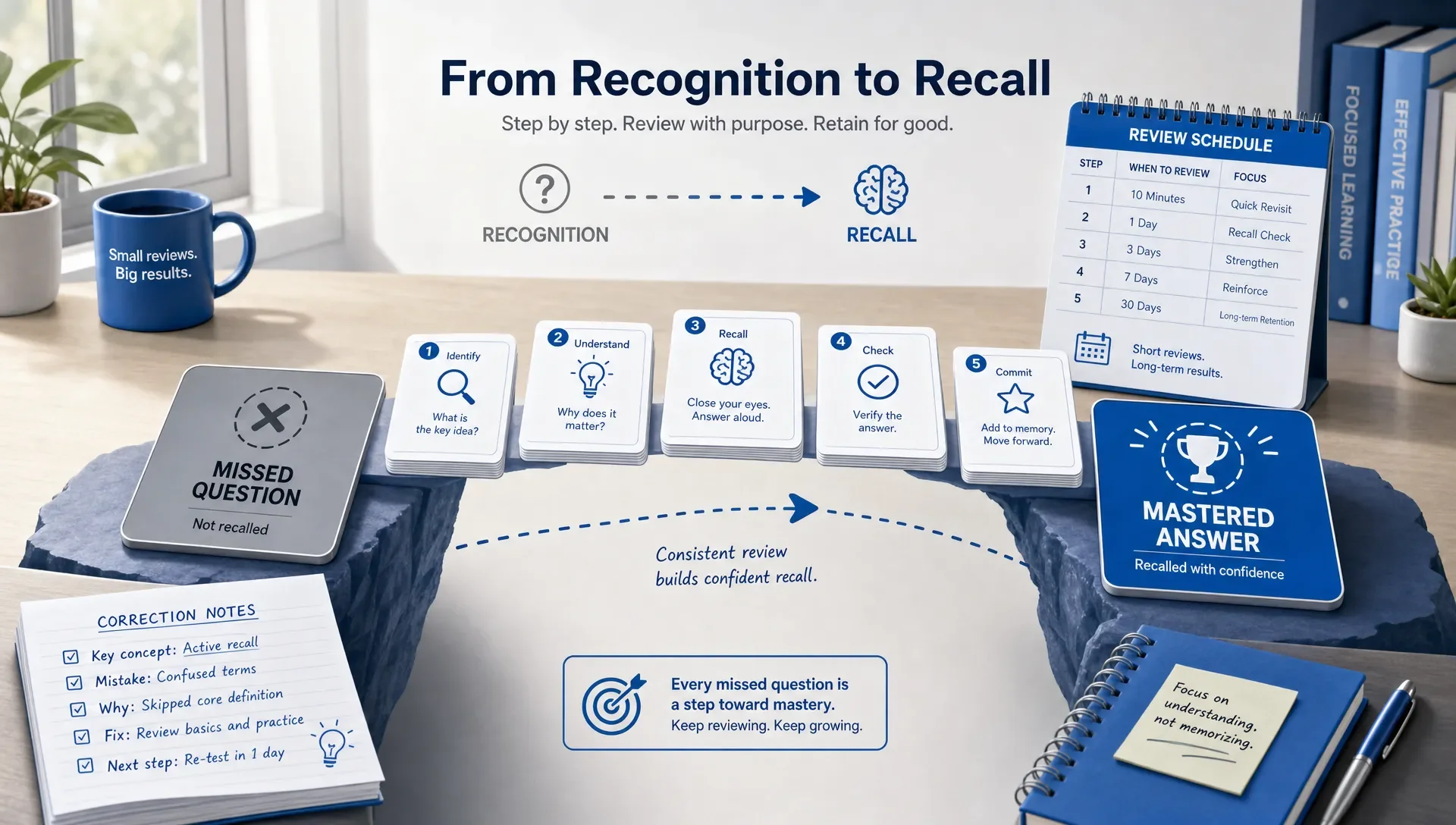
Flashcards are most effective for exams when they force you to retrieve a fact, apply it to a scenario, and then check your answer without assistance. If your flashcards feel simple, yet your practice scores remain stagnant, the issue often isn't a lack of effort. Instead, your cards might be testing recognition rather than true recall.
Here's the core principle: each card should help you answer a future exam question more quickly or precisely. Create cards based on exam objectives, questions you missed in practice, and facts you frequently confuse. Then, review these cards using a spaced schedule, rather than simply rereading the entire deck daily.
Why Flashcards Boost Learning Through Active Recall
Effective flashcards aren't condensed notes. They're prompts for retrieval. The front of the card poses a brief test, and the back offers a straightforward way to check your response.
This design is crucial because retrieval practice stands as one of the most powerful learning strategies for exam preparation. A 2013 review by Dunlosky et al. identified practice testing and distributed practice as highly effective learning techniques. Similarly, Roediger and Karpicke's 2006 retrieval practice study found that students who actively recalled material retained more knowledge over time compared to those who only restudied.
For certification exams, this approach is highly practical. You don't just need to recognize terms like availability, least privilege, or route table. You need to understand when they apply, what they exclude, and how they affect outcomes in a given scenario. Flashcards can achieve this, but only if you design them to make your brain actively work before revealing the answer.
Crafting Flashcards for Certification Exams
Begin with the exam objective, not the textbook chapter. Certification exams are structured around objective domains, so your flashcard deck should mirror this organization. For instance, if you're studying cloud fundamentals, align your cards with the objective progression in an AZ-900 Microsoft Azure Fundamentals study guide. Avoid simply creating a disorganized collection of definitions.
An effective flashcard comprises three elements: a precise prompt, a concise answer, and a verifiable reason. This reason prevents the card from becoming a tool for superficial memorization.
| Card type | Best for | Example front | Example back |
|---|---|---|---|
| Definition card | Core terms you must know instantly | What are the three goals of the CIA triad? | Confidentiality, integrity, and availability. |
| Contrast card | Concepts that look similar | In AWS networking, which is stateful: a security group or a network ACL? | A security group is stateful. A network ACL is stateless. |
| Cause and effect card | Understanding consequences | What happens when a system lacks redundancy? | A single component failure can create downtime or service disruption. |
| Procedure card | Ordered steps or formulas | What is the first step when troubleshooting a network issue? | Identify the problem before changing the configuration. |
| Scenario card | Applying facts to exam-style wording | A user needs only temporary access to a resource. What access principle should guide the design? | Least privilege: grant only the access needed for the required time and task. |
Don't attempt to convert every sentence you encounter into a card. Flashcards should focus on facts that are frequently tested, easily confused, or essential for solving more complex questions. If a fact won't help you answer an exam question, it likely doesn't warrant a card.
Designing Flashcards to Prevent Superficial Memorization
The most common ineffective flashcard features a label on the front and a paragraph on the back. This format allows you to simply acknowledge the page where you saw the information, rather than proving you can actually produce the answer.
A more effective card requires you to perform an action: define, compare, choose, calculate, sequence, or explain why. If you can't grade your answer in under five seconds, the card is too ambiguous. If a single missed card suggests you've forgotten three distinct concepts, then break it down into smaller, more focused cards.
| Weak card | Better card | Why the better version works |
|---|---|---|
| Subnetting notes | How many usable IPv4 host addresses are in a /26 network? | It requires calculation and has one checkable answer. |
| Encryption | What security goal does hashing support better than confidentiality? | It forces a distinction between integrity and secrecy. |
| Shared responsibility model | Which cloud security tasks are usually the customer's responsibility? | It connects the term to decisions you may see in scenarios. |
| Incident response | What should you do before eradicating malware from an affected system? | It checks sequence, not just vocabulary. |
You can also enhance cards by adding a subtle context clue. For instance, the prompt "which service is cheapest?" is overly broad. A prompt such as "which storage class fits infrequently accessed data that still needs rapid retrieval?" more closely mirrors the structure of certification questions.
Implementing Spaced Repetition Without Overwhelming Your Deck
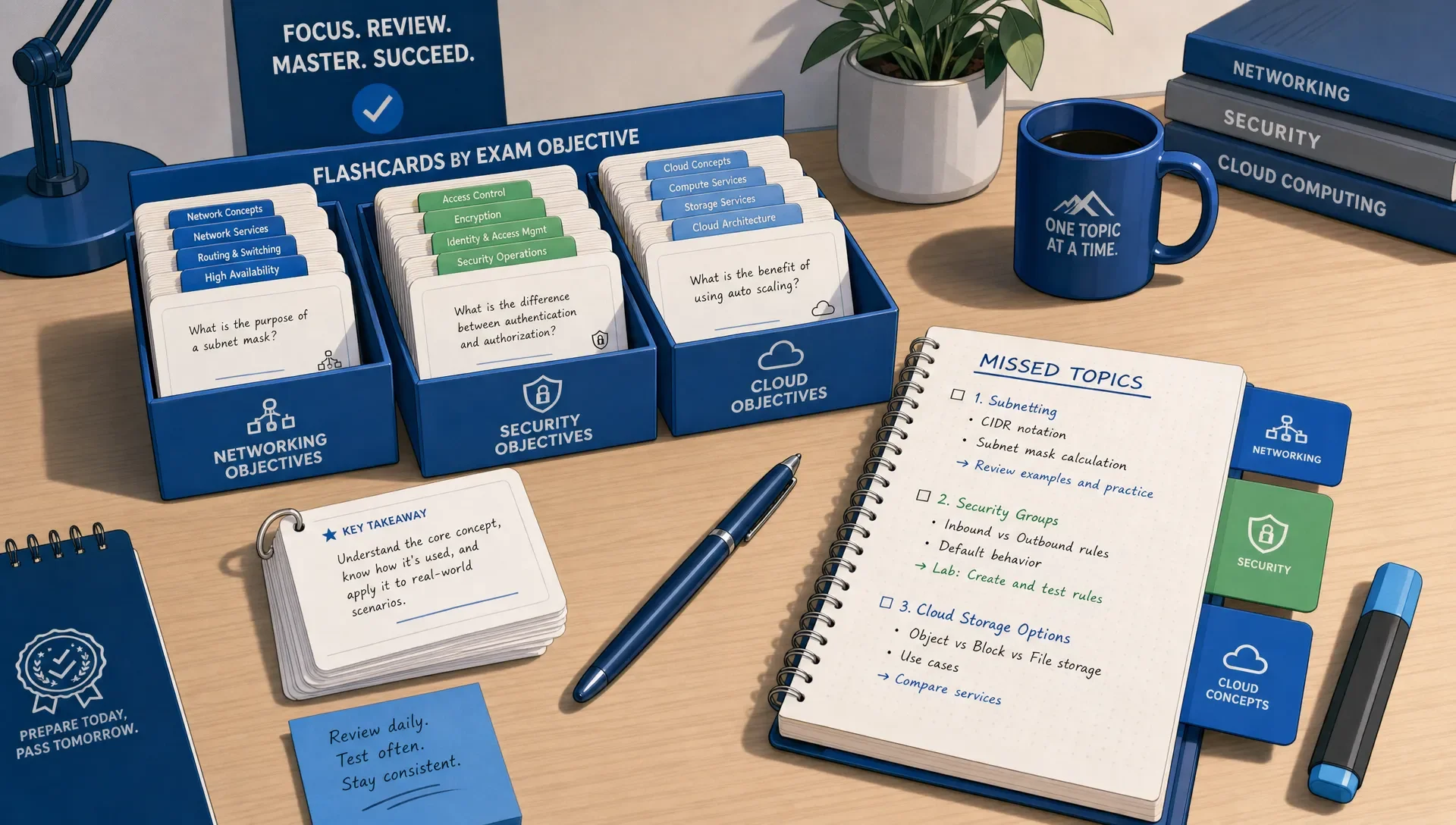
Simply reviewing the same deck daily isn't an effective strategy. Spaced repetition is effective because it schedules easier cards for later review, while more challenging cards reappear sooner. A review of distributed practice by Cepeda et al. concluded that distributing learning over time significantly improves retention compared to cramming.
For certification preparation, maintain a simple system. Avoid adding dozens of new cards just because you've completed a chapter. Instead, introduce a smaller number of high-value cards, complete your scheduled reviews, and let missed cards guide your study focus for the next session.
| How the card felt | What to do next | What it tells you |
|---|---|---|
| Easy and instant | Schedule it farther out | The fact is becoming durable. |
| Correct but slow | Review it again soon | You know it, but it isn't fluent yet. |
| Missed completely | Relearn the source concept before repeating | The gap is probably understanding, not memory. |
| Confusing wording | Rewrite the card now | The card design is hurting recall. |
| Always easy and low value | Retire or suspend it | Your study time belongs elsewhere. |
Spaced repetition proves particularly valuable for areas rich in vocabulary, such as cloud service names, port numbers, governance terms, command syntax, and security controls. However, don't let the flashcard deck become your entire study plan. Flashcards are one component of a broader study loop, not the ultimate goal.
For a more in-depth review rhythm, MindMesh Academy's guide on mastering spaced repetition for studying explains how to time reviews effectively without turning exam prep into cramming.
Integrating Flashcards with Practice Questions
While flashcards help facts stick, practice questions reveal whether you can apply those facts effectively under exam conditions. It's best to use them in tandem.
Before attempting practice questions, flashcards build your fluency with the terms and rules necessary for clear thinking. After practice questions, incorrect answers pinpoint exactly which cards you need to create or refine. If a question's explanation highlights a missed keyword, a specific condition, or a rule exception, that's a prime candidate for a new flashcard.
For example, if a learner struggles with access control, cryptography, or risk management questions on a CompTIA Security+ practice exam, the solution isn't to reread the entire domain. A more effective approach is to convert the missed concept into one or two targeted flashcards, then revisit similar questions later to verify your understanding.
This is also where detailed explanations prove valuable. A single wrong answer might require several different flashcards, depending on the underlying cause. You might need a definition card for an unknown term, a contrast card for two concepts you mixed up, or a scenario card for a rule you understood theoretically but couldn't apply.
For a more comprehensive recall system, the MindMesh Academy article on test prep methods that actually stick illustrates how active recall, mixed practice, and mistake review integrate for better results.
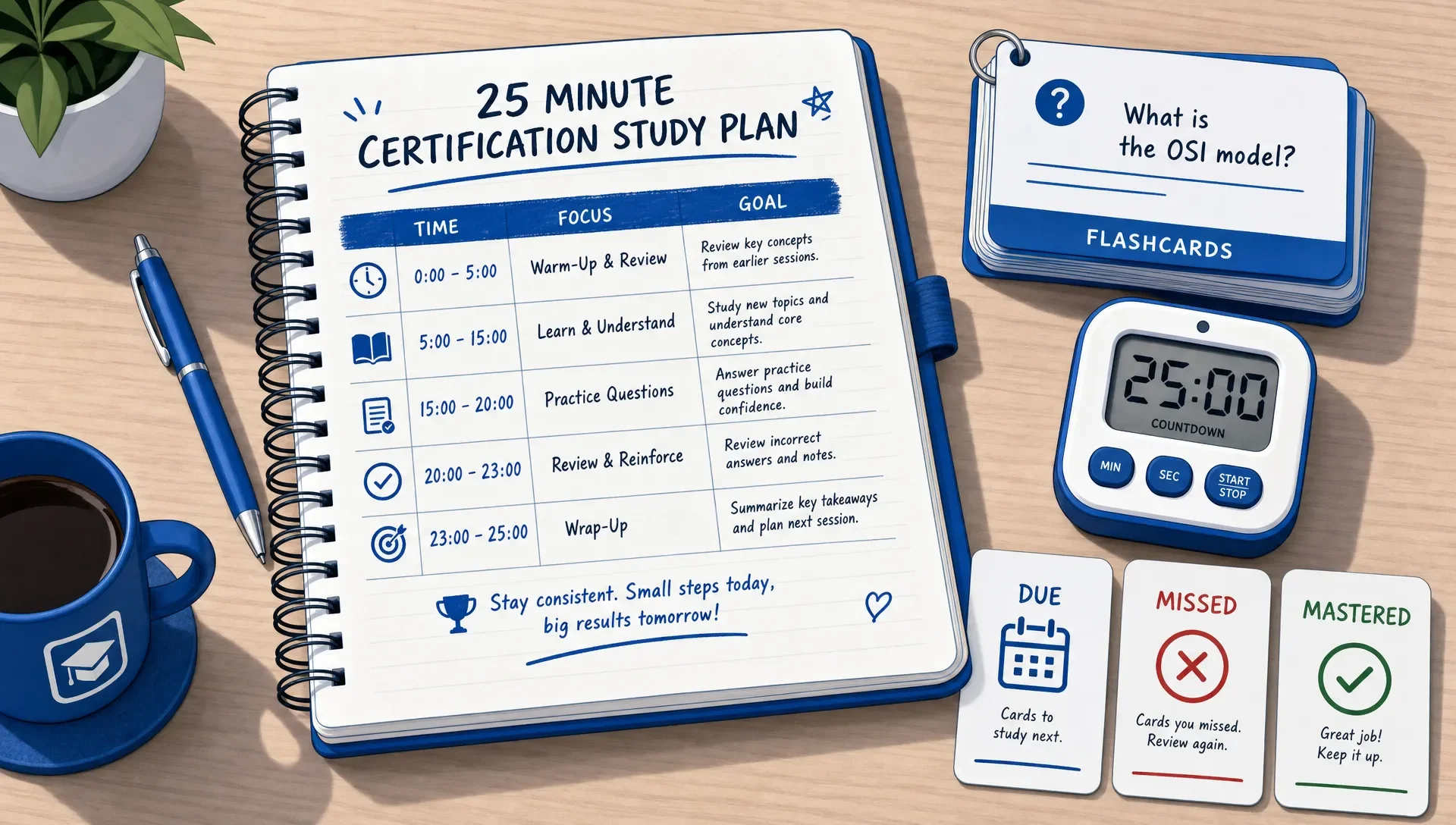
A Repeatable 25-Minute Flashcard Study Routine
You don't need extended study blocks to make progress. What you need is a repeatable session that begins with active retrieval and concludes with a clear decision on your next study focus.
- Select a single exam objective or subtopic, not an entire domain.
- Answer all due flashcards closed-book before consulting any notes.
- Categorize each card as easy, slow, missed, or unclear.
- Immediately rewrite any unclear cards to ensure future reviews test the correct concept.
- Add no more than five new cards, drawing from missed questions or gaps in your understanding of objectives.
- Complete five practice questions related to the same or a connected objective.
- Note your weakest topic to ensure your next session begins with a targeted review.
This routine is effective because it bypasses passive warm-ups. You test your knowledge first, address any gaps, and then re-test in a slightly different format. Over time, your flashcard deck will become more concise, precise, and directly aligned with your actual exam performance.
Common Flashcard Pitfalls That Hinder Study Progress
Most issues with flashcards stem from creating too many, making them overly broad, or reviewing them without linking them to your practice exam performance.
| Mistake | What it looks like | Better habit |
|---|---|---|
| Copying paragraphs | The back of the card is a block of notes. | Use one answer, one reason, and one example if needed. |
| Testing recognition | The front is only a term like IAM or RAID. | Ask for the definition, difference, use case, or limitation. |
| Adding too many new cards | The deck grows faster than you can review it. | Cap new cards and prioritize missed exam objectives. |
| Keeping easy cards forever | You spend time on facts you already know. | Space them farther out, retire them, or review them only before final checks. |
| Ignoring mistakes | You mark a missed card and move on. | Relearn the concept, then rewrite the prompt. |
| Avoiding scenarios | Every card is a definition. | Add cards that ask when, why, or which option fits. |
A crucial warning: avoid turning every practice question into a flashcard. If you missed a question because you rushed, misread the wording, or selected an answer too quickly, the solution might involve improving your test-taking discipline rather than creating another factual card.
Recognizing When Your Flashcards Are Effective
Your flashcards are effective when they demonstrably alter your study habits and practice performance. You should observe quicker recall of definitions, clearer distinctions between similar concepts, and more precise feedback during your practice question reviews.
A clear indicator of progress is that your errors become more specific. Initially, you might simply note, "I don't understand networking." Later, a more refined note might read, "I confuse stateful and stateless filtering when the question mentions return traffic." This second, narrower problem is directly solvable with two or three focused flashcards.
MindMesh Academy integrates this connected workflow: offering study guides aligned with exam objectives, practice questions featuring explanations, flashcards incorporating spaced repetition, adaptive weakness-based practice, progress tracking by topic, and readiness assessment, including performance-based question formats. These elements are vital because a flashcard shouldn't be an isolated study tool. It should inform your subsequent practice sessions and confirm whether the information is ready for exam application.
You don't need to feel 100 percent comfortable with every single card before scheduling your exam. However, you do need solid evidence that your weak topics are diminishing, your recall remains consistent over several days, and your practice results are improving in the most critical objective areas.
Frequently Asked Questions
How many flashcards should I create per exam objective? Create as many as necessary to cover high-value facts, but avoid aiming for an arbitrary fixed number. A small objective might require five cards, while a dense one could need 30. If your reviews are becoming overwhelming, you're likely creating cards for low-value details.
Are digital or paper flashcards more effective for exams? Digital flashcards generally simplify spaced repetition and progress tracking. Paper cards can be beneficial for short-term drills or quick sorting. The most effective choice is the format you'll consistently review and grade with honesty.
Should I use pre-made flashcards or create my own? Pre-made cards can save time for standard definitions. However, creating your own cards is superior for addressing mistakes, clarifying confusing concepts, and targeting exam objectives where you personally struggle. Your most effective deck typically blends both approaches.
How frequently should I review flashcards before an exam? During active preparation, review due cards daily or almost daily, but don't review every card every day. Easy cards should be scheduled further out, while missed cards should reappear sooner after you've re-learned the underlying concept.
Can flashcards prepare me for performance-based questions? Flashcards support your understanding of the facts and decision rules underpinning performance-based questions, but they aren't a substitute for hands-on or scenario-based practice. Use cards to recall commands, sequences, and constraints, then practice applying them in realistic formats.
How do I convert missed practice questions into flashcards? First, pinpoint why you missed the question. If you simply lacked a fact, create a definition card. If you confused two options, make a contrast card. If you understood the fact but couldn't apply it, design a scenario card.
Build a Flashcard System That Supports Exam Readiness
Start with a single objective today. Create five cards based on facts you frequently forget, answer them closed-book, and then complete a few practice questions to confirm your understanding and application.
For a cohesive platform that integrates this workflow, MindMesh Academy offers study guides aligned with exam objectives, robust practice questions, and flashcards with spaced repetition. This comprehensive approach ensures your flashcards remain directly connected to your exam performance, providing clear insights into your readiness. Ready to apply these strategies? Start building your foundation with our AZ-900 practice exam.

Written by
Alvin Varughese
Founder, MindMesh Academy
Alvin Varughese is the founder of MindMesh Academy and an enterprise architecture leader. An electrical engineer by training, he moved from factory automation in South Africa to cloud architecture at GE Appliances and Humana (Fortune 50), and holds 20 professional certifications including AWS Solutions Architect Professional, Azure DevOps Engineer Expert, and Microsoft Agentic AI Business Solutions Architect. He built MindMesh Academy after interviewing too many highly certified candidates who couldn't answer basic questions: the goal is prep that makes you better at the job, not just able to pass the exam.