Exam Topics You Can Practice With a Home Lab
Exam Topics You Can Practice With a Home Lab
To get the most from a home lab, focus on the topics exam objectives ask you to configure, verify, or troubleshoot. Choose a single objective, set up the simplest environment to demonstrate it, and define a clear success check. This could be successful name resolution or a denied login. Don't start by buying equipment or recreating an entire corporate network.
For routing and switching, use a network simulator. For operating system tasks, an isolated virtual machine often works best. Only use a separate cloud test environment when the objective specifically requires it. Always save a known-good state before making changes, and plan how you'll restore it. The projects below pair each setup with a controlled fault and a success check. This helps you practice diagnosis, not just follow installation steps.
Home lab topics exam candidates can practice
Labs are most effective when exam objectives describe an observable action. You can inspect a routing table, test permissions, or troubleshoot a failed connection. Objectives on governance, terminology, or choosing between services still require focused reading and scenario-based questions.
| Topic area | Small home lab project | Evidence that it works |
|---|---|---|
| Networking | Connect two subnets and configure routing | Hosts reach the intended destination and the route table explains why |
| Operating systems | Create users, permissions, and a scheduled task | Each user has the expected access, and the task produces a log |
| Security | Apply least privilege to a shared resource | An authorized account succeeds while an unauthorized account fails |
| Cloud | Configure identity permissions and private storage | The intended identity can perform only the required action |
| Automation | Read an API response and validate its data | The script handles both valid input and a controlled failure |
Check your current blueprint before choosing projects. For instance, the official Cisco CCNA exam topics clearly distinguish between configuration and verification tasks and concepts you need to explain. Your lab exercises should mirror these action verbs, not just textbook chapter titles.
How to set up a safe certification home lab
For practical tasks described in exam objectives, start with a single simulator or virtual machine. Add a second system only if you need to demonstrate communication, access boundaries, or a client-server relationship.
A network simulator supports many routing and switching exercises, often without needing physical routers. For operating system work, use an OS image you're licensed to run. Confirm your computer supports your chosen virtualization tool. You don't need a rack of equipment to test permissions or inspect logs.
Keep these boundaries in place:
- Isolate experiments: Use an internal virtual network when the exercise doesn't require internet access.
- Save a recovery point: Take a snapshot or export a known-good configuration before introducing faults.
- Use synthetic data: Create test accounts, sample files, and disposable credentials, not copies of workplace data.
- Limit exposure: Don't publish remote administration services or scan systems you don't own or have permission to test.
While a snapshot helps you recover a virtual machine, it doesn't remove cloud resources or revoke external credentials. Always document cleanup steps for anything outside the VM before you start.
Networking lab: troubleshoot routing, VLANs, and DNS
Build two networks and prove the traffic path
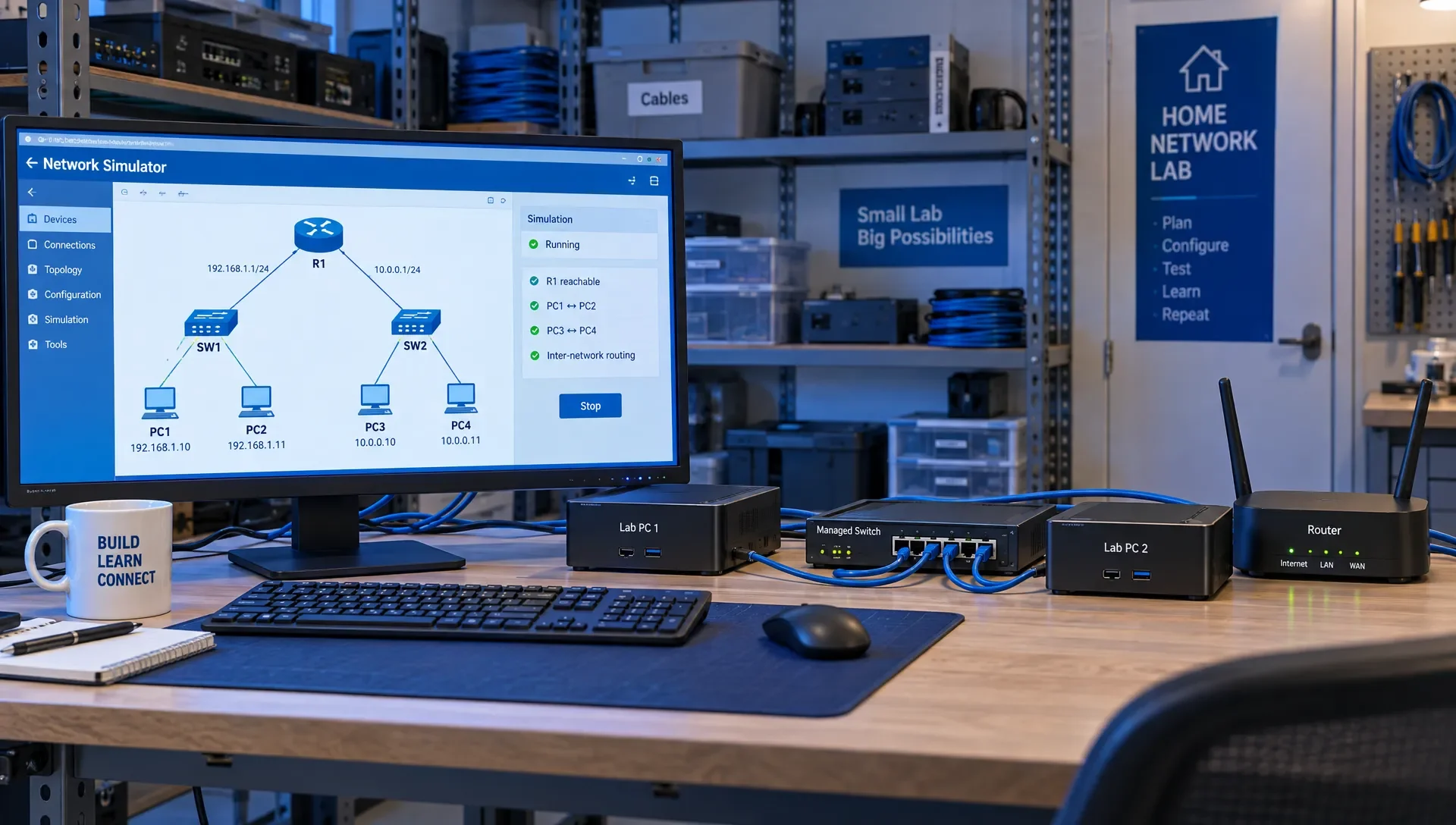
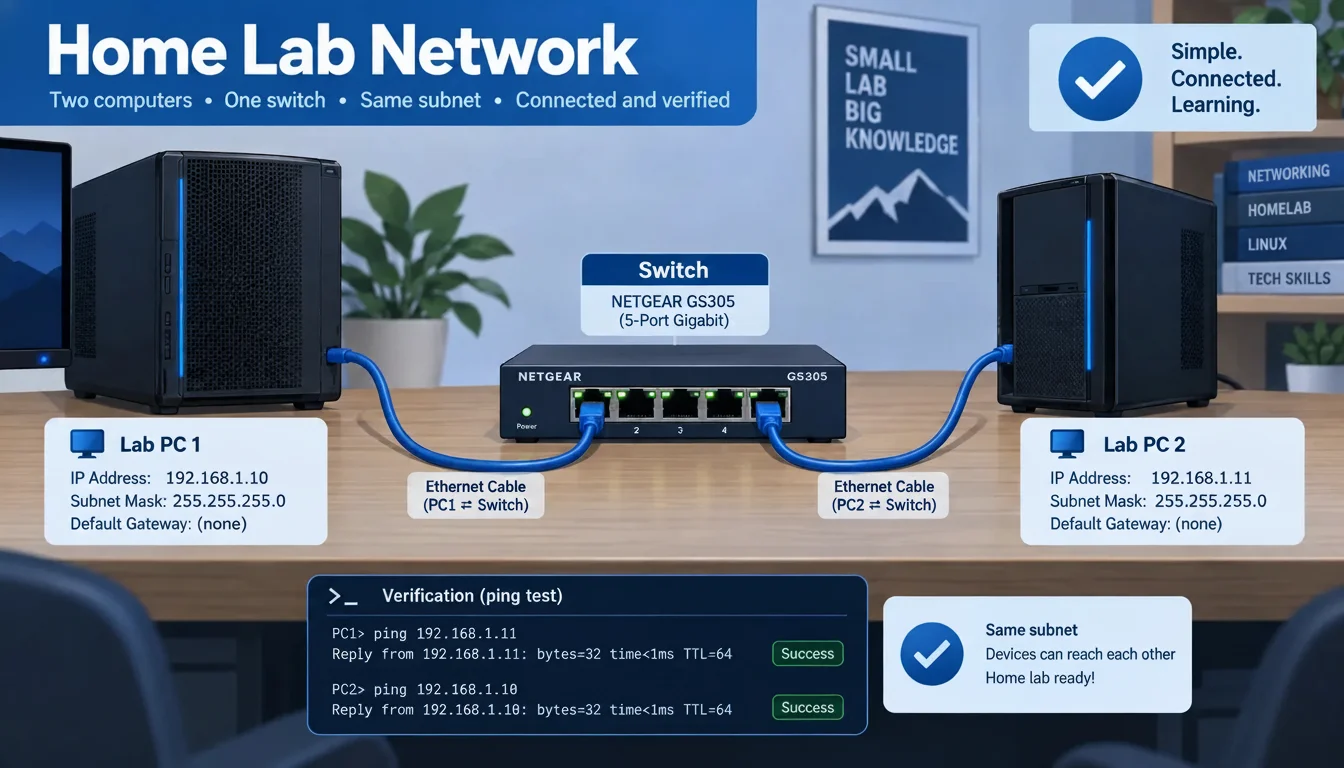
In a simulator, create two small subnets. Connect them via a router, assigning each host an IP address and default gateway. First, confirm local connectivity. Then, test communication between the subnets.
When exam objectives describe networking topics as configuration or verification, collect more than just a successful ping. Record the host's address, gateway, and routing information. Use the simulator's packet inspection tools or relevant device commands to explain where traffic flows.
Next, change one host's default gateway to an incorrect address. Before testing, predict which connections should still work. Local communication might remain available even if traffic to the other subnet fails.
Add one fault at a time
If your blueprint includes VLANs, extend the same environment with them. Verify access-port assignments and trunk configuration before adding another feature. Reserve NAT, access control lists, or routing protocols for separate exercises. This way, any failure has a manageable set of potential causes.
For DNS practice, compare reaching a service by IP address with resolving its name. A failed name lookup isn't the same problem as a missing route. Likewise, a blocked ping doesn't prove every application connection is broken.
After restoring the lab, try an unfamiliar scenario in the CCNA practice exam. Explain what evidence supports your answer, instead of just relying on a memorized command.
Security lab: verify least privilege and useful logging
Create two synthetic users and a folder with harmless sample files. Give one user the necessary access for a defined task (like reading a report), while denying the other user that same access. Keep a separate administrator account for recovery.
Prioritize security topics where exam objectives relate to access control, secure configuration, or interpreting logs. Your success check should include both an allowed action and a denied action. A configuration isn't proven secure just because the administrator can use it.
Inspect the relevant audit or event logs. If you don't see the expected event, check if auditing is enabled and if you're looking at the correct log. Don't assume every operating system records every access attempt by default.
For a controlled fault, remove the authorized user's permission, reproduce the failure, and then restore the intended setting. Then, explain why simply granting administrator access would be an excessive solution.
Use the CompTIA Security+ practice exam to test your judgment on related scenarios: which control fits a requirement, which permission is excessive, and what a log entry truly establishes.
Operating-system lab: manage permissions and recover a service
Using a single Linux or Windows VM, create a standard user, a shared working directory, and a scheduled task that writes a timestamp to a test file. Confirm the task runs under the intended account, rather than silently relying on administrator privileges.
For operating system troubleshooting objectives, record the symptom before changing the configuration. Useful evidence includes service state, file permissions, network settings, and relevant logs.
Choose a nonessential test service and stop it deliberately. Observe the resulting failure, identify the stopped service, and restore it. Don't disable security controls or critical host services just to manufacture a problem.
Then, change a permission on the task's output directory. Check if the task starts but fails to write its result. This helps distinguish scheduling problems from access issues.
You should be able to explain the difference between a task not running, a process failing, and a successful process producing an unexpected result. Tie commands like ipconfig /all, ip route, or nslookup to a specific diagnostic question, rather than just reciting a list.
Cloud lab: test identity permissions and private storage
Cloud topics, which exam candidates often find confusing, become more concrete when you can test who can perform a specific action. Use a dedicated test environment to create a private storage resource and a narrowly scoped test identity. Upload only a harmless sample file.
Confirm the intended identity can perform the required action. Then, test an action it shouldn't be able to perform. Don't use your account's most privileged identity as proof that a limited-access configuration works.
For foundational exams, keep deployment work proportional to the objective. The official AZ-900 study guide helps you distinguish between concepts you need to describe and those you choose to explore hands-on. Building a resource can clarify a concept, even if it's not a direct exam requirement.
Set cost controls before creating resources
Don't assume a resource is free. Review the cloud provider's pricing and configure budget alerts before you start. As the AWS Budgets documentation explains, budgets track costs and notify you, but an alert isn't a guaranteed spending cap.
Afterward, delete all resources you created. Check for retained storage, snapshots, or other dependencies. Pair your observations with the MindMesh Academy AZ-900 study guide. This keeps your experiment tied to the objective, rather than becoming an open-ended cloud project.
Automation lab: handle API responses and failed inputs
Start locally with a small JSON file, perhaps representing an inventory or support ticket response. Write a script that reads this data, checks required fields, and produces a short summary. You can practice parsing and validation without needing a paid service or live credentials.
For automation topics covered in exam outlines, add one controlled failure: a missing field, an unexpected value, or an invalid JSON document. Your script should report the problem clearly, rather than producing misleading output.
If you later use a test API, inspect authentication requirements, response codes, and rate limits. Keep tokens out of source files and screenshots. Don't mistake a successful request made with an administrator token for evidence that the integration uses appropriate permissions.
If you're turning this exercise into a workplace proposal, first document the manual task, required integrations, and human approval steps. These are useful inputs for AI opportunity audits and process automation. However, keep a business prototype separate from your exam lab, and continue using synthetic data.

How to turn a working lab into exam practice
Completing a tutorial proves you followed instructions. To truly check your understanding, rebuild a smaller version without the instructions and explain what each setting changes.
Go back to the specific topics named in the exam objectives. If an objective asks you to verify routing, your evidence should include routing information and connectivity tests. If it asks you to explain a security control, describe what the control prevents and what it doesn't address.
For every lab, keep a short record including the objective, expected behavior, observed result, and recovery steps. Include the incorrect setting you introduced, so you can reconstruct the fault later.
A practical review session can follow this sequence: state the expected behavior from memory, inspect the environment, introduce one fault, diagnose it, and restore the baseline. On your next attempt, change an address, permission, or input value. This prevents you from solving the exercise simply by remembering yesterday's steps.
Then, answer a related question without consulting your lab notes. MindMesh Academy's guide to practice examination habits that improve recall is a useful companion for connecting hands-on work with closed-book practice.
What a home lab can't tell you about exam readiness
A successful build doesn't measure your knowledge across every domain, your pacing, or your ability to distinguish between several plausible answers. It also won't perfectly reproduce every performance-based question interface.
Use labs for practicing observable behavior and troubleshooting. Use study guides for comprehensive coverage, flashcards for recall, and practice questions for unfamiliar scenarios. For subjects like governance, contractual responsibilities, or project management decisions, inventing a technical build can distract from the actual objective.
Keep two separate checks: first, whether you can perform the task; second, whether you can answer questions about it without the environment in front of you.
Frequently asked questions
Do I need physical networking equipment for certification practice? No. A simulator can support many routing, switching, and addressing exercises. Physical equipment becomes useful when your objective involves cabling, hardware handling, or behavior your simulator doesn't reproduce. Start with the objective before deciding what to buy.
Which home lab project should I start with? Choose one of the topics exam objectives describe as configuration, verification, or troubleshooting. Build a small example with a clear success check, such as two hosts communicating across subnets or a standard user accessing only an authorized folder.
Can a home lab help with performance-based questions? It can help you practice interpreting symptoms, choosing actions, and checking results. It doesn't guarantee familiarity with the exam interface, so pair hands-on work with relevant performance-based practice formats when available.
How can I practice cloud topics without unexpected charges? Review pricing, use a dedicated test environment, configure budget alerts, and remove all resources when you're done. Check for retained storage and dependencies. Don't treat free-tier eligibility or an alert as a hard spending limit.
How do I know if a lab is too complicated? If you can't clearly identify the objective, expected result, and cleanup steps, reduce the scope. One controlled fault is usually a better starting point than several simultaneous changes. Add complexity only after you can explain the baseline and recover it reliably.
Start your next home lab with one exam objective
Choose one practical objective from your current blueprint. Write down the success check before you build anything. Save the baseline, introduce one safe fault, and explain how you recovered.
Use MindMesh Academy's objective-based study guides, practice questions with explanations, and spaced-repetition flashcards to reinforce the knowledge around that task. Your next step isn't simply a bigger lab. It's proving you can handle the same objective even when the details change.
Ready to test your cloud fundamentals knowledge? MindMesh Academy offers practice questions with detailed explanations, along with study guides to help you solidify your understanding and prepare for the AZ-900 exam.

Written by
Alvin Varughese
Founder, MindMesh Academy
Alvin Varughese is the founder of MindMesh Academy and an enterprise architecture leader. An electrical engineer by training, he moved from factory automation in South Africa to cloud architecture at GE Appliances and Humana (Fortune 50), and holds 20 professional certifications including AWS Solutions Architect Professional, Azure DevOps Engineer Expert, and Microsoft Agentic AI Business Solutions Architect. He built MindMesh Academy after interviewing too many highly certified candidates who couldn't answer basic questions: the goal is prep that makes you better at the job, not just able to pass the exam.