Exam Review Checklist for Better Retakes
Exam Review Checklist for Better Retakes
A good exam review after a failed certification attempt tells you exactly what to change before the retake. Don't restart the whole course, don't reread every page, and don't book the next slot just because the material feels familiar. First, capture what the score report says, sort your misses by objective, and decide which skills need practice, not just more reading.
Use the checklist below within 24 hours of your result or practice-test miss pattern, while the experience is still fresh. The goal is simple: turn disappointment into a retake plan with objective-level priorities, better question review, and proof that you're ready before you pay for another attempt.
Use an Exam Review Checklist Before You Study Again
Retakes usually go wrong when candidates treat the failed attempt as a vague signal that they need to study more. You need a narrower diagnosis. Was the issue a weak domain, rushed timing, unfamiliar wording, performance-based questions, or overconfidence on topics you thought you knew?
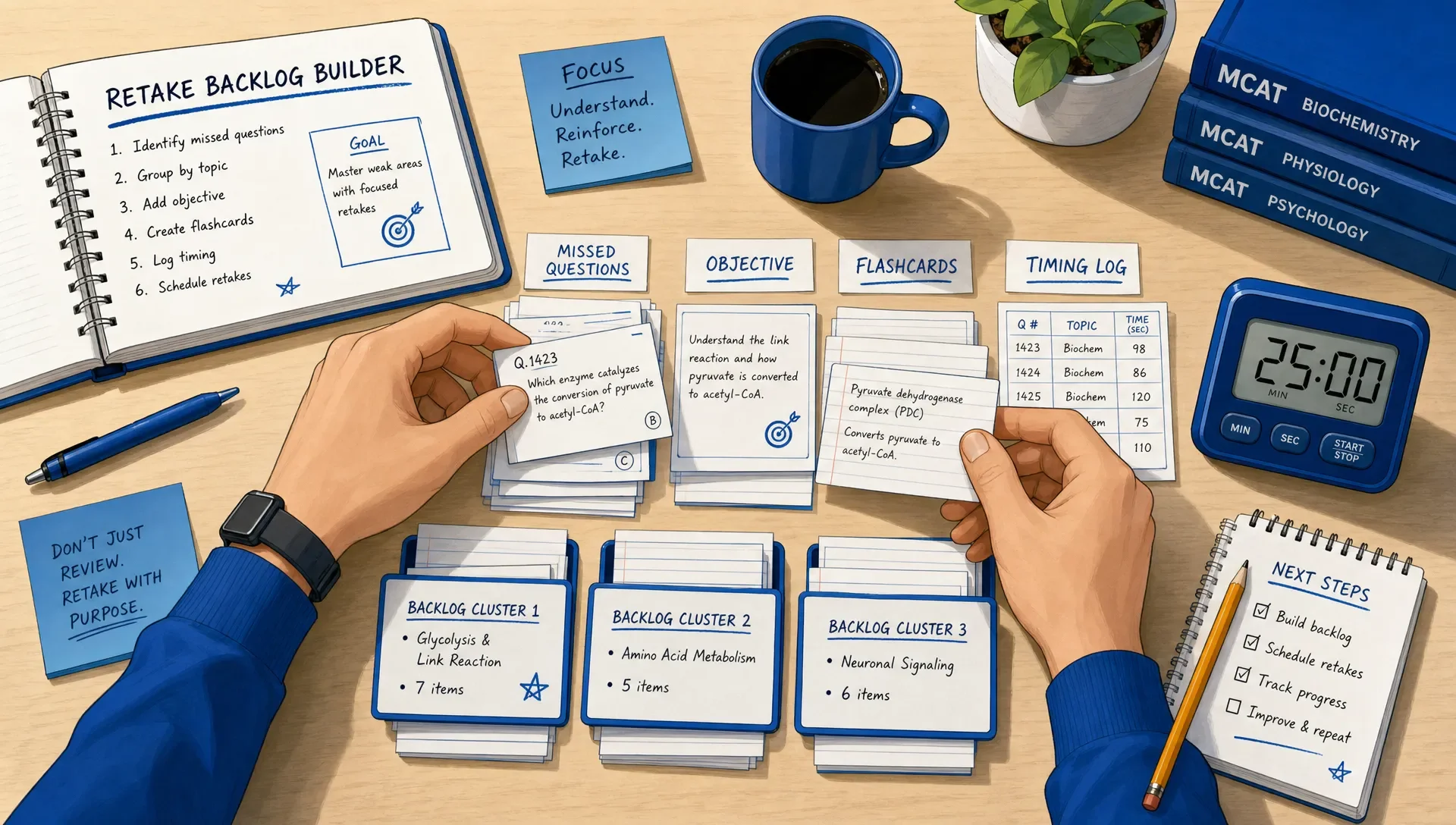
Your exam review should produce a short retake backlog. That backlog isn't a list of chapters. It's a list of testable tasks you can now perform more accurately, such as choosing the right IAM policy boundary, calculating project float, or identifying the secure network control in a scenario.
Cognitive science backs this active approach. In a well-known paper on the testing effect, Roediger and Karpicke found that retrieval practice improved long-term retention compared with repeated studying. For certification prep, that means practice questions, self-explanation, and spaced recall are usually more useful than passive rereading after a miss.
| Checklist item | What to capture | Why it matters for the retake |
|---|---|---|
| Vendor score report | Domain scores, pass line context, and any section feedback | Shows where the exam says you were weakest |
| Question memory notes | Topics, wording traps, and scenario types you remember | Helps identify patterns without violating exam rules |
| Timing data | Sections or question types that slowed you down | Separates knowledge gaps from pacing problems |
| Confidence data | Questions you guessed, changed, or answered too fast | Exposes false confidence and hesitation |
| Retake rules | Waiting period, attempt limits, and registration policy | Prevents rushed scheduling mistakes |
Capture the Score Report and Retake Rules First
Start with the official result report, even if it feels too broad. Most vendors don't hand you a question-by-question breakdown, but domain performance is enough to begin. Map each weak area to the published exam objectives. Then, mark whether the problem was knowledge, application, or recognition under pressure.
Keep your exam review focused on the vendor blueprint. If an AWS, Azure, CompTIA, Cisco, or PMI objective isn't on the exam outline, it shouldn't dominate your retake plan. If an objective appears in a low-scoring domain, it gets priority until you can answer mixed questions on it without relying on memory of a recent explanation.
Also, check the retake policy before choosing a date. Microsoft publishes an official credential retake policy, and AWS explains certification retake details in its AWS Certification FAQs. Rules can change, so confirm the current policy for your exam instead of trusting an old forum post.
If you're rebuilding around cloud fundamentals, a focused practice path such as the AWS Certified Cloud Practitioner practice exam can help you test domain gaps without drifting into unrelated study.
Classify Missed Questions by Cause, Not Just Topic
Topic labels are useful, but they don't explain enough. Two candidates can miss the same encryption question for different reasons. One doesn't know the service feature. The other knows the feature but misread a scenario constraint. Your retake plan should treat those as different problems.
At this point, your exam review becomes diagnostic. For every missed practice question and every remembered exam struggle, assign one primary cause. Don't create ten categories. Use a small set you can act on.
| Miss type | What it looks like | Best fix before retake |
|---|---|---|
| Content gap | You couldn't define the concept or service | Relearn the objective, then answer basic recall questions |
| Application gap | You knew terms but couldn't choose in a scenario | Practice scenario questions and explain why each distractor fails |
| Wording trap | You missed qualifiers like best, first, least, or except | Slow down on stems and underline constraints in practice |
| Timing issue | You rushed late questions or spent too long early | Run timed sets with review of pacing decisions |
| False confidence | You answered quickly and were wrong | Add spaced flashcards and require evidence before selecting |
| Performance task weakness | You struggled with drag-and-drop, configuration, or sequence logic | Practice performance-based formats and step ordering |
This table is especially useful for exams with scenario-heavy questions. For deeper analysis on an answer-by-answer basis, use MindMesh Academy's guide on how to review every practice exam question better after you've classified the miss.
Rebuild Weak Objectives with Short Practice Loops
The best exam review doesn't turn into a month of random studying. Use short loops instead: learn the objective, retrieve it from memory, answer a small mixed set, review explanations, and schedule a spaced follow-up. Then move on only when you can explain the decision process without reading the answer first.
A practical loop can fit into 45 to 75 minutes. Start with one weak objective from the vendor outline. Read or watch only enough to rebuild the concept. Close the material and write what you remember. Answer 10 to 20 questions that mix that objective with adjacent topics, then review the reasoning behind every option.
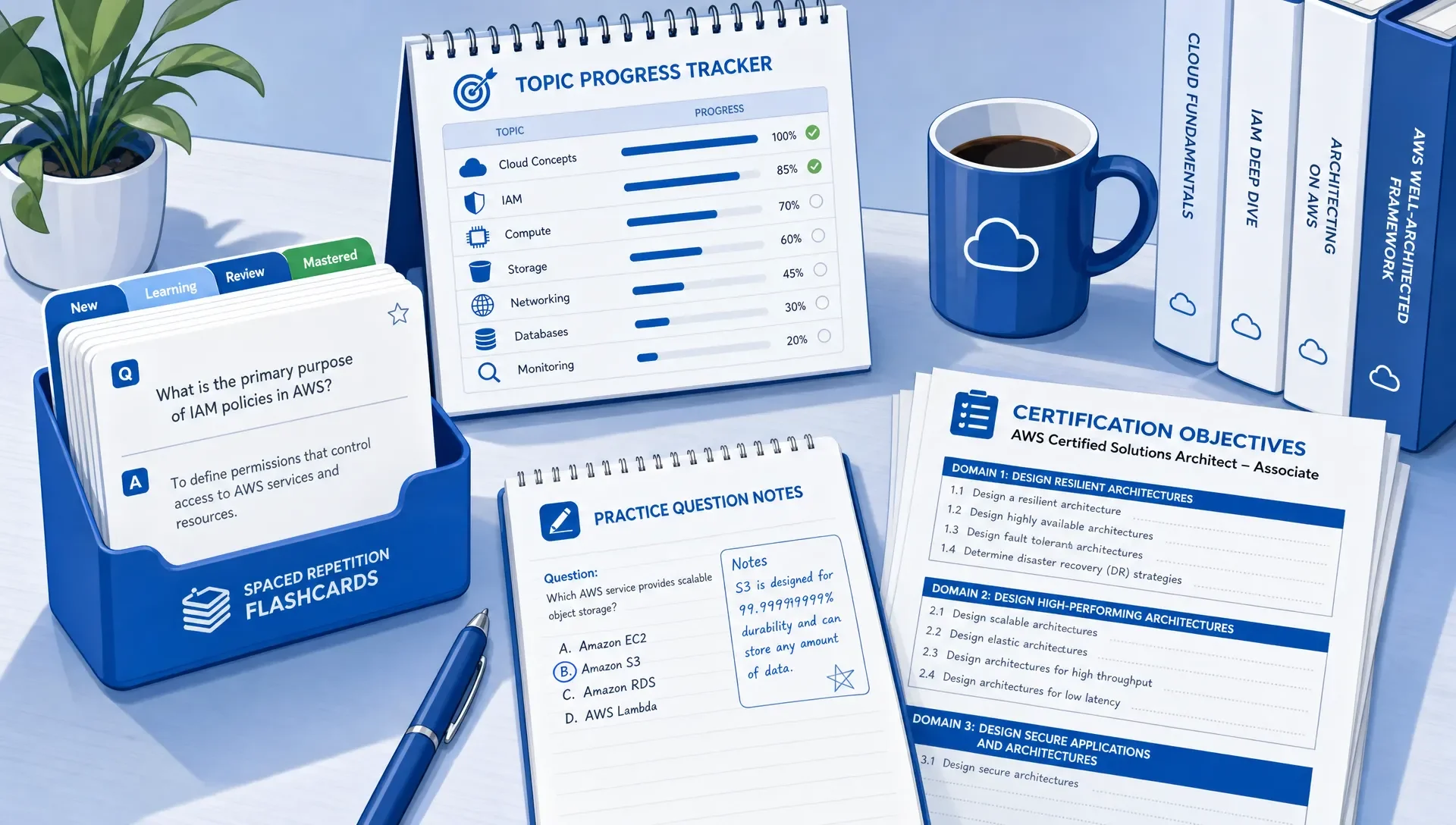
MindMesh Academy is built around that connected workflow: study guides by exam objectives, practice questions with explanations, flashcards with spaced repetition, adaptive weakness-based practice, and readiness tracking by topic. For example, if security fundamentals are your retake focus, the CompTIA Security+ practice exam can help you turn weak domains into targeted question practice.
Use flashcards for facts, ports, formulas, command meanings, governance terms, and service limits. Use scenario questions for judgment. Don't try to fix an application gap with only flashcards, and don't waste scenario practice on terms you still can't define.
Decide When You Are Retake-Ready
Before you schedule the retake, your exam review needs evidence. A higher practice score is helpful, but it isn't enough by itself if you got there by memorizing a small bank of questions. Readiness means you can handle fresh wording, mixed domains, and timed pressure.
Use a retake threshold that combines performance and behavior. You want consistent scores across multiple sets, fewer repeated miss types, and stronger confidence calibration. If you mark a question as high confidence, it should usually be right. If low-confidence answers are improving because you're reasoning better, that's a good sign.
A simple readiness rule works well for many candidates:
- You can explain every missed practice question without rereading the full lesson.
- Your weakest domains have improved across at least two separate study sessions.
- You finish timed sets with enough margin to review flagged questions.
- You no longer miss the same objective for the same reason.
- You can answer mixed questions, not just questions from the chapter you just studied.
If you want a broader method for reviewing full practice tests, MindMesh Academy's article on how to review an exam practice test the right way pairs well with this retake checklist.
Build a One-Week Retake Plan from the Checklist
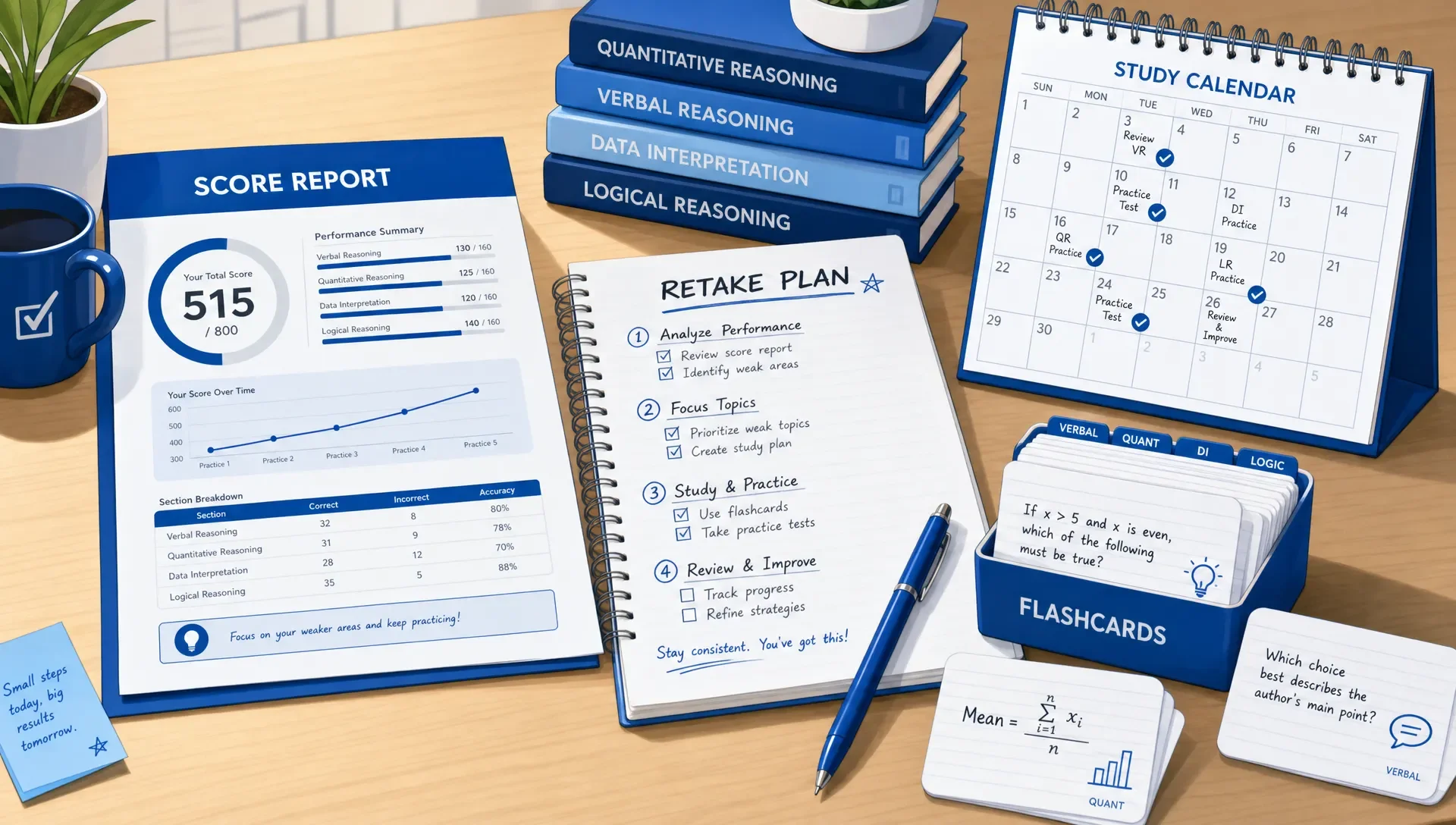
A retake plan should be short enough to follow and specific enough to measure. If you have one week, avoid the temptation to cover everything equally. Put most of your effort into weak objectives that appear frequently on the exam blueprint. Then, use mixed review to keep stronger areas warm.
Here is a balanced one-week structure you can adapt:
| Day | Main focus | Output you should have |
|---|---|---|
| Day 1 | Score report mapping and miss classification | A ranked list of weak objectives and miss causes |
| Day 2 | Highest-priority weak domain | Notes from recall, corrected questions, and flashcards |
| Day 3 | Second weak domain plus performance tasks | Scenario explanations and task sequence practice |
| Day 4 | Mixed timed set | Timing notes and updated miss table |
| Day 5 | Spaced review of missed concepts | Fewer repeat mistakes on prior weak topics |
| Day 6 | Full or half-length practice exam | Readiness score plus confidence and pacing review |
| Day 7 | Light recall and logistics | Exam rules confirmed, no heavy cramming |
For Microsoft fundamentals candidates, pairing objective-based review with a structured resource like the AZ-900 Microsoft Azure Fundamentals study guide can keep the final week focused on what the exam actually measures.
Avoid These Retake Mistakes
A failed attempt can push you into overcorrecting. Some candidates study for too many hours without retrieval practice. Others take the same practice test repeatedly until they know the answers by position. Both habits create the feeling of progress without proving readiness.
The most common retake mistake is treating explanations as the end of review. An explanation is only useful if you can close it and reproduce the reasoning. After reading why the correct answer works, say why each wrong answer fails. Then come back later with a similar question and test whether the reasoning stuck.
Also, avoid rescheduling too soon just to get the exam behind you. If the vendor requires a waiting period, use it as a structured repair window. If there's no long wait, still require objective-level proof before booking. Retakes cost time, energy, and often money, so your preparation should reduce avoidable risk.
Frequently Asked Questions
How soon should I do an exam review after failing? Do it within 24 hours if possible. You don't need to relive every detail, but you should capture domain scores, timing problems, remembered question types, and confidence issues before they blur together.
Should I retake the exam as soon as the waiting period ends? Not automatically. A useful exam review should show that your weak objectives have improved through fresh practice, not just that you've waited the required number of days.
How many practice questions should I do before a retake? Use enough to prove consistency across weak and mixed domains. For many learners, smaller reviewed sets beat huge question marathons because the explanation work is where the improvement happens.
What if my score report only gives broad domains? Break each broad domain into official exam objectives. Then use practice questions to find the specific subtopics that cause misses, such as terminology, scenario judgment, calculations, or performance-based steps.
Are flashcards enough for a certification retake? Flashcards help with recall, definitions, and facts, but they aren't enough for scenario-heavy exams. Pair them with practice questions, explanations, and timed mixed sets.
If your first attempt at a certification exam didn't go as planned, don't just study more—study smarter. MindMesh Academy offers the tools to transform your exam review into an actionable retake plan. Our platform helps you pinpoint weak areas, practice with objective-aligned questions, and use spaced repetition flashcards to reinforce key concepts. Ready to turn those gaps into strengths? Prepare to pass with confidence by testing your knowledge and reasoning with our AZ-900 Microsoft Azure Fundamentals practice exam.

Written by
Alvin Varughese
Founder, MindMesh Academy
Alvin Varughese is the founder of MindMesh Academy and an enterprise architecture leader. An electrical engineer by training, he moved from factory automation in South Africa to cloud architecture at GE Appliances and Humana (Fortune 50), and holds 20 professional certifications including AWS Solutions Architect Professional, Azure DevOps Engineer Expert, and Microsoft Agentic AI Business Solutions Architect. He built MindMesh Academy after interviewing too many highly certified candidates who couldn't answer basic questions: the goal is prep that makes you better at the job, not just able to pass the exam.