
Exam Prep Tips for Busy Certification Candidates
Exam Prep Tips for Busy Certification Candidates
If you're balancing work, family, commuting, and a certification deadline, effective exam preparation isn't about studying longer. It's about making each session count. This week, start by mapping official exam objectives, reserving realistic study blocks, and taking a short diagnostic quiz. This way, you'll know exactly which topics need your attention first.
Your goal isn't to consume every resource available. It's to build reliable recall, recognize exam-style wording, and track whether your weak areas are shrinking. This needs a simple system you can repeat even when you're tired, not a perfect schedule you abandon after three days.
Start With Official Exam Objectives and a Real Calendar
Certification exams are built around published objectives, domains, or skills measured. These documents tell you what can appear on the exam and how vendors describe the expected knowledge. For example, AWS publishes official certification exam information for its programs, and Microsoft Learn provides official study guides, like the AZ-900 skills measured guide.
Before you open another video, book, or practice set, turn these objectives into a checklist. Mark each line as "strong," "shaky," or "unknown." The best exam prep tips only work when they're tied to a target, because busy candidates don't have spare hours to spend on topics they've already mastered.
| Planning item | What to write down | Why it matters |
|---|---|---|
| Exam date | Your scheduled or target test date | Creates a real backward plan |
| Weekly study windows | Specific days and times you can protect | Prevents vague intentions |
| Objective checklist | Strong, shaky, and unknown topics | Shows what deserves time first |
| Practice baseline | Your first quiz score by domain | Separates confidence from evidence |
| Review cadence | Days for flashcards and missed questions | Keeps older topics from fading |
If your calendar is unpredictable, plan both a minimum and a stretch version. The minimum version might be four 30-minute blocks per week. The stretch version could add a weekend review session. When life gets messy, you still have a plan you can execute.
Exam Prep Tips for Busy Certification Candidates Who Study in Short Blocks
Short sessions work best when each one has a specific job. A 20-minute window is enough for one exam objective, ten flashcards, or a focused review of missed questions. It's not enough time to open five tabs, reorganize your notes, and then decide what to do next.
Use a session menu so you don't waste the first five minutes choosing. Match the block length to the task instead of forcing every study session to look the same.
| Available time | Best use of the block | Avoid this |
|---|---|---|
| 10 minutes | Flashcards or definitions | Starting a brand-new complex topic |
| 20 to 25 minutes | One objective plus active recall | Passive reading with no check |
| 45 minutes | Practice questions and explanation review | Racing through questions for a score only |
| 60 minutes or more | Mixed review across weak domains | Studying only your favorite topic |
A useful short block has three parts: recall what you know, check it against the source, and record the next action. For example, if you're studying identity and access management, close your notes first and explain the concept from memory. Then compare your explanation to the guide, fix the gap, and tag the objective for review.
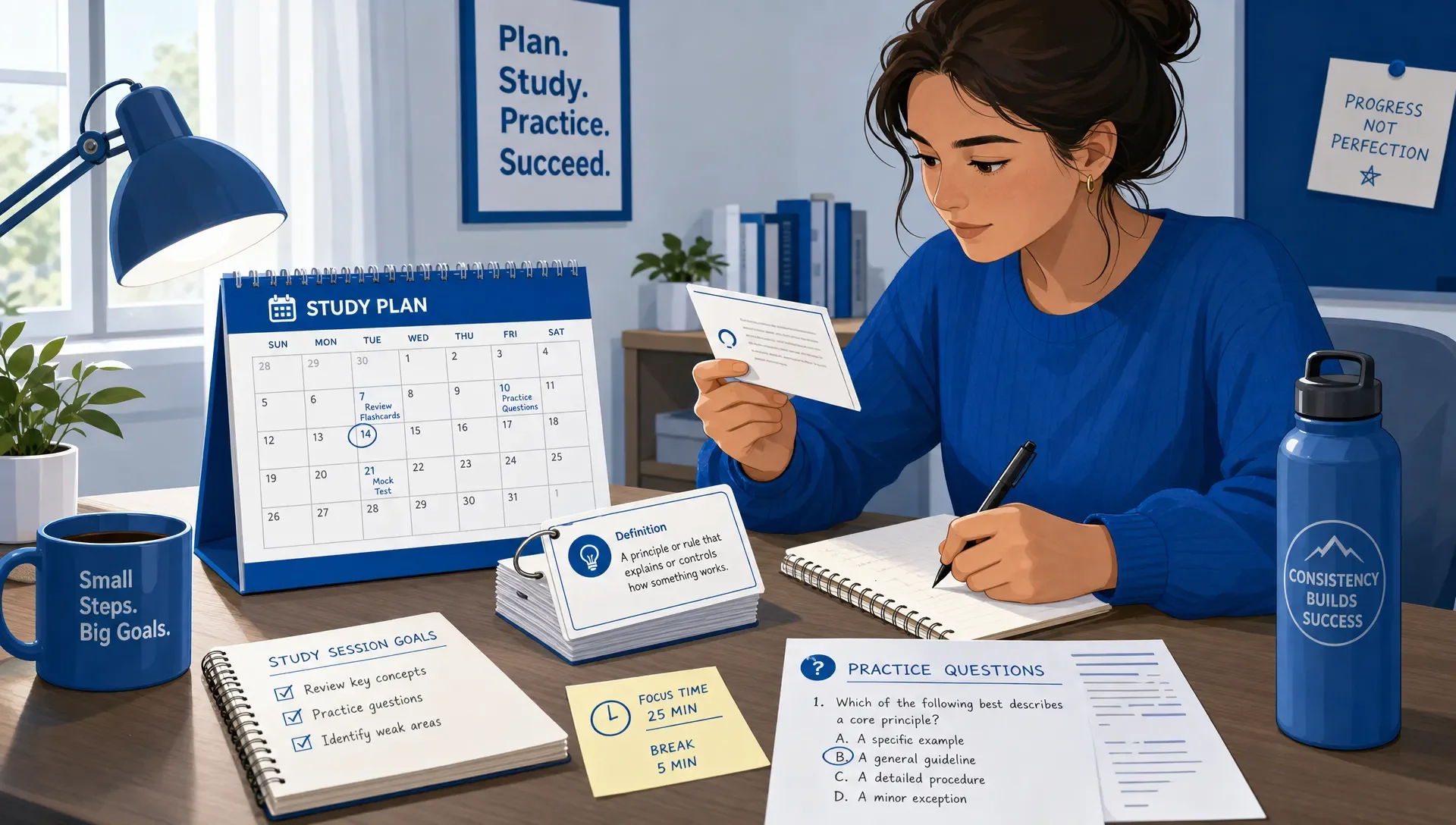
Use Practice Questions as Learning, Not Just Scoring
Practice questions are most valuable when you treat every answer choice as feedback. If you only record the final score, you miss the reason you got questions wrong. A wrong answer can mean you forgot a fact, misunderstood the scenario, missed a keyword, or chose too quickly.
Retrieval practice has strong support in learning science. In a 2006 Psychological Science paper, Roediger and Karpicke found that taking tests improved later retention compared with additional study alone. For busy learners, the best exam prep tips turn practice into retrieval training, not just score prediction.
When you review a missed question, write the rule behind the answer in your own words. Then write why the best distractor was wrong. If you're preparing for an entry-level cloud certification, an AWS Certified Cloud Practitioner practice exam can help you practice reading vendor-style scenarios under time pressure. If you're working on security fundamentals, a CompTIA Security+ practice exam gives you a structured way to expose weak domains before test day.
Don't wait until the final week to do questions. Use them early, even before you feel ready. A low early score is useful if it tells you exactly what to study next.
Build a Weekly Study Loop That Fits Work and Family
A weekly loop keeps your preparation moving without requiring daily willpower. You decide what happens on each type of study day, then repeat the pattern until your readiness improves. These exam prep tips keep the system small enough to survive busy weeks.
| Day type | Main task | Evidence to capture |
|---|---|---|
| Learning day | Study 1 to 2 objectives | Short notes or recall summary |
| Recall day | Flashcards and closed-book explanation | Cards missed more than once |
| Practice day | Timed question set | Score by objective or domain |
| Review day | Rework missed questions | Cause of each mistake |
| Reset day | Adjust next week's priorities | Top 3 weak areas |
The loop matters more than the exact days. If Tuesday becomes impossible, move the recall day to Wednesday. If your weekend disappears, do a smaller practice set instead of skipping review entirely.
The weekly study loop approach works especially well for candidates who prepare after work because it removes the daily question of what to study. You just follow the next step in the loop.
The Institute of Education Sciences practice guide Organizing Instruction and Study to Improve Student Learning recommends spacing learning over time rather than concentrating it in one session. That's exactly why a weekly loop beats a weekend-only cram plan for most certification candidates.
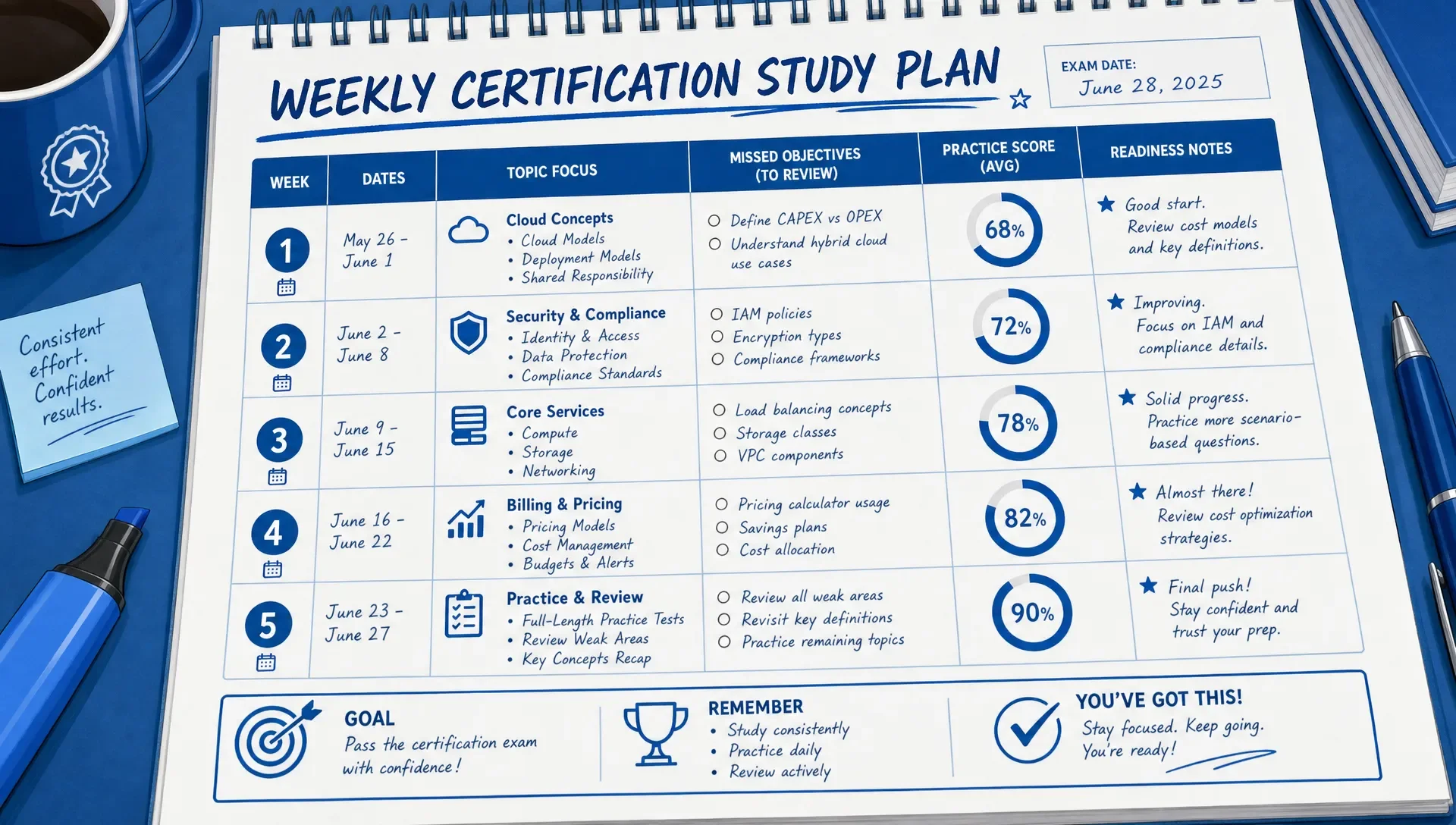
Track Weak Objectives Before You Add More Materials
When candidates feel stuck, they often buy another book, open another playlist, or restart from chapter one. More materials can help, but only after you know the real blocker. A candidate who misses subnetting questions for three different reasons doesn't need more random networking content. They need to isolate the exact skill gap.
Use these exam prep tips to make weakness tracking specific. Don't write "networking is bad." Write "confuses CIDR ranges," "forgets port numbers," or "misses requirement words in routing scenarios." Specific labels make your next session obvious.
MindMesh Academy is built around this kind of connected workflow. It connects study guides by exam objectives, practice questions with explanations, flashcards with spaced repetition, adaptive weakness-based practice, progress tracking by topic, mastery tracking, and readiness tracking. This means you can move from learning to recall to practice without losing sight of which objectives still need work.
Prepare for Scenario Questions and Performance-Based Formats
Many certification exams test application, not just definitions. You may need to choose the best service for a business need, identify the most secure configuration, or troubleshoot a sequence of steps. Performance-based question formats raise the pressure because they require you to do something with the knowledge.
The right exam prep tips for scenario-heavy exams focus on decision cues. As you review questions, circle the words that changed the answer: cost, least privilege, highly available, fastest recovery, on-premises, serverless, encrypted at rest, or minimal downtime. Then ask yourself which objective the question is really testing.
For performance-based formats, practice the task pattern instead of memorizing only the final answer. If the exam expects you to configure, order, match, or troubleshoot, rehearse the steps from memory. Then check your work and repeat the weak part. This is slower than reading explanations, but it builds the kind of readiness you can use when the interface or wording looks unfamiliar.
Protect Your Energy During the Final Week
The final week is for sharpening, not rebuilding your entire study plan. If you discover a weak domain, study it in focused blocks and test it again. Don't blow up the schedule by trying to relearn every topic from scratch.
Use timed practice, but don't take full-length exams back to back if it leaves you exhausted and reviewing poorly. One full-length test can be useful for pacing. Smaller, targeted sets are often better for repairing weak areas.
Two days before the exam, reduce the load. Review high-yield notes, repeat missed flashcards, and revisit objectives you tagged as shaky. The night before, stop chasing obscure details. Your brain needs sleep more than one more frantic pass through the material.
Frequently Asked Questions
What are the best exam prep tips if I only have 30 minutes a day? Use one clear task per session. Rotate between objective study, flashcards, practice questions, and missed-question review. A daily 30-minute session works best when you track the objective covered and the next weakness to revisit.
How early should I start taking practice questions? Start early with small sets. You don't need to finish all study material first. Early practice questions reveal how the exam phrases concepts and help you find weak areas before they become final-week surprises.
Should I study every day for a certification exam? Daily study helps some candidates, but consistency matters more than perfection. Four focused sessions per week can work if you include recall, practice, and review. If you miss a day, continue the loop instead of restarting the plan.
How do I know when I'm ready to schedule the exam? Look for stable evidence across several areas: consistent practice performance, fewer repeated mistakes, strong recall on major objectives, and enough pacing control to finish timed sets. Readiness should come from patterns, not one lucky score.
Is cramming ever useful for busy candidates? Cramming can help refresh facts you already understand, but it's weak for building durable understanding from zero. If your exam is close, focus on missed objectives, repeated question types, and core scenarios instead of trying to cover everything equally.
Turn Limited Study Time Into Measurable Progress
Busy candidates don't need a louder study plan. They need a smaller one that produces evidence every week. Anchor your prep to official objectives, use short sessions with a defined purpose, treat practice questions as retrieval training, and track weak topics until they improve.
MindMesh Academy helps certification learners connect those steps through objective-based study guides, practice questions with explanations, spaced repetition flashcards, adaptive weakness-based practice, and readiness tracking. If your schedule is tight, prepare for the AWS Cloud Practitioner exam with our study guide and focus each session on finding a weak objective, practicing it actively, and recording what you'll review next.

Written by
Alvin Varughese
Founder, MindMesh Academy
Alvin Varughese is the founder of MindMesh Academy and an enterprise architecture leader. An electrical engineer by training, he moved from factory automation in South Africa to cloud architecture at GE Appliances and Humana (Fortune 50), and holds 20 professional certifications including AWS Solutions Architect Professional, Azure DevOps Engineer Expert, and Microsoft Agentic AI Business Solutions Architect. He built MindMesh Academy after interviewing too many highly certified candidates who couldn't answer basic questions: the goal is prep that makes you better at the job, not just able to pass the exam.