Cram for the Exam Without Forgetting It Tomorrow
Cram for the Exam Without Forgetting It Tomorrow
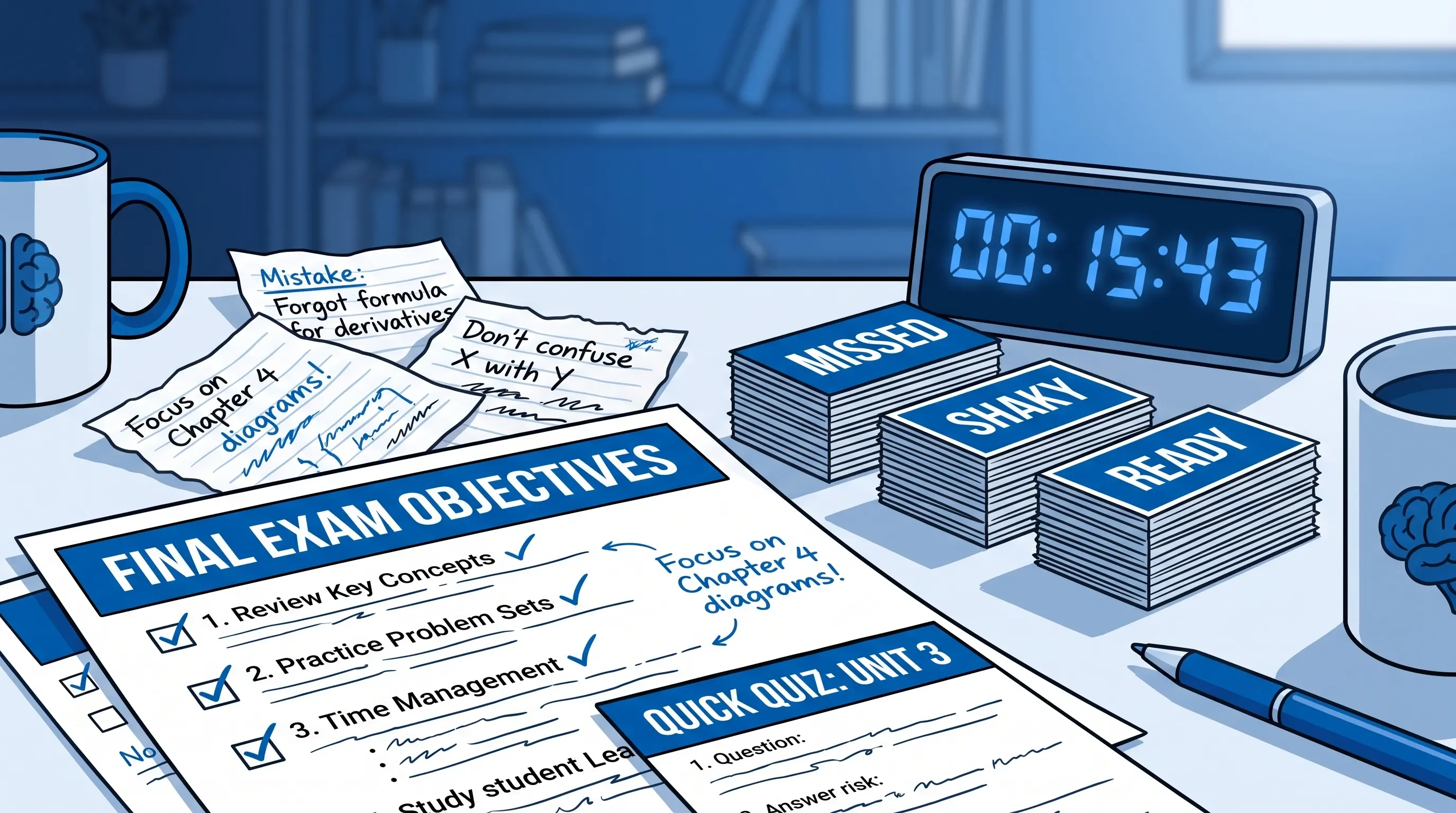
If you need to cram for an exam, don't just reread your notes. Start by finding the exam objectives you keep missing. Then, test yourself without looking at the book, immediately review the explanation for anything you get wrong, and revisit those weak points later the same day.
The goal isn't to "cover everything." It's to practice retrieving answers enough times that your brain can find them under pressure tomorrow, next week, or whenever your exam is scheduled. A smart cram session is selective, active, and uses spaced repetition, even if you only have a short time to prepare.
What to Study First When Your Exam is Close
When time is limited, your initial study choices are more critical than how many hours you put in. Don't simply open a course at chapter one and hope to reach the end. Certification exams are built around specific objectives, domains, and task statements, so your cram plan should reflect that.
Use three filters to decide what deserves your attention first: what the exam emphasizes, what you've missed before, and what you can't explain without your notes. If you're unsure how to prioritize, MindMesh Academy's guide to things to study first when your exam date is close offers a useful framework for narrowing down your list.
This simple priority table helps keep you focused:
| Time left | Main goal | Best use of study time | What to avoid |
|---|---|---|---|
| 7 days | Close major gaps | Take a diagnostic quiz, map misses to objectives, and review weak domains | Starting a brand-new full course from lesson one |
| 72 hours | Improve recall speed | Practice mixed questions, review explanations, and make flashcards for repeated misses | Long passive rereading sessions |
| 24 hours | Stabilize what you know | Run short timed question sets, review your mistake notes, and get enough sleep | All-night studying and chasing obscure edge cases |
| Exam morning | Warm up retrieval | Review formulas, ports, command syntax, or process steps you've already studied | Learning large new topics for the first time |
For many IT certifications, the most valuable material isn't just a fact you vaguely remember. It's a concept you can recognize in a practice question but can't apply in a scenario. These are the items most likely to trip you up on exam day.
How to Cram for the Exam Using Active Recall
Active recall means you try to produce an answer before looking at the source material. This is the opposite of rereading, highlighting, or passively watching another explanation video.
Retrieval practice has strong scientific support. In an experiment by Roediger and Karpicke published in Psychological Science, students who practiced recalling material performed better on delayed retention tests than those who repeatedly restudied. When you're cramming, this is crucial because delayed recall is exactly the problem you're trying to solve.
Use this pattern for each weak objective:
- Prompt yourself first: Turn the objective into a question before you read the answer.
- Answer closed-book: Speak it aloud, write it down, or choose an option without looking at notes.
- Check immediately: Compare your answer to the explanation, not just the correct letter.
- Repair the gap: Write one sentence explaining why the correct answer is right.
- Return later: Test the same point again after a break, then again before bed.
This approach feels slower than skimming, but it produces clear evidence of what you know. If you can answer without help, you're closer to ready. If you can't, you've found the next thing to fix.
A 48-Hour Cram Schedule That Reduces Forgetting
Even a compressed schedule can benefit from spacing. The Institute of Education Sciences practice guide on organizing instruction and study to improve learning recommends spreading learning over time instead of concentrating practice into one long block. You don't need weeks to apply this idea; you can space reviews across morning, afternoon, and evening.
Here's a practical 48-hour plan for a certification exam:
| Time block | What to do | Why it works |
|---|---|---|
| 48 hours out | Take a mixed practice set or diagnostic quiz | Identifies weak objectives before you waste time |
| 42 hours out | Review explanations for every missed or guessed question | Converts errors into specific study targets |
| 36 hours out | Study only your top 3 to 5 weakest areas | Prevents scattered cramming |
| 24 hours out | Take another timed mixed set | Tests whether your review improved recall |
| 18 hours out | Create a short flashcard deck for repeatedly missed items | Targets fragile facts and rules |
| 12 hours out | Re-answer missed questions without looking at explanations | Forces retrieval instead of mere recognition |
| Night before | Do a 20 to 30 minute light review, then sleep | Protects memory consolidation and exam focus |
| Exam morning | Warm up with a small set of familiar prompts | Activates recall without causing panic |
If you're preparing for a cloud fundamentals exam, a focused tool like the AWS Certified Cloud Practitioner practice exam can help you pinpoint exactly which objectives still need work, rather than just guessing based on your confidence.
How to Review Practice Questions So You Remember the Concept
Practice questions are only helpful if you review them correctly. A score tells you how you performed once. The explanation tells you what to change before your next attempt.
When you miss a question, don't just copy the answer. Ask yourself what kind of mistake it was. Did you lack the definition? Did you misunderstand the scenario? Did two options seem correct? Did you forget a sequence, command, port, process group, or shared responsibility boundary?
This table turns mistakes into specific actions:
| Mistake type | What it usually means | Best fix |
|---|---|---|
| Vocabulary miss | You didn't know a term or acronym | Make a short flashcard with a plain-English definition |
| Rule miss | You forgot a requirement, threshold, or condition | Write an if-then statement and test it later |
| Scenario miss | You knew the fact but applied it to the wrong situation | Rewrite the question in your own words before answering again |
| Distractor trap | You picked a plausible but incomplete option | Explain why each wrong answer is wrong |
| Sequence miss | You confused order, workflow, or escalation steps | Draw the steps from memory, then check |
Think of question review as narrowing possibilities based on feedback. That's why tools like a Wordle solver with tile-color input are a useful comparison: each clue removes bad options and improves your next guess. Exam review works the same way when you use explanations to correct your mental model, not just to memorize a letter.
For a security certification, this is especially important because many questions test your judgment, not just isolated facts. If you're studying for Security+, the CompTIA Security+ practice exam is most effective when you review each explanation and map your misses back to the objective area.
How to Use Flashcards When You're Cramming
Flashcards can save a cram session, but only if you use them strategically. Don't turn every paragraph into a card. You'll create too much review work and end up flipping cards without truly thinking about the answers.
Use flashcards for material that needs quick recall: command syntax, service names, protocol behavior, project management terms, port numbers, formulas, security controls, cloud responsibility boundaries, or definitions that appear across many questions.
Good cram flashcards are short and directly answerable. "What does RTO measure?" is better than "Explain business continuity." "Which Azure service stores secrets?" is better than "Review Azure security services." If a card requires a full paragraph to answer, it's probably a note, not a flashcard.
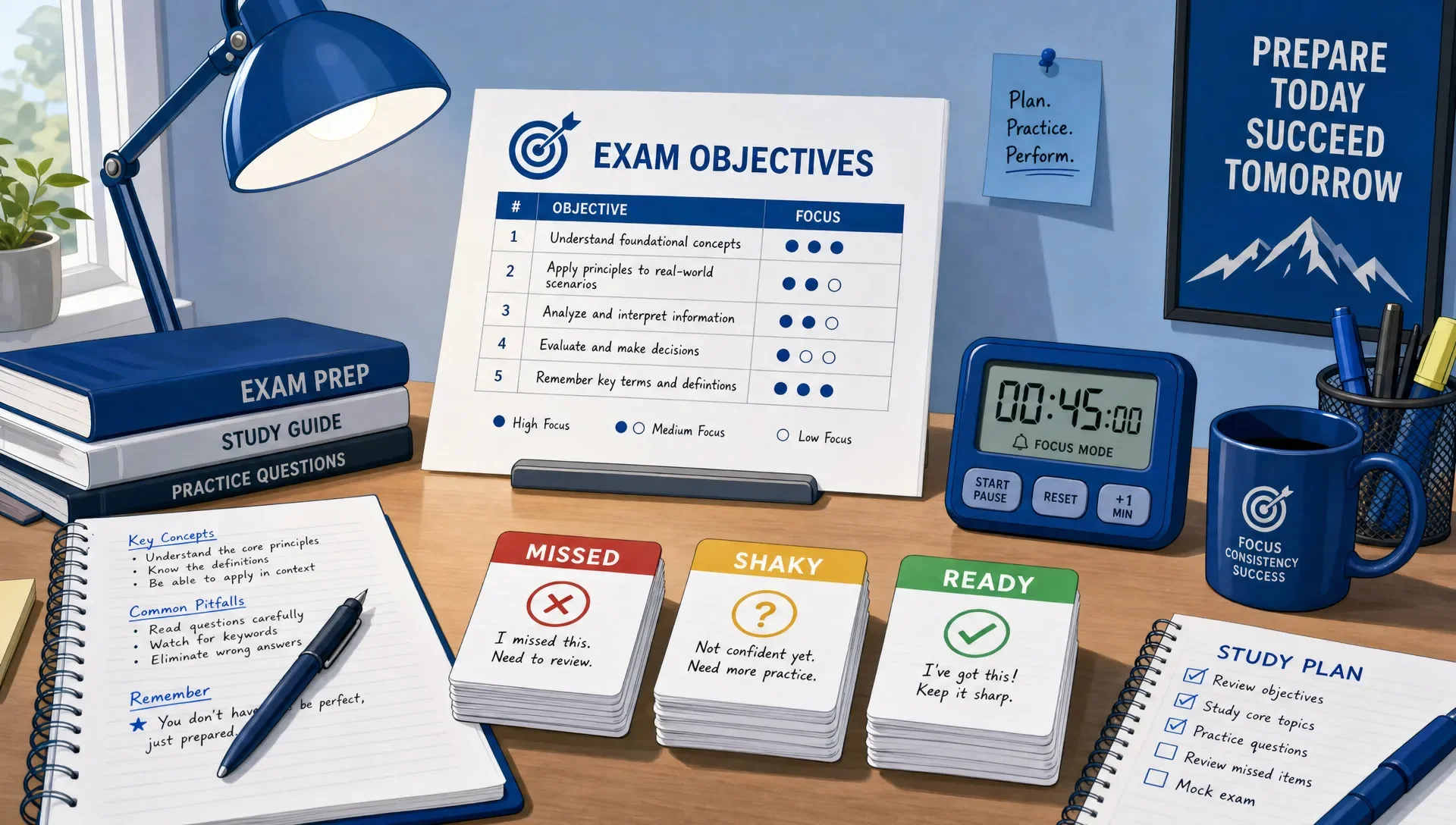
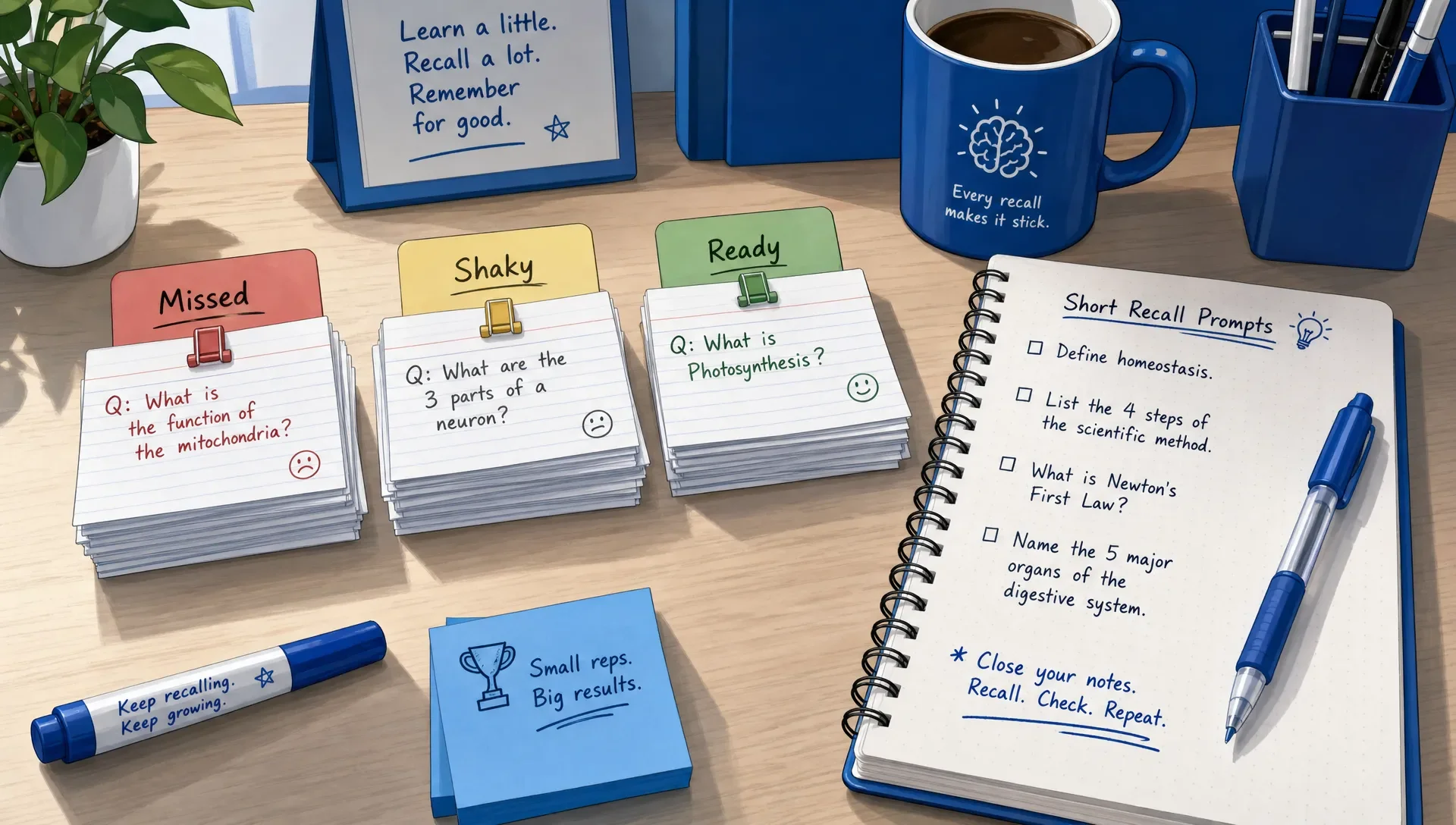
A strong cram deck has three piles: missed, shaky, and ready. Review missed cards first. If you get one right twice across separate sessions, move it to shaky. If you can explain it quickly the next morning, move it to ready. This keeps your focus on the items most likely to disappear under exam pressure.
Study guides organized by objective also help prevent random card creation. For example, an AZ-900 Microsoft Azure Fundamentals study guide can help you keep flashcards aligned with the exam objectives instead of building a deck from scattered notes.
What to Do the Night Before the Exam
The night before an exam is for stabilization, not last-minute heroics. If you've been cramming all day, your instinct might be to keep pushing until you're exhausted. This often leads to worse recall, more anxiety, and sloppy reading on exam day.
Sleep supports memory consolidation. A review by Rasch and Born in Physiological Reviews describes how sleep contributes to memory processing after learning. For exam prep, the practical takeaway is simple: don't sacrifice sleep for low-quality study hours unless you truly have no other choice.
Use your final evening for a light pass through high-yield material:
- Re-answer questions you previously missed, closed-book.
- Review a short flashcard deck of fragile facts.
- Read your one-page mistake summary.
- Pack your ID, testing details, and any approved materials.
- Stop studying early enough to get a full night's sleep.
If you find yourself trying to learn a large new topic at midnight, write down one or two key rules from that topic and then move on. At that point, deep understanding is less useful than calm recall of what you've already studied.
What Not to Do When You Cram for the Exam
Bad cramming often feels productive because it fills time. Good cramming produces recall you can actually test.
| Cramming habit | Why it fails | Better move |
|---|---|---|
| Rereading the same chapter repeatedly | Recognition feels like mastery, but it isn't recall | Close your notes and answer prompts from memory |
| Taking a full practice exam with no review | You get a score but don't fix knowledge gaps | Review every miss and every lucky guess |
| Studying only your favorite topics | Confidence rises while weak areas remain unaddressed | Start with repeated misses and high-weight objectives |
| Making huge flashcard decks | The sheer volume overwhelms your review time | Create cards only for fragile, testable facts |
| Pulling an all-nighter | Focus and recall typically suffer significantly | Do a short review, sleep, and warm up in the morning |
| Memorizing answers | Slightly different wording on the exam breaks recall | Explain the concept behind each answer |
The rule is straightforward: if a study activity doesn't require you to retrieve, apply, or explain, it probably shouldn't dominate a cram session.
Frequently Asked Questions About Cramming for Exams
Can I cram for the exam and still remember the material later? Yes, but only if you use retrieval practice, spaced review, and mistake analysis. If you only reread notes, you'll likely recognize the material while studying and struggle to recall it later.
How many practice questions should I do the day before an exam? Do enough to find and repair weak areas, but not so many that you stop reviewing explanations carefully. For many learners, several short timed sets with thorough review are more effective than one long practice exam followed by exhaustion.
Is it better to study new material or review weak areas when time is short? Review weak areas first, especially if they align with high-weight exam objectives. Only learn new material if it fills a major gap that is highly likely to appear on the test.
Should I use flashcards during last-minute study? Yes, if the cards are short and targeted. Use them for facts, terms, commands, formulas, and rules you consistently miss. Avoid trying to convert entire study guides into cards at the last minute.
What should I do if I keep missing the same type of question? Identify the mistake type. If it's a vocabulary miss, create a definition card. If it's a scenario miss, rewrite the scenario and explain why the correct answer fits. Re-test that specific point later without looking.
Is an all-nighter ever worth it before a certification exam? Usually no. If you're completely unprepared, a short emergency review might help, but sacrificing all sleep often harms attention and recall more than it helps. Prioritize the highest-yield objectives, then get some rest.
Use a Cram Session to Build Readiness, Not Just Urgency
Cramming doesn't have to mean panic studying. If you focus on exam objectives, practice questions, explanations, flashcards, and spaced review, even a short study window can build usable memory.
MindMesh Academy is built for that kind of connected workflow. You can study by exam objectives, practice with explanations, use flashcards with spaced repetition, and track your readiness by topic so your final study hours go where they matter most.
If your exam is close, start with one diagnostic set today. Mark every miss, review the explanation, build a small flashcard deck, and re-test those exact weak points before bed. That's how you cram for the exam and show up well-prepared on exam day. Ready to test your knowledge? Build a strong foundation for your Azure certification with our AZ-900 Microsoft Azure Fundamentals practice exam.

Written by
Alvin Varughese
Founder, MindMesh Academy
Alvin Varughese is the founder of MindMesh Academy and an enterprise architecture leader. An electrical engineer by training, he moved from factory automation in South Africa to cloud architecture at GE Appliances and Humana (Fortune 50), and holds 20 professional certifications including AWS Solutions Architect Professional, Azure DevOps Engineer Expert, and Microsoft Agentic AI Business Solutions Architect. He built MindMesh Academy after interviewing too many highly certified candidates who couldn't answer basic questions: the goal is prep that makes you better at the job, not just able to pass the exam.