
Your Ultimate CompTIA Network+ Practice Test Guide
High-quality CompTIA Network Plus practice tests are the most effective way to be well-prepared for the N10-009 exam. These tools offer more than simple quizzes. Use them to experience the actual testing environment and accurately identify your weak points. This targeted preparation builds the specific skills and steady self-assurance you need to succeed on your scheduled exam day.
Why Practice Tests Are Your Strategic Advantage for the Network+ Exam
Preparing for the CompTIA Network+ certification requires steady effort. The N10-009 exam tests a wide array of technical topics, from network architecture and security protocols to hardware setup and troubleshooting. A common mistake candidates make is relying only on passive learning, such as reading text-heavy study guides or watching videos. While these tools are good for learning facts, they do not prepare you for the specific environment of the actual test.
Success in high-level IT certifications—whether the Network+, AWS Solutions Architect, or PMP—requires active study. This is why a realistic practice test is an essential tool. It moves you beyond just knowing the material and forces you to apply it in a practical way.
Think about a pilot learning to fly. You would not want to be on a plane where the pilot had only read a manual. Pilots spend significant time in a flight simulator before they ever take off for real. This simulator creates difficult weather conditions and mechanical failures, forcing the pilot to make quick decisions under pressure. It shows exactly where their skills need work. A high-quality practice exam does the same for your technical networking skills.
Simulating the Real Exam Experience
The CompTIA Network+ N10-009 exam is a respected standard because it confirms you have the skills required for modern networking roles. The test includes a maximum of 90 questions. These are a mix of standard multiple-choice items and performance-based questions (PBQs) that require you to solve problems in a simulated environment. You have 90 minutes to complete the exam and must earn a score of 720 on a scale of 100-900 to pass. You can find the full official details on the CompTIA website.
A reliable practice test is built to replicate these exact conditions. It helps you learn to manage your time and perform under pressure while becoming used to the different question formats. This type of practice builds mental muscle memory. On the day of your appointment, the test interface and the timer will feel familiar, which helps reduce anxiety. This focus on active preparation is a key part of passing. To see more about the steps involved, look at our guide on how to get a CompTIA certification.
A practice test is more than a way to measure your progress. It is an active learning tool. Every wrong answer is an opportunity to strengthen a specific topic, turning a potential mistake into a confirmed skill before you take the real exam.
Reflection Prompt: Have you ever felt overwhelmed by the clock during an exam? How could simulating the testing environment help you control that pressure for a certification like the Network+ or the Azure Administrator?
Beyond a Simple Score: The Power of Diagnostic Feedback
The real advantage of a CompTIA Network Plus practice test is the diagnostic data it provides. A basic quiz might just give you a final score, but a high-quality tool gives you a detailed look at how you performed in every exam domain.
This feedback tells you exactly which topics you know and where you have gaps in your knowledge. It allows you to stop guessing and start using a targeted study plan. You can spend your time fixing your specific weaknesses instead of reviewing material you already understand.
Review the weighted domains for the N10-009 exam in the table below to help plan your study schedule:
CompTIA Network+ (N10-009) Exam Domains at a Glance
This table shows the different sections of the Network+ exam and how much they contribute to your final score. Use this information to prioritize your study time based on the importance of each topic.
| Exam Domain | Percentage of Exam |
|---|---|
| 1.0 Networking Fundamentals | 24% |
| 2.0 Network Implementations | 19% |
| 3.0 Network Operations | 16% |
| 4.0 Network Security | 19% |
| 5.0 Network Troubleshooting | 22% |
Networking Fundamentals and Network Troubleshooting account for 46% of the questions on the test. Knowing this helps you decide where to put the most effort. If you master these two areas, you are much closer to a passing score. This kind of specific insight is what helps successful candidates pass their first time.
Key Takeaway: Focus on the official exam domain weights for any certification you pursue. For an AWS exam, the weights might emphasize security or cost management. These percentages act as a map for your study plan, showing you exactly what the test will prioritize.
Deconstructing Realistic Network+ Practice Questions
Now, let's move from theory to practical application. Reading a textbook builds foundational knowledge, but the real test involves applying that knowledge to scenario-based questions. To demonstrate this, we will examine several practice questions that mirror the types you will find on the current N10-009 exam.
These are not simple vocabulary recall exercises. CompTIA presents real-world situations that challenge you to use critical thinking and problem-solving skills under pressure. This approach mimics the daily experience of a network engineer in a production environment.
For each question, we will do more than identify the correct choice. Real learning happens when we analyze why an answer is correct and why the other options are wrong. This systematic method helps you develop the discernment needed to spot distractors and avoid common mental traps found throughout the exam.
Question 1: Networking Fundamentals
We will start with a troubleshooting scenario that involves a core networking concept you must master to be well-prepared.
Scenario: A network technician is assisting a user who can connect to the office printer by entering its IP address but cannot access any external websites like Google or CNN. The technician suspects a specific network service has failed.
Which protocol is MOST likely causing the problem?
- A) DHCP
- B) DNS
- C) SMTP
- D) ARP
Correct Answer: B) DNS
Explanation Breakdown:
This is a standard Network+ troubleshooting question. The most significant clue in the description is that the user can reach resources via an IP address but fails to access them using human-readable names.
- A) DHCP (Dynamic Host Configuration Protocol): DHCP automatically assigns IP addresses and other configuration parameters to devices. Because the user can communicate locally using an IP address, their computer clearly has a valid IP, meaning DHCP functioned correctly.
- B) DNS (Domain Name System): DNS acts as the internet's phonebook. It translates domain names (e.g., mindmeshacademy.com) into numerical IP addresses that computers use to find resources. If DNS is down, this translation fails. However, if you already know the destination IP address, as with the printer, direct communication still works.
- C) SMTP (Simple Mail Transfer Protocol): SMTP handles the transmission of email. It does not affect a user's ability to browse websites or reach local network printers.
- D) ARP (Address Resolution Protocol): ARP maps IP addresses to physical MAC addresses on the local network segment. Since the user can print, local network communication is functional, proving that ARP is working as intended.
This question assesses your understanding of exam objective 1.3, which covers the concepts and purposes of network services.
Question 2: Network Implementations
Next, we will look at a wireless networking question. These are frequent on the Network+ exam because Wi-Fi is used in almost every office today.
Scenario: An IT team is upgrading the wireless infrastructure in a crowded office building. Their goals are to provide faster data speeds for all users and to reduce interference from neighboring wireless networks and internal sources like microwave ovens.
Which wireless standard is the best choice to fulfill these requirements?
- A) 802.11b
- B) 802.11g
- C) 802.11n
- D) 802.11ac
Correct Answer: D) 802.11ac
Explanation Breakdown:
This question requires you to identify the traits of different Wi-Fi standards. The two requirements are higher speed and lower interference.
- A) 802.11b: This standard is obsolete. It offers very slow speeds, with a maximum of 11 Mbps, and operates only in the crowded 2.4 GHz band.
- B) 802.11g: While faster than the 'b' standard, it is still limited to the congested 2.4 GHz band, which is prone to interference from other electronics.
- C) 802.11n: This was a major advancement because it supports both 2.4 GHz and 5 GHz bands. However, 802.11ac provides even higher throughput and better optimization for the 5 GHz band, making it the better choice here.
- D) 802.11ac: Also known as Wi-Fi 5, this is the superior choice for this scenario. It operates mostly in the 5 GHz frequency band. This band provides more channels and less congestion than the 2.4 GHz band used by older standards and household appliances. This specific feature directly solves the interference problem while offering much higher speeds. (Verify current hardware requirements for N10-009 on the CompTIA site).
This scenario maps to exam objective 2.2, which involves installing and configuring wireless standards and technologies.
A quick pro tip: Avoid merely memorizing the standard letters like b, g, n, ac, and ax. Instead, focus on understanding their core features, such as the operating frequency (2.4 GHz vs. 5 GHz), typical speeds, and the best use cases for each. This conceptual understanding helps you answer scenario-based questions across many different IT certifications.
Question 3: Network Security
Network security is a large part of the Network+ exam, accounting for 19% of the total score. This question focuses on specific security tools.
Scenario: A security analyst wants to implement a solution that can identify and actively block malicious network traffic before it enters the company's internal network. This action must happen in real-time.
Which security tool is the MOST appropriate for this requirement?
- A) NIDS
- B) SIEM
- C) Honeypot
- D) NIPS
Correct Answer: D) NIPS
Explanation Breakdown:
The most important phrase in this prompt is "actively block." This distinction is key. You must separate tools that only monitor from tools that can take immediate action to stop a threat.
- A) NIDS (Network Intrusion Detection System): A NIDS is a passive tool. It works like a security camera by detecting suspicious activity and creating logs or alerts. It cannot step in to stop the traffic. It detects threats but does not prevent them.
- B) SIEM (Security Information and Event Management): A SIEM is an analytical platform. It gathers and compares security logs and data from many sources to find patterns or threats. It is not an inline device that inspects and blocks live traffic as it moves through the cable.
- C) Honeypot: This is a decoy system designed to look vulnerable. Its purpose is to lure attackers so IT staff can study their methods. While it provides good intelligence, it does not provide active protection for your actual production servers.
- D) NIPS (Network Intrusion Prevention System): A NIPS is an active security appliance placed inline. This means it sits directly in the path of network traffic. Because it is inline, it can inspect every packet in real-time and proactively drop or block malicious data before it reaches its destination. This matches the scenario's requirement perfectly.
This question relates to exam objective 4.2, which covers deploying appropriate security solutions.
By analyzing questions in this way, you are not just memorizing facts. You are building the skills of a technician who knows how to apply knowledge to solve complicated problems. This is exactly what the N10-009 exam measures. A high-quality practice test will include many of these analytical challenges to ensure you can pass with confidence.
Reflection Prompt: Consider the proactive nature of a NIPS and the reactive nature of a NIDS. In what specific office environment would you choose to prioritize one over the other?
How to Analyze Your Practice Test Results for Real Progress
The moment you click 'submit' on a full-length CompTIA Network+ (N10-009) practice test (verify current exam code on the vendor site) is a significant milestone. However, you should resist the urge to close the browser tab and walk away. The most productive work of your study session is actually just starting. While your raw score tells you if you passed or failed the practice run, the real value is found in the detailed breakdown of your performance.
Simply glancing at your overall percentage and moving on is a major strategic error. Your goal is not just to pass a practice exam; it is to determine exactly which steps you need to take to pass the actual certification exam. This requires a thorough examination of why you missed certain questions and the identification of repeating patterns in your mistakes.
Moving Beyond the Overall Score: Domain-Specific Insights
It is natural to focus on a final score, such as "75% correct." While this provides a general benchmark, it does not offer enough detail to guide your next study session. A more effective approach is to break down your results by the official CompTIA exam domains. This shows you exactly where your knowledge is solid and where it is thin.
Any high-quality practice test platform should automate this analysis. It should provide a performance snapshot that looks similar to this:
- Networking Fundamentals: 90%
- Network Implementations: 85%
- Network Operations: 70%
- Network Security: 65%
- Network Troubleshooting: 75%
With these numbers, your study plan becomes obvious. Network Security and Network Operations are the domains that need your immediate attention. This breakdown changes a vague goal of "studying more" into a direct objective: "I need to master the security protocols and operational procedures required for the N10-009 exam." This allows you to use your study time much more efficiently.
The following flowchart shows the three-step workflow you should apply to every question you face during a practice session.
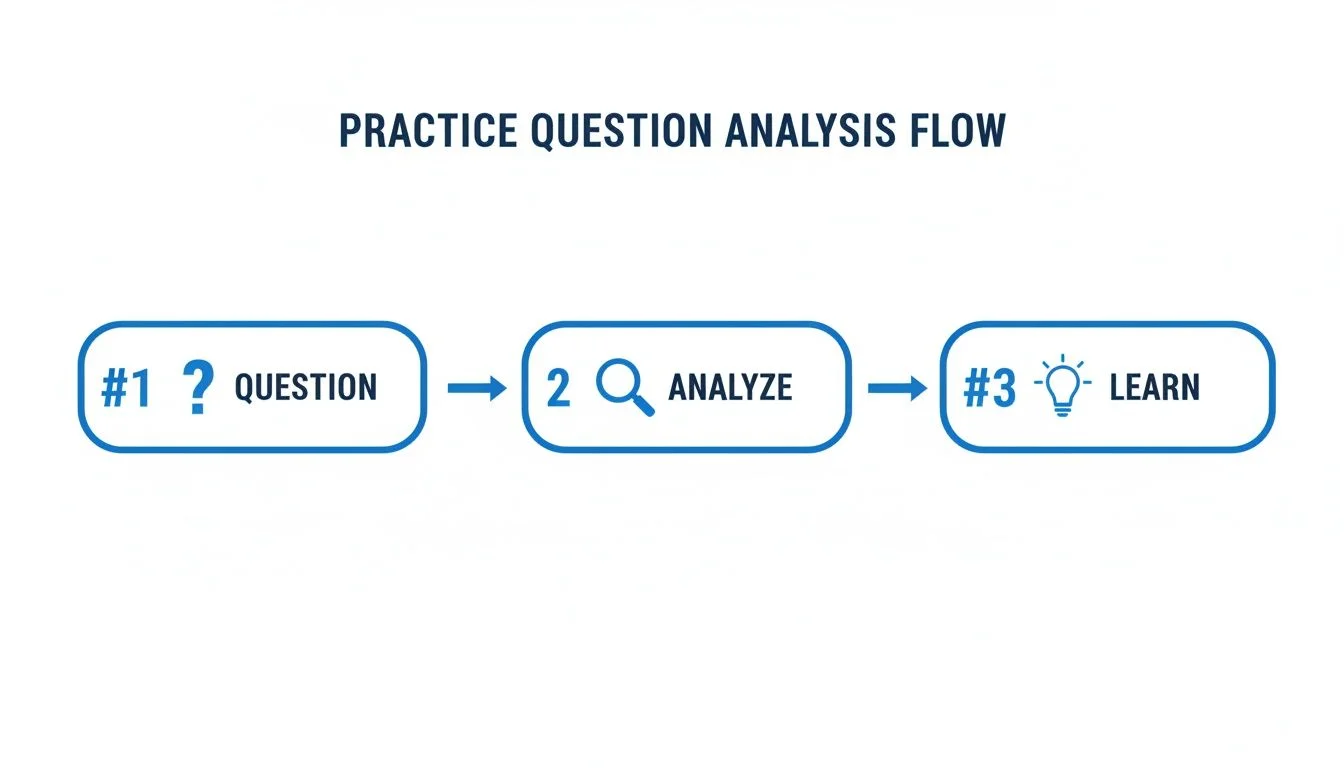
Every question is a chance to learn, regardless of whether you got it right or wrong. By following this cycle—questioning the logic, analyzing the answer choices, and learning the underlying concept—you will build the technical proficiency needed for the final testing day.
Conducting a Knowledge Gap Analysis
Once you identify your weakest domains, you need to look at the individual questions. For every answer you missed, you must find the root cause. This methodical process is a personal "knowledge gap analysis."
Do not simply read the correct answer and move to the next item. For each mistake, ask yourself these four questions:
- Was this a true knowledge gap? Did you actually understand the technical material? For example, if a question asks you to distinguish between a NIDS and a NIPS, or requires a specific subnet mask calculation, and you couldn't do it, you have a knowledge gap. You might need to review the OSI model layers or specific routing protocols like OSPF or BGP.
- Did you misinterpret the question? Often, students move too fast and miss words like "NOT," "EXCEPT," "BEST," or "FIRST." This is a reading accuracy issue rather than a lack of technical knowledge.
- Were you misled by a distractor? CompTIA uses plausible but incorrect options to test your precision. If you chose an answer that looked right but wasn't the "best" fit for the specific scenario described, you were caught by a distractor.
- Was time a factor? If you made a mistake because you saw the timer winding down and felt pressured to choose quickly, your challenge is test-taking speed and stress management.
Categorizing your errors in this way is very useful. If most of your mistakes are knowledge gaps, your priority is to go back to your textbook or video course to review the core concepts. If your errors are caused by distractors or misinterpretation, you need to practice more with the specific way CompTIA words their exam questions.
The purpose of analyzing a practice test is not to focus on your mistakes. It is to create a data-driven plan that points you toward the specific information you need to pass the certification exam with confidence.
Using an Error Log and Modern Tools
A simple but effective way to track your progress is with an error log. You can use a basic spreadsheet to record the question ID, the incorrect answer you chose, the correct answer, and the reason you made the mistake based on the four categories mentioned above. Reviewing this log every few days helps you remember difficult concepts and prevents you from making the same mistakes twice.
Modern study platforms make this process much faster. For example, the dashboard at MindMesh Academy turns your practice test results into visual data automatically.
This type of dashboard tracks your performance against every individual exam objective. It uses charts to show where you are strong and where you need help. You can see immediately if you are struggling with subnetting, specific wireless security standards like WPA3, or command-line troubleshooting tools like "tracert" or "dig." This changes your review from a manual chore into a quick, strategic exercise. You spend less time looking for your weaknesses and more time fixing them, which is the best way to improve your score on the actual exam.
Building a Study Plan That Actually Works
You have finished your practice test and looked over the data. You now have a clear view of what you know and, more importantly, where you are struggling. This is the moment when many students make a mistake. They fall back into the habit of reading a textbook from the first page to the last. While that might feel productive, it is often a waste of time. We are going to use a different strategy that targets your gaps directly.
Instead of generic reading, we will build a study plan that is efficient and tailored to your specific needs. This method focuses on adaptive learning. The goal is to make sure every hour you spend studying actually improves your score. You are not just trying to pass time; you are trying to fix weaknesses.
This strategy uses two main techniques: Spaced Repetition and the adaptive study path. By combining these, you stop scanning pages and start building knowledge that stays with you. You move away from temporary memorization and toward a functional understanding of networking concepts.

Using Spaced Repetition to Make Concepts Stick
Most students have experienced the "cram and forget" cycle. You study for ten hours straight, feel like an expert on Friday, and forget everything by Monday. This happens because the brain treats a single, massive block of information as a temporary event. Spaced repetition is the solution to this problem. It is a proven method for moving data from short-term memory into long-term storage.
The idea is straightforward: rather than studying a topic once for a long time, you review it in short bursts over several days or weeks. You revisit the material just as you are about to forget it. This forces your brain to work harder to recall the information, which strengthens the neural connections.
Take a difficult topic like subnetting or the details of the N10-009 exam objectives. A spaced repetition schedule would look like this:
- Day 1: Study the core concept of CIDR notation and practice calculating host ranges for several Class C networks.
- Day 3: Perform a quick five-minute review of the formulas you used on Day 1 to keep them fresh.
- Day 7: Solve five new subnetting problems without looking at your notes to test your active recall.
- Day 16: Complete a mixed quiz that includes subnetting and other IP addressing topics to ensure the knowledge is permanent.
Each time you successfully remember the steps for calculating a subnet mask, you wait longer before the next review. This tells your brain that the information is important and needs to be kept. It is much better than spending five hours on subnetting in one night and never looking at it again until the test. Any high-quality CompTIA Network Plus study guide will suggest this type of active recall because it is the fastest way to prepare for a technical exam.
Carve Out Your Adaptive Study Path
The next step is to make your learning personal. An adaptive study path uses the results from your CompTIA Network Plus practice test to show you exactly what to study today. It is a flexible plan that changes as you improve. This ensures you spend your time on the topics that provide the biggest boost to your exam score rather than reviewing what you already know.
To build your own adaptive path, follow these steps:
- Prioritize Your Weakest Domains: Look at your score report for the N10-009. If you scored 65% in Network Security but 90% in Network Architecture, your path is clear. You should start with the security domain. Do not waste time on the topics where you are already hitting your target score.
- Drill Down with Precision: You cannot just study "Security" as a whole. You need to find the specific gaps. If you missed questions about stateful firewalls or WPA3 encryption, create a study session that focuses only on those protocols. Avoid the temptation to read the entire security chapter. Focus on the parts that caused you to miss points.
- Continuous Review and Re-Evaluation: After you finish a focused study session, take a short quiz on that specific topic. If your score goes up, you can move that topic into your spaced repetition rotation and find the next weakest area on your list. This keeps your momentum high and prevents you from getting stuck on one subject for too long.
This cycle creates a feedback loop: you study, you test, you look at the results, and you adjust. It is the most effective way to close gaps. You stop guessing what to study and start using data to drive your progress.
An adaptive study plan acts like a tutor. It knows where you are failing and gives you the right material at the right time to help you reach the level of knowledge required for the exam.
Putting It All Together in a Typical Week
Suppose your first practice test showed you were struggling with Network Security (specifically firewall rule sets) and Network Troubleshooting (using command-line tools). You also did well on Wireless Standards, but you want to keep that knowledge fresh.
Here is how a week of adaptive study would look for a student preparing for the current N10-009 exam:
| Day | Primary Focus (Weakest Area) | Secondary Focus (Spaced Repetition) |
|---|---|---|
| Monday | Study Firewall Rules and ACL logic | Review 802.11 wireless standards |
| Tuesday | Practice using ping, traceroute, and nslookup | Take a 10-question subnetting quiz |
| Wednesday | Quiz yourself on firewall configuration scenarios | Review the 7 layers of the OSI Model |
| Thursday | Solve Layer 2 and Layer 3 connectivity problems | Review DNS and DHCP port numbers |
| Friday | Take a mini-test on security and troubleshooting | Review Network Fundamentals (Domain 1.0) |
This schedule works because it forces you to spend the most energy on your hardest topics while using spaced repetition to maintain your strengths. You are always moving forward, but you aren't leaving your old knowledge behind. Keep in mind that a good plan only works if you stay focused. You may need to find ways to improve your focus while studying to make these sessions effective.
Some digital tools, like those from MindMesh Academy, build this adaptive logic into their software. These systems look at your practice test scores and automatically suggest which drills you should do next. They provide a dashboard that shows your progress across all exam domains. This takes the guesswork out of planning and lets you focus entirely on learning the material. When you use a system like this, you spend less time organizing and more time preparing, which helps you walk into the testing center with confidence.
Connecting Your Certification to a Higher Salary and Career Growth
Passing the CompTIA Network+ exam (verify current exam details on the vendor site) does much more than just add a bullet point to your resume. It represents a functional and clear move for your career path and your future earning potential. Every hour you spend working through a CompTIA Network Plus practice test is more than just reading; it is a specific effort intended to produce real results in your bank account. When a hiring manager sees this certification on your LinkedIn profile or CV, they see proof that you have the skills to handle the networking issues that occur in a modern office. This verified expertise is often what makes a recruiter look closer at your background.
This credential acts as a gateway to several of the most needed roles in information technology. Certified professionals are often first in line for jobs like Network Administrator, Junior Network Engineer, IT Support Specialist, and technical help desk positions. It is frequently the specific factor that moves an application out of a crowded digital inbox and onto a manager’s desk for a formal interview. Employers want to know that the person they hire understands subnetting, security protocols, and troubleshooting before they start the job.
Translating Certification into Compensation
What does this certification actually mean for your paycheck? The statistics are clear. Getting your CompTIA Network+ can increase how much you earn each year. On average, IT workers who hold this certification earn a salary of about $73,938 USD (verify current salary data on the vendor site).
That number changes based on where you live and how many years you have been in the industry. Starting roles in smaller markets might begin at $29,000, but as you gain more experience and take on more responsibility, you can move toward senior positions that pay over $144,500 in major cities (verify current salary data on the vendor site).
Seeing these numbers helps make late-night study sessions feel more productive. Every difficult practice question you solve is a step toward building the professional profile that earns a higher salary. Studying changes from a repetitive chore into a clear strategy for your professional life.
Your Network+ certification is more than just a certificate; it is proof of your value. It provides you with the confidence and the credentials to talk about your salary and the specific job title you want to hold.
While the certification helps you get an interview, your performance in that interview is what finalizes the job offer. To succeed, you must be able to talk about your skills clearly. Mastering effective interview practice is how you show your worth and secure the pay that matches your certification. The Network+ is a solid foundation for a long IT career. To see where you can go next, check out our guide to the best certifications for network engineers and plan your next professional move.
Your Top Questions About the Network+ Practice Test Answered
While you prepare for the CompTIA Network+ exam, you likely have several questions about how to use practice tests. Finding specific answers helps you create a study plan that works while increasing your certainty before you enter the testing center. Most candidates want to know how these tools fit into a daily routine and how to interpret their scores. We will address the most frequent questions from people looking to start their careers as network professionals.
How Many Practice Tests Should I Take?
There is no single number that works for every student, but experience shows that most successful candidates reach their goal by completing at least 3-5 full-length, high-quality practice exams. You should view these as technical checkpoints rather than random sets of questions.
The first practice exam you take establishes your baseline. You should take this early in your preparation, even if you feel like you have not learned enough yet. Your goal is not to pass on the first try. Instead, you are looking for an honest look at your current knowledge so you can see where you are weakest. This diagnostic data helps you build a targeted study plan for the N10-009 exam from the very first day.
The next two or three tests are your progress markers. Use these after you have spent time focusing on the weak areas identified in your baseline. If you struggled with subnets or OSI layer functions on the first try, these mid-point exams show if your study methods are actually working. They keep you from spending too much time on topics you have already mastered.
Save your final practice test for the week before your scheduled appointment. This is your final dress rehearsal. You must replicate the actual testing environment to get the full benefit. Clear your desk, set a timer for the full duration, and do not look at any outside resources. This builds the physical and mental endurance required to stay focused for the entire length of the official CompTIA exam.
Are Free CompTIA Network+ Practice Tests Good Enough?
Free resources are tempting when you are already paying for exam vouchers and books. A free test can work well for a quick five-minute check on a specific protocol or a single port number. However, building an entire study strategy around free materials is risky. The biggest issue is often the lack of maintenance. Many free websites still use questions from the retired N10-008 version or even older iterations. The current N10-009 exam includes updated objectives that free materials often miss.
Another gap in free resources is the absence of performance-based questions (PBQs). These are the simulation-style questions that require you to configure a virtual router or fix a network diagram. Since these carry a significant weight in your final score, you need practice tools that mimic this specific interaction. A premium practice exam often includes specific scenarios involving command-line interface (CLI) tools or server room configurations. These simulations are hard to find on free platforms, but they represent the core of what a network technician does daily.
Much of the actual learning from a practice test happens during the review of the answer explanations. You need to understand exactly why the correct answer is right and why the other options are wrong for that specific technical scenario. This is how you master the material instead of just memorizing a pattern. Many free resources skip these explanations entirely, leaving you to search for answers on your own.
A paid practice test is an investment in your career. High-quality tools from providers like MindMesh Academy stay updated with current exam requirements. They mirror the difficulty of the real test and provide the feedback required to improve your scores.
What Is a Good Score on a Practice Test?
CompTIA sets the passing score for the N10-009 exam at 720 on a scale of 100 to 900. While that is the technical requirement for certification, your practice test goals should be higher to account for the stress of the actual event. I tell my students to aim for a consistent score of 85-90% or higher on their final practice exams.
This ten-to-fifteen percent buffer is a safety margin. When you sit down in the testing center, your performance might drop due to nerves, time pressure, or the phrasing of a question you did not expect. If you are consistently scoring 88% at home, a slight dip on exam day still keeps you well above the 720 mark. Scoring in this high range also proves that you have moved past simple recognition and have reached a point where you can apply networking concepts to different scenarios. This indicates you are ready to pass the actual Network+ exam with confidence.
Ready to stop guessing and start building a data-driven study plan? The MindMesh Academy platform offers realistic practice exams, an adaptive learning dashboard, and targeted drills designed to close your knowledge gaps and build your confidence. Take this next step in your Network+ certification effort at CompTIA Network+ Practice Exams.

Written by
Alvin Varughese
Founder, MindMesh Academy
Alvin Varughese is the founder of MindMesh Academy and an enterprise architecture leader. An electrical engineer by training, he moved from factory automation in South Africa to cloud architecture at GE Appliances and Humana (Fortune 50), and holds 20 professional certifications including AWS Solutions Architect Professional, Azure DevOps Engineer Expert, and Microsoft Agentic AI Business Solutions Architect. He built MindMesh Academy after interviewing too many highly certified candidates who couldn't answer basic questions: the goal is prep that makes you better at the job, not just able to pass the exam.