
Top Computer Networking Certifications for 2026
Top Computer Networking Certifications for 2026: Your Roadmap to IT Mastery
Computer networking serves as the foundation for modern IT systems. Every digital interaction, from cloud infrastructure management to data center security, depends on stable network performance. Networking certifications act as formal credentials that validate practical skills in designing, building, and maintaining these critical systems. Standard options like CompTIA Network+, Cisco CCNA, and the professional-level CCNP provide a structured path for technicians to advance their careers and distinguish themselves in a competitive hiring environment.
MindMesh Academy recognizes the vital role these credentials play in long-term career growth. This guide provides the specific details required to evaluate different certification paths. We aim to provide the facts needed to make informed decisions about your technical education and professional development. Use these insights to determine which path matches your specific career goals and technical interests.
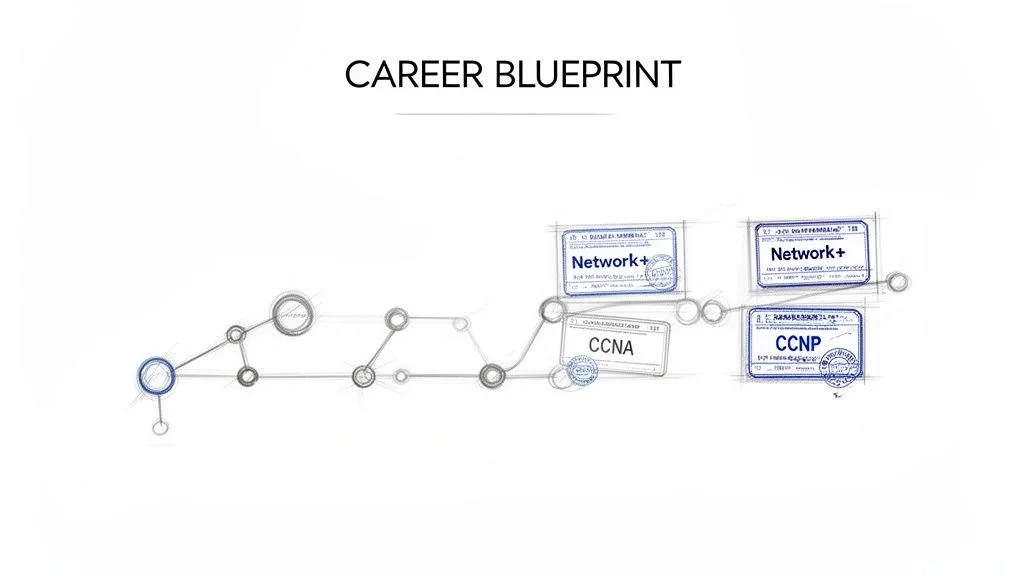
Why Networking Certifications Are Your Career Blueprint
Proving your technical ability is vital in the current IT market. A computer networking certification signals your value to hiring managers and helps your resume stand out from a large pool of applicants. It is more than just a credential; it provides verified evidence of your professional focus and technical foundation. These certifications tell a potential employer that you possess a standardized, industry-recognized skill set. They show you understand core networking theory and can maintain the critical infrastructure that supports an entire business.
The need for skilled network professionals continues to grow. Organizations are moving quickly to adopt cloud services like AWS, Azure, and Google Cloud while managing IoT devices and supporting distributed teams. As these elements merge, network complexity increases. This environment requires professionals who can do more than just mention these systems on a resume. Companies need individuals with validated credentials to confirm their technical proficiency.
Consider the stakes of modern connectivity. Every business application, cloud instance, security protocol, and data transfer depends on a stable network. A network professional is not just a technician; they are the people who make modern business operations possible.
Charting Your Course with Certifications
Networking certifications offer a clear, structured path for learning. They provide a logical framework to expand your knowledge, beginning with basic concepts and moving toward expert-level skills. This structure ensures you master one layer of technology before you try to tackle the next. This diagram shows the standard tiered structure of networking certifications, helping you move from entry-level roles to advanced mastery.
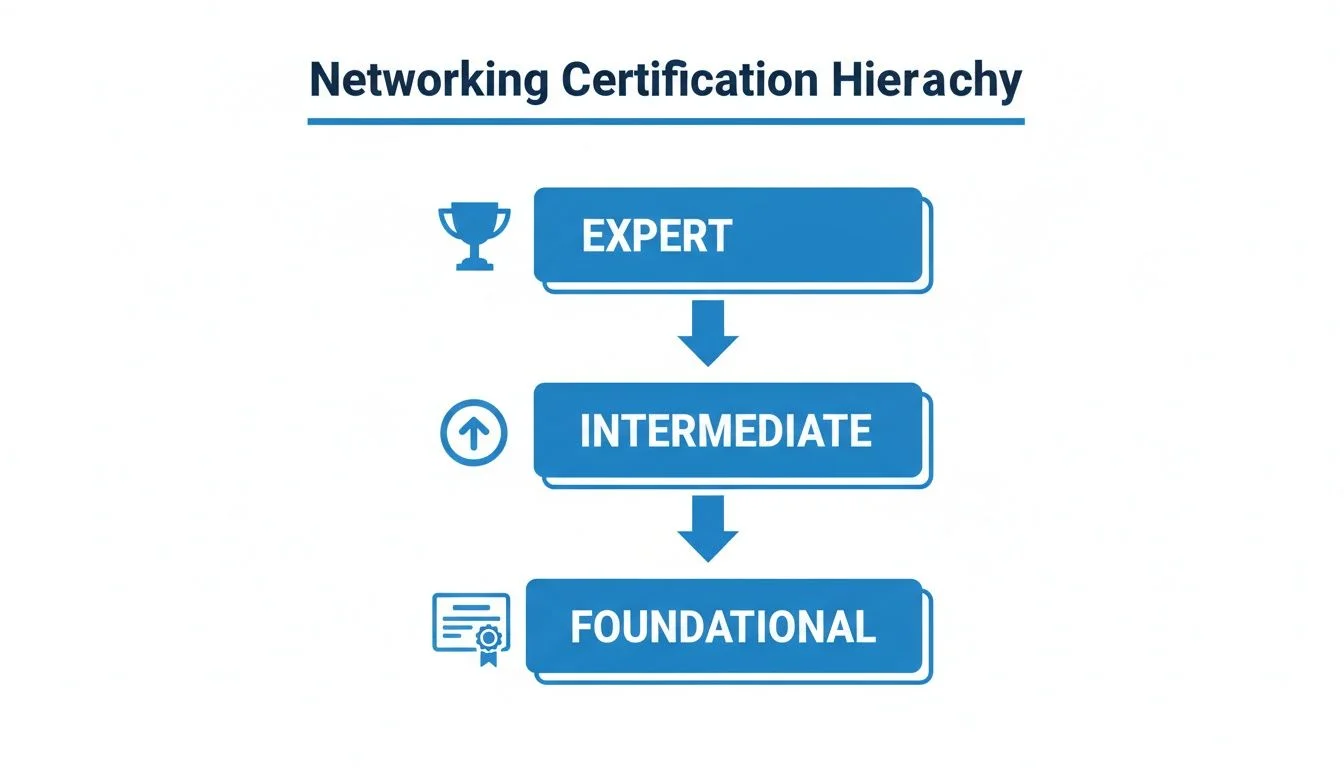
This hierarchy works as a professional map. It lets you check your current skill level and find the specific certifications you need to reach your career goals. To help you plan, the following table outlines several respected certifications based on the experience level they target. You can use this as a quick reference to match your career plans with the right exam.
Networking Certifications by Experience Level
| Experience Level | Top Certifications | Best For |
|---|---|---|
| Foundational | CompTIA Network+ (N10-009), Cisco CCST | Beginners, career changers, and help desk technicians looking for their first step into networking roles. |
| Intermediate | Cisco CCNA, CompTIA Security+ | Professionals with 1-3 years of experience who want to specialize and take on network administrator or engineer roles. |
| Expert | Cisco CCNP/CCIE, AWS Advanced Networking | Senior engineers and architects aiming for leadership positions, high-level consulting, and six-figure salaries. |
Earning these certifications shows you are serious about your work. It shows you take a proactive approach to learning new technologies and mastering the skills that keep our world connected. Once you earn a new certification, make sure your professional profile reflects that achievement. Optimizing your LinkedIn profile is a vital step to help recruiters find your validated skills.
Building Your Foundation with CompTIA Network+
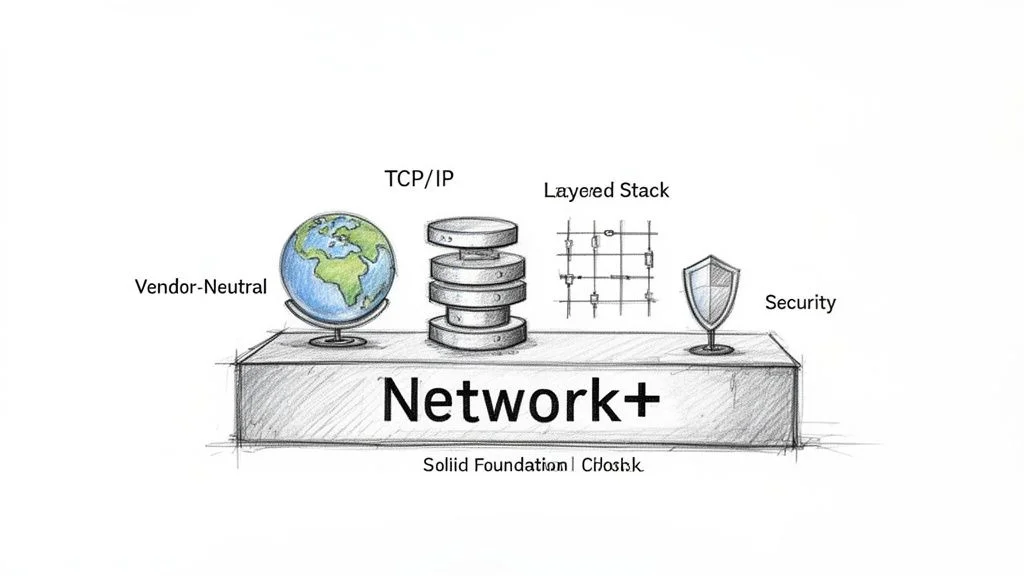
A solid IT career depends on a strong base, much like a stable network infrastructure requires a reliable physical layer. In the field of computer networking, the CompTIA Network+ certification serves as a standard entry point. This credential acts as a universal language for the industry. It teaches the primary rules, protocols, and technical concepts that apply across any environment, regardless of which hardware vendor or software platform a company chooses to use.
The vendor-neutral nature of Network+ is its most significant benefit. While other certifications might focus exclusively on a single manufacturer's product line, Network+ provides a portable skill set that transfers between different employers. It is similar to mastering the rules of grammar and logic before writing a technical manual or a script. These core principles remain the same no matter what tools you use to implement them.
By earning this certification, you demonstrate that you can build, manage, and protect a network. It validates your ability to apply core networking concepts in any professional IT setting. You gain the confidence to speak the same language as senior engineers and contribute to technical discussions during your first week on the job.
What Core Concepts Does Network+ Cover?
The current CompTIA Network+ exam (the N10-009 version) evaluates practical, job-ready knowledge. It avoids over-reliance on abstract theory and focuses on the skills required for modern networking roles. The exam covers a wide range of topics that are necessary for everyday infrastructure tasks.
Here is an analysis of the key domains covered by the exam:
- Networking Fundamentals: This domain confirms your grasp of the OSI model and the TCP/IP stack. You will learn to differentiate between network types, such as Local Area Networks (LANs), Wide Area Networks (WANs), and Wireless LANs (WLANs). The curriculum also includes physical standards like Ethernet cabling, fiber optics, and various connector types. This knowledge is functional because the OSI model provides a standard framework for diagnosing issues across different types of equipment.
- Network Implementations: In this section, you study the practical aspects of configuring and checking network hardware. This includes setting up switches and routers to ensure data moves correctly. You will also look at wireless networking standards, specifically 802.11a/b/g/n/ac/ax, antenna configurations, and the best ways to deploy secure wireless access points. Understanding Virtual Local Area Networks (VLANs) is a major part of this domain, as it allows you to segment traffic and improve network efficiency.
- Network Operations: This domain focuses on the day-to-day management of network performance and uptime. You will learn to use network monitoring tools and establish performance baselines to identify when a system is behaving poorly. The exam also covers disaster recovery plans and the necessity of keeping accurate documentation for all network configurations. For instance, managing a virtual environment like an AWS Virtual Private Cloud (VPC) requires these operational skills to maintain consistent connectivity.
- Network Security: You will study the essentials of protecting a network from unauthorized access. This includes finding common vulnerabilities, hardening devices to prevent attacks, and setting up basic security controls. You will work with firewalls, intrusion detection systems (IDS), and access control lists (ACLs). These skills are not just for specialized security roles; they are a standard requirement for any modern administrator and provide a path toward earning certifications like CompTIA Security+.
- Network Troubleshooting: This area helps you build a logical approach to finding and fixing connectivity issues in wired and wireless environments. You will learn specific troubleshooting methodologies and how to use command-line tools like ping, tracert, ipconfig, and netstat. For example, knowing how to identify subnetting errors is a fundamental requirement for resolving IP addressing conflicts and restoration of service.
By covering these five areas, the Network+ exam ensures you have a versatile skill set that applies to many entry-level IT positions.
Who Is the Ideal Candidate for Network+?
CompTIA Network+ has been a standard foundational certification since it was first released in 1999. It remains a primary starting point for aspiring technicians and professionals with 0-2 years of experience who want to grow their technical abilities.
This certification is a logical step for several specific professional groups:
- Career Changers: If you are moving into IT from a different industry, Network+ gives you the vocabulary and concepts needed to work effectively with a technical team. It helps you understand how data moves, which is the basis for almost every other IT discipline.
- Help Desk Technicians: If you currently work in general support and want to move into infrastructure, this certification is the bridge. It allows you to move away from resetting passwords and toward managing the hardware that keeps a company connected.
- Aspiring Network Administrators/Engineers: Most junior-level administration and engineering roles list Network+ as a requirement or a preferred qualification. It proves you have the background knowledge to handle more advanced vendor-specific training.
If you are committed to a career in networking, the Network+ certification is a reliable first step that provides a high return on the time spent studying.
What Career Paths Does Network+ Unlock?
Earning the Network+ credential functions as a tool to open doors for various foundational IT roles. It tells hiring managers that you have the skills to contribute to an infrastructure team immediately.
Key Insight: The primary benefit of Network+ is its role in helping you land your first job dedicated specifically to networking. It shifts your status from an applicant with general interest to a professional with a verified credential.
Common job titles for those who hold a Network+ certification include:
- Network Administrator: You will manage the daily operations, software updates, and hardware configurations of a company's internal network.
- Junior Network Engineer: You will work under the guidance of senior staff to design, install, and fix network solutions for various clients or departments.
- IT Support Specialist: This role involves solving more complex technical problems that general help desk staff cannot handle, particularly those involving connectivity.
- Systems Administrator: You will manage servers and storage. Because these systems rely on the network, the skills from Network+ are essential for your daily tasks.
- NOC Technician (Network Operations Center): You will watch network performance screens, identify errors, and respond to alerts to make sure the network stays online around the clock.
In these positions, you handle the vital task of keeping data flowing securely. The information you learn for the exam prepares you for these duties and helps you start a long-term career. To see the specific exam objectives and find strategies for passing, you can review our CompTIA Network+ study guide.
Reflection Prompt: How might understanding Network+ concepts help you identify a connectivity problem in a remote office or a cloud-based environment?
Leveling Up Your Career with the Cisco CCNA
Specialization often follows the mastery of universal networking principles. If the CompTIA Network+ serves as a general entry into IT infrastructure, obtaining the Cisco Certified Network Associate (CCNA) is a transition into specialized engineering. This certification requires you to take foundational theory and apply it to the specific hardware that powers most global networks. Because Cisco equipment is so widely used, the skills learned here have immediate practical application in modern data centers and corporate offices.
The CCNA has remained a staple of the IT industry since 1998. Over nearly three decades, it has changed to match the shifting demands of the field. It moved away from a narrow focus on simple routing and switching to include security, wireless, and automation. Today, the credential proves a technician can build, protect, and manage networks using industry-standard equipment and logic. It is a rigorous validation of technical ability that employers recognize immediately.
What the Modern CCNA Covers
The current CCNA exam (200-301) focuses on the requirements of a 2026 technical environment. While the basic mechanics of how packets move across a wire are still there, the curriculum now highlights skills needed to handle software-defined networks and automated systems. Cisco designed this version to produce engineers who can handle current tickets while preparing for future infrastructure shifts.
These are the primary domains covered in the exam:
- Network Fundamentals: This section expands on basic connectivity by looking at specific network components and physical topologies like star and mesh layouts. You must master the details of IPv4 and IPv6 addressing, including complex subnetting and the behavior of various protocols. The goal is to understand how a router makes internal forwarding decisions rather than just knowing what a router is.
- Network Access: This domain focuses on the logic of local connections. You will practice configuring and verifying VLANs (Virtual Local Area Networks) to keep traffic separated and efficient. It also covers the setup of inter-VLAN routing and the management of wireless LANs. You will need to understand access point operations and security standards like WPA3 to ensure mobile devices connect safely.
- IP Connectivity: This is the core of traditional networking. Candidates must learn to configure and fix issues within static routing and dynamic protocols like OSPFv2 (Open Shortest Path First version 2). You must understand how routes propagate through a system and how a network reaches convergence after a link failure.
- IP Services: This area deals with the background utilities that keep a network running. You will spend time configuring NAT (Network Address Translation) to manage public and private IP space, NTP (Network Time Protocol) for synchronization, and DHCP (Dynamic Host Configuration Protocol) for automatic address assignment. These services are vital for the stability of daily operations.
- Security Fundamentals: This domain teaches you how to defend the perimeter and the internal switches. It includes setting up VPNs (Virtual Private Networks) for remote access and using Access Control Lists (ACLs) to filter traffic based on specific rules. You will also implement Layer 2 security, such as port security, to prevent unauthorized devices from plugging into a physical wall jack.
- Automation and Programmability: This modern addition introduces how software interacts with hardware. You will study controller-based networks (SDN) and how they differ from traditional management. The exam covers basic APIs (Application Programming Interfaces) and data formats like JSON. These tools allow you to automate manual tasks and manage dozens of devices through a single interface.
Cisco updated this curriculum to ensure that CCNA holders are ready for the next wave of network management. By including automation alongside traditional routing, the certification remains relevant even as the industry moves toward more programmable infrastructure.
Who Should Pursue the CCNA
The CCNA is the right path for those who have moved past the basics and want to accelerate their career growth. Cisco recommends this certification for professionals with one to three years of hands-on experience working with network technologies. Many candidates choose this after passing the Network+ or after spending time in a help desk role where they had limited exposure to networking hardware.
The Cisco Certified Network Associate (CCNA) is a widely recognized mid-level credential that serves as a career catalyst. It has evolved to include modern requirements like automation and specific security practices. Reports indicate that professionals with a CCNA earn an average salary of $89,066 annually (verify current salary data on sites like PayScale or Glassdoor), which shows its value to hiring managers. You can find more details about the top-paying Cisco certifications on Global Knowledge.
If you are a junior administrator or a support technician looking for a specialized path, this certification provides the necessary technical depth. It bridges the gap between understanding how a network functions and being able to build one from the ground up.
Reflection Prompt: As automation becomes more common in the CCNA curriculum, how will the daily routine of a network administrator change over the next decade?
Career and Salary Benefits of the CCNA
Earning a CCNA is a strategic professional choice. It often leads to better job titles and higher pay by qualifying you for roles that require more than just general IT knowledge. Many organizations list the CCNA as a requirement for any position that involves direct configuration of their core infrastructure.
Key Career Roles for CCNA Holders:
- Network Administrator: These professionals manage the daily operations and health of a company’s network. They configure the routers and firewalls that keep the business connected and secure.
- Junior Network Engineer: In this role, you assist with the design and deployment of large-scale systems. You will likely work under a senior engineer to troubleshoot complex connectivity issues across multiple sites.
- NOC Technician (Network Operations Center): These technicians work in a monitoring environment. They watch for outages, analyze performance trends, and act as the first responders when a critical link goes down.
- Field Network Technician: These roles are mobile. You travel to different client locations to install hardware, run cables, and perform on-site repairs for organizations that do not have their own dedicated IT staff.
The CCNA exam is difficult and requires a high level of preparation. You will need to spend significant time in a lab environment, either with physical hardware or simulators, to understand how commands affect live traffic. To help with this process, MindMesh Academy provides structured resources for your study plan. You can start by reviewing our Cisco CCNA study guide, which explains the exam objectives and offers strategies for the test. Success on the exam depends on your ability to apply logic under pressure, but the career rewards for doing so are substantial.
Mastering the Advanced Tier: CCNP, CCIE, and AWS Advanced Networking
You have earned your status by securing foundational certifications like the CompTIA Network+ or the Cisco CCNA. You have demonstrated you can manage and troubleshoot basic network environments, but your career goals now focus on senior engineering, architectural design, or technical leadership. Moving to this level requires moving into the expert tier of networking credentials.
These advanced certifications are not simple updates to your current knowledge. They represent a significant shift in your technical capabilities. This stage of professional development is less about using standard tools and more about understanding how to build and optimize the systems themselves. Certifications such as the Cisco Certified Network Professional (CCNP), the Cisco Certified Internetwork Expert (CCIE), and the AWS Certified Advanced Networking Specialty are the standards that separate generalists from experts.
CCNP vs. CCIE vs. AWS Advanced Networking: Specialization or Mastery?
While the CCNP, CCIE, and AWS Advanced Networking are all top-level credentials, they serve different functions for your professional growth. The CCNP focuses on specific domains, the CCIE proves total mastery through a physical lab environment, and AWS Advanced Networking focuses on specialized cloud infrastructure.
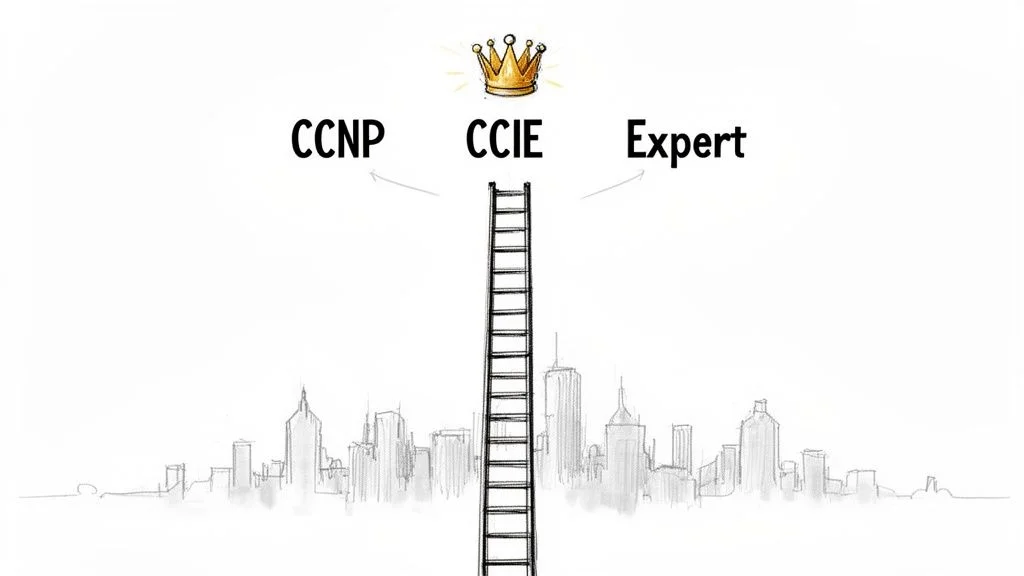
- Cisco Certified Network Professional (CCNP): The CCNP is the standard progression for anyone who has finished the CCNA. It confirms your ability to work as a senior network engineer who can plan, deploy, and fix local and wide-area enterprise networks without supervision. The CCNP allows you to choose a specific track, such as Enterprise Networking, Security, Data Center, or DevNet. This flexibility helps you align your skills with specific market needs. Holding this certification shows you can manage high-pressure network environments independently.
- Cisco Certified Internetwork Expert (CCIE): The CCIE is often viewed as the highest academic equivalent in the networking world. It is a difficult and highly respected certification across the globe. You cannot pass this exam through simple study or memorization. It requires an eight-hour, hands-on lab exam where you must solve difficult, real-world networking issues under tight deadlines. Candidates must have an instinctive understanding of how protocols work and how to fix them when they fail.
- AWS Certified Advanced Networking Specialty: This certification is designed for engineers who build and maintain complex network structures within AWS. It confirms your knowledge of advanced AWS networking, including hybrid architectures, complex routing, VPN configurations, Direct Connect setups, and security protocols. It is a vital credential for architects who oversee massive cloud migrations or large-scale deployments.
Most experts do not stop at a single certification. A typical career path involves earning a CCNP to gain specific skills for senior roles, then using that knowledge to face the challenge of the CCIE or moving into cloud-specific networking with the AWS Specialty.
The Demanding Path to the Top
Earning these expert-level certifications is a massive commitment that can take months or years of study. You cannot rely on reading books or watching tutorial videos alone. This level of certification requires thousands of hours of hands-on lab practice. You must understand the specific behaviors of protocols, track how traffic moves through a system, and develop the mindset of a principal architect.
The process of earning an expert-level certification changes how you work as an IT professional. You go beyond learning a technology; you build the mental strength and problem-solving skills needed to handle issues that do not have a standard solution. At this level, you are not just following a blueprint. You are the one creating the blueprint.
To master these advanced topics, you need to apply what you learn in real environments. Building experience and mastering vendor-specific networking platforms, such as those from MikroTik, helps you connect theoretical concepts to the realities of live networks. This practical experience is vital for passing the exam and performing in a high-level job.
Reflection Prompt: How does the "grueling, hands-on lab" format of the CCIE exam test a different set of skills compared to a multiple-choice theory exam, and why is that important for an expert-level network engineer?
The Six-Figure Payoff for Expertise
The effort required for these exams leads to high financial rewards. Advanced certifications serve as a direct path to the highest-paying roles in the technology sector. These positions involve making strategic choices and designing architectures that determine whether a company succeeds or fails.
Projections for 2026 show a clear link between expert certifications and high salaries. Many of these roles pay well over $100,000 annually. The market pays a high premium for people who have verified their skills at this level.
Salary Potential of Top Networking Certifications (2026 Projections)
| Certification | Experience Level | Average Annual Salary (USD) |
|---|---|---|
| CompTIA Network+ (N10-009) | Entry-Level | $78,500 (verify current salary data on industry job boards) |
| Cisco CCNA | Associate | $95,200 (verify current salary data on industry job boards) |
| CCNP Enterprise | Professional | $132,400 (verify current salary data on industry job boards) |
| AWS Advanced Networking | Professional/Specialty | $158,800 (verify current salary data on industry job boards) |
| CCIE Enterprise Infrastructure | Expert | $170,100 (verify current salary data on industry job boards) |
These numbers show the high return on investment for those who move up the certification ladder. An expert-level credential can result in a salary that is double what an entry-level technician earns.
Beyond the money, these certifications give you the authority to influence an organization's strategy. You are no longer just keeping the lights on; you are the architect who builds the future of the company's infrastructure. You align technical abilities with the goals of the business. For those who want to focus specifically on the cloud, our AWS Certified Advanced Networking Specialty study guide provides a clear plan. When you reach this level, you become an essential asset to any employer.
The transition from a mid-level engineer to an expert requires more than just time on the job. It requires a structured approach to learning the most difficult aspects of networking. Whether you choose to master Cisco's enterprise systems or focus on the complexities of the AWS cloud, these certifications prove you have the technical depth to lead. Companies in 2026 will continue to face more complex security threats and connectivity requirements, making the skills found in the CCNP, CCIE, and AWS Specialty exams more important than ever. By committing to this path, you secure your role as a leader in the field.
How to Build Your Certification Study Plan
Passing a major networking certification exam requires a long-distance mindset. You cannot win this race with a sudden burst of speed at the end. Simply buying the latest study guide or subscribing to a video service is not enough to ensure success. You need a strategy that is both logical and easy to follow every day. If you try to learn without a structure, you will likely spend too much time on easy topics and skip the difficult ones, leading to frustration and burnout.
Think of your study plan as a map through a dense forest. It provides a direct trail to the summit and keeps you from getting lost in the technical details. A defined structure allows you to manage your hours efficiently, keep your energy high, and enter the testing center with the confidence that you have covered every necessary detail.
Here is a breakdown of the steps you should take to organize your preparation effectively.
Step 1: Set Your Target and Timeline
Your first task is to conduct a realistic assessment of your current skills. Where are you starting, and what is your specific goal? A person starting with the CompTIA Network+ will face different hurdles than an engineer working toward the CCNP. Evaluate what you already know about IP addressing, the OSI model, and physical hardware. Being honest about your experience prevents you from setting a timeline that is too short to be practical.
After assessing your skills, the most effective move you can make is to pick an exam date. This single action provides immediate focus. It is easy to say you will finish the CCNA "sometime this year," but paying for the exam and selecting a date on the calendar creates a sense of urgency. For most people with a basic IT background, a three to six-month preparation window (verify current testing windows on the vendor site) is a realistic target for an associate-level certification.
Pro Tip: Booking your exam is a psychological strategy. It turns a general hope into a project with a fixed deadline. This forces you to budget your time and energy more strictly. This method is common in many professional fields because it prevents "scope creep" in your personal study habits.
Once the date is set, work backward from that point. If you have 12 weeks until the exam, you can determine exactly how many chapters or lab exercises you must complete each week to finish the material with time left for a final review.
Step 2: Gather Your Study Arsenal
Using only one book or one video series is a mistake that many students make. To truly understand how networks function, you must see the concepts explained from different perspectives. Using a variety of tools helps clarify difficult ideas and ensures you are ready for the different ways a vendor might phrase a question.
Your toolkit should include these specific resources:
- Official Certification Guides: These are your primary texts and are essential for your success. These books are written by the exam vendor, such as Cisco Press or CompTIA, and follow the exam blueprint exactly. They provide the depth of knowledge you need for the multiple-choice portions of the test.
- Video Training Courses: A high-quality video course, such as those found at MindMesh Academy, can make dry technical topics more interesting. These are particularly helpful for visualizing how data moves through a network or how complex routing protocols like OSPF actually exchange information between routers.
- Practice Exams: These serve as your primary way to measure progress. Good practice tests do more than show you the right answers; they prepare you for the time pressure and the way questions are worded. Use these to find your weak spots so you can go back and study those specific areas again.
- Hands-On Labs: You cannot pass a modern networking exam by just reading. You must spend time on the command line. Practical work builds the muscle memory required to configure and troubleshoot devices quickly during the actual exam.
When it comes to lab work, you have several options depending on your budget. Building a physical lab with used routers and switches provides the most realistic experience, but it takes up space and costs more money. Simulators like Cisco Packet Tracer are excellent for beginners because they allow you to build topologies quickly without hardware. For those who need more realism, emulators like GNS3 or EVE-NG allow you to run the actual operating system code from the hardware. This means the features and bugs you see in the lab are the same ones you would find in a real data center.
Step 3: Create a Weekly Study Schedule
Consistency is more important than the total number of hours you spend. It is better to study for one hour every day than to try to cram for eight hours on a Saturday. Your brain needs time to process new information, and a daily routine helps move that knowledge from short-term memory to long-term understanding.
Here is a sample schedule for a CCNA candidate that you can adjust for your own needs:
Sample CCNA Weekly Study Schedule
| Day | Focus Area | Activity | Estimated Time |
|---|---|---|---|
| Monday | New Concepts | Read two chapters from the Official Cert Guide and take notes on key terms. | 1.5 hours |
| Tuesday | Reinforcement | Watch video lessons from MindMesh Academy that cover the chapters you read on Monday. | 1 hour |
| Wednesday | Hands-On Practice | Open Packet Tracer or GNS3. Configure the protocols or services you studied earlier in the week. | 2 hours |
| Thursday | Review and Reinforcement | Review your notes and practice the specific commands used in Wednesday's lab. | 1 hour |
| Friday | Application | Try a more difficult lab or a troubleshooting scenario where you have to find and fix a mistake in a configuration. | 1.5 hours |
| Saturday | Assessment | Take a quiz or a practice exam on this week's topics. Identify any questions you got wrong. | 1 hour |
| Sunday | Rest / Light Review | Use this day for rest. Your brain needs downtime to consolidate what you have learned. |
This schedule ensures you are not just memorizing facts but are actually applying the skills. If you find that a specific topic takes longer than expected, adjust the schedule for the following week to give yourself more time.
Step 4: Execute, Adapt, and Overcome
The final step is to follow the plan, but you must remain flexible. You will eventually hit a topic that is harder than the others. You might have a busy week at work that prevents you from finishing your labs. When this happens, do not give up.
Instead of demanding perfection, focus on persistence. Use your practice exam scores to guide your study. If you are scoring 90% on security topics but only 50% on subnetting, you know where to focus your energy. If you find yourself struggling with OSPF configuration, spend an entire weekend building different OSPF networks until the commands become second nature.
Your study plan is a living document. Change it as you learn more about your strengths and weaknesses. By following this disciplined approach, you will gain the technical skills and the practical experience needed to earn your certifications and advance your career in IT. Success in networking is built one day and one lab at a time.
Your Networking Certification Questions Answered
Deciding on a networking certification path often brings up many questions. You might feel uncertain about where to start, how long your credentials will stay valid, or which study methods actually work. These concerns are common among IT professionals who want to ensure their training translates into career growth.
I hear several specific questions regularly from people planning their next career move. The following answers provide clarity on the choices you face in the current networking field.
Should I Start with Network+ or Go Straight to CCNA?
This is a frequent point of debate for those entering the field. The best starting point depends on your current knowledge and professional background. There is no single correct answer that applies to everyone, but your daily experience usually dictates the right path.
CompTIA Network+ provides the basic alphabet and grammar of networking. It covers the OSI model, how TCP/IP functions, and how to implement basic security protocols. The Cisco CCNA builds on this by teaching you how to construct technical sentences. It focuses on how to configure and manage specific hardware found in most enterprise environments. While Network+ focuses on theory and vendor-neutral standards, the CCNA requires you to apply those concepts to Cisco hardware and software.
- If you have less than a year of IT experience: Those who are new to the field or switching careers benefit from the vendor-neutral approach of the Network+ certification. This credential builds a broad foundation that applies to any IT environment. It prepares you for more specialized training later and ensures you understand the core mechanics of how data moves across a network.
- If you have one year or more of IT experience: Professionals who already understand core IT concepts and have worked with hardware may want to jump directly into the CCNA. This exam is demanding. It requires you to understand practical application within the Cisco environment immediately. You will need strong self-discipline and the ability to solve complex configuration problems from the start of your study sessions.
Choosing the Network+ first can reduce the steep learning curve of the CCNA. However, if your goal is to work specifically with enterprise-grade routing and switching, the CCNA is the more direct route to those specific job roles.
How Long Do Computer Networking Certifications Last?
Networking technology changes quickly. Because of this, certifications are not permanent achievements. To prove your skills are current, you must renew your credentials every few years. This ensures that a certified professional understands modern standards and hasn't fallen behind as new protocols emerge.
Most associate-level certifications, such as the CompTIA Network+ and the Cisco CCNA, remain valid for three years. You must take action before this period ends to keep your status active. If you let a certification expire, you often have to start the process over from the beginning. You generally have two ways to maintain your certification:
- Pass the current version of the exam: Retaking the exam confirms you know the latest objectives. As vendors update their tests to include new technologies like automation or software-defined networking, passing the new version shows you have kept up with these changes.
- Earn Continuing Education (CE) credits: You can collect credits by participating in professional development. This might involve earning a higher-level certification, which often renews your lower-level certs automatically. For example, passing a CCNP exam will renew an existing CCNA. Other options include attending industry conferences, completing authorized training courses, or contributing to technical content development.
This cycle of renewal keeps the industry standards high. It forces professionals to stay engaged with new developments rather than relying on knowledge that might be a decade old.
Are Cloud Certifications Making Networking Certs Obsolete?
Cloud and traditional networking are not in competition. Instead, they are merging. Traditional networking principles remain the foundation for every major cloud provider, including AWS, Azure, and Google Cloud. You cannot manage a cloud environment effectively if you do not understand the underlying network that supports it.
Basic tasks in the cloud require a firm grasp of routing, subnetting, and security. When you set up a Virtual Private Cloud (VPC) or a Virtual Network (VNet), you are applying traditional networking concepts in a virtual space. Troubleshooting data movement between an on-premises data center and the cloud requires knowledge of VPNs and private connections. Without these skills, you cannot secure or optimize a modern business infrastructure.
Key Takeaway: Cloud and networking skills are converging. The most successful IT professionals will be those who understand both fields. You cannot configure services like AWS Direct Connect or Azure ExpressRoute without a clear understanding of BGP and private IP addressing.
Forward-thinking technicians are now pursuing both types of credentials. Combining a strong networking certification like the CCNA with a cloud-specific cert, such as the AWS Certified Solutions Architect Associate, makes you much more valuable to employers. Companies need people who can bridge the gap between physical hardware and virtualized cloud services.
How Important Is Hands-On Lab Practice?
Hands-on practice is the most critical part of your preparation. You cannot pass modern networking exams by just memorizing facts from a book. Vendors like Cisco design their tests to evaluate your ability to configure and troubleshoot actual equipment. If you haven't spent time working with a command-line interface (CLI), you will likely struggle during the exam.
Watching instructional videos is a good start, but it does not replace the experience of fixing a broken configuration. You need to spend significant time in a lab environment. This builds the muscle memory required to type commands quickly and accurately. It also helps you understand how different protocols interact in a live setting.
Your toolkit for practical study should include:
- Simulators: Software like Cisco Packet Tracer is excellent for those starting out. It allows you to build network topologies and test basic configurations without needing expensive physical hardware. It provides a safe environment to see how data flows through a network you designed.
- Emulators: For more advanced study, tools like GNS3 or EVE-NG are better options. These programs run actual network operating systems, such as Cisco IOS. They allow you to practice complex scenarios involving advanced routing protocols and firewall rules that simulators might not support.
This practical work is what separates those who understand the theory from those who can do the job. When you are faced with a network outage in a real office, the time you spent in the lab will give you the confidence to find and fix the problem efficiently.
Ready to turn your study plan into a success? MindMesh Academy offers focused video courses, realistic practice exams, and tools to track your progress as you master the material. Start preparing to pass with confidence today at MindMesh Academy.

Written by
Alvin Varughese
Founder, MindMesh Academy
Alvin Varughese is the founder of MindMesh Academy and an enterprise architecture leader. An electrical engineer by training, he moved from factory automation in South Africa to cloud architecture at GE Appliances and Humana (Fortune 50), and holds 20 professional certifications including AWS Solutions Architect Professional, Azure DevOps Engineer Expert, and Microsoft Agentic AI Business Solutions Architect. He built MindMesh Academy after interviewing too many highly certified candidates who couldn't answer basic questions: the goal is prep that makes you better at the job, not just able to pass the exam.