Your Guide to CompTIA IT Certification Training in 2026
IT professionals looking to strengthen their careers or enter new specializations often face a confusing number of choices. A vendor-neutral foundation serves as a vital advantage for any modern technician. This guide from the experts at MindMesh Academy explains why CompTIA IT certification training remains the most reliable method for building a long-term career in technology through 2026. These programs provide the practical skills needed to stay competitive as industry requirements change.
Why CompTIA Is Your Essential First Step in Tech
IT is a vast field containing diverse specializations like cloud computing, cybersecurity, and advanced networking. Before specializing in a specific area—perhaps as an AWS Solutions Architect or an Azure Administrator—you must understand the underlying rules that govern all these systems. CompTIA certifications provide this base, offering foundational principles and practices that remain consistent regardless of which specific vendor's hardware or software you use.
This vendor-neutral approach provides a distinct advantage for IT professionals. Instead of focusing only on one product—like a specific Cisco router or a Microsoft server operating system—you gain a broad understanding of the underlying technologies that make all such products work. This grants you significant flexibility and adaptability. You become a more versatile asset to organizations that use a mix of different platforms and technologies—such as running Linux servers alongside Windows desktops—to meet their business goals.
The Gold Standard for Foundational Skills
Hiring managers need proof of your skills in a crowded job market. Research shows that certifications are a reliable indicator of capability. One study found that over 90% of employers (verify latest industry reports) see IT certifications as a predictor of future job performance. A CompTIA credential gives you an edge by proving you have validated, practical skills that meet current industry standards. These certifications are often listed as requirements or preferred qualifications in job descriptions for entry-level positions.
This training provides the knowledge required for several entry-level and intermediate roles, such as:
- Help Desk Technician
- Network Administrator
- Junior Cybersecurity Analyst
- Technical Support Specialist
Having a CompTIA certification on a resume is more than just a line of text. It shows a clear commitment to learning the core concepts of information technology. It demonstrates professional growth and a desire to contribute to a team, which are traits hiring managers prioritize when looking for new talent.
Pursuing CompTIA IT certification training is a clear path to becoming a hirable professional. It provides the structure and credentials needed to enter your first IT role and start a career. This foundation allows you to build a long-term career path across many different industries. To find the right starting point for your goals, explore the diverse CompTIA certification paths offered by MindMesh Academy.
Understanding the Core CompTIA Certifications
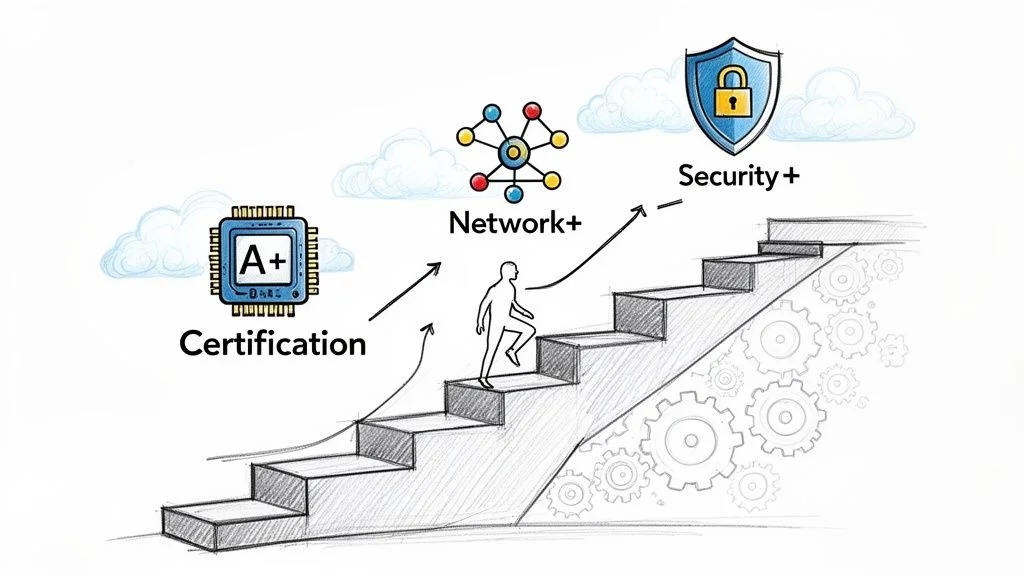
Starting a career in Information Technology requires a clear strategy. Think of it like selecting a base specialization in a technical field. Each foundational CompTIA certification—A+, Network+, and Security+—builds specific technical abilities, strengthens your professional profile, and opens different doors in the employment market.
These three certifications form the "big three" of the IT world. Identifying the right one to start with depends on your current knowledge and where you want to end up.
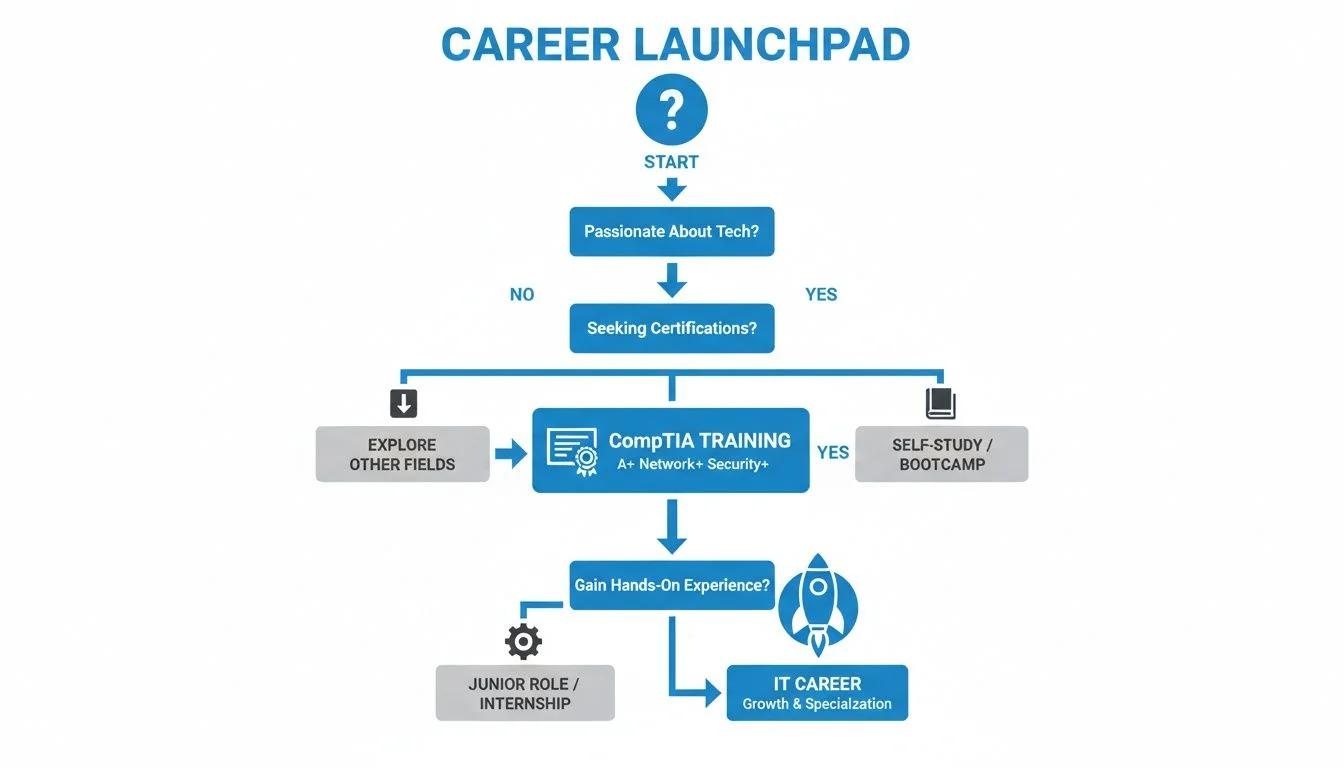
Choosing a starting point is only the first step. You need a structured training plan to turn an interest in computers into a technical career. Use the comparison below to see which path aligns with your current skills and professional goals.
Which Foundational CompTIA Certification Is Right for You?
| Certification | Focus Area | Ideal Candidate Profile | Common Job Roles |
|---|---|---|---|
| CompTIA A+ | Core hardware, software, and troubleshooting across devices and operating systems. | Individuals who enjoy practical problem-solving, hands-on diagnostics, and helping others resolve technical issues. | Help Desk Technician, Technical Support Specialist, Field Service Technician |
| CompTIA Network+ | Network infrastructure, protocols, and connectivity, including wired and wireless technologies. | Professionals interested in how data moves, network architecture, and how different devices communicate across a distance. | Network Administrator, Junior Network Engineer, NOC Technician |
| CompTIA Security+ | Core cybersecurity principles, threat detection, risk management, and compliance. | Candidates focused on defending digital assets, finding system weaknesses, and stopping cyber attacks. | Security Administrator, Junior IT Auditor, Systems Administrator |
While every certification provides a strong entry point, they serve different career paths. Here is a detailed look at the specifics of each exam and the roles they prepare you for.
CompTIA A+: The Universal Tech Translator
An A+ certified professional acts as a translator between human users and complex computer systems. These technicians are the first responders for IT departments. They fix everything from broken laptop screens to blue-screen errors and mobile sync issues.
If you are the person friends call when their Wi-Fi fails, or if you find yourself taking apart electronics just to see how the circuit boards fit together, A+ is the right choice. This certification covers the widest range of topics among the foundational three. It builds a base that covers almost every part of modern computing.
The CompTIA A+ credential requires passing two separate exams: 220-1201 (Core 1) and 220-1202 (Core 2). This structure ensures you understand both the physical hardware and the software that runs on it.
CompTIA A+ goes beyond basic computer repair. It validates your ability to handle hardware, software, networking basics, security, and the troubleshooting methodology that every IT professional uses.
A+ training focuses on several key domains:
- Hardware: You will work with the physical parts of PCs, laptops, and mobile devices. This includes identifying motherboards, installing CPUs, managing RAM, and configuring peripheral devices.
- Operating Systems: Training involves installing and managing Windows, macOS, Linux, Android, and iOS. You will learn to navigate these systems and use command-line tools to fix errors.
- Software Troubleshooting: This area focuses on diagnosing application crashes and OS slowdowns. You will learn to identify why a program is failing and how to optimize system performance for the user.
- Operational Procedures: This covers the professional side of IT. You will learn about safety, environmental regulations, and how to communicate technical solutions to non-technical people.
This certification is a requirement for many entry-level roles. Help Desk Technicians and Technical Support Specialists often need A+ to get past initial hiring filters. Even if you want to work in the cloud, you still need to understand the local hardware that connects to that cloud. You can find more detail on the specific exam objectives in our CompTIA A+ Core 1 study guide.
CompTIA Network+: The Digital Traffic Controller
A+ technicians look at individual devices. Network+ professionals look at the connections between them. They are digital traffic controllers. They make sure data moves quickly and securely from one point to another without getting lost or blocked.
The Network+ exam (currently N10-009) is designed for those who want to understand the mechanics of the internet. If you are interested in routers, switches, and the protocols that run the web—like TCP/IP, DNS, and DHCP—this is your field. It moves you past the individual computer and into the infrastructure that keeps a company connected.
Networking knowledge is useful for more than just network engineers. In modern IT environments, everything is connected. Cloud engineers managing AWS VPCs or Azure VNets need to understand routing. Even a project manager with a PMP or a service desk lead with an ITIL certificate will find that networking knowledge helps them understand why a project is delayed or why a service is down.
CompTIA has issued more than 3.6 million certifications. This high number has created a standard that employers trust. The Public Sector Network’s 2026 IT industry outlook shows that companies continue to use these certifications to confirm that new employees have the skills to work on hardware, networks, and security systems immediately.
CompTIA Security+: The Digital Guardian
Cybersecurity is a constant concern for every business. The Security+ professional acts as a guardian for the organization's data. These specialists defend networks and systems against hackers, malware, and other threats. This is the most specialized of the three foundational certifications.
If you enjoy finding vulnerabilities and thinking about how to protect data, Security+ is the next logical step. It is for people who look at a system and think about how it might be attacked, then work to close those gaps.
This CompTIA IT certification training proves you can:
- Assess and audit the security of a technical environment. You will learn to find weaknesses before an attacker does.
- Implement and monitor security controls. This includes securing cloud systems, mobile devices, and Internet of Things (IoT) hardware.
- Operate within legal frameworks. You will learn how to stay compliant with laws like GDPR and HIPAA while following company security policies.
- Identify and respond to incidents. When a security breach happens, you will know the steps to contain the damage and investigate the cause.
The Security+ credential leads to jobs like Security Administrator, Systems Administrator, and Junior IT Auditor. It tells employers that you have the practical skills to handle security challenges in a real-world setting.
A+ teaches the language of computers. Network+ provides the map for connecting them. Security+ provides the shield. It is the standard starting point for a career in cybersecurity.
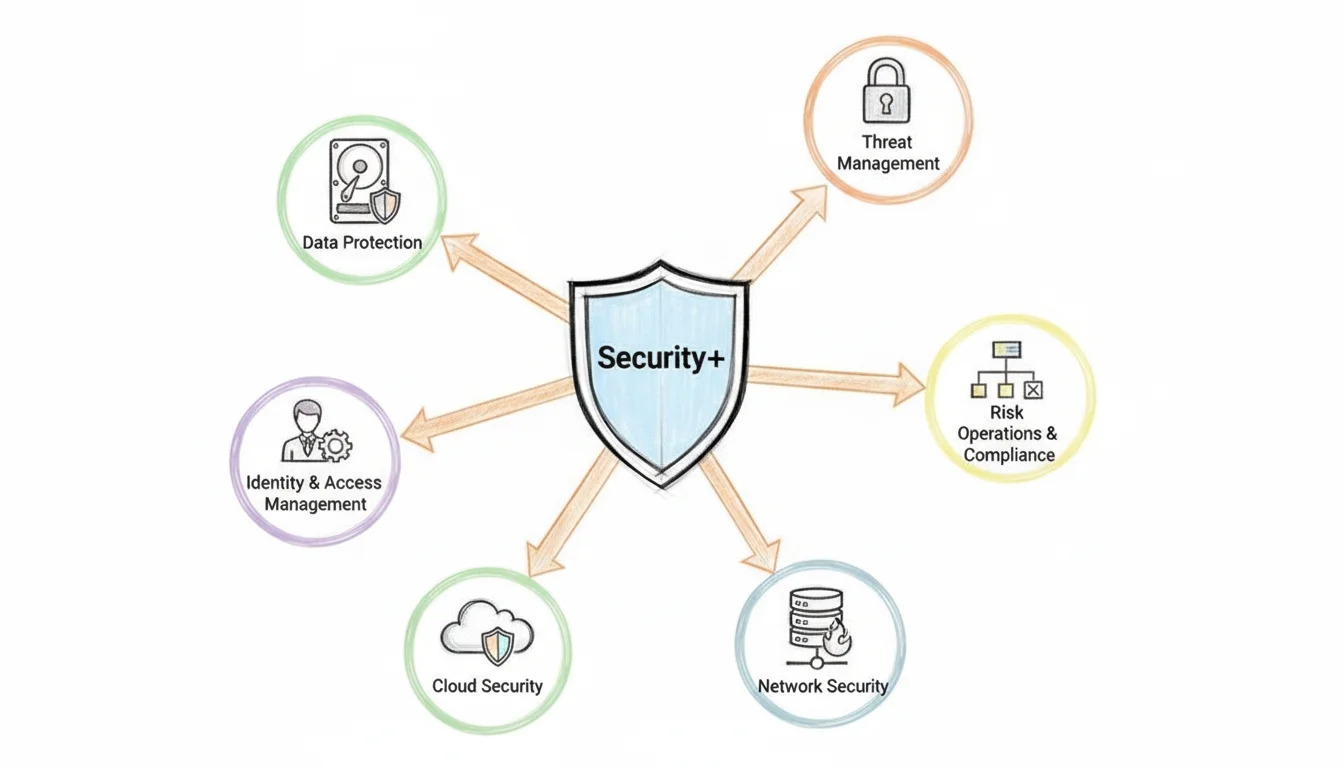
This certification carries weight with hiring managers. It proves you understand how to harden systems and manage risk in an environment where digital threats change every day.
Your Passkey to Government and Defense Roles
The Security+ certification is highly valued because the U.S. Department of Defense (DoD) recognizes it. Under DoD Directive 8570 and 8140, this certification is mandatory for many IT and cybersecurity roles within the government.
This gives you a major advantage in the job market. Having a Security+ certification is a strict prerequisite for many positions with government agencies and defense contractors. Without it, you cannot even apply for these roles.
The private sector also follows these standards. Companies that work with the federal government often require their employees to have the same certifications. You will find that many banks and hospitals use the same hiring criteria.
Earning CompTIA Security+ is like getting a master key. It opens doors to government agencies, defense contractors, and large corporations in the finance and healthcare sectors. These industries use high security standards and want employees who are trained to meet them.
Investing in CompTIA IT certification training for Security+ is a practical move for your career. It places you in a position to apply for high-stakes roles that offer stability and growth.
Where Theory Meets the Trenches
Security+ focuses on practical application. You won't just memorize definitions; you will learn how to defend a network.
Imagine you work for a major hospital. As a Security+ professional, you would protect patient records to comply with HIPAA laws. You would ensure that only authorized doctors can see sensitive data and block any unauthorized attempts to access the hospital network.
In the finance world, a Security+ analyst might:
- Set up threat detection systems to find and stop fraudulent transactions as they happen.
- Run risk assessments on new mobile banking apps to fix security holes before customers use them.
- Manage access controls to ensure only specific employees can handle sensitive financial data, keeping the bank in line with PCI DSS standards.
These tasks are vital to the business. They protect money and private information. The Security+ exam is built to prove you are ready to take on these responsibilities.
The demand for these skills remains high. Analysis for 2026 shows that CompTIA Security+ is the certification most requested by employers. It appears in more job postings than any other CompTIA credential. It is the leading entry-level cybersecurity qualification in the world because it meets DoD requirements and addresses the global need for better security.
The Foundation for a Cybersecurity Career
Security+ is often called an entry-level certification, but it is actually the foundation for advanced work. It provides the base for everything that comes after.
Advanced certifications like CompTIA CySA+ (Cybersecurity Analyst), PenTest+, and the (ISC)² CISSP expect you to already know the material covered in Security+. If you master these core concepts now, you set yourself up for senior roles and specialized fields like incident response or security architecture. These specialized roles often come with higher salaries and more responsibility.
Whether you want to be a penetration tester, a security architect, or a Chief Information Security Officer (CISO), you will likely start with the skills found in Security+. You can get a head start by reading our in-depth CompTIA Security+ study guide.
How CompTIA Certifications Fit Into the 2026 Job Market
A certification’s worth is tied directly to the career opportunities it creates. Choosing CompTIA IT certification training is a practical way to manage your career trajectory. You are not just earning a digital badge; you are making a specific investment to meet the needs of a technical job market that requires proven skills. This demand is expected to increase as more industries integrate advanced technology into their daily operations.
The data supports this trend. Predictions for 2026 show the U.S. tech workforce growing by 1.9%. This small percentage represents 185,499 new job openings (verify current growth projections through official labor reports). This increase will push the total number of people working in technology to nearly 9.8 million. To get a detailed understanding of these shifts, the full CompTIA State of the Tech Workforce report is a useful resource for planning your next move.
Where the Tech Jobs Are Booming
Tech opportunities are appearing across the country, but a few specific states are leading the way in new job creation. Knowing where these high-growth areas are located can help you decide where to focus your job search or where to live.
The top states for projected tech job growth in 2026 include:
- Texas: Leading the nation with 32,238 new tech jobs expected (verify local hiring data via state labor boards).
- California: Maintaining a strong position with a projected 16,949 new roles.
- Florida: Showing a major increase with 14,453 estimated new positions.
- New York: Continuing as a primary economic center with 13,566 additional tech roles.
- Washington: Expanding its tech sector with 9,524 new jobs.
New roles are only one part of the equation. The industry also sees a 6% annual replacement rate. This means that about 323,000 jobs open up every year because workers retire or move into different career fields. This constant turnover ensures that there is a steady need for new technicians to enter the workforce and fill essential roles.
A CompTIA certification acts as a recognized credential in this growing job market. It shows employers that you have the verified, vendor-neutral skills needed to be productive immediately, which is vital in high-growth regions where companies need to hire quickly.
As you plan your professional path, remember the pervasive and growing demand for digital skills in almost every sector. The knowledge you get from CompTIA training makes you a useful employee in IT departments and in any business that relies on modern technology to function.
Why the Fundamentals Matter More Than Ever
There is a lot of excitement regarding Artificial Intelligence (AI) and cloud computing right now. It is easy to think that basic IT skills might become less important, but the reality is quite different. Complex AI systems and large-scale cloud services do not run on their own. They require a secure and stable infrastructure to function at all.
Consider the process of building a smart home. You can buy the most advanced voice assistants and automated lights, but they will not work without stable electrical wiring (networking). You also need reliable locks (cybersecurity) and hardware that is set up correctly. Employers understand this logic. They need people who can maintain the base layer of technology before they can use the more advanced tools.
Businesses are looking for technicians who can:
- Construct and manage resilient networks (Network+ skills): This is the essential foundation that supports AI, cloud storage, and remote work systems.
- Secure critical data and systems (Security+ skills): This protects the privacy and availability of the data used by modern companies and AI models while following the risk management rules found in frameworks like ITIL.
- Diagnose and resolve complex tech problems (A+ skills): This provides the direct support that keeps the hardware and software in a digital environment running efficiently.
By completing CompTIA IT certification training, you are learning more than how to do a job today. You are mastering the stable fundamentals that will support the technology of the future. This approach helps you build a career that remains strong even as tools and software change.
Building Your Personal CompTIA Study Plan
Choosing a certification is a great first step, but the actual labor begins with your first study session. Succeeding in your CompTIA IT certification training does not require brute force or trying to cram for 12 hours at a time. In fact, that approach often leads to brain fatigue and poor retention rather than actual learning. Instead, success depends on using a smart strategy backed by how the brain stores and retrieves data. A carefully organized study plan changes a massive volume of technical documentation into a manageable sequence of tasks. We are looking for more than passive reading of textbooks. This section focuses on proven methods designed to help you get the most out of every hour you spend at your desk. You want to ensure this knowledge is not just available for the exam but remains a part of your professional toolkit for years to come.
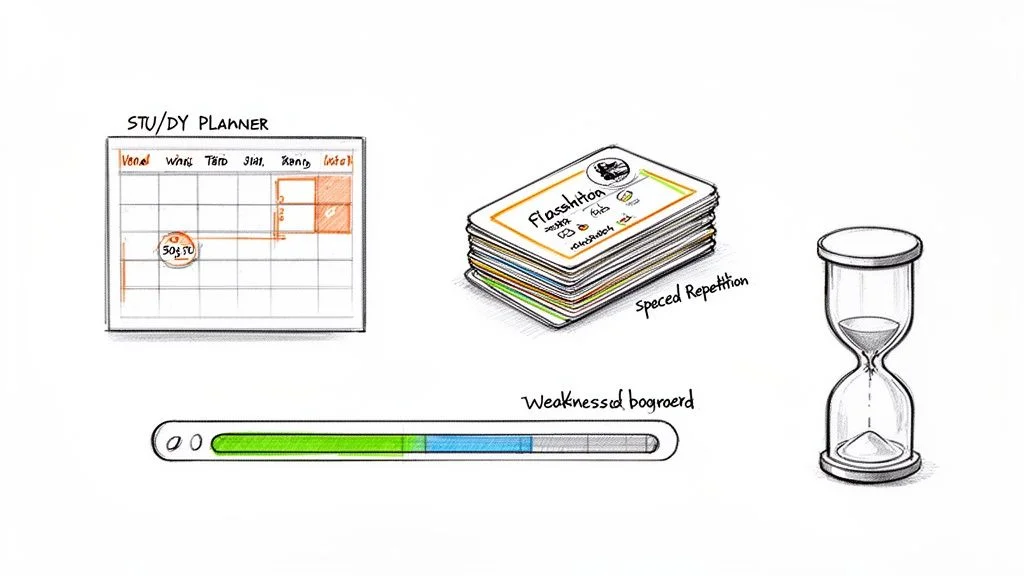
These tools help you turn abstract IT concepts into practical knowledge you can use under pressure. They move you away from just reading and toward actually doing.
Master Concepts with Evidence-Based Techniques
If your plan is to memorize definitions to pass a CompTIA exam, you will likely struggle. These exams do not just test your memory. The questions evaluate how you apply what you know to solve real-world problems. You might be asked to troubleshoot a connectivity issue or identify a security threat based on a specific scenario. Two methods work best to prepare for this: Spaced Repetition and Active Recall.
Spaced Repetition involves reviewing information at increasing intervals. Think of it like watering a garden. If you pour a huge amount of water on a new plant all at once, the soil becomes waterlogged and the plant might die. However, if you water it right as the soil starts to dry out, the roots grow deeper and the plant becomes more resilient. Your brain works the same way. Looking at a concept like subnetting or firewall rules right before you are likely to forget them strengthens the neural pathways. This makes the information easier to find when you are sitting in the testing center. You are essentially training your brain to keep that information in long-term storage rather than letting it fade away after a few hours.
Active Recall requires your brain to find information without looking at your notes or a textbook. Instead of reading a chapter on the Network+ N10-009 again, close the book and try to explain the seven layers of the OSI model. Ask yourself what happens at the Physical layer versus the Data Link layer. Explain the difference between TCP and UDP out loud. That mental struggle to find the answer is exactly what builds knowledge that lasts. This principle works for any technical test, including the PMP or ITIL exams. It forces you to engage with the material rather than just looking at it.
The most common mistake is confusing familiarity with mastery. Reading a chapter twice makes you feel like you know it because the words look familiar. Active Recall proves whether you actually do. It is the difference between watching an expert configure a router and typing the commands yourself. It is the test that tells you if you are truly ready for the exam.
When you combine these two methods, studying becomes an active process of building real skills that you can use in a server room. You stop being a passive consumer of information and start becoming a technician.
Structuring Your Study Timeline
No single schedule works for every person. The best plan is the one you can stick to every single day without failing. Your timeline depends on your current technical skills, which CompTIA exam you are taking, and your existing daily commitments. To find your path, consider these three common approaches to timing your preparation:
- The 30-Day Sprint (Intensive): This fast-paced schedule works for people who can study for several hours every day. It is essentially a full-time job. This fits well if you are currently between roles or on a dedicated study break. You will cover new topics every day and review older ones constantly to keep them fresh. You might spend four hours on new modules in the morning and two hours on practice questions in the afternoon.
- The 60-Day Focus (Balanced): This is the most common choice for many learners. It involves about 1-2 hours of focused work on weekdays and longer sessions on the weekend. This allows enough time for concepts to sink in without losing the momentum you need to finish. You have time to set up home labs and practice the commands you are learning.
- The 90-Day Marathon (Working Professionals): If you have a full-time job, family responsibilities, and other daily tasks, this plan works best. It breaks the material into small, daily pieces. You might only study for 45-60 minutes a day, but you must do it every day. Consistency matters more than occasional long nights of cramming. This pace helps you avoid burnout over the long term.
Regardless of which path you choose, staying consistent is the most important factor. A small effort every day produces better results than a 10-hour session once a week. Frequent contact with the material keeps your brain in learning mode and prevents you from having to re-learn topics you forgot during a long break.
Using Smart Tools to Guide Your Path
One of the hardest parts of self-study is knowing what to focus on next. How do you know if you really understand a topic or if you just think you do? This is where a good learning tool helps. A quality platform uses a progress dashboard to show your performance in real-time. It maps your scores on quizzes and practice tests against specific exam domains. This takes the guesswork out of your daily routine.
This data tells a very clear story. For instance, your dashboard might show that your score for "Network Operations" is 92%, while "Security" is sitting at 48%. This information tells you exactly what to do during your next study session. Instead of reviewing things you already know, you use data to guide your effort toward your weakest areas. You can stop wasting time on the concepts you have already mastered.
The system points you toward specific modules, lessons, or practice questions that cover your knowledge gaps. This makes your CompTIA IT certification training far more efficient. It prepares you for the exam and the actual technical work you will do on the job. By using these tools, you ensure that every minute you spend studying moves you closer to your goal. You gain a transparent, data-driven picture of your progress. This intelligent approach helps you walk into the testing center feeling prepared because you have seen the data that proves you know the material.
Getting the Most Out of Practice Tests
When you engage in CompTIA IT certification training, viewing practice tests only as a final evaluation is a mistake. That perspective misses half the actual value. These tests are the best diagnostic tools you have. Used correctly, they change from a simple grading tool into a personalized map. This map shows exactly where your knowledge is solid and where you need to do more work. You can identify specific domains that require extra study hours before you sit for the actual exam.
Treat every practice test as if it were the official certification exam. Success depends on more than just the facts you have memorized. You also have to perform well while the clock is ticking. Set a timer for the exact duration allowed by CompTIA. Put away your notes, turn off your phone, and remove all external resources. Find a quiet space where no one will interrupt you. Simulating these actual exam conditions builds the mental stamina you need. It also improves the time management skills required to stay focused when the stakes are high.
From Score to Strategy
Finishing a practice exam is not the end of your study session. It is the start of the most important phase. Your total score is just a single data point. The real value is found in the review that follows. While a score indicates if you might pass, a thorough review of every question explains why. It helps you find small but important gaps in your technical understanding.
This part of the process requires you to be honest about what you know. You should review every single question on the test, not just the ones you missed:
- For questions you answered correctly: Do not just skip these. Ask yourself if you knew the answer for certain or if you made a lucky guess. If you were confident, try to explain the concept out loud. This active recall helps your brain store the information more effectively. It confirms that you actually understand the logic behind the answer rather than just recognizing a familiar word or phrase.
- For questions you answered incorrectly: This is where you actually improve. Do not just look at the right answer and move to the next item. You must analyze why the wrong option looked correct at the time. Did you misunderstand a specific technical term? Did you only remember part of a concept? Was the question a scenario designed to test how you apply knowledge in a real-world situation? This process finds errors that can be expensive on exam day. It functions like a root cause analysis used in ITIL problem management.
This level of review separates people who want to pass from those who want to build a career. It represents the shift from memorization to true mastery of the exam objectives.
Many students fall into a trap where they read the same chapters over and over. While reading feels productive, it often creates a false sense of security. Reviewing a practice test is an active and sometimes difficult process. It forces you to look at the limits of your knowledge. That discomfort is the fastest way to make progress.
Closing the Gaps with Smart Feedback
The cycle of testing, analyzing, and fixing is the heart of smart exam preparation. You identify a weak spot and focus your energy on fixing it before you move forward. This simple feedback loop leads to continuous improvement in your scores and your technical skills.
Modern learning platforms are built to support this cycle. For example, at MindMesh Academy, we use your practice test results as data. If you keep missing questions about network security protocols, the platform notices. It does more than show you a failing grade in that category. It points you to the exact video lessons, hands-on labs, and flashcards that cover those specific protocols. This ensures your study time is efficient. You turn targeted effort into real confidence, making your practice tests a clear path to passing your exam.
Answering Your Top Questions About CompTIA Training
Committing to a certification program is a significant decision. You likely have several questions before you begin your study. Getting clear, direct answers is the first step toward feeling prepared for your CompTIA IT certification training. Here are answers to the questions we frequently hear from people starting their careers in technology.
How Long Does It Take to Get Certified?
The time it takes to get certified varies based on your background, but we can provide realistic benchmarks. If you are new to the IT field, expect to spend two to three months preparing for the CompTIA A+ (exams 220-1201 and 220-1202—verify current pricing and codes on the vendor site). This certification covers wide-ranging topics; building a strong foundation takes time.
If you have some IT experience, you might prepare for the Network+ (N10-009—verify current pricing and codes on the vendor site) or Security+ exams in four to eight weeks of consistent study. The most important factor in your timeline is your study strategy. A plan that targets your individual weak points will be much more effective than reading a textbook from cover to cover without a specific goal.
Are CompTIA Certs Still Relevant?
Yes. While the industry often highlights specialized cloud paths like the AWS Certified Solutions Architect or Azure Administrator Associate (verify current pricing on the vendor site), the vendor-neutral model used by CompTIA remains essential. These certifications prove you understand the mechanics of how technology works, not just how to click buttons in a specific software suite.
Consider a driving analogy. You must understand traffic laws, road signs, and the basics of how a vehicle functions before you specialize in a specific type of transport. The knowledge from Network+ or A+ is like learning the rules of the road. Once you have that foundation, you can more easily master a specific platform like an AWS cloud environment or an Azure database.
Employers value CompTIA certifications because they prove you have adaptable skills. This means you can join a technical team and contribute regardless of which specific vendors they use. You will be able to learn new technologies faster because you understand the underlying principles that govern them. This versatility is a major asset in any organization.
Which Certification Should I Start With?
For most people entering the IT field, the CompTIA A+ is the best place to start. It provides a foundation in hardware, software, operating systems, and troubleshooting. It also covers basic networking principles that you will use throughout your career.
If you are not a beginner, your path might look different. If you have spent time building computers or managing home networks, you might choose to start with the Network+. This is a good choice if your goal is to understand data flow and how networks are built. If your long-term goal is cybersecurity, the most effective path involves starting with A+ to learn how systems work, followed by Security+.
Your choice should depend on your current skills and your career goals. Think about what part of technology interests you the most and start there.
At MindMesh Academy, we focus on improving how IT professionals study. Our platform uses techniques like Spaced Repetition and Active Recall to help you keep what you learn for the long term, not just for the exam. We analyze your practice test results to find exactly where you need to improve. This allows us to adjust your study plan so you can spend your study time effectively. See how our approach can help you pass with confidence by exploring our CompTIA courses at MindMesh Academy.

Written by
Alvin Varughese
Founder, MindMesh Academy
Alvin Varughese is the founder of MindMesh Academy and an enterprise architecture leader. An electrical engineer by training, he moved from factory automation in South Africa to cloud architecture at GE Appliances and Humana (Fortune 50), and holds 20 professional certifications including AWS Solutions Architect Professional, Azure DevOps Engineer Expert, and Microsoft Agentic AI Business Solutions Architect. He built MindMesh Academy after interviewing too many highly certified candidates who couldn't answer basic questions: the goal is prep that makes you better at the job, not just able to pass the exam.