CompTIA Certification Renewal: A Complete 2026 Guide
CompTIA Certification Renewal: Strategies for IT Professionals
The renewal email usually hits at the worst time. You're busy with tickets, projects, maybe a job search, and then CompTIA reminds you that the certification you worked hard to earn is heading toward expiration.
That message creates a very specific kind of stress. Not because the process is impossible, but because individuals often remember pieces of it instead of the whole system. They know CEUs are involved. They vaguely remember fees. They've heard a higher-level cert can renew a lower one. What they often don't know is which option is smartest, what can go wrong, and where people lose time or money.
That's where practical planning matters more than mechanics. Good CompTIA certification renewal isn't just about getting enough CEUs. It's about choosing the path with the least friction, keeping documentation clean, and avoiding bad assumptions about stacking, deadlines, and portal submissions.
If you're still building your cert path, it also helps to understand how these credentials fit together long term. A good starting point is to accelerate your IT career with CompTIA certifications before you lock yourself into a renewal strategy that doesn't support your next move.
That Email Just Landed: Your CompTIA Cert Is Expiring
Individuals don't start thinking about renewal when they pass the exam. They think about it when the warning email lands and suddenly the credential feels less permanent than it did on exam day.
I've seen the same pattern over and over. Someone has A+, Network+, or Security+, has done plenty of real work since earning it, and assumes renewal will be straightforward. Then they log in and realize they need the right activities, the right timing, the right documentation, and in some cases a better strategy than “upload whatever I've done lately.”
That's the part many guides miss. Renewal isn't hard because the rules are mysterious. It gets messy because people treat it like an admin task instead of a career decision.
Practical rule: The best renewal path is usually the one that reduces manual proof, reduces audit exposure, and supports the next certification you actually want.
Some people should use a single-activity option and be done with it. Others should renew by moving up the ladder. Others are better off using CEUs they're already earning through work, training, mentoring, or writing, but only if they're disciplined about tracking proof from the start.
The good news is that the CompTIA renewal maze becomes manageable once you stop looking at it as a pile of disconnected rules. It helps to think in three layers:
- Your expiration timeline: when the clock ends and what requirement applies to your cert
- Your renewal path: CEUs, a higher certification, or a qualifying single activity
- Your risk controls: documentation, fees, and avoiding assumptions about automatic renewal
If you handle those three layers in order, the process gets much cleaner.
Your CompTIA Renewal Clock: Understanding Key Requirements
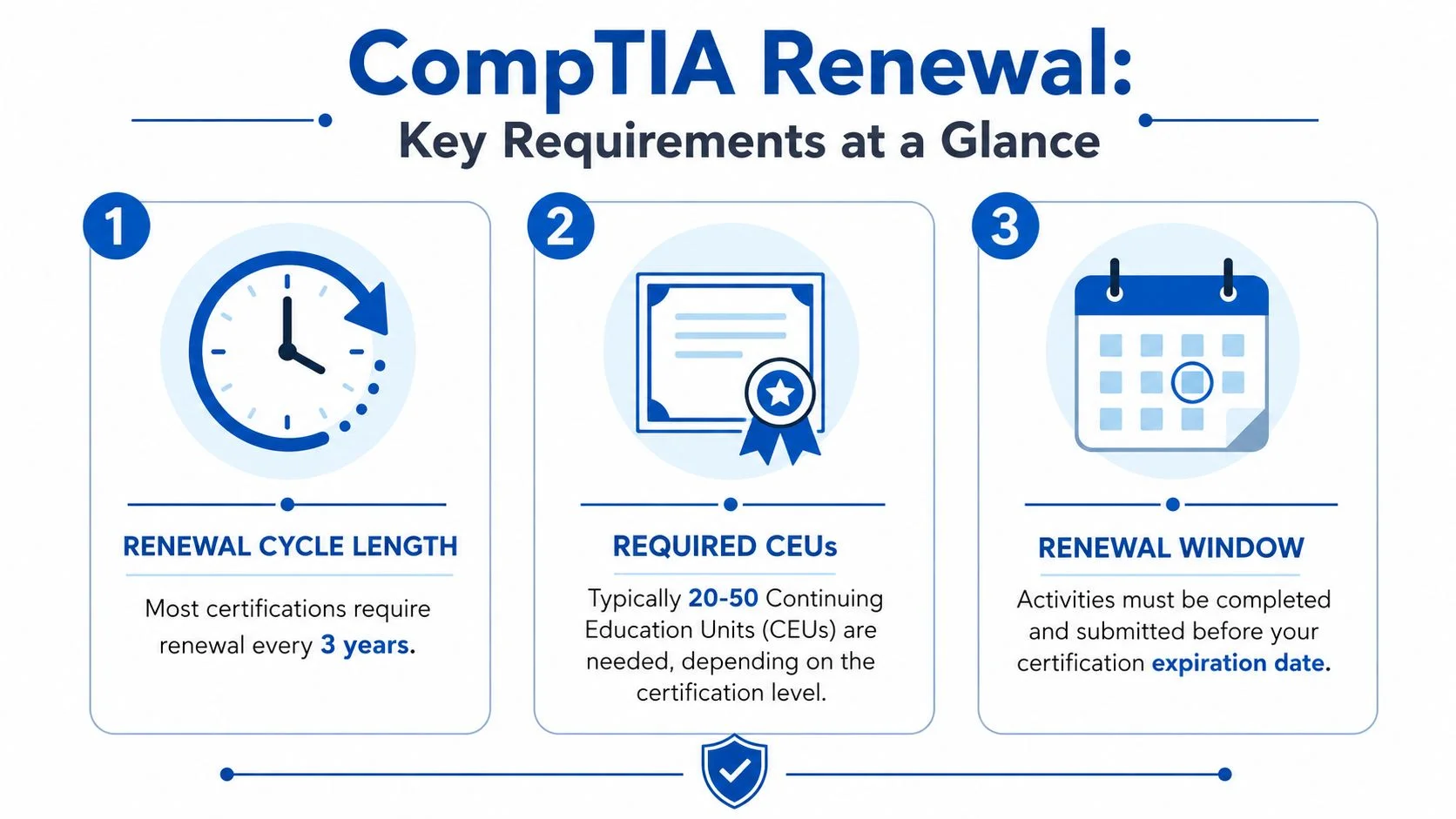
The renewal clock matters more than many people expect because timing mistakes create avoidable risk. For most CompTIA certifications in the Continuing Education program, the cycle runs three years from the date you earned the certification, and each cert carries its own CEU target. CompTIA's renewal framework and CEU requirements are summarized in Global Knowledge's CompTIA renewal FAQ.
The CEU targets that matter
Use the CEU number as a planning target, not just a checkbox. One CEU generally maps to one hour of qualifying activity, but the smarter question is whether the activity is clearly tied to your certification objectives and easy to prove later.
| Certification | Renewal cycle | Required CEUs |
|---|---|---|
| CompTIA A+ | 3 years | 20 |
| CompTIA Network+ | 3 years | 30 |
| CompTIA Security+ | 3 years | 50 |
| CompTIA Cloud+ | 3 years | 50 |
| CompTIA CySA+ | 3 years | 60 |
| CompTIA PenTest+ | 3 years | 60 |
| CompTIA CASP+ | 3 years | 75 |
That difference matters.
A webinar you attended two years ago may count. A webinar you attended two years ago with no completion record, no agenda, and no clear tie to the exam objectives can turn into a weak submission if CompTIA reviews it. The same applies to work experience, teaching, mentoring, and writing. Good renewal planning means choosing CEUs that are both valid and defensible.
If you hold Security+, start tracking activities against exam domains early. It makes renewal easier and also keeps your skills aligned with what employers still ask about. A Comprehensive Security Plus guide can help you map training and study time to topics that stay relevant for both renewal and day-to-day security work.
What the deadline really means
The expiration date is not the day to begin organizing proof. It is the end of your usable window.
I advise people to treat the last several months as buffer time, not earning time. That buffer protects you if an activity is rejected, a certificate goes missing, or you discover that something you assumed would count only earns partial credit. Waiting until the end usually causes three problems at once:
- You limit your options: Some CEU sources are easy to complete over time but hard to reconstruct later.
- You lose documentation: Completion emails, event agendas, manager sign-off, and publication records are easy to misplace.
- You make expensive choices: Rushed renewals push people toward fee-heavy or time-heavy options they could have avoided with earlier planning.
The safest approach is simple. Save proof as you earn it, label files clearly, and keep one folder per certification cycle.
The requirement behind the requirement
The published CEU total is only part of the job. The other part is understanding how your certifications interact so you do not do extra work that produces little renewal value.
CompTIA's higher-level renewal structure can work in your favor. In some cases, renewing or earning a higher certification also renews lower certifications in the same track. That is where experienced practitioners save time. They stack effort upward instead of submitting separate pools of low-value activities for each cert.
The common mistake is assuming every qualifying action has that same effect. It does not. Some activities renew a certification fully. Others only add CEUs toward the requirement. If you miss that distinction, you can spend hours collecting documents for activities that technically count but do not give you the cleanest renewal outcome.
The practical takeaway is to plan backward from the cert that gives you the most coverage, then choose activities that leave a clean paper trail. That approach cuts admin work, lowers audit exposure, and keeps your renewal strategy aligned with your next career move.
Three Paths to Renew: Choosing Your Best Strategy
Your renewal deadline is set. Now the main decision starts. Choose the wrong path, and you can spend more than necessary, submit weak documentation, or burn time on activities that do little for your next role.
CompTIA recognizes several renewal options, including CE activities, passing the current exam version, earning a higher-level certification, and, for some certifications, using CertMaster CE. On A+, Network+, and Security+, CertMaster CE is a single-course renewal option that costs $199 (verify current pricing on the vendor site) and renews the certification for three years after completion, according to CompTIA's renewal options page.
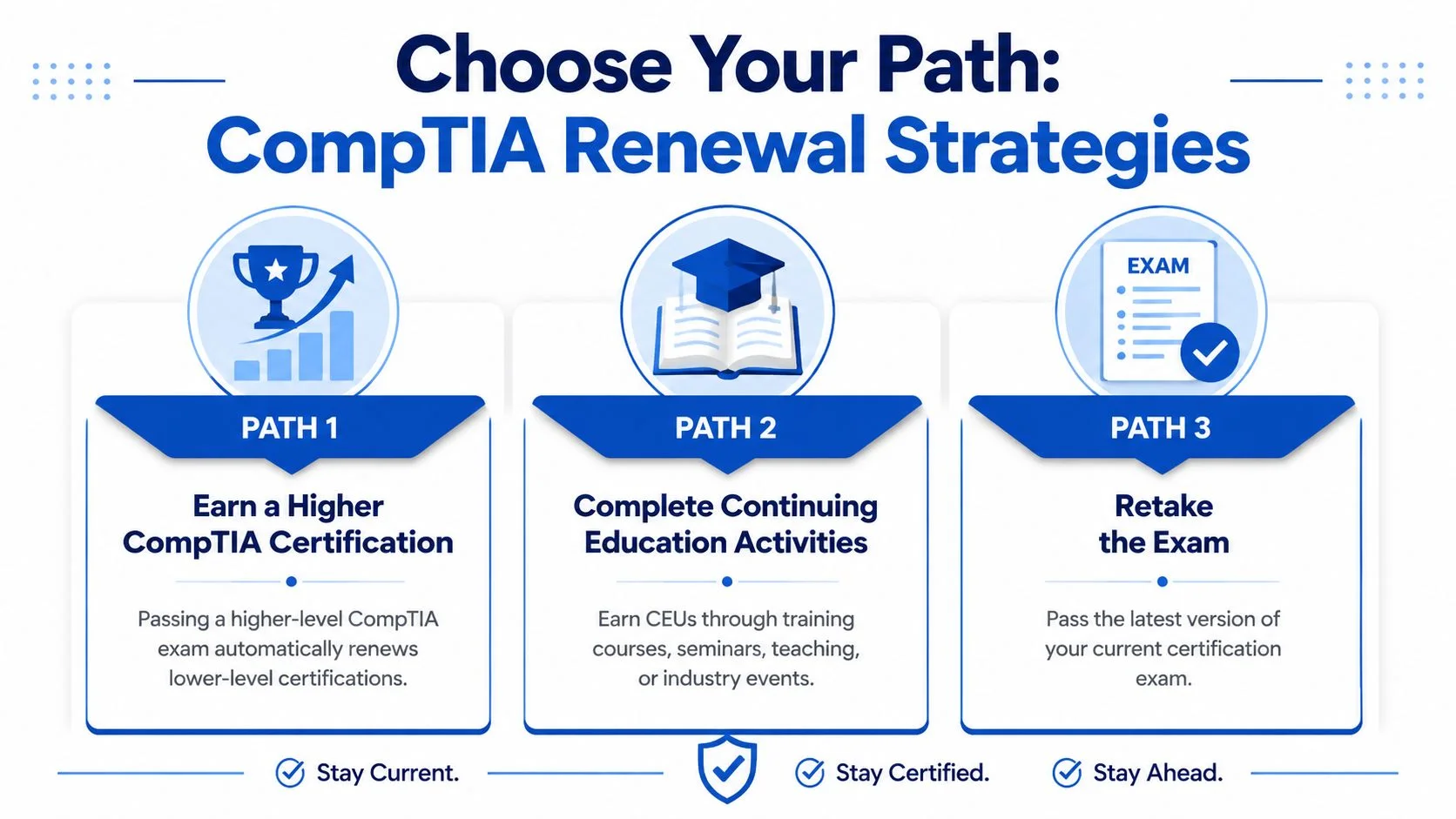
The best choice depends on two things. How much audit-proof evidence you can produce, and whether the renewal step also moves your career forward.
Path one: using CE activities
CEUs give you the most flexibility. They also create the most admin risk.
This route fits people who already attend training, teach, mentor, write, or complete related professional development during the renewal cycle. It works well when those activities are already part of the job. It works poorly when you have to reconstruct everything at the end from half-saved emails, missing attendance records, and vague course titles.
The trade-off is straightforward. CEUs can be the cheapest path if you plan early and stack activities carefully. They can also become the most frustrating path if you spread effort across low-value items that are hard to document or only partially relevant to the certification.
Best for: professionals with consistent learning habits, organized recordkeeping, and enough time to verify each activity before submission.
Path two: using a single-activity option
For A+, Network+, and Security+, CertMaster CE is often the lower-risk choice. You are buying predictability.
That matters if your renewal window is tight or your documentation folder is already messy. Instead of assembling multiple CEU entries and hoping every file meets review standards, you complete one approved course and close the loop. For someone managing several deadlines at once, that reduction in failure points can be worth more than the price.
It is still a trade-off. CertMaster CE solves renewal cleanly, but it may not give the same long-term return as a higher certification if you were already planning to move up.
Best for: someone who wants a controlled process, limited paperwork, and fewer chances to get tripped up by documentation issues.
Path three: earning a higher-level certification
This is usually the strongest strategy if the next certification already matches your job path. You renew and advance at the same time.
Used well, this approach cuts duplicate effort. Instead of collecting a patchwork of CEUs for maintenance only, you put your time into a credential that can improve your role options, compensation discussions, or technical range. The catch is that you need to confirm the renewal relationship before you commit. Higher-level stacking is powerful, but assumptions are where people get burned.
If Security+ is part of that plan, a solid prep resource like this Comprehensive Security Plus guide can help you decide whether advancing now makes more sense than paying for a maintenance course.
Best for: professionals who were already planning their next certification and want renewal effort to produce career value.
What works and what doesn't
A simple comparison helps.
| Renewal path | What works well | What tends to fail |
|---|---|---|
| CE activities | Strong fit if your normal work already includes training, teaching, mentoring, or publishing | Saving proof late, submitting weak relevance mapping, scattering CEUs across activities that are hard to verify |
| CertMaster CE | Good fit if you want a simpler process with fewer documentation variables | Choosing it by default when a higher cert would give better long-term return |
| Higher-level cert | Strong fit if your next role or specialization already points that way | Assuming every cert upgrade automatically renews every related lower cert without checking the details |
| Retaking exam | Useful if you want a fresh skills benchmark and are comfortable with exam pressure | Treating it as the first option when another path would cost less or carry less risk |
Choose the path that gives you the fewest failure points, the cleanest evidence trail, and the most career value for the time you spend.
Earning CompTIA CEUs: A Practical Guide
The risky version of CEU renewal looks familiar. Someone does real training, attends a few webinars, maybe mentors a junior tech, then tries to rebuild proof a month before expiration. That is how valid work turns into rejected submissions.
CEUs work best when you plan them early and keep an audit trail as you go. The same discipline that is critical for security and compliance also protects you during renewal. Save proof when the activity happens, record why it matches the certification, and keep everything in one place.
For A+, the details matter more than many guides admit. You need 20 CEUs during the renewal cycle, and a meaningful share of what you submit has to map directly to A+ objectives, specifically the current Core 1 and Core 2 domains, based on Infosec Institute's A+ renewal process guide. The practical takeaway is simple. General IT activity is not enough. Relevance has to be obvious on paper.
What usually earns CEUs
The accepted categories are broad, but some are easier to defend than others:
- Training and courses: often the cleanest option if you get a certificate of completion and the topic lines up well with the exam objectives
- Webinars and conference sessions: useful, but only if you keep attendance records and can explain the relevance
- Teaching or mentoring: strong for senior technicians, team leads, and internal trainers
- Publishing content: can work well if the content is technical, dated, and clearly yours
- Work experience: helpful, but usually the category people document poorly
The mistake is treating all CEUs as equal. They are not. A completed course with a date, provider name, and syllabus is usually safer than a vague work-experience summary written from memory.
The relevance test that causes trouble
CompTIA reviews whether the activity supports the certification being renewed. If you are renewing A+, your submission should point clearly to hardware, OS, troubleshooting, networking, mobile devices, or related A+ objective areas. If you are renewing Security+, broad IT operations work may still fall short unless you show the security connection.
I tell people to write the relevance statement first, not last.
Use a plain sentence: “This activity supports A+ objective X because it covered Y task or skill.” If that sentence feels strained, the CEU may be weak. If it reads cleanly, your documentation is usually on the right track.
A tracking method that holds up under review
A spreadsheet is enough. The format matters less than consistency.
Track each activity with these fields:
- Activity name
- Provider or employer
- Date completed
- Time or CEUs claimed
- Certification renewed
- Related exam objective
- Proof saved
- Notes for relevance
- Submitted or not submitted
That extra “notes for relevance” field prevents a common failure point. Six months later, people remember they attended something, but not why it matched the cert. Write the reason while it is fresh.
Work experience and content creation need tighter proof
These categories can save time, but they carry more review risk.
For work experience, avoid broad descriptions like “desktop support” or “handled tickets.” Describe the actual tasks that tie back to the exam objectives, such as device configuration, OS troubleshooting, endpoint support, or basic network diagnosis. If employer verification is required, get it on company letterhead and make sure the dates, role, and activities are specific.
For published content, keep the final article, publication date, and authorship proof. A technical post with your byline and a clear topic match is much easier to defend than an internal draft with no date and no visible author.
Stack CEUs with intent, not by accident
Through this, experienced practitioners save time. Do not collect random low-value activities just because they are available. Build a CEU mix that gives you both enough credits and a clean evidence trail.
A smart stack usually has one or two anchor activities, such as a formal course or approved training, then smaller items like webinars or mentoring hours to fill the gap. That reduces the number of separate submissions you may need to explain later. It also lowers the chance that one weak item leaves you short near the deadline.
If your records are messy, your activities only loosely match the objectives, or you already know you dislike admin work, manual CEUs may be the wrong choice even if they are technically allowed. In that situation, a single-path renewal option can be safer than gambling on a pile of borderline submissions.
If you are still building your A+ foundation, it helps to study for CompTIA A+ Core 1 with the exam domains in front of you. That habit makes future CEU mapping much easier because you already know how CompTIA organizes the skills it expects to see.
Managing Costs, Fees, and Potential Audits
The renewal warning usually hits at the worst time. You log in planning to submit a few CEUs, then realize you still owe fees, your documentation is scattered, and you are not fully sure which activities would survive a review. That is how a routine renewal turns into a deadline problem.
Cost planning matters here, but the listed fee is only part of the decision. The full expense often comes from last-minute cleanup, rejected submissions, and paying for a backup renewal option because the first plan was too loose.
Fees are only one part of the renewal risk
If you renew through the Continuing Education program, CompTIA expects both payment and qualifying renewal activity. Paying annual CE fees keeps your record in good standing for that path. It does not complete the renewal by itself.
CompTIA also states that CE fees must be paid before your certification expires, and CE activities still need to be properly documented and submitted within the renewal cycle, as explained in the CompTIA Continuing Education program FAQ.
That distinction matters because professionals often budget for the fee and underestimate the admin work attached to the CEU route.
Audit exposure usually starts with weak evidence
Random audits are part of the program. In practice, the bigger problem is not the audit itself. It is poor recordkeeping.
A usable CEU record should make four things obvious without extra detective work:
- what the activity was
- when you completed it
- how much participation or time it represents
- why it maps to the certification being renewed
If one of those is missing, your claim gets harder to defend. A certificate with no date, a webinar screenshot with no duration, or a course title that sounds only loosely related can create rework at the worst point in your cycle.
Good renewal records follow the same discipline that is critical for security and compliance. Save proof early, label it clearly, and keep it somewhere you can reach quickly if CompTIA asks questions.
Compare renewal paths by failure risk, not sticker price
The cheapest-looking route on paper is not always the cheapest route in practice.
Manual CEU renewal works well for people who already have relevant training, clean records, and enough discipline to submit everything on time. It can be the economical choice.
It can also become the expensive choice if your CEUs are spread across small activities, your proof is inconsistent, or you are close to expiration and still guessing what counts. In those cases, a single-path option such as CertMaster CE, or renewing through a higher qualifying certification, may cost more upfront but reduce the chance of duplicate effort and failed submissions.
That is the trade-off experienced practitioners watch closely. Lower fee. Higher admin burden. Higher fee. Lower audit and documentation friction.
The expensive mistake is mixing strategies without a plan
The pattern I see most often is partial commitment. Someone pays CE fees, logs a few activities, delays the documentation, then buys a different renewal option late in the cycle because confidence drops.
That creates two avoidable costs. More money spent than necessary, and more time spent cleaning up work that no longer matters.
Choose your route early. If you are taking the CEU path, treat documentation like part of the requirement, not an afterthought. If your records are already messy, the safer move is often to use a renewal option with fewer moving parts.
A Step-by-Step Guide to Submitting Activities on the CompTIA Portal
Submitting CEUs is where careful planning turns into actual renewal. This part isn't difficult, but it's easy to make avoidable mistakes if your records are scattered or your activity descriptions are vague.
Start with your evidence ready before you open the portal. That means your completion records, your date information, and your relevance notes should already be in one place.
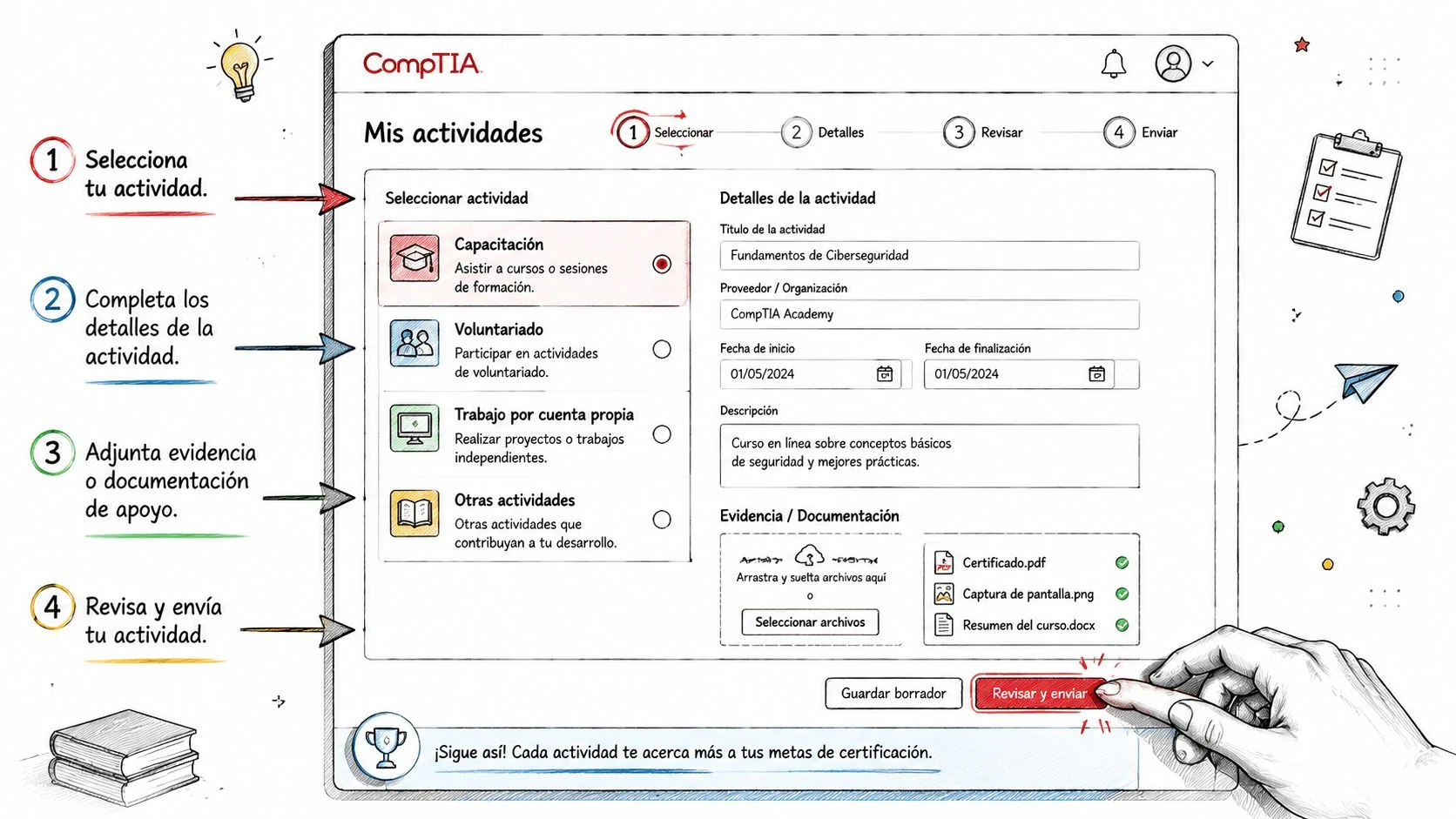
Step one: find the right certification record
Log in to your CompTIA certification account and locate the Continuing Education area tied to the certification you're renewing.
Be careful here. If you hold more than one credential, make sure you're attaching the activity to the correct certification record. A relevant training event might support more than one cert in theory, but your portal entry still needs to be associated properly.
Step two: add the activity with enough context
When you submit an activity, don't write the minimum and hope the reviewer fills in the blanks.
A solid submission usually includes:
- The exact activity name: use the course title, webinar title, or publication title as it appears on the proof
- The provider or organization: training company, conference host, employer, or publisher
- The completion date: make sure it falls within your renewal window
- The activity type: choose the category that best matches what you did
- A short relevance explanation: identify how the activity supports the exam objectives
If the activity is work experience, your employer letter matters just as much as the portal text. If it's a publication, your authorship and publication details need to be obvious.
Step three: upload documentation that can survive review
The biggest submission mistake is uploading proof that only proves part of the claim.
For example, a registration email may show you signed up for a webinar, but it may not prove you completed it. A course certificate may show completion, but not the scope of what you learned. A manager letter may confirm employment, but not explain how the work aligns to the cert objectives.
Use the strongest evidence you have, not just the easiest file to find.
Review your upload the way an auditor would. Can this file prove the claim without extra explanation?
A short walkthrough can help if you want to see the portal process in action before doing it yourself.
Step four: verify before you move on
Before you submit, check four things:
- Dates match the renewal cycle
- Hours match the proof
- The activity category is correct
- The relevance note is specific
Then save your own copy of everything you uploaded. Don't rely on memory. Keep a local folder or cloud folder with the exact files and notes used for each submission.
A practical submission habit
Submit activities soon after completion instead of batching everything at the end. That keeps your details fresh and gives you time to fix anything CompTIA doesn't accept.
When people run into trouble, it's rarely because the portal is hard to use. It's because they postponed submissions until they had to reconstruct months or years of professional development from old inboxes and half-remembered events.
Advanced Strategies and Common Renewal Mistakes
The professionals who handle CompTIA certification renewal best usually do one thing differently. They think in certification paths, not isolated renewals.
That matters because strategic CEU stacking is useful, but easy to misunderstand. A higher-level certification can have a domino effect, but not every relationship is a full renewal. The clearest example is that PenTest+ fully renews Security+, Network+, and A+ but only grants 33 CEUs to Cloud+, which is not a full renewal, according to the discussion highlighted in this CompTIA renewal stacking thread.
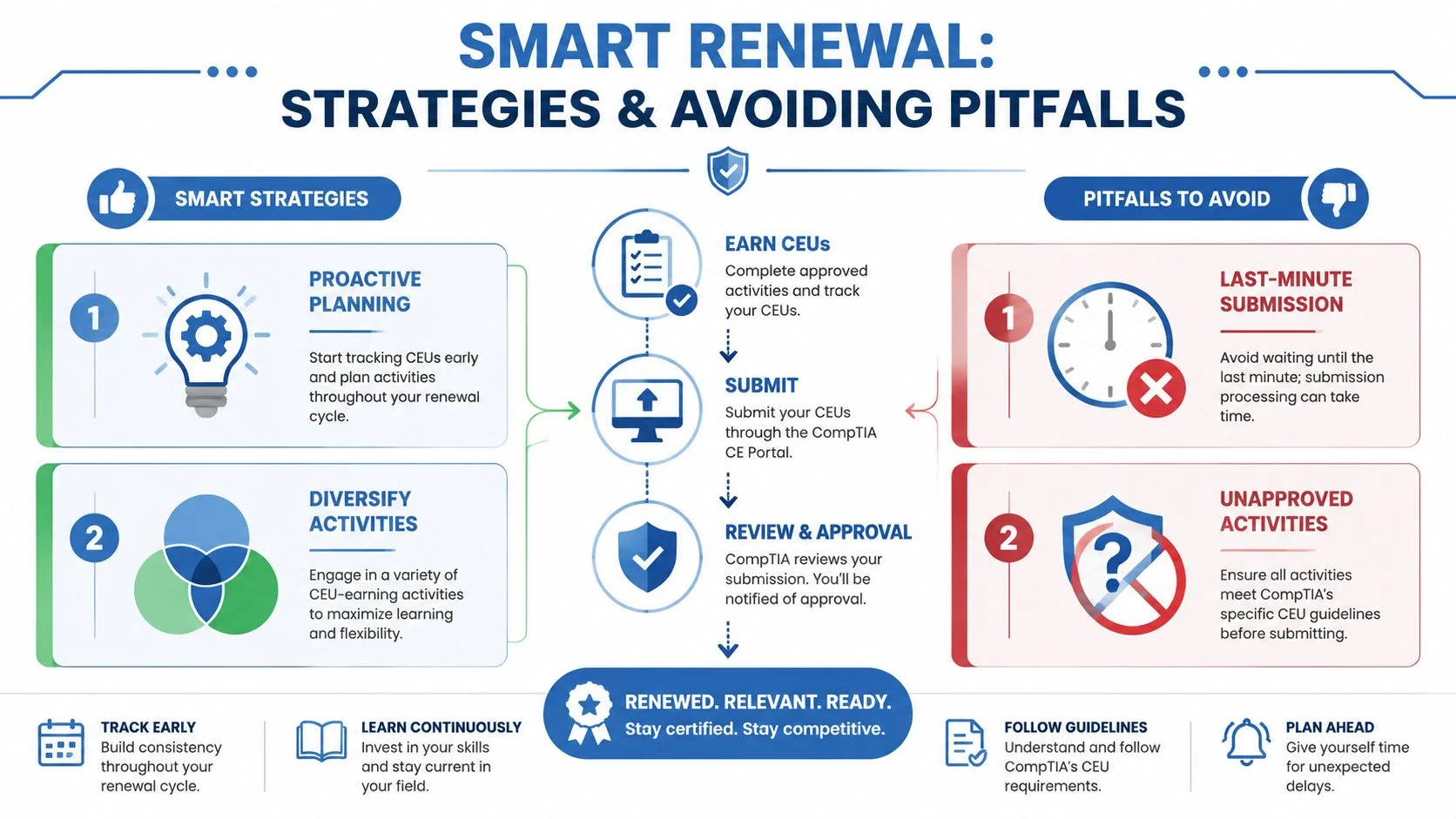
The stacking rule people get wrong
The dangerous assumption is “If a higher cert helps one lower cert, it probably handles all of them.”
That's where people get burned. A partial CEU grant is not the same as a renewal. If you plan around the wrong assumption and let a cert expire, you can lose that certification status and end up back at exam retake territory.
The mistakes worth avoiding
These are the ones I'd watch most closely:
- Letting a lower cert expire while assuming the chain will sort itself out: stacking only helps if the certifications in the path are still valid when the renewal action applies
- Choosing CEUs without objective mapping: broad IT relevance isn't enough
- Paying fees without finishing submissions: money keeps the process open, but it doesn't complete it
- Saving weak proof: attendance, duration, date, and relevance all matter
- Waiting too long to choose a strategy: late planning forces rushed decisions
The savvy approach
A smarter renewal plan usually looks like this:
| Situation | Best practical move |
|---|---|
| You want the safest low-friction option | Use a single-activity route where available |
| You're moving up the CompTIA ladder anyway | Renew through the higher-level certification |
| You already do steady professional development | Use CEUs, but track evidence from the start |
| You hold several certs | Map the stack carefully and check where renewals are full versus partial |
The best renewal plan is the one you can explain on one page. Expiration date, chosen path, required proof, and fallback option.
That's how you keep renewal from turning into a last-minute scramble.
If you want a cleaner way to prepare for your next CompTIA exam and reduce renewal stress later, MindMesh Academy gives you structured study paths, progress tracking, and exam-focused materials designed to help you build real understanding instead of cramming. That makes the first pass easier, and it also makes long-term certification planning much more manageable. To get started, test your knowledge and prepare for your next CompTIA exam with a CompTIA Security+ practice exam.

Written by
Alvin Varughese
Founder, MindMesh Academy
Alvin Varughese is the founder of MindMesh Academy and an enterprise architecture leader. An electrical engineer by training, he moved from factory automation in South Africa to cloud architecture at GE Appliances and Humana (Fortune 50), and holds 20 professional certifications including AWS Solutions Architect Professional, Azure DevOps Engineer Expert, and Microsoft Agentic AI Business Solutions Architect. He built MindMesh Academy after interviewing too many highly certified candidates who couldn't answer basic questions: the goal is prep that makes you better at the job, not just able to pass the exam.