Your Ultimate CISSP Sample Exam and Study Guide
Your Ultimate CISSP Sample Exam and Study Guide: A Strategic Approach
IT professionals pursuing the CISSP certification should treat a realistic CISSP sample exam as a diagnostic tool rather than a simple pre-test. It provides a precise snapshot of current knowledge and strategic thinking before you enter the testing center. Use these practice questions to pinpoint weak domains and familiarize yourself with the unique scenario-based question format. This process serves as a vital first step for building the mental endurance required for success. Identifying technical gaps early lets you focus study efforts where they matter.
Why a Realistic CISSP Sample Exam Is Your Most Powerful Study Tool
Many candidates fail the CISSP because they treat it like a vocabulary test. They spend months memorizing definitions from a massive textbook, only to find the actual exam feels entirely different. This certification is not a technical trivia game. Instead, it is a rigorous test of your managerial judgment and your ability to apply security principles to messy, real-world business problems.
In the exam room, you rarely see questions asking for the exact bit length of an encryption key. You must understand technical details, but the exam focuses on how you apply them. For instance, you might face a scenario where you must choose the most effective risk mitigation strategy for a company facing a specific threat. You will have to weigh the financial budget, the impact on business operations, and legal compliance before choosing an answer. Critical thinking on this level requires active practice rather than passive reading.
Moving Beyond Theory to Application
A high-quality CISSP sample exam pushes you out of the comfort of theory and into the pressure of problem-solving. It acts as a bridge. It connects your conceptual knowledge of the eight security domains to the practical skills needed when the clock is ticking. This simulation is a requirement for serious preparation, much like the steps taken for the PMP, AWS Solutions Architect Professional, or Azure Security Engineer exams.
Simulation is vital for several reasons that affect your final score:
- Identifying Knowledge Gaps: A diagnostic mock test provides a clear baseline across the domains. You stop guessing which chapters to reread. Instead, you get data that shows exactly where to focus your study hours to get the best results.
- Building Mental Stamina: The actual exam is a marathon. It lasts for hours and requires constant focus. A timed mock test prepares your brain for this intensity. It teaches you how to manage your time and how to fight the mental fatigue that often leads to errors in the final hour.
- Exposing Question Patterns: The exam is known for tricky wording and distracting answer choices. Regular practice helps you see through these traps. It helps you adopt the perspective of a manager who cares about the business, rather than a technician who only cares about the hardware.
Knowing how to study for exams effectively is vital, especially regarding your review process. The goal is more than achieving a high score on the practice test. The real work happens after the test. You must analyze your results and find the logic behind every wrong answer. Treat every mistake as a chance to learn something you did not quite grasp.
A mock exam is a diagnostic tool. It is not your final grade. It is a starting point that shows where your study efforts will provide the best return. It functions like a penetration test for your own knowledge; you find the vulnerabilities so you can fix them before the real test begins.
Reflection Prompt: Look at your current job. Which of the eight domains do you think you know best? Which one seems the most difficult? Use a mock exam to see if your assumptions are correct.
The Career and Salary Advantage
Earning your CISSP is a major achievement that changes your career path. Experts project 3.5 million unfilled cybersecurity jobs by 2025. Holding this credential makes you a top candidate. It is a serious investment in your professional future. The financial rewards are significant, with average salaries for certified professionals sitting around $131,000 (verify current salary trends on sites like Glassdoor or Payscale). For strategic roles such as an Information Security Manager, that figure can rise to $175,583 (verify current local market rates).
This CISSP sample exam is more than just a set of questions. It is the first step toward a successful career. It shows that you are committed to high standards and that you understand how to protect an organization at a strategic level.
How To Approach Your First Timed Mock Exam
Treat your first timed CISSP sample exam like a formal dress rehearsal. The goal is to recreate the official testing environment so you can see how your focus and mental endurance hold up under pressure. Use this session to determine if your critical thinking remains sharp after three or four hours of testing.
Find a quiet space where you can work without any interruptions before you begin. Turn off your phone notifications and leave the device in another room. Inform your family or roommates that you are completely off-limits for the duration of the test. Completing the exam in a single, continuous block is non-negotiable. If you take unauthorized breaks, you will get a skewed and inaccurate assessment of your true stamina.
Setting Up for Success
Organize your testing station before you hit the start button. You cannot have notes or books nearby, so focus on removing any potential reason to lose your concentration.
- Use an External Timer: While the screen displays a clock, a physical timer on your desk helps you internalize your pacing without constantly looking at the exam window.
- Keep Water on Hand: Hydration helps you stay clear-headed. Use a basic water bottle to avoid unnecessary restroom breaks or sugary distractions that lead to a mid-test crash.
- Optimize Your Comfort: Check your chair, desk height, and lighting. A small annoyance like screen glare or an uncomfortable seat can become a major distraction by the third hour.
- Mental Preparation: Take a few deep breaths before you start. Remind yourself that this is a learning tool rather than a final verdict. Managing pre-exam anxiety is as important as managing your technical knowledge.
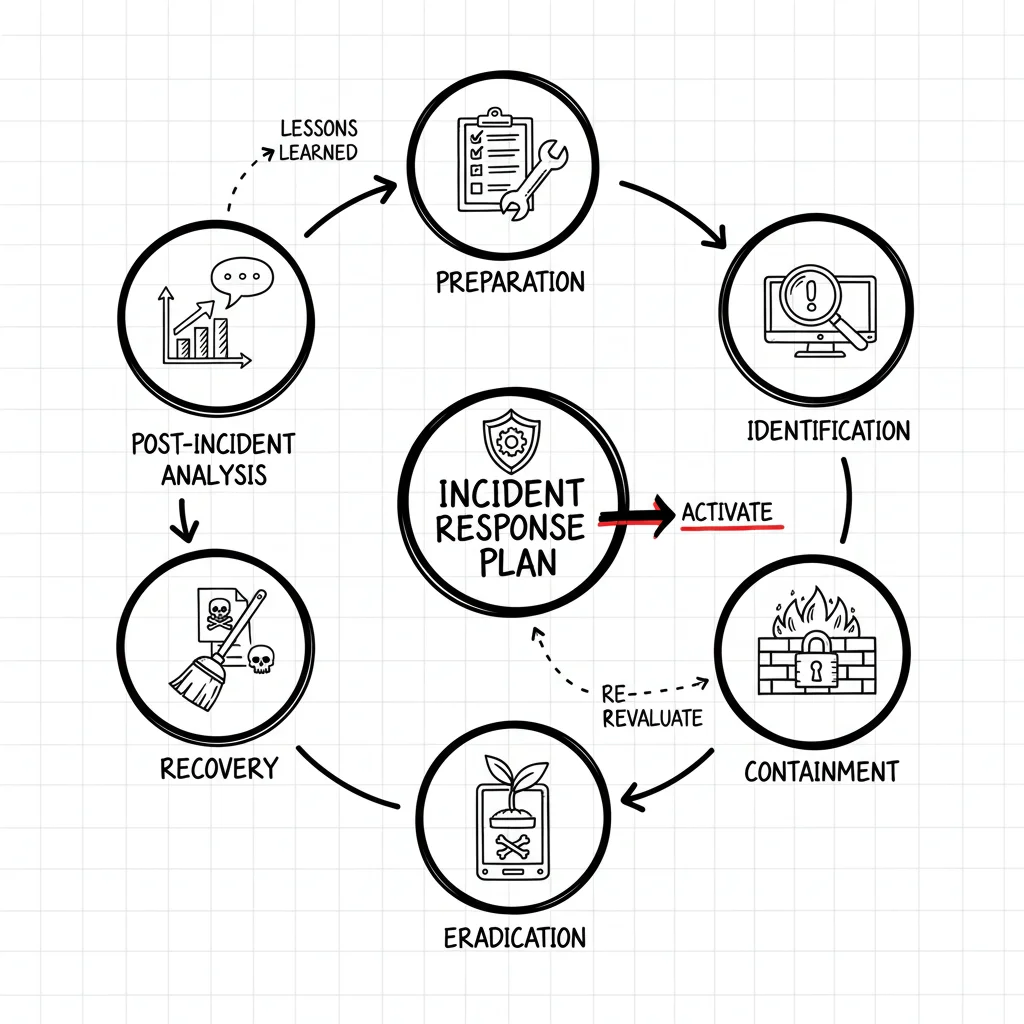
The real CISSP exam tests your ability to manage fatigue and anxiety just as much as your technical knowledge. This first practice run is where you build the mental strength necessary for high-stakes environments like incident response or project management.
During the Exam: Your Game Plan
Once the timer starts, your strategy for each question is the priority. This exam is known for tricky phrasing and scenario-based questions that test your judgment rather than just your memory. Do not rush to select an answer. Pause and determine what the question is actually asking.
Read the entire question carefully. Read it a second time if the meaning is not immediately clear. Look for keywords that indicate the specific security principle being tested. Try to think of the correct answer before looking at the multiple-choice options. This technique helps you avoid the "distractor" choices that look correct but are intended to mislead you.
Next, use a rigorous process of elimination. You can usually remove one or two options that are clearly incorrect or irrelevant to the scenario. This leaves you with two plausible possibilities, which improves your chances of selecting the best answer. Understanding the CISSP exam question types you'll encounter will give you a significant advantage during this stage.
Finally, manage your time with discipline. If a question is too difficult, do not get stuck. Flag it for review and move on to the next one. Spending five minutes on one hard question might force you to rush through several easy ones later, which can lower your score. Keep a steady pace so every question gets the attention it deserves without letting a single problem derail your progress.
Reflection Prompt: During your mock exam, where did you find yourself spending the most time? Was it on understanding the question, analyzing options, or second-guessing yourself? Use these insights to refine your process for the next session.
The MindMesh Academy CISSP Full-Length Practice Exam
This is where your preparation meets reality. Below is our 125-question CISSP practice exam. This simulation reflects the actual testing experience. It covers all eight domains of the official body of knowledge to test how you apply security principles in practical scenarios.
Before starting, treat this as the real event. Find a quiet room. Set aside a three-hour block of time. Turn off your phone and close other browser tabs. Replicating actual testing conditions provides the most accurate data on your current readiness.
The current CISSP exam is a challenging hurdle. It uses a Computerized Adaptive Test (CAT) format. This means the computer evaluates your ability level as you answer each question. If you answer correctly, the next question will likely be more difficult. If you answer incorrectly, the system presents a slightly easier question to find your exact proficiency level. Because of this adaptive nature, you will face between 100 to 150 questions. You have a maximum of three hours to complete the test.
To pass, you must earn a score of 700 out of 1000 scaled points. This is roughly equivalent to a 70% success rate across all domains. The exam does not just test your memory. It requires a managerial mindset. You will often have to choose the "best" answer among several good options by applying logic and sound judgment to complex business situations.
Use this mock exam as a diagnostic tool. Your goal is to find where your knowledge is strong and where it is thin. Every question you miss provides a data point. If you find yourself guessing, even if you get the answer right, mark that topic for review. This allows you to build a focused study plan for your final weeks of preparation.
Give this your full effort. Good luck.
CISSP Sample Exam Questions
1. A security architect is designing a system for a financial institution. The primary requirement is to ensure that a transaction, once completed, cannot be denied by any party involved. Which security service is the architect primarily addressing?
- a) Confidentiality
- b) Integrity
- c) Availability
- d) Non-repudiation
2. During a business impact analysis (BIA), a company identifies a critical business process with a Recovery Time Objective (RTO) of 4 hours and a Recovery Point Objective (RPO) of 15 minutes. Which disaster recovery solution would BEST meet these requirements?
- a) Daily tape backups stored off-site
- b) A cold site with equipment ready for installation
- c) Asynchronous replication to a hot site
- d) A warm site with pre-configured network connectivity
3. An organization is implementing a new access control system. The policy states that users should only be granted the minimum permissions necessary to perform their job functions. This policy is an example of:
- a) Role-Based Access Control (RBAC)
- b) The principle of least privilege
- c) Mandatory Access Control (MAC)
- d) Discretionary Access Control (DAC)
4. A company's web server was compromised. The incident response team created a bit-for-bit copy of the affected hard drive for analysis. What is this copy called?
- a) A system snapshot
- b) A forensic image
- c) A file backup
- d) A disk clone
5. Which of the following cryptographic attacks is most effective against hashing algorithms?
- a) Man-in-the-middle attack
- b) Birthday attack
- c) Chosen-plaintext attack
- d) Brute-force attack
6. An organization wants to classify its data based on its sensitivity and the potential damage from disclosure. Which individual is ultimately responsible for this data classification?
- a) Data custodian
- b) System administrator
- c) Data owner
- d) Security analyst
7. A company is concerned about employees taking sensitive documents home. Which of the following technologies is best suited to prevent this?
- a) Intrusion Detection System (IDS)
- b) Data Loss Prevention (DLP)
- c) Web Application Firewall (WAF)
- d) Unified Threat Management (UTM)
8. In the context of risk management, what is the term for the amount of risk an organization is willing to accept to achieve its objectives?
- a) Risk avoidance
- b) Risk transference
- c) Risk appetite
- d) Residual risk
9. What is the primary purpose of the Bell-LaPadula model?
- a) To ensure data integrity
- b) To maintain data availability
- c) To enforce data confidentiality
- d) To manage access control lists
10. A software developer is using a static analysis tool to review code before it is compiled. What is the main advantage of this approach?
- a) It can identify vulnerabilities in third-party libraries.
- b) It can find security flaws early in the development lifecycle.
- c) It simulates real-world attacks against the running application.
- d) It requires minimal expertise from the developer to use effectively.
11. An organization uses a third-party cloud provider for data storage. What type of control is this an example of?
- a) Corrective control
- b) Detective control
- c) Physical control
- d) Administrative control
12. Which phase of the incident response lifecycle involves learning from a security event to prevent future occurrences?
- a) Containment
- b) Eradication
- c) Preparation
- d) Post-incident activity (Lessons Learned)
13. What is the primary function of a Trusted Platform Module (TPM)?
- a) To encrypt all data on a hard drive.
- b) To securely store cryptographic keys.
- c) To filter network traffic.
- d) To provide antivirus protection.
14. During a security assessment, a penetration tester successfully exploits a vulnerability on a web server to gain initial access. What is the next logical step in the attack methodology?
- a) Covering tracks
- b) Privilege escalation
- c) Reporting the finding
- d) Maintaining access
15. An organization wants to implement a system that requires two individuals to approve a high-risk transaction. This is an example of:
- a) Job rotation
- b) Least privilege
- c) Separation of duties
- d) Need-to-know
Pro Tip: As you work through this practice exam, pay close attention to any question that gives you pause or makes you second-guess. The goal isn't just to identify what you don't know, but also what you aren't 100% confident about. Those are the golden nuggets for building your personalized study plan.
16. Which of the following is an example of a detective security control?
- a) A firewall rule blocking malicious traffic
- b) Security awareness training for employees
- c) A log file showing failed login attempts
- d) An encrypted database
17. What is the main difference between a Business Continuity Plan (BCP) and a Disaster Recovery Plan (DRP)?
- a) BCP focuses on keeping business functions running, while DRP focuses on restoring IT infrastructure.
- b) DRP is a part of BCP, but BCP is not part of DRP.
- c) BCP is for man-made disasters, while DRP is for natural disasters.
- d) There is no significant difference; the terms are interchangeable.
18. A network administrator is configuring a new wireless network and wants to use the most secure protocol available. Which of the following should be chosen?
- a) WEP
- b) WPA
- c) WPA2 with AES
- d) WPA3
19. A company wants to ensure that emails are authentic and have not been tampered with in transit. What technology should be used?
- a) SSL/TLS
- b) Digital Signatures
- c) Symmetric Encryption
- d) VPN
20. What type of fire suppression system is most appropriate for a data center to protect equipment without causing damage from the agent itself?
- a) Water-based sprinkler system
- b) Dry pipe system
- c) Gaseous fire suppression system (e.g., FM-200)
- d) Foam-based system
For some extra practice, feel free to check out these additional CISSP sample questions with detailed explanations to get some more reps in.
21. In the OSI model, at which layer does data encryption and decryption typically occur?
- a) Layer 2 (Data Link)
- b) Layer 3 (Network)
- c) Layer 4 (Transport)
- d) Layer 6 (Presentation)
22. The Clark-Wilson model is primarily concerned with which security principle?
- a) Confidentiality
- b) Integrity
- c) Availability
- d) Non-repudiation
23. A security team is performing a vulnerability scan of their network. They use a scanner that has been provided with administrative credentials to access and assess systems. What type of scan is this?
- a) Unauthenticated scan
- b) Black-box scan
- c) Credentialed scan
- d) Passive scan
24. What is the primary security risk associated with the Internet of Things (IoT) devices?
- a) High power consumption
- b) Lack of physical security controls
- c) Weak or non-existent built-in security features
- d) Limited network bandwidth
25. An organization is conducting a risk assessment. The team calculates the Single Loss Expectancy (SLE) for a particular asset. What two factors are multiplied to determine the SLE?
- a) Asset Value (AV) and Exposure Factor (EF)
- b) Asset Value (AV) and Annualized Rate of Occurrence (ARO)
- c) Exposure Factor (EF) and Annualized Rate of Occurrence (ARO)
- d) Threat and Vulnerability
Continue with questions 26 through 125, following the same format and covering all eight CISSP domains proportionally. The answer key and detailed explanations will be provided in the next section of this guide.
To succeed on the remaining 100 questions of this practice set, you must be prepared to answer questions from every corner of the ISC2 Common Body of Knowledge. The domains are weighted differently, but you must show proficiency in each one to pass.
Domain 1, Security and Risk Management, is usually the largest portion of the exam. It covers high-level concepts like security governance, compliance requirements, legal regulations, and professional ethics. You will also see questions about risk management frameworks and personnel security policies.
Domain 2, Asset Security, focuses on the practicalities of data protection. This includes identifying and classifying information and assets. You must understand the data lifecycle, from creation and storage to retention and eventual destruction.
Domain 3, Security Architecture and Engineering, involves the technical models that keep systems secure. You should be familiar with engineering processes, fundamental security design principles, and specific security models like Biba or Bell-LaPadula. Cryptography and physical security also fall into this category.
Domain 4, Communication and Network Security, covers the pipes that move data. You need a strong grasp of the OSI model, secure network components, and communication channels. Expect questions on network protocols and wireless security.
Domain 5, Identity and Access Management (IAM), is about controlling who has access to what. You will be tested on physical and logical access to assets, identification and authentication methods, and the implementation of authorization mechanisms like RBAC or MAC.
Domain 6, Security Assessment and Testing, asks how you verify that your controls are working. This includes designing and performing security audits, vulnerability assessments, and penetration testing.
Domain 7, Security Operations, is the "day-to-day" domain. It covers incident response, disaster recovery planning, and investigations. You also need to know about resource provisioning and the protection of physical facilities.
Finally, Domain 8, Software Development Security, looks at the security of the applications themselves. You will need to understand the Software Development Life Cycle (SDLC), how to identify security requirements in the development environment, and how to assess the effectiveness of software security controls.
As you move into questions 26 through 125, keep these domain boundaries in mind. The exam will likely mix these topics together, forcing you to switch your focus quickly between technical network details and high-level policy management. Finishing this full-length set will give you the stamina required for the three-hour testing window.
Making Sense of Your Results: Explanations and Domain Analysis
You have finished the timed mock exam. Take a breath and step back for a moment. The most valuable phase of this practice exercise starts now: the systematic review of your results. You need to understand not just which questions you missed, but the logic that led to those errors.
Every wrong answer on a CISSP sample exam serves as a specific indicator of where your knowledge or logic might be failing. These mistakes are lessons that show you exactly where to focus your study time. By analyzing your errors, you can refine your strategic thinking and adapt to the mindset expected of a senior security professional.
This section provides more than a simple answer key. We have included detailed explanations to show you the logic behind the best choice. We also analyze the distractors—the incorrect options—to explain why they do not fit the specific context of the question. As you go through these, try to link each concept back to its specific CISSP domain. This active review helps build the mental structure you need for the actual test.
Mapping Your Wrong Answers to the CISSP Domains
Before looking at individual questions, look at your overall performance across the different subject areas. The CISSP exam uses eight distinct domains. The organization that manages the credential, (ISC)², assigns a specific percentage weight to each domain. Use this structure to turn your raw score into a prioritized study plan. If you see a cluster of mistakes in one area, you have found your primary weakness.
Pay attention to the official weighting. If you struggle in a domain that accounts for 15% of the exam, that area deserves more attention than a domain that only accounts for 10%. Concentrating your effort where the exam is heaviest will provide the best return on your study time.
The following table shows the current weighting for the eight domains:
CISSP Exam Domain Weighting
Use this table to align your sample exam results with the official (ISC)² weights. This helps you decide which areas require the most intensive review.
| Domain Number | Domain Name | Exam Weighting (%) |
|---|---|---|
| 1 | Security and Risk Management | 15% |
| 2 | Asset Security | 10% |
| 3 | Security Architecture and Engineering | 13% |
| 4 | Communication and Network Security | 13% |
| 5 | Identity and Access Management (IAM) | 13% |
| 6 | Security Assessment and Testing | 12% |
| 7 | Security Operations | 13% |
| 8 | Software Development Security | 11% |
Some domains clearly carry more weight. For instance, Domain 1 covers Governance, Risk, and Compliance (GRC), which serves as a common thread through the entire curriculum. You must have a strong grasp of these principles to succeed. Many candidates find success by Mastering GRC Cyber Security frameworks to understand how technical controls support business goals.
Answer Key and In-Depth Explanations
Here is the detailed breakdown for the first 25 questions of the sample test. Use these explanations to understand the reasoning behind each correct choice.
1. Correct Answer: d) Non-repudiation
- Why it's right: Non-repudiation ensures that a party in a communication or transaction cannot falsely deny having sent or received a message. In the context of a financial institution, this is a critical requirement for legal and audit purposes. It is typically implemented through digital signatures and audit logs. When a user signs a transaction with their private key, the resulting signature proves the origin and the fact that the content has not changed.
- Why others are wrong: Confidentiality (a) is about preventing unauthorized people from seeing data, which does not prove who sent it. Integrity (b) ensures data has not been modified, but it does not inherently link the data to a specific individual in a way that prevents denial of the action. Availability (c) ensures systems are up and running when needed. While these are all parts of the CIA triad, they do not satisfy the specific requirement for proof of origin and receipt.
- Domain: Security and Risk Management (Domain 1). This is a foundational security concept. While it involves technical tools often discussed in Domain 3, the requirement for non-repudiation usually stems from business, legal, or regulatory needs, which are Domain 1 concerns.
2. Correct Answer: c) Asynchronous replication to a hot site
- Why it's right: The Recovery Time Objective (RTO) of 4 hours means the system must be back online within that window. The Recovery Point Objective (RPO) of 15 minutes means the organization can only afford to lose 15 minutes worth of data. To meet such a tight RPO, data must be copied to the backup site almost in real-time. Asynchronous replication sends data changes to the backup site as they happen, usually with a very small lag. A hot site is a fully equipped facility that can take over operations immediately, making a 4-hour RTO achievable.
- Why others are wrong: Daily tape backups (a) would result in an RPO of up to 24 hours, far exceeding the 15-minute limit. A cold site (b) is just an empty room with power and cooling; it takes days or weeks to install hardware and restore data, which fails the 4-hour RTO. A warm site (d) has some equipment pre-installed but usually requires several hours or even a day to become fully operational, making it too slow for a strict 4-hour window.
- Domain: Security Operations (Domain 7). Disaster recovery and business continuity planning are core elements of this domain.
3. Correct Answer: b) The principle of least privilege
- Why it's right: This principle dictates that users should only have the minimum level of access required to perform their jobs. By restricting permissions to only what is necessary, an organization reduces the risk of accidental or intentional damage. If an account is compromised, the damage is limited to the specific permissions that account held. This is a primary method for reducing the internal attack surface.
- Why others are wrong: Role-Based Access Control (RBAC) (a) is a method of managing permissions by assigning them to roles rather than individuals, but it is not the principle itself. Mandatory Access Control (MAC) (c) uses security labels and sensitivity levels to restrict access, which is a specific model. Discretionary Access Control (DAC) (d) allows data owners to decide who has access. These are all frameworks or models used to enforce security, while "least privilege" is the underlying goal.
- Domain: Identity and Access Management (IAM) (Domain 5). This domain focuses on how identities are managed and how access is granted or restricted.
4. Correct Answer: b) A forensic image
- Why it's right: A forensic image is a bit-for-bit copy of a storage device. It captures everything, including the operating system files, user data, deleted files, and "slack space" between files. This type of copy is necessary for legal evidence because it can be verified with a cryptographic hash to prove that the evidence has not been altered since it was collected. Standard copy methods do not capture hidden or deleted data.
- Why others are wrong: System snapshots (a) are useful for restoring a system to a previous state but do not capture the raw disk data needed for a thorough investigation. File backups (c) only collect active files and miss deleted data or system metadata. A disk clone (d) creates a functional copy of a drive but may not follow the strict evidentiary procedures required for a formal forensic investigation.
- Domain: Security Operations (Domain 7). This domain covers the investigation process and the proper handling of digital evidence.
5. Correct Answer: b) Birthday attack
- Why it's right: This attack is based on the "birthday paradox" in mathematics, which shows that in a small group of people, there is a surprisingly high chance that two people share the same birthday. In cryptography, this attack tries to find two different inputs that produce the same hash output, known as a collision. If an attacker can find a collision, they can swap a legitimate file for a malicious one without changing the hash value, breaking the integrity of the system.
- Why others are wrong: A Man-in-the-middle attack (a) involves an attacker sitting between two parties to intercept or change their communication. A Chosen-plaintext attack (c) is used to crack encryption by analyzing how specific known text is encrypted. A Brute-force attack (d) involves trying every possible password or key combination until the right one is found. None of these specifically target the mathematical probability of hash collisions like the birthday attack does.
- Domain: Security Architecture and Engineering (Domain 3). This domain covers cryptography and the vulnerabilities of different mathematical models.
Think Like a Manager: Many CISSP questions do not ask for a purely technical solution. They want you to choose the answer that makes the most sense for the business. You must balance the need for security with costs and the impact on daily operations. This focus on high-level decision-making is what defines the CISSP approach.
6. Correct Answer: c) Data owner
- Why it's right: The data owner is usually a senior executive or department head who is ultimately accountable for the protection and use of a specific set of data. They decide how the data is classified (e.g., public, private, or secret) and define the rules for who can access it. While they don't do the technical work themselves, they carry the legal and organizational responsibility for that data.
- Why others are wrong: A data custodian (a) is the person or team (like IT or a database admin) that handles the day-to-day technical management of the data, such as performing backups or setting permissions as directed by the owner. A system administrator (b) manages the underlying servers and infrastructure. A security analyst (d) monitors for threats and vulnerabilities but does not have the authority to decide data classification for a business unit.
- Domain: Asset Security (Domain 2). This domain focuses on identifying, classifying, and protecting organizational assets.
7. Correct Answer: b) Data Loss Prevention (DLP)
- Why it's right: DLP tools are designed to stop sensitive information from leaving the network. They scan outgoing traffic—like emails, cloud uploads, or web traffic—for specific patterns like credit card numbers, social security numbers, or keywords marked as "confidential." If the tool detects these patterns, it can block the transmission and alert the security team. This is the most direct solution for preventing data exfiltration.
- Why others are wrong: An Intrusion Detection System (IDS) (a) looks for patterns of malicious activity or attacks, not necessarily the unauthorized transfer of sensitive data. A Web Application Firewall (WAF) (c) is designed to protect web servers from attacks like SQL injection. Unified Threat Management (UTM) (d) is a device that combines many security features (firewall, antivirus, IDS) into one, but it is not a specialized tool for content-aware data protection like a DLP system.
- Domain: Communication and Network Security (Domain 4). This domain deals with the tools and protocols used to secure data as it moves across networks.
8. Correct Answer: c) Risk appetite
- Why it's right: Risk appetite is a high-level statement that describes how much risk an organization is willing to take to reach its goals. For example, a startup might have a high risk appetite to grow quickly, while a bank will have a very low risk appetite. This statement is set by senior management and provides the direction for all other security and risk decisions in the company.
- Why others are wrong: Risk avoidance (a) is a specific strategy where you decide not to engage in an activity because it is too risky. Risk transference (b) involves giving the risk to someone else, such as buying insurance or outsourcing a process. Residual risk (d) is the amount of risk that remains after you have put all your controls and defenses in place. None of these are broad guiding principles set by the board of directors.
- Domain: Security and Risk Management (Domain 1). Understanding how organizations manage risk is the most significant part of this domain.
9. Correct Answer: c) To enforce data confidentiality
- Why it's right: The Bell-LaPadula model was developed for the US military to ensure that classified information does not leak to people with lower security clearances. It uses two main rules: the Simple Security Property (no read up) and the Star Property (no write down). By following these rules, the model ensures that information only flows from lower levels to higher levels, preventing unauthorized disclosure.
- Why others are wrong: This model does not focus on integrity (making sure data is accurate) or availability (making sure systems are up). There are other models, like Biba or Clark-Wilson, that were created specifically to address integrity. Bell-LaPadula is strictly about keeping secrets, which is the definition of confidentiality.
- Domain: Security Architecture and Engineering (Domain 3). This area covers the formal security models used to design secure systems.
10. Correct Answer: b) It can find security flaws early in the development lifecycle.
- Why it's right: SAST tools look at the code before the program is even finished or running. This allows developers to find mistakes like buffer overflows or hardcoded passwords while they are still writing the software. Fixing a bug during the coding phase is much cheaper and faster than trying to fix it after the software has been deployed to users. This "shift left" approach is a fundamental part of modern secure software development.
- Why others are wrong: SAST cannot find issues that only happen when the program is actually running (a), as it only looks at the static text of the code. It is not necessarily better at finding logic flaws (c) than a human reviewer or a dynamic test. While it can be used for cloud configurations, its primary and most famous benefit is the ability to find vulnerabilities early in the development process (d).
- Domain: Software Development Security (Domain 8). This domain focuses on integrating security into every step of the software creation process.
11. Correct Answer: d) Administrative control
- Why it's right: Administrative controls are the policies, procedures, and guidelines created by management to direct the organization's security efforts. When you choose a cloud provider and sign a contract with them, you are using administrative controls to manage risk. The contract and the Service Level Agreement (SLA) define the security responsibilities of the provider, which is a management-level decision.
- Why others are wrong: Corrective controls (a) are used to fix a problem after it has happened. Detective controls (b) are used to find a problem that is currently happening or has already happened. Physical controls (c) are things you can touch, like locks, fences, or cameras. Choosing a vendor and setting up a legal contract fits none of these categories; it is a procedural, management-focused action.
- Domain: Security and Risk Management (Domain 1). This domain categorizes the different types of controls used to mitigate risk.
12. Correct Answer: d) Post-incident activity (Lessons Learned)
- Why it's right: This is the final stage of incident response. After the immediate threat is gone and the systems are back to normal, the team meets to discuss what happened. They look at what went well and what could be improved. The goal is to update the incident response plan so the organization is better prepared for the next event. This phase is critical for the long-term improvement of the security program.
- Why others are wrong: Containment (a) is the step where you stop the "bleeding" and prevent the incident from spreading. Eradication (b) is the step where you remove the root cause of the incident, such as deleting malware. Preparation (c) involves all the work done before an incident happens, such as training and setting up tools. While these are all part of the process, they do not involve the final review and process improvement.
- Domain: Security Operations (Domain 7). This domain covers the lifecycle of how an organization responds to security events.
13. Correct Answer: b) To securely store cryptographic keys.
- Why it's right: A TPM is a specialized chip on a computer's motherboard. It provides a secure place to store sensitive information like encryption keys, passwords, and digital certificates. Because the TPM is hardware-based, it is much harder for an attacker to steal these keys than if they were stored in the regular software of the operating system. It also helps verify the integrity of the boot process to ensure the computer hasn't been tampered with.
- Why others are wrong: A TPM does not perform the actual encryption of a hard drive (a); it holds the key that the encryption software uses. It does not look at network traffic (c) like a firewall does, and it does not scan for viruses (d). Its sole focus is hardware-level security and key management.
- Domain: Security Architecture and Engineering (Domain 3). This domain looks at the hardware and software components that make a system secure.
14. Correct Answer: b) Privilege escalation
- Why it's right: In a penetration test, the goal is often to see how much control an attacker can gain. After getting a foot in the door with a low-level account, the tester will try to find a vulnerability that allows them to become an administrator or a root user. This is called privilege escalation. Once they have higher privileges, they can access sensitive data or change system settings that a normal user cannot touch.
- Why others are wrong: Covering tracks (a) is something an attacker does at the end of an attack to hide their presence. Maintaining access (d) involves installing backdoors so the attacker can come back later. Reporting the finding (c) is the final step of the entire penetration test project. After the initial "break-in," the most logical next move in the attack chain is to gain more power within the system.
- Domain: Security Assessment and Testing (Domain 6). This domain covers the different ways organizations test their own defenses.
15. Correct Answer: c) Separation of duties
- Why it's right: This control ensures that no single person has enough power to commit and hide a fraudulent act. By requiring two different people to approve a high-value transaction, the organization forces them to work together. This makes it much harder for one person to steal money or change records because they would need to convince another person to help them, which is known as collusion.
- Why others are wrong: Job rotation (a) involves moving people between different roles to prevent them from staying in one position long enough to figure out how to bypass controls. Least privilege (b) is about giving people only the access they need. Need-to-know (d) is about restricting information to those who require it for a specific task. While these are good controls, they don't specifically describe the "two-person rule" for a single transaction.
- Domain: Security and Risk Management (Domain 1). This area focuses on the personnel and procedural controls used to protect the business.
16. Correct Answer: c) A log file showing failed login attempts
- Why it's right: A detective control is like a smoke detector; it doesn't stop the fire, but it lets you know a fire is happening. A log of failed logins doesn't stop someone from trying to guess a password, but it provides the information you need to realize a brute-force attack is underway. You can then use that information to take action.
- Why others are wrong: A firewall rule (a) is a preventative control because it blocks unauthorized traffic before it gets in. Security awareness training (b) is also preventative because it teaches employees how to avoid mistakes that could lead to a breach. An encrypted database (d) is a preventative technical control because it stops unauthorized people from reading the data if they manage to steal the files.
- Domain: Security and Risk Management (Domain 1). You must be able to distinguish between preventative, detective, and corrective controls.
17. Correct Answer: a) BCP focuses on keeping business functions running, while DRP focuses on restoring IT infrastructure.
- Why it's right: This is a vital distinction in the CISSP curriculum. Business Continuity Planning (BCP) is broad and looks at the whole company. It asks, "How do we keep the business alive if the office burns down?" This might involve finding a temporary workspace or setting up manual processes. Disaster Recovery Planning (DRP) is a subset of BCP that is specifically focused on the technology. It asks, "How do we get the servers and data back online?"
- Why others are wrong: Options (b), (c), and (d) provide incorrect or reversed definitions. BCP is not just for short-term events, and it is certainly not only for natural disasters. BCP and DRP work together, but they address different aspects of the organization’s resilience.
- Domain: Security Operations (Domain 7). Managing the continuity of operations is a major part of this domain.
18. Correct Answer: d) WPA3
- Why it's right: WPA3 is the current standard for wireless security. It was designed to fix several weaknesses in WPA2. One of its most important features is the use of Simultaneous Authentication of Equals (SAE), which protects against offline dictionary attacks where an attacker captures data and tries to guess the password on their own computer. It also provides better encryption for public Wi-Fi networks.
- Why others are wrong: WEP (a) is very old and can be cracked in seconds with basic tools. WPA (b) was a temporary fix for WEP and is also considered insecure. WPA2 (c) was the standard for many years and is still widely used, but it is not the most secure option available today now that WPA3 exists.
- Domain: Communication and Network Security (Domain 4). This domain covers the protocols and standards used to protect wireless and wired communications.
19. Correct Answer: b) Digital Signatures
- Why it's right: A digital signature provides two things: proof of who sent the message (authenticity) and proof that the message hasn't been changed (integrity). It works by taking a hash of the email and then encrypting that hash with the sender’s private key. Anyone with the sender’s public key can decrypt the hash and compare it to the email content. If they match, the receiver knows exactly who sent it and that it is untampered.
- Why others are wrong: SSL/TLS (a) encrypts the connection between two points but does not necessarily prove who wrote the email sitting in your inbox. Symmetric encryption (c) uses the same key for both parties, which doesn't provide strong proof of which person actually created the message. A VPN (d) protects traffic as it moves through a tunnel but does not provide a way to sign individual documents or emails.
- Domain: Communication and Network Security (Domain 4). This domain explores how cryptographic tools are applied to network communication.
20. Correct Answer: c) Gaseous fire suppression system (e.g., FM-200)
- Why it's right: Modern data centers house very expensive and sensitive electronic equipment. If you use a traditional water sprinkler, the water will destroy the servers even if the fire doesn't. Gaseous systems work by releasing a gas that interferes with the chemical reaction of the fire or removes the heat. These gases do not leave a residue and do not conduct electricity, so they can put out a fire without ruining the electronics.
- Why others are wrong: Water sprinklers (a) cause massive damage to computers. Dry pipe systems (b) still use water; they just keep the water out of the pipes until a fire is detected to prevent leaks. Foam-based systems (d) are usually used for fuel fires (like at an airport) and would be a mess to clean up in a server room, likely causing permanent damage to the hardware.
- Domain: Security Operations (Domain 7). This includes physical and environmental security controls for facilities.
21. Correct Answer: d) Layer 6 (Presentation)
- Why it's right: The OSI model is a way to describe how different network protocols interact. Each layer has a specific job. Layer 6, the Presentation Layer, is responsible for translating data into a format that the application can understand. This includes tasks like data compression and, most importantly for security, encryption and decryption. When data is prepared for the application to use, Layer 6 handles the syntax and formatting.
- Why others are wrong: Layer 2 (Data Link) (a) deals with MAC addresses and local hardware communication. Layer 3 (Network) (b) deals with IP addresses and routing. Layer 4 (Transport) (c) deals with things like TCP and UDP to ensure data arrives correctly. While encryption can happen at other layers (like IPsec at Layer 3), the Presentation Layer is the traditional answer for where data formatting and encryption live in the conceptual OSI model.
- Domain: Communication and Network Security (Domain 4). You must know the OSI model layers and what happens at each one.
22. Correct Answer: b) Integrity
- Why it's right: The Clark-Wilson model was designed for businesses rather than the military. In a business, it is often more important that data is accurate and has not been tampered with than that it is kept secret. This model uses "well-formed transactions" to ensure that data can only be changed in specific, authorized ways. It also requires "separation of duties" to make sure that no single person can change data without someone else checking the work.
- Why others are wrong: Confidentiality (a) is the focus of the Bell-LaPadula model. Availability (c) is about ensuring the system stays online. Non-repudiation (d) is a goal of digital signatures. While these are all important, Clark-Wilson is the primary formal model for ensuring the integrity of data in a commercial setting.
- Domain: Security Architecture and Engineering (Domain 3). This domain involves studying the classic models of computer security.
23. Correct Answer: c) Credentialed scan
- Why it's right: In a standard vulnerability scan, the scanning tool looks at the target from the outside. In a credentialed scan, you give the tool a username and password. This allows the scanner to log in and look at the system from the inside. It can see missing patches, incorrect registry settings, and local configuration errors that an outside scanner would miss. This provides a much more accurate and detailed picture of the system's security posture.
- Why others are wrong: An unauthenticated scan (a) only sees what a random person on the network can see. A black-box scan (b) is a type of penetration test where the tester has no information at all. A passive scan (d) just listens to network traffic and doesn't actually interact with the target system. None of these provide the deep level of detail that a credentialed scan offers.
- Domain: Security Assessment and Testing (Domain 6). This domain covers the tools and techniques used to find weaknesses in an environment.
24. Correct Answer: c) Weak or non-existent built-in security features
- Why it's right: Many Internet of Things (IoT) devices, like smart light bulbs or cheap cameras, are built with a focus on low cost rather than security. They often have "hardcoded" passwords that cannot be changed, or they use old versions of software that have known vulnerabilities. Even worse, many of these devices cannot be updated or patched, meaning that once a security hole is found, the device stays vulnerable forever.
- Why others are wrong: High power consumption (a) is usually not a problem for IoT; in fact, many use very little power. While they may lack physical security (b), the bigger threat is that they are reachable over the internet. Limited bandwidth (d) can be a challenge for the device's performance, but it is not the primary reason they are such a significant security risk to the network.
- Domain: Security Architecture and Engineering (Domain 3). As more devices connect to the network, securing non-traditional computers becomes a major concern.
25. Correct Answer: a) Asset Value (AV) and Exposure Factor (EF)
- Why it's right: The Single Loss Expectancy (SLE) is a calculation used to figure out the dollar amount the company would lose if a specific threat happened one time. The formula is Asset Value (the cost of the item) multiplied by the Exposure Factor (the percentage of the asset that would be lost). For example, if a $100,000 server is in a building and a fire would destroy 50% of it, the SLE is $50,000.
- Why others are wrong: The Annualized Rate of Occurrence (ARO) (b and c) is used to calculate the Annualized Loss Expectancy (ALE), which tells you the expected loss per year. Threat and Vulnerability (d) are the components of risk, but they are not the specific numbers used in the SLE math formula.
- Domain: Security and Risk Management (Domain 1). Quantitative risk assessment requires you to understand and apply these specific formulas.
Continue this format for questions 26 through 125 and beyond.
Turning Your Mock Exam Results Into a Killer Study Plan
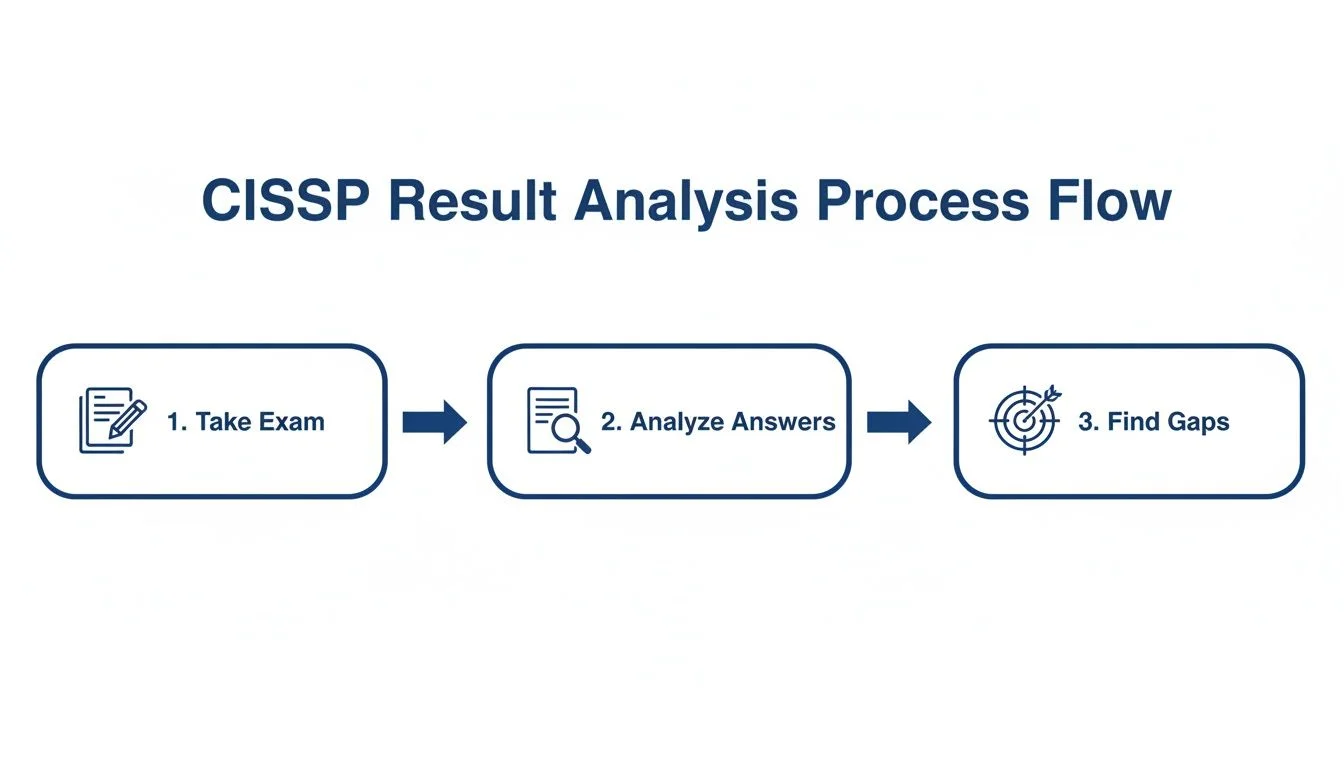
Receiving your score on a CISSP practice test is only the start of your preparation. That number—whether it is a 65% or an 85%—does not tell the whole story. The real value comes from examining the logic behind your answers. You must look at the questions where you hesitated, the topics that caused confusion, and the specific patterns in your errors. This analysis is how you move from simply taking a test to building a smart, targeted study plan that produces actual results.
Do not get stuck on the total percentage. Your first priority should be breaking down your performance question by question. Map every wrong answer to its official CISSP domain. This simple step identifies your weakest spots and tells you exactly where to spend your limited study time for the best improvement. If you failed Domain 3 questions but cruised through Domain 2, you have found your immediate priority.
This strategy converts raw data into specific instructions for your study sessions. Instead of guessing what to read next, you use your own performance history to guide your efforts.

The flowchart above shows the cycle of effective exam prep: test your knowledge, analyze exactly where you failed, and then systematically fix those gaps.
From Analysis to Action With Spaced Repetition
After you identify your weakest domains, you must find out why you missed specific questions. Most errors fall into one of three categories:
- Knowledge Gaps: You were not familiar with a specific term, process, or concept. This signals a need to review the primary study materials for that topic.
- Misinterpretation Errors: You understood the underlying concept but the question wording was confusing. You failed to identify what the question actually asked. This requires more practice with critical reading and scenario-based questions.
- Best-Answer Traps: This is a common issue on the CISSP. You found an answer that was technically correct, but it was not the most appropriate choice from a management perspective. You must learn to choose the answer that addresses risk at an organizational level.
This detailed analysis helps you use a technique called Spaced Repetition. Instead of reading whole chapters again, make flashcards for the specific concepts you missed. Review these cards often at first. As you remember them better, wait longer between review sessions. This moves information from short-term to long-term memory. It is a highly effective way to study for the CISSP, PMP, AWS, or Azure certifications.
Carving Out Your Adaptive Learning Path
Your analysis creates a learning path suited to your specific needs. For example, if you often miss questions about Business Continuity Planning (BCP), you can start a study "sprint" on that topic. Spend an entire study session on BCP. Watch specific videos, read the relevant sections in your study guide, and take quizzes that focus only on BCP. This active approach fixes your weaknesses rather than wasting time on material you already know.
Your mock exam results are not just a grade; they are a guide to the specific knowledge gaps you need to fill. If you follow this data, you make sure every minute of your study time helps you pass the exam.
This level of strategy separates those who pass from those who do not. It also prepares you for the high-paying roles that come with the certification. CISSP holders earn significant pay; projections for 2025 (verify current salary trends on industry sites) show average base pay reaching $143,708. Total compensation for roles like Information Security Manager can climb to $175,583.
Using your mock exam results this way builds a strong foundation for your cybersecurity career. It is about more than one test; it is about developing a mindset for solving complex security problems. To see how the CISSP fits into your professional growth, explore our comprehensive cyber security certification roadmap.
Got Questions About the CISSP Exam? We've Got Answers.
Preparing for the CISSP for the first time can feel like a heavy undertaking. It is normal to have many questions about how the process works. Finding clear and direct answers about the mechanics of the test and the best ways to study will help you feel more prepared. We will look at the most frequent questions professionals ask when they start preparing for this difficult examination.
How Is The Real CISSP Exam Scored?
You should start by letting go of the idea that this is a simple percentage-based test. The exam uses a scaled scoring system. To pass, you need to earn 700 out of 1,000 possible points. This is not the same as getting 70% of the questions right because the points are weighted based on difficulty and other factors.
The test utilizes a format known as a Computerized Adaptive Test (CAT). The testing software changes based on how you perform while you are sitting at the computer. If you answer a question correctly, the next one the system gives you will likely be more difficult. If you get a question wrong, the software might offer a slightly easier one to see if you understand the underlying concept. The goal of this algorithm is to find out, with high statistical certainty, if you have enough knowledge across all eight domains. This adaptive format is why memorizing facts is not enough to succeed. You must understand how to apply security principles to different business scenarios.
How Many Practice Exams Should I Take?
There is no single number that works for everyone, but a good plan usually includes three to four full-length, timed practice tests. Do not rush through these just to see a score at the end. Use them as milestones to measure your progress and find out where you need to spend more time.
Here is a helpful way to organize your practice schedule:
- The First One (Your Baseline Diagnostic): Take this test very early in your preparation. Do this before you have finished all your reading. It acts as a raw look at your current knowledge. It will show you which areas you already understand and where you have significant gaps.
- The Middle Ones (Progress Checks): After you have spent a few weeks or months studying, use one or two more tests to see how you are improving. Check to see if your weak areas are getting better. You might also find that you are starting to forget details in areas you thought you knew well.
- The Final One (The Dress Rehearsal): Schedule your last practice test about one or two weeks before your actual exam date. Focus on simulating the real environment. Sit in a quiet room, set a timer, and do not look at your notes. This builds the mental stamina you need for the actual test day.
The real way to pass is not about the total number of sample tests you finish. It is about how much time you spend looking at the results. It is better to take one exam and spend four hours reviewing every answer than to take five exams and only look at the final score. You need to understand why the right answer is correct and why the other choices are wrong.
What Are The Most Challenging CISSP Domains?
Which domains feel the hardest depends on what you do for a living. Your work history will make some parts of the book feel like common sense and others feel like a foreign language.
Technical professionals, such as network engineers or systems administrators, often have a hard time with Domain 1 (Security and Risk Management). This area is difficult because it requires you to stop thinking like a technician. You have to think like a manager. Instead of looking for a technical fix for every problem, you have to look at the business risk and the cost of the solution.
On the other hand, if you work in project management or compliance, you might find the technical parts of the exam much harder. Domain 3 (Security Architecture and Engineering) and Domain 4 (Communication and Network Security) involve deep details about cryptography, protocols, and hardware. The best way to find your own difficult spots is to take a diagnostic test and see where your lowest scores appear.
Can I Pass The CISSP With Self-Study Alone?
Yes, you can. Many people pass the exam every year by studying on their own without a formal bootcamp. Successful self-study does not require a teacher, but it does require high-quality materials and a disciplined schedule.
A successful plan usually includes a few different types of resources. You should have the official (ISC)² study guides and at least one set of video lessons to explain the more technical topics. You also need a high-quality practice test platform. When your tools give you clear explanations for every question, you can build a study plan that focuses on your specific needs. This approach allows you to spend your time where it matters most, helping you be well-prepared for the exam.
Ready to see where you stand and create a study plan that works? MindMesh Academy provides adaptive tools and practice exams designed to help you master the material. Start preparing today to prove your expertise in cybersecurity.
Ready to Get Certified?
Prepare for the exam using expert-vetted study materials from MindMesh Academy:
- CISSP Study Guide — Master all eight CISSP domains with our thorough and expert-led study guide.
- CISSP Practice Exams — Test your readiness with scenario-based practice questions.

Written by
Alvin Varughese
Founder, MindMesh Academy
Alvin Varughese is the founder of MindMesh Academy and an enterprise architecture leader. An electrical engineer by training, he moved from factory automation in South Africa to cloud architecture at GE Appliances and Humana (Fortune 50), and holds 20 professional certifications including AWS Solutions Architect Professional, Azure DevOps Engineer Expert, and Microsoft Agentic AI Business Solutions Architect. He built MindMesh Academy after interviewing too many highly certified candidates who couldn't answer basic questions: the goal is prep that makes you better at the job, not just able to pass the exam.