CISM Security Certification: Your 2026 Authoritative Guide
Preparing for CISM: A Manager's Guide to Security Leadership
You've probably seen this pattern in your own career: you became the person everyone calls when a control fails, an audit gets tense, or a security project stalls. You can explain firewalls, identity, logging, and incident response in detail. But when the conversation shifts to budgets, risk tolerance, governance, or reporting to the board, the dynamic changes.
That's the point where many strong technical professionals start looking at the CISM security certification.
CISM isn't for proving you can configure a tool. It’s for proving you can lead a security program in a way the business understands, supports, and funds. If you're trying to move from solving isolated security problems to directing security as a business function, this credential deserves a serious look from a MindMesh Academy perspective.
What Is the CISM and Who Needs It?
Imagine a budget meeting. The security issue is clear to you: a real control gap, a weak audit trail, and growing risk. Then the executive team asks three questions: What's the business impact? Which risk should we address first? How will you show the program is working six months from now?
CISM, short for Certified Information Security Manager, was built for exactly that kind of conversation.
ISACA’s certification centers on security management at the organizational level. The exam focuses on governance, risk management, security program development, and incident response oversight. A good shorthand is this: CISM measures whether you can turn security from a set of technical activities into a managed business function with clear priorities, accountability, and evidence.
This shift matters because many capable practitioners hit the same wall. They can solve control problems. They can explain tools. They can respond under pressure. What slows career growth is the next layer of work: setting direction, defending priorities, influencing leaders, and explaining why a security decision supports the business.
The shift from technical expert to security manager
A senior engineer often starts with the control itself. A security manager starts with the risk decision around that control.
Here's the difference in plain terms. An engineer may ask, "Which safeguard should we deploy?" A CISM-level leader asks, "Which safeguard reduces the right risk, fits the business process, and can the organization maintain it over time?" It’s the difference between choosing a lock and running the whole key system for the building.
That's why CISM tends to attract people who already have strong security foundations and now need to lead through policy, prioritization, budgeting, and executive communication. If your next role depends on judgment across teams more than hands-on administration, this credential lines up with that move.
Who usually benefits most
CISM usually fits professionals whose work already affects security outcomes beyond a single tool or team.
- Security leads: People setting priorities for analysts, engineers, or consultants.
- IT managers: Leaders balancing uptime, operational risk, vendors, and continuity.
- Risk and compliance professionals: Practitioners who need deeper security management judgment.
- Internal auditors and governance staff: People reviewing whether security controls are designed and operating effectively.
- Technical professionals moving upward: Engineers, architects, or administrators preparing for broader ownership.
There's also a practical study angle that candidates often miss. CISM rewards judgment patterns more than memorized definitions. If you want to identify skill gaps before you commit months of study, review your experience against the exam domains and ask where you have made actual management decisions, not just supported them.
If you're comparing certifications, place CISM in the "security program owner" category. It suits the person accountable for outcomes, evidence, and direction—the colleague who has to explain why a control matters, how success will be measured, and what the business should do next.
Are You Ready for the CISM Certification?
You are in a meeting with operations, legal, and an executive sponsor after a security incident. No one asks you to tune a firewall rule. They ask which risks matter now, what the business can tolerate, who owns the next decision, and how progress will be reported. If that kind of responsibility already feels familiar, CISM may fit where your career is heading.
CISM is designed for professionals who already have real security experience and some history of leading decisions, programs, or outcomes. The formal eligibility details come from ISACA, but the bigger question is simpler: Has your work shifted from executing tasks to shaping direction?
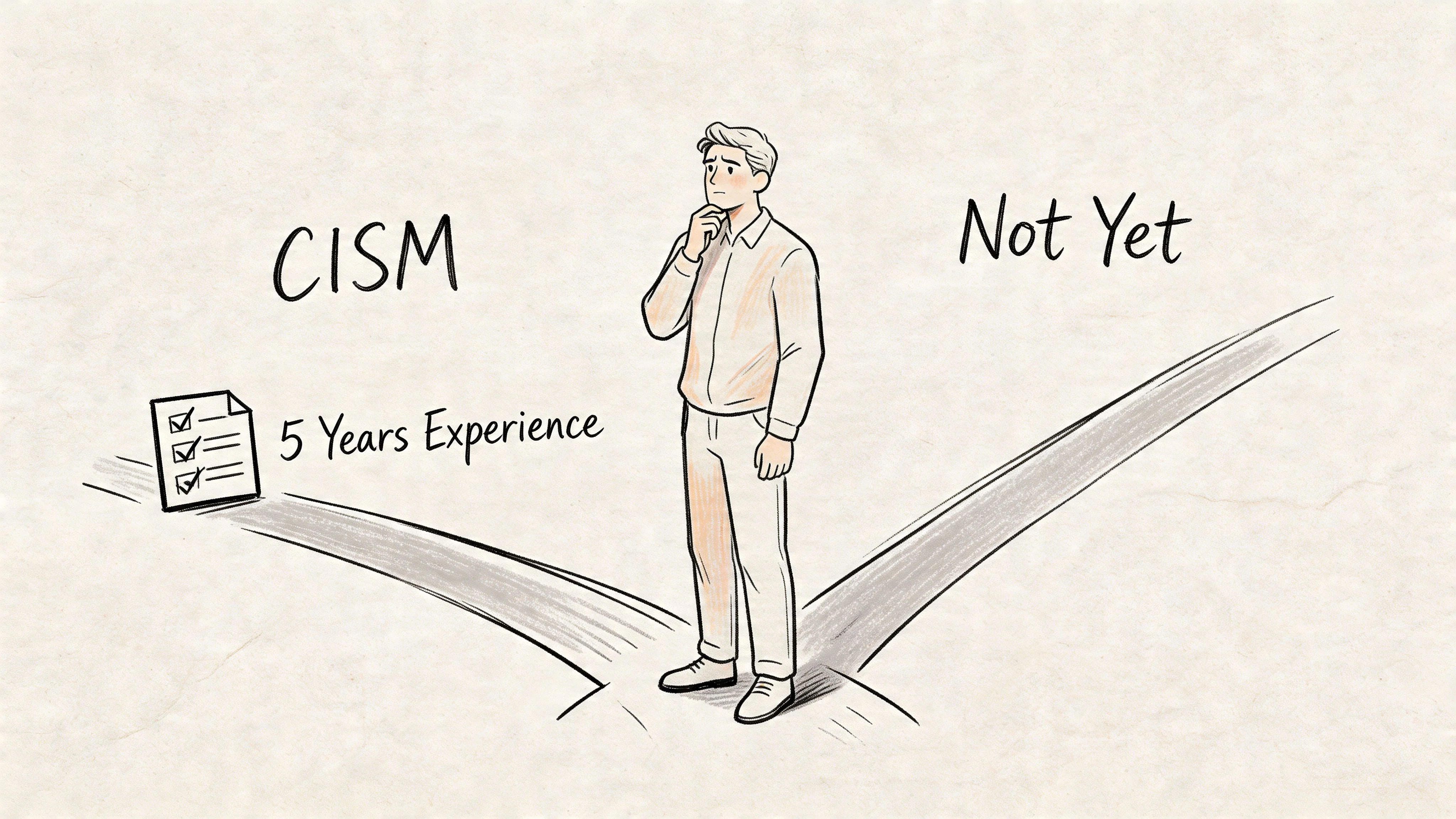
Management experience doesn't only mean direct reports
Strong candidates often get stuck at this point. They hear "management experience" and assume it only counts if they have performance reviews, hiring authority, and a team org chart.
CISM uses a wider definition in practice. Security management often looks like setting priorities, guiding risk decisions, coordinating work across functions, and making sure controls support business goals. You may have been doing that for years without the word "manager" in your title.
Work that often reflects CISM-level readiness includes:
- Policy ownership: You helped write, update, interpret, or enforce security policies and standards.
- Risk guidance: You assessed gaps, compared treatment options, and explained tradeoffs to leadership.
- Program coordination: You ran awareness efforts, vendor reviews, vulnerability workflows, or control implementation across teams.
- Incident leadership: You organized response efforts, set communication paths, and helped choose recovery priorities.
- Governance participation: You contributed to steering committees, audit follow-up, metrics reporting, or remediation planning.
The common thread is judgment. Someone had to decide what mattered, what could wait, and how to explain the reasoning.
What the exam mindset looks like
A technical specialist usually focuses on whether a control works. A security manager also has to ask whether the control is appropriate, whether the cost makes sense, whether the owner understands the risk, and whether leadership has enough information to act.
That shift matters.
CISM rewards candidates who can connect security work to business outcomes. You will see questions that test prioritization, governance, accountability, and communication, not just technical correctness. In other words, the exam often asks, "What should the organization do next?" instead of "What setting should be changed?"
A useful way to judge your readiness is to review recent projects and separate them into two groups:
- Work where you mainly implemented or supported a control.
- Work where you influenced scope, priority, risk treatment, reporting, or cross-team decisions.
If your second group is starting to fill up, you are probably closer than you think.
A practical self-check before you commit
Do not just ask whether you have enough books, videos, or practice questions. Start by gathering evidence from your own work. List five to eight projects from the last two or three years. For each one, note the decision you influenced, the stakeholders involved, the business tradeoff, and the outcome.
That small exercise does two jobs at once. It shows whether your background matches the exam's management focus, and it gives you raw material for a smarter study plan later.
You can also intentionally identify skill gaps between your current responsibilities and the work expected from security managers or CISOs. Be specific. Maybe you are strong in incident coordination but weaker in governance reporting. Maybe you can assess technical risk well but have less experience presenting treatment options to senior leaders. Those gaps should shape how you study.
Modern study methods help. If a domain feels familiar because you have lived it, simple review may be enough. If a domain feels abstract, build a spaced repetition routine around the decisions, terms, and scenarios that keep tripping you up. Treat your study plan like incident response preparation: review key patterns repeatedly, test recall under pressure, and fix weak spots before they become expensive.
Signs you're ready now
You are likely ready to pursue CISM if several of these sound true:
- You explain security issues to business leaders, not only technical peers.
- You have owned outcomes that depended on coordination across departments.
- You regularly weigh business risk, cost, urgency, and control effectiveness together.
- You are comfortable recommending a course of action, not just presenting findings.
- You want your next role to include more accountability for policy, program direction, or incident readiness.
If that describes your current role, CISM is less about learning a brand-new discipline and more about organizing experience you already have. That's also the right time to study efficiently. Build from real scenarios, review them over time, and practice the management judgment the exam is built to measure.
Decoding the CISM Exam Blueprint
A candidate can know security cold and still miss CISM questions because the exam judges management decisions, not tool familiarity. The blueprint matters because it tells you where ISACA expects that judgment to show up.
You will face 150 multiple-choice questions in 4 hours. The exam uses a scaled score, and the published domain weights are Information Security Governance (17%), Information Risk Management (20%), Information Security Program Development and Management (33%), and Information Security Incident Management (30%).
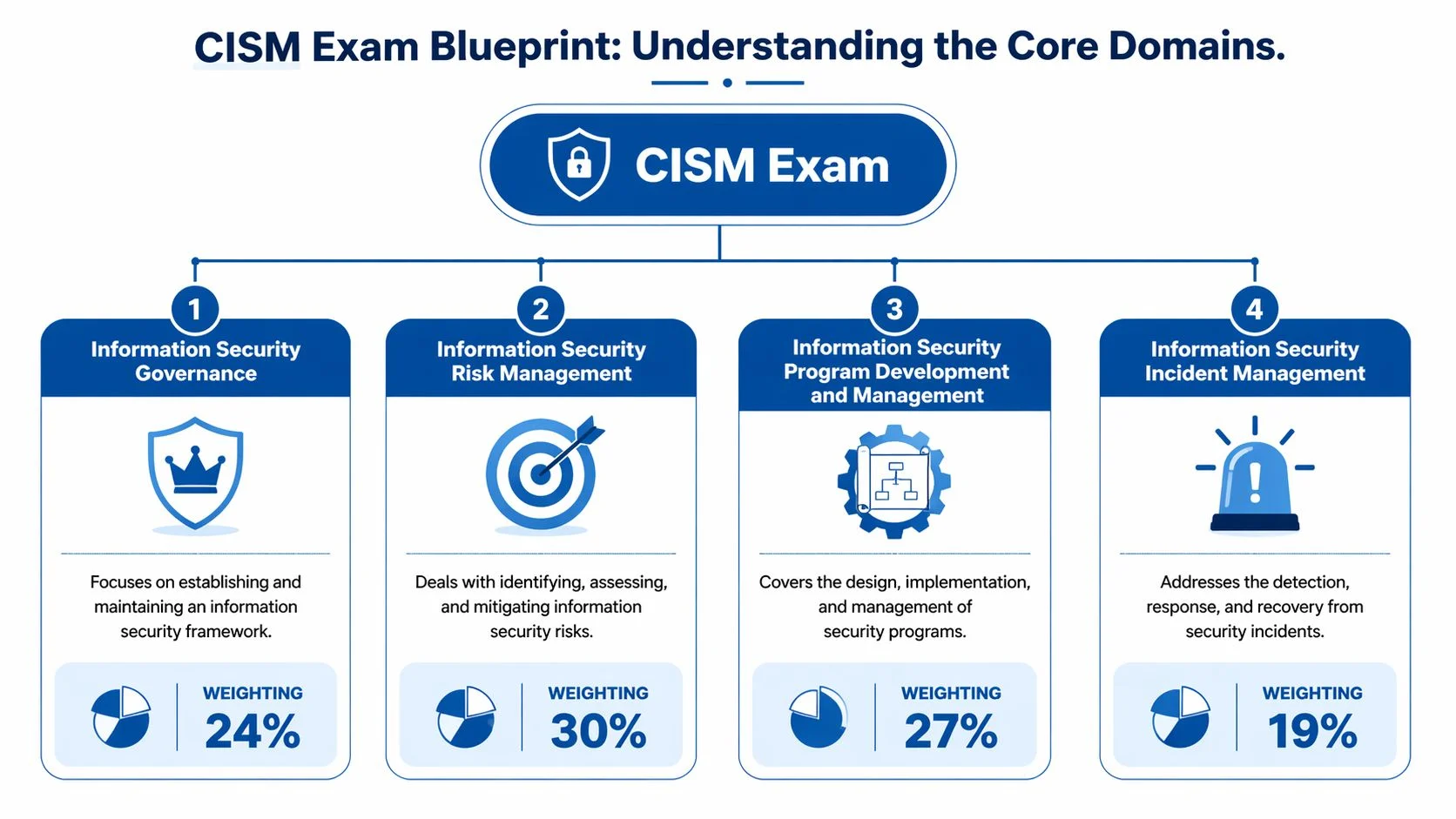
If an infographic or third-party summary shows different percentages, rely on the current weighting published by ISACA.
One useful way to understand the blueprint is to compare the domains to the responsibilities of a security leader over time. First, you set direction. Then you evaluate risk. Then you build and run the program. Then you prepare for disruption and lead through it.
| Domain | Leadership responsibility | What you're really being tested on |
|---|---|---|
| Information Security Governance | Set direction and accountability | Whether security supports business goals and has clear oversight |
| Information Risk Management | Judge what matters most | Whether you can identify, assess, and treat risk in business terms |
| Information Security Program Development and Management | Build and operate the program | Whether you can turn strategy into controls, metrics, staffing, and repeatable processes |
| Information Security Incident Management | Lead during disruption | Whether response, communication, recovery, and improvement are managed well |
Governance tests whether security has authority
Governance questions ask whether security is guided by approved policy, defined roles, executive support, and business alignment. Candidates with strong technical backgrounds often move too quickly toward controls. CISM usually wants you to confirm that the organization has the mandate and oversight to make those controls meaningful.
A good mental check is simple. Before choosing an answer, ask, "Who approved this, who owns it, and how does it support the business?" That habit helps you avoid answers that sound efficient but ignore accountability.
Risk management tests judgment, not just identification
Risk management on CISM is about choosing a sensible response based on impact, likelihood, tolerance, and business priorities. The exam rewards defensible decisions. It does not reward the loudest technical reaction.
This domain often trips up candidates who are used to severity scores alone. A critical vulnerability still sits inside a business context. If a question gives you a choice between an immediate control change and a step that confirms business impact, ownership, or treatment approval, pause and read carefully. Managers are expected to make decisions the organization can justify and sustain.
Program development deserves the most study time
Information Security Program Development and Management is the largest part of the blueprint at 33%. That should shape your calendar, not just your reading list.
This domain covers the work of turning policy into operations. You are dealing with implementation planning, resource allocation, awareness efforts, metrics, exceptions, and ongoing oversight. In practice, many candidates realize they have read the material but have not trained the decision patterns.
Use a more evidence-based study method here. Instead of rereading a chapter and calling it done, build scenario cards. On one side, write a management problem such as tool rollout delays, weak adoption, unclear ownership, or missing metrics. On the other side, write the best next management action and why it fits CISM logic. Review those cards on a spaced repetition schedule over several weeks. That method helps you retain judgment under pressure, which is what the exam is measuring.
A practical example helps. If an organization wants to reduce email-related data exposure, a manager has to define ownership, scope, policy exceptions, rollout sequencing, and success measures. Reading about Data Loss Prevention best practices can sharpen that program-level thinking because it shows how controls succeed or fail when process and accountability are unclear.
Exam mindset: The strongest answer usually reflects governance, repeatability, and business alignment.
Incident management measures leadership under pressure
Information Security Incident Management accounts for 30% of the exam, so it needs serious attention. This domain includes readiness, detection, classification, escalation, communications, coordination, recovery, and lessons learned.
A responder asks what action to take next on the keyboard. A manager asks whether the organization has the authority, communication path, and recovery structure to handle the event cleanly.
Study this domain the same way experienced teams rehearse incidents. Use short scenario reviews. Quiz yourself on escalation order, stakeholder communication, evidence handling, and post-incident improvement. Then revisit those scenarios a few days later and again the next week. Spaced review helps you remember the sequence when a question adds stress and ambiguity.
What the scaled score means for your study plan
A scaled score confuses many candidates because it does not translate neatly into a raw percentage target. The practical takeaway is straightforward: You need broad, reliable performance across the blueprint.
So do not spend three weeks polishing your favorite domain while neglecting another one. A better plan is to weight your time according to the blueprint, test recall regularly, and track misses by domain and decision type. If you keep missing governance questions because you skip approval and accountability, that pattern tells you exactly what to review next.
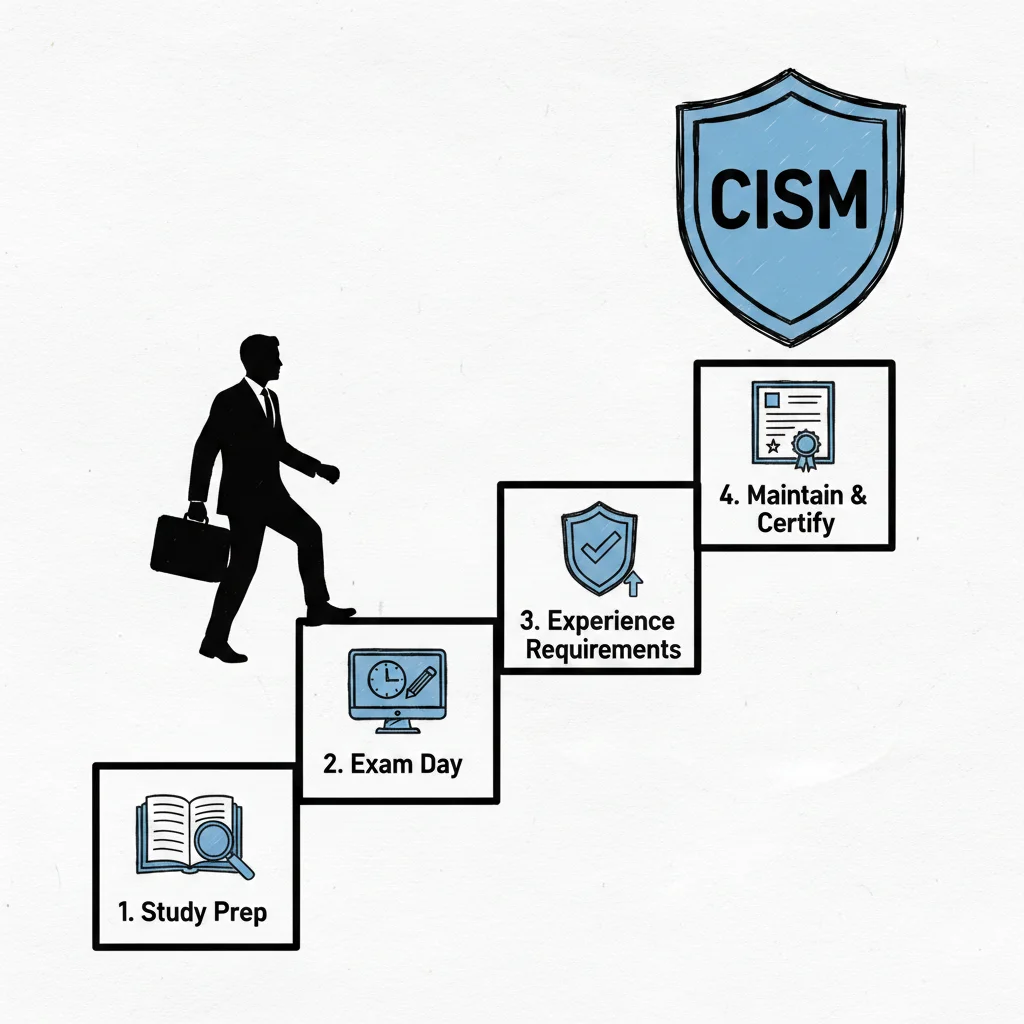
Your Path to CISM Certification Step by Step
Passing the exam is only one part of becoming CISM certified. Treat the process like a project with administrative steps, documentation, and a maintenance phase. That mindset saves a lot of frustration later.
Step one, verify that the credential matches your profile
Before you register, carefully review your work history. CISM rewards experience-backed judgment. If your background already includes governance, risk, program ownership, or incident leadership, move forward confidently.
If not, don’t force the timeline. It’s often smarter to spend a stretch of time taking on policy reviews, audit remediation ownership, or risk reporting responsibilities before you sit the exam.
Step two, register and schedule intentionally
Once you decide to proceed, register through ISACA and choose a test date that creates a real deadline. Many candidates linger in passive preparation because they never commit to a date.
A date changes behavior. It also helps you reverse-plan your study calendar, your review cycles, and your practice-question milestones.
Here’s a practical sequence that works well:
- Choose a preparation window: Most working professionals need a structured study period, not sporadic weekend reading.
- Book the exam after you map your weeks: Don’t choose a date first and hope your schedule cooperates.
- Block dedicated study sessions: Put them on your calendar like leadership meetings.
- Keep an experience record: Capture projects and responsibilities that support your application.
Step three, study for managerial judgment
CISM questions often hinge on the “best” answer in a business context. That means your preparation should include more than content review.
Prioritize activities that build judgment:
- Scenario review: Read a question, then explain why each wrong answer is weaker.
- Decision framing: Practice identifying the business issue, not only the technical issue.
- Policy language: Get comfortable with terms like accountability, oversight, risk treatment, and incident escalation.
- Executive translation: Summarize technical issues in one or two business-focused sentences.
Step four, pass the exam and complete the application
After you pass, don’t assume you’re done. Certification also involves the formal application process to verify your qualifying work experience.
Candidates find preparation advantageous before exam day. If you’ve already documented projects, responsibilities, and management-related duties, the application stage feels straightforward. If you haven’t, you may end up reconstructing years of work from memory.
Keep a simple record of projects, dates, stakeholders, and responsibilities while you study. Future you will be grateful.
Step five, maintain the credential like a practicing leader
A management certification shouldn’t sit still. Security changes too quickly for that.
Once certified, keep building in the same areas the exam emphasizes: governance, risk, program direction, and response readiness. The best CISM holders don’t treat the certification as a finish line. They use it as a professional standard for how they operate.
Time and cost planning without guesswork
While specific fee details are not provided here, plan qualitatively rather than guessing precise figures. Expect to budget for:
- Exam registration
- Optional ISACA membership
- Official study materials
- Practice questions
- Ongoing maintenance requirements
On the time side, most professionals do better when they think in phases instead of hours. One phase for learning the blueprint. One for active recall and question practice. One for review and exam-readiness.
That project approach keeps the journey manageable.
CISM vs. CISSP: Which Is Right for Your Career?
People often compare CISM with CISSP as if one must be “better.” That’s the wrong question. The key question is which one matches the work you want to do.
The simplest version is this: CISM is usually the stronger fit for security management and business alignment. CISSP is usually the stronger fit for broad technical and architectural credibility.
CISM vs. CISSP at a Glance
| Attribute | CISM (Certified Information Security Manager) | CISSP (Certified Information Systems Security Professional) |
|---|---|---|
| Core orientation | Security management, governance, program leadership | Broad security practice and architecture |
| Best for | Managers, aspiring CISOs, security program owners | Architects, senior practitioners, consultants |
| Question mindset | Business-first, risk-based, governance-driven | Broad domain mastery across security disciplines |
| Typical value in meetings | Explaining priorities, risk decisions, oversight | Explaining design choices, controls, and architecture |
| Strongest career signal | “I can lead security as a business function” | “I understand enterprise security comprehensively” |
| Ideal candidate | Experienced professional moving into leadership | Experienced professional needing broad technical recognition |
Choose CISM if your future work sounds like this
You want to brief executives, shape policy, prioritize investments, and lead a security program over time. You care about whether security supports business goals, not only whether a control is technically elegant.
You may also be the right fit for CISM if your favorite problems involve these questions:
- Which risks deserve funding first?
- How should we structure accountability?
- What should leaders see on a security dashboard?
- How do we improve incident readiness across departments?
These are management questions.
Choose CISSP if your future work sounds different
If you want to stay closer to enterprise architecture, security engineering, or broad technical design, CISSP may align better.
That doesn’t mean CISSP is “more technical” in a simplistic sense or that CISM is nontechnical. Both require experience and judgment. The difference is emphasis. CISSP tends to reward broad understanding across security disciplines. CISM keeps pulling you back to business alignment, governance, and management accountability.
Real-world decision scenarios
A few quick examples make the distinction clearer.
-
You want to become a CISO or director of security. CISM is often the cleaner fit because it signals leadership-level security management.
-
You want to design secure enterprise systems or advise on architecture across many domains. CISSP may be more aligned.
-
You already have technical credibility but need stronger management positioning. CISM fills that gap well.
-
You lead teams but still want a broad practitioner credential first. CISSP can still make sense if your role remains heavily architecture-focused.
Don’t choose based on popularity. Choose based on the conversations you want to lead two years from now.
The overlooked part of the decision
A lot of candidates ask which exam is harder. That’s not the best filter.
A better filter is this: Which certification matches the judgment your target role will demand every week?
If your work is moving toward governance, reporting, accountability, and enterprise program leadership, CISM usually gives a more accurate signal to employers. If your role depends on broad technical design authority, CISSP may carry more direct relevance.
Creating Your Winning CISM Study Plan
Most CISM candidates don’t fail because they’re incapable. They fail because they study the wrong way. They read too much, highlight too much, and test themselves too late.
For a management exam, passive reading is especially weak. You need recall, pattern recognition, and judgment under scenario pressure.
Why cramming works poorly for CISM
CISM isn’t built around memorizing isolated facts. It asks you to distinguish between several plausible actions and choose the one that fits governance, risk, and business priorities best.
That means a late push of dense reading usually leaves you with familiarity, not mastery. You recognize terms, but you can’t retrieve them quickly or apply them in ambiguous scenarios.
A stronger system uses three methods together:
- Active recall: Close the book and pull the idea from memory.
- Spaced repetition: Revisit material on a schedule so it sticks.
- Scenario practice: Use questions to train managerial judgment, not just recall.
A practical study framework
If I were mentoring a colleague, I’d suggest a plan that looks like this.
Phase one, build the map
Start with the official exam structure and understand what each domain is trying to assess. Don’t memorize details yet. Build a plain-language summary of each domain in your own words.
A useful exercise is to create one page per domain with these prompts:
- What decisions does this domain cover?
- Who usually owns those decisions in real organizations?
- What does a bad answer in this domain tend to ignore?
- What would leadership care about here?
This phase turns the exam from a list into a system.
Phase two, convert notes into retrieval practice
Now start spaced repetition. Instead of rereading chapters, turn your notes into prompts.
Examples:
- “What’s the purpose of governance in a security program?”
- “When should a security manager escalate a risk?”
- “What usually comes before selecting a control?”
- “After an incident, what management actions matter most?”
Review those prompts on a rotating schedule. The point is effortful recall. If an answer feels hard to retrieve, that’s exactly why it needs repetition.
If you want a broader framework for how to prepare for standardized tests, that kind of discipline transfers well here. The difference is that for CISM, your review prompts should stay rooted in business scenarios, not trivia.
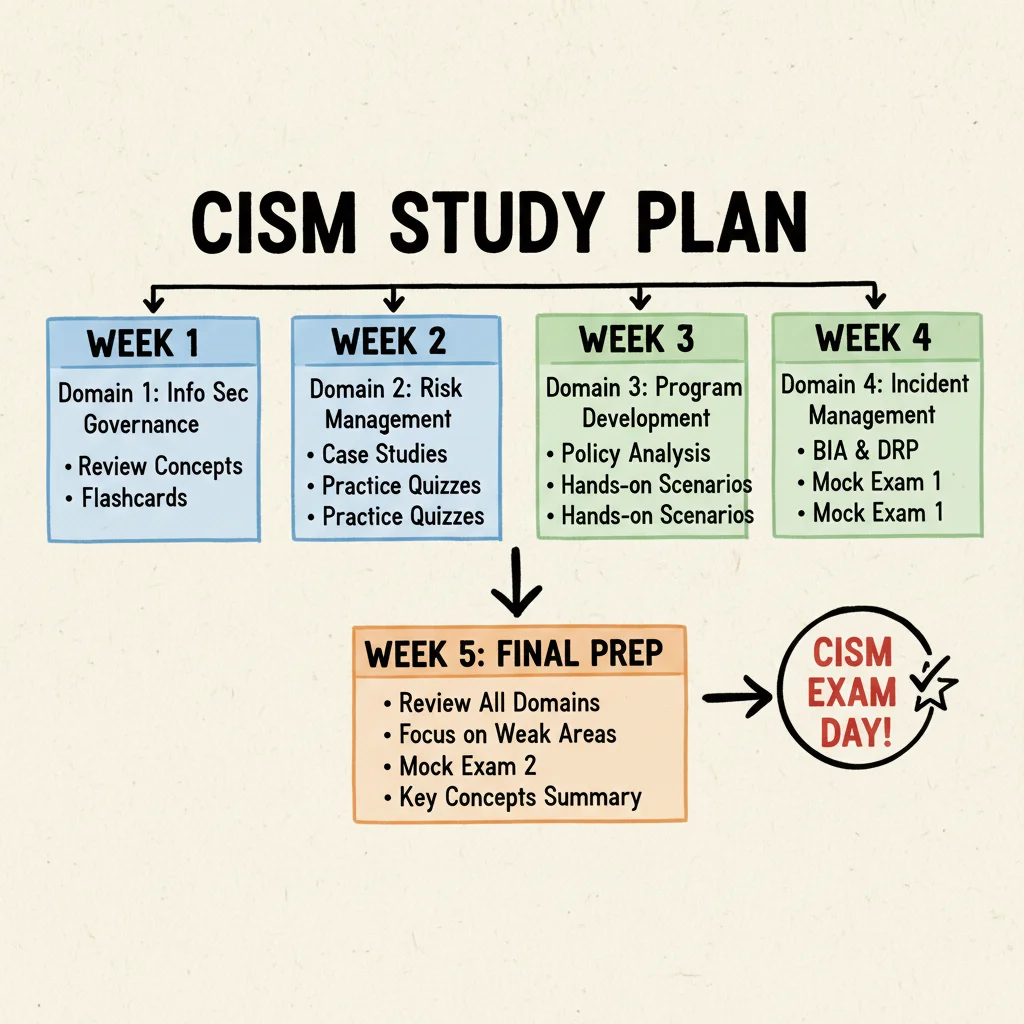
Build a three-month rhythm
You don’t need a heroic schedule. You need a repeatable one.
Here’s a simple model:
| Month | Primary focus | What to do |
|---|---|---|
| Month 1 | Domain understanding | Read core material, summarize each domain, create flash prompts |
| Month 2 | Recall and application | Use spaced repetition, begin serious practice questions, review errors |
| Month 3 | Exam conditioning | Mixed-domain question sets, weak-area review, timing practice |
Keep each study session narrow. One domain concept. One batch of questions. One review loop. That’s better than a sprawling five-hour session that leaves little behind.
Use practice questions the right way
Candidates often misuse question banks. They chase scores instead of insight.
A better routine looks like this:
- Answer the question without rushing.
- Write why you chose your answer.
- Review every option, including the wrong ones.
- Extract the management principle behind the item.
- Turn misses into future review prompts.
That last step is where growth happens. If you missed a question because you answered like an engineer instead of a manager, write that down explicitly.
Your wrong answers are study material. Treat them like a map, not a verdict.
Prepare for updated topics without getting distracted
ISACA has updated the exam to address modern threats, explicitly including “security considerations for artificial intelligence and blockchain,” as noted in an Infosec Institute CISM resource. The trap here is obvious. Candidates either ignore these topics entirely or go too deep into technical novelty.
For CISM, keep the focus managerial.
Ask questions like:
- How do AI-related risks affect governance and oversight?
- What policy or control ownership issues arise with new technologies?
- How should risk assessment adapt when technologies change quickly?
- What incident considerations appear when systems rely on emerging platforms?
You don’t need to become a niche specialist in every new topic. You need to understand how a security manager governs, evaluates, and responds to them.
A short video review can help reinforce that mindset before practice sessions:
Common mistakes to avoid
These are the patterns I see most often:
- Studying as if CISM were a technical certification: You’ll overvalue implementation detail and miss management logic.
- Rereading instead of recalling: Familiarity feels productive, but it fades fast.
- Ignoring high-impact weak areas: The uncomfortable topics are often the ones that need the most review.
- Treating new topics as separate silos: Fold them back into governance, risk, program management, and incident response.
- Waiting too long to do questions: Questions are not the final step. They are part of learning.
If you stick with spaced repetition and question review, your understanding gets steadier. That’s what you want on exam day. Not panic-powered memory. Calm retrieval.
The Career and Salary Impact of Your CISM Certification
You are in a meeting with senior leadership after a security incident. The technical team has details. What they need from you is judgment: Which risks matter first, who owns the response, what needs to change in policy, and how to explain the tradeoff in business terms. That is the kind of responsibility CISM is built to support.
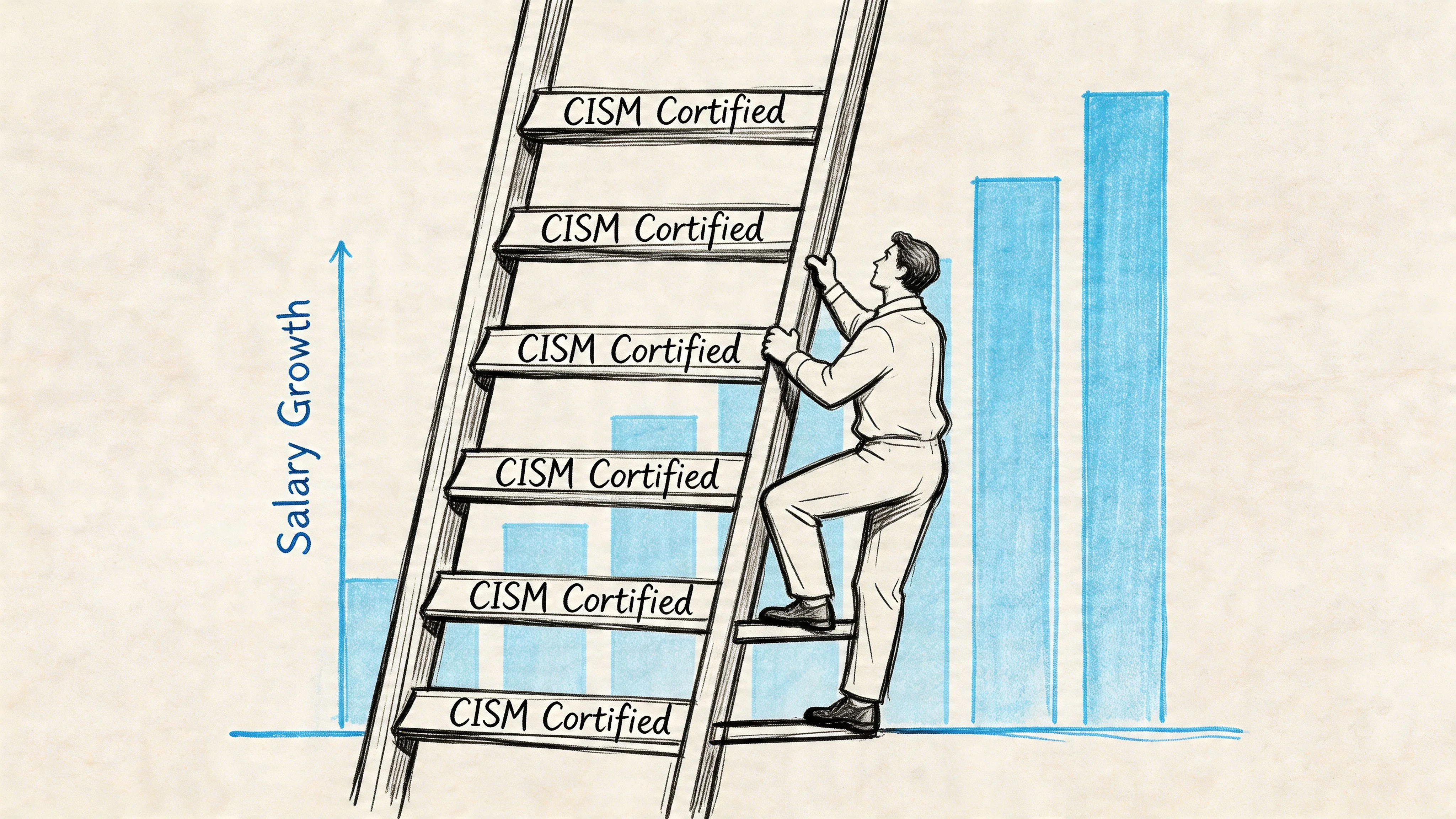
A strong CISM does not signal that you know every product or configuration detail. It signals that you can run security like a management function. Employers often read the credential as evidence that you can connect governance, risk, incident response, and program decisions to business priorities.
That matters because security leadership jobs usually go to people who can make sound decisions under pressure and and clearly articulate those decisions.
What employers tend to read into CISM
Hiring managers often associate CISM with readiness for roles such as:
- Information Security Manager
- Security Program Manager
- Director-level security roles
- Risk and governance leadership roles
- Chief Information Security Officer pathways
If you are planning long-term growth, CISM often makes more sense as part of a broader certification path for IT security, not as a standalone milestone. The credential fits best when your day-to-day work is already shifting from hands-on execution toward ownership, prioritization, and oversight.
Why the credential has business value
CISM is attractive to employers because it focuses on outcomes they care about. Analysts writing Fortra’s CISM overview summarize the credential as one that helps professionals align security programs with business goals and improve incident response effectiveness.
That framing is useful. A security manager is rarely judged by the number of controls they can name from memory. They are judged by whether the program reduces risk, supports decisions, and holds up during a stressful week.
This is also why your study approach matters to your career, not just your exam result. If you prepare with spaced repetition, active recall, and steady question review, you are training the same mental habit you need at work: Retrieve the right principle quickly, apply it in context, and explain why it fits.
Salary and market positioning
CISM is often associated with stronger compensation because it maps to management and leadership responsibilities. Salary still depends on scope, industry, location, and whether you are leading a team, a program, or an enterprise function.
Use the credential as a positioning tool, not a salary promise.
The professionals who get the best return from CISM usually pair it with visible evidence of judgment. Examples include leading a risk review, improving incident coordination, writing clearer policies, or helping executives make better security decisions. The certification opens the door. Your track record is what keeps it open.
Why CISM can change your career direction
Some certifications sharpen technical depth. CISM sharpens managerial judgment. That shift can change the kinds of problems people trust you to handle.
You start seeing security work less like a set of isolated controls and more like a portfolio that needs priorities, owners, metrics, and follow-through. A good study plan reinforces that shift. Review missed questions by domain. Turn weak concepts into flashcards. Revisit them on a schedule until the reasoning feels natural, not forced. That is how exam prep turns into practical leadership skill.
The lasting value of the CISM security certification comes from that change in perspective. It helps you grow into roles where your job is not only to protect systems, but to guide decisions.

Written by
Alvin Varughese
Founder, MindMesh Academy
Alvin Varughese is the founder of MindMesh Academy and an enterprise architecture leader. An electrical engineer by training, he moved from factory automation in South Africa to cloud architecture at GE Appliances and Humana (Fortune 50), and holds 20 professional certifications including AWS Solutions Architect Professional, Azure DevOps Engineer Expert, and Microsoft Agentic AI Business Solutions Architect. He built MindMesh Academy after interviewing too many highly certified candidates who couldn't answer basic questions: the goal is prep that makes you better at the job, not just able to pass the exam.