CISA Practice Test: A Strategic Plan to Pass in 2026
CISA Practice Test: A Strategic Plan to Prepare for the Exam
You're probably in one of two places right now. Either you've done a significant number of CISA questions and your scores feel inconsistent, or you haven't started because every prep provider seems to promise the same thing: more questions, more drills, more repetition.
That's the trap.
A CISA practice test is useful, but only if you treat it as a diagnostic and decision-making tool. If you use it like a trivia app, you'll get better at recognizing answer patterns without improving your ability to think like an auditor. I’ve seen this happen with junior colleagues repeatedly. The people who improve fastest aren't always the ones who answer the most questions. They're the ones who learn why an answer is correct, why the other options are wrong, and what the question writer is truly testing.
Why Your CISA Practice Test Strategy Might Be Failing
Many candidates assume sheer volume will carry them through. They collect apps, work through random sets during lunch breaks, and feel productive because the question count keeps rising. Then they sit for the exam and realize the real challenge isn't recall. It's judgment.
That mistake matters because the exam isn't forgiving. The CISA exam's first-time pass rate is between 45% and 60%, with many industry estimates narrowing that to 45% to 55% according to this review of CISA difficulty and pass-rate estimates. Nearly half of candidates fail on the first attempt. That’s not because they're incapable. It’s usually because their preparation was broad but shallow.
The quantity trap
Random practice has a seductive rhythm. You answer a question, get instant feedback, and move on. The problem is that this approach can reward recognition instead of reasoning.
A common pattern looks like this:
- You remember the wording instead of the underlying concept.
- You chase weak scores emotionally instead of analyzing domain trends.
- You retake tests too soon and mistake familiarity for true understanding.
- You ignore why distractors were incorrect, which is often where the exam teaches critical distinctions.
Practical rule: If your review process takes less time than your test-taking session, you're likely missing most of the learning opportunities.
The CISA exam rewards disciplined reading. It tests how you interpret qualifiers, risk priorities, governance responsibilities, and the “best” auditor action in a given scenario. This means your preparation must build judgment under pressure, not just answer recall.
What a better strategy looks like
A strong practice strategy does three things simultaneously. It measures what you know, exposes what you misunderstand, and trains your decision-making under timed conditions.
That's why I tell candidates to stop asking, “How many questions have I done?” and start asking better questions:
| Better question | Why it matters |
|---|---|
| Which domain keeps producing the same error pattern? | Repeated mistakes usually point to a conceptual gap. |
| Am I missing questions because I lack knowledge or because I misread a qualifier? | These require different corrective actions. |
| Can I explain why three options are wrong, not just why one is right? | That perspective is much closer to the real exam mindset. |
If you haven't looked carefully at exam mechanics recently, this Guide to exam structure and scoring offers a useful reminder that exam strategy and scoring interpretation are just as important as content coverage.
Building Your Practice Test Arsenal
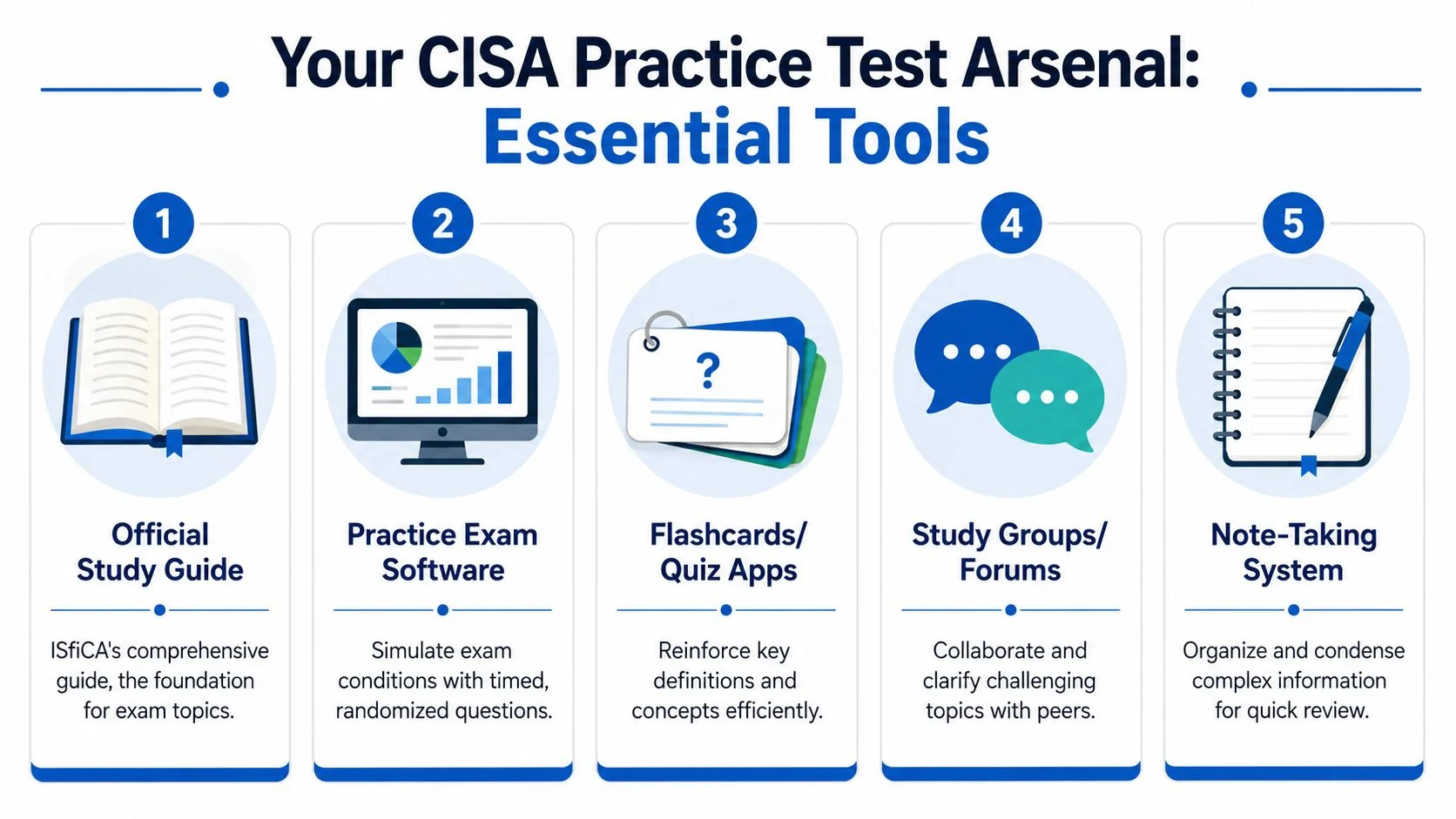
You don't need ten resources. You need the right mix of resources, each assigned a specific job. Most candidates approach this backward. They buy one giant question bank and expect it to handle diagnosis, remediation, timing, and confidence building all at once.
It won't.
What belongs in the stack
Think in layers, not brands.
- A baseline diagnostic tool. You need one source that allows you to take a broad first pass across all domains and clearly highlights your weak areas.
- Domain-focused quizzes. These are helpful when you know exactly where your understanding needs work.
- A full simulation engine. This enables testing of pacing, concentration, and answer discipline.
- A primary reference text. Practice questions expose gaps. A reliable reference source helps close them.
- A note system. If you don't capture error patterns, you'll repeat them.
Official versus third-party options
Official resources typically excel at one thing: teaching the exam's language. This matters because CISA questions often hinge on subtle distinctions between the most correct answer and merely plausible ones.
Third-party resources can still be beneficial, especially when you want more repetition or a different explanation style. But you must screen them aggressively.
Use this comparison when choosing:
| Resource type | Best use | Main risk |
|---|---|---|
| Official question banks | Learning terminology and exam logic | Can feel limited if you want more variation |
| Third-party platforms | Extra volume and alternate explanations | Quality varies; some content ages poorly |
| Mobile quiz apps | Short review sessions and recall reinforcement | Easy to confuse convenience with depth |
| Forums and peer groups | Clarifying why an answer is better in context | Advice quality is inconsistent |
A good reality check is whether the provider gives meaningful explanations, not just answer keys. Candidates often discover too late that a large question volume doesn't automatically build scenario-based reasoning. That’s why I often compare prep formats across certifications, including how CISSP practice exams are structured around explanation quality rather than simple repetition.
Features that actually matter
High-quality CISA practice tests often include question banks exceeding 800 questions, plus separate Certification Mode and Practice Mode. ISACA notes that candidates should keep retaking tests until they reach 90% or higher in two consecutive attempts in practice-oriented review as described on the ISACA CISA practice quiz page.
These distinctions matter because each mode solves a different problem:
- Certification Mode is for pressure. It tells you how you perform when you can't pause and second-guess every item.
- Practice Mode is for repair. It gives you room to stop, think, and study the explanation carefully.
- Post-test reports are where the true value resides. If the platform doesn't break down weaknesses in a useful way, it isn't doing enough.
A good question bank doesn't just mark you wrong. It shows you how your reasoning went wrong.
A Phased Approach for Practice Test Success
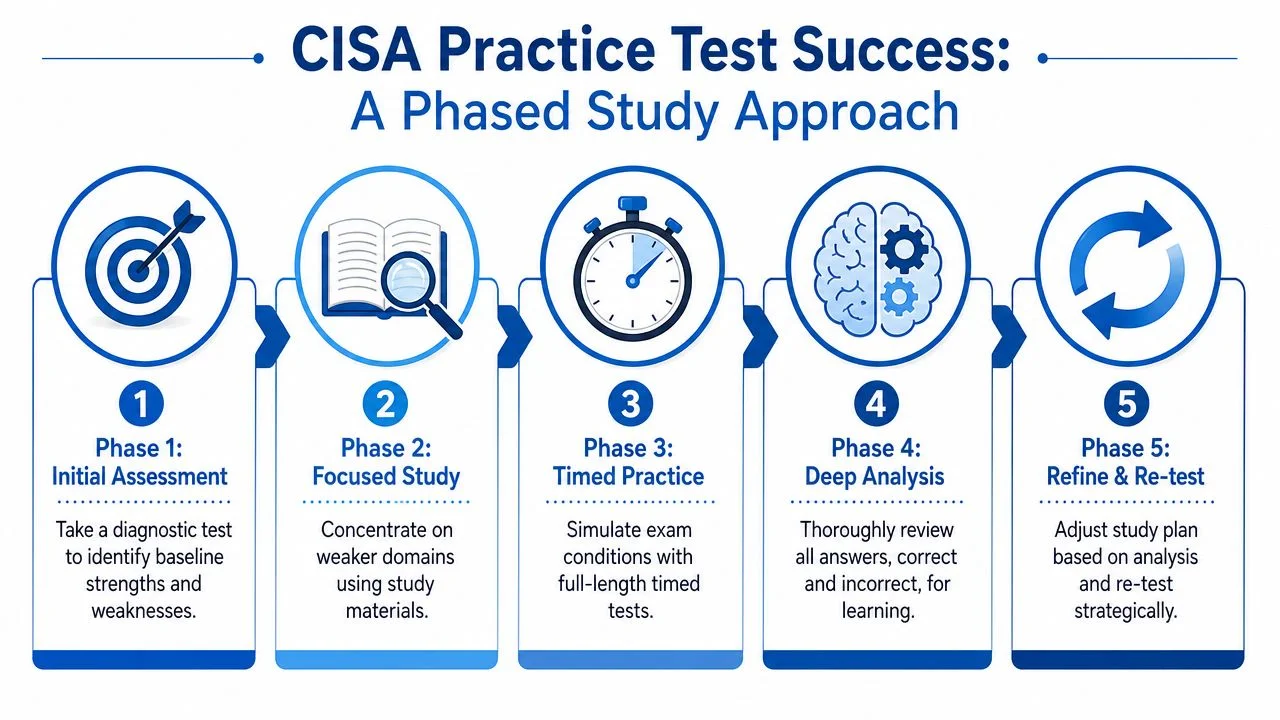
Most candidates don't fail because they lack effort. They fail because they use the same study behavior from start to finish. Early preparation should diagnose. Mid-stage preparation should correct. Late-stage preparation should simulate.
That's a different rhythm.
Phase one with a cold diagnostic
Start with one broad test before you feel ready. Don't study right up to it. The point is to expose your natural baseline, not your warmed-up performance.
When you finish, don't obsess over the total score first. Instead, look for patterns such as:
- Recurring mistakes in governance questions.
- Confusion between control design and control operation.
- Weak prioritization when several answers seem reasonable.
- Rushed errors in longer scenarios.
This first test is a map, not a verdict.
Phase two with targeted reinforcement
Real progress comes from pulling apart each weak area and rebuilding it with smaller sets and focused review.
I prefer a loop:
- Take a short domain quiz.
- Review every explanation in detail.
- Write a brief note on the logic you missed.
- Return to the source material.
- Re-test the same concept later, not immediately.
That delayed return matters. Immediate retesting measures memory. A later retest measures genuine learning.
For candidates who struggle with structuring study across regulated exams, I often point them to examples outside IT as well. Good preparation design is portable. These mortgage licensure practice resources demonstrate the same principle: use practice not just to drill facts, but to identify weak categories, revisit source material, and then re-test with intent.
Phase three with full rehearsals
Near the end, stop fragmenting your prep. Shift into whole-exam behavior.
Your goal changes from “Can I answer this topic?” to “Can I sustain good decisions for an entire sitting without losing discipline?” That's a distinct skill set. Fatigue, impatience, and overthinking start to matter significantly.
Use full simulations to test:
| Simulation focus | What you're really checking |
|---|---|
| Pacing | Whether you linger too long on hard items |
| Stamina | Whether your judgment degrades late in the session |
| Recovery | Whether a few difficult questions shake your confidence |
| Flagging discipline | Whether you know when to move on efficiently |
Mentor's note: A practice test should conclude with a study decision. If you finish a mock exam and can't articulate exactly what to fix next, that mock was wasted.
Deconstructing Your Results for Real Improvement
The score report is often the least valuable part of a CISA practice test.
What truly matters is the trail of decisions that produced it.

The exam itself consists of 150 questions, and the passing standard is 450 on a scaled range of 200 to 800. Official prep guidance also recommends scoring above 90% in practice mode consistently before you feel ready for the actual exam. That benchmark matters because a raw practice score and a scaled exam outcome are not the same thing. The practice score signals readiness. The scaled score determines certification.
Build a remediation log
After every serious practice session, log your misses. Keep it simple. You’re not writing an essay; you’re building a decision record.
A useful remediation log can track:
- Question topic
- Why you chose the wrong answer
- Why the correct answer was better
- Why each distractor failed
- What rule or principle you need to remember next time
This transforms your review from passive reading to active diagnosis.
Here's the key distinction I want candidates to understand:
| Error type | What it usually means | Best fix |
|---|---|---|
| Knowledge gap | You didn't know the concept | Return to source material |
| Logic gap | You knew the topic but prioritized poorly | Review explanation and decision logic |
| Reading error | You missed words like FIRST or BEST | Slow down and mark qualifiers |
| Confidence error | You changed a correct answer without reason | Tighten your review discipline |
Review the distractors, not just the key
At this stage, many people finally start seeing significant improvement.
If you only read why the right answer is right, you train recognition. If you also study why the wrong options are tempting but inferior, you train discrimination. That's precisely what the exam expects from an auditor.
The strongest candidates don't just know the answer. They know why management, operational, and control-focused options differ in priority.
A quick visual walkthrough can help reinforce that mindset before your next review cycle:
What to do when your scores stall
Plateaus are normal. They usually indicate one of three things:
- You're retaking too many familiar questions. Switch to unseen or less familiar sets.
- You're reviewing too quickly. Spend more time on explanation analysis than on answering a high volume of questions.
- You're mixing topics too randomly. Go back to focused domain work for a short period, then reintroduce mixed sets.
Don't chase a higher score by brute force. Chase cleaner reasoning. Higher scores usually follow.
Mastering Exam Day with Realistic Simulations
By the final stretch, content review should no longer be your primary concern. Execution should be.
A realistic CISA practice test isn't just a batch of questions with a timer. It's a full rehearsal of how you'll behave when attention starts to drift, when a scenario feels ambiguous, and when you're tempted to spend too long trying to force certainty.
Simulate the environment properly
Candidates often say they've done full mock exams, but when I ask how, I find out they were checking messages, pausing for snacks, or reviewing explanations halfway through. That's not simulation. That's open-ended practice.
Build a repeatable setup:
- Use a quiet room where you won't be interrupted.
- Silence every device that isn't required for the test.
- Sit the full session without casual breaks whenever you're doing a true mock.
- Use the same time of day as your scheduled exam if possible.
- Flag questions instead of getting stuck on them.
These details matter because exam strain is cumulative. You want your brain to recognize the conditions, not fight them for the first time on test day.
Use the two-pass method
A proven strategy is to use a first pass of 120 to 150 minutes, then take a brief mental break, followed by a second pass of 45 to 60 minutes to revisit flagged questions, as outlined in this guidance on CISA exam timing and review strategy.
That structure works because it protects you from two common mistakes. The first is spending too much time on a difficult question early. The second is losing easy points because fatigue sets in before you've seen the whole exam.
I coach candidates to use the passes differently:
| Pass | Objective | Mindset |
|---|---|---|
| First pass | Secure the questions you can answer with confidence | Keep moving |
| Break | Reset attention and reduce emotional carryover | Breathe, don't review mentally |
| Second pass | Reassess flagged items with fresh judgment | Compare options calmly |
Don't use your first pass to prove how smart you are. Use it to bank what you already know.
Rehearse your decision rules
Before each mock, define how you'll act when things get messy. That prevents improvisation under pressure.
For example:
- If two answers both look plausible, choose the one that best fits the auditor's role and level of responsibility.
- If a question becomes a time sink, flag it and move on.
- If you feel your confidence drop after a hard cluster, stick to your process instead of chasing a score.
That kind of discipline is what separates useful simulations from glorified quizzes. If you want a broader set of effective exam preparation tips, the same core principle applies across certifications: preparation works best when you train behavior, not just memory.
Your Final CISA Pre-Exam Checklist
In the final days, don't reinvent your plan. Tighten it.
You should already know where your weak spots were, what you did to correct them, and what your exam-day process looks like. The goal now is to confirm readiness, not create panic with last-minute resource switching.
The short list that matters
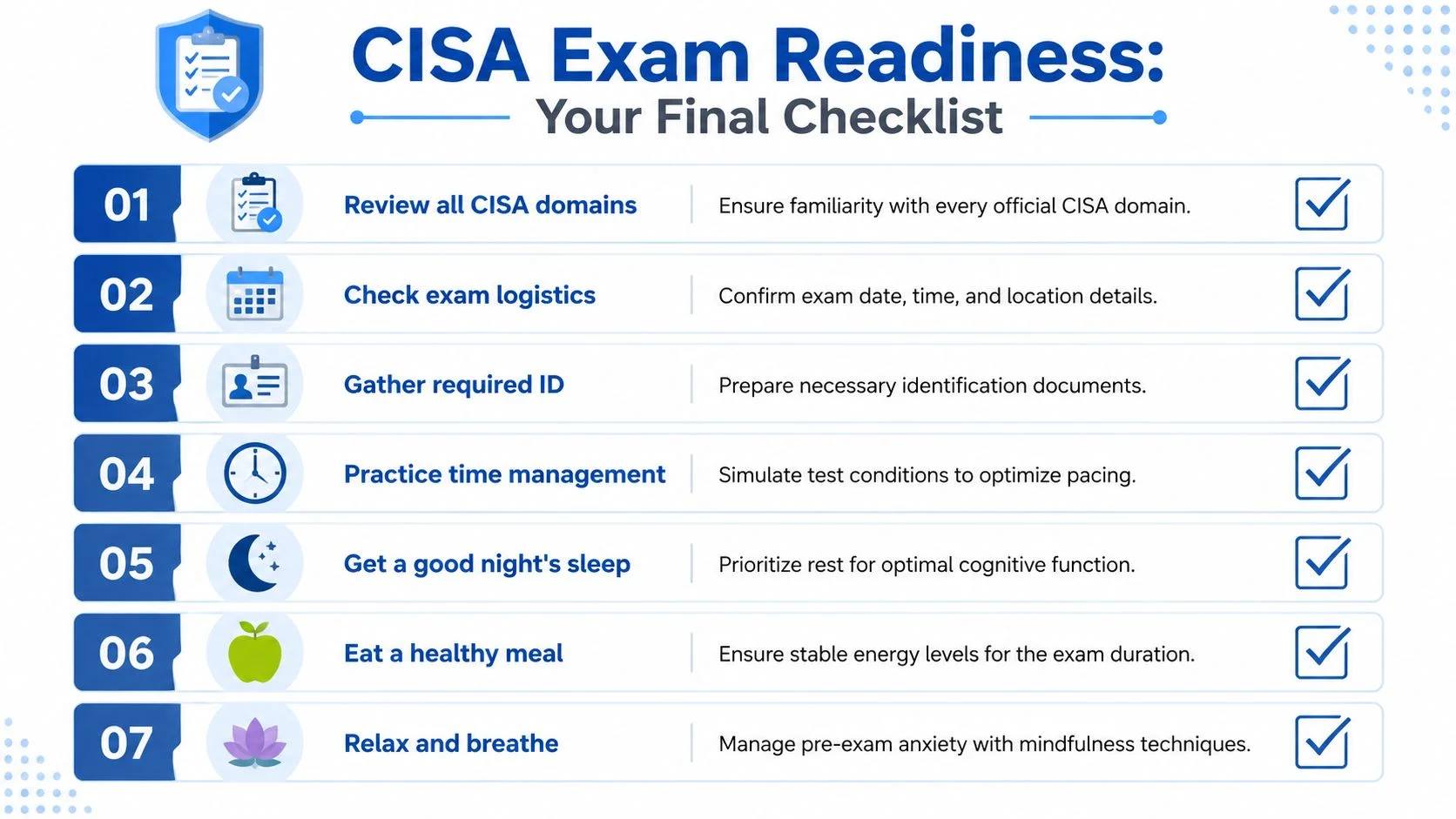
Run through this checklist thoroughly.
- Weak areas closed: You've revisited repeated error themes and corrected the concepts behind them.
- Practice performance stable: Your recent mock and practice-mode work show consistency, not just one lucky result.
- Explanations understood: You can explain why distractors are wrong, not just identify the correct answer.
- Timing plan rehearsed: Your flagging method and two-pass approach feel natural.
- Resource set frozen: You're not adding random apps, PDFs, or advice threads at the last minute.
- Logistics handled: You know what you need, where you need to be, and what your exam day will look like.
A final judgment call
If you're still asking whether you should do “just one more big dump of questions,” the answer is usually no. At the end, another giant batch rarely fixes the problem. A careful review of your last few errors often does.
That's the primary point of a CISA practice test. It's not there to impress you with a score. It's there to make your weaknesses visible early enough to correct them.
Go into the exam with a method, not with hope.
If you've practiced in phases, reviewed your mistakes like an auditor, and rehearsed under realistic conditions, you're walking in with something better than confidence. You're walking in with control.
If you're ready to organize your CISA prep, track weak domains, and study with concept-first methods, MindMesh Academy offers tools designed for deliberate certification preparation. Explore our resources to build a strong foundation for your exam: https://www.mindmeshacademy.com/certifications

Written by
Alvin Varughese
Founder, MindMesh Academy
Alvin Varughese is the founder of MindMesh Academy and holds 20 professional certifications including Microsoft Agentic AI Business Solutions Architect, AWS Solutions Architect Professional, and Azure DevOps Engineer Expert. He's held senior engineering and architecture roles at Humana (Fortune 50) and GE Appliances. He built MindMesh Academy to share the study methods and first-principles approach that helped him pass each exam.