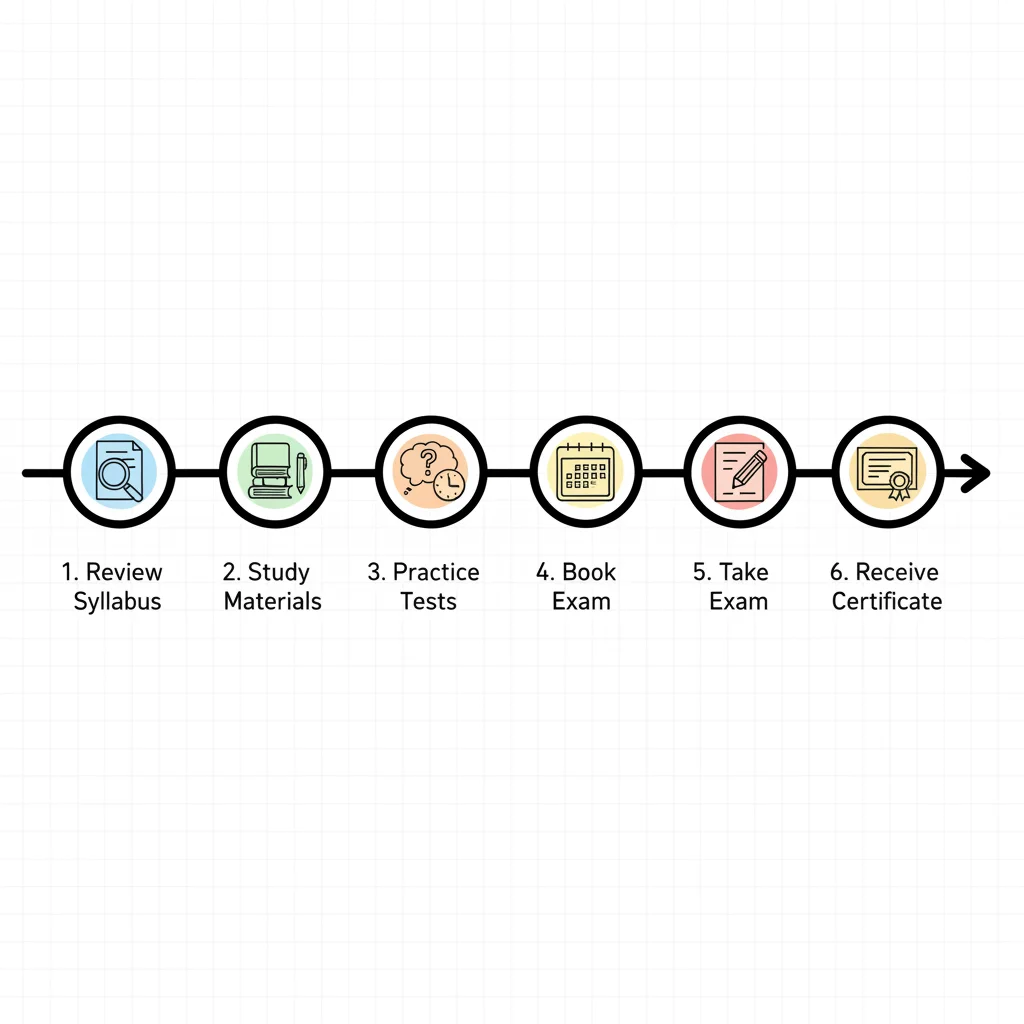
Certification PRINCE2 Foundation: A 2026 Guide to Passing
The PRINCE2 Foundation Certification: A Practical Guide
You're probably here because work already feels project-heavy, even if your job title doesn't say project manager. Maybe you're in IT support and keep getting pulled into rollouts. Maybe you're a developer who's tired of vague handoffs and shifting priorities. Maybe you're changing careers and want a framework that helps you sound credible fast.
That's where PRINCE2 Foundation certification becomes useful.
I've seen a lot of junior professionals assume PRINCE2 is only for full-time project managers. It isn't. At Foundation level, it gives you something more basic and more valuable: a structured way to think. You learn how projects are justified, organized, planned, controlled, and closed. Once that clicks, meetings make more sense, documentation stops looking random, and you start spotting risks before they become drama.
PRINCE2 Foundation also has a practical advantage. It's a recognized starting point, and if you later want to go further, it opens the door to the next level. More importantly, it helps you contribute better right now, whether you work in delivery, operations, infrastructure, software, or support.
What is PRINCE2 Foundation and Why It Matters for IT Professionals
PRINCE2 Foundation is the entry-level certification for the PRINCE2 project management method. Think of it as learning the operating system behind structured projects. You're not proving that you can run every project alone. You're proving that you understand the language, logic, and moving parts of a PRINCE2 environment.
That matters because many professionals already work inside projects without formal training. They attend standups, review plans, chase approvals, manage dependencies, and handle incidents that affect delivery. PRINCE2 helps those activities stop feeling disconnected.
A method, not a script
New learners often worry that PRINCE2 is too rigid. That's the wrong mental model. A better way to see it is this: PRINCE2 gives teams a framework for control and decision-making, but it can be adjusted to suit the project.
So instead of memorizing a pile of theory, you should ask practical questions:
- Why does this project exist
- Who is accountable for what
- What needs to be planned and controlled
- When should a project stop, continue, or escalate
Those are the habits PRINCE2 builds.
Historically, PRINCE2 Foundation serves as a gateway to advanced credentials and is a prerequisite for the Practitioner certification. PeopleCert stewards PRINCE2, which is widely adopted across the UK, Western Europe, Australia, and increasingly in the USA, Asia, and Africa, as noted in a PRINCE2 training overview.
Why it still matters for hiring
Employers don't just hire for tools. They hire for judgment, coordination, and clarity. If you scan roles tied to PMO, coordination, delivery, and project support, you'll see how often structured project knowledge shows up in the market. This HiredBySkill project management coordinator listing is a good example of the kind of role where project method knowledge strengthens your profile.
If you're also comparing frameworks, our PMP certification study guide helps clarify where PMP and PRINCE2 differ. PMP leans heavily into broad project management knowledge and experience. PRINCE2 Foundation is often the cleaner starting point if you want a method you can grasp quickly and apply in structured environments.
PRINCE2 Foundation is often less about becoming “the project manager” and more about becoming the person who understands how the project is supposed to run.
Who Should Get the PRINCE2 Foundation Certification
A lot of people talk themselves out of PRINCE2 Foundation because they think, “I'm not a project manager.” In practice, that's exactly why many people should consider it.

If your work touches delivery, coordination, service changes, implementations, migrations, releases, vendors, or reporting, PRINCE2 can help. It gives you a map of how work should move from idea to controlled execution.
IT professionals who need structure
This is one of the strongest use cases.
Maybe you work in infrastructure and projects keep landing in your queue with unclear ownership. Maybe you're in software and you want to understand why business case, approvals, and stage control keep affecting technical timelines. Maybe you're in service delivery and need a better way to communicate with project leads.
A recent Axelos survey of 1,200 global professionals found that PRINCE2 Foundation holders in IT see 25% faster promotion rates. LinkedIn data shows 40% of certified non-PM IT workers report improved cross-functional collaboration, according to an overview of PRINCE2 certification levels.
That doesn't mean the certificate does magic on its own. It means structured thinking gets noticed.
Career changers who need credibility
If you're moving from one role into tech, operations, PMO support, or delivery coordination, PRINCE2 Foundation helps you close a common gap. Employers want people who can work in projects without creating confusion. This certification gives you the vocabulary and logic to do that.
You'll start understanding terms like business case, stage boundary, tolerance, product focus, and exception. That matters in interviews because it changes how you talk about work. You stop describing tasks only by activity and start describing them by purpose, ownership, and control.
Team members who want to contribute more
You don't need direct authority to benefit from PRINCE2. Business analysts, coordinators, test leads, support analysts, and technical specialists all work better when they understand project structure.
Here's where learners often get confused. They think Foundation is about leading projects. It isn't only that. It's also about becoming effective inside a project environment.
Consider these situations:
- A QA analyst who understands stage control can raise issues at the right time instead of too late.
- An IT coordinator who understands roles and responsibilities can escalate to the correct decision-maker.
- A service delivery specialist who understands risk and progress can communicate more clearly when implementation plans shift.
Practical rule: If your work gets affected by projects, PRINCE2 Foundation is relevant to you.
A simple self-check
PRINCE2 Foundation is probably a good fit if you want one or more of these:
- More clarity: You're tired of messy projects and want a common framework.
- Better communication: You need to work across business and technical teams.
- A career bridge: You want an entry credential before moving into PMO, coordination, or delivery roles.
- A next step: You may eventually want Practitioner, and Foundation is the required start.
Decoding the PRINCE2 Syllabus Principles Practices and Processes
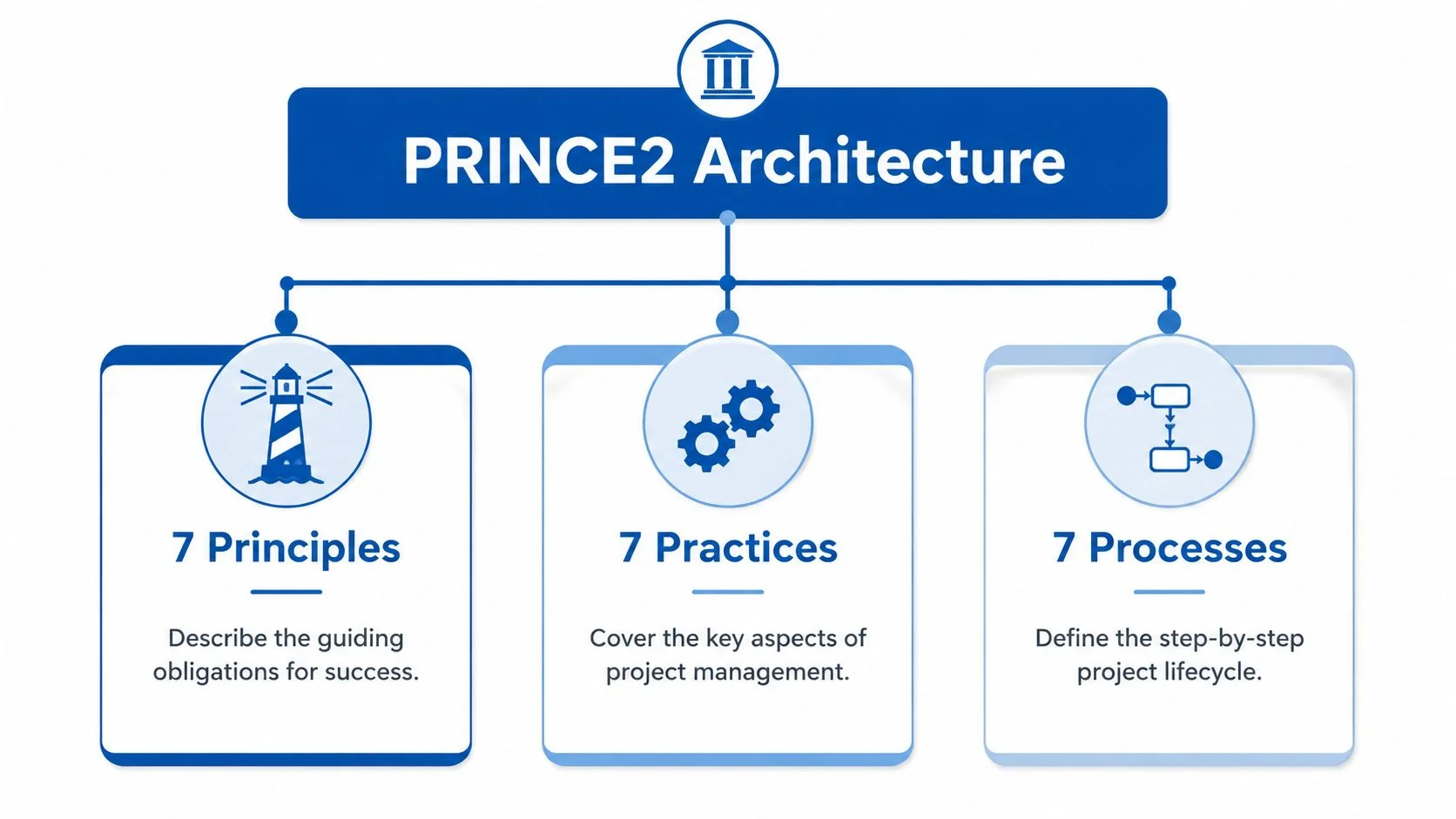
The PRINCE2 Foundation exam tests whether you understand the architecture of the method. The key phrase is architecture. You're learning how the parts fit together, not just isolated definitions.
The exam assesses knowledge of seven principles, seven practices, and seven processes, and understanding how those parts connect is central to success, as explained in this PRINCE2 certification guide.
Start with the mental model
I teach PRINCE2 like this:
| Part | What it means | Easy way to remember it |
|---|---|---|
| Principles | The guiding rules | Why the method works |
| Practices | The management areas you must pay attention to | What must be managed |
| Processes | The flow of the project lifecycle | How work moves forward |
If you mix these up, studying gets harder than it needs to be.
The seven principles
The principles are the core ideas behind PRINCE2. They shape decision-making. If a project ignores them completely, it isn't really operating in a PRINCE2 way.
A few matter a lot for beginners:
- Continued business justification means the project must keep making sense.
- Learn from experience means teams don't pretend every project starts from zero.
- Defined roles and responsibilities means ownership should be clear.
- Manage by stages means teams review progress at controlled points.
- Manage by exception means not every issue needs senior escalation.
- Focus on products means clarity on outputs matters more than activity for activity's sake.
- Tailor to suit the project means the method adapts to context.
A common mistake is trying to memorize these as a flat list. Don't. Tie each principle to a workplace scenario. For example, if nobody knows who approves scope changes, that's a roles-and-responsibilities problem. If a project continues even though the business need disappeared, that's a business-justification problem.
The seven practices
Practices are the core management areas. They include business case, organizing, quality, plans, risk, issues, and progress.
These are the topics you manage throughout a project, not one time only. That's why they show up repeatedly in questions. The exam wants to know whether you understand that PRINCE2 isn't a one-off checklist. It's a controlled management approach.
Here's the simpler interpretation:
- Business case asks whether the project remains worthwhile.
- Organizing asks who's involved and what authority they hold.
- Quality asks what “done properly” looks like.
- Plans ask how delivery will happen.
- Risk asks what could affect success.
- Issues ask what needs handling or escalation.
- Progress asks how performance will be monitored and reported.
Don't study practices as separate islands. In real questions, they overlap. A risk can affect plans. A plan can affect progress. An issue can trigger escalation.
The seven processes
Processes show the project lifecycle in action. They include starting up, directing, initiating, controlling a stage, managing product delivery, managing stage boundaries, and closing a project.
If principles are your mindset and practices are your management lenses, processes are the route the project follows.
Learners often struggle here because process names sound similar. The fix is to attach each one to a practical question.
- Starting Up a Project asks if the project should even begin properly.
- Directing a Project is about high-level oversight and decision-making.
- Initiating a Project builds the solid base for controlled delivery.
- Controlling a Stage covers day-to-day management within a stage.
- Managing Product Delivery focuses on creating and handing over outputs.
- Managing a Stage Boundary checks whether the next stage should proceed.
- Closing a Project wraps things up in a controlled way.
If you expect to continue beyond Foundation, this PRINCE2 Practitioner certification guide is useful for seeing how the knowledge deepens later.
What actually helps you pass
You don't need to become a theorist. You need a clean mental map.
Use this study order:
- Learn the principles first so you understand the logic.
- Study the practices next so you know the management areas.
- Study the processes last so you can place the flow of work around that logic.
That sequence reduces confusion because you stop memorizing names in isolation.
Navigating the PRINCE2 Foundation Exam Format and Scoring
The exam feels much less intimidating once you know the exact structure.
The PRINCE2 Foundation exam has 60 multiple-choice questions, a 60-minute time limit, and a 60% pass mark, which means 36 correct answers. It has an approximate 95% pass rate, and the certificate does not expire, according to this PRINCE2 Foundation certification guide.
What those numbers mean in practice
First, the exam is tight on time, but it isn't designed to trap you. You have roughly a minute per question, so hesitation hurts more than difficulty. If you know the framework well, the pace is manageable.
Second, the pass mark is realistic. You do not need perfection. You need consistent understanding across the syllabus.
Third, the non-expiring certificate matters more than people think. Once you pass Foundation, that credential remains valid. For many professionals, especially those using it to strengthen a move into coordination or PMO work, that permanence makes it a stable first investment.
What candidates often misunderstand
The exam tests foundational understanding. It doesn't reward random memorization very well.
You'll do better if you can answer questions like these in plain English:
- Why does a project need continued business justification
- What is the purpose of managing by stages
- Which management area is concerned with quality
- At what point is a stage reviewed before continuing
That's different from trying to recite isolated definitions.
Most candidates who struggle don't fail because PRINCE2 is too hard. They struggle because they studied disconnected flash facts without understanding the logic underneath.
How to manage the clock
A simple exam rhythm works well:
- First pass: Answer the questions you know immediately.
- Second pass: Return to the ones that need thought.
- Final check: Make sure you haven't left anything unanswered.
Because the format is multiple-choice, staying calm matters. Don't spend too long wrestling with one difficult item early on. Keep moving.
The Career-Boosting Benefits of Your PRINCE2 Foundation Credential
The value of PRINCE2 Foundation isn't limited to “I passed an exam.” The bigger payoff is how it changes the way you work and how other people trust you in project settings.

In real organizations, projects often stumble early. Teams rush initiation, skip clarity, and discover basic gaps after work has started. PRINCE2 Foundation helps professionals avoid that pattern because it trains them to ask sharper questions at the beginning.
In major markets, PRINCE2 Foundation-certified individuals contribute 20-30% higher project initiation efficiency, with data showing reduced “starting up” phase overruns from 15% to 5% through more precise application of the method, according to an overview of PRINCE2 certification requirements.
Why that matters for your career
Hiring managers may not describe it this way, but they value people who reduce friction. A candidate who understands project initiation, roles, risk, and progress reporting usually needs less hand-holding than someone who only understands their own technical task.
That's especially useful in roles connected to PMO support, delivery coordination, implementation, and IT change work. If you want a realistic picture of how those responsibilities show up on the job, this article on key duties for IT project managers helps connect the certification to day-to-day delivery work.
What changes after you learn the method
You start noticing the difference between activity and control.
For example:
- A team can be busy without being properly organized.
- A project can have a plan without having a clear business case.
- A manager can ask for progress updates without defining tolerances or escalation paths.
Once you understand PRINCE2, those gaps become easier to identify. That improves your judgment, and judgment is what often moves people into more trusted roles.
Here's a short explainer if you want a visual summary before going deeper:
Benefits for employers and teams
The credential also helps inside organizations that are standardizing how they train staff. Teams work better when they share a common method and vocabulary.
That's one reason training providers and internal academies often look for systems that can organize structured exam prep. If you're supporting a training business or internal program, tools such as test prep center software can help manage delivery and learner administration around certification pathways.
A good certification pays off twice. First in the exam result, then in the way you show up at work.
The less obvious benefit
Confidence.
Not fake confidence. Working confidence.
When someone says the project needs a better business case, a clearer stage boundary, or stronger issue handling, you won't be nodding along vaguely. You'll know what those terms mean and why they matter.
That changes how people see you. More significantly, it changes how you see your own next step.
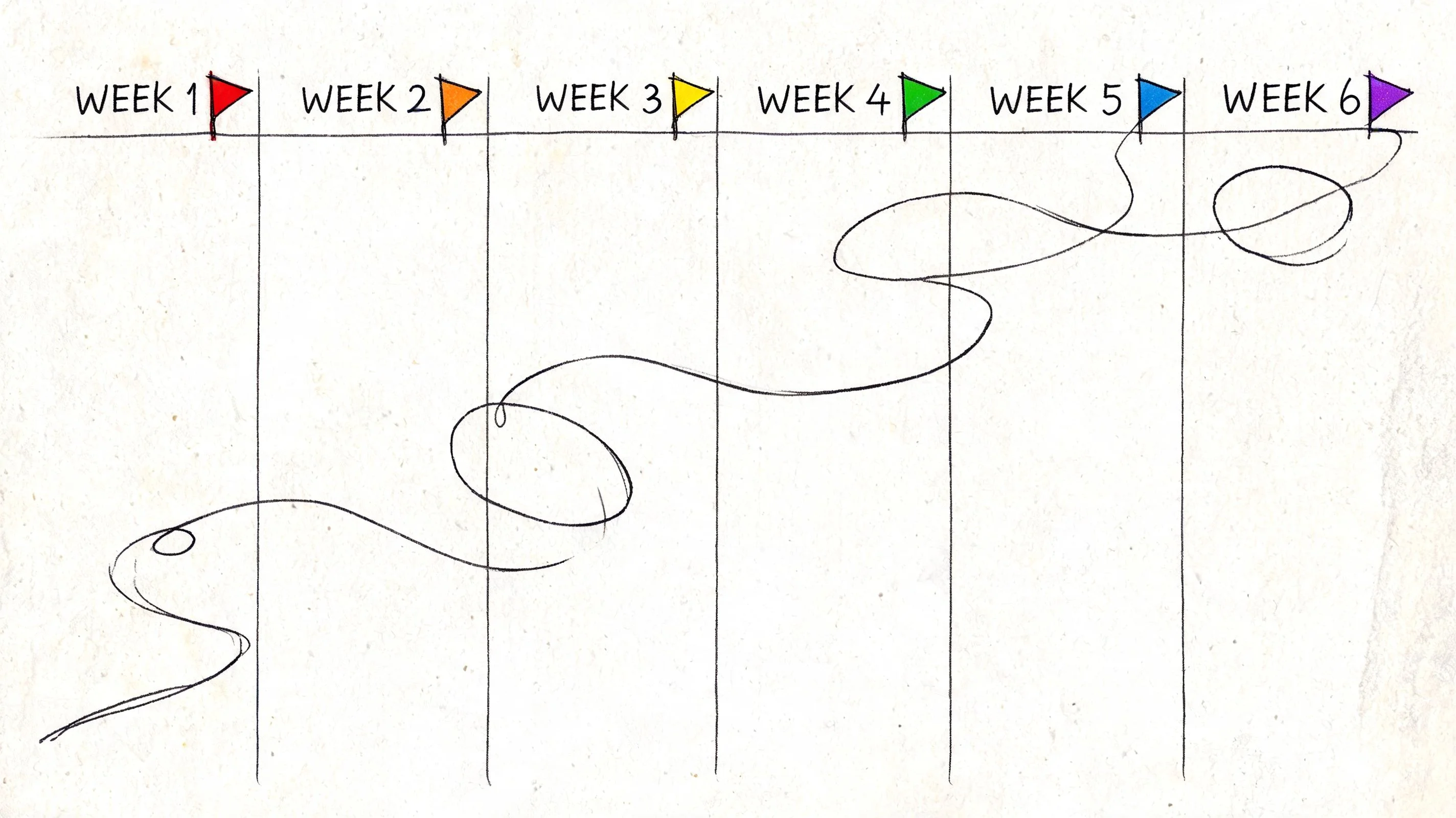
Your Proven 6-Week Study Plan with MindMesh Academy
Failure to pass the PRINCE2 Foundation exam rarely stems from an impossible syllabus. Instead, candidates often struggle because their study plan lacks structure. They read inconsistently, jump between various topics, and wait too long to test their knowledge.
A better approach is short, regular sessions with repeat review.
Week 1 build the foundation
Start with orientation, not intensity.
Focus on understanding what PRINCE2 is, how the method is structured, and why the three-part architecture matters. Learn the difference between principles, practices, and processes until you can explain it without notes.
Use your study platform to do three things:
- Read actively: Summarize each topic in your own words.
- Create recall cycles: Review the same concepts again after a short gap.
- Track confusion: Mark the terms that still blur together.
By the end of the week, you should be able to explain the whole PRINCE2 model to another person in simple language.
Week 2 master the seven principles
This week is about logic.
Take one principle at a time and attach it to a workplace example. Don't just memorize “manage by exception.” Ask what it looks like when a team escalates only when tolerances are exceeded. Don't just memorize “focus on products.” Ask how that changes planning.
A strong weekly pattern looks like this:
| Day | Focus |
|---|---|
| Day 1 | Learn the first group of principles |
| Day 2 | Review and test recall without notes |
| Day 3 | Learn the remaining principles |
| Day 4 | Match each principle to a real project scenario |
| Day 5 | Quiz yourself on mixed questions |
| Day 6 | Revisit weak spots |
| Day 7 | Light review only |
If you can't explain a principle in plain language, you probably don't know it well enough yet.
Week 3 learn the seven practices
Many learners slow down at this point because the management areas start to overlap. That's normal.
Treat each practice like a lens for looking at the project:
- Business case is the value lens.
- Organizing is the accountability lens.
- Quality is the acceptance lens.
- Plans are the route map.
- Risk is the uncertainty lens.
- Issues are the problem-handling lens.
- Progress is the control lens.
Use spaced repetition heavily here. Review terms, definitions, and examples in small bursts rather than one long cram session. Adaptive learning works best in this part because it keeps pushing your weaker topics back into view until they stick.
Week 4 map the seven processes
Now bring movement into the picture.
Study the processes in order and ask what each one is trying to achieve. Don't get stuck trying to memorize names alone. Build a story of the project from start to close.
A useful exercise is to write one sentence for each process:
- Starting up decides whether the project is worth setting up properly.
- Directing gives high-level control.
- Initiating creates the management baseline.
- Controlling a stage handles day-to-day oversight.
- Managing product delivery coordinates the creation of outputs.
- Managing stage boundaries checks readiness for the next step.
- Closing confirms proper completion.
At the end of this week, start doing mixed practice questions that combine all three layers of the framework.
Week 5 shift from learning to exam readiness
Studying becomes performance training.
Stop trying to “cover content” and start proving what you know under time pressure. Do timed question sets. Review every mistake. Categorize each error.
Your mistakes usually fall into one of these buckets:
- Knowledge gap: You didn't know the concept.
- Mix-up: You confused two similar terms.
- Rushing: You read too fast and missed the clue in the question.
- Overthinking: You talked yourself out of the right answer.
That diagnosis matters. You fix each type differently.
Exam mindset: Wrong answers are useful if they tell you exactly what kind of mistake you're making.
Week 6 rehearse the real exam
Keep this week calm and deliberate.
Do at least a couple of full timed runs under exam-like conditions. Review lightly between them. Don't flood yourself with new material at the last minute unless you've found a clear weak area.
Your checklist for the final week:
- Know the framework cold: Principles, practices, processes.
- Recognize common wording: Especially around roles, control, and purpose.
- Practice elimination: Narrow down answer options logically.
- Protect energy: Sleep and focus matter more than one extra hour of cramming.
The day before the exam, review summary notes and high-yield concepts only. If your preparation has been consistent, the last day should feel like sharpening, not panic.
Final Steps Registering and Taking Your Online Exam
By the time you're ready to book, keep the process simple. Don't make registration feel bigger than it is.
You'll typically arrange the exam through an accredited training route or directly through the certification ecosystem that manages PRINCE2. Before you confirm your booking, check the exam details carefully so there are no surprises about timing, format, or delivery.
Your pre-exam checklist
Use a practical checklist, not a hopeful one.
- Check your booking details: Make sure your name and exam schedule are correct.
- Prepare your room: Choose a quiet place where you won't be interrupted.
- Test your device: Confirm your computer, camera, and internet connection are working properly.
- Have identification ready: Don't leave this for the last minute.
- Plan your timing: Log in early so small issues don't turn into stress.
What to do during the exam
Start steady. Read each question fully. If an item looks awkward, don't panic and don't freeze.
A good rhythm is simple:
- answer the obvious ones first
- mark the uncertain ones mentally for review
- keep an eye on time without obsessing over it
- return at the end with a calmer head
Many candidates lose points not because they lack knowledge, but because they get rattled by two or three awkward questions and let that affect the rest of the paper.
After you click submit
Take a breath.
If you've studied with understanding instead of pure memorization, you've already done the hard part. Passing PRINCE2 Foundation won't make you an instant senior project leader, and that's fine. What it does give you is something durable: a cleaner way to think, speak, and operate in project environments.
That's a strong place to begin.
Ready to prepare for your PRINCE2 Foundation certification? MindMesh Academy offers structured study support for IT professionals and career changers. Our adaptive learning paths, spaced repetition, and progress tracking help you learn efficiently and build a strong foundation for the exam. Explore all certification options today: MindMesh Academy Certifications

Written by
Alvin Varughese
Founder, MindMesh Academy
Alvin Varughese is the founder of MindMesh Academy and an enterprise architecture leader. An electrical engineer by training, he moved from factory automation in South Africa to cloud architecture at GE Appliances and Humana (Fortune 50), and holds 20 professional certifications including AWS Solutions Architect Professional, Azure DevOps Engineer Expert, and Microsoft Agentic AI Business Solutions Architect. He built MindMesh Academy after interviewing too many highly certified candidates who couldn't answer basic questions: the goal is prep that makes you better at the job, not just able to pass the exam.