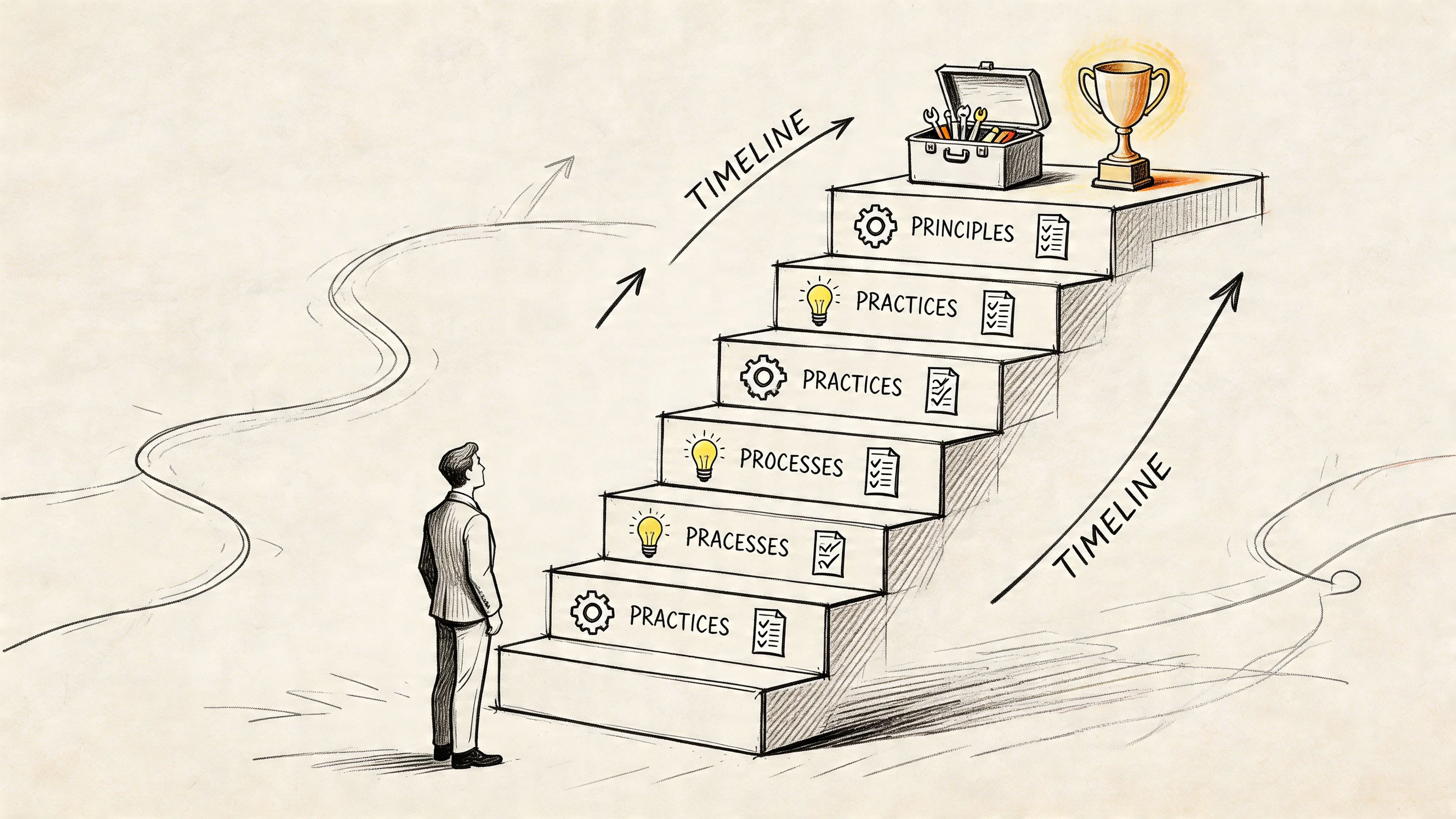
PRINCE2 Project Management Practitioner: A 2026 Guide
PRINCE2 Project Management Practitioner: A 2026 Guide
You have finished the foundational work by grasping the core terminology and framework. Perhaps you have already passed the PRINCE2 Foundation exam, which confirms your knowledge of the method's basic building blocks. Now a question arises: Do you stop there, content with knowing what the manual says, or do you advance to a level that requires you to demonstrate how to apply it effectively under real-world pressure?
This is the shift offered by the PRINCE2 Project Management Practitioner certification. It is not about gathering more information; it is about moving from theoretical comprehension to practical application. This is where you prove you can transition from understanding principles to making informed decisions in a live project scenario.
At MindMesh Academy, we often see this moment of hesitation. Project coordinators, business analysts, delivery leads, and technical professionals understand PRINCE2 well enough to discuss its elements. However, when they face the Practitioner syllabus, which emphasizes judgment and adaptation, confidence often wavers. The questions are longer, answer options frequently seem equally plausible, and despite being an open-book exam, candidates often struggle with the clock.
This reaction is normal.
The Practitioner level is a test of judgment. It requires you to dissect a complex project situation, identify critical elements, ignore the noise, and choose the most appropriate PRINCE2-based response. This means your preparation strategy must change. Passive reading or memorization will not work. Success depends on active learning techniques such as scenario practice, active recall, and spaced repetition. These methods are far more effective than highlighting pages in a manual. You are now learning to run a project rather than simply describing one.
Why Your Next Career Move Is The PRINCE2 Practitioner
It is a Monday morning. Your project board asks if a slipping supplier milestone requires an exception report. They want to know if the business case is still viable and what specific controls you will use before the next stage begins. If you only have Foundation-level knowledge, you can understand the terms being used. If you have Practitioner-level skills, you can answer these questions with a clear and structured plan. This difference marks your transition from being seen as project support to a professional who is trusted with project judgment.
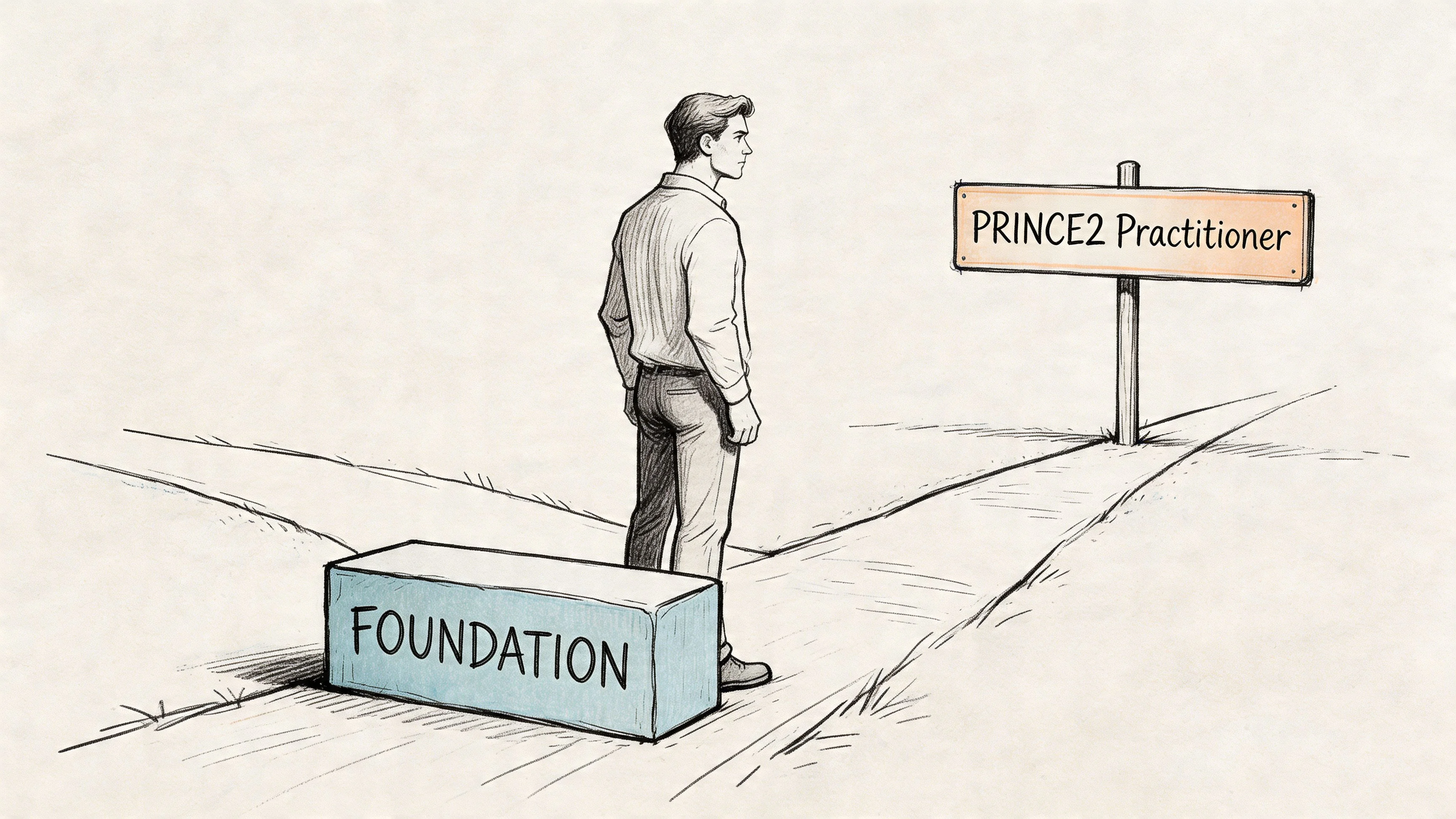 Caption: Making the strategic choice between foundational knowledge and applied project management expertise.
Why career growth often starts here
The Foundation level provides the map, but the Practitioner level teaches you how to navigate when the route changes. This is common during cloud migrations or agile-focused software developments where requirements shift frequently. You might have to choose between two technical paths in an Azure or AWS migration. You may need to tailor a reporting structure for a specific IT infrastructure project where standard templates do not fit the timeline.
Experienced managers look for this ability. They do not want someone who can only list the seven PRINCE2 themes. They need people who can look at a complicated situation, use the method practically, and explain why a specific decision makes sense for that project context. This skill is vital if you want to become a delivery owner or move into PMO leadership. It is also the bridge for project coordinators who want more autonomy or for anyone seeking their first formal project manager title. Your value in these roles depends on your judgment when things get difficult. A PRINCE2 Practitioner must show they can govern a project effectively, much like a professional holding a PMP credential is expected to demonstrate applied knowledge. Your market value increases when people trust you to make controlled decisions instead of just managing project paperwork.
What employers are really buying
The Practitioner certification is popular because it focuses on execution. A project coordinator might spend their day updating logs and chasing task updates. A Practitioner-level professional does more. They recommend whether project tolerances are at risk and if a stage boundary needs a more detailed review. They also check if the business case—the ongoing justification for the project—still supports the work.
This certification tells employers that you can apply the theory to a real-world context. AXELOS, the body that manages the certification, states that the Practitioner exam tests your ability to apply and tailor the method to specific needs. This is exactly what hiring managers want for roles that require governed delivery (PRINCE2 qualifications overview).
Salary trends also show the benefits of this level. Data indicates a pay increase for project professionals who work in structured environments and hold recognized certifications. The PMI Earning Power Salary Survey (PMI Earning Power Salary Survey) frequently shows that these credentials lead to better financial outcomes for those who can demonstrate applied management skills.
Who benefits most from making the move
Three groups usually see the best return on their investment when they earn the Practitioner certification:
- Project coordinators and PMO analysts: These professionals are ready to stop doing administrative tasks and start making controlled decisions that affect project outcomes.
- Technical professionals and business analysts: This group includes solution architects, senior developers, and scrum masters. They already influence how projects are delivered but need a recognized management framework to make their impact official.
- Team leads and career changers: Many people manage projects without a formal title. This certification gives them a way to prove their project management skills to the global market and gain recognition.
If you want to reach these goals, you cannot rely on reading alone. You must train your judgment. Modern study methods focus on this requirement. Scenario drills, adaptive learning paths, and spaced repetition help you practice the critical thinking required by the exam and by actual projects. These methods prepare you to apply the framework rather than just memorize it.
If you are looking at different career paths in project or service management, you should compare various Certifications. This helps you choose a path that fits your long-term plans. The PRINCE2 Practitioner certification gives you the tools to answer a critical question from any hiring manager: Can you stay in control when a project becomes difficult?
Reflection Prompt: Think about a recent project you were involved in. Were there moments where a clear, structured decision-making process was needed, but perhaps wasn't fully in place? How might Practitioner-level thinking have influenced the outcome?
PRINCE2 Foundation Versus Practitioner: A Critical Comparison
Many candidates assume the Practitioner exam is simply a longer or harder version of Foundation. This is a significant error in judgment. While both levels focus on the same PRINCE2 framework, they test different cognitive abilities.
Learning PRINCE2 is like learning the game of chess. At the Foundation level, you learn the rules of the board and how each piece moves. You understand what a rook can do and the requirements for castling. The Practitioner level puts you in the middle of a live game. You are challenged to choose the best move while facing pressure and constraints. Several options might seem logical, but only one move fits the specific strategy required for that unique match.
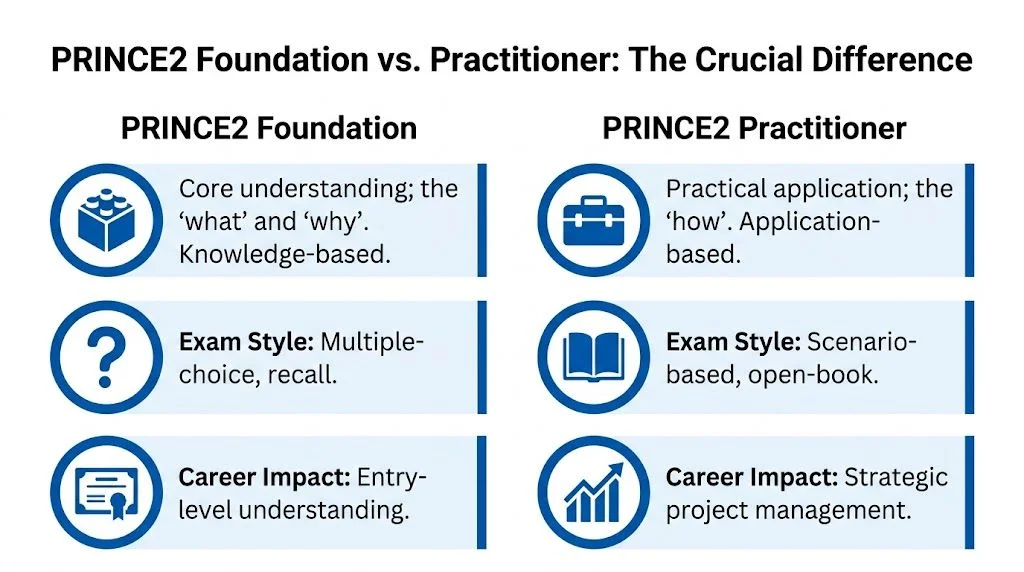 Caption: A clear delineation of the learning objectives and application expectations for PRINCE2 Foundation vs. Practitioner.
The shift from knowing to doing
At the Foundation level, the core question is whether you understand the various components of the PRINCE2 method. It is a test of memory and comprehension.
At the Practitioner level, the objective changes. The exam asks: "Can you apply and tailor the method effectively within a given project context?" You might need to decide how to adjust governance for an Azure DevOps pipeline intended for a small internal tool versus a massive, client-facing application. The framework remains the same, but your application of it must change based on the risks and needs of the organization.
This shift affects every part of the exam:
- Question wording: The exam moves from recall-based questions to complex, scenario-based problems.
- Reading volume: Each question often includes a detailed project narrative that you must analyze.
- Role of the manual: The official book is a reference tool for verification, not a dictionary to look up basic definitions.
- Judgment required: You must assess small details and weigh the implications of every decision you make.
A side-by-side view
| Area | Foundation | Practitioner |
|---|---|---|
| Primary aim | Understand PRINCE2 terms and structure | Apply PRINCE2 in complex project scenarios |
| Mental task | Recall and comprehension | Analysis, critical thinking, and judgment |
| Question feel | Direct and knowledge-based | Context-heavy and narrative-driven |
| Study style that works | Learn definitions and relationships | Practice selecting the best response in context |
| Value in the workplace | Shows awareness and basic understanding | Shows applied capability and decision-making skill |
Why open book doesn't make it easy
Candidates often see the "open book" format and relax their study habits. This is a major trap. You do not have enough time to search for every answer during the test. The Practitioner exam requires you to answer dozens of complex questions in a limited window. If you spend time looking at the index to find basic concepts, you will run out of time.
The manual is there to support your judgment, not replace it. You use it to check a specific process step or verify a detail after you have already analyzed the problem. If you haven't practiced navigating the text, the manual becomes a distraction that slows your progress.
Practical Rule: If you are searching the manual to find whole answers from scratch during the Practitioner exam, you are already behind schedule. You are likely struggling with application, not just memory.
This is why Practitioner status carries more professional weight. It proves you can recognize project problems and synthesize solutions quickly without getting lost in the documentation.
How this compares with other project credentials
Some professionals compare the PRINCE2 Practitioner with broader credentials like the Project Management Professional (PMP) certification. If you work in an environment that integrates various management styles, explore the Project Management Professional guide. While PMP covers a wider range of knowledge areas, both exams test your ability to apply theory to actual project problems.
Foundation proves you can join the conversation. Practitioner proves you can lead the discussion and make high-stakes decisions when the path forward is unclear.
What candidates usually underestimate
Candidates often fail the Practitioner exam because they overlook three specific challenges:
- The ambiguity of answer options: Multiple choices often look correct at first glance. You must identify the response that is most compliant with the PRINCE2 method and best fits the provided scenario. This is like choosing a cloud architecture; several designs might work, but only one is the most efficient given the current constraints.
- The critical need for tailoring: Textbook answers are frequently incorrect because they are too rigid. The exam expects you to scale the method for small projects or high-risk ones. If a scenario describes a small team with a low budget, a full-scale governance approach is usually the wrong choice.
- The discipline of exam reading: The questions are long and filled with data. You must scan the text for roles, dates, and clues without rushing. Skimming too quickly leads to missing the one specific word that makes an answer wrong.
Failure is rarely caused by a lack of knowledge about the method. It happens because candidates have not trained their ability to apply those rules to complicated project realities.
Decoding The Practitioner Syllabus and Exam Format
Imagine you are forty minutes into a mock exam session. The scenario on your screen describes a high-stakes, highly regulated FinTech project. You are faced with two answer options that both appear technically correct. Even though your official manual is open right next to you, you spend three minutes scanning pages for a specific keyword. You find a relevant paragraph, but you still cannot decide which option fits the specific constraints of the scenario.
This experience is common and highlights the specific pressure of the Practitioner exam. It is not a test of what you can find in a book, but how you apply what you find to a specific problem.
The syllabus is much easier to handle once you stop treating PRINCE2 principles, practices, and processes as separate topics for revision. During the exam, they act as a single, combined control system. A principle sets the general boundary, such as "Manage by Exception." A practice provides the specific management focus, like "Risk." Finally, a process determines the current state of the project and dictates which action the manager should take next, such as "Controlling a Stage."
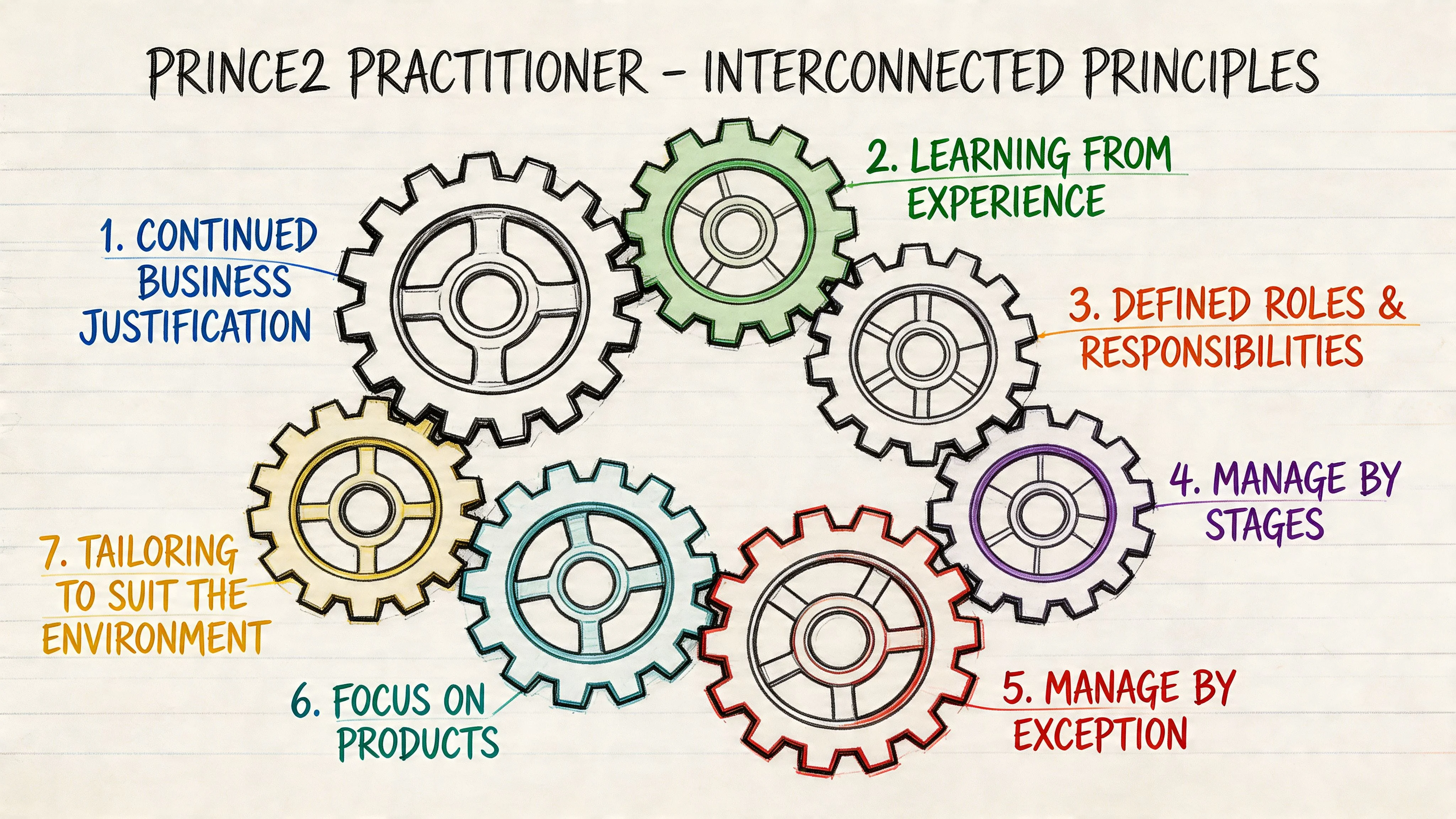 Caption: The seven PRINCE2 principles are interconnected, forming the foundation of effective project governance.
How the syllabus is really built
A productive way to study for the Practitioner level is to sort every topic into three categories based on these questions:
- What must always be true? These are the Principles. They are the non-negotiable obligations that every PRINCE2 project must follow. If you are not applying these, you are not using PRINCE2.
- What must be controlled throughout the project? These are the Practices. They include the Business Case, Organization, Quality, Plans, Risk, Change, and Progress. These are the ongoing disciplines that a project manager uses from start to finish.
- What happens now, and who acts? These are the Processes. This category includes Starting Up a Project, Directing a Project, Initiating a Project, Controlling a Stage, Managing Product Delivery, Managing a Stage Boundary, and Closing a Project. They show the chronological flow of work and define specific responsibilities.
This structure seems simple on paper, but candidates often struggle with it during the exam. Consider a question about a delayed software vendor. At first, it looks like a simple risk management issue. However, in a real project environment, it also affects the Progress practice. The Project Manager might need to talk to the Project Board, which involves the Organization practice. They will likely need to review the Stage Plan and check if the delay ruins the original Business Justification. The exam tests your ability to connect these different management areas quickly.
Tailoring in PRINCE2 means adjusting the method to fit the specific project context, including its size, risk level, and the culture of the organization. The goal is to ensure the core principles and practices remain effective without adding unnecessary work.
Tailoring is often misunderstood. It does not mean skipping controls because the team is in a hurry or because a project is small. You cannot just skip the Business Case for a small internal IT tool. Instead, tailoring means choosing the right amount of documentation, the frequency of reporting, and the level of decision-making authority for that specific tool. For example, a small web app project might use short, informal email updates and fewer stage reviews compared to a multi-million dollar cloud migration for a bank, which would require formal governance gates and detailed audits.
What the exam format means in practice
The official Practitioner exam uses scenario-based questions and has a set time limit. It is an open-book format and requires you to reach a specific passing score. The difficulty does not come from the rules themselves, but from the combination of time limits and questions that test your judgment. The answer choices are often very similar, and they are designed to see if you can make a professional decision rather than just repeating a definition.
The open-book nature of the exam changes how you should prepare. You cannot rely on the book to give you the answers; you must use the book to confirm what you already know. Think of the manual as a technical map. You need to know how to read the map before you start the journey. If you are trying to learn how the map works while the clock is ticking, you will run out of time and lose your focus.
Using modern study tools can make this easier. Adaptive study paths, such as those used at MindMesh Academy, can find the specific topics where you are struggling. Spaced repetition helps you remember the core method for a long time, so you can recall it instantly during the test. MindMesh Academy uses these techniques because success on the Practitioner exam depends on how fast you can recognize a problem and apply the right part of the PRINCE2 manual.
Why PRINCE2 7 catches some candidates out
If you studied older versions of PRINCE2, you might find the term "practices" confusing.
Earlier versions, including the PRINCE2 6th edition, called these "themes." The update to PRINCE2 7 changed this to "practices" to show that these are active tasks you do every day. You do not just check on risk once and forget about it. You actively manage risk, plans, change, and quality throughout the whole project. This change in language reminds managers that these are continuous responsibilities, not just chapters in a book to be checked off.
Understanding this shift is helpful before you start your full revision. It changes your mindset from "learning theory" to "managing a project."
*Caption: Understanding the evolution of PRINCE2 concepts, particularly the shift from 'themes' to 'practices', is key for PRINCE2 7 Practitioner.*How scenarios test tailoring
Practitioner questions almost never ask for a direct definition from the manual. Instead, they ask you to choose the best action for a specific project.
The scenario might involve a small software update with very little risk. It might also describe a massive, multi-vendor cloud infrastructure project that has strict government regulations and formal board meetings. In another scenario, you might be managing an agile team that has to work within the standard PRINCE2 stages. In all these cases, the PRINCE2 method stays the same, but the way you use it must change.
This is where memorization fails. A student who only memorized definitions will usually pick the answer that sounds the most like the textbook. However, a student who has practiced with different scenarios will look at the project context first. They will ask, "What is the most practical action for this specific project?" It is similar to a cloud architect choosing between different storage options like S3, EBS, or EFS. They don't just need to know what the services are; they need to know which one fits the specific workload they are building.
What to practice before exam day
Your study time should be spent building the same judgment skills the exam requires. You should answer many realistic scenario questions and look closely at why the wrong answers were wrong. You need to get fast at using the manual so you only open it to check a specific detail, not to find an answer from scratch. Working through old papers and practice exams is the best way to build this discipline.
Some people find it helpful to look at other scenario-based exams, such as the Project Management Professional. The rules for PMP are different, but the skill of reading a scenario, identifying your role, and choosing the best solution for the situation is exactly the same. Practicing this type of thinking will help you regardless of which certification you are taking.
A simple model for answering faster
To stay on track and save time during the exam, use this five-step sequence for every scenario question:
- Locate the Context: Determine the project type and its constraints. Is it a high-risk government project or a small internal update? Is it using an agile approach?
- Identify the Role: Determine who is supposed to act. Are you the Project Manager, the Team Manager, or a member of the Project Board?
- Find the Management Area: Decide which practice the question is targeting. Is this about Risk, Change, Quality, or Progress?
- Place it in the Project Flow: Determine which process the project is currently in. Are you in the middle of a stage (Controlling a Stage) or at the very end of the project (Closing a Project)?
- Test the Answer Against Tailoring: Check if the answer makes sense for the project's size and environment. Does it follow PRINCE2 principles while remaining realistic and practical?
This sequence is a working method that helps you stay organized under pressure. If you combine this approach with adaptive study and spaced repetition, the PRINCE2 syllabus will stop feeling like a list of terms. It will become a logical system you can use to control any project.
Key Takeaway: The 5-Step Scenario Strategy
For every Practitioner scenario question, remember to:
- Scan Context
- Find Role
- Name Issue
- Reject Distractors
- Choose Controlled & Tailored
Your Strategic 12-Week Study Plan For Success
You finish a long day at the office, open the official PRINCE2 manual, and spend 45 minutes reading. You feel like you have been productive. However, a week later, when you sit down to answer a practice scenario question, you still hesitate. You find yourself unsure about who should take action, which document is the most critical in a specific situation, and whether a particular issue relates to a practice or a process. This gap between knowing the theory and applying it in practice defines the central challenge of the Practitioner exam.
Candidates rarely fail because they did not work hard enough. Instead, their struggle usually comes from using Foundation-level study habits. Those habits do not work for a scenario-based exam. The Practitioner level requires you to use professional judgment under tight time constraints. In this environment, the manual serves as a functional tool for verification rather than a safety net that will give you every answer.
 Caption: A progress dashboard helps you visualize your study progress, identifying strengths and areas needing more attention, which is vital for Practitioner success.
Why structure changes the result
AXELOS recommends accredited training as the primary path for Practitioner success. This is because the exam tests how you apply knowledge, not just what you can remember. Training like this gives you constant exposure to how scenarios are built. It teaches you how to make decisions based on specific roles and how to use the manual effectively when the clock is ticking. While you can study on your own, independent study often fails because reading feels like learning, even when it is not. Only active recall and timed practice reveal what you have actually mastered.
Modern study tools are built to solve this problem. Adaptive learning paths help you use your time better by moving you away from topics you already know. Instead, they force you to focus on the concepts you regularly get wrong. Spaced repetition ensures that these logical patterns stay fresh in your mind. This is useful when a test question uses familiar words in a confusing or new way. For the Practitioner level, these methods are not just extra features. They are the most effective ways to train for the specific exam you will sit.
A realistic 12-week rhythm
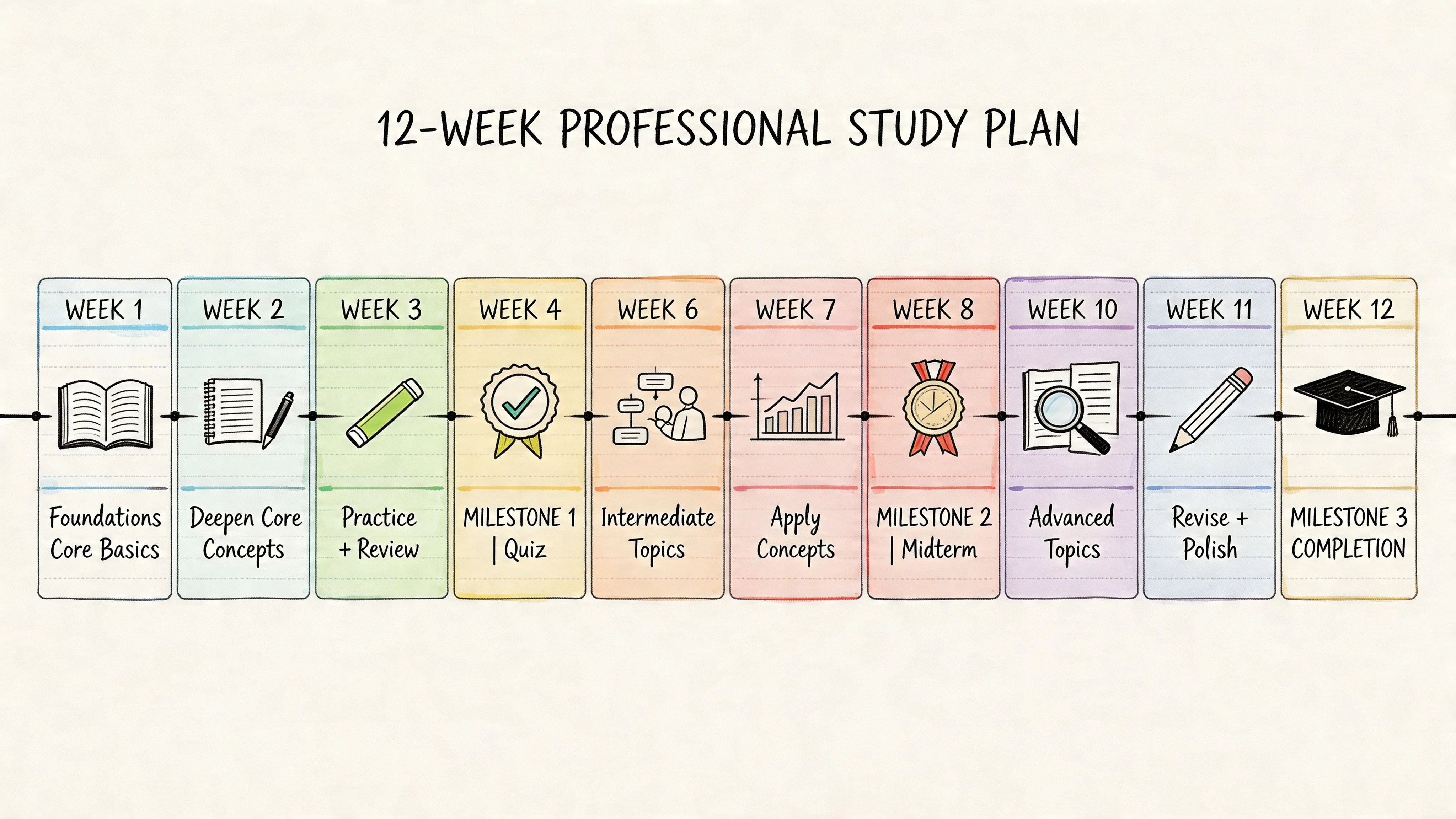
Treat your 12-week study plan like a project with clear phases. Start by making sure your foundation is solid. Next, test your ability to make decisions. Finally, spend your time rehearsing for the actual exam day.
Weeks 1 to 3: Rebuild Foundational Application
Your first goal is to solidify what you learned at the Foundation level. However, you must now look at that information through the lens of application.
- Week 1: Principles Focus. Revisit the seven principles. Try to explain each one in plain language. Link each principle to a real-world IT project scenario. For example, consider "Manage by Exception." This means a Project Manager does not bother the Project Board with every small problem. Instead, they only escalate issues if an AWS cost overrun or a timeline delay exceeds a pre-set tolerance of 10%. If you cannot explain why a principle matters for a live project, you need to spend more time on it.
- Week 2: Practices Mastery. Study the seven practices. Focus on who is responsible for what. You should know which roles in the Organization practice own specific tasks. Learn which documents support each area, such as the Business Case or various Project Plans. Define what "good control" looks like. For instance, effective Risk management is about finding threats before they happen, not just writing down a list of problems that have already occurred.
- Week 3: Process Flow Immersion. Walk through the seven processes. Start at "Starting Up a Project" and go all the way to "Closing a Project." You should be able to explain the flow and the main activities in each process without checking your notes. Focus on how processes talk to each other. Understand how the work in "Controlling a Stage" provides the data needed for "Managing a Stage Boundary" when a project phase is ending.
At this stage, focus on being clear and thorough. Speed is less important than building a strong mental map of how the pieces fit together.
Weeks 4 to 6: Shift to Contextual Application
Now you must stop just knowing the words and start using them in specific situations. Use short scenarios to practice your logic. For every scenario you read, ask yourself these four questions:
- What is the main problem here? Is it a change in scope, a conflict over resources, or a problem with quality?
- Who is responsible for this under PRINCE2 rules? Does this belong to the Project Manager, the Project Board, or the Team Manager?
- Which PRINCE2 element is being tested? Is the question about a specific principle, a practice like Change, or a process like Controlling a Stage?
- How would you adapt PRINCE2 for this specific project? Consider if the project is a small internal update or a massive public sector change.
This is where most candidates see their scores start to rise. A question about risk stops looking like a general management puzzle. You stop confusing a change request with a simple progress report. You start to see the important facts and ignore the "noise" in the scenario description. You will no longer just pick the answer that sounds the most professional or official.
Spend extra time on the areas that often get confused in the exam. Pay close attention to risk, quality, and change. Review the specific activities inside Controlling a Stage until you know them by heart.
Weeks 7 to 9: Incorporate Time Pressure
In this phase, you must bring in the pressure of the clock. Start working on exam-style questions in timed blocks of 20 or 30 minutes.
After every practice session, look at every answer you got wrong. Also look at the ones where you just guessed correctly. For each one, write down two things: why your first choice seemed right at the time, and which specific detail in the manual or the scenario proved that choice was wrong.
This habit is powerful. It shows you your own patterns. You might realize you answer too fast when you see a word you recognize. You might realize you keep giving the Project Manager's jobs to the Project Board. Identifying these habits now prevents them from happening on the day of the test.
If you are using a platform like MindMesh Academy, use the adaptive review features. These systems show you the types of questions you usually avoid or misread. This acts like a digital coach, pushing you to improve your weakest areas through constant, focused practice.
Weeks 10 to 12: Final Exam Rehearsal
Your final three weeks are about execution. You want to be calm and controlled when you sit for the actual exam.
- Manual Navigation Practice: You must be able to find key sections and role descriptions fast. Do not waste time flipping pages. Use tabs and the index to reach the right page in seconds.
- Full Mock Papers: Take several full mock exams. Do this under real exam conditions. Sit in a quiet room, set a timer for the full duration, and take scheduled breaks. This builds the stamina you need for a long exam.
- Error Log Maintenance: Keep a short list of the traps you keep falling into. Note down tricky wording that has fooled you before and any topics that still feel shaky.
- Targeted Review: Use spaced repetition for your weak spots. Do not re-read whole chapters. Only review the specific parts of the manual that address your remaining errors.
By the end of week 12, the manual should feel like a tool you know how to use. It should not feel like a heavy book that you hope will save you.
Why spaced repetition fits Practitioner so well
The Practitioner exam does not reward people for knowing single facts. It rewards people for understanding how facts relate to each other. You must keep strong links in your mind between different concepts. You need to connect:
- A PRINCE2 principle to how people actually act on a project.
- A specific role to what that person is allowed to decide.
- A type of issue to the reaction PRINCE2 requires.
- A project's environment to the way the method should be tailored.
This kind of memory comes from active recall over a long period. If you try to cram all this information in a few days, you might recognize the words, but you will not have the judgment needed for the scenarios. Spaced repetition works like a project review. You look at the information right before you are likely to forget it. This makes the memory stronger every time.
For a busy IT professional, this is the best way to study. Short, timed sessions are better than trying to read for three hours on a Sunday night when you are already tired.
A weekly pattern busy professionals can sustain
This schedule helps you balance a full-time job with your study goals. It prevents you from burning out before the exam.
| Day | Focus |
|---|---|
| Monday | Review flashcards for the topics you found difficult last week. |
| Tuesday | Spend one hour on a single topic, such as the Risk Management Practice. |
| Wednesday | Complete a short drill of 3-5 scenario questions under a time limit. |
| Thursday | Practice finding five specific items in the manual and review your Wednesday answers. |
| Friday | Take a timed set of 10-15 mixed questions to test your range. |
| Weekend | Do one long study session of 2-3 hours and a quick 30-minute recap. |
Keep this rhythm consistent. Do not skip days if you can help it.
Consistency is more important than the total number of hours. A steady 12-week plan using adaptive practice and spaced reviews will prepare you better than a frantic rush at the end. This structured approach is the way to turn PRINCE2 theory into the professional judgment you need for the exam and for your actual project work.
How To Master A PRINCE2 Practitioner Scenario Question
Let's analyze a realistic example typical of a modern IT project.
Scenario: You are managing a software implementation project where the Project Board initially approved a business case based on a phased rollout. Midway through the current stage, a critical third-party supplier proposes a significant change that could improve long-term usability and scalability. For example, they suggest switching to a new cloud-native database in Azure. However, this change will definitely impact current stage timing and costs. The Project Manager is unsure whether to approve the change immediately, escalate the issue, or defer the decision.
This specific type of question often causes candidates to freeze. Several actions might seem reasonable when you first read them.
Step One: Break Down the Scenario
Do not read the text like a novel. Read it as a signal map to identify core components:
- What kind of issue is this? This is a proposed change with implications for progress (timing and cost), the Business Case (long-term usability versus current impact), and potentially Manage by Exception.
- Which role is being tested? The question focuses on the Project Manager.
- Which part of PRINCE2 is most relevant? Look toward the Change practice, Progress practice, Business Case practice, and the Controlling a Stage process.
Step Two: Identify the Decision Boundary
Many weak answers result from candidates answering a question that was not actually asked. If the question specifically asks what the Project Manager should do next, do not choose an answer that describes what the Project Board should do. The only exception is if the scenario clearly shows that an escalation is mandatory because of tolerance breaches or specific governance rules.
Good candidates do not hunt for the most impressive or detailed answer. They search for the most appropriate answer for that specific role, at that precise moment, within that particular context.
Step Three: Test Each Option Against PRINCE2 Logic
Suppose the answer options are presented as follows:
- A. Approve the change immediately because it promises significant long-term product improvement.
- B. Reject the change because stage plans are already approved and the team must follow them strictly.
- C. Assess the full impact of the proposed change on stage tolerances, the Business Case, and existing controls before deciding on a course of action, potentially escalating if necessary.
- D. Send the issue to the Project Board immediately for their decision without conducting any prior analysis.
The correct PRINCE2 answer almost always preserves control, follows the established decision path, and aligns with the principle of "Continued Business Justification."
In this scenario, the strongest option is C. This requires the Project Manager to assess the impact first. PRINCE2 requires controlled decision-making. The fact that a change might be beneficial does not automatically justify approving it on the spot. Conversely, an approved stage plan does not mean you must reject every change. Option C follows a structured, PRINCE2-compliant approach. It requires an impact assessment before any definitive decision or escalation occurs.
Step Four: Eliminate Distractors
Incorrect options often contain one or more of these specific flaws:
- They skip impact assessment: Option A jumps to approval without understanding the consequences.
- They ignore role boundaries: Option D passes responsibility to the Project Board before the Project Manager has completed their own required analysis.
- They sound proactive but break governance: Option A appears decisive but it bypasses the necessary controls.
- They use rigid PRINCE2 language without tailoring: Option B takes an inflexible stance that may not fit a situation requiring analysis and adaptation.
This is a common trap in the exam. The examiners offer a textbook-sounding answer that does not actually fit the unique project situation described in the scenario.
Step Five: Justify the Answer in One Sentence
Practice explaining why your chosen answer is the right one in a single sentence:
"The Project Manager must first assess the full impact of the proposed change on current stage tolerances, updated plans, and the ongoing business justification, then follow the correct escalation path if authority limits are exceeded."
If you can say this clearly, you have grasped the essence of the question and the proper PRINCE2 response.
A Repeatable Method for Every Scenario
Apply this five-part rhythm to every scenario question you encounter:
- Scan the Context: Identify the unique characteristics of the project.
- Find the Role: Determine exactly whose responsibility the question is testing.
- Name the Issue: Identify the specific PRINCE2 areas involved, such as Risk or Quality.
- Reject Misaligned Options: Systematically remove answers that violate PRINCE2 principles or the provided context.
- Choose the Best Fit: Select the response that protects project control and fits the specific scenario.
By using this method, the exam format becomes a predictable exercise in pattern recognition rather than a source of stress. Focus on the mechanics of the framework and the specific constraints of the scenario provided. This approach will help you pass with confidence.
Applying PRINCE2 Practitioner Skills In The Real World
You have passed your Practitioner exam and earned the credential. Now, you arrive at the office on Monday morning to find the actual test has just started.
The project sponsor is calling for weekly updates. Meanwhile, the delivery team is busy with a Scrum-based AWS migration and is vocal about wanting less paperwork. To complicate things, a major third-party API integration fails before you have even finished the first stage. No exam question can fully prepare you for the pressure and shifting priorities of a live meeting like this. PRINCE2 remains a highly useful asset here, but its value depends entirely on your ability to apply its principles with clear judgment.
This transition marks the shift from classroom theory to on-the-ground work. The manual acts as your map, but real-world projects come with unpredictable weather, heavy traffic, and sudden detours that require you to adapt.
Tailoring without losing control
Junior project managers often fall into one of two traps. Some treat PRINCE2 as a rigid checklist, applying every template regardless of the project's size. Others remove so much structure that the team loses track of who makes decisions, resulting in a disorganized mess.
Effective tailoring is like adjusting the controls on a car to handle specific road conditions. A minor, internal software update might only need short Highlight Reports and basic Product Descriptions. You can likely get away with quick, informal Stage Reviews. In contrast, a company-wide change like a new core banking system involves several outside vendors and strict regulations. This type of project requires firm lines of authority, better assurance methods, and detailed reporting. The cost of a single mistake in a high-stakes environment is simply too high for a casual approach.
The goal is to maintain consistent control rather than producing identical piles of paperwork. Roles still need to be defined, decisions must follow a clear path, and the Business Case requires constant attention. You are scaling the method to meet the project's specific needs, not removing the parts that keep the project safe.
What catches new Practitioners out
Most problems for new Practitioners stem from daily management habits rather than a lack of knowledge. They often struggle with the following areas:
- Template Misuse: Practitioners sometimes view a completed document as proof that the project is under control. A Risk Register is useless if the team never looks at it or fails to act on the threats it lists. Documents must guide real-time decisions to be effective.
- Over-tailoring Governance: In an attempt to be efficient, some managers simplify governance until it becomes invisible. When you skip too many checks, critical issues or exceptions only appear when it is too late to fix them without extra budget or time. This leads to reactive firefighting.
- Neglecting Stakeholder Education: You cannot assume that senior users, team managers, or third-party suppliers understand how you have tailored PRINCE2. If an IT Operations lead does not grasp the concept of "Manage by Exception," they may escalate every tiny technical glitch to your desk.
This last point often causes more delays than technical issues. If the Project Board, users, and suppliers do not have a shared understanding of tolerances and approval points, you will spend your day explaining the process instead of managing the work. In technical environments, using PRINCE2 alongside frameworks like ITIL helps bridge the gap between project delivery and daily operations.
Sustainability now belongs in project decisions (PRINCE2 7)
The latest version, PRINCE2 7, includes sustainability as a core performance target. As a Practitioner, you must include sustainability in your standard controls and decision-making steps. This is no longer an optional extra; it is a metric for success.
Start by asking specific management questions during the project lifecycle:
- Does the technical delivery plan, such as choosing specific cloud regions in AWS or Azure, lead to unnecessary energy use?
- Is a procurement choice at odds with the company's goals for ethical sourcing or reducing environmental impact?
- Do we need to record a risk because a solution has long-term social or environmental consequences? This could include the disposal of old hardware or the impact of a new automated system on the local workforce.
You do not have to mention sustainability in every single status update. However, you must evaluate it whenever it touches the project's value, cost, or long-term viability. In a practical sense, this means checking the Business Case, project plans, and risk approaches to ensure these factors are not ignored.
A cloud migration offers a clear example. Decisions about data retention, where servers are physically located, and how you retire on-premises hardware all affect the Business Case. For a technology rollout in a modern office, you might focus on device reuse and the energy efficiency of the final software. These are tangible project outcomes that stakeholders now expect you to manage.
To help manage these uncertainties in a structured way, this guide to risk mitigation planning provides a framework for choosing the right responses to project threats.
What capable application looks like under pressure
The most effective Practitioners are rarely those who can recite the manual word for word. Instead, they are the people who stay calm and keep the project on track when things go wrong.
You will see several specific patterns in the way successful Practitioners work:
- Strategic Stage Boundaries: They use the end of a stage as a real decision point. This is the time to check if the project is still worth the investment before committing more funds, rather than just treating it as a clerical task.
- Active Business Case Management: They keep the Business Case at the center of the project. When a team feels pressured to "just get it done," the Practitioner reminds everyone of the actual value the project is supposed to deliver.
- Early Escalation: They do not hide bad news. If a project is about to go outside its agreed tolerances, they tell the Board immediately. This prevents a small deviation from growing into a project-ending crisis.
- Intelligent Tailoring: They modify reports and controls so they fit the project perfectly. An agile IT project needs different documentation than a large-scale construction job, and a good manager knows exactly what to change.
- Integrating New Concerns: They treat topics like cybersecurity and sustainability as part of the existing PRINCE2 controls. They do not see them as extra administrative burdens, but as essential parts of a healthy project.
This is why modern study techniques are so important. The Practitioner exam is difficult because it tests how you apply judgment in these scenarios. Methods like adaptive learning and spaced repetition, such as those found at MindMesh Academy, allow you to practice the mental steps used by professionals. You learn to read a situation, identify what matters most, and choose a response that keeps the project moving without adding unnecessary complexity.
The lasting value of becoming a PRINCE2 Practitioner is the ability to turn a structured method into effective, real-world decisions. It provides the framework you need to lead a project to a successful conclusion, regardless of the challenges that appear along the way.
How MindMesh Academy Ensures Your Practitioner Success
The PRINCE2 Practitioner exam is notoriously difficult for those who rely on passive study habits. If your preparation consists primarily of reading the official manual several times while hoping that the correct answers will simply stand out on exam day, you are making the process much harder than it needs to be. Success at this level requires more than just knowing the facts; it requires the ability to apply them under pressure.
What preparation needs to solve
An effective study system for the Practitioner exam must achieve four specific goals:
- Pattern Recognition: You must see enough scenario patterns to recognize how the PRINCE2 themes and processes interact in different business contexts.
- Active Application: Your study should force you to apply knowledge rather than just reviewing it. This moves your understanding from simple recognition to active recall.
- Targeted Revision: The system needs to identify and revisit your specific weak areas before you lose that knowledge.
- Visible Metrics: You need a way to see your progress clearly so you can change your study tactics based on actual performance data.
This approach is necessary because passing the Practitioner exam depends on your ability to apply the methodology consistently, not just your familiarity with the terminology.
Where adaptive study earns its keep
A structured learning platform provides significant advantages for this type of exam. MindMesh Academy offers certification preparation that includes adaptive learning paths, spaced repetition, numerous practice questions, and a detailed progress dashboard. For a scenario-based exam like PRINCE2 Practitioner, these tools are useful because they allow you to focus on the specific concepts and question types that cause you the most trouble. You avoid wasting time on topics you have already mastered.
This changes your entire approach to preparation. Instead of deciding to simply "study PRINCE2" for the evening, you can address specific, identified gaps in your knowledge:
- "I struggle to identify exactly when an issue must be escalated to the Project Board."
- "I am consistently making errors during the 'Managing a Stage Boundary' process."
- "I understand Change Control theory, but I fail questions regarding how to tailor that process for a small-scale internal project versus a massive infrastructure upgrade."
An adaptive study path turns those vague worries into concrete next sessions. The platform points you at the specific question types where your judgment is still slipping, then keeps cycling them back through spaced repetition until your performance stabilizes. The dashboard makes that progress visible, so booking the exam stops being a guess and starts being a decision based on evidence.
That kind of disciplined loop is the difference between candidates who pass with confidence on the first attempt and those who repeatedly run out of time during the open-book exam. When you are ready to put a structured study system around your PRINCE2 Practitioner prep, browse MindMesh Academy's full certification catalog to find the path that fits your goals and start training your judgment instead of just rereading the manual.

Written by
Alvin Varughese
Founder, MindMesh Academy
Alvin Varughese is the founder of MindMesh Academy and an enterprise architecture leader. An electrical engineer by training, he moved from factory automation in South Africa to cloud architecture at GE Appliances and Humana (Fortune 50), and holds 20 professional certifications including AWS Solutions Architect Professional, Azure DevOps Engineer Expert, and Microsoft Agentic AI Business Solutions Architect. He built MindMesh Academy after interviewing too many highly certified candidates who couldn't answer basic questions: the goal is prep that makes you better at the job, not just able to pass the exam.