
Career Development Definition: Shape Your IT Future
Career Development Defined: Shaping Your IT Future
You open a job posting for a role that looks like your next step. Maybe it's Cloud Engineer, Security Analyst, Solutions Architect, or Technical Project Manager. You read the requirements, and that familiar drop in your stomach hits. You know some of it. You've done adjacent work. But the posting mentions tools, platforms, or methods you haven't touched in a while, or perhaps ever.
That moment often prompts the wrong question: “Am I qualified right now?”
A better question is: “What system helps me stay qualified over time?”
That system is career development. Not the vague concept discussed in annual reviews, but the practical process. It's how an IT professional decides what to learn next, which certification matters, where experience gaps exist, and how to move from today's role to a better one without years of drifting.
Why Career Development is Your Most Important Skill
You can excel at your current job and still fall behind in your career.
This often surprises IT professionals. A network engineer might troubleshoot complex issues faster than anyone on the team, yet lose ground when employers shift toward cloud networking and infrastructure as code. A help desk lead with years of strong user support experience might discover that the next step expects automation, identity management, or security knowledge. The problem isn't poor performance. It’s treating career progress like a reward for good work instead of a system needing regular maintenance.
Think of career development as patch management for your professional value. If you update only when something breaks, you spend more time catching up and remain exposed to risk. If you review, prioritize, and apply changes on a schedule, you stay relevant in a changing environment.
The Problem with Passive Growth
Passive growth sounds reasonable. Do solid work. Be dependable. Pick things up as needed. Wait for the next opportunity.
In tech, this approach quickly expires.
Role requirements change before job titles do. Tools that were once optional become baseline. Skills that set you apart become assumed. By the time a professional notices the gap, the market has often moved another step ahead.
This is why career development belongs in the same category as technical problem-solving and communication. It's not a soft extra. It's the skill that helps you decide what to learn, what to ignore, and how to prove your experience still matches the roles you want.
A practical career strategy usually includes four repeated actions:
- Audit your current skills against the direction of your field.
- Find gaps early while they are still manageable.
- Choose structured learning based on target roles, not hype.
- Create evidence through certifications, projects, and applied work.
For IT professionals, that third point is more important than it used to be. Certifications, lab work, and structured platforms are now part of the core system, not optional add-ons. If your goal is to move into cloud, security, data, DevOps, or leadership, informal learning alone often leaves too many gaps. A focused program in career development training can give shape to what would otherwise become scattered effort.
Why This Matters More in IT
Experience still matters. Current experience matters more.
I tell junior and mid-career tech professionals to picture two servers. One has been reliable for years but hasn't been updated, documented, or tested against current requirements. The other is actively maintained and ready for new workloads. Both have history. Only one inspires confidence for the next deployment.
Careers work the same way.
The professionals who keep advancing aren't usually the ones who know everything. They are the ones who review their direction regularly, invest in relevant learning, and turn that learning into visible proof. This habit protects against stagnation and creates options. Promotions become easier to pursue. Lateral moves become easier to justify. New specializations become easier to enter.
If you want one skill that improves every other part of your working life, start here. Career development is the discipline that keeps your technical ability aligned with market demand. In IT, that alignment keeps opportunity within reach.
What is the Real Career Development Definition?
Many IT professionals treat career development like a side project. They plan to think about it after the release, after the migration, or after the next incident-heavy quarter. Then a role opens in cloud, security, architecture, or delivery leadership, and they realize they have experience but not a clear story, not enough proof, or a few missing skills that slow everything down.
That is why a useful career development definition needs to be practical. For an IT professional, career development is the ongoing process of choosing where your career is headed, measuring the gap between your current profile and that target, and closing that gap with deliberate learning, relevant experience, and visible proof.
Your career works like a maintained production system. It needs monitoring, updates, and occasional redesign to keep meeting new requirements. If you leave it untouched for too long, the problem is rarely your effort. The problem is drift.
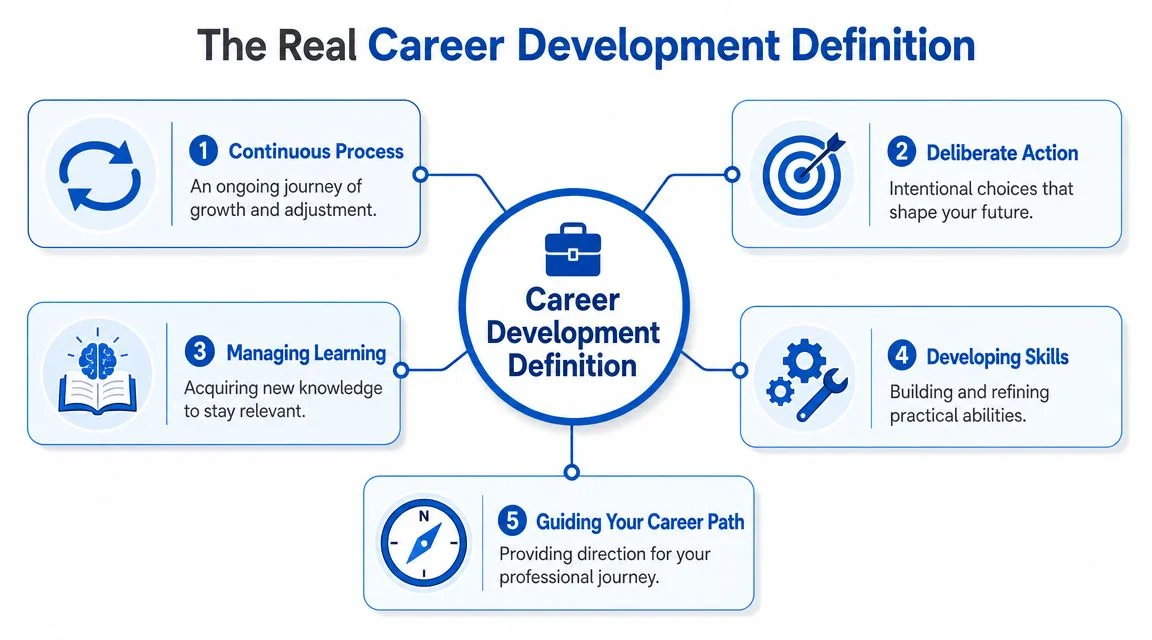
Where People Get Confused
Career development is often reduced to promotion planning. In practice, it is broader and more useful.
It includes promotion, but also covers role changes, specialization, leadership growth, marketability, and staying relevant as tools and expectations change. A support engineer moving into cloud operations, a developer shifting into DevOps, and a project coordinator preparing for delivery leadership are all practicing career development, even if none of them gets promoted this quarter.
That distinction matters because it changes your actions. If you define career development too narrowly, you wait for permission. If you define it correctly, you build readiness before the opportunity appears.
Career development also differs from a few related ideas:
- Job searching, which is only one expression of career progress.
- Training, which is one input rather than the whole system.
- Performance management, which focuses on your current role more than your next one.
- Ambition, which provides energy but not a method.
A Practical Definition for IT Professionals
In IT, the concept becomes clearer when you break it into a working loop.
-
Set a Destination
Pick a realistic target role or next capability area. Be specific. “Move into cybersecurity” is vague. “Qualify for a junior security analyst role with hands-on SIEM exposure” is usable. -
Audit Your Current Position
Review your skills, certifications, project history, business context, and evidence. Evidence matters. Hiring managers and internal leaders look for proof, not private intentions. -
Identify the Gap
Compare your current profile with actual role requirements. In tech, the missing piece is often not only knowledge. It may be project scope, documentation quality, stakeholder communication, or a recognized credential. -
Close the Gap with Structure
Planned learning demonstrates its value. Labs, stretch assignments, mentoring, and structured career development training help turn a vague goal into scheduled progress. If your path includes delivery or program leadership, a resource like this PMP certification study guide can show how formal certification fits into a wider career plan rather than sitting in isolation. -
Review and Adjust
Technology changes. So do your interests, strengths, and opportunities. A good plan is revised regularly, just like a technical roadmap is revised when requirements shift.
Here is the part many articles miss. For modern IT careers, certifications and structured learning platforms are not decorative extras. They are often part of the evidence layer of your career. They signal current knowledge, reduce ambiguity for employers, and give shape to learning that might otherwise stay scattered.
That does not mean every certification is worth pursuing. It means your development plan should include the forms of proof your target role respects. In some paths, that proof comes from architecture decisions and shipped systems. In others, it comes from incident response work, portfolio projects, or formal credentials. Usually, it comes from a mix.
So a strong definition of career development is not “getting ahead” in the abstract. It is a repeatable system for deciding where you want to go, building the capability to get there, and collecting evidence that shows you are ready.
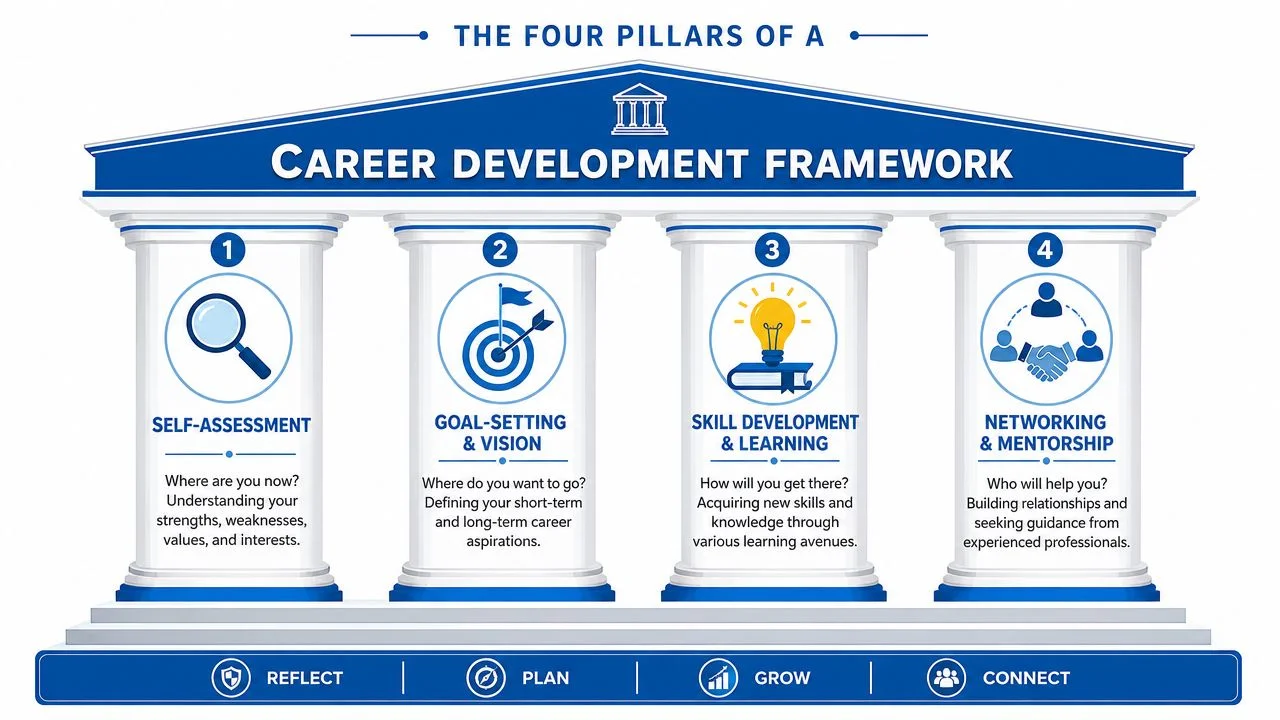
The Four Pillars of a Career Development Framework
A framework matters because careers drift when they rely on good intentions alone. In IT, that drift usually looks familiar: you stay busy, solve real problems, pick up useful tools, and still struggle to show why you are ready for the next role.
The fix is structure.
The model I use with junior and mid-career tech professionals has four pillars. They work like parts of a production system. If one part is weak, the whole system becomes unreliable. You might study hard but aim at the wrong role. You might choose the right goal but fail to build proof that hiring managers can trust.
Start with the visual model below, then test each pillar against your own situation.
Pillar One: Honest Self-Assessment
Self-assessment is baseline diagnostics for your career. Before you plan an upgrade, you need to know the current system state.
Many IT professionals confuse familiarity with readiness. They know their daily tasks well, so they assume they are close to the next role. Employers assess something different. They look for scope, depth, consistency, and evidence.
A useful self-assessment reads like a hiring manager's checklist. Write down your technical stack, project ownership, incident or delivery experience, certifications, communication strengths, and the kinds of problems you can solve without help. Then compare that inventory with the requirements of the role you want.
A support engineer might find strong troubleshooting and customer communication skills, but weak automation, cloud fundamentals, or design documentation. That gap is valuable. It gives you a direction instead of a vague sense that you need to "grow."
Useful inputs for self-assessment include:
- Your recent work such as tickets, deployments, incidents, and project contributions.
- Job descriptions for the next role you want.
- Feedback from managers or peers that shows repeated strengths or blind spots.
- Evidence of skill such as labs, certs, GitHub work, or internal presentations.
Pillar Two: Direction for Your Effort
Career effort needs a target. Otherwise, learning turns into random accumulation.
Good goals in IT are specific enough to guide decisions. "Get better at tech" is too broad to help. "Move from help desk into cloud support within 12 months" gives you a role, a time horizon, and a filter for what to study.
A useful goal has two parts:
| Goal Element | Example for IT Professionals |
|---|---|
| Role Direction | Security analyst, cloud engineer, scrum master, technical project manager |
| Proof Requirement | Build project experience, earn a relevant certification, lead a migration workstream |
Don't build a learning plan around topics you find interesting. Build it around the role you want someone to trust you with.
As noted earlier, career development connects current capability to future responsibility through deliberate planning. In IT, that planning has to account for something many generic definitions skip. Employers don't only ask what you know. They ask how you can prove it.
Here's a practical explainer that pairs well with that framework:
Pillar Three: Turning Ambition into a Build Plan
This pillar is where theory becomes a roadmap.
Once you know your gap, you can choose learning activities that close it. That might mean labs, projects, shadowing, stretch assignments, documentation practice, certification prep, or a combination. The right mix depends on the role. A future cloud engineer needs different proof than a future program manager.
If you're aiming at delivery leadership, a structured resource like this PMP certification study guide can help translate broad project experience into a recognized framework. If your target is more technical, your plan might center on cloud labs, architecture diagrams, incident response exercises, or scripting practice.
This is the part many IT professionals underestimate. Certifications and structured learning platforms are no longer side items for a resume. In many tech paths, they form part of the evidence that makes your growth visible and credible.
A strong plan answers three questions:
- What will I learn?
- How will I prove it?
- When will I review progress?
Pillar Four: Execution Plus Iteration
Plans only matter if they survive contact with real work.
Execution means study, practice, application, and documentation. It means finishing the course, building the lab, writing the postmortem, volunteering for the migration workstream, or leading the meeting. Career progress becomes real when other people can see evidence, not just intent.
Iteration matters for a different reason. Tech careers change as you gain exposure. You may start by aiming at networking and discover that cloud security fits your strengths better. You may pursue management and later realize solutions architecture suits you more. That is not wasted effort. It is better information.
Put the four pillars together, and the framework becomes practical: know your current state, choose a clear destination, build the missing capability, and keep adjusting as the market and your interests change. That is how career development stops being an abstract definition and becomes an operating system for long-term growth in IT.
Navigating Your Career Path with Modern Models
Much career advice still assumes a ladder. Entry level to mid-level. Mid-level to senior. Senior to manager. One rung at a time, one direction only.
That's not how most IT careers unfold.
A better mental model is movement across a lattice, or even a jungle gym. You don't only go up. You move sideways into adjacent tools, diagonally into related disciplines, or temporarily into roles that broaden judgment before increasing title.
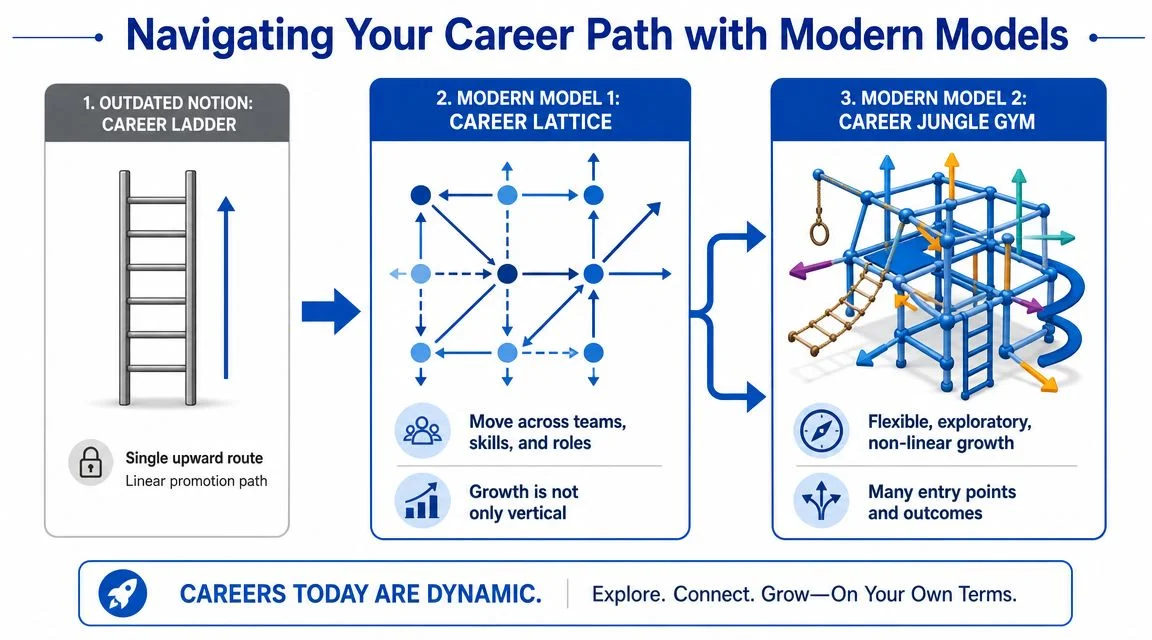
Why the Ladder Model Breaks Down in IT
Let's say you work in IT support and want to become a cloud engineer. A ladder mindset tells you to wait for a direct upward opening in your current track. A modern model suggests you might first move into systems administration, platform support, or junior cloud operations. That lateral move can be the smartest route because it gives you missing exposure.
The same thing happens elsewhere:
- A QA analyst may pivot into test automation.
- A network administrator may shift into cloud networking.
- A developer may move sideways into DevOps or site reliability work.
- A project coordinator may grow into technical program delivery.
Each move may look indirect on paper. In practice, it can be exactly what your next role requires.
The Cycle That Fits Real Careers
The model I trust most for modern tech careers is a cycle:
| Stage | What It Looks Like in Practice |
|---|---|
| Learn | Study a new platform, framework, process, or certification track. |
| Apply | Use it in a lab, project, internal initiative, or stretch assignment. |
| Grow | Take on stronger responsibility, broader scope, or a new title. |
| Reassess | Review what changed in your interests, strengths, and target market. |
This works because IT rewards demonstrated adaptability. Employers don't just want someone who once learned a system. They want someone who can continue learning as systems evolve.
A related career lens comes from NACE, which defines career readiness as a foundation for lifelong career management, not just entry-level success. This includes proactively developing one's career through continual learning and opportunity review, as outlined in its career readiness definition.
If your next move involves cloud, a role-specific path like AWS cloud certification training can support that Learn stage, but the larger point is the sequence. Study alone doesn't change your career. Study plus application does.
Sideways moves often feel slower in the moment. Later, they're the reason your profile makes sense for a bigger role.
What This Means for Your Decisions
When you evaluate a role or learning opportunity, stop asking only, “Is this a promotion?” Ask better questions:
- Does this expand my capability in a direction I care about?
- Will this give me proof I can use later?
- Does this help me move into a stronger specialization or broader scope?
- Will I come out of this with clearer positioning in the market?
That's how experienced professionals avoid getting trapped by title-only thinking.
Measuring the ROI of Your Career Development
Career development takes time, attention, and often money. That means you should treat it like an investment, not a motivational slogan.
In IT, the return usually shows up in four forms: better role access, stronger resilience when job requirements shift, more credibility for larger projects, and greater control over what kind of work fills your week.
What "Return" Actually Looks Like
You don't need to reduce everything to salary alone, although compensation often matters. The sharper test is whether your development work creates options you didn't have before.
For example, a support technician who learns scripting and cloud fundamentals may qualify for a platform role that was previously out of reach. A business analyst who gains project delivery discipline may become credible for implementation leadership. A systems engineer who documents architecture decisions and deepens cloud knowledge may become a stronger candidate for design-focused roles.
Here are useful career ROI signals you can track without guessing:
- New responsibilities gained such as owning a migration task, leading a sprint ceremony, or running a stakeholder meeting.
- Skills you can now demonstrate in interviews or on real projects.
- Credentials completed that support your target role.
- Market alignment based on how closely your profile matches current job requirements.
- Decision confidence because you know your next step instead of reacting under pressure.
A Simple Scorecard for IT Professionals
You can measure progress with a plain monthly review. No complicated dashboard needed.
| Area to Review | Questions to Ask |
|---|---|
| Skills | What can I do now that I couldn't do three months ago? |
| Proof | What evidence do I have besides saying I learned it? |
| Positioning | Am I closer to a target role, or just busier? |
| Visibility | Do more people trust me with higher-value work? |
That last question matters more than many people realize. Career development isn't only private growth. It's visible trust accumulation.
Real-World Barriers are Part of the Equation
There's another layer people often ignore. Not every career challenge comes from mindset or effort.
Workforce research summarized by the Center for American Progress notes that career development bottlenecks are often structural. Access to transportation, childcare, and other support services materially affect who can complete training or work pathways.
That matters because it changes the advice. If your constraints are time, caregiving, schedule instability, or budget pressure, your plan has to account for reality. A perfect roadmap that ignores your life won't survive contact with your calendar.
Build a plan you can repeat on hard weeks, not just ideal weeks.
That may mean choosing shorter study sessions, asynchronous learning, one certification at a time, or projects that fit your current role instead of adding a second full-time job to your evenings. Pragmatic plans last longer.
Build Your IT Career Development Plan Today
A good plan doesn't need to be fancy. It needs to be clear enough that you can act on it this week.
Most stalled careers don't stall because the person lacks ambition. They stall because the next move is fuzzy. So let's turn the career development definition into a working plan.
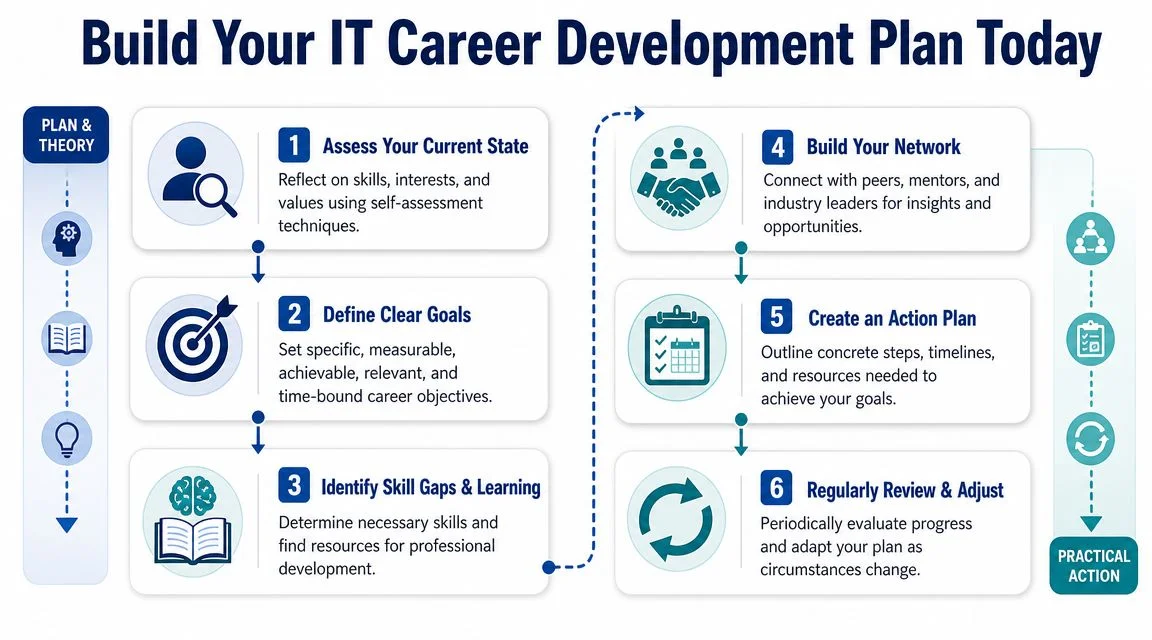
Start with a Target Role, Not a Random Course
Write down one role you want in the future. Just one. Cloud administrator, cybersecurity analyst, service delivery manager, solutions architect, technical project manager, whatever fits your direction.
Then answer these three questions in writing:
- What does this role require that I already have?
- What does it require that I'm missing?
- What proof would make another person believe I'm ready?
That last question sharpens everything. Hiring managers and internal leaders don't evaluate hopes. They evaluate evidence.
Build a Six-Part Plan You Can Actually Follow
Use this checklist and keep it simple:
- Assess your baseline by listing current skills, tools, certifications, and practical experience.
- Define a near-term goal such as qualifying for an interview, taking ownership of a project area, or preparing for a role change.
- Identify two or three gaps so your learning stays focused.
- Choose your proof such as a certification, portfolio project, lab work, documented improvement, or stretch assignment.
- Set a study rhythm that fits your real schedule.
- Review monthly and adjust based on what you've completed and what changed.
Where Certifications Fit In
Certifications matter most when they solve a specific problem. They can help you structure learning, prove commitment, and create an external signal that supports your target move. They are especially useful when you need a roadmap through a broad domain like cloud, security, service management, or project delivery.
For the execution part of your plan, one option is to accelerate your career with certifications using a platform that organizes study by track, supports spaced repetition, and shows progress through a dashboard. That kind of structure is useful when your gap isn't motivation but clarity and consistency.
Still, don't make the common mistake of thinking the credential alone will do the work. Pair every certification with application:
- AWS path paired with labs, deployments, or cloud architecture notes.
- PMP path paired with project ownership, planning documents, or stakeholder coordination.
- CompTIA or security path paired with troubleshooting logs, incident practice, or system hardening tasks.
Keep the Plan Visible
A hidden plan is usually an abandoned plan. Put yours somewhere you'll see weekly. Notes app, spreadsheet, task manager, whiteboard — it doesn't matter.
Use four headings:
| Heading | What to Write Under It |
|---|---|
| Target Role | The role you're moving toward |
| Skill Gaps | The missing capabilities you must build |
| Proof in Progress | Certs, projects, labs, presentations, or responsibilities |
| Next Review Date | The day you'll check and update the plan |
You don't need a perfect five-year map. You need the next credible move, backed by evidence, and reviewed often enough that drift doesn't take over.
If you treat your career like an IT system, this is the maintenance schedule.
Ready to build your career development plan and gain the proof you need? Start building your project management foundation with a PMP practice exam at MindMesh Academy.

Written by
Alvin Varughese
Founder, MindMesh Academy
Alvin Varughese is the founder of MindMesh Academy and an enterprise architecture leader. An electrical engineer by training, he moved from factory automation in South Africa to cloud architecture at GE Appliances and Humana (Fortune 50), and holds 20 professional certifications including AWS Solutions Architect Professional, Azure DevOps Engineer Expert, and Microsoft Agentic AI Business Solutions Architect. He built MindMesh Academy after interviewing too many highly certified candidates who couldn't answer basic questions: the goal is prep that makes you better at the job, not just able to pass the exam.