
Azure Certification Training: Your 2026 Success Guide
Azure Certification Training: Building Your Study System
You're likely in one of three situations right now.
Perhaps you work in IT and regularly see Azure mentioned in job descriptions. Or you already use Azure at work, but only in specific areas, and you want a credential to validate broader skills. Maybe you're changing career directions and need to figure out which Azure certification will best serve your goals.
This confusion is normal. Azure is a vast platform. Microsoft offers 20 distinct Azure cloud certifications, and their names don't always make it clear where to begin. Many respond by buying a course, watching videos, and hoping a clear path emerges.
This approach often creates more friction, not less.
Effective Azure certification training isn't just about choosing an exam. It's about creating a study system that fits your background, your target role, and how Azure exams test knowledge. Get that system right, and your certification path becomes much clearer.
Your Starting Point in the Cloud
You sign up for an Azure exam, open the study guide, and hit a familiar wall. You encounter service names you haven't used, exam codes that blend together, and online advice that assumes you already know your destination. The problem isn't usually effort. It's starting without a map.
Azure is a practical platform for investment because it remains one of the major cloud providers employers use across infrastructure, data, security, and application teams. Microsoft outlines this in its Azure training and certifications overview. Certification becomes easier to justify when the platform appears across many real job paths.
Start with the career question
Before you choose an exam, answer the question that underpins every good certification plan:
What kind of work do you want to be trusted with next?
This answer should guide all your subsequent decisions. A support engineer aiming for cloud administration needs a different study plan than a developer building Azure applications. An architect requires broader design judgment than either. Candidates often run into trouble when they pick an exam title first and only later try to connect it to a role.
Think of it like driving directions. If you type the wrong destination into the map, following the route perfectly still takes you to the wrong place.
Use this filter instead:
- New to cloud or Azure: Begin with a fundamentals exam.
- Working with Azure services already: Look at a role-based associate certification.
- Designing solutions or leading implementations: Focus on architect or expert paths.
- Working in a narrow domain such as security, data, or AI: Consider a specialty certification after your core path is clear.
What training should help you do
Good training does more than explain Azure products. It should help you make decisions, test your understanding, and identify weak areas early.
At a minimum, your training plan should help you:
- Choose the right first exam for your current level.
- Map the full sequence so each study block builds toward the next milestone.
- Separate platform learning from exam preparation, because hands-on skill and exam technique are related but not identical.
- Practice tasks in Azure so services feel familiar under pressure.
- Check readiness with evidence, such as practice scores, lab completion, and repeated review of missed topics.
If you want a structured place to compare paths, MindMesh Academy's expert Azure certification training can help you review options without jumping between scattered resources.
Practical rule: Choose the exam that proves the work you want to do next, not the exam name you happen to recognize first.
Build a study system, not just a reading list
This is the shift many candidates miss. Certification works best when you treat it like a small consulting project. You define the target role, assess your current skills, gather evidence on weak spots, and adjust each week based on results.
That process helps you avoid a common failure pattern. People watch hours of video, feel busy, and only discover gaps when practice questions expose them. A better approach is to study, test, review, and repeat. The goal is not to collect facts. The goal is to make exam questions feel familiar because you have already worked through the kind of decisions they are asking you to make.
Once your target role is clear, the Azure path becomes much easier to follow.
Decoding Azure Certification Levels
Microsoft organizes its Azure certifications into a clear progression: Fundamentals, Associate, Expert, and a smaller set of Specialty certifications.
That structure matters because many candidates fail for a predictable reason. They choose an exam by title, not by readiness. Then they study hard with the wrong assumptions. A fundamentals exam expects clean vocabulary and service recognition. An associate exam expects you to configure, troubleshoot, and choose the right option under constraints. An expert exam expects design judgment across multiple services.
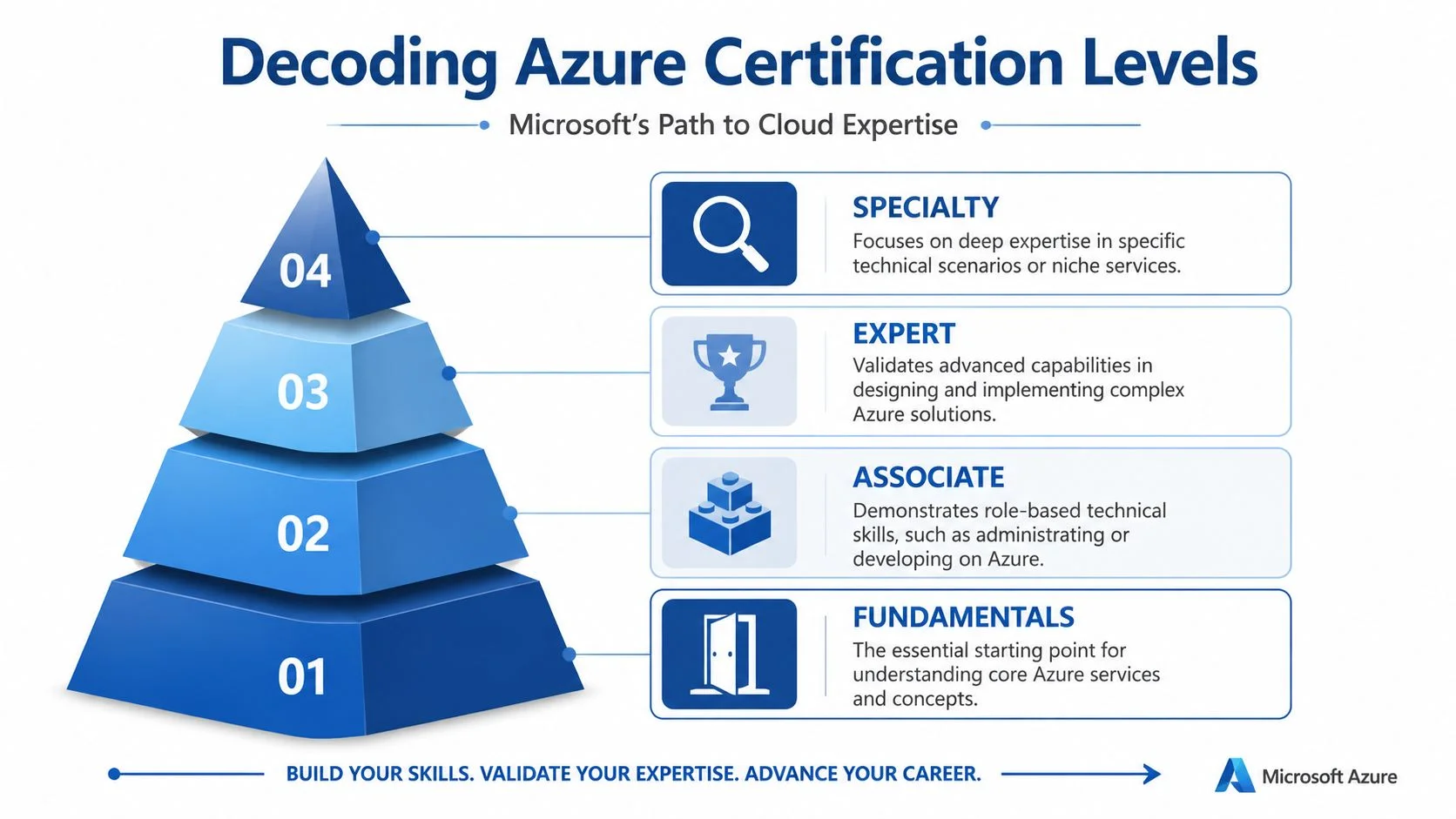
The three main levels you'll see most often
The practical question is simple: what kind of evidence does each level ask you to produce?
| Level | What it proves | Who it fits |
|---|---|---|
| Fundamentals | Broad Azure and cloud understanding | Beginners, career changers, non-specialists |
| Associate | Role-based technical execution | Admins, developers, engineers |
| Expert | Advanced design or cross-domain capability | Architects, senior engineers, lead practitioners |
A certification can support salary discussions and internal mobility, but the bigger benefit is clarity. The level tells you how Microsoft expects you to think on the exam.
Fundamentals builds the vocabulary every higher exam depends on
Fundamentals is the tier many people try to skip. That often creates avoidable friction later. If you don't have a firm grasp of Azure pricing models, identity concepts, core services, governance terms, and shared responsibility, associate-level questions become harder than they need to be.
This level fits candidates who need a clean mental map of the platform. You are learning the names, categories, and purposes of services, much like learning the layout of a city before planning the fastest route through it. You aren't proving deep implementation yet. You are proving that the platform makes sense to you.
If identity terms still blur together, a focused resource like this Guide for Azure identity automation can also make Azure AD and PowerShell concepts easier to place in context.
Associate is where certification becomes role-based
Associate exams are the working tier. Microsoft tests whether you can perform tasks that match a real job function, such as administering resources, deploying applications, securing identities, or managing data services.
This changes how you should study. Reading alone is rarely enough here because the exam assumes you can recognize patterns from hands-on work. If a question asks about storage replication, RBAC scope, virtual networking, or monitoring, you need more than a definition. You need enough familiarity to compare options and spot what would work in production.
This is also the level where candidates often misread difficulty. The problem isn't obscure trivia. The problem is incomplete practice.
Expert measures design judgment
Expert certifications fit professionals who make architecture decisions, connect multiple Azure domains, and weigh trade-offs. At this level, the exam often reflects the kind of judgment senior engineers use every day: cost versus resilience, speed versus control, simplicity versus customization.
That's why expert prep feels different from earlier levels. Memorizing features helps, but it doesn't carry the exam. You need to understand why one design is stronger for a given set of constraints, and where a technically valid option still creates operational problems later.
Specialty is narrower by design
Specialty certifications cover focused technical areas. They work best as targeted proof after you already have a solid base in Azure.
Starting with a specialty exam is a bit like learning one tool in a workshop before you understand the rest of the bench. You may pass, but your progress becomes harder to extend. For most candidates, Specialty makes more sense after Fundamentals or Associate, depending on prior experience.
If you want a structured place to start at the fundamentals tier, MindMesh Academy Azure certification prep offers a practical study guide that begins with core concepts before shifting into exam preparation.
Mapping Your Role-Based Learning Path
A common mistake is picking the certification that looks popular or impressive without checking whether it matches the work you do.
Azure certifications are role-based for a reason. Microsoft tests whether you can make sound decisions in a specific job context. If your exam choice doesn't align with your daily responsibilities, your study plan turns into a tour of unfamiliar services instead of practice for work you already understand.
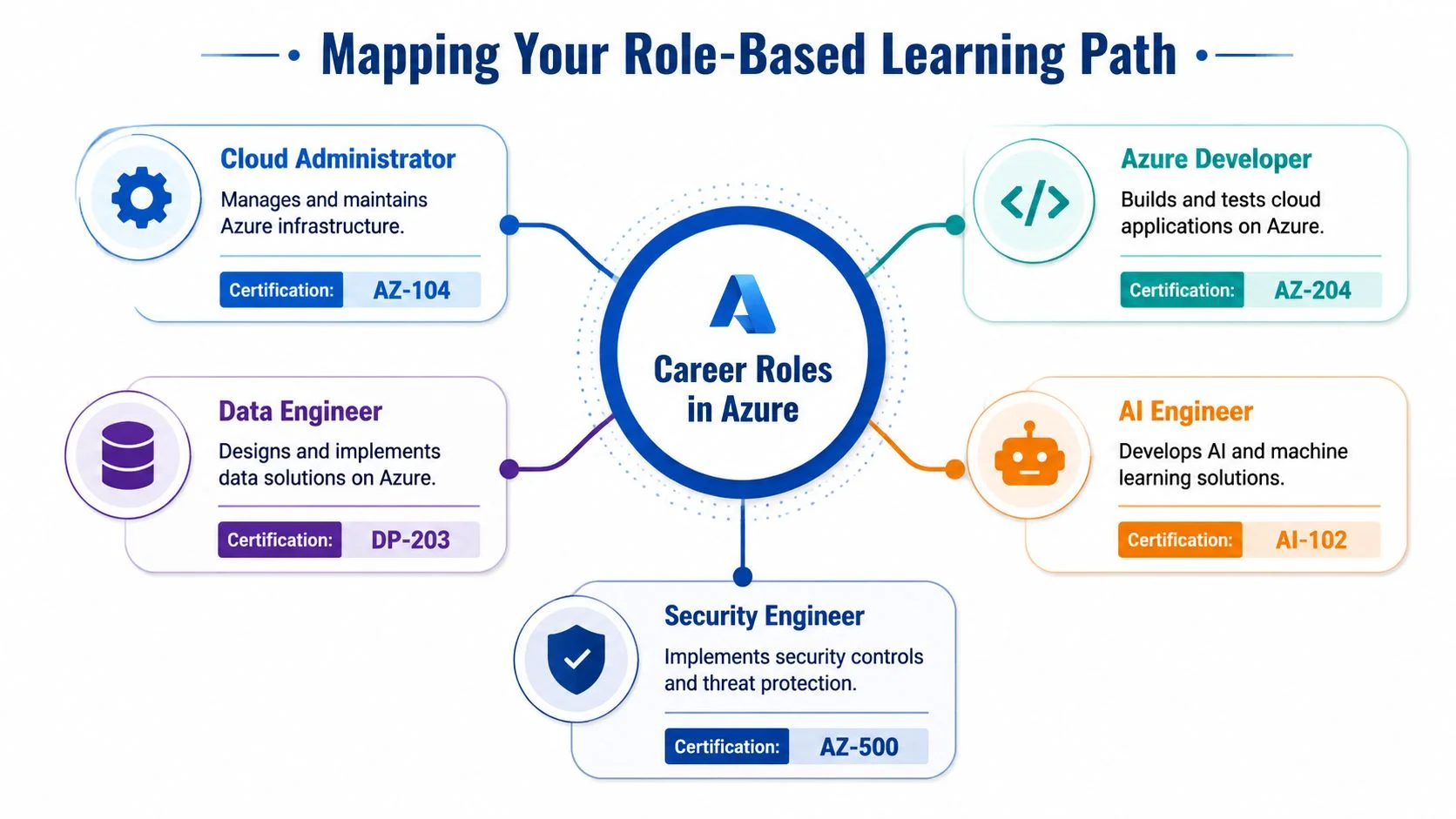
A better approach is to map your path from evidence. Start with three questions:
- What do you do every week in Azure?
- What decisions are you expected to make on your own?
- Which certification matches those tasks closely enough that studying also improves your job performance?
That filter prevents a lot of wasted effort.
Cloud administrator path
Choose the administrator path if your work revolves around subscriptions, identities, virtual machines, storage, networking, governance, or operational monitoring. This is usually the clearest fit for people responsible for keeping Azure environments running correctly.
AZ-104 is the exam many people in this role target first. It focuses on implementing, managing, and monitoring Azure resources. Microsoft Learn outlines the skills measured for AZ-104 in its exam page for Azure Administrator, which makes it a better planning reference than broad certification roundups.
This path works well for:
- Systems administrators shifting from on-premises operations into Azure
- Support engineers who now own cloud resources and access
- Platform engineers who need stronger day-to-day administration skills
Identity often becomes the sticking point here. Many candidates are comfortable with compute and storage, then lose time on RBAC, users, groups, and automation because those topics cut across almost every admin scenario. If you need a practical companion resource for that part of the journey, this Guide for Azure identity automation from Server Scheduler is useful because it connects identity tasks to repeatable operational workflows.
Azure developer path
Choose the developer path if you spend more time in application code than in infrastructure operations.
This route fits engineers building APIs, background services, event-driven workflows, authentication flows, and deployment pipelines on Azure. The exam focus reflects that job. You need to understand how applications use Azure services, how they authenticate, how they store and move data, and how they are monitored after release.
A simple test helps if you are undecided. Review the last two weeks of your work. If your tickets mostly involved code changes, integrations, SDKs, or application deployment, the developer path is usually the better match. If your tickets mostly involved provisioning, policy, access, backups, or network configuration, the administrator path is usually closer.
Solutions architect path
The architect path fits professionals who design across multiple domains at once. That often includes identity, networking, governance, resilience, cost, and security.
This path is broader and more judgment-heavy than admin or developer exams. It works best after you have implemented Azure services directly and seen how design choices affect operations later. Without that hands-on base, architecture questions can feel like choosing between several acceptable answers with very little to anchor your reasoning.
A good rule is simple. If you are usually asked, "How should we build this in Azure?" the architect path may fit. If you are usually asked, "Can you configure or troubleshoot this service?" another role-based path is probably a better first step.
Security engineer path
Pick the security path if your responsibilities center on protecting identities, enforcing policy, reducing attack surface, investigating risk, or hardening cloud configurations.
This isn't just an admin path with extra security vocabulary. The mindset is different. Security exams expect you to spot exposure early, apply controls consistently, and understand how identity, governance, and monitoring work together. Candidates who already handle Conditional Access, Defender, compliance settings, or privileged access reviews usually have a much cleaner ramp here than candidates studying security only as a side interest.
Data professional path
The data path fits engineers and analysts working with ingestion, transformation, warehousing, analytics, or machine learning workflows on Azure.
Here, role match matters even more than title. A software engineer who occasionally queries a database usually shouldn't start with a data certification. A data engineer building pipelines every week probably should. The exam should mirror the systems you touch regularly, not the domain you hope to explore someday.
Your certification path should mirror your responsibilities. When it does, your study plan becomes narrower, more practical, and easier to sustain.
A simple role-to-path decision filter
Use this table if you are comparing two possible directions:
| If your work mostly involves | Likely best path |
|---|---|
| Managing infrastructure, access, and service health | Administrator |
| Building applications, APIs, and integrations | Developer |
| Designing end-to-end Azure solutions | Solutions Architect |
| Protecting identities, enforcing controls, and reducing risk | Security Engineer |
| Building pipelines, models, and data platforms | Data Professional |
The goal isn't to pick the most advanced-sounding certification. The goal is to choose the exam where your current job gives you a running start. That's how you build a study plan with evidence behind it, avoid common mismatch traps, and turn certification prep into skill growth you can use immediately.
Mastering the Azure Exam Experience
You finish a practice test with time left, change three answers during review, and miss all three. That pattern is common in Azure certification prep. The problem usually isn't a total lack of knowledge. It's a mismatch between how you studied and how Microsoft asks you to apply that knowledge under time pressure.
Treat the exam like a production system you need to understand before launch. You don't prepare only by memorizing service names. You prepare by learning the format, the timing, and the decision style behind the questions.
Use AZ-900 as the clearest example
Azure Fundamentals gives you the easiest place to learn Microsoft's exam style because the scope is broad and the question format is straightforward. For AZ-900, candidates can expect a short exam window and a multiple-choice heavy experience. Microsoft also states that fundamentals exams do not expire, which is why AZ-900 is often a practical first certification to earn and keep, as shown on the Microsoft credentials support page for certification expiration.
That matters for two reasons. First, the exam teaches you how Microsoft frames questions. Second, it lets you build a repeatable exam process before you move to role-based certifications with more scenario-driven thinking.
What questions are really testing
Many candidates prepare for Azure exams as if they were vocabulary quizzes. Microsoft exams are closer to judgment tests.
At the fundamentals level, questions often ask you to separate related concepts, choose the Azure service that fits a stated requirement, or identify the right explanation for pricing, governance, security, or support. At the associate and expert levels, the challenge shifts. You need to read a scenario, spot the constraint, and choose the option that fits that constraint best.
A useful rule is this: every exam question has a decision point. Sometimes it's cost. Sometimes it's management overhead, identity, scalability, or compliance. If you train yourself to find that decision point first, the distractors become easier to eliminate.
How to pace yourself
Strong candidates usually follow a simple rhythm instead of trying to solve every question perfectly on the first read.
Use this approach:
- First pass: Answer the questions you know without hesitation.
- Second pass: Return to the items that need closer reading or elimination.
- Final check: Review flagged questions only.
Avoid over-reviewing, as it can lead to second-guessing correct answers.
Read carefully for qualifiers such as best, most cost-effective, least administrative effort, or meets the requirement. Those small phrases often determine the right answer. In mentoring sessions, this is one of the biggest score improvers because candidates stop treating all technically correct options as equally correct.
Reduce friction before exam day
Exam performance drops when small problems pile up. A noisy room, an unfamiliar testing interface, weak time awareness, or unclear weak spots can each cost you a few questions. Together, they can cost you the pass.
Build a short pre-exam checklist:
- Know the format: Expect objective questions at the fundamentals level and more applied reasoning as exams become more advanced.
- Know your timing: Practice in timed sessions so your pace feels familiar.
- Know your weak areas: Label them clearly by exam objective, not by a vague sense of discomfort.
- Know your test setup: Confirm your identification, environment, internet connection, and check-in steps ahead of time.
A process mindset helps. Candidates who pass consistently don't rely on confidence alone. They reduce avoidable mistakes, practice under realistic conditions, and walk into the exam knowing exactly how they will handle the experience.
Evidence-Based Study Strategies That Work
You finish a video lesson on virtual networks and feel confident. The next day, you try a practice question that asks which design meets a specific requirement with the least administrative effort, and the confidence disappears. That gap between recognition and recall is where Azure candidates lose points.
Passive study methods such as watching videos, rereading notes, and highlighting slides feel productive because they are easy to complete. Azure exams reward a different skill. You need to recognize a requirement, connect it to the right service or configuration, and rule out answers that are technically possible but not the best fit.
Microsoft's own training materials are useful for learning the platform, but they are not enough by themselves for exam prep. In this Microsoft Learn Q&A thread, Microsoft Learn discussion guidance states that the training is “not intended to be a stand-alone study resource used for passing the exam.” A stronger approach is to treat the official Skills Measured outline as your control document, then pair it with labs, retrieval practice, and targeted question review.
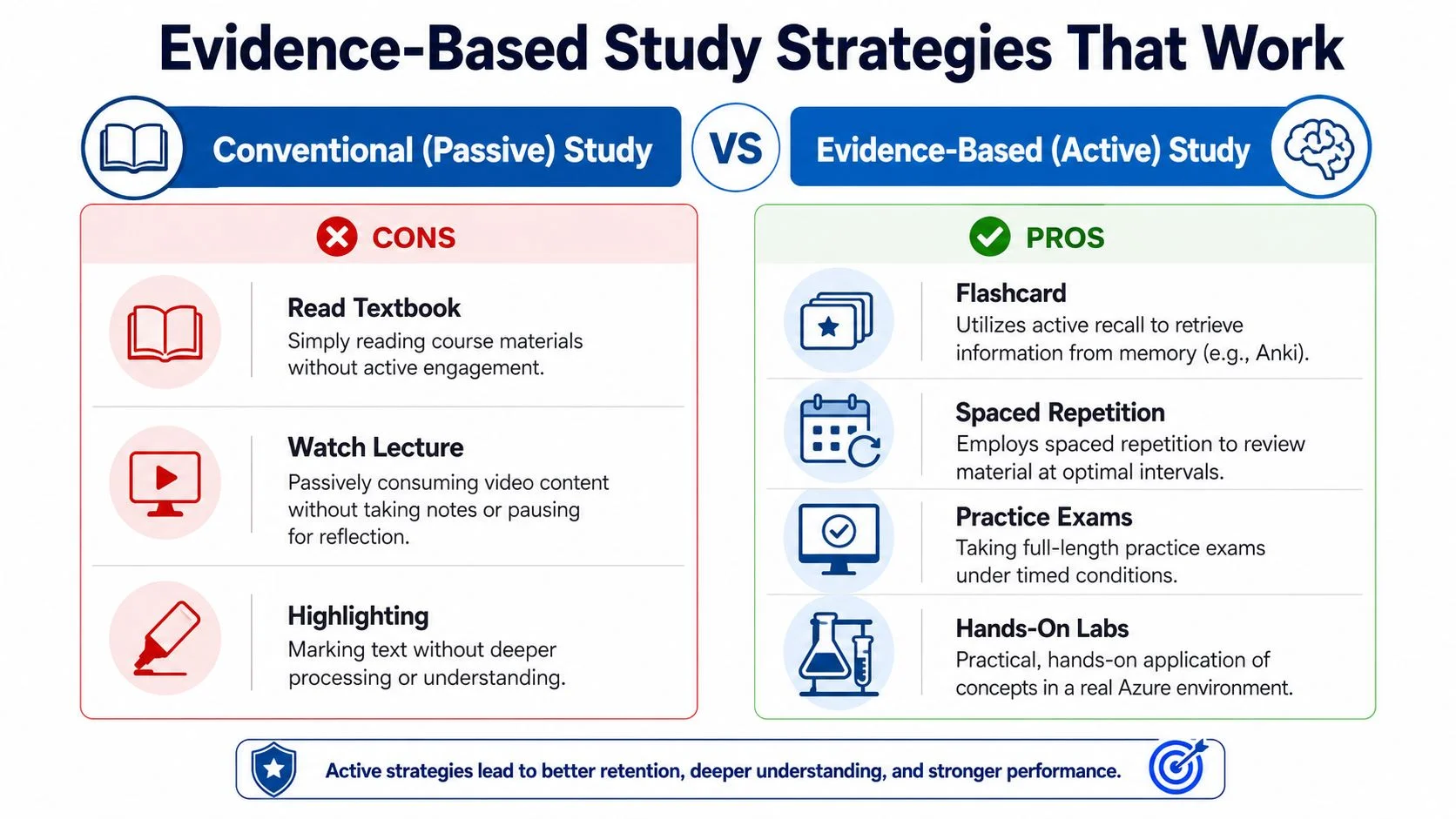
Start with the Skills Measured document
The exam outline works like a project scope document. If a topic is on the outline, it deserves study time. If it isn't, it may still help your general Azure knowledge, but it shouldn't displace exam objectives.
Create a tracker with three labels:
| Status | Meaning |
|---|---|
| Red | I don't understand this area yet |
| Yellow | I understand it, but I can't explain or apply it reliably |
| Green | I can explain it, answer questions on it, and use it in Azure |
This sounds simple because it is. It also works.
Candidates often study by mood. They review what feels familiar, avoid what feels messy, and end the week with a false sense of progress. A red-yellow-green tracker fixes that by showing where your weak spots are in plain view.
Use retrieval practice to test memory, not familiarity
Reading a page twice is like walking the same route as a passenger. You recognize the streets, but you aren't proving that you can drive. Azure exam prep improves when you force your brain to retrieve information without prompts.
A few reliable methods:
- Close the tab and teach the topic out loud. If you studied RBAC, explain the difference between roles, scope, and assignments from memory.
- Write short scenario prompts. Example: “A company needs centralized secrets storage for applications. Which Azure service fits, and why?”
- Use flashcards for distinctions. They work well for service limits, feature boundaries, and terminology that candidates tend to mix up.
- Quiz by objective early. Don't wait until the final week to discover that networking or identity is still weak.
If you are preparing for AZ-104, these comprehensive AZ-104 study resources are an example of material organized around exam objectives, progress tracking, and repeated review instead of passive content consumption.
Build labs into the same week you learn the topic
Azure concepts become durable when you touch them.
If you study storage accounts on Tuesday, create one the same week. If you review NSGs, apply rules and test the result. If you learn about monitoring, open Azure Monitor and inspect what signals are available. The goal isn't to build a huge project. The goal is to connect terms on the page to actions in the portal, CLI, or ARM templates.
Certification questions often test applied judgment. You are choosing between options that all sound plausible. Hands-on practice gives you the mental model to see why one answer fits the requirement better.
Use practice questions as diagnostics
Practice tests are most useful when they expose weakness early.
Treat each question as a signal, not a score report. When you miss a question, label the reason. Did you misunderstand the service? Miss a keyword such as least effort or most secure? Confuse two similar options? Run out of time because the scenario was dense? That diagnosis tells you what to fix next.
A good review loop looks like this:
- Answer a small set by domain
- Review every incorrect answer
- Trace the mistake to the matching exam objective
- Return to documentation or a lab
- Retry a similar question later from memory
That loop creates evidence. You are no longer guessing whether you are improving. You can see that a yellow area is turning green because your errors are shrinking in one domain at a time.
Protect your study consistency
The best method fails if you only use it twice a week.
Set a weekly rhythm before motivation fades. Decide which days are for learning, which are for labs, and which are for question review. If follow-through is your weak point, use this guide to beat procrastination with a study plan. Azure certification prep gets easier when each session already has a job.
The pattern I have seen across successful candidates is simple. They study against the exam outline, retrieve from memory often, practice inside Azure, and review mistakes with discipline. That process is repeatable, which is exactly what you want when the goal is not just to learn Azure, but to pass on purpose.
Your 12-Week Azure Certification Prep Plan
Monday night, you open your laptop after work and ask the same question many Azure candidates ask around week two: what should I study tonight?
That question sounds small, but it causes a lot of lost time. A good 12-week plan answers it before the week starts. You aren't trying to study harder than everyone else. You are building a repeatable system that turns the exam outline into steady proof of progress.
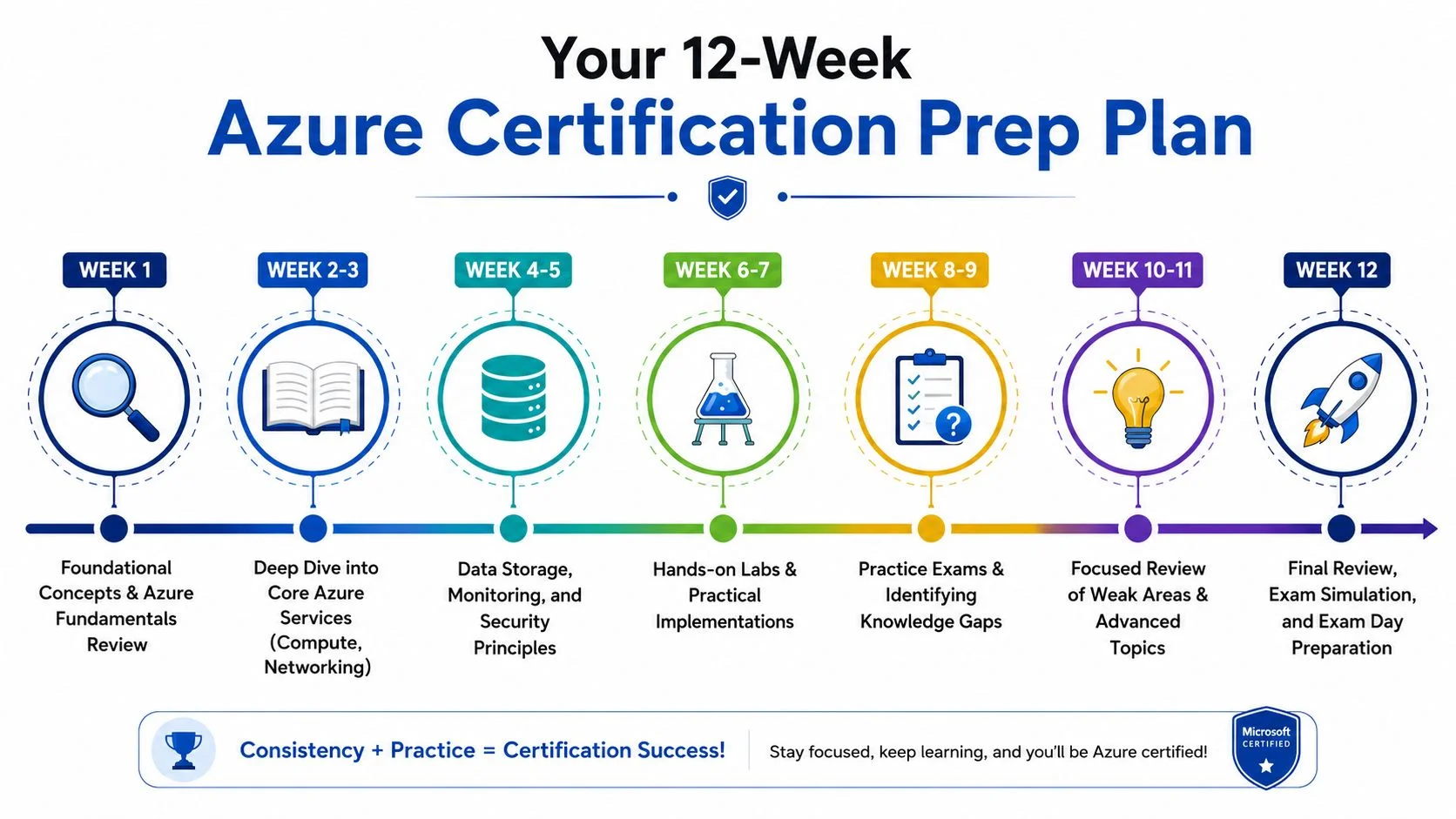
Treat these 12 weeks like a cloud migration plan. First you define scope. Then you build core capability. After that, you test for weak points before go-live. The exam is your production cutover date.
Weeks 1 to 2 build your map
Start with one exam and commit to it. Splitting attention across AZ-900 and AZ-104 usually creates shallow progress in both, especially if you are also balancing a job or family schedule.
During these first two weeks, do four things:
- Read the Skills Measured outline from top to bottom
- Mark each domain as strong, medium, or weak
- Choose one main course, one documentation source, and one practice question source
- Set fixed study blocks on your calendar
Keep the resource stack small. Candidates often fail this phase by collecting five courses, three sets of notes, and a folder full of random videos. That feels productive, but it creates the same problem as deploying too many tools in Azure without a design. More moving parts, more confusion.
If consistency is the issue, borrow a structure you can follow. This guide can help you beat procrastination with a study plan. A schedule you can repeat beats an ambitious one you abandon after six days.
Weeks 3 to 5 build the core
Now you move domain by domain.
Stay with one area long enough to explain it from memory, complete a few related tasks, and answer basic scenario questions without guessing. For many candidates, this is the stage where Azure starts to feel less like a list of services and more like a working system.
A simple weekly rhythm works well:
| Day type | Focus |
|---|---|
| Learning day | Read or watch the main lesson for one exam domain |
| Recall day | Close the material and write what you remember |
| Lab day | Perform the related task inside Azure |
| Review day | Check errors, fill gaps, and retry weak topics |
For AZ-104 candidates, this usually means rotating through identity, storage, compute, networking, and governance in chunks large enough to stick. If that is your target, these comprehensive AZ-104 study resources can help you study against the actual administrator domains instead of wandering across Azure topics that never appear on the exam.
Weeks 6 to 8 turn knowledge into operating skill
This phase is where many candidates discover whether they understand the platform.
Reading about role assignments is different from setting one up. Recognizing the name of a storage feature is different from configuring it and seeing where the options live. Azure exams often test that practical familiarity indirectly through scenario wording, answer choices, and service comparisons.
Your work here should include:
- Deploying and configuring common services
- Practicing identity and access tasks
- Creating, modifying, and reviewing resource settings
- Repeating common workflows until the portal feels familiar
Don't chase novelty here. Repetition matters. An engineer who has created a virtual network three times will often hesitate under exam pressure. An engineer who has created, edited, peered, and troubleshot one several times usually reads those questions with far less friction.
Here's a useful short explainer to keep the rhythm concrete:
Weeks 9 to 10 focus on failure patterns
By this point, equal study time across all domains stops making sense. Your plan should become narrower and more evidence-based.
Use practice questions by domain, then sort every miss into a small set of causes:
- Concept gap You don't understand the underlying Azure idea well enough.
- Service mix-up You confused similar tools, features, or SKUs.
- Reading error You knew the topic, but missed a condition in the scenario.
- Lab weakness You understood the definition, but not the operational detail.
That last category matters more than many people expect. Azure exams often punish partial familiarity. If you only know what a service does in theory, the answer choices can all look plausible.
Weeks 11 to 12 rehearse the real exam
The final stretch is for consolidation, not content sprawl.
Your goal is to walk into exam day with a short, honest list of remaining weak spots and a plan for each one. That is a much better signal than feeling vaguely confident because you watched a lot of videos.
Use these checkpoints:
- Can you explain each exam domain in plain language?
- Can you answer timed practice questions without relying on pattern recognition alone?
- Can you perform the common tasks your role-based exam expects?
- Can you ignore shortcuts like dumps and stick to real preparation?
Book the exam when your errors are becoming narrower, not when your notes are becoming longer.
The best candidates I have coached do one thing consistently in the final week. They reduce noise. No new course. No random study sprint. No panic resource shopping. They review their evidence, tighten weak areas, and protect sleep.
The best final-week feeling is clarity. You know what you know, you know what still needs work, and your plan already tells you what to do next.
Choosing Your Path Forward
Two candidates can study for the same Azure exam, put in similar hours, and get very different results. The difference is usually not intelligence or effort. It is whether they treated certification like a project with evidence, checkpoints, and feedback.
That is the path worth choosing.
Set one role-based target. Study the published skills measured for that exam. Test yourself in ways that force recall instead of passive recognition. Spend enough time in the portal, CLI, or labs that exam questions feel like familiar work rather than trivia. That process is repeatable, and it scales whether you are starting with AZ-900 or working toward an expert-level certification.
The career value goes beyond the badge itself. A certification gives you a clearer way to explain what you can do, which services you understand, and how your Azure knowledge maps to real job responsibilities. After you pass, make sure that progress shows up in your resume and interview examples. If you want help translating certification work into stronger job search materials, this guide on how to land jobs with a skills-first resume is a useful companion.
Treat your certification as proof of capability, not just a test result. That mindset changes how you study and how employers read your experience.
Success often comes from a clearer process.
If you want structured support while you study, MindMesh Academy offers certification prep resources built around concept mastery, active recall, and progress tracking across Azure paths. Put your skills to the test with our AZ-900 practice exam to see where you stand.

Written by
Alvin Varughese
Founder, MindMesh Academy
Alvin Varughese is the founder of MindMesh Academy and an enterprise architecture leader. An electrical engineer by training, he moved from factory automation in South Africa to cloud architecture at GE Appliances and Humana (Fortune 50), and holds 20 professional certifications including AWS Solutions Architect Professional, Azure DevOps Engineer Expert, and Microsoft Agentic AI Business Solutions Architect. He built MindMesh Academy after interviewing too many highly certified candidates who couldn't answer basic questions: the goal is prep that makes you better at the job, not just able to pass the exam.