AWS vs Azure vs GCP: How the Three Clouds Compare
AWS vs. Azure vs. GCP: Choosing Your Cloud Platform
Navigating the cloud landscape for IT professionals means understanding the nuanced differences between the major players. When considering AWS, Azure, or GCP, the "best" choice is never universal; it's a strategic decision deeply tied to an organization's specific technical needs, existing infrastructure, and long-term strategic goals. For those pursuing cloud certifications like the AWS Solutions Architect Associate, Azure Administrator Associate (AZ-104), or Google Cloud Professional Cloud Architect, grasping these distinctions is fundamental to both passing exams and excelling in real-world scenarios.
Amazon Web Services (AWS) leads with the most extensive and mature service portfolio. Microsoft Azure excels in enterprise integration and hybrid cloud solutions, particularly for organizations rooted in the Microsoft ecosystem. Google Cloud Platform (GCP), meanwhile, stands out for its prowess in data analytics, artificial intelligence (AI), and its industry-leading Kubernetes offerings. This article will provide IT professionals with a comprehensive, education-focused comparison to inform strategic decisions and support certification preparation.
Choosing Your Cloud Platform: AWS, Azure, or GCP
 Figure 1: Visualizing the interconnected yet distinct ecosystems of AWS, Azure, and GCP.
Selecting a cloud provider is one of the most critical infrastructure decisions in modern IT. It extends far beyond merely leasing servers and storage; you're committing to a technological partner that will influence your development velocity, data security posture, and scalability capabilities. The ongoing debate around AWS vs. Azure vs. GCP isn't about declaring an absolute winner, but rather identifying the platform that best aligns with your organizational context and professional growth trajectory.
Heading into 2025, the cloud infrastructure market continues its dynamic growth. Amazon Web Services (AWS) maintains its leadership with approximately 30% market share. Microsoft Azure holds a strong second position with an impressive 20-23%, demonstrating consistent momentum. Google Cloud Platform (GCP) follows with roughly 12-13%, but its rapid advancements, particularly in areas like AI and data, position it as a significant challenger. For a deeper dive into cloud platform growth and market share analysis, resources like pilotcore.io offer valuable insights.
These market shares also reflect the core identity and strategic focus of each provider:
- AWS: As the pioneering market leader, AWS offers an unparalleled depth and breadth of mature services. Its vast ecosystem makes it a robust choice for a wide spectrum of users, from agile startups requiring rapid scalability to large enterprises demanding proven, feature-rich environments.
- Azure: Microsoft leverages its extensive enterprise software legacy. With deep integration into products like Office 365, Windows Server, and Active Directory, Azure often represents the most logical and least disruptive path to cloud adoption for companies already embedded in the Microsoft ecosystem.
- GCP: Google's heritage in global-scale data and innovation shines through. It delivers best-in-class tools for data analytics (e.g., BigQuery), machine learning, and container orchestration with the industry-standard Google Kubernetes Engine (GKE).
From a strategic perspective, professionals often consider AWS for its comprehensive toolkit, Azure for its seamless enterprise and hybrid integration, and GCP for cutting-edge data-heavy and cloud-native application development. Aligning your platform choice with your career focus can also be a significant advantage.
To provide a clearer picture, the following table summarizes the primary strengths and ideal use cases for each major cloud provider. This foundational understanding is crucial for any IT professional, especially when preparing for certification exams that test your ability to recommend appropriate cloud solutions.
| Cloud Provider | Primary Strength | Ideal For |
|---|---|---|
| AWS | Comprehensive Services & Market Leadership | Businesses needing the widest array of mature tools, a massive support community, and extensive compliance certifications. |
| Azure | Enterprise Integration & Hybrid Cloud | Organizations deeply integrated with Microsoft products or requiring robust hybrid solutions for gradual cloud migration. |
| GCP | Data Analytics, AI & Kubernetes | Companies focused on data science, machine learning, and modern, containerized, cloud-native application development. |
Grasping these fundamental differentiators is an excellent starting point. From here, we'll delve into a more detailed, practical comparison to help you make a confident and informed decision, both for your projects and your certification journey.
Understanding The Big Three Cloud Providers
*Figure 2: A video overview providing a high-level comparison of AWS, Azure, and GCP.*To make a truly informed decision in the AWS vs. Azure vs. GCP debate, IT professionals must understand the unique identity and historical context behind each platform. Their divergent origins profoundly impact their strengths, weaknesses, and the types of problems they are best equipped to solve. This foundational knowledge is essential for mapping a provider's capabilities to specific technical requirements and business objectives, a common challenge on certification exams.
Each platform possesses a distinct character, attracting different user bases and shaping various career paths. For IT professionals, examining job descriptions for roles such as AWS Solutions Architect roles can provide insights into the specific skills in demand for each cloud environment.
Amazon Web Services: The Market Pioneer
Amazon Web Services (AWS) is unequivocally the pioneer of public cloud computing. Its launch of Amazon S3 in 2006 effectively created the market, giving it an unparalleled head start in developing the most mature and extensive service portfolio available today.
With over 200 fully-featured services, AWS is renowned for being the most comprehensive cloud offering. Its foundation is built on exceptional reliability and a vast, feature-rich ecosystem. This makes AWS a robust choice for virtually any organization, from dynamic startups requiring instant scalability to vast enterprises that demand battle-tested infrastructure proven over many years. The sheer number of services ensures that there is almost always an AWS tool to address any conceivable technical requirement.
Key Takeaway for IT Professionals: AWS's paramount advantage lies in its unmatched service breadth and market maturity. For those pursuing certifications, mastering AWS means navigating a vast landscape of services, which, while challenging, opens doors to the widest array of career opportunities.
This maturity is also reflected in AWS's enormous user community and extensive, high-quality documentation, which are invaluable resources for teams learning the platform or troubleshooting complex issues—a critical support system for anyone preparing for or holding AWS certifications.
Microsoft Azure: The Enterprise Powerhouse
Microsoft Azure entered the cloud arena later than AWS but strategically leveraged Microsoft's entrenched dominance in enterprise software. Its greatest strength is its seamless integration with the Microsoft products that millions of businesses rely on daily, including Office 365, Windows Server, and Active Directory.
For organizations deeply invested in the Microsoft ecosystem, migrating to Azure often represents the most logical and friction-free transition. This familiarity significantly reduces the learning curve and streamlines existing operational workflows.
Azure also excels in the hybrid cloud domain. Services like Azure Arc enable enterprises to manage their on-premises servers, multi-cloud deployments, and edge devices from a unified control plane. This focus makes Azure an ideal platform for large enterprises seeking a phased cloud adoption strategy, allowing them to bridge legacy systems with modern cloud services without a drastic, overnight overhaul. For a deeper understanding of these architectural models, exploring what cloud computing architecture truly entails is highly beneficial, especially for those pursuing Azure Solutions Architect certifications.
Google Cloud Platform: The Data and Cloud-Native Specialist
Google Cloud Platform (GCP) evolved from the formidable internal infrastructure Google built to power its own global services, such as its search engine and YouTube. This legacy is clearly evident in its public cloud offerings, which boast exceptional strengths in global networking, big data, and container orchestration.
GCP's most significant contribution to the industry is Kubernetes, the open-source container management system that has become a ubiquitous standard. Its managed service, Google Kubernetes Engine (GKE), is widely recognized as the most advanced and developer-friendly Kubernetes offering available.
Beyond containers, Google's profound expertise in data analytics is showcased through services like BigQuery, a serverless data warehouse capable of processing petabytes of data in mere seconds. This makes GCP an outstanding choice for organizations with demanding data-heavy workloads or those building modern, cloud-native applications from the ground up, aligning well with Google Cloud Professional Data Engineer and Cloud Developer certification paths.
- Reflection Prompt: Consider your current professional role or career aspirations. Which of these foundational identities (pioneer, enterprise powerhouse, data specialist) resonates most with your projects or desired skill set? How might this influence your certification path?
Core Services: A Detailed Feature Comparison
 Figure 3: A conceptual comparison of fundamental cloud services provided by the Big Three.
When IT professionals analyze AWS, Azure, and GCP, the discussion invariably centers on their core services. These essential building blocks—compute, storage, databases, and networking—form the bedrock of virtually every cloud application. While they superficially offer similar functionalities, the critical differences lie in their implementation, performance characteristics, and specific feature sets.
Understanding these details is paramount for designing cloud solutions that are not only functional but also resilient, scalable, and cost-efficient. For certification exams, being able to articulate these distinctions and choose the appropriate service for a given scenario is a key skill. Let's delve into a practical, head-to-head analysis of these foundational pillars.
Core Service Equivalents: AWS vs Azure vs GCP
Before a deep dive, a "translation guide" is invaluable. The three major cloud providers often use proprietary names for functionally similar services. This table maps the most common equivalents, helping IT professionals navigate and transfer their skills across platforms.
| Service Category | AWS (Amazon Web Services) | Azure (Microsoft) | GCP (Google Cloud Platform) |
|---|---|---|---|
| Compute | Amazon EC2 (Elastic Compute Cloud) | Azure Virtual Machines | Google Compute Engine (GCE) |
| Storage | Amazon S3 (Simple Storage Service) | Azure Blob Storage | Google Cloud Storage |
| Databases | Amazon RDS, DynamoDB | Azure SQL, Cosmos DB | Google Cloud SQL, Firestore |
| Networking | Amazon VPC (Virtual Private Cloud) | Azure VNet (Virtual Network) | Google VPC (Virtual Private Cloud) |
- Reflection Prompt: If you're currently certified in one cloud, take a moment to consider how you would translate a core service you use daily into its equivalent on the other two platforms. How similar or different do you perceive their underlying philosophies to be?
Compute Instances: The Virtual Workhorses
Virtual machines (VMs) are the fundamental abstraction of compute power in the cloud, providing the raw horsepower for applications. All three providers offer incredibly robust VM services, each optimized for slightly different use cases.
Amazon’s Elastic Compute Cloud (EC2), being the oldest, offers unmatched maturity. With over 400 distinct instance types, AWS provides an almost overwhelming array of choices, allowing users to select an EC2 instance precisely optimized for any workload, from lightweight web servers to demanding high-performance computing (HPC) clusters. Understanding these instance types is a core component of AWS Solutions Architect certification exams.
Microsoft’s Azure Virtual Machines are highly competitive with EC2, with a strong emphasis on Windows integration. For organizations heavily invested in Windows Server or SQL Server, Azure offers a natural and advantageous fit, including perks like the Azure Hybrid Benefit that allows reuse of on-premises licenses to significantly reduce cloud costs—a crucial consideration for AZ-900 and AZ-104 exam candidates.
Google Cloud’s Compute Engine (GCE) distinguishes itself with its exceptional global network performance and a developer-friendly per-second billing model. This makes it particularly cost-effective for workloads that frequently scale up and down. Many users report GCE's instance provisioning to be remarkably fast, appealing to teams focused on rapid elasticity.
Key Differentiator: While AWS boasts the sheer variety of instance types, GCP often edges out with superior networking speed and more granular billing. Azure's undeniable advantage lies in its deep integration and cost-saving benefits for Windows-centric enterprise environments.
Object Storage: Comparing Durability And Access
Object storage, the unsung hero of cloud infrastructure, is essential for housing everything from vast data lakes and disaster recovery backups to static website assets. All three platforms provide services engineered for immense scale, high durability, and diverse access tiers, though their pricing and feature sets vary.
Amazon’s Simple Storage Service (S3) is the original and remains the industry benchmark. Its comprehensive range of storage classes, from the immediately accessible S3 Standard to the extremely cost-effective S3 Glacier Deep Archive, is unrivaled. Its long-standing presence means S3 enjoys near-universal integration with third-party tools and applications, a significant ecosystem advantage.
Azure Blob Storage closely mirrors S3's functionality, offering its own Hot, Cool, and Archive tiers. Its primary strength lies in its seamless integration with other Microsoft services. For users leveraging tools like Azure Data Factory or relying on Microsoft 365, Blob Storage feels like a natural extension of that familiar ecosystem.
Google Cloud Storage simplifies its storage classes (Standard, Nearline, Coldline, Archive) while emphasizing a standout feature: multi-regional storage. This automatically replicates data across different geographic locations, dramatically simplifying high-availability and disaster recovery strategies, a valuable consideration for GCP Professional Cloud Architect candidates.
Database Services: Relational and NoSQL Showdown
Databases are the core of any significant application, making their selection a critical architectural decision. Fortunately, all three providers offer excellent managed database services that abstract away the complexities of patching, backups, and scaling, allowing developers to concentrate on application logic.
For traditional relational databases:
- AWS Relational Database Service (RDS) is exceptionally versatile, supporting engines like PostgreSQL, MySQL, Oracle, and SQL Server. Its custom Aurora engine, compatible with MySQL and PostgreSQL, offers significantly enhanced performance and scalability, making it a powerful choice for high-demand applications.
- Azure SQL Database is a pure Platform-as-a-Service (PaaS) built on the SQL Server engine. It includes intelligent features for performance tuning and security, positioning it as a powerhouse for any organization already invested in the Microsoft database world.
- Google Cloud SQL provides fully managed instances of MySQL, PostgreSQL, and SQL Server. It is praised for its ease of setup and tight integration with other GCP services, such as Google Kubernetes Engine (GKE) and BigQuery.
The NoSQL arena is equally competitive. AWS DynamoDB is a robust choice for key-value and document workloads, delivering consistent single-digit millisecond latency at virtually any scale. Azure Cosmos DB is a unique multi-model database that supports various APIs (SQL, MongoDB, Cassandra) and offers "push-button" global distribution for unparalleled availability. Google’s Firestore and Bigtable, meanwhile, provide highly scalable options ideal for mobile application backends and massive analytical datasets, respectively.
Networking: Virtual Clouds and Global Reach
The efficacy of any cloud service ultimately relies on a robust and secure network foundation. Each provider offers mechanisms to create isolated network environments within their cloud, but their underlying global network architectures present key differentiators.
AWS Virtual Private Cloud (VPC) was the first of its kind, offering granular control over network environments. This flexibility, however, often comes with a steeper learning curve. AWS also boasts the largest global footprint, with more Availability Zones and Regions than any other provider, essential for global applications and disaster recovery planning.
Azure Virtual Network (VNet) provides similar network isolation capabilities. Its particular strength lies in simplifying hybrid cloud configurations. Tools like ExpressRoute facilitate establishing dedicated, private connections between on-premises data centers and Azure, streamlining enterprise connectivity.
Google Cloud's VPC features a significant architectural advantage: it operates as a global resource by default. Unlike AWS and Azure where a VPC is typically regional, a single Google VPC can span subnets across any region worldwide. This fundamentally simplifies the design for globally distributed applications and represents a substantial competitive advantage for GCP Professional Cloud Architect candidates studying multi-region deployments.
Advanced Capabilities: AI, Machine Learning, and Serverless
 Figure 4: The convergence of advanced AI/ML and serverless technologies within cloud computing.
While core services like compute and storage form the infrastructure's backbone, the true differentiators—the services that provide a business with a competitive edge—are found in the advanced domains of Artificial Intelligence (AI), Machine Learning (ML), and serverless computing. For any IT professional serious about obtaining advanced cloud certifications, mastering these areas is no longer optional; it's essential. This is where we transition from merely managing infrastructure to building intelligent, highly responsive applications that are shaping the future of technology. The platform chosen here directly influences an organization's innovation speed and the sophistication of its product offerings.
AI and Machine Learning Platforms
Every major cloud provider offers a formidable suite of tools for building, training, and deploying ML models, but each approaches this challenge from a slightly different angle. An organization's existing skill sets and the specific business problems to be solved heavily influence which platform will be the most effective fit.
AWS SageMaker is AWS's comprehensive, all-in-one toolkit designed to cover the entire ML lifecycle. It provides deep, granular control that experienced data scientists appreciate. For professionals pursuing an AWS certification, a thorough understanding of key AWS services for generative AI like Bedrock and SageMaker is crucial for grasping its full capabilities.
Azure Machine Learning leverages Microsoft’s strengths: a user-friendly interface and deep integrations across the Azure and broader Microsoft ecosystems. Its visual, drag-and-drop designer makes ML more accessible to developers and data analysts who may not have deep-learning expertise. For instance, a fintech company might use it to rapidly deploy a fraud detection model without requiring specialized AI/ML engineering skills.
Google Cloud's Vertex AI is a direct outcome of Google’s pioneering work in AI. It's a unified platform engineered to streamline MLOps (Machine Learning Operations) and offers direct access to Google's powerful pre-trained models. A key advantage here is the availability of Google's custom Tensor Processing Units (TPUs), which can dramatically accelerate specific deep learning tasks.
The Bottom Line for ML: AWS provides the most exhaustive and flexible toolkit for experienced data scientists. Azure democratizes ML, making it more accessible to a broader developer audience. GCP is ideal for teams looking to leverage Google's cutting-edge AI research and pre-built, optimized models.
It's important to remember that building a model is only one part of the equation. To successfully manage and deploy models in production environments, adopting robust MLOps best practices for engineering leaders is absolutely essential, regardless of the chosen platform.
Serverless Computing Functions
Serverless computing, or Functions-as-a-Service (FaaS), represents a paradigm shift where developers can execute code without provisioning or managing servers. This event-driven approach is perfect for building microservices, processing data streams, or powering IoT backends. While all three providers offer compelling FaaS solutions, their ecosystems and execution models present important distinctions.
AWS Lambda is the original and remains the market leader in serverless. It boasts the most extensive list of event triggers and benefits from an immense, highly active community. Its seamless integration with virtually every other AWS service makes it the natural choice for constructing event-driven architectures on AWS.
Azure Functions stands out with its versatile development model. It supports a wide array of programming languages and includes Durable Functions, a powerful feature that enables the creation of complex, stateful workflows within a serverless framework. This is incredibly useful for orchestrating long-running business processes.
Google Cloud Functions is designed for speed and simplicity. It integrates beautifully with other GCP services, especially data and analytics tools like BigQuery and Pub/Sub. It excels as the "glue" that connects different components of a data pipeline or reacts dynamically to events within the Google ecosystem.
Here’s a quick comparison of their key features:
| Feature | AWS Lambda | Azure Functions | Google Cloud Functions |
|---|---|---|---|
| Ecosystem | Most mature, integrating with over 200 AWS services. | Excellent integration with Microsoft ecosystem and enterprise tools. | Tightly woven into GCP’s data, analytics, and ML services. |
| Execution | Up to 15 minutes max execution time. | Offers consumption and premium plans for longer-running jobs. | Up to 9 minutes for HTTP triggers, 60 minutes for event-driven. |
| Language Support | Extensive support for Node.js, Python, Java, C#, Go, Ruby, PowerShell. | Broad support, including first-class citizens like C#, F#, and PowerShell. | Strong support for modern languages like Go, Python, Node.js. |
In practical deployment, the choice of a serverless platform often aligns with the organization's primary cloud provider. However, for advanced certifications and sophisticated real-world architecture, understanding these subtle differences is crucial for building applications that are efficient, scalable, and cost-effective.
Getting a Handle on Pricing Models and Cost Management
Discussing cloud technology is one aspect, but truly understanding its financial implications is where strategic expertise becomes paramount. When evaluating AWS, Azure, and GCP, IT professionals must delve into their intricate pricing models. This is the only way to proactively avoid unexpected bills and ensure that proposed architectures are not only powerful but also economically sustainable—a critical skill tested in virtually all cloud certification exams, particularly in the cost optimization domains.
All three hyperscale providers fundamentally operate on a pay-as-you-go model, which initially seems straightforward. For core services like virtual machines, billing is often granular, by the second or minute. While ideal for short-lived tasks, relying solely on on-demand pricing for steady, predictable workloads is akin to overlooking significant cost-saving opportunities.
How to Actually Get a Discount
To significantly reduce costs for long-term projects, each provider offers its own flavor of commitment-based discounts. While all promise savings, the mechanisms to achieve them vary considerably.
- AWS Reserved Instances (RIs) & Savings Plans: AWS offers discounts up to 75% with RIs, requiring a commitment to a specific instance type in a particular region for a 1 or 3-year term. Savings Plans are a more flexible, newer alternative, providing discounts on overall compute spend without locking into precise instance types, offering greater flexibility for evolving workloads.
- Azure Reservations: Similar to AWS RIs, Azure Reservations involve committing to a 1 or 3-year term for specific services. A significant advantage is the Azure Hybrid Benefit, which allows organizations to reuse existing on-premises Windows Server or SQL Server licenses in Azure, leading to substantial cost reductions.
- GCP Committed Use Discounts (CUDs): Many professionals find GCP’s approach refreshingly straightforward. By committing to a certain level of spending over 1 or 3 years, discounts are applied automatically across various services, often with less restrictive conditions on instance types than traditional RIs.
Key Insight for Cost Optimization: GCP uniquely offers Sustained Use Discounts. This is an automatic discount applied when a Compute Engine (GCE) VM runs for a significant portion of the month, requiring no upfront commitment or special configuration—a distinct advantage for steady-state workloads.
Watching Out for the Hidden Costs
Your monthly cloud bill encompasses more than just compute and storage. Several "gotcha" costs can accumulate rapidly if not meticulously managed. Data egress fees—the cost incurred when moving data out of the cloud—are a classic example. While ingesting data is almost universally free, extracting it incurs charges that can quickly escalate, especially for applications serving large volumes of content globally.
Beyond egress, small but pervasive costs for services like NAT gateways, load balancers, and dedicated IP addresses, though inexpensive individually, can significantly inflate an invoice when deployed at scale. Effective cost management necessitates a comprehensive view of every billed item, aligning with the principles taught in PMP or ITIL certifications regarding resource optimization.
- Reflection Prompt: Have you ever encountered an unexpected cloud bill? What were the contributing factors, and how could better cost management strategies have prevented it?
The Tools of the Trade for Cost Management
Fortunately, IT professionals are not left to navigate cloud costs blindly. Each provider equips users with robust native tools to track, analyze, and optimize cloud spending.
- AWS Cost Explorer: This is the primary tool for deep dives into your AWS bill. It offers powerful visualization capabilities, allowing you to segment spending by service, tags, or other metrics to pinpoint cost drivers and identify areas for optimization.
- Azure Cost Management + Billing: A notable feature of this tool is its ability to provide a unified view of both Azure and AWS costs, a major benefit for multi-cloud environments. It includes extensive features for setting budgets, creating alerts, and generating intelligent recommendations for cost savings. For those new to Azure, understanding the Azure pricing and TCO calculators is an excellent starting point.
- Google Cloud Billing: Integrated directly into the GCP console, this tool provides clear dashboards and reports on spending. Users can establish firm budgets and configure alerts to prevent unpleasant financial surprises.
Strategic Use Cases: Making the Right Call
Ultimately, the AWS vs. Azure vs. GCP debate is not about identifying a single "winner." It's about strategically aligning a cloud provider's core strengths with your specific business requirements and technical roadmap. The optimal choice is always contingent on your existing technology stack, the nature of your workloads, and your long-term strategic vision. Let's move beyond feature lists and examine clear, scenario-based recommendations.
The following decision tree visually illustrates how the different discount models from AWS, Azure, and GCP can align with various operational patterns and long-term commitments, providing a practical framework for cost-effective cloud strategy.
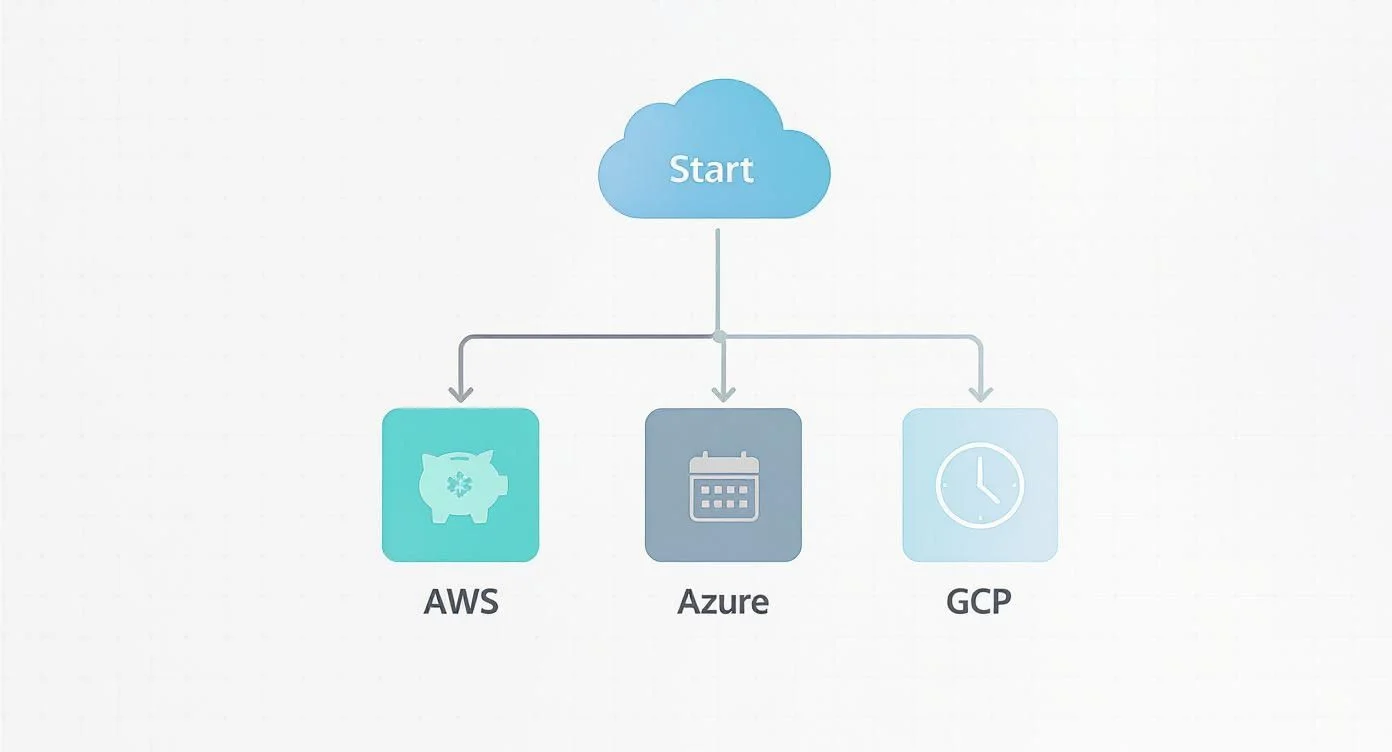 Figure 5: A decision tree to guide the selection of cloud providers based on cost optimization strategies.
As depicted, the most effective way to save money profoundly depends on your operational patterns—whether you prioritize long-term commitment, require maximum flexibility, or manage highly predictable workloads.
Best Fit for Large Enterprises and Hybrid Cloud
Microsoft Azure has significantly solidified its position, claiming nearly 25% of the global cloud market by early 2025, with quarterly revenue growth surging an impressive 33%. A key driver for this success is its sophisticated approach to hybrid cloud and its deep integration with the enterprise software leveraged by 85% of Fortune 500 companies. Additional details on Azure's market share growth can be found on turbo360.com.
If your organization is deeply entrenched in the Microsoft ecosystem—utilizing Windows Server, Office 365, and Active Directory—then Azure offers the most logical and least disruptive path to cloud adoption.
- Scenario for Certification Focus: Imagine a global manufacturing company undergoing digital transformation. They need to modernize legacy on-premises applications but must retain significant data center presence due to stringent industry regulations and data sovereignty laws.
- Recommendation & Certification Connection: Azure is purpose-built for this. With tools like Azure Arc and Azure Stack, the company can manage all resources—both on-premises and in the cloud—from a single, unified dashboard. This creates a genuine hybrid environment that simplifies operations and facilitates a gradual, controlled migration, a scenario frequently explored in Azure Solutions Architect Expert certification exams.
Ideal for Startups and Broad Service Needs
Amazon Web Services remains the unequivocal market leader for compelling reasons. Its service catalog is simply the most comprehensive and mature available. This makes AWS a reliable, robust choice for virtually any entity, from agile startups needing to scale rapidly to large enterprises demanding the utmost reliability from proven, mature technology.
Key Recommendation for IT Professionals: Opt for AWS when your project demands the widest possible selection of mature, feature-rich services, coupled with access to an expansive global support community. Its scale and consistent reliability make it a powerful and secure foundation for almost any technical undertaking, aligning perfectly with foundational AWS Certified Cloud Practitioner and AWS Solutions Architect Associate paths.
Startups, in particular, benefit immensely from the vast ecosystem of AWS documentation, tutorials, and third-party tools. When resources are constrained, this readily available support can be a critical factor in accelerating development and streamlining troubleshooting.
The Choice for Data Analytics and Cloud-Native Innovation
Google Cloud Platform has intelligently carved out its niche by focusing on Google's core strengths: data, analytics, and containerization. If your business is inherently data-driven, GCP often provides a distinct competitive advantage through its specialized services.
- Scenario for Certification Focus: Consider a cutting-edge tech company building an entirely new application from scratch. Their architecture is firmly microservices-based, leveraging containers extensively, and their core features require top-tier machine learning capabilities.
- Recommendation & Certification Connection: In this scenario, GCP emerges as the clear front-runner. Its Google Kubernetes Engine (GKE) is widely considered the gold standard for managed Kubernetes, offering superior management and features. When GKE is paired with data powerhouses like BigQuery and advanced AI services such as Vertex AI, it creates an optimal environment for building intelligent, modern applications that can scale effortlessly. This setup is a prime focus for GCP Professional Cloud Developer and Professional Data Engineer certifications.
Frequently Asked Questions
When IT professionals are making the critical decision between AWS, Azure, and GCP, a few common questions consistently arise. Let's address these directly to help you make a confident and well-informed choice.
This section tackles the most frequent queries I hear from IT professionals just like you, offering concise, expert-level answers.
Which Cloud Is Best for a Small Startup?
For a small startup, the "best" cloud typically hinges on three key factors: a generous free tier, ease of use, and the breadth of community support available.
AWS offers a substantial 12-month free tier, providing an excellent runway for building, testing, and iterating without incurring immediate costs. Furthermore, its enormous community and extensive documentation are invaluable resources for small teams who often need to troubleshoot independently.
On the other hand, Google Cloud Platform (GCP) provides a very compelling "Always Free" tier for certain services that, unlike AWS's timed free tier, never expires. GCP is also known for its developer-centric design and often simpler pricing, making it an attractive option for startups prioritizing rapid development, especially if they are building cloud-native applications from the ground up.
How Do the Security Models Compare?
All three cloud giants adhere to a shared responsibility model for security. This means they are responsible for securing the cloud itself (the underlying infrastructure, physical data centers, and network hardware), while you, the customer, are responsible for securing what you put in the cloud (your data, access controls, applications, and configurations).
Their differences lie primarily in the security tools they provide and the depth of their compliance certifications.
- AWS boasts the most extensive catalog of security services and holds an exceptional number of compliance certifications. This makes it a default choice for highly regulated industries such as finance, healthcare, and government, where rigorous compliance is non-negotiable.
- Azure is a leader in identity and access management, largely due to its deep integration with Active Directory. If your organization is already a Microsoft shop, your security team will find Azure's identity services familiar and powerful, streamlining enterprise-grade access control.
- GCP leverages Google's renowned global private network and advanced threat intelligence. It provides a "secure-by-default" posture that is particularly strong in network security and data encryption at rest and in transit.
The Bottom Line on Security: All three providers offer incredibly robust security. Your choice often depends on your specific regulatory needs and existing ecosystem. AWS for maximum compliance breadth, Azure for seamless enterprise identity management, and GCP for leveraging Google's world-class network security.
How Difficult Is It to Migrate Between Cloud Providers?
Migrating applications and data between AWS, Azure, and GCP can be a significant undertaking, with vendor lock-in often being the primary challenge. Vendor lock-in occurs when applications are tightly integrated with a specific provider's proprietary services, such as AWS Lambda, Azure Cosmos DB, or Google BigQuery. If your application's architecture is deeply reliant on these unique services, switching clouds can necessitate a costly and time-consuming rewrite.
To mitigate this risk, smart organizations adopt strategies like a multi-cloud approach from the outset or prioritize the use of open-source, cloud-agnostic tools like Kubernetes. When applications are containerized using Kubernetes, they become significantly more portable, allowing them to run on any of the major cloud providers with minimal modifications. The best defense against migration difficulty is proactive architectural planning to avoid deep dependencies on any single provider's proprietary "special sauce."
Ready to master the cloud and earn your certification? At MindMesh Academy, we provide expert-curated study materials and evidence-based learning techniques to help you pass your exams and excel in your IT career. Start your learning journey with us today. Find out more at AWS Solutions Architect Associate Practice Exams.
Ready to Get Certified?
Prepare with expert-curated study guides, practice exams, and spaced repetition flashcards at MindMesh Academy:

Written by
Alvin Varughese
Founder, MindMesh Academy
Alvin Varughese is the founder of MindMesh Academy and an enterprise architecture leader. An electrical engineer by training, he moved from factory automation in South Africa to cloud architecture at GE Appliances and Humana (Fortune 50), and holds 20 professional certifications including AWS Solutions Architect Professional, Azure DevOps Engineer Expert, and Microsoft Agentic AI Business Solutions Architect. He built MindMesh Academy after interviewing too many highly certified candidates who couldn't answer basic questions: the goal is prep that makes you better at the job, not just able to pass the exam.