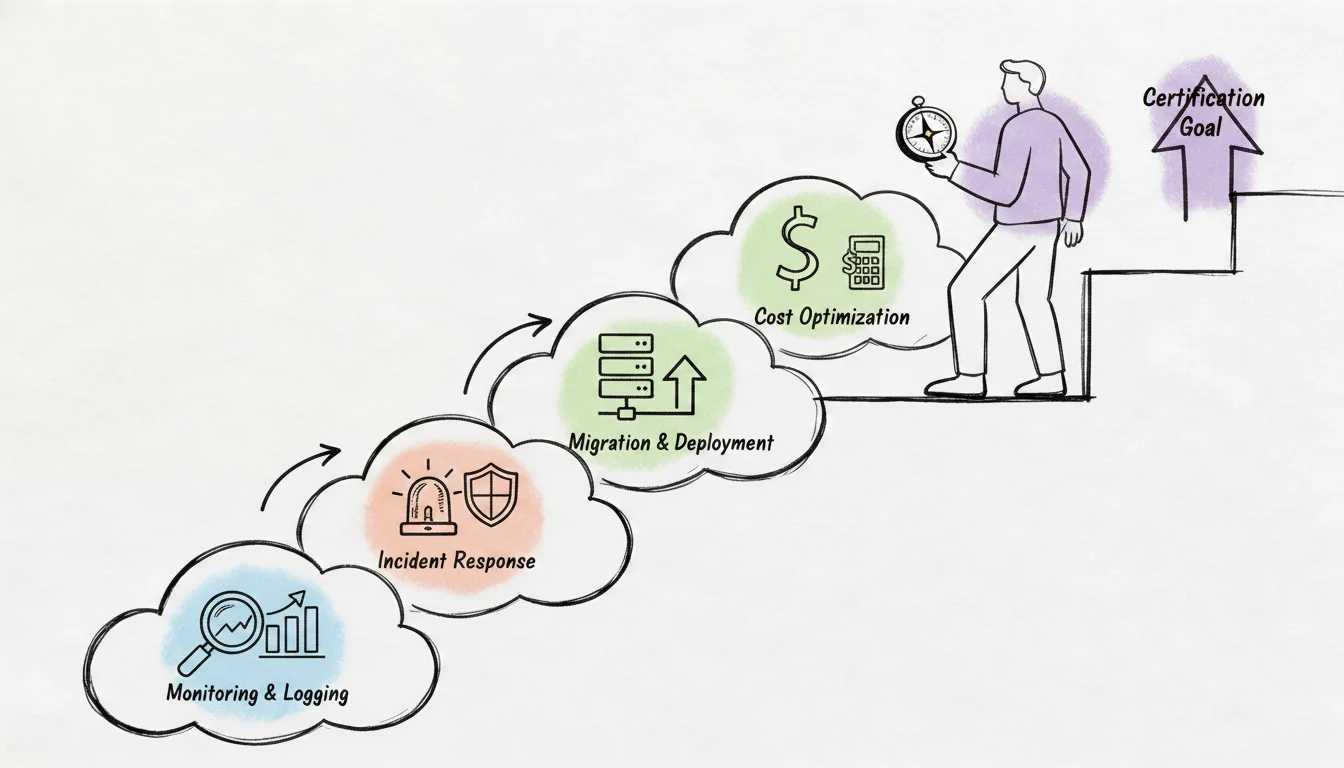
Master AWS Sys Ops: Your 2026 Certification Guide
IT operations changed as cloud platforms like Amazon Web Services became the standard for modern infrastructure. You might find your current role requires more technical AWS expertise, or perhaps you are aiming for a specialized cloud operations position. Mastering AWS SysOps involves much more than traditional server administration; it requires a different mental model for managing resources at scale.
Feeling overwhelmed is common when you first face operational issues under high pressure. You might deal with critical system alerts, unhealthy instances, or undocumented deployments that cause unexpected behavior. Other challenges include rising monthly costs or backup strategies that fail to inspire confidence during a disaster recovery drill. In older on-premises setups, these problems usually required manual troubleshooting and long hours in a physical data center. On AWS, the solution is disciplined cloud operations. This approach integrates active monitoring, intelligent automation, proactive security, recovery planning, and constant cost awareness.
The AWS Certified SysOps Administrator – Associate certification became popular because it taught this specific mindset. Even as industry practices shift toward cloud-native models, the skills of an AWS SysOps professional stay relevant to every modern business. Companies globally need people who can keep AWS environments stable, secure, efficient, and resilient. This guide provides the strategy to master this field, helping you pass the current exam with confidence and handle real-world operational tasks with ease. By focusing on these core principles, you can transform from a traditional administrator into a capable cloud professional ready for any challenge.
What Is AWS SysOps and Why It Matters in 2026
When IT professionals hear the term "SysOps," many default to a narrow definition. They picture a traditional server administrator whose daily tasks have moved to a cloud environment. This perspective fails to capture the scope of the modern role.
AWS SysOps, or cloud operations, involves the advanced practice of managing and maintaining cloud-resident systems. It marks a shift from manual, reactive fixes to a style of work where you design, build, and automate environments to be observable and responsive. The core responsibility is no longer just logging into individual machines to check statuses. Instead, it involves architecting systems that inform you of their health, handle failures without human intervention, and scale to meet traffic demands or business growth.
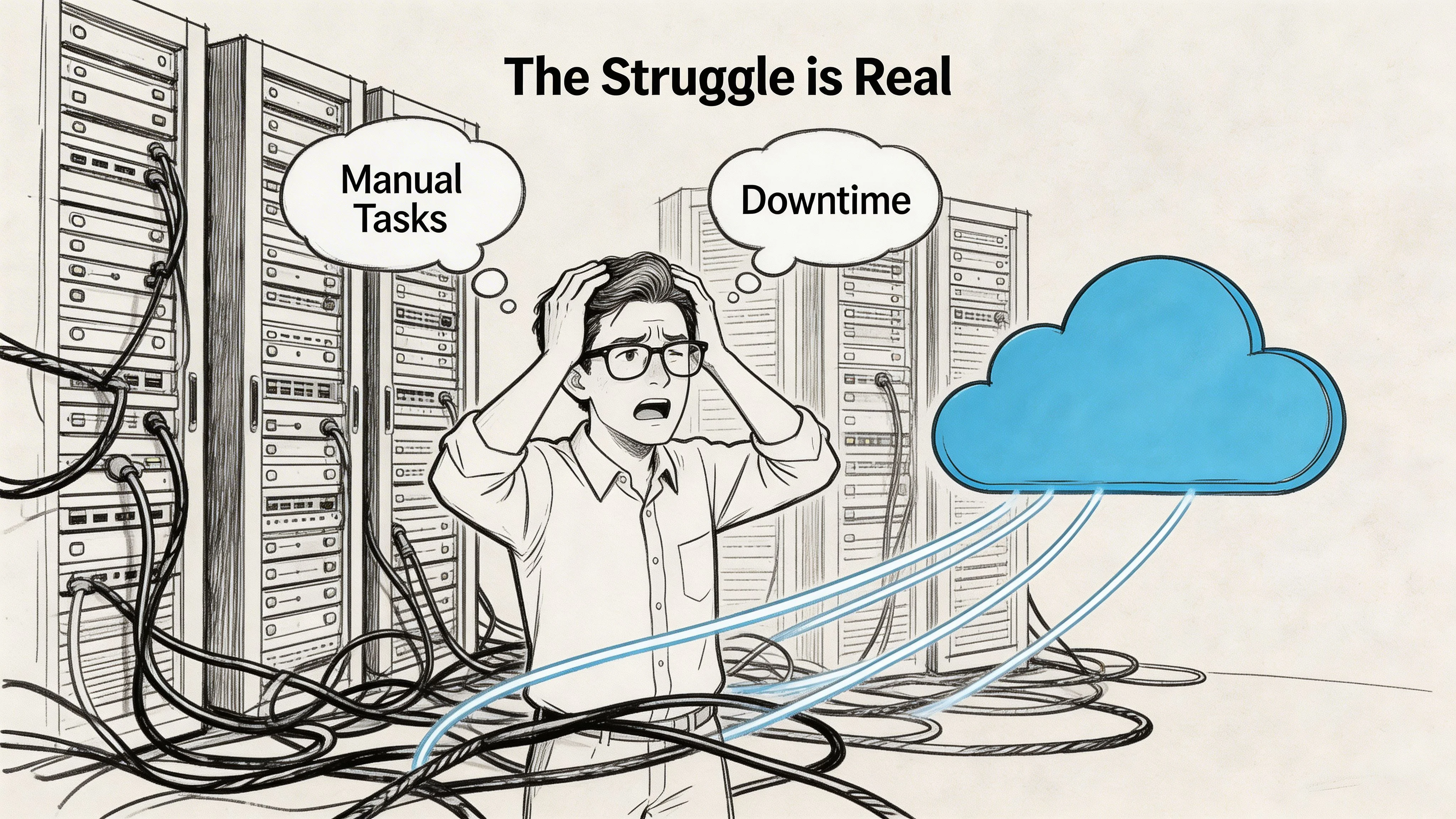 Caption: The image above illustrates the challenges of traditional, manual IT operations, a stark contrast to the proactive, automated approach of modern AWS SysOps.
The Shift from Reactive Admin to Cloud Operator
The evolution of this role is similar to the difference between a building repairman and a systems engineer. A traditional technician reacts to broken parts, such as a failing boiler or a stuck lock. They spend their time responding to immediate crises.
A cloud operations professional focuses on proactive design. While they still solve problems, their primary goal is to build the systems that prevent those problems from occurring. They set up the alarm logic, automate the maintenance cycles, and plan the recovery paths for disasters. In the AWS environment, this means using Amazon CloudWatch to track system health through metrics and logs. It involves using AWS Systems Manager to handle patching across hundreds of instances at once rather than one by one.
They use Amazon EC2 Auto Scaling to manage capacity so that the system grows or shrinks based on actual demand. Security is handled through AWS Identity and Access Management (IAM) to ensure only the right people have the right access. Data protection relies on AWS Backup for centralized policy management, while AWS Config tracks every change made to the environment for compliance. These tools do not just perform tasks; they create a framework for reliable operations at a massive scale.
This change is why mastering the CloudOps path is essential. It requires a specific mindset that prioritizes long-term stability over quick manual fixes:
- Observability First: You cannot manage what you do not measure. Proactive collection of metrics and log data is a requirement for modern operations. For certification, you must know how to build CloudWatch dashboards and use CloudTrail to audit every API call made in your account. High-level operators do not wait for a user to report a problem; they see the error rates rising in a dashboard before the user even notices a slowdown.
- Automation Over Heroics: Relying on a single person to remember a complex fix during a midnight outage is a risk. Professional operators use automated runbooks and infrastructure as code. Tools like AWS CloudFormation allow you to define your entire environment in a text file. If something breaks, you do not fix it manually; you update the code and redeploy. The exam will test your ability to choose an automated solution over a manual one every time.
- Resilience by Design: High availability is a core requirement of every cloud project. This involves planning for the failure of a single data center by using Multi-AZ deployments. You must understand how to set Recovery Point Objectives (RPO) and Recovery Time Objectives (RTO) to ensure that even if a region goes offline, the business can continue to function with minimal data loss.
- Cost as an Operational Signal: Cloud expenses are a direct reflection of how well an environment is managed. If costs spike unexpectedly, it often points to a technical failure, such as a memory leak causing excessive scaling or a developer leaving expensive resources running. Monitoring spend is an operational task that identifies technical waste and points toward better architectural choices.
Reflection Prompt: Think about a recent operational issue you or your team faced. How might an "observability first" or "automation over heroics" mindset have prevented or resolved it more efficiently?
If your current work involves manual ticket queues and undocumented patching, look into IT cost reduction strategies. Improving your operational discipline is the most effective way to lower the total cost of ownership for cloud resources.
Why the Certification Story Changed
AWS has updated the certification path to match the current needs of the industry. A significant change is the retirement of the AWS Certified SysOps Administrator – Associate exam in September 2025. It is being replaced by the AWS Certified CloudOps Engineer – Associate certification. This change in title from "Administrator" to "Engineer" is intentional. It shows that the industry now expects people in this role to build and engineer solutions, not just look after them.
Existing SysOps credentials remain valid until they expire, but new students should look toward the CloudOps version. The update reflects a world where cloud-first operations are the baseline. Employers no longer want people who can just keep a virtual machine running. They want engineers who understand how to use automation to maintain hundreds of machines with the same effort it used to take to maintain one.
MindMesh Academy Insight: Approaching this topic only as a way to pass a test is a mistake. View your study as a way to adopt a new working model. The certification is simply a way to prove you have mastered the practical skills needed to run a professional cloud environment.
What Employers Actually Need from This Role
In a real team, the cloud operations engineer is the person who bridges the gap between development and stable production. They provide answers to difficult technical questions that affect the bottom line of the business:
- Why did the application become slow after the most recent code update?
- Which specific alarm should we set to catch a database slowdown before it causes a site outage?
- Can we restore our database from a backup in under thirty minutes if a primary site fails?
- Are we wasting money on large server instances that are only running at ten percent capacity?
- Is a connection failure caused by a network routing change or a change in IAM permissions?
These questions are not simple puzzles. They require an understanding of how different parts of the AWS environment interact. Solving them requires a mix of systems thinking and business continuity planning. This is the same type of logic used by PMP or ITIL professionals, but applied to technical cloud resources.
When you look at different AWS certifications, you will see how the SysOps role fits between basic cloud knowledge and high-level architecture. It provides the technical foundation you need if you want to move into DevOps or security engineering later in your career. It is the role that keeps the lights on and ensures the system remains stable as the company grows. Professionals who master these skills are the ones who can be trusted with the most critical business workloads.
Decoding the AWS Certified SysOps Administrator – Associate Exam Blueprint (SOA-C02)
While the certification name might change over time, the skills tested by the AWS Certified SysOps Administrator – Associate (SOA-C02) blueprint remain a foundation for effective cloud operations. This exam is widely regarded as one of the most practical AWS associate-level certifications. It consistently challenges candidates with a core question: Can you effectively operate, troubleshoot, and optimize AWS systems, especially when dealing with real-world pressure?
Many candidates fail by underestimating this exam. They often study AWS services in isolation, treating each tool as a separate island. However, true operational expertise requires understanding how various services interact and integrate to form stable solutions. You must think beyond individual features. Your focus should be on building operational workflows that handle the entire lifecycle of a cloud resource.
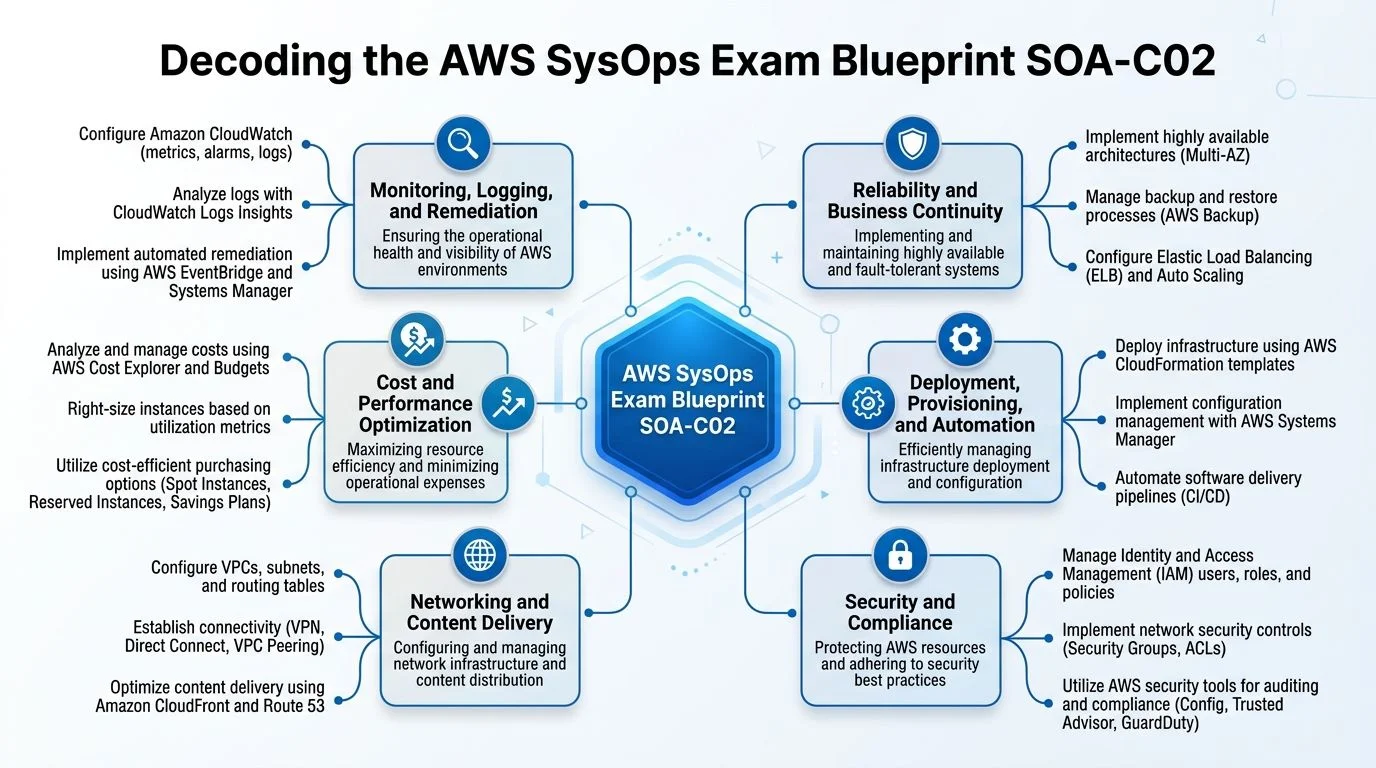 Caption: A visual representation of the domain breakdown for the AWS Certified SysOps Administrator – Associate (SOA-C02) exam, highlighting key areas of focus.
The Domain Weights Tell You What AWS Values
The AWS Certified SysOps Administrator – Associate exam uses a weighted domain model. These weights offer clear insights into operational priorities within AWS. Notably, the domain of Monitoring, Logging, and Remediation accounts for a significant 20% of the exam content, as detailed in Jefferson Frank’s analysis of the SOA-C02 blueprint. This is not an arbitrary percentage. It is a direct indicator of what operational maturity looks like in a cloud environment.
A beginner might simply watch dashboards. A skilled cloud operator transforms raw signals into immediate action. This skill involves understanding the intricate interplay between various AWS services. You must know how Amazon CloudWatch metrics inform thresholds for CloudWatch Alarms. You must understand how these alarms trigger Amazon EventBridge events. Finally, you need to know how those events orchestrate automated responses via AWS Systems Manager actions. The exam moves beyond service recognition. It tests your ability to build automated response chains that keep systems running without manual intervention.
The Exam Domains at a Glance
The following table provides a breakdown of the domains and their respective weighting within the AWS Certified SysOps Administrator – Associate (SOA-C02) exam:
| Domain | Percentage of Exam |
|---|---|
| Monitoring, Logging, and Remediation | 20% |
| Reliability and Business Continuity | 16% |
| Deployment, Provisioning, and Automation | 18% |
| Security and Compliance | 16% |
| Networking and Content Delivery | 18% |
| Cost and Performance Optimization | 12% |
What Each Domain Means on the Job (and for the Exam)
We will examine each domain to understand its operational significance and how it appears in exam questions.
Monitoring, Logging, and Remediation
This domain represents the center of effective AWS SysOps. It requires you to know what to monitor, how to collect data, and what automated actions should follow specific events. A common error for candidates is confusing services like Amazon CloudWatch, AWS CloudTrail, AWS Config, and direct system logs. Each of these serves a distinct purpose in the AWS environment:
- CloudWatch focuses on performance metrics and application logs. It tells you what the system is doing right now. If CPU usage spikes or an application returns errors, CloudWatch captures that data.
- CloudTrail provides an audit trail of API calls. It records who did what, when they did it, and from where. If a resource is deleted, CloudTrail tells you which user or service initiated the deletion.
- AWS Config tracks resource configurations and changes over time. It shows what the system looks like and how it has changed. It is used to ensure resources stay within specific configuration rules.
For a clearer distinction, our article on AWS CloudTrail vs CloudWatch offers a detailed comparison.
Key Concepts for the Exam:
- CloudWatch Metrics: You must understand how to collect, analyze, and interpret performance data. This includes standard metrics provided by AWS and custom metrics sent from within your applications.
- CloudWatch Alarms: You will need to configure alarms based on metric thresholds or state changes. You should also understand composite alarms, which combine multiple alarms to reduce notification noise.
- Event-Driven Services: Learn to use Amazon EventBridge to route events from AWS services to targets. This is how you bridge the gap between a detected problem and a solution.
- Systems Manager Automation: Use Systems Manager documents and runbooks to fix common issues automatically. This reduces the time it takes to recover from failures.
Certification Scenario: If an EC2 instance fleet has repeated health check failures, the exam might ask for the best AWS-native way to detect the issue, notify the team, and fix it automatically. The best solution will minimize manual work and use integrated services for a quick, repeatable response.
Reliability and Business Continuity
This domain evaluates your ability to design workloads that survive failures. AWS uses specific concepts to define this reliability:
- Multi-Availability Zone (Multi-AZ) deployments: This ensures high availability within a single region. By spreading resources across different data centers, you protect against local hardware or power failures.
- Backup Strategies: You must implement automated backups using services like AWS Backup. This includes taking EBS snapshots and RDS automated backups on a consistent schedule.
- Restore Planning: Creating backups is only half the job. You must regularly test restoration processes. This validates your Recovery Time Objective (RTO) and Recovery Point Objective (RPO) targets.
- Scalable Architecture: Use Auto Scaling Groups and Elastic Load Balancing to handle changing traffic loads. These services also replace unhealthy instances automatically to maintain uptime.
- Disaster Recovery: Plan for regional outages using active-passive or active-active multi-region architectures. This is the highest level of reliability.
A common challenge for candidates is memorizing features without context. Instead, ask yourself: "What specific failure am I stopping with this solution?"
Consider these examples for exam preparation:
- Individual Instance Failure: Use Auto Scaling to replace the instance. Combine this with health checks to ensure the replacement is functioning correctly.
- Availability Zone (AZ) Outage: Use Multi-AZ designs. This includes RDS Multi-AZ for databases and ELB to distribute traffic across different zones.
- Data Deletion or Corruption: Use robust backup policies and S3 object versioning. Ensure you have clear procedures for restoring data to a specific point in time.
- Regional Disaster: Use cross-region replication. Services like AWS Backup can copy snapshots to a different region to ensure data survives a large-scale event.
Always link the AWS solution to the specific failure it is designed to mitigate. The exam tests your understanding of these connections.
Deployment, Provisioning, and Automation
This domain separates admins who click buttons in the console from those who build repeatable environments. For the exam, expect scenarios involving:
- AWS CloudFormation: This is the primary tool for Infrastructure as Code. You should understand templates, stacks, change sets, and nested stacks. Knowing how to update a stack without causing downtime is a critical skill.
- AWS Systems Manager: This service manages EC2 instances and on-premises servers. Focus on Patch Manager for updates, Run Command for executing tasks at scale, and State Manager for maintaining configurations.
- Amazon Machine Image (AMI) Creation: You need to know how to build "golden" AMIs. These are pre-configured images that ensure every instance you launch starts with the same software and security settings.
- Launch Templates: Use these to define instance launch parameters. They have replaced older launch configurations and offer more flexibility, such as versioning.
- Operational Automation: Use AWS Lambda, Step Functions, and EventBridge to automate routine tasks. This moves the workload away from human operators and into code.
The exam favors solutions that reduce human error and configuration drift. It looks for consistent and predictable outcomes across environments.
Many answer choices in this domain will seem possible. However, the correct AWS-preferred answer will prioritize repeatability and minimal manual effort. This usually means using Infrastructure as Code (IaC) or managed automation services. This approach follows standard principles of consistent service delivery and change management.
Security and Compliance
In AWS SysOps, security is a daily operational task. You are responsible for protecting data and maintaining access controls. This includes:
- Identity and Access Management (IAM): You must configure users, groups, roles, and policies. Always apply the principle of least privilege, giving users only the access they need to do their jobs.
- Auditing and Logging: Use CloudTrail for API logs and VPC Flow Logs for network traffic. These tools help you track activity and find security issues.
- Encryption: Understand encryption for data at rest and in transit. Know how to use AWS Key Management Service (KMS) to manage encryption keys for S3 buckets and EBS volumes.
- Patch Management: Keep operating systems and applications updated. Use AWS Systems Manager Patch Manager to automate the rollout of security patches across your fleet.
- Network Controls: Use Security Groups and Network ACLs to restrict traffic. Understand how AWS WAF can protect web applications from common attacks.
- Compliance: Use AWS Config and Security Hub to monitor your compliance status. These services can flag resources that do not meet your organization's security standards.
A common mistake is focusing only on IAM users while ignoring service-linked roles. You must understand how different AWS services gain permission to talk to each other. For example, you should know how to use an instance profile to allow an EC2 instance to access an S3 bucket securely.
Certification Focus: Expect questions on IAM role trust policies and resource-based policies. You will need to show how to grant temporary access and how to review change history to identify security misconfigurations.
Networking and Content Delivery
AWS networking can be difficult for some, but the exam does not require you to be a specialist network engineer. Instead, it tests your ability to troubleshoot connectivity and design VPCs. You need to understand:
- VPC Design: Know the difference between public and private subnets. Understand how to use route tables, internet gateways, NAT gateways, and VPC endpoints.
- Traffic Flow: Learn how traffic moves between VPCs through peering or to external networks via VPN and Direct Connect.
- IP Addressing: Understand public, private, and Elastic IP addresses. Know how to manage network interfaces for your instances.
- DNS: Use Amazon Route 53 for domain registration and DNS resolution. Know how to set up health checks to route traffic away from failing endpoints.
- Content Delivery: Use Amazon CloudFront to speed up content delivery. This improves performance for global users and provides an extra layer of security.
When traffic fails to move from one point to another, use a mental checklist to find the problem:
- Path: Is there a route in the route table for the destination? Are source/destination checks turned off for NAT instances?
- Policy: Do the security groups allow the traffic? Remember that security groups are stateful. Do the Network ACLs allow the traffic? Remember that NACLs are stateless and need rules for both directions.
- Name Resolution: Is DNS working? Can you resolve the hostname to an IP address from within the VPC?
- Architecture: Is the service running and listening on the right port? Is the load balancer sending traffic to healthy targets?
Practice drawing VPC diagrams. Tracing the path of a request through each component helps you visualize the rules at each hop. This makes networking questions much easier to answer.
Cost and Performance Optimization
This domain is where effective operators show their value. AWS operations involves making choices about performance and cost. You must select the right resources and use scaling patterns that save money.
Key areas for the exam:
- Resource Rightsizing: Match instance types and storage volumes to your actual needs. Do not pay for a large instance if a small one can handle the load. Use tools to identify over-provisioned resources.
- Storage Tiering: Move data to cheaper storage when it is not accessed frequently. Use Amazon S3 storage classes like Infrequent Access or Glacier. Choose the right EBS volume type, such as gp3, to balance cost and speed.
- Cost Management: Know how to use AWS Cost Explorer to see spending trends. Use AWS Budgets to get alerts when costs go over a specific limit.
- Commitment Models: Use Reserved Instances and Savings Plans for predictable workloads. These can offer significant discounts over standard On-Demand pricing.
- Performance Monitoring: Use CloudWatch to find bottlenecks. If a disk is slow or a database is hitting its limit, you need to know how to adjust the resource to improve performance.
The best answers in this domain demonstrate an approach based on observed data. Do not make assumptions about what you need. Use metrics to align your AWS spend with the actual requirements of your workload. This ensures you get the most value while maintaining the performance users expect. Refining your ability to interpret these metrics will help you pass with confidence. Be sure to verify current pricing on the vendor site before making any final recommendations in a real-world scenario.
Crafting Your 90-Day AWS SysOps Study Plan: A Structured Approach for IT Professionals
Many candidates for the AWS SysOps exam fail not because the technical material is impossible to learn, but because their study habits lack direction. They often start by clicking through random practice questions, feel defeated by low scores, and then move sporadically between different services without a clear system. A better strategy mimics the workflow of a professional cloud administrator. You must first understand the environment, then learn to operate it, and finally master the art of troubleshooting and optimization when things go wrong.
The official AWS guidance for this certification suggests that candidates should have one year of hands-on experience with deployment, management, networking, and security on AWS. Once earned, the credential has a 3-year validity period. To maintain your status, you can retake the current exam or progress to professional-level certifications as outlined on the official AWS certification page. These requirements reflect the practical nature of the SysOps role, which prioritizes functional skill over theoretical memorization.
Days 1-30: Building Your Foundational AWS SysOps Skills
The first month of your study schedule should focus on a steady foundation. Your main objective is to understand the primary AWS services used in almost every operational scenario. If you have a weak grasp of these basics, you will struggle with the complex architectural patterns and troubleshooting logic required in the later stages of the exam.
Concentrate your efforts on this specific service stack:
- Amazon EC2 (Elastic Compute Cloud): You need to be proficient in the entire instance lifecycle. This involves selecting appropriate Amazon Machine Images (AMIs), choosing instance types based on CPU or memory requirements, and managing EBS volume attachments. You must also learn how to configure health checks, read system logs to diagnose boot failures, and use IAM instance profiles to provide secure access to other services.
- Amazon S3 (Simple Storage Service): Study the different storage classes like Standard, Intelligent-Tiering, and Glacier Deep Archive. Practice implementing lifecycle policies to move data automatically between these classes to save money. You should also understand how to secure data using bucket policies, Access Control Lists (ACLs), and object versioning to prevent accidental deletions.
- AWS IAM (Identity and Access Management): Learn to manage users, groups, and roles. The technical requirement here is the principle of least privilege. You must understand how policy evaluation logic works, specifically how an explicit "deny" overrides an "allow" and how to grant an EC2 instance permission to write to an S3 bucket without using hardcoded credentials.
- Amazon VPC (Virtual Private Cloud): This is the base of all AWS networking. You must be able to design subnets, separating public resources from private ones. Learn to configure route tables, internet gateways, and NAT gateways. You must also distinguish between security groups, which act as stateful firewalls at the instance level, and Network ACLs, which serve as stateless firewalls at the subnet level.
- Amazon CloudWatch: This is your primary window into the health of your systems. Learn how to collect standard metrics like CPU and disk I/O, and how to use the CloudWatch agent for custom logs. You should be able to set up alarms that trigger based on specific thresholds and build dashboards that provide a clear view of your operational state.
Hands-on Imperative: Do not just read the technical whitepapers. You must build an environment to see how it functions. Launch an EC2 instance, assign it a role, and configure it to push application logs to CloudWatch. Once it is running, intentionally break a configuration—such as deleting a route in a route table—to see how your monitoring tools report the failure. This active style of learning is the most effective way to prepare for SysOps questions.
What to Do If Your Hands-On Experience Is Thin
Many students worry because they do not have the full year of professional experience recommended by AWS. While this is a valid concern, it is not a reason to stop. It simply means your training must include more intense and frequent lab work. Treat every lab session as a production task. You should document every step: what you created, the errors you encountered, how you fixed those errors, and which AWS tool gave you the information you needed to solve the problem.
MindMesh Academy Philosophy: To grow as a SysOps professional, you must change your perspective. Stop asking what a service does and start asking how you would rely on it during a production outage. This shift in thinking prepares you for the scenario-based questions that define the actual exam.
Days 31-60: Training Your Cloud Operator Instincts
In the second month, the individual concepts you learned earlier will begin to work together. Your focus shifts from isolated services to how these tools integrate to form a functional system. The exam focuses heavily on these integrations, as they represent how real-world cloud environments are managed.
Spend your time practicing these service combinations:
- Amazon EC2 Auto Scaling + Amazon CloudWatch: Study how CloudWatch metrics like memory usage or network traffic drive Auto Scaling Group actions. You must understand scaling policies, including target tracking and step scaling, as well as the importance of cooldown periods to prevent rapid, unnecessary scaling actions.
- AWS Systems Manager + Amazon EC2: Practice automating your operations. Use Patch Manager to keep instances updated, Run Command to execute scripts across hundreds of instances simultaneously, and Parameter Store to manage your application secrets and configuration data securely.
- AWS CloudFormation + AWS IAM: Learn to deploy infrastructure as code. You should be able to write or modify templates that create resources while ensuring that the associated IAM roles provide the correct permissions. Automation is a core theme of the SysOps exam, and CloudFormation is the primary tool for achieving it.
- AWS Backup and Data Protection + Core Workloads: Do not just learn how to click a "backup" button. You must understand how to restore data quickly to meet recovery objectives. Practice restoring an EBS volume from a snapshot or an RDS database to a specific point in time. Verify that the application can still access the restored data.
- High Availability (HA) Patterns: Compare the risks of a single-instance setup against the stability of a Multi-AZ deployment. Work with Elastic Load Balancing (ELB) to distribute traffic and use Multi-AZ RDS to ensure your database remains available even if a data center fails.
Cultivate Scenario Journaling: Use a journal to work through operational problems. Write down a problem, such as "users are reporting slow response times from the web server." Then, list the steps you would take to find the cause. Which CloudWatch metric do you check first? When do you look at VPC Flow Logs? This mental exercise builds the diagnostic skills you will need during the test.
Weekly Rhythm for Busy Professionals
Most IT professionals have to study while working a full-time job. To succeed, you must find a schedule that you can maintain for several months. Consistency is more important than occasional eight-hour study sessions. Try this weekly plan:
- Early Week (Monday and Tuesday): Use these days for reading and theory. Review the AWS documentation, FAQs, and your course videos. This is when you acquire the raw information.
- Midweek (Wednesday through Friday): Move from theory to practice. Perform labs that correspond to what you read earlier in the week. If you read about VPCs on Monday, spend Thursday building a VPC with public and private subnets.
- Weekend (Saturday and Sunday): This is for review and testing. Take practice exams and review your lab notes. Identify the areas where you still feel confused and mark them for extra study the following week.
This pattern is effective because it moves you through three stages of learning: acquisition, application, and reflection. When you explain a concept to yourself after building it in a lab, the information becomes much easier to recall under the pressure of an exam timer.
Days 61-90: Sharpening Your AWS SysOps Exam Judgment
The final 30 days are for refining your strategy rather than learning new services. You must learn how to think like the people who write the exam. Your focus should be on three specific skills:
- Operational Soundness: In many questions, multiple answers might be technically possible. You must choose the one that is the most efficient, cost-effective, or follows AWS best practices.
- Identifying Distractors: Practice spotting answers that require too much manual work or suggest using a third-party tool when a native AWS service exists to solve the problem.
- Deconstructing Scenarios: Learn to ignore the "noise" in a long question. Find the core problem, the constraints (like "minimize cost" or "maximize speed"), and the specific goal the question asks you to reach.
The Power of a Mistake Log: Keep a record of every practice question you get wrong. Do not just look at the right answer; write down the logic that led you to the wrong one. This helps you find flaws in your reasoning.
Examples of Useful Mistake Categories for AWS SysOps:
| Mistake Pattern | What it Usually Means for Your Study |
|---|---|
| Suboptimal Tooling: Selecting a method that works but is not the most efficient AWS-native solution. | You need to review AWS best practices, specifically the Well-Architected Framework's operational excellence pillar. |
| Data Confusion: Mistaking CloudWatch metrics for CloudTrail audit logs. | Review the difference between "what is happening now" (monitoring) and "who did what" (auditing). |
| Missing HA Clues: Failing to notice that a scenario requires high availability or disaster recovery. | Train yourself to look for keywords like "redundancy," "fault tolerance," or "regional failure" in question stems. |
| Manual vs. Automated: Choosing a manual fix when an automated AWS service could handle the task. | Revisit the automation features of Systems Manager, Auto Scaling, and CloudWatch Events. |
| Ignoring Cost: Picking a technically perfect solution that ignores a "low cost" constraint. | Study the pricing models of different storage classes and instance types to understand the trade-offs. |
At the end of these three months, your goal is not just to pass a test. You are training to become a reliable administrator. By following this structure, you will be able to handle operational challenges with the confidence of an expert who knows exactly which tool to use when a system goes offline. (Verify current exam codes and pricing on the vendor site before registering).
Mastering Hands-On Labs and Practice Questions for AWS SysOps Certification
For an operations-focused certification like AWS SysOps Administrator, theoretical knowledge alone is insufficient. You cannot pass this exam by remaining solely within the pages of documentation and conceptual understanding. The exam is designed to validate that you can actually manage a fleet, not just describe it.
Many students express frustration, stating they understand the AWS documentation yet still struggle when confronted with complex scenario-based questions. This common challenge arises because operational expertise extends far beyond mere recall. It demands pattern recognition under pressure, the ability to rapidly diagnose issues, and the instinct to apply the most effective AWS-native solution. Hands-on labs are where this critical pattern recognition is forged and solidified. When you have seen a specific error message ten times in a lab, you do not panic when it appears on the screen during a timed exam.
Build Labs That Force Critical Operational Decisions
The most effective AWS SysOps labs are those that compel you to make informed decisions among several plausible paths, much like real-world operational scenarios. For instance, merely reading about Amazon CloudWatch alarms is one thing. It is a different level of understanding to decide which specific metric is most relevant for a given workload. You must determine what threshold will provide meaningful alerts without generating excessive noise and what automated action should follow an alarm state change. The certification exam consistently tests this operational judgment.
Design your labs to incorporate friction and troubleshooting challenges, not just guided setup steps. If everything works perfectly the first time, you have not learned how to fix it when it fails. Try these specific lab scenarios:
- Troubleshoot an Unhealthy Amazon EC2 Instance: Do not just launch an instance and log in. Create a scenario where an instance becomes unhealthy by messing with the network configuration or the system boot files. Systematically check the system status checks, which indicate hardware issues, versus instance status checks, which indicate software or OS issues. Use CloudWatch logs and analyze the behavior of the attached IAM instance profile. Review AWS CloudTrail events to see if a recent configuration change caused the failure.
- Recover from Suboptimal Auto Scaling Behavior: Intentionally misconfigure an Auto Scaling group policy or trigger. Set a scaling threshold that is impossible to reach or one that causes "flapping," where instances constantly launch and terminate. Diagnose why the scaling is not behaving as expected. Examine the alarm configurations, review the cooldown period assumptions, and analyze the baseline load patterns to identify the root cause and implement corrective actions.
- Validate Backup and Restore Workflows: Do not stop at creating an AWS Backup vault or an RDS snapshot. Rigorously practice restoring a critical workload from a backup into a different Availability Zone or even a different VPC. Verify that the restored database is fully functional and meets your Recovery Point Objective (RPO) and Recovery Time Objective (RTO). If the restore takes four hours and your SLA is one hour, you have identified a critical operational gap that you must solve using better automation or cross-region replication.
- Resolve Network Connectivity Confusion: Simulate network issues within a VPC. Can an EC2 instance reach an S3 endpoint? Can a client connect to a database in a private subnet? Systematically test to determine if the problem is related to VPC route tables, security groups, or Network ACL policies. Practice using the VPC Reachability Analyzer to trace the path and identify where the traffic is being dropped, whether at the Internet Gateway, a NAT Gateway, or a missing route.
Don’t Skip Patching in Hybrid Scenarios
A topic often glossed over in preparation resources is the application of AWS Systems Manager Patch Manager, particularly in hybrid cloud environments. Real-world operational scenarios, and consequently exam questions, often explore troubleshooting failed patch baselines, analyzing compliance reporting, and understanding agent connectivity. You can find a detailed review of these concepts in this SysOps practice exam and Patch Manager gaps resource. Many candidates struggle here because their exposure has been limited to basic tutorials.
Mastering Patch Manager is essential because questions frequently appear straightforward until you are asked to diagnose why a patching process failed. You might need to know why a managed instance is not reporting expected behavior or how to verify compliance effectively after a patch cycle. If the SSM Agent is not running or the IAM role lacks the proper permissions, the instance will never show up in the console.
To solidify your understanding, use labs that cover:
- Mixed Operating Systems: Go beyond patching a single instance type. Implement patching across diverse operating systems like Amazon Linux and Windows Server to understand OS-specific nuances. Different operating systems use different update commands, and Patch Manager handles these through specific SSM documents that you should be familiar with.
- Baseline Troubleshooting: Deliberately introduce a minor misconfiguration into a patch baseline, such as an incorrect approval rule, or break the target instance's connection to the S3 bucket where the patches are stored. Systematically trace the failure using the Systems Manager execution history and the logs stored on the instance itself.
- Compliance Review: Practice interpreting the compliance reports generated by Patch Manager. Identify which patches were applied, which failed, and the overall compliance status of your managed instances. Learn how to use Resource Data Sync to send this compliance data to Amazon S3 for centralized reporting across multiple accounts.
- Hybrid Management Thinking: Extend your perspective beyond purely AWS-native environments. Consider how the Systems Manager Agent functions on on-premises servers. Learn how to manage them as hybrid instances by using activation codes and understanding how they communicate back to the AWS API over the internet or through a Direct Connect link.
MindMesh Academy Insight: A candidate who has experienced and fixed a failed Patch Manager run is often far more prepared and calmer under exam pressure than one who has only memorized its feature list. Practical failure leads to deeper understanding.
How to Dissect Scenario Questions Effectively
A significant source of frustration during practice questions comes from rushing through the problem statement. When faced with a lengthy scenario, adopt a structured approach to break it down into manageable components:
- Identify the Core Problem: What is the fundamental issue presented? Is it related to availability, monitoring visibility, IAM permissions, network connectivity, compliance, or cost optimization? Pinpointing the actual problem immediately guides your thinking toward the correct service.
- Recognize Key Constraints: What are the non-negotiable conditions? Is the goal the lowest operational overhead, the fastest recovery time, the least manual intervention, or a solution that uses existing AWS-native tools? These constraints often eliminate several options that might be technically possible but do not meet the specific requirements of the question.
- Determine the AWS-Preferred Solution: Which answer aligns best with the AWS Well-Architected Framework? The exam consistently favors managed services, automation over manual tasks, highly available designs, and solutions that scale efficiently.
Effective Elimination Method for Scenario Questions:
- Eliminate Manual Solutions: Immediately discard answer choices that require human intervention or manual steps. AWS generally prioritizes automation. If an answer suggests an administrator must manually log in to fix a server, it is likely incorrect.
- Discard Symptomatic Fixes: Remove options that only address a symptom without tackling the underlying root cause of the problem. For example, if a disk is full, adding more disk space is a temporary fix, while setting up an automated cleanup script or an alarm is an operational solution.
- Compare Operational Fit: Among the remaining viable options, evaluate which solution offers the most resilient and operationally sound approach for the given scenario. If two options solve the problem, choose the one that requires the least maintenance.
Example of the Thought Process in Action
Consider a scenario where an application's instances are consistently failing health checks during intermittent load spikes.
A superficial approach might be to suggest increasing the instance size to a larger type. While this might stop the failure, it is an expensive and inefficient fix that does not address why the failures are happening.
A stronger AWS SysOps approach involves asking a series of diagnostic questions:
- Are we monitoring the most relevant CloudWatch metric for this specific workload, such as application-level latency or memory utilization, rather than just basic CPU usage?
- Is our Auto Scaling policy tied to the correct performance signal, or is it reacting too slowly to the spikes?
- Is the application designed to be stateless and horizontally scalable, or are there underlying dependencies like a single database connection limit preventing clean scaling?
- Is the failure truly due to insufficient capacity, or is it a configuration issue or a dependency bottleneck in another service?
This systematic approach is the habit that the certification exam is designed to reward. By practicing these diagnostic steps in your labs, you will find that the exam questions become much easier to navigate.
How MindMesh Academy Accelerates Your AWS SysOps Certification Success
At MindMesh Academy, we know that most certification difficulties do not start with a shortage of information. Instead, they begin with inefficient study systems. It is a common story: an IT professional reads a long chapter, feels productive for an hour, only to find the information has vanished a few days later. They might get a low score on a practice exam and react by focusing only on one small topic while ignoring the rest of the syllabus. Others watch video lectures for hours, assuming that because they understand the speaker, they have mastered the material. This confusion between recognition and recall is a trap that slows down even the most dedicated students.
This is where a structured, intelligent learning platform like MindMesh Academy changes your AWS SysOps preparation. We provide a system designed to replace aimless browsing with targeted progress.
Why Spaced Repetition Matters for Cloud Operations
Managing AWS operations requires a grasp of many services that can look identical until you look at their specific functions. This complexity means that looking at material once often results in fast memory loss. If you do not interact with the data frequently, your brain clears it out to make room for other things.
MindMesh Academy uses spaced repetition to fight this decay. This learning method is built for cloud studies because it brings concepts back to your attention right as your memory of them begins to fade. It turns review into a science rather than a guess. This is useful for technical details like CloudWatch alarm triggers, IAM policy logic, specific AWS Backup configurations, and the roles of service-linked accounts. Instead of relying on a random review schedule, this system makes every study session count.
For anyone aiming for this certification, the method is vital. The exam goes beyond checking for shallow familiarity. It demands precise, contextual recall and the ability to apply knowledge accurately when the clock is ticking. You cannot just have a general idea of how a service works; you need to know exactly how it behaves in a failure scenario.
Adaptive Learning Pinpoints and Fortifies Weak Spots
Another common problem is the urge to study things you already understand. Many students avoid networking or automation troubleshooting because those topics feel difficult or dry. Our adaptive learning path stops this behavior. The system constantly checks your performance and brings your weak spots to the front. You cannot hide from the topics that actually need work.
This changes your study in three practical ways:
- Optimized Time: You stop reviewing concepts you have already mastered. This keeps your study hours focused on difficult material that actually impacts your score.
- Targeted Improvement: You are asked to look at hard topics more often. By seeing them while the memory of a previous mistake is still fresh, you learn faster and retain the logic longer.
- True Exam Readiness: Your focus moves from simple consumption to a plan based on data. This ensures full coverage of all exam domains so no topic takes you by surprise.
This approach is effective for cloud operations. Watching a demo video might give you a false sense of security. Real mastery is tested in questions that combine monitoring, IAM settings, and automated fixes. These are the exact areas our system highlights to ensure you are ready for the actual exam environment.
Progress Tracking Provides Objective Accountability
A progress dashboard might look like a minor feature, but it handles a significant mental block. People often lose steam and stop studying when they cannot see their own growth. If the work feels invisible, it is hard to stay disciplined over several weeks.
MindMesh Academy provides a visual record of your study history. It shows that your work is building toward a goal. It identifies the milestones you reach and shows where you need to pick up the pace. This transparency keeps you moving forward when the material gets tough.
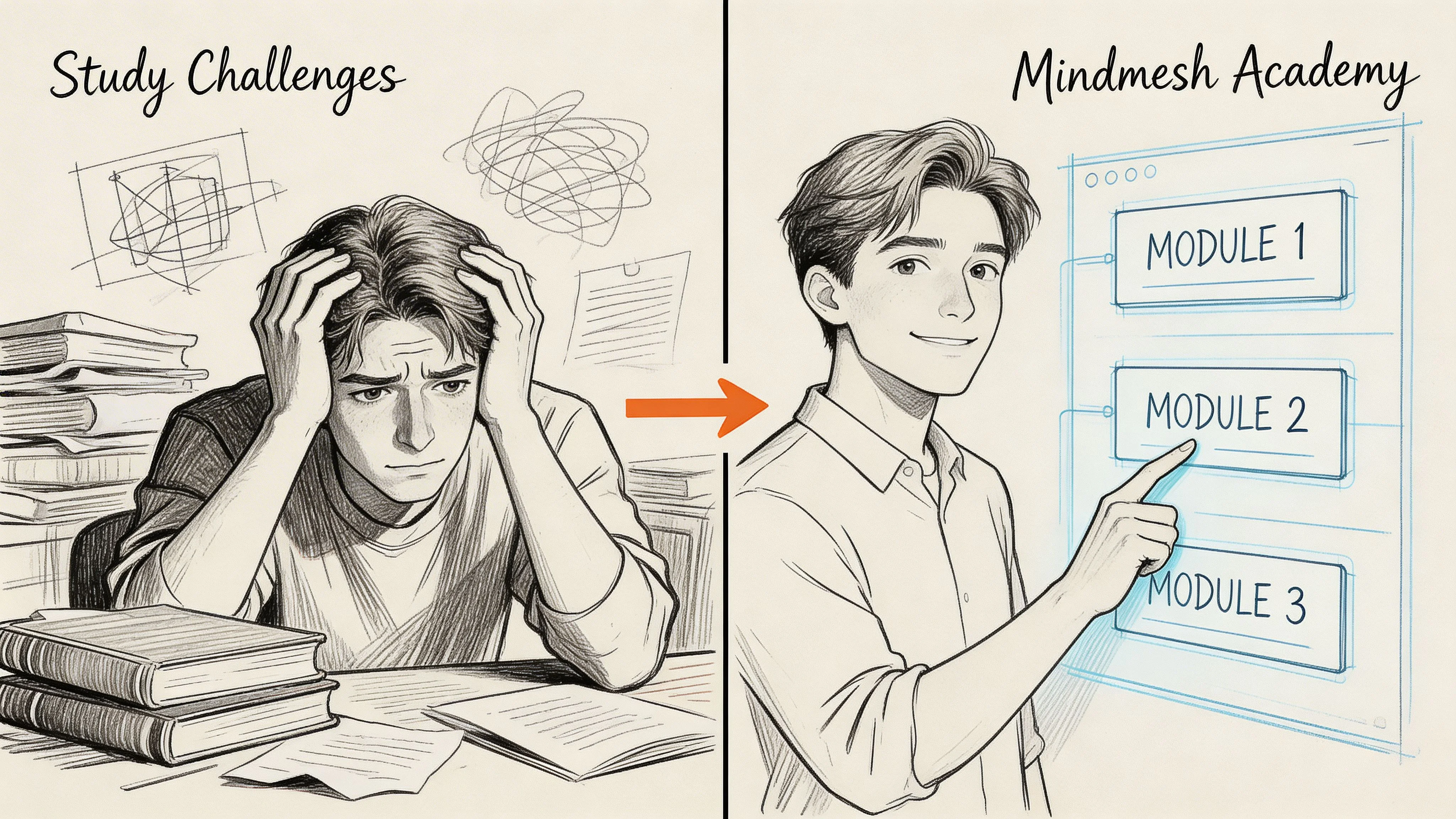 Caption: A mock-up of the MindMesh Academy dashboard, visually tracking your progress across different AWS SysOps exam domains.
Good tracking allows you to answer specific questions about your preparation:
- Which exam domains, such as Networking or Security, am I still finding difficult?
- Are my wrong answers grouped around a certain AWS service or a specific operational problem?
- Am I looking at old material enough, or am I only moving forward and forgetting the start?
MindMesh Academy Principle: For serious IT professionals, study confidence should come from clear data and steady progress, not just from a passing mood or a subjective feeling of readiness.
Why a Structured System Outperforms Random Resource Stacking
Many students collect a disorganized pile of resources. They have a few videos, some handwritten notes, various flashcards, and a list of blog posts. While some people are organized enough to make this work, it often leads to gaps in knowledge and wasted time. You spend more time managing your tools than you do learning the material.
Most professionals do better with a single, integrated system that handles the common problems of studying for a difficult exam:
| Common Study Problem | MindMesh Academy System Response |
|---|---|
| Forgetting early topics as you move through the course. | Spaced repetition brings concepts back before they disappear, keeping SysOps details fresh in your mind. |
| Not knowing your own weak areas or overestimating your skill. | Adaptive learning finds and fixes your weak spots, ensuring you practice what is actually hard. |
| Having no way to see if you are actually getting ready for the test. | Progress tracking gives you clear metrics so you can see your improvement over time. |
This is the goal of MindMesh Academy. We do not just provide more content to read. We provide a process that reflects how real-world cloud skills are built and kept. By following a system instead of a random list of tasks, you can pass with confidence.
Your AWS SysOps Career Roadmap and Next Steps
Earning an AWS SysOps certification, currently transitioning to the AWS Certified CloudOps Engineer – Associate title, marks a significant professional milestone. However, the most substantial career growth happens when you become the expert that a team depends on to maintain and protect production environments.
The value of this learning path is found in how it trains you to think operationally. It prepares you to predict how complex systems might fail, design thorough monitoring for early detection, and build efficient recovery procedures to prevent issues from repeating. This proactive mindset is highly valued across the IT industry, from small startups to large enterprises.
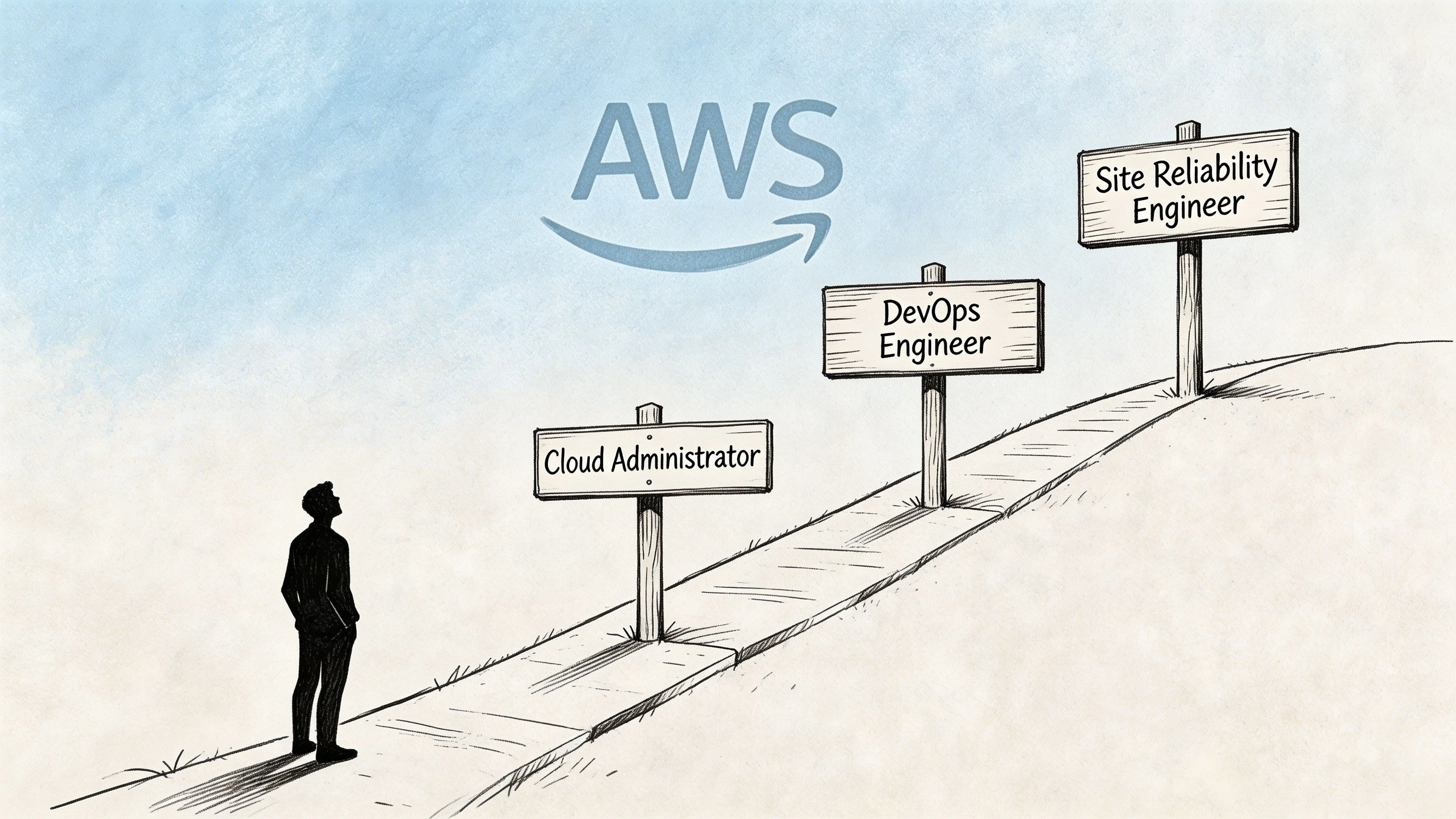 Caption: Navigating your career path in AWS cloud operations, with various roles building upon the SysOps foundation.
Where These Skills Lead: Your Cloud Career Trajectory
Mastering cloud operations creates opportunities across many roles. While job titles can vary, the core responsibilities and technical requirements often overlap significantly:
- Cloud Administrator: This foundational role focuses on the health and security of AWS environments. You will manage user permissions, oversee resource provisioning, and handle basic troubleshooting. Your goal is to ensure that all infrastructure remains visible to monitoring tools and adheres to security policies.
- Systems Operations Engineer: This role handles the daily reliability of live systems. You will manage monitoring configurations, lead incident response efforts, and maintain backup and patching cycles. This position often follows frameworks like ITIL Service Operation processes to deliver consistent services to the business.
- DevOps Engineer: This position connects software development and IT operations. You use your operational knowledge to build automated delivery systems, such as continuous integration and continuous delivery (CI/CD) pipelines. You will use infrastructure as code tools to manage resources, ensuring that automated deployments remain stable in production.
- Site Reliability Engineer (SRE): This advanced role applies software engineering methods to solve operational problems. SREs focus on building highly reliable systems and analyzing system behavior under heavy stress to prevent failures. You will work on automating manual tasks and using data to maintain high levels of system performance.
These roles all share a high level of accountability for environments that require high availability, strong security, and cost efficiency.
What the Salary Picture Looks Like
The earning potential for those with AWS operational skills reflects the high demand for cloud experts. Industry data from April 2026 indicates that professionals with skills related to the AWS Certified SysOps Administrator earn an average annual salary of $112,422. (Verify current pricing and market data on career sites like Glassdoor or LinkedIn).
Typical salary ranges for these roles in the U.S. market span from $66,000 to $122,000 annually. Entry-level positions usually start around $63,000. As you gain experience, compensation can increase to $86,661, $108,591, and $129,082. These figures vary by location, with major technology hubs reporting higher averages than the national baseline.
These numbers are clear market signals showing that employers value operational excellence. Companies invest in professionals who can minimize downtime, optimize cloud costs, and secure their AWS environments.
Turning a Certification Into a Strategic Career Move
An AWS certification provides a strong foundation, but it is just a starting point. A certificate by itself will not advance your career if you cannot explain how you apply operational thinking to real-world problems. You must show practical evidence of your skills.
You can demonstrate your operational expertise through several methods:
- Home Labs and Personal Projects: Actively build and secure workloads in your own AWS environment. Do more than follow simple tutorials; try to break your configurations and then fix them. Be ready to discuss the specific problems you encountered, the AWS services you used to resolve them, and what you learned about system reliability.
- Documented Workplace Wins: Record the operational improvements you make at your current job. For example, if you set up a new CloudWatch alarm to catch an error early or used Systems Manager to automate a manual task, document the result. Quantify the impact, such as time saved or a reduction in service downtime, to prove your value to future employers.
- Strategic Certification Progression: Plan your next certifications to support your long-term goals. If you want to move into a DevOps role, the SysOps Associate is a logical step before the AWS Certified DevOps Engineer – Professional. This shows that you have a clear plan for your professional growth.
If you are looking beyond your first certification, it is helpful to build an effective professional growth plan. This ensures your certification choices support a larger career direction instead of just being a collection of digital badges.
The Next Logical Step After AWS SysOps
For some, mastering cloud operations is the ultimate goal. For others, the AWS SysOps (or CloudOps Engineer) certification is a base camp for specialized roles.
If you want to focus on automation and designing delivery pipelines using infrastructure as code, your next step is often the AWS Certified DevOps Engineer – Professional certification. This path is common because skilled cloud operators naturally think about repeatability and system resilience.
To help you understand this career transition, here is a brief explanation:
The process of mastering AWS SysOps involves more than passing an exam. It requires a thorough understanding of how professionals manage cloud environments with a focus on uptime, security, and cost control.
If you want to do this type of high-impact work, the path is worth taking. Start by adopting an operational mindset, build in hands-on labs, and study real-world scenarios. When you are ready, earn the credential that matches current industry standards.
Ready to improve your cloud operational skills and reach your certification goals? MindMesh Academy offers a practical system to help you prepare for certifications like the AWS Certified CloudOps Engineer – Associate. Stop relying on disorganized notes and guessing what to study next. If you want a structured study system featuring focused reviews, learning that adapts to your needs, and clear progress tracking, visit MindMesh Academy today. Turn your AWS SysOps preparation into a successful and confident plan.

Written by
Alvin Varughese
Founder, MindMesh Academy
Alvin Varughese is the founder of MindMesh Academy and an enterprise architecture leader. An electrical engineer by training, he moved from factory automation in South Africa to cloud architecture at GE Appliances and Humana (Fortune 50), and holds 20 professional certifications including AWS Solutions Architect Professional, Azure DevOps Engineer Expert, and Microsoft Agentic AI Business Solutions Architect. He built MindMesh Academy after interviewing too many highly certified candidates who couldn't answer basic questions: the goal is prep that makes you better at the job, not just able to pass the exam.