
Acing AWS Practice Exams How to Pass Your Certification First Try
Acing AWS Practice Exams: Your Blueprint for First-Try Certification Success
To pass your AWS certification exam on the first attempt, treat practice tests as an essential tool. Simply taking them is insufficient; you must integrate them into a focused study plan. High-quality AWS practice exams do more than assess knowledge. They build the mental stamina and critical thinking required to solve complex scenarios under pressure. Use these simulations to identify and fix knowledge gaps before you enter the testing center. This methodical preparation helps you move past simple theory. It builds the practical, exam-ready expertise that distinguishes candidates who pass on their very first try.
Why Many Professionals Struggle with AWS Exams and How You Can Excel
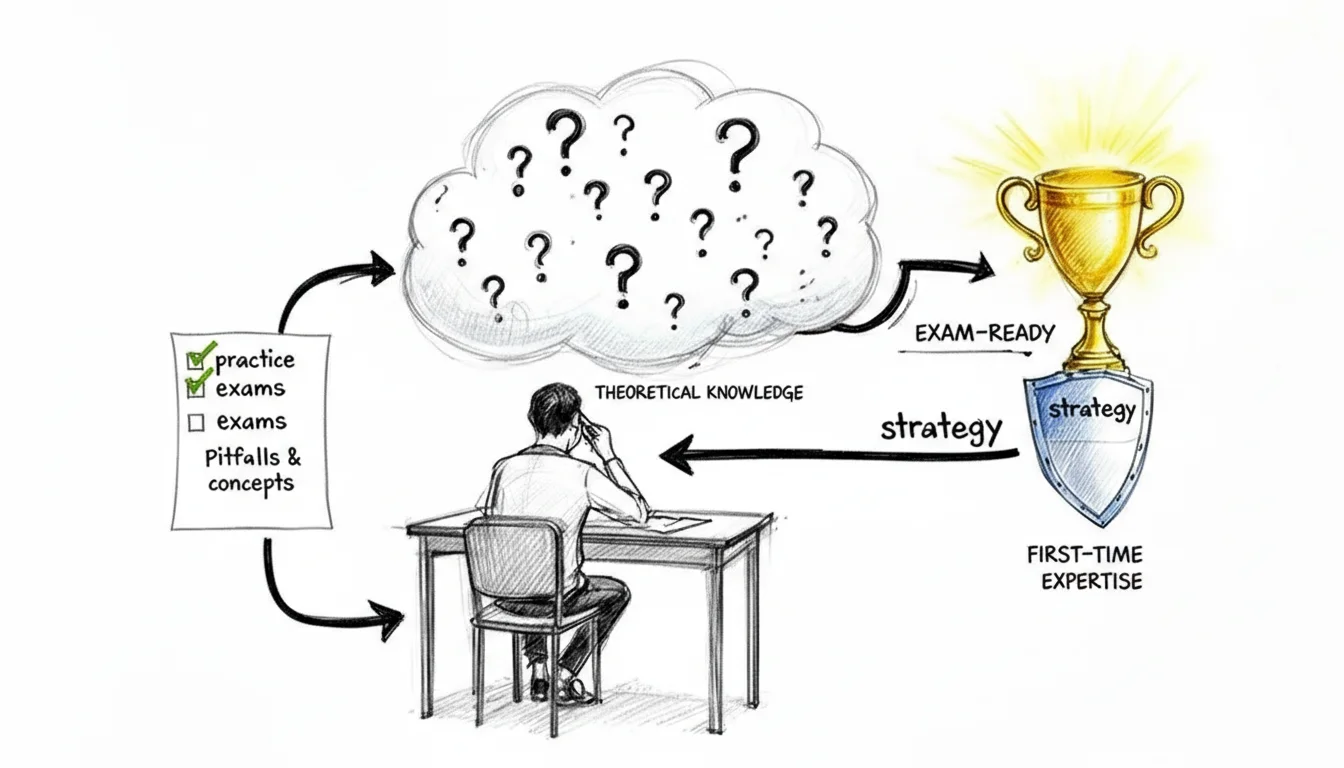
Facing an AWS certification exam often feels like a steep climb. The stories about difficult questions and changing pass rates are usually true. These tests present a reality that catches many future cloud experts off guard. However, most people do not fail because they lack the intelligence to succeed. Instead, they struggle because of a gap between traditional study habits and the actual technical demands of the test environment.
Many candidates rely on passive learning. They spend weeks watching video lectures, reading through whitepapers, or memorizing lists of facts. They assume that if they absorb enough information, they will pass. But AWS certifications—similar to the PMP or various Azure exams—test your ability to use knowledge in difficult, real-world situations. You will see long questions with several answers that look correct. Your job is to choose the best solution based on specific details in the scenario. This requires a strong understanding of best practices like the AWS Well-Architected Framework, which covers security, reliability, and cost optimization.
The Sobering Statistics
The data regarding success rates is clear. Look at the AWS Certified Solutions Architect – Associate (SAA-C03), which is a common starting point for many. Estimates suggest that only about 27% of candidates pass on their first attempt (verify current pass rate trends on the official AWS site). This means a massive 73% of test-takers do not succeed the first time (verify current pass rate trends on the official AWS site). These people often fail because their preparation did not build the active problem-solving skills the exam requires.
This high failure rate is not a reason to quit. It is a sign that you need a better, more active way to prepare. You must move past simply reading and start practicing. A structured plan that uses AWS practice exams is the most effective way to close this gap.
Reflection Prompt: Have you ever felt unprepared for an exam despite extensive study? What was missing from your preparation?
Shifting From Passive Study to Active Practice
To prepare for the pressure of a real certification, you must train your mind for the mental strain of the testing center. This is about more than facts. You need "exam muscle." This refers to the ability to solve tricky questions quickly, manage your time, and stay focused when you are tired.
The table below shows the differences between just studying and actually training for the test.
| Common Pitfall (Passive Study) | Strategic Solution (Active Practice) |
|---|---|
| Watching hours of video lectures on a loop. | Running full-length, timed exam simulations to build mental stamina. |
| Reading whitepapers and hoping the facts stay in your memory. | Reviewing every question to understand why one answer is best and the others are wrong. |
| Re-studying topics you already know well. | Reviewing score reports to find specific weak points for focused study. |
| Stopping after getting one passing score on a single practice test. | Taking different practice exams to track progress and confirm your knowledge. |
This active method is a cycle that you repeat until you are ready.
- Diagnose Weaknesses: Use your practice test scores to find exactly which AWS services or domains are giving you trouble. You might find you understand S3 storage classes but struggle with VPC networking or DynamoDB vs. RDS.
- Targeted Remediation: Do not watch an entire course again. Instead, use your time to fix the specific gaps you found. If you keep missing questions about Amazon S3 lifecycle policies, spend an hour focusing only on that topic.
- Build Endurance: Always practice under timed conditions. You must keep your focus sharp for the entire 130-minute window (verify current exam duration for your specific certification on the official AWS site).
By using each practice exam as a tool to find problems rather than just a pass/fail quiz, you turn your preparation into a plan for success. This process ensures you are not just memorizing data. You are building the critical thinking and problem-solving skills needed to pass. To see how to create a full plan, read our guide on how to prepare for AWS certification with proven strategies. Stop just reading and start training to pass with confidence.
Finding Practice Exams That Truly Mirror the Real Test
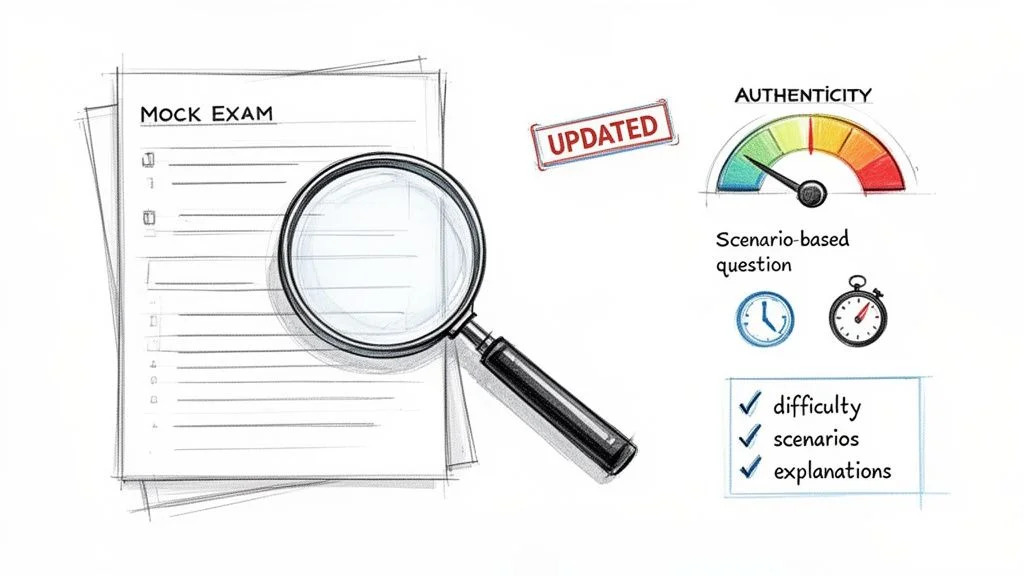
AWS practice exams are not all the same. Using a low-quality resource is a mistake that often leads to a false sense of security. This confidence usually vanishes the moment you see the first few questions on the actual exam. Your goal is to find study tools that do more than just provide a quiz. They need to replicate the style, technical depth, and difficulty of the official certification.
A good comparison can be found in the world of security testing. There is a massive difference between running a basic vulnerability scan and performing a full penetration test. A scan just looks for known surface-level issues, while a penetration test simulates an actual attack to see how a system holds up under pressure. When preparing for your exam, knowing the difference between vulnerability assessment vs. penetration testing helps clarify why you should avoid superficial practice questions. You need questions that prepare you for difficult, scenario-based challenges that test your logic, not just your memory.
You should search for practice tests specifically designed to follow the official AWS exam blueprint. The best resources include scenario-based questions that force you to act like a solutions architect, a data engineer, or a security expert. You must be able to apply technical knowledge to solve business problems rather than just repeating definitions you found in a textbook.
The Anatomy of a High-Quality Practice Exam
When you look at different practice resources, certain features are essential. A high-quality exam provider will focus on several key areas to make sure your study time is effective.
Focus on these priorities during your search:
- Authentic Scenario-Based Questions: Good questions present real-world business problems. These are often similar to short case studies. You will be asked to choose the solution that is the most cost-optimized, secure, or operationally efficient from a list of several valid-looking options. This mimics the actual decision-making process required during the AWS exam. For example, a question might describe a company with a workload that changes throughout the week. It would then ask you to design a resilient and budget-friendly compute solution using tools like EC2 Auto Scaling, Spot Instances, and Reserved Instances.
- Up-to-Date Content Aligned with Exam Blueprints: AWS updates its services and features all the time. If a provider does not update its question bank to match the current exam requirements, the material becomes misleading. This applies to the SAA-C03 for the Solutions Architect Associate and the DOP-C02 for DevOps Professional. Before you buy or start a test, check the version number. Ensure it matches the current version listed on the official AWS certification site.
- Detailed Explanations for Every Answer: This is the most vital part of any practice tool. Every question needs a clear, thorough explanation. This includes the correct answer and every incorrect option. These explanations should link back to official AWS whitepapers, documentation, or well-architected framework best practices. This turns a simple test into a learning tool. If you do not have these explanations, you are simply testing your current knowledge instead of expanding it.
Real learning does not happen just because you got a question right. It happens when you understand why an answer is correct and why the other choices were wrong in that specific business context.
Red Flags: What to Avoid in a Practice Exam
You must be critical of the materials you use. Avoid resources that act as "brain dumps" or focus on simple, definition-based quizzes. These resources are usually easy to identify.
- Overly Simplistic, Definitional Questions: If a question asks something basic like "What is Amazon S3?", it is a bad sign. That question will not prepare you for the complex problem-solving required on the day of the test. AWS exams focus on how you apply a service, not just whether you know its name.
- Lack of Explanations: A practice test that only tells you if you were "correct" or "incorrect" is a waste of your time. It provides no context and does nothing to help you improve your understanding of the cloud.
- Outdated or Irrelevant Material: Watch for tests that mention services AWS has retired or use old pricing models. If you see old console screenshots or deprecated service names, the content is not being maintained. It will not reflect what is on the current exam.
Reflection Prompt: How do you currently evaluate the quality of your study materials? What new criteria will you apply going forward?
By choosing your AWS practice exams carefully, you make sure that every hour of study helps you build the practical knowledge needed to pass with confidence. To learn more about this, look at our guides on choosing the right AWS practice tests. Your success depends on the quality of your materials.
Simulating Real Exam Conditions to Build Mental Endurance
Success on an AWS certification exam requires mental stamina and sharp time management alongside technical knowledge. You might understand the technical differences between various Amazon S3 storage classes, such as S3 Standard, S3 Intelligent-Tiering, and S3 One Zone-IA. However, the real challenge is recalling those specifics accurately after sitting in a testing center for two hours. This demands a specific type of preparation that goes beyond reading documentation or watching videos.
Simulating the actual testing environment using your AWS practice exams is a requirement for anyone aiming to pass with confidence. Your goal is to train your brain to work under the same pressure and time constraints you will face during the official session. Beyond practicing technical questions, you are developing the concentration and decision-making speed needed to remain focused from the first question through the last. If done correctly, the final exam day should feel like just another routine practice session at your desk.
Creating Your Exam Bubble
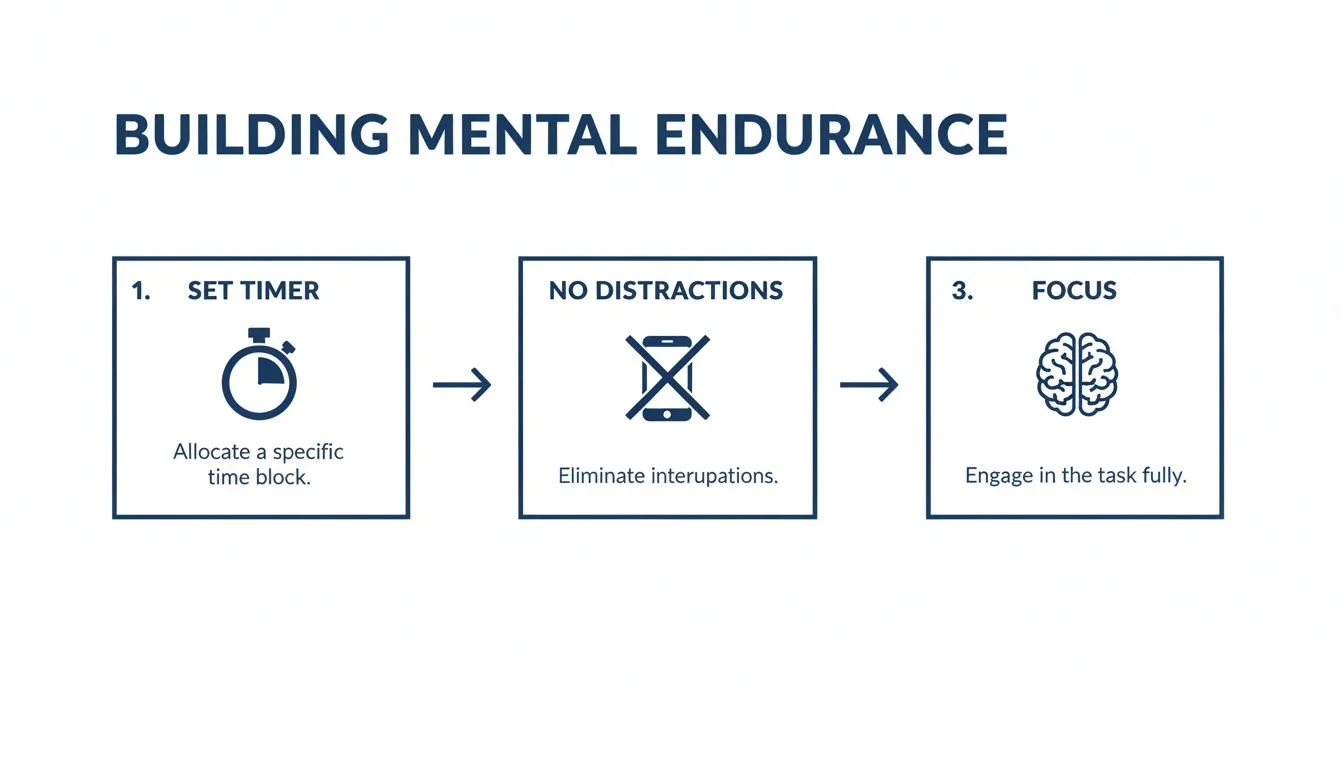
Establish a quiet, controlled space for every practice attempt. Treat this area as your personal testing center. Silence your phone, close all browser tabs that are not the exam itself, and disable desktop notifications. Tell anyone you live with that you cannot be interrupted for the full duration of the test.
Building endurance means working without any breaks or interruptions. You should embrace deep work principles to maintain high levels of concentration. This intense focus is a skill you must develop to succeed on AWS, PMP, or ITIL exams. If you find your mind wandering after 45 minutes, you need more practice sessions to extend that window of performance.
Follow these specific steps to mirror the official experience:
- Set a Strict Timer: Find the official time limit for your exam and follow it. For example, the AWS Certified Solutions Architect – Associate (SAA-C03) allows exactly 130 minutes (verify current limits on the AWS site). Do not pause the timer for any reason once it starts.
- No Outside Assistance: This is a vital rule for realistic assessment. Do not look at your notes, search Google for a definition, or check the AWS documentation. The goal of a simulation is to find exactly where your memory fails when you are under pressure.
- Use Only Permitted Items: You are usually allowed a clear glass of water, but not much else. Do not get up for snacks or take unscheduled breaks. Stay in your chair and maintain the same posture you will use during the proctored exam.
The Psychology of Test-Taking
When you are inside your exam bubble, use specific strategies to manage your mental energy. If a question is confusing or covers a service you haven't mastered, do not let it ruin your momentum. Mark the question for review and move to the next one immediately. Spending ten minutes on a single difficult problem is a poor trade-off if it prevents you from answering three easier questions at the end of the test.
A reliable strategy involves making educated guesses by process of elimination. Most AWS questions have four options. You can often remove two choices immediately by spotting services that do not fit the requirements for cost, security, or high availability. This changes a difficult guess into a 50/50 choice, significantly increasing your chances of getting the point.
This type of simulation does more than check your knowledge; it builds the confidence necessary to walk into the testing center without excessive anxiety. By placing yourself in a timed, high-pressure environment repeatedly, you train your mind to stay calm and perform at its best when the result actually counts toward your certification.
How to Analyze Your Results and Pinpoint Your Weak Spots
Selecting "submit" on an AWS practice exam does not represent the end of your study session. Instead, it marks the beginning of the most effective part of your preparation. The real benefit comes when you carefully examine your results, looking well beyond whether you passed or failed. You should use a practice test as a diagnostic tool to identify the exact areas where you need to spend more time.
Your final score is a single data point that does not tell the whole story. You find the most useful information in the patterns of your mistakes. Rather than just acknowledging a wrong answer, you should adopt the mindset of an investigator and categorize every error. This structured approach helps candidates pass with confidence and separates them from those who end up retaking the same test multiple times without making progress.
Categorizing Your Mistakes
Set up a consistent system to track your progress, such as a spreadsheet, a physical notebook, or a flashcard application. For every question you answer incorrectly on your AWS practice exams, record it and assign it to a category. The goal is to make your technical blind spots impossible to ignore so you can fix them before the actual test date.
Consider these three methods to help you understand your errors:
- By AWS Service or Domain: This is essential for directing your study time. Review your results to see if you are consistently failing questions about networking components like VPC, Direct Connect, and Route 53. You might also find that database services, such as RDS, Aurora, and DynamoDB, are your primary struggle. Grouping errors this way shows you exactly where your technical knowledge is thinnest.
- By Question Keyword or Concept: Pay attention to whether you struggle when a prompt asks for the "most cost-effective," "highest availability," "least operational overhead," or "most secure" option. If these questions trip you up, you likely need to spend more time studying how the AWS Well-Architected Framework applies to different scenarios. You must understand the logic of the framework rather than just the names of individual services.
- By Question Type: Sometimes the problem is not the technology but the way the question is written. You might have trouble with long, wordy scenarios that require intense focus and reading comprehension. You might also find that reading IAM policies or CloudFormation templates is difficult under a time limit. Identifying these issues helps you improve the specific skill of taking a standardized exam.
You should focus on understanding why you missed a question instead of only looking at what you missed. Did you misread a word? Did you overlook a specific requirement mentioned in the prompt? Is there a fundamental concept you do not understand yet? You must be honest during this assessment to make actual progress.
Building a Targeted Remediation Plan
After you have collected and sorted this data, you can build a study plan that is both efficient and accurate. If you see many mistakes involving Amazon S3 storage classes like Standard, Infrequent Access, Glacier, and One Zone-IA, you do not have to watch an entire 40-hour (verify course duration with the training provider) video course again. You can focus your energy only on that specific topic.
This repeating process helps you build the mental stamina required to take the exam and learn from your errors.
A good remediation plan requires more than just reading notes. If you find that VPC networking is a weakness, use the AWS Free Tier to get hands-on experience. Build a custom VPC from the ground up. Add public and private subnets, set up NAT gateways, and compare the effects of security groups and NACLs. Working directly in the console makes technical concepts stick in your memory in a way that reading a book never will.
When you treat every practice test as a mission to collect data, you create a powerful cycle: test your knowledge, analyze the gaps, study specific topics, and validate your new skills on the next exam. This method ensures that every hour you spend studying moves you closer to passing your certification.
Using Spaced Repetition to Make Knowledge Stick
You have completed an AWS practice exam and identified your weak spots. This is a solid start. Now you must decide how to proceed. If your first instinct is to re-read your notes or watch a video on those difficult topics, you are likely wasting time. Passive review is often the least effective way to ensure complex information stays in your memory. AWS services cover massive amounts of technical ground. Your brain needs a better system than just looking at the same material again.
You must move from seeing the information to active recall. The most effective way to do this for any certification, from the AWS Certified Cloud Practitioner (CLF-C02) to advanced specialty exams, is Spaced Repetition. The concept is straightforward. Instead of cramming for six hours, you review material in short bursts at increasing intervals. You might revisit a concept one day later, then three days after that, then a week later. This process works with your brain’s natural forgetting curve. It signals that this data is important and helps move it into long-term memory.
How Spaced Repetition Works in the Real World
Let's look at a practical way to use this for AWS exam preparation. Imagine you often miss questions about the differences between Amazon RDS Multi-AZ deployments and Read Replicas. This is a common hurdle for many students. Instead of reading the documentation one more time, build a schedule around this specific concept.
- Day 1 (Initial Learning): Right after you miss a question on a practice test, review the topic thoroughly. Do not just read the text. Create something new. You could build a comparison table that lists failover mechanisms, performance impacts, and specific use cases. Sketch a diagram showing how data flows from a primary instance to a standby in a Multi-AZ setup versus how it reaches a Read Replica. Focus on the difference between synchronous and asynchronous replication.
- Day 2 (First Recall): The next day, spend five minutes recalling those details without looking at your notes. Ask yourself what the primary goal of Multi-AZ is compared to a Read Replica. If you struggle to remember, check your notes briefly and then try again later in the day.
- Day 5 (Reinforcement): A few days later, find a practice question that specifically targets RDS architecture. Work through the logic of the question. Do not just select the correct answer. Explain why the three incorrect options are wrong. This forces you to justify your reasoning and strengthens the memory.
- Day 12 (Deepening Understanding): Now, try to teach the concept. Explain the differences between Multi-AZ and Read Replicas to a colleague, a study partner, or even to yourself out loud. Teaching requires you to organize your thoughts and quickly highlights any remaining gaps in your logic.
This method works because every time you retrieve a memory, you strengthen the neural connection. This makes recall faster and more reliable when you are under pressure during the actual exam.
Let Adaptive Learning Do the Heavy Lifting
Tracking this schedule for every AWS service is difficult. Most students do not have the time to manage a manual calendar for dozens of topics like VPC endpoints, IAM roles, or S3 encryption types. This is where an automated system becomes a significant advantage for your study routine.
An adaptive learning system tracks your performance on practice questions to create a dynamic study plan. It identifies your weak areas and schedules topics for review based on memory science. This ensures you see the right material at the best time for retention.
Platforms like MindMesh Academy have this logic built into their systems. When you finish one of our AWS practice exams, the dashboard provides more than just a percentage. It breaks down your results by domain and service. Then, it automatically begins showing you questions on your weaker topics at the correct intervals.
If you have trouble with the specifics of VPC networking, those concepts will appear frequently in your review sessions. If you have mastered S3 storage tiers, the system will move those review dates further out. This focuses your study time where it has the biggest impact. You stop wasting time on material you already know and remove the guesswork about what to study next. The system guides you through the process, making sure every minute spent studying helps close the knowledge gaps that matter most. You can then walk into the testing center ready to pass with confidence.
If you want to learn more about this method, you can explore our guide on mastering spaced repetition studying.
Your Top Questions About AWS Practice Exams, Answered
As you prepare for an AWS certification, questions about how to use practice exams will certainly come up. Using these tools with a clear strategy is what separates people who pass from those who feel like they are simply gambling on their results. Let’s look at the most frequent questions we hear from IT professionals who are getting ready for their certification exams.
How Many Practice Exams Should I Take?
The right number depends on your goals and current knowledge. A good rule is to take 3 to 5 full-length, high-quality mock exams for your specific certification. Use the first practice test as a baseline. Its main purpose is to show you where your knowledge gaps are and which services you need to study more. Every exam after that helps you track your progress and see if your study efforts are working.
Avoid the trap of rushing through many low-quality tests. You will learn more by carefully analyzing five high-quality exams than by skimming through twenty bad ones. Each good exam provides enough data to identify patterns in your mistakes and measure your improvement. This helps you avoid burnout while ensuring you focus on the topics that appear most often on the actual test.
What Score Should I Be Aiming For?
Try to achieve scores between 85% and 90% on your practice runs before you schedule the real test. You should reach these scores across several different exams from different providers. This consistency proves that you have mastered the cloud concepts rather than just memorizing a specific list of questions.
Do not feel discouraged if your first scores are in the 50% or 60% range. This is very common for most students. Use those early scores as a map to guide your study sessions for the following week. It is much more useful to see a low score at home than to see one at the testing center. A high practice score gives you the confidence to sit for the exam knowing you are ready for the challenge.
Are Practice Exams Harder Than the Real Exam?
Most high-quality study resources are designed to be slightly harder than the actual certification test. Reputable providers often include more complex scenarios or ask about more granular details than the official AWS exam does. This is a deliberate choice. By forcing you to deal with difficult scenarios, these exams help you over-prepare. It forces you to improve your critical thinking and time management under tough conditions. When you eventually take the real exam, it should feel more manageable by comparison.
The AWS certification program carries a lot of weight in the tech industry. Early 2025 data shows there are more than 1.42 million active AWS Certifications held by professionals globally (verify current statistics on the AWS training site). Because exams like the SAA-C03 focus heavily on scenarios, and 82% of hiring managers say these certifications make candidates stand out (verify current industry reports), your study time is a valuable investment. If you can handle the hardest practice questions, you will be ready for the real thing. You can see more stats on the value of AWS certification to see why this effort pays off.
When Should I Stop Taking Practice Tests Before My Exam?
Give your brain a chance to rest before the test date. I suggest taking your last full-length practice exam two or three days before your appointment. This gives you time for a final review of a few small topics without the stress of a full mock test.
Do not spend the day before your exam doing a frantic study marathon. Instead, focus on light review and relaxation. If you arrive at the testing center with a clear, well-rested mind, you will be much better at analyzing the questions. Trust the work you have already done. Success on exam day is about being calm and focused, not just about how many facts you can cram into your head at the last minute.
If you want to change your study habits from guessing to a data-driven plan, MindMesh Academy can help. We provide a set of high-quality AWS practice exams and use adaptive learning technology to find your specific knowledge gaps. You can fix your weaknesses quickly and efficiently. Visit our AWS Cloud Practitioner Practice Exams to start your preparation. You can also look at our AWS Cloud Practitioner Study Guide for more help.

Written by
Alvin Varughese
Founder, MindMesh Academy
Alvin Varughese is the founder of MindMesh Academy and an enterprise architecture leader. An electrical engineer by training, he moved from factory automation in South Africa to cloud architecture at GE Appliances and Humana (Fortune 50), and holds 20 professional certifications including AWS Solutions Architect Professional, Azure DevOps Engineer Expert, and Microsoft Agentic AI Business Solutions Architect. He built MindMesh Academy after interviewing too many highly certified candidates who couldn't answer basic questions: the goal is prep that makes you better at the job, not just able to pass the exam.