
AWS Certification Practice Test Score Benchmarks
AWS Certification Practice Test Score Benchmarks
An AWS certification practice test score is useful if you know what benchmark to compare it against. As a general rule, aim for 80% or higher on fresh Foundational practice tests, 82% to 88% on Associate practice tests, and 85% to 90% on Professional or Specialty practice tests before you schedule the real exam.
One score isn't the final word. Look for a pattern: two or three fresh, timed practice exams above your target benchmark, no weak domain dragging below 75% to 80%, and enough time left to review flagged questions. If you're preparing for the AWS Certified Cloud Practitioner exam, a full-length AWS certification practice test can help you compare your score against these readiness signals without guessing.
AWS Passing Scores Versus Practice Test Percentages
AWS exam scores and practice test percentages aren't the same. According to the AWS Certification FAQ, AWS reports certification exam results as scaled scores from 100 to 1,000. The minimum passing score depends on the exam level, not on a simple raw percentage.
This matters because a practice test might show 72% correct, but an AWS Associate passing score of 720 doesn't mean you need exactly 72% of the questions right. Scaled scoring accounts for the exam form and question difficulty. Your practice test provider may use raw percentages, weighted domains, or its own scoring model.
Use this table as your starting point:
| AWS exam level | Official AWS passing scaled score | What not to assume | Practical practice test target |
|---|---|---|---|
| Foundational | 700 | 70% practice score automatically equals ready | 80% or higher on fresh tests |
| Associate | 720 | 72% practice score automatically equals ready | 82% to 88% on fresh tests |
| Professional | 750 | 75% practice score automatically equals ready | 85% to 90% on fresh tests |
| Specialty | 750 | 75% practice score automatically equals ready | 85% to 90% on fresh tests |
A higher practice benchmark gives you a safety margin for exam-day pressure, unfamiliar wording, and questions that combine multiple services in one scenario.
AWS Certification Practice Test Score Benchmarks by Exam Level
The right benchmark depends on the exam you're taking. A Cloud Practitioner candidate can often reach readiness with broad conceptual knowledge and consistent practice. A Solutions Architect Associate candidate needs stronger scenario judgment. A Professional or Specialty candidate needs both depth and speed.
| Practice score range | Foundational readiness | Associate readiness | Professional or Specialty readiness |
|---|---|---|---|
| Below 60% | Major content gaps | Major content gaps | Major content gaps |
| 60% to 69% | Review objectives before another full test | Not ready for exam scheduling | Not ready for exam scheduling |
| 70% to 74% | Borderline if domains are uneven | Still too risky | Still too risky |
| 75% to 79% | Close, but check weak domains | Borderline and needs targeted work | Not enough margin |
| 80% to 84% | Reasonable readiness if fresh and timed | Close, but verify consistency | Borderline |
| 85% to 89% | Strong readiness | Strong readiness if domains are balanced | Good readiness if timing is controlled |
| 90% or higher | Strong, unless score is from repeated questions | Strong, unless score is from repeated questions | Strong, but still review missed scenarios |
Fresh matters. If you score 91% on a test you've already taken twice, you may be recognizing answers instead of solving problems. Repeated questions are still useful for review, but they're weak evidence of exam readiness.
A better signal is a fresh test score in the target range, followed by a clear explanation of why each correct answer is best and why each distractor is wrong. If you struggle with the wording of AWS scenarios, review the method in MindMesh Academy's guide to reading AWS certification exam questions before you burn through more practice sets.
What Counts as a Fresh AWS Practice Test Score
A fresh score comes from questions you haven't memorized. It's fine if the topics are familiar, but the exact scenarios, answer choices, and phrasing should be new enough that you have to reason through them.
Here's a simple way to classify your scores:
| Score type | How it happens | How much you should trust it |
|---|---|---|
| Fresh timed score | First attempt on a full-length test under exam timing | High trust |
| Fresh untimed score | First attempt, but you pause often or look things up | Medium trust |
| Repeated timed score | Second or third attempt on the same test | Low to medium trust |
| Review mode score | You answer with explanations visible or check notes | Low trust as a readiness metric |
Review mode is excellent for learning. It's not a readiness benchmark. Treat it like a study session, not like a predictor of your AWS exam result.
Domain Score Benchmarks That Matter More Than Your Average
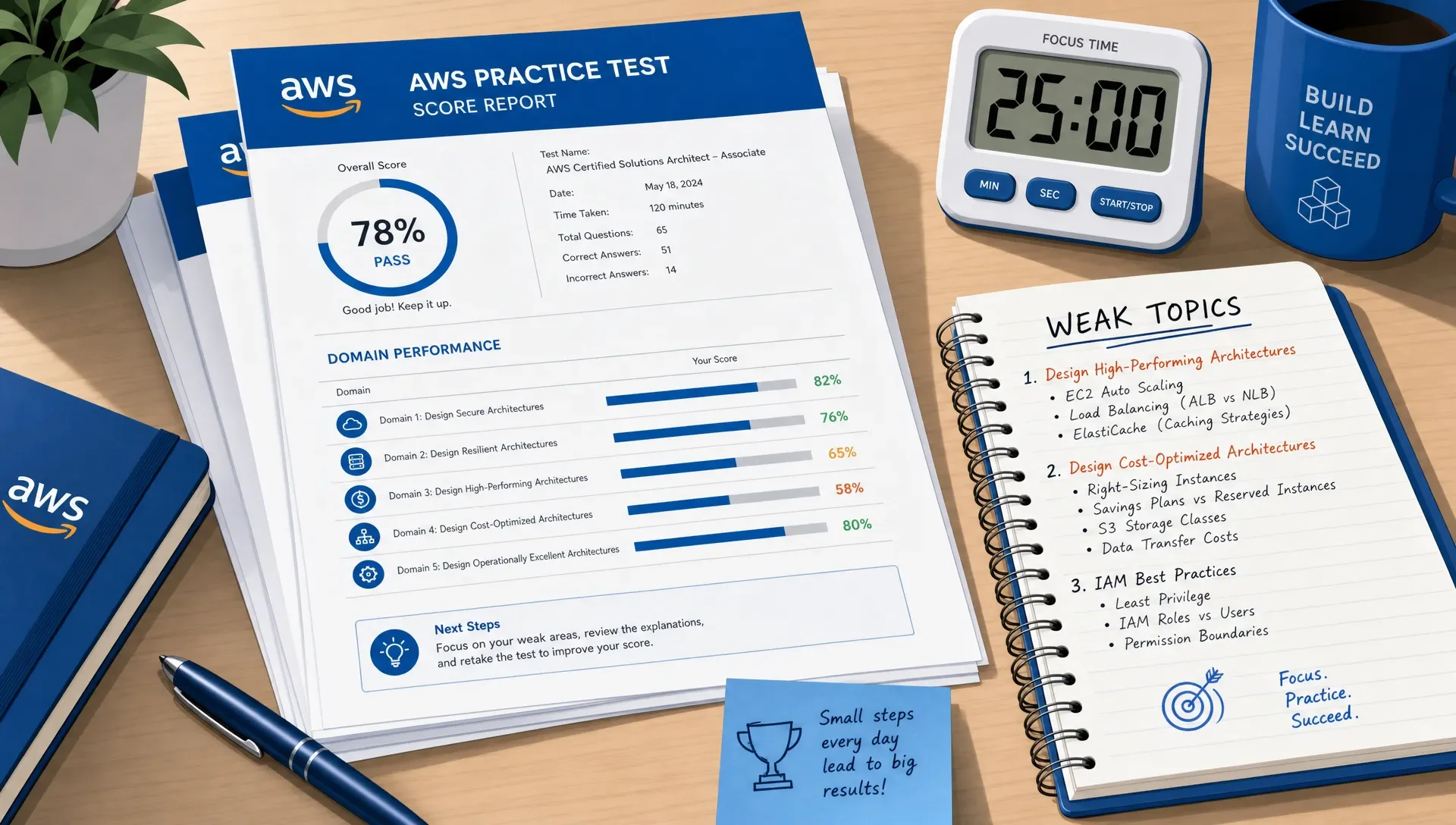
Your total score can hide a dangerous weakness. For example, an Associate candidate might score 84% overall but only 62% in security or networking. That candidate isn't as ready as the average suggests because AWS scenario questions often combine domains.
A safer benchmark is:
- Foundational exams: Keep every domain at 75% or higher, with your overall score at 80% or higher.
- Associate exams: Keep every major domain at 78% or higher, with your overall score above 82%.
- Professional and Specialty exams: Keep every major domain at 80% or higher, with your overall score above 85%.
If your domain scores swing widely between attempts, slow down. Don't keep taking full tests just to chase a better average. Use the domain report to identify your next study block, then return to a fresh timed test after targeted practice.
How Many Practice Test Attempts Show Real Readiness
One good score is encouraging, but two or three consistent scores provide stronger evidence. Exam readiness is a trend, not a screenshot.
For most AWS candidates, a reliable pattern looks like this:
| Readiness signal | Minimum benchmark |
|---|---|
| Full-length fresh practice tests completed | 2 to 3 |
| Scores | At or above the target range for your exam level |
| Domain performance | No major domain below 75% to 80% |
| Timing | Finish with review time remaining |
| Explanations | You can explain missed questions without memorizing answers |
| Retake behavior | Repeated-test scores aren't your main evidence |
If your first score is low and your third score is high, check why. Improvement after targeted review is good. Improvement because you remember the wording isn't the same thing.
This is where spaced review helps. In a peer-reviewed study, Roediger and Karpicke found that retrieval practice improved long-term retention compared with restudying alone. In exam prep terms, that means you should actively answer questions, explain your reasoning, and revisit weak topics over time instead of rereading notes until they feel familiar.
Timing Benchmarks for AWS Practice Exams
A passing-level score earned with unlimited time isn't the same as a passing-level score under exam conditions. AWS exams reward careful reading, but they also punish slow decision-making.
Use the time limit from your current AWS exam guide, then measure these three things:
| Timing metric | Good benchmark | Warning sign |
|---|---|---|
| Average pace | You stay close to the required minutes per question | You spend too long on early questions |
| Flagged questions | You flag uncertain items and keep moving | You get stuck trying to perfect one answer |
| Final review time | You finish with 10 to 15 minutes left when possible | You run out of time or rush the final section |
For scenario-heavy exams, timing problems usually come from reading the whole question too loosely. Start by finding the final ask, then identify constraints such as cost, high availability, least operational overhead, migration timeline, or security requirement. After that, eliminate choices that violate a constraint, even if they contain familiar AWS services.
If timing is your main problem, don't immediately add more content review. Practice question triage. Mark the questions where two answers seem plausible, move on, and return if time allows.
What to Do When Your AWS Practice Test Score Is Too Low
Low scores are useful if they change your study plan. A 64% practice score isn't a failure, but it's clear evidence that another full-length test tomorrow is probably a poor use of time.
Use this score-based plan:
| Your latest fresh score | Best next step | When to take another full test |
|---|---|---|
| Below 60% | Return to the exam objectives and rebuild the weakest topics | After several focused study sessions |
| 60% to 69% | Review explanations, make flashcards, and practice by weak domain | After weak domains improve in short quizzes |
| 70% to 79% | Drill missed scenario patterns and timing | After you can explain most misses without notes |
| 80% to 84% | Fix uneven domains and retest under strict timing | Within a few days if this was fresh |
| 85% or higher | Review misses, confirm consistency, and schedule if other signals are strong | Take one more fresh test if unsure |
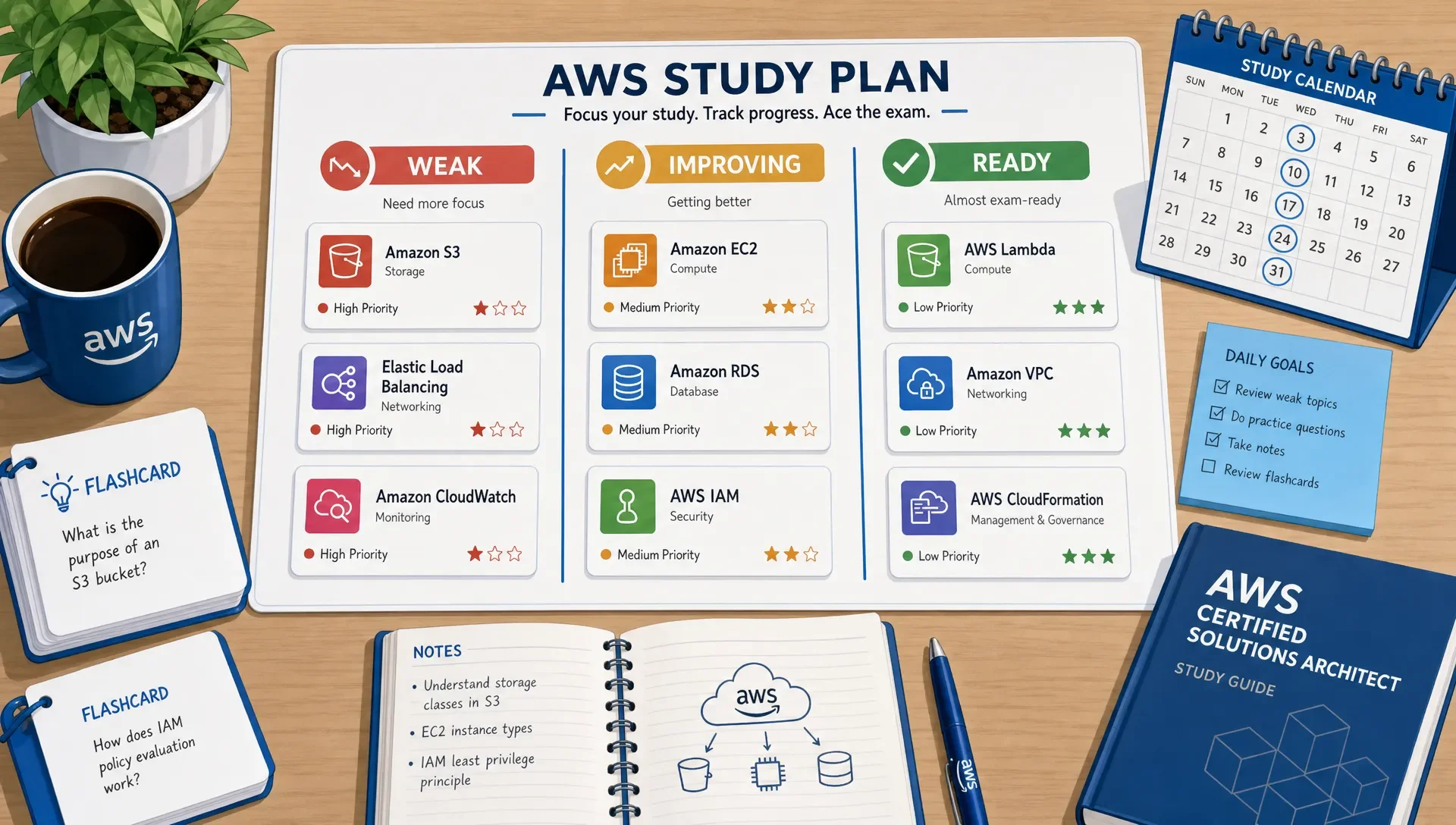
If you're preparing from the beginning, work through an objective-based path before relying on full-length tests. MindMesh Academy's AWS Certified Cloud Practitioner study guide is organized around exam objectives, which makes it easier to connect weak scores to specific topics instead of studying randomly.
Common Reasons Practice Scores Don't Match Exam Results
A candidate can score well in practice and still underperform on the real exam. When that happens, the issue usually isn't one mysterious bad day. It's often one of these patterns.
| Practice score problem | What it looks like | How to fix it |
|---|---|---|
| Memorized questions | High retake scores, lower fresh scores | Use new question sets and explain reasoning aloud |
| Weak domain hidden by average | Overall score looks fine, one domain is poor | Study by domain before another full test |
| No timing pressure | Strong untimed score, rushed real exam | Take strict timed tests and practice flagging |
| Shallow explanation review | You read why the right answer is right but ignore distractors | Write why each wrong option is wrong |
| Overreliance on service names | You pick familiar AWS services without matching requirements | Train yourself to identify constraints first |
A strong practice plan tests both knowledge and judgment. If you want a broader readiness checklist beyond scores, MindMesh Academy's article on AWS exam readiness signs walks through timing, confidence, consistency, and domain balance.
How MindMesh Academy Helps You Achieve Readiness
A score tells you where you stand. The next step is knowing what to do with it.
MindMesh Academy supports AWS certification prep with study guides by exam objectives, practice questions with explanations, flashcards with spaced repetition, adaptive weakness-based practice, and readiness tracking. This combination matters because your practice score shouldn't sit in isolation. It should connect to the topics you missed, the concepts you need to revisit, and the next questions you should practice.
Instead of treating every missed question the same, look for the underlying skill gap. Did you misunderstand IAM policy evaluation? Did you confuse storage classes? Did you miss a networking clue? Did you overlook the phrase "least operational overhead"? Once you identify the pattern, your next study session gets sharper.
Frequently Asked Questions
What is a good AWS certification practice test score? A good benchmark is 80% or higher for Foundational exams, 82% to 88% for Associate exams, and 85% to 90% for Professional or Specialty exams. The score should come from a fresh, timed test.
Is 70% enough to pass an AWS certification exam? Don't assume that 70% is enough. AWS reports scaled scores, not raw percentages, and practice tests vary in difficulty. A 70% practice score is usually borderline at best and too risky for Associate, Professional, or Specialty exams.
How many AWS practice tests should I take before the exam? Most candidates should complete two or three fresh full-length practice tests. The goal isn't to take as many tests as possible, but to show consistent scores, balanced domains, and controlled timing.
Should I retake the same AWS practice test? Yes, but use retakes for review, not as your main readiness benchmark. A retake score can be inflated because you may remember the questions or answer choices.
Why did I score high on practice tests but fail the AWS exam? Common causes include memorized practice questions, weak domains hidden by a strong average, poor timing, or difficulty interpreting scenario wording. Review your missed-question patterns instead of only reviewing the final score.
How close should my AWS domain scores be? Try to keep every major domain within a reasonable range. For Associate exams, no major domain should be below about 78% when your overall score is above 82%. For Professional and Specialty exams, aim for 80% or higher by domain.
Build Your AWS Exam Plan Around Evidence
The best AWS certification practice test score benchmark isn't a single number. It's a pattern of fresh scores, balanced domains, clean timing, and clear reasoning.
If your scores are below benchmark, use them as a map. Review the exam objectives, practice the weak domains, and turn missed questions into flashcards or short explanations. If your scores are consistently above benchmark and you can defend your answer choices under time pressure, you're in a much stronger position to schedule the exam.
MindMesh Academy helps you connect your objective-based study to practice questions, spaced repetition, and readiness tracking, so your next score tells you exactly what to improve. Ready to put your knowledge to the test? Start strong and prepare for your Solutions Architect Associate exam with our practice exams today.

Written by
Alvin Varughese
Founder, MindMesh Academy
Alvin Varughese is the founder of MindMesh Academy and an enterprise architecture leader. An electrical engineer by training, he moved from factory automation in South Africa to cloud architecture at GE Appliances and Humana (Fortune 50), and holds 20 professional certifications including AWS Solutions Architect Professional, Azure DevOps Engineer Expert, and Microsoft Agentic AI Business Solutions Architect. He built MindMesh Academy after interviewing too many highly certified candidates who couldn't answer basic questions: the goal is prep that makes you better at the job, not just able to pass the exam.