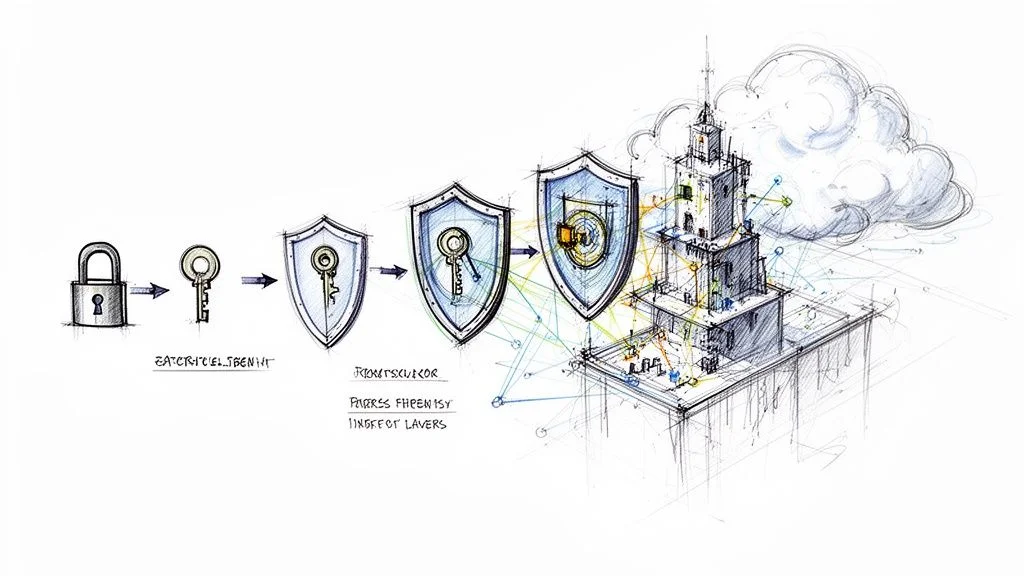
Master the AWS Security Specialty Certification
The AWS Certified Security – Specialty certification validates your skills in designing, implementing, and managing security solutions on the AWS cloud. This exam tests experienced IT professionals who work daily with cloud security protocols. It requires a clear understanding of AWS security services and mastery of best practices.
Earning this certification demonstrates your ability to safeguard critical assets against modern threats while maintaining compliance and operational integrity. Use this guide to prepare for the current exam. Professionals who hold this title often serve as technical leads, ensuring every layer of their cloud environment remains secure and resilient over time.
Your Blueprint for AWS Security Mastery
If you are ready to earn a respected cloud security credential, you have come to the right place. The AWS Certified Security – Specialty is not meant for beginners. It serves as a mark of distinction for professionals who have dedicated significant time to understanding how to reduce the risks of securing modern cloud environments.
Passing this exam proves your capability to handle sophisticated security challenges, design resilient architectures, and automate security operations. It shows employers that you possess practical knowledge of AWS security services, covering data protection, incident response, infrastructure hardening, and compliance. This guide from MindMesh Academy provides a clear path to help you pass with confidence.
Who Should Pursue This Certification?
The AWS Security Specialty targets professionals who are already working in the field. If you serve in one of the following roles and have a history of practical experience, this certification is a logical next step for your professional growth.
- Security Engineers: These professionals implement, maintain, and troubleshoot security controls and configurations on a daily basis within AWS environments to keep data safe.
- Cloud Architects: These individuals are responsible for designing secure, scalable, and fault-tolerant cloud infrastructures from the ground up, ensuring security is part of the architecture from the first day.
- DevSecOps Professionals: These experts focus on building security practices and automation into the continuous integration/continuous delivery (CI/CD) pipeline, integrating security tools into the development lifecycle.
- Experienced IT Professionals: These workers have at least two years of direct, hands-on experience securing AWS workloads and understand the specific details of cloud-native security.
The exam assumes you have applied theoretical concepts to real-world scenarios. AWS recommends having at least five years of general IT security experience, with a minimum of two of those years spent working directly within AWS. This recommendation exists because the exam uses scenario-based questions that test problem-solving skills rather than memorization. If you are still building that foundational experience, exploring other valuable AWS certifications can prepare you for this advanced credential.
This certification is more than just a test; it helps you become a valuable asset in a job market that needs specialized talent. Earning this credential acts as a signal for recruiters seeking cloud security experts, which often leads to career advancement and salary increases.
Reflection Prompt: Do your current responsibilities and experience align with these recommendations? Where might you need to gain more hands-on experience before tackling this specialty exam?
Deconstructing the Exam Domains
To pass the AWS Certified Security – Specialty (SCS-C03) exam, you must do more than just memorize a list of tools. You need to develop the perspective of an AWS security professional. This involves understanding how the five core domains integrate to create a secure cloud environment.
Your preparation should focus on building a layered security architecture. You begin by determining access controls through Identity and Access Management. Then, you build network-level protections like gateways and firewalls. Next, you protect the data stored within those environments, establish monitoring for constant visibility, and finally, create response plans for unexpected security events. This integrated approach mirrors the daily responsibilities of a security engineer.
The following infographic illustrates why developing these skills is a strong investment for your career.
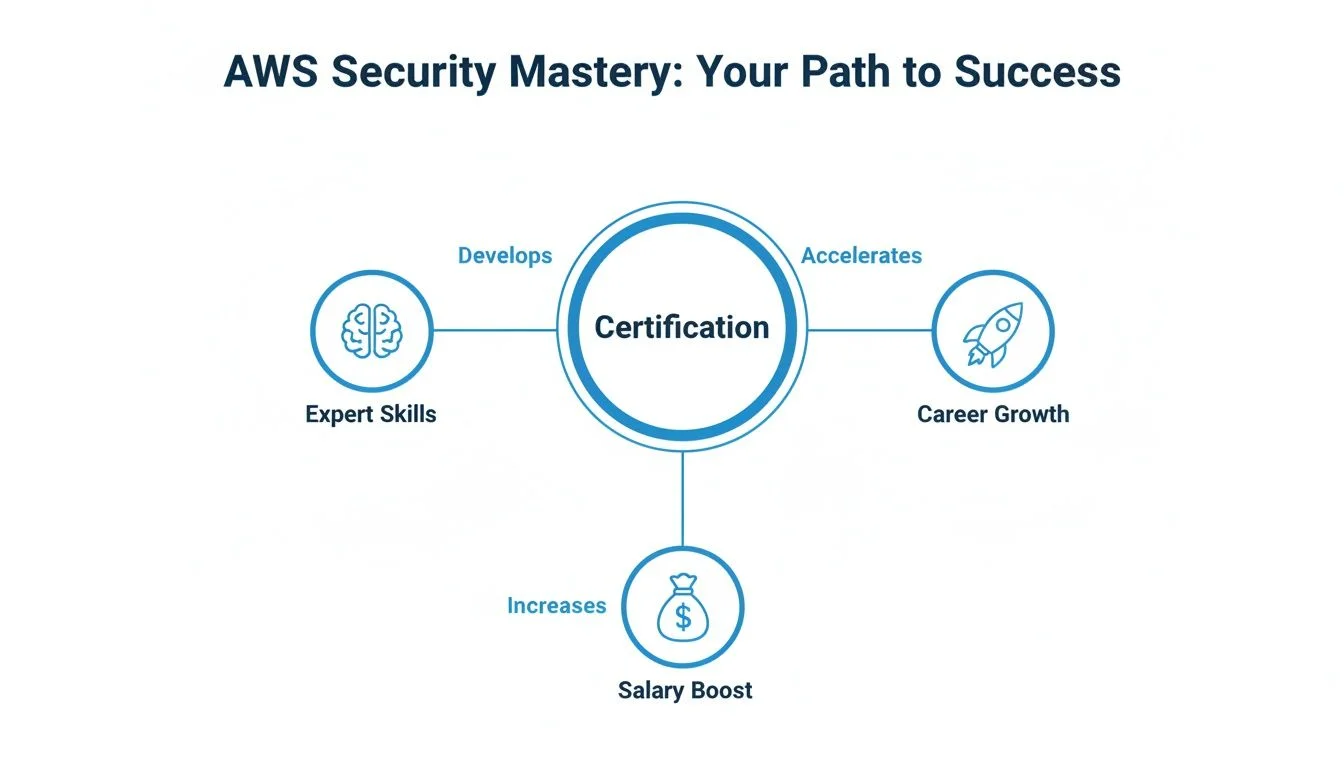
As shown, building expertise across these domains does more than earn you a digital badge. It translates directly into career growth and higher earning potential. The demand for cloud security professionals remains high across all sectors.
To start, let’s look at what each domain covers, how much it counts toward your score, and the specific services you need to know.
Reflection Prompt: Which of these domains feels most familiar to you currently, and which represents the biggest learning opportunity?
AWS Security Specialty Exam Domain Breakdown
| Domain | Weighting | Key Concepts & Services |
|---|---|---|
| Domain 1: Identity & Access Management | 20% | IAM (Policies, Roles), AWS Organizations (SCPs), IAM Identity Center, Federation (SAML, OIDC), Cognito |
| Domain 2: Infrastructure Security | 26% | VPC (Security Groups, NACLs, Endpoints), AWS WAF, Shield, CloudFront, Systems Manager, Inspector |
| Domain 3: Data Protection | 22% | KMS, CloudHSM, Certificate Manager (ACM), S3 Encryption, EBS Encryption, Macie |
| Domain 4: Logging & Monitoring | 20% | CloudTrail, CloudWatch, Config, GuardDuty, Security Hub, EventBridge |
| Domain 5: Incident Response | 12% | IAM Role for IR, Step Functions, Lambda, Forensic Snapshots, Isolate/Contain Strategies |
This table serves as a roadmap for your study plan. We will now examine the specific knowledge required for the first three domains.
Domain 1: Identity and Access Management (20%)
This domain accounts for 20% of your total score. It is the foundation of every security practice within AWS. Everything in the cloud starts with an identity and a set of permissions. The primary goal here is the principle of least privilege. This means ensuring that every user, application, and service has only the specific access required to perform its job—and nothing more.
Mastering this domain requires more than a basic knowledge of AWS Identity and Access Management (IAM). You must be able to design and troubleshoot complex access patterns for large organizations.
To succeed in this domain, you must be proficient in:
- JSON Policy Logic: You will need to write and interpret JSON policies. This includes understanding the "Effect," "Action," "Resource," and "Condition" elements. You must understand how AWS evaluates policies. For instance, an explicit "Deny" in any policy always overrides an "Allow." You should also know how permissions boundaries and Service Control Policies (SCPs) limit the maximum permissions an identity can have.
- Cross-Account Access Patterns: Modern cloud architectures use multiple AWS accounts to isolate workloads. You must know how to configure IAM roles that allow users in a development account to access resources in a production or security account. This involves setting up trust policies and identity policies. You should also understand the External ID property, which prevents the "confused deputy" problem when allowing third-party SaaS providers to access your account.
- Identity Federation and SSO: The exam tests your ability to connect AWS with external identity systems. You must understand AWS IAM Identity Center (formerly AWS SSO) and how it manages access across an entire AWS Organization. You should also know how SAML 2.0 and OpenID Connect (OIDC) allow employees to sign in using corporate credentials from providers like Okta or Active Directory.
- Policy Variables and Conditions: Expert-level IAM involves using conditions to restrict access based on specific context. This includes limiting access to specific IP ranges, requiring Multi-Factor Authentication (MFA), or ensuring traffic comes through a specific VPC Endpoint. You should also understand how to use policy variables to create scalable policies that apply to many users at once.
Certification Scenario: You might see a question asking you to design a role for an external auditor in Account A. They need read-only access to S3 buckets in Account B. However, they should only be allowed access if they have MFA enabled and are connecting from a specific office IP address. You would need to determine the correct trust policy for the role in Account B and the permissions policy in Account A to make this work.
Key Takeaway: IAM is about more than creating users. It is a system for designing a scalable access model that supports enterprise identity solutions while maintaining strict control.
Domain 2: Infrastructure Security (26%)
Infrastructure Security is the largest part of the exam at 26%. This domain focuses on the protection of your actual resources—where your applications run and how they communicate. You are responsible for securing virtual networks, compute instances, containers, and edge services.
The main strategy here is defense-in-depth. This approach assumes that no single security control is perfect. Instead, you use multiple layers of protection so that if one fails, others remain in place to stop an attacker. This principle is a major focus of the AWS Security Specialty (SCS-C03) exam.
The essential topics you must master include:
- VPC Security Controls: You must understand the technical differences between Security Groups and Network Access Control Lists (NACLs). Security Groups are stateful; if you allow a request in, the response is automatically allowed out. NACLs are stateless, meaning you must write rules for both directions. You also need to know when to use VPC Endpoints (Interface vs. Gateway) to keep your traffic on the private AWS network instead of sending it over the public internet.
- Edge Protection Services: AWS WAF, Shield, and CloudFront form your outer perimeter. You should know how to use AWS WAF to block common web threats like SQL injection and cross-site scripting (XSS) using managed rules. You must also understand the difference between AWS Shield Standard, which is free and active by default, and Shield Advanced, which provides specialized DDoS protection and access to the DDoS Response Team.
- Compute Hardening and Patching: Securing an EC2 instance or a container involves more than just firewall rules. You must know how to use AWS Systems Manager (SSM) for automated patching and configuration management. You should also be familiar with Amazon Inspector, which scans your instances and container images for software vulnerabilities. This ensures that your compute environment is protected against known exploits.
- Network Isolation Techniques: You need to understand how to design subnets and route tables to isolate sensitive databases from the public internet. This includes using NAT Gateways for outbound-only internet access and using Bastion hosts or Systems Manager Session Manager for secure administrative access without exposing SSH ports to the world.
Certification Scenario: Consider a three-tier web application. You may be asked how to configure the security groups so the web tier can talk to the application tier, but the database tier only accepts traffic from the application tier. You might also need to decide whether to place an Application Load Balancer in a public or private subnet and how to associate an AWS WAF Web ACL to protect the front end.
To prepare effectively, try to look at infrastructure from an attacker's point of view. Understanding the basics of a cloud penetration test can help you identify common misconfigurations. This helps you find vulnerabilities in your network setup before they are exploited.
Reflection Prompt: Can you explain the difference between a Security Group and a Network ACL? In what situation would you use an NACL to block a specific IP address instead of using a Security Group?
Domain 3: Data Protection (22%)
Data Protection makes up 22% of the exam. This domain focuses on keeping your data safe while it is "at rest" (stored on a disk) and "in transit" (moving across a network). Data is often the most important asset an organization owns, and you must know how to protect it using encryption and discovery tools.
Encryption is your most powerful tool in this domain. You must have a high level of expertise in how AWS handles encryption keys and how different services use them.
To excel in this domain, you will need a deep understanding of:
- AWS Key Management Service (KMS): This is the central service for data encryption. You must know the difference between AWS-managed keys and customer-managed keys. You should understand how to write KMS key policies that define who can use a key to encrypt or decrypt data. You should also understand "encryption context," which adds an extra layer of security by requiring specific metadata to be present during the decryption process.
- Data Discovery with Amazon Macie: You cannot protect data if you do not know where it is located. Amazon Macie uses machine learning to scan S3 buckets for sensitive information like credit card numbers, social security numbers, or private keys. You should know how to set up Macie discovery jobs and how to act on the findings to improve your data security posture.
- Encryption in Transit: This involves using SSL/TLS to protect data as it moves. You must know how to use AWS Certificate Manager (ACM) to request and deploy certificates. This includes understanding the validation process—either via DNS or email—and knowing how to attach those certificates to services like CloudFront or an Application Load Balancer to ensure secure communication.
- Storage Service Encryption: You must understand how encryption works for specific services. For Amazon S3, you should know the differences between SSE-S3 (managed by S3), SSE-KMS (managed by KMS), and SSE-C (where the customer provides the key). For EBS volumes and RDS databases, you should know how to enable encryption at rest and how to share encrypted snapshots across different AWS accounts.
- S3 Security Features: Beyond encryption, you must know how to use S3 Block Public Access to prevent accidental data exposure. You should also understand S3 Object Lock for data that must not be deleted or changed, which is important for compliance and protecting against ransomware.
Certification Scenario: An exam question might describe a company that needs to store sensitive medical records in S3. You would need to recommend a strategy that includes using a customer-managed KMS key for encryption, enabling S3 Versioning, and using S3 Object Lock in "compliance mode" to meet legal requirements. You might also need to explain how to use a VPC Endpoint to ensure that the data never leaves the AWS network when it is being uploaded.
Key Takeaway: Data protection in AWS is a combination of strong encryption, careful key management, and automated tools that find and classify sensitive information across your storage services. Understanding the shared responsibility model is helpful here; AWS secures the underlying hardware, but you are responsible for how you configure encryption and manage your keys.
Is the AWS Security Specialty Worth It? Your Career and Salary Potential
Committing the time and effort needed to earn the AWS Security Specialty certification is a major investment. It is reasonable to ask if the career return justifies the work. The clear answer is that the payoff is high. This certification provides a direct path to higher pay and senior, high-impact roles in a technology sector that currently lacks enough specialized talent.
This credential is more than a simple addition to your resume. It marks you as an expert in a market where cloud security skills are extremely rare. As more organizations run their entire businesses on cloud platforms, the need for professionals who can actually secure those environments has reached new heights.
How Specializing Translates to Your Paycheck
The financial impact of this certification is clear. You should view this credential as a tool to increase your earning potential. We see professionals who hold the AWS Security Specialty certification earning average salaries of about $148,000 annually in the US (verify current regional trends on local job boards). For top performers, these figures often rise above the $190,000 mark.
These statistics are supported by salary surveys, which showed a projected 9% year-over-year salary increase in reports from 2026. This pay premium exists because companies are ready to pay more for experts who can defend their most important digital assets against a constant stream of cyber threats. For a more detailed look at these numbers, you can refer to the 2026 salary report.
Sky-High Demand in a High-Stakes World
The high compensation for AWS Security Specialty holders is a result of the massive demand for these specific skills. The need for qualified cloud security experts is driven by a mix of increasing cyber threats and strict legal requirements.
- Non-Stop Cyber Threats: Hardly a day goes by without news of a major data breach or a ransomware attack. Businesses are looking for individuals with the skills to build resilient defenses using tools like AWS WAF for traffic filtering, Amazon GuardDuty for threat detection, and AWS Shield for protection against DDoS attacks.
- The Compliance Maze: Rules like GDPR, CCPA, and HIPAA are not suggestions. They include heavy financial penalties for companies that fail to follow them. Professionals with the AWS Security Specialty certification are the experts organizations trust to design, build, and audit cloud environments that follow these strict standards.
This combination of factors has created a significant gap in the workforce. In a single year, job listings that specifically requested this certification grew by 73%. By 2026, it is expected to be one of the most popular credentials, with an estimated 12,000-15,000 open roles every year. This represents a 35% year-over-year growth rate, partly caused by the new security challenges created by artificial intelligence (AI) workloads in the cloud.
Your AWS Security Specialty certification acts as a signal to hiring managers. It proves you have the practical, tested skills to take on a senior security role and make an immediate impact. This helps you stand out in a competitive job market.
A Stamp of Expertise for Long-Term Success
Ultimately, this certification is an investment in a long-term career. As you plan your professional future, consider if technology a good career path for your goals. The data suggests that specializing in cloud security is one of the most stable and rewarding paths available today.
As long as AWS stays the leader in the cloud market, the need for professionals who can protect its services will only grow. Earning this certification is a way to keep your skills relevant. It ensures your expertise stays in demand and your pay remains high for many years. You become a vital part of any modern organization's security strategy.
Building Your Strategic Study Plan
Passing the AWS Certified Security – Specialty (SCS-C03) exam requires more than just a casual interest in cloud security. To be blunt: attempting this test without a defined plan usually ends in frustration. This is not a certification you can cram for over a long weekend. Success requires a structured approach that builds technical skills over several months. A reliable study plan, usually lasting 8-12 weeks, serves as your primary defense against the volume and technical depth of the exam content. It allows you to enter the testing center with actual confidence rather than just hope.
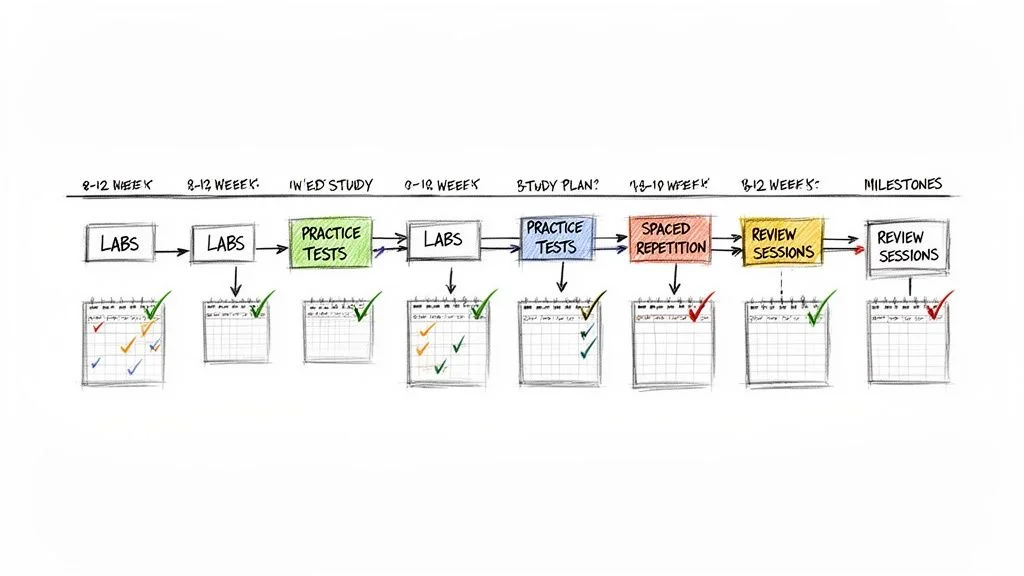
The most effective preparation uses a methodology centered on practical application. Passive reading of whitepapers or watching videos won't be enough to pass. You must work directly in the AWS console to build the physical memory of how security services function and communicate. This hands-on aptitude is exactly what the exam questions measure. They present scenarios where you must choose the most secure or cost-effective configuration, a task that is much easier if you have actually configured those services yourself.
Reflection Prompt: Have you ever created a detailed study plan for a certification? What were its strengths and weaknesses?
Adopting an Evidence-Based Learning Framework
Effective study plans use cognitive science to ensure information sticks. Re-reading high-level notes often creates a false sense of mastery. Instead, use techniques that force your brain to work harder during the learning process, which leads to better retention during the actual exam.
One such technique is Spaced Repetition. Rather than trying to memorize every IAM condition key in one sitting, you review the concepts at specific intervals. You might study KMS key policies today, review them again in two days, and then check your knowledge again in a week. This method works because it forces the brain to reconstruct the memory just as it starts to fade, making the mental connection stronger each time. Pair this with Active Recall, where you quiz yourself without looking at notes. Instead of looking at a list of S3 bucket policy components, try to write them out on a blank piece of paper from memory. If you cannot explain a concept clearly without looking at your notes, you have not yet mastered it.
A study plan should function as a flexible system. Use it to find your weakest domains and focus your energy where it will have the most impact. This ensures you spend your time building actual expertise rather than reviewing things you already know.
A structured process changes a massive pile of documentation into a logical sequence of tasks. It turns an intimidating goal into a series of weekly wins. By the time you reach the end of your schedule, the security aspects of the exam will feel like a natural extension of your daily routine rather than a collection of abstract facts.
The 8-Week Practice-Heavy Study Blueprint
This 8-week blueprint provides a framework you can adjust based on your current workload and experience level. The core of this schedule is a cycle: learn the theory, apply it in a lab, and review the results. This repetition ensures that by week eight, you are ready for the pressure of the testing environment.
| Week | Focus Area | Key Activities |
|---|---|---|
| Weeks 1-2 | Foundational Concepts & IAM | Focus on IAM, AWS Organizations, and IAM Identity Center. Complete at least 5 hands-on labs that cover policy writing, cross-account roles, and configuring identity federation. |
| Weeks 3-4 | Infrastructure & Data Protection | Study VPC security, AWS WAF, Shield, KMS, and Macie. Use labs to build secure networks and set up encryption for data at rest and in transit. |
| Weeks 5-6 | Logging, Monitoring & Incident Response | Work with CloudTrail, Amazon GuardDuty, and AWS Security Hub. Build automation for incident response using AWS Lambda and Step Functions. Take your first full-length practice exam. |
| Weeks 7-8 | Weakest Domain Review & Final Prep | Review your practice exam scores to find weak spots. Spend this time on targeted labs and intensive review of those specific areas. Take 2-3 more practice exams under timed conditions. |
The schedule intentionally places heavy study at the beginning and transitions into intense testing and review at the end. This final cycle of testing and review is where most students see their scores improve. For a more detailed breakdown of every topic, you can view the AWS Certified Security – Specialty study guide. This guide carefully maps out specific resources for each of the five exam domains.
The Financial and Career Motivation
Staying focused for two months is difficult, so it helps to remember why you are pursuing this credential. The AWS Security Specialty is a major factor in career growth. Companies are moving to the cloud faster than they can hire security experts to protect those environments. Some industry reports indicate a 41% increase in the demand for professionals who can secure cloud infrastructure.
This demand affects your salary. Estimates suggest that by 2026, professionals who hold this certification can expect global salaries between $150,000 and $175,000 (verify current pricing and market rates on the vendor site or local job boards). If you also have experience with AI security, that figure can rise above $170,000. When you [discover more insights about top-paying certifications], it becomes clear that the time spent studying offers a significant return. You are not just passing a test; you are positioning yourself for high-level roles in a competitive market. This credential serves as a signal to employers that you have the technical discipline to handle complex security requirements.
Mastering Hands-On Labs and Practice Questions
You cannot pass the AWS Certified Security – Specialty (SCS-C03) exam by just reading study guides or watching videos. While theoretical knowledge provides a necessary framework, the exam functions as a practical evaluation of your technical skills. It verifies whether you can actually execute security tasks in a live environment. To succeed, you must spend significant time working directly within the AWS management console.
This is where hands-on labs become your strongest ally. Reading about the features of AWS WAF is a good starting point, but it is a different experience to build a Web ACL from scratch. You should practice implementing rules that specifically block simulated SQL injection attacks. Then, you need to connect that WAF to a live Application Load Balancer and verify that the traffic is filtered correctly. This type of active practice builds the muscle memory required to solve complex problems during the exam.
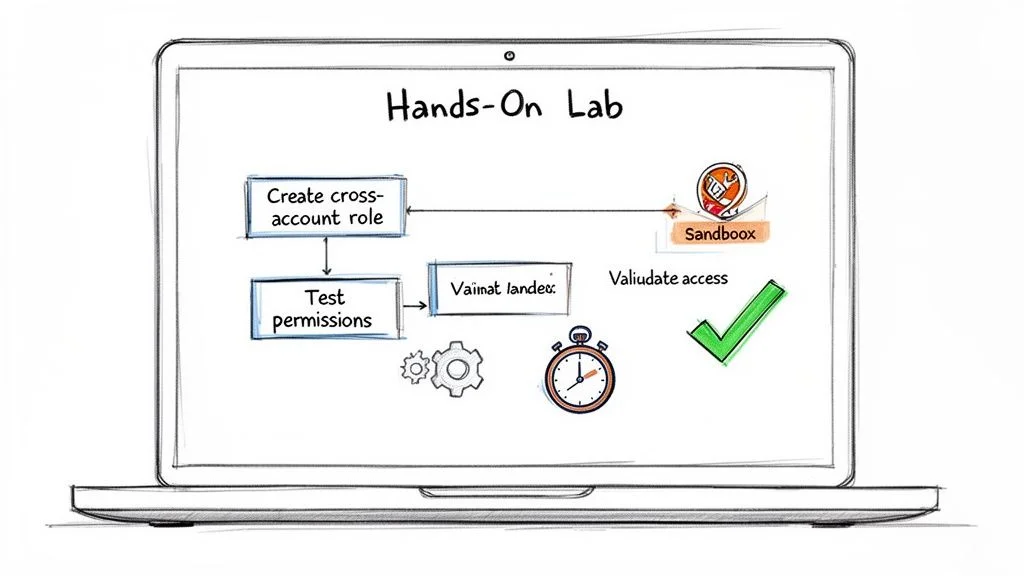
True learning happens when you move beyond simple memorization. Instead of just remembering the steps to create a cross-account IAM role, you should physically build the trust relationship. You need to test how the permissions work across accounts and troubleshoot the setup when things go wrong. If you spend an hour figuring out why a specific policy is resulting in an "Access Denied" error, that time is well spent. Solving those errors is how the most important technical concepts become permanent.
From Theory to Practice with Labs
The goal of a well-crafted lab is not just to follow a list of instructions. It should force you to think like a security engineer. You need to understand the logic behind every configuration choice you make. The best labs give you a scenario and a security goal, then ask you to find the solution. This mirrors the way exam questions are written, where you are presented with a problem and must choose the best architectural fix.
Here are three lab ideas that focus on scenarios frequently found on the current exam:
- Tuning KMS Key Policies: Do not just create a default KMS key. Create a customer-managed key (CMK) and write a custom key policy. Ensure this policy allows a specific IAM role to encrypt and decrypt data but explicitly prevents all other users from using the
kms:ScheduleKeyDeletionaction. Practicing this helps you understand how resource-based policies function and how they interact with identity-based permissions. - Building a Secure VPC Architecture: Move past the default VPC settings. Design a three-tier application architecture that uses public, private, and isolated database subnets. Apply Security Groups and Network ACLs to control the flow of traffic. You should configure the rules so that only web traffic reaches the public tier, and only the application tier can talk to the database. This exercise clarifies the difference between stateful and stateless traffic filtering.
- Automating Incident Response: This topic is central to the SCS-C03 exam. Set up a scenario where an Amazon GuardDuty finding—such as an EC2 instance communicating with a known malicious IP—triggers an Amazon EventBridge rule. Configure that rule to launch an AWS Lambda function. The function should automatically isolate the instance by replacing its security group with a "quarantine" group that restricts all inbound and outbound traffic. This lab teaches you how to coordinate three different services to create an automated security workflow.
Treat every lab like a dress rehearsal for a real security event or a design challenge. When you practice these security patterns and service connections, you will be able to analyze exam questions much faster. You will recognize the correct solution because you have built it before.
This practical work is the difference between knowing the name of a service and knowing how to use it to secure an environment. One is just trivia. The other is a validated skill that the exam is designed to test.
Reflection Prompt: Which of these lab ideas seems the most difficult for you? Start with that one to bridge your biggest knowledge gaps first.
Using Practice Questions as a Diagnostic Tool
Hands-on labs build your skills, but practice questions act as a diagnostic tool. They identify exactly where your knowledge is weak. The main purpose of a practice test is not to get a high score. It is to find the topics you think you know but do not actually understand. Every question you get wrong is a signal telling you where to focus your next study session.
When you review your results, do not just look at the correct answer. You should perform a thorough analysis of your performance by answering these three questions:
- Why was my answer wrong? Determine if you missed a technical detail, misunderstood a service limit, or misread the requirements in the question.
- Why is the correct answer right? Explain the technical logic in your own words. If you can explain why a specific IAM policy or encryption setting is the best choice, you have mastered that concept.
- Why are the other options wrong? This step is the most important. On the exam, distractors often look like correct answers but contain one small flaw. If you can identify why three of the four options are incorrect, you prove that you have a detailed understanding of the subject.
This method turns practice questions into a powerful learning tool. To use this strategy effectively, find a high-quality AWS Certified Security – Specialty practice exam that offers detailed explanations for every single option. These explanations should clarify why the right answer is correct and why the distractors do not fit the specific scenario.
As your test date gets closer, you must perform a full-length simulation. Set aside a block of time where you will not be interrupted. Put your phone away and set a timer for 170 minutes. Complete an entire practice exam in one sitting. This builds the mental focus and time management skills you will need during the actual test. Knowing the material is one part of the challenge; staying sharp for nearly three hours is the other. Consistent simulation ensures you are ready for both.
Avoiding Common Exam Pitfalls
I have seen many talented engineers fail the AWS Security Specialty certification. This failure rarely occurs because they lack technical skill. Instead, they usually fall into a few common traps that are easy to avoid if you recognize them early. Knowing these pitfalls ahead of time gives you a clear advantage over those who go in unprepared.
The most frequent mistake is underestimating the actual scope of this test. It is tempting to focus entirely on one area you find interesting, such as Infrastructure Security, while neglecting other fields like Incident Response or Data Protection. This approach often leads to failure. The exam assesses whether you can perform as a versatile cloud security professional. Having a major weakness in even one domain can lower your final score enough to prevent you from passing. You must treat every domain listed in the exam guide with equal importance to ensure you are ready for any scenario the test presents.
Don't Put All Your Eggs in One Study Basket
Another mistake is relying on only one study resource. No matter how good a specific video course, book, or set of flashcards is, it cannot show you every perspective the actual exam will cover. A video might explain a concept well, but it won't help you build the physical memory needed to configure complex services when the clock is ticking.
To prepare properly, you need a varied set of tools. This is a balanced approach to learning that targets different parts of your memory and skill set.
- Video Courses: These are excellent for building a base of knowledge. Use them to see how services look in the console and to get a visual walk-through of how different components interact.
- Official AWS Documentation: This remains your definitive source of truth. When you need a specific answer about service limits, detailed configurations, or the specific behavior of a feature, you must go here. Whitepapers are especially helpful for understanding best practices.
- Hands-On Labs: You need these to turn theoretical knowledge into actual skill. There is no substitute for building a solution yourself. Labs help you remember the specific steps required to secure an environment effectively.
- High-Quality Practice Exams: Use these as a diagnostic tool to measure your progress. They help you find your weak spots and get you used to the phrasing of questions. They also help you manage the pressure of the time limit.
By mixing these resources, you do more than memorize facts for a day. You develop a functional understanding that helps you during the exam and remains useful throughout your professional career.
Theory Isn't Enough—You Have to Get Your Hands Dirty
Reading about security is only the first step. The AWS Security Specialty exam uses scenario-based questions that require you to apply what you know instead of simply reciting definitions. I often talk to candidates who read every available page on AWS KMS and Amazon GuardDuty but never opened the AWS console to actually use them.
Many who fail tell me a similar story: "I knew what the individual services did, but I couldn't figure out how to make them work together to solve the real-world problem in the question."
This is what happens when you skip the lab work. This is the point where abstract ideas meet the reality of a live environment. To avoid this, make labs a central part of your schedule. Use a sandbox account to build and experiment. Break your configurations on purpose and then try to fix them. Write a complex IAM policy and test its permissions. Configure an AWS WAF rule to stop a simulated attack. This direct experience in the console builds the problem-solving skills this exam is designed to test.
Reflection Prompt: Which AWS security service do you feel most comfortable configuring from scratch, and which do you need to practice more hands-on?
Your Top Questions About the AWS Security Exam
As your test date approaches, you likely have practical questions about the exam process and the value of the credential. These answers address common concerns and help you finalize your study plan with more clarity.
Who should take this exam? While AWS does not enforce strict prerequisites, this is not an entry-level certification. AWS officially suggests that candidates have at least five years of general IT security experience. Furthermore, you should have at least two years of hands-on experience specifically securing AWS workloads. This background is necessary to understand the complex, scenario-based questions that make up the bulk of the test. You will need to know how different services interact under pressure to find the right solution.
How Hard Is the Exam, Really?
The AWS Certified Security – Specialty is widely considered one of the more difficult exams in the AWS program. Its difficulty does not come from memorizing lists of features or service limits. Instead, the test requires you to apply knowledge across many different services to solve multi-layered security problems. You must act like a senior security architect working in a large corporate environment. You will often be asked to choose the most secure or cost-effective solution among several options that seem technically correct.
While the challenge is high, the financial rewards are significant. Salaries fluctuate based on your specific location and years of experience, but this certification is a known career booster. Salary projections for 2026 suggest the average US salary for certificate holders ranges from $158,000 to $185,000 (verify current trends on job boards). In major tech hubs, top professionals can earn more than $200,000. You can [see the full salary research for AWS security certs] to understand how this credential might change your own financial future.
Your AWS Certified Security – Specialty certification remains valid for three years. To maintain your active status, you must recertify. You can do this by passing the current version of the Security Specialty exam (SCS-C03) or by passing the AWS Certified Solutions Architect – Professional exam before your current certification expires.
What's New with the Exam?
AWS frequently updates its exams to match the shifting state of cloud technology. The current version includes an increased focus on modern security threats and new service categories. You will find more questions regarding the security of generative AI and machine learning workloads than in previous versions. These updates ensure the exam remains a relevant measure of the skills needed to protect modern cloud environments.
Ready to verify your skills and move your career forward? MindMesh Academy offers a learning path with study guides, hands-on labs, and practice exams built for the AWS Certified Security – Specialty exam. Prepare with confidence and build your technical expertise today at MindMesh Academy.

Written by
Alvin Varughese
Founder, MindMesh Academy
Alvin Varughese is the founder of MindMesh Academy and an enterprise architecture leader. An electrical engineer by training, he moved from factory automation in South Africa to cloud architecture at GE Appliances and Humana (Fortune 50), and holds 20 professional certifications including AWS Solutions Architect Professional, Azure DevOps Engineer Expert, and Microsoft Agentic AI Business Solutions Architect. He built MindMesh Academy after interviewing too many highly certified candidates who couldn't answer basic questions: the goal is prep that makes you better at the job, not just able to pass the exam.