Ansible and Terraform: The Ultimate 2026 Guide
Beyond "Ansible vs Terraform": Integrating Automation for DevOps Success
Many junior DevOps engineers face the same challenge before their first certification exam: a team can create cloud resources, but the deployed servers lack consistent configuration. Or they can configure machines well, but provisioning those machines repeatedly becomes a messy, manual task.
This is precisely where Ansible and Terraform come together effectively.
Most beginners start by asking the wrong question: "Which one is better?" In real environments, a more practical question is how to connect them cleanly, safely, and repeatedly within a pipeline. This handoff often causes teams difficulty, especially when passing Terraform outputs into Ansible using custom scripts that become fragile over time. For more on this, explore DevOps study materials for IT professionals and practical industry coverage from env0 on Terraform and Ansible handoff patterns.
The DevOps Dilemma: Provisioning vs. Configuration
A common early-career mistake is to treat infrastructure creation and server configuration as the same job.
They aren't.
If your team launches a virtual machine, attaches networking, and creates related cloud resources, that's provisioning. If your team then logs into that machine to install packages, create users, configure services, and deploy an application, that's configuration management.
Two Different Problems
Setting up a new office offers a helpful comparison:
- Provisioning involves getting the building, power, rooms, doors, and network cabling in place.
- Configuration is placing desks, installing laptops, setting permissions, and making sure every room is ready for use.
When teams blur these responsibilities, they typically create one of two problems:
- Manual infrastructure drift: Someone clicks around a cloud console, and no one remembers exactly what changed.
- Manual server drift: One engineer installs software one way, another does it differently, leading to "identical" servers behaving inconsistently.
The real problem usually isn't choosing Terraform or Ansible. It's building a reliable handoff between them.
This is why the classic "Ansible vs. Terraform" framing only helps you partly. In production, separating concerns usually leads to a stronger pattern. One tool creates the environment, and the other prepares and maintains what runs inside it.
Why Learners Get Confused
Certification learners often see both tools described as "automation." While true, this description is too broad to be useful.
A better mental shortcut is:
- Terraform answers: What infrastructure should exist?
- Ansible answers: What should this machine do after it exists?
Remembering this distinction makes many exam questions simpler and many real-world design choices clearer.
Understanding Terraform: The Infrastructure Architect
Terraform acts as the infrastructure architect for your environment. You describe the desired state in code, and Terraform uses cloud and platform APIs to build that state repeatably. If you're studying for an exam, this is a key distinction: Terraform focuses on provisioning and resource lifecycle control, not daily software setup inside a host.
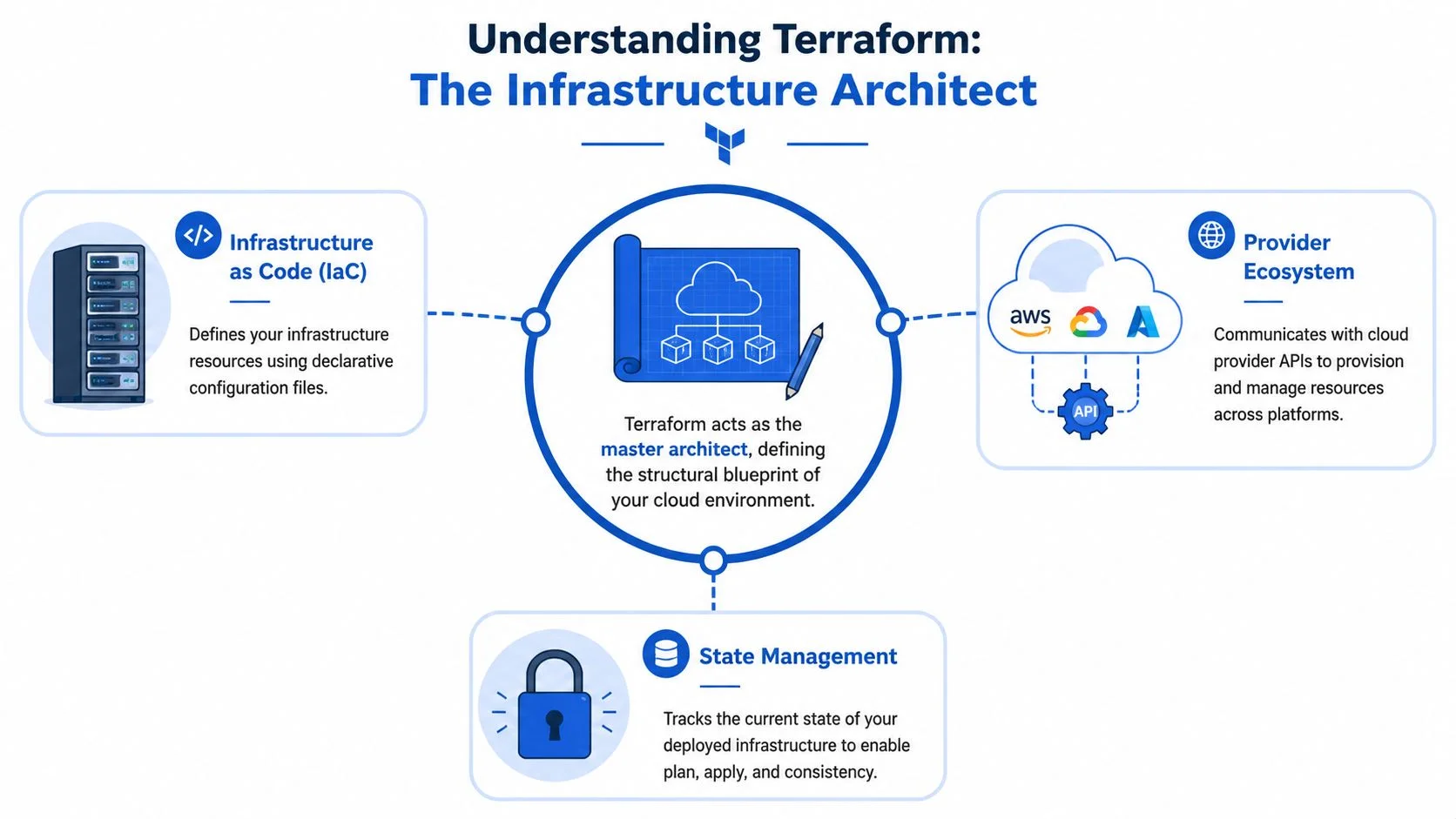
Here's how Terraform works in practice: you define the end state in code. Terraform then checks what already exists, calculates the necessary changes, and applies them in the correct order. This makes it well-suited for creating VPCs, subnets, security groups, load balancers, databases, and virtual machines across AWS, Azure, Google Cloud, and many other providers.
Terraform configurations are written in HCL (HashiCorp Configuration Language), designed to express infrastructure clearly without requiring a full programming application. For production teams, this means the code remains readable during reviews, and the plan output allows everyone to inspect changes before anything is created.
What Terraform Actually Does
Terraform manages infrastructure resources and their relationships. If one resource depends on another, Terraform builds a dependency graph and handles the execution order. Junior engineers often overlook this point, assuming the tool merely "runs scripts." It performs a more structured comparison: desired state versus actual state, then determines what must be created, updated, or removed.
This workflow typically looks like this:
- You declare resources in code.
- Terraform refreshes its view of the environment.
- Terraform generates an execution plan.
- Terraform applies approved changes.
For certification preparation, associate Terraform with terms like desired state, execution plan, resource graph, providers, and state management. These clues often point to Terraform quickly. For a good companion read, check out this Terraform vs. Ansible DevOps comparison, especially to see the handoff in a pipeline beyond a simple feature checklist.
Why the State File Matters
The state file is where many exam questions get more specific.
Terraform uses state to track the resources it manages. This record allows it to map code to real infrastructure, detect drift, and plan changes safely. Without state, Terraform would struggle to know if a database already exists, if a subnet was renamed, or if an instance tag changed outside the codebase.
This is also why teams manage state storage carefully. In real projects, remote backends like S3 with DynamoDB locking, or Terraform Cloud, are common. Multiple engineers may run plans and apply changes against the same environment. Shared state reduces collisions and makes CI/CD automation much safer.
If you find these clues in an exam question, Terraform is usually the correct answer:
| Terraform Clue | Why it points to Terraform |
|---|---|
| Provisioning from scratch | Terraform creates infrastructure resources. |
| Dependency ordering | It builds resources based on their relationships. |
| Desired state comparison | State helps Terraform track and plan changes. |
| Multi-cloud resource management | Providers allow one workflow to target many platforms. |
A Small Terraform Example
provider "aws" {
  region = "us-east-1"
}

resource "aws_instance" "web" {
  ami           = "ami-example"
  instance_type = "t3.micro"

  tags = {
    Name = "web-server"
  }
}

output "web_name" {
  value = aws_instance.web.tags.Name
}
This example is intentionally small. Focus on the pattern: the code declares infrastructure, and Terraform takes responsibility for creating and tracking it over time.
One final production note: Terraform is typically the first part of the workflow, not the entire process. It sets up servers, networks, and related resources. Afterward, another tool often takes over to configure what runs on those systems. This separation of responsibilities is common in real pipelines and frequently appears in certification scenarios.
Understanding Ansible: The System Configurator
Ansible acts on machines that are already available, transforming them into usable servers for actual workloads. After your cloud instances come online, Ansible installs software, writes configuration files, starts services, creates users, applies security settings, and deploys application code.
This role is crucial in production. A fresh VM is like a new apartment with bare walls, no furniture, and no internet account. The space exists, but no one can live or work there. Ansible handles the setup that makes the environment ready.
How Ansible Works
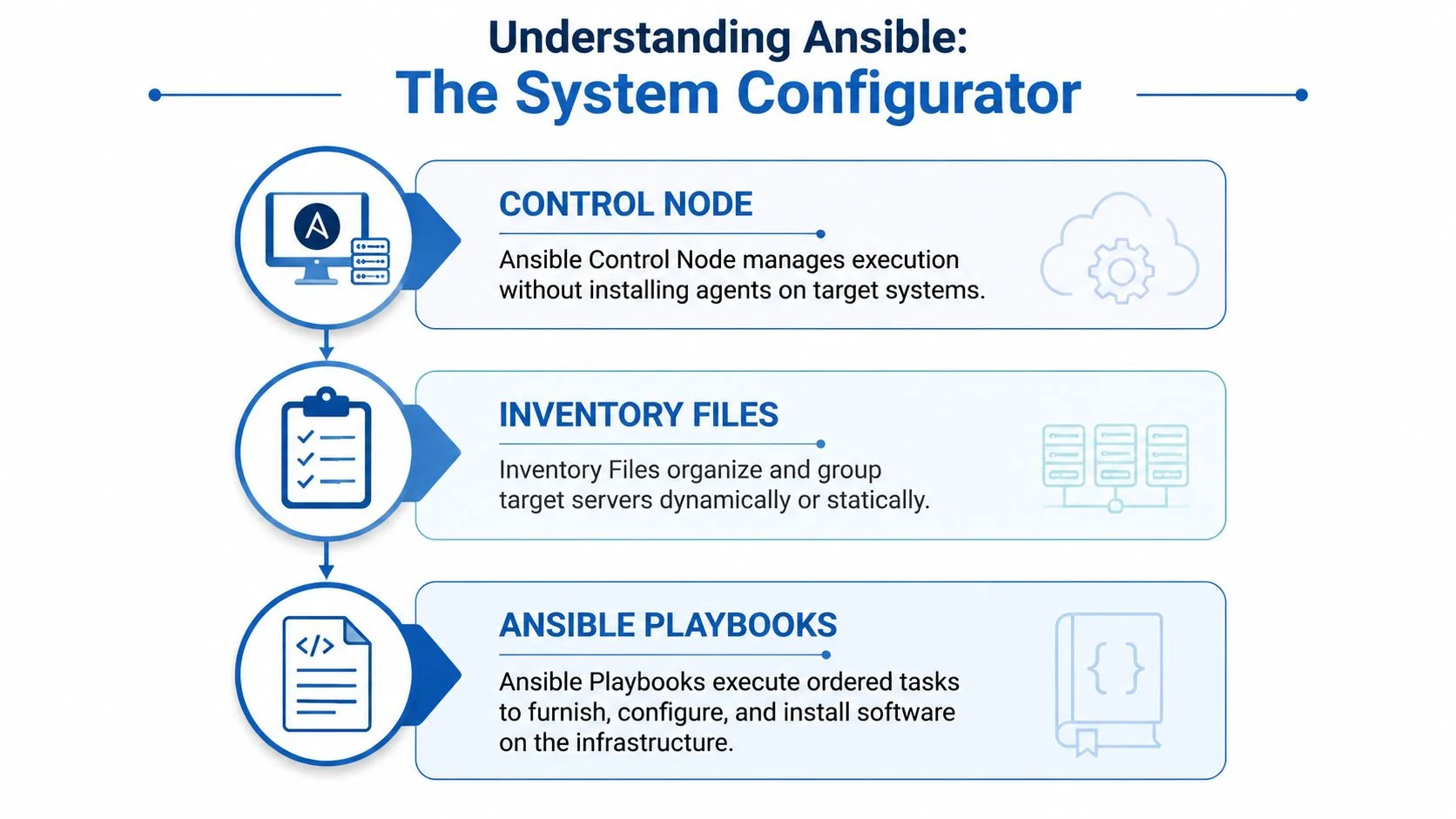
Ansible typically runs from a control node. From there, it connects to target systems listed in an inventory and applies instructions defined in playbooks.
The inventory answers a simple question: which hosts should receive this change? The playbook answers the next: what should happen on those hosts? This split is easy to remember for certification exams: inventory is the target list, and playbooks are the task list.
Playbooks are commonly written in YAML, which keeps the syntax readable. You can often understand a playbook's intent even before knowing every module in detail. If you're building your foundations, this mapping of infrastructure and operations concepts is also explained well in the MindMesh Academy DevOps guide.
A basic playbook might look like this:
- name: Configure web servers
  hosts: web
  become: true
  tasks:
    - name: Install nginx
      package:
        name: nginx
        state: present

    - name: Ensure nginx is running
      service:
        name: nginx
        state: started
        enabled: true
Read this example like a checklist: target the web hosts, use higher privileges, install Nginx, and ensure the service is running and enabled at boot. This is the kind of code you'll frequently see in production pipelines after provisioning is complete.
Why Idempotency Matters
Ansible is built around idempotent tasks. This means a well-written playbook can run repeatedly and keep systems aligned with the intended configuration.
This behavior saves teams from much difficulty.
If nginx is already installed, the package task reports that the system is already in the correct state. If the service is already running and enabled, Ansible leaves it alone. You get predictable reruns instead of accidental churn. In CI/CD, patching windows, and recovery work, this predictability is one of Ansible's greatest strengths.
Common jobs for Ansible include:
- Installing packages and dependencies
- Managing configuration files
- Starting, stopping, and enabling services
- Deploying application releases
- Applying routine operational changes across many servers
Where Ansible Fits Best
Ansible excels when your team needs to standardize what happens inside servers. This includes web tiers, application hosts, bastion boxes, and even network devices in some environments.
For exam preparation, remember the practical sequence. A cloud instance may exist, but it still needs users, packages, services, secrets handling, and application configuration before it can serve traffic. That's where Ansible typically enters the workflow.
Junior engineers often ask if Ansible can also work with cloud APIs. It can. However, in real projects, keeping responsibilities clear makes automation easier to test and troubleshoot. One tool builds the infrastructure; the other configures the operating system and application layer.
This separation isn't just cleaner architecture. It also matches how many production pipelines are designed. Terraform can output host details, and Ansible can use those details to continue the job. If you remember Ansible as the tool that prepares provisioned systems for actual use, you'll be well-prepared for both certification questions and daily DevOps work.
Ansible vs. Terraform: A Side-by-Side Comparison
Imagine you're on call after a release. A new environment was created, but the application fails because the web package is missing, the service is disabled, and the configuration file has incorrect values. This is when the difference between Terraform and Ansible stops being academic and starts affecting uptime.
A useful way to compare them is to look at the layer each tool controls and the mechanics it uses to keep that layer consistent. Terraform is strongest at defining infrastructure resources and their relationships. Ansible is strongest at applying repeatable changes across systems that already exist.
Spacelift explains this distinction well in its technical comparison of Ansible and Terraform. Terraform uses declarative HCL and a state file to track what it created. Ansible uses YAML playbooks to run ordered, idempotent tasks on target machines without maintaining the same kind of infrastructure state.
Terraform vs. Ansible: Key Differences
| Criterion | Terraform | Ansible |
|---|---|---|
| Primary Scope | Provisioning infrastructure resources | Configuring existing systems |
| Main Language | HCL | YAML |
| Automation Style | Declarative | Procedural and task-oriented |
| State Model | Persistent state file | No persistent infrastructure state in the same sense |
| Best At | Resource creation, lifecycle control, dependency management | Software installation, service configuration, operational changes |
| Typical Target | Cloud resources and foundational infrastructure | Hosts, operating systems, and deployed applications |
| Change Handling | Compares declared state to live environment | Reruns idempotent tasks to maintain alignment |
| Common Exam Clue | Build or replace infrastructure | Configure or operate infrastructure |
The language difference matters more than many beginners expect.
Terraform functions like an architectural blueprint. You declare the desired destination, such as "one VPC, two subnets, one load balancer, three instances," and Terraform calculates the creation order based on dependencies. Ansible acts like an automated operations runbook. The playbook lists actions in the order they should occur, such as install Nginx, copy a configuration file, enable the service, then start it.
This design choice impacts troubleshooting. If a subnet ID changes unexpectedly, Terraform state and plans help you identify drift before applying changes. If a package version is incorrect on twenty servers, Ansible allows you to rerun the playbook and bring those hosts back to the expected configuration. For teams building repeatable operating system standards, these top configuration management tips on MindMesh Academy offer a useful companion to this comparison.
What This Means in a Production Pipeline
In production, the cleanest split is ownership by layer.
Terraform should typically own resources with cloud identities and lifecycles: networks, instances, IAM objects, DNS records, managed databases, and similar building blocks. Ansible should typically own what gets installed or changed inside the provisioned systems: packages, users, services, configuration files, scheduled jobs, and application deployment steps.
This boundary keeps code easier to review. It also aligns closely with certification exam wording. If a question focuses on creating, replacing, or relating infrastructure objects, Terraform is usually the better answer. If the question focuses on standardizing server setup or performing repeatable operational tasks, Ansible is usually the better fit.
AuditYour.App also provides a helpful Terraform vs. Ansible DevOps comparison if you want a second explanation after studying this matrix.
A practical rule for junior engineers is simple: ask which layer you are changing – the cloud control plane or the guest operating system. That one question usually points you to the correct tool and prevents much messy automation later.
Integrating Ansible and Terraform: A Practical Workflow
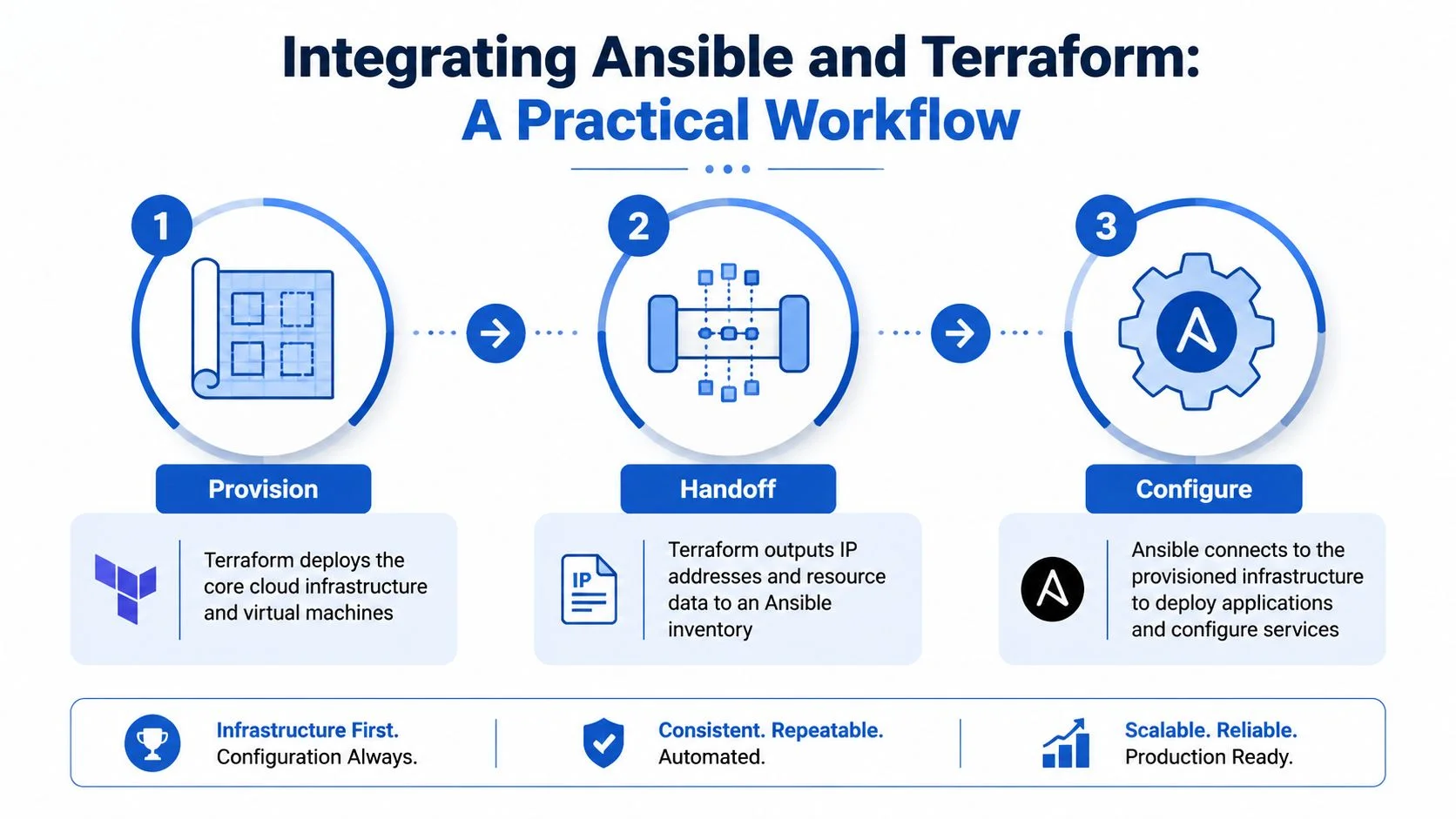
The most effective production pattern is a sequential handoff.
Terraform handles Day 0 provisioning. Ansible takes over for Day 1 configuration and Day 2 operations such as patching and updates. Red Hat describes this as a widely accepted operational model, often combined with GitOps workflows to preserve audit records and reduce manual intervention, as explained in their discussion of Ansible and Terraform roles.
Step 1: Create Infrastructure with Terraform
Begin by provisioning the machine or service you need. The core design idea is that Terraform should also expose the values Ansible will need later, such as a hostname or instance label.
provider "aws" {
  region = "us-east-1"
}

resource "aws_instance" "app" {
  ami           = "ami-example"
  instance_type = "t3.micro"

  tags = {
    Name = "app-server"
    Role = "web"
  }
}

output "app_server_name" {
  value = aws_instance.app.tags.Name
}
This example keeps the handoff simple. In a real pipeline, outputs often include host-related metadata or identifiers that downstream automation can consume.
Step 2: Capture Terraform Outputs
This is the part many teams underestimate.
The handoff between tools is often built with scripts or platform tooling rather than with the tools alone. If this layer is poorly designed, you create brittle "glue code" and potential secret sprawl. This is one reason mature teams place this flow inside CI/CD rather than relying on humans copying values between steps.
A conceptual shell step might look like this:
terraform init
terraform apply -auto-approve
terraform output -json > tf-output.json
Your pipeline can then transform that machine-readable output into something Ansible understands, such as inventory data or runtime variables.
For a broader explanation of how this fits into delivery pipelines, the MindMesh Academy DevOps guide offers useful context around automation stages and team workflows.
Clean automation isn't just about using the right tools. It's about making the handoff between tools boring and predictable.
A simple generated inventory file might look like this:
[web]
app-server ansible_host=server-from-terraform
This example is intentionally generic. In production, teams often generate inventory dynamically from Terraform outputs during a pipeline run instead of maintaining static host lists manually.
Step 3: Configure the Provisioned System with Ansible
Once the target is known, Ansible takes over.
Here's a small playbook that installs and starts Nginx on the newly provisioned host:
- name: Configure web server
  hosts: web
  become: true
  tasks:
    - name: Install nginx
      package:
        name: nginx
        state: present

    - name: Deploy application config
      copy:
        dest: /etc/nginx/conf.d/app.conf
        content: |
          server {
            listen 80;
            server_name _;
          }
      notify: restart nginx

  handlers:
    - name: restart nginx
      service:
        name: nginx
        state: restarted
Your pipeline then runs:
ansible-playbook -i inventory.ini playbook.yml
That's the clear "and" model in a single thought:
- Terraform creates infrastructure.
- Terraform outputs become pipeline data.
- Ansible consumes that data to configure systems.
Later in the workflow, this video gives a helpful visual walkthrough of related concepts:
What a Production Team Should Watch Closely
The basic pattern is simple. The operational details determine whether teams succeed or fail.
- Keep secrets out of casual glue code: Don't hardcode credentials into inventory files or ad hoc scripts.
- Let CI/CD orchestrate the sequence: The pipeline should manage initialization, planning, application, output capture, and playbook execution.
- Separate ownership: Terraform modules and Ansible roles should remain readable and focused.
- Design for failure recovery: If provisioning succeeds but configuration fails, your team should know whether to retry Ansible, roll back infrastructure, or investigate manually.
Exam-Relevant Takeaway
If an exam asks which tool should create a virtual network, instance, or load balancer, choose Terraform.
If it asks which tool should install packages, enforce service configuration, or handle ongoing patching on those hosts, choose Ansible.
If it asks how modern teams use both together, the safest answer is the Day 0, Day 1, Day 2 handoff model.
Best Practices and Certification Study Notes
The challenge with Ansible and Terraform isn't just learning their names. It's understanding where their boundaries should remain distinct.
In regulated enterprise settings, the difference between Terraform's state-based drift detection and Ansible's repeated idempotent runs becomes important for audit trails, compliance, and deciding when immutable replacement should be preferred over in-place changes, as discussed by Harness on governance and lifecycle tradeoffs.
Best Practices for Real Teams
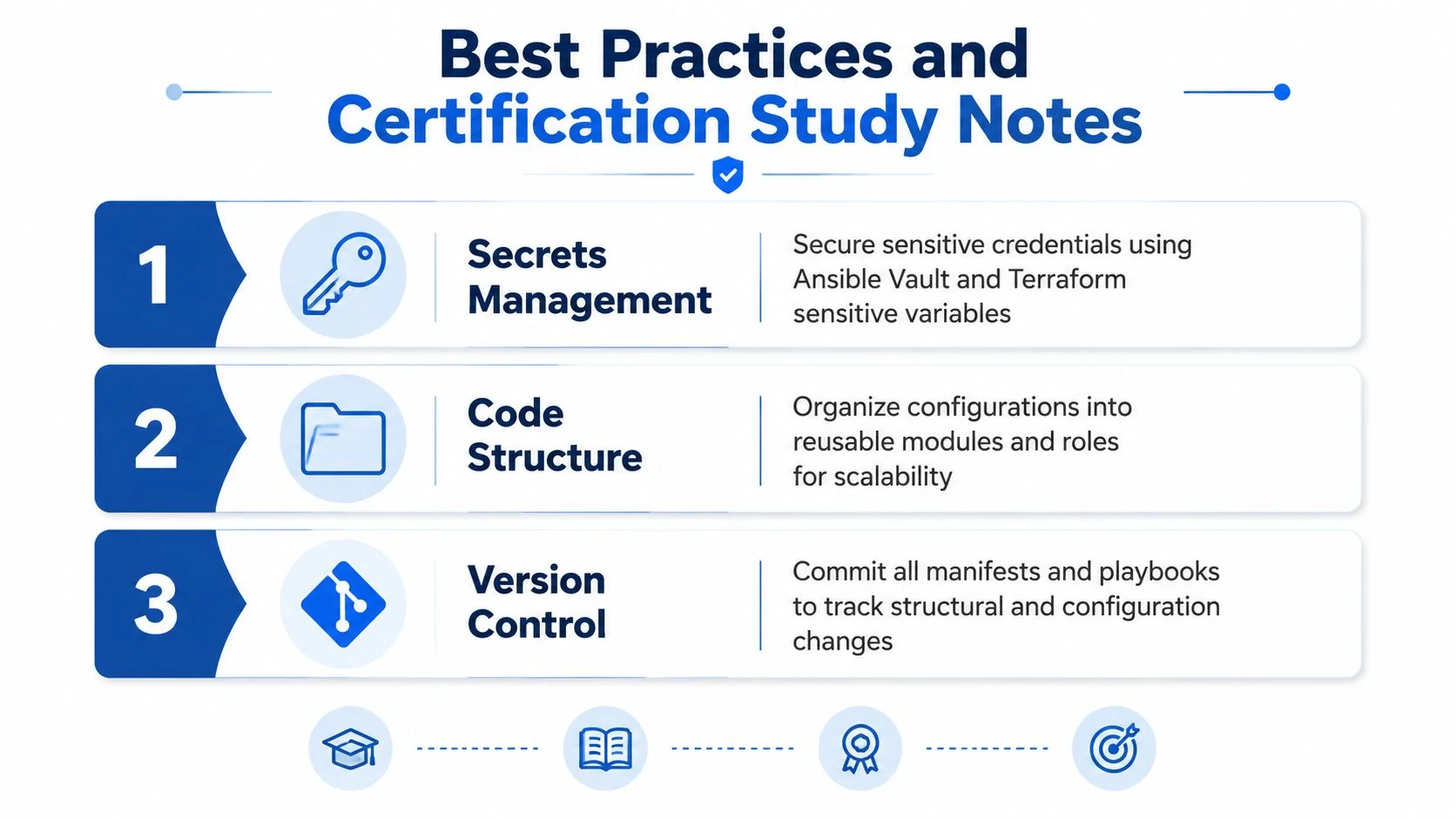
- Separate provisioning from configuration: Keep Terraform modules focused on infrastructure objects. Keep Ansible roles focused on software and host behavior.
- Treat the handoff as a first-class design problem: Outputs, inventory generation, and secret handling deserve the same review discipline as the resource code itself.
- Use version control for both: Infrastructure definitions and playbooks should reside in repositories with review history. This aids auditability and rollback decisions.
- Validate YAML before running playbooks: Small formatting mistakes can disrupt execution. If you need a quick way to compare YAML validation tools, that resource can help you choose a checker that fits your workflow.
- Structure code for reuse: Terraform benefits from modules. Ansible benefits from roles and organized inventories.
- Document mutable versus immutable decisions: Some systems should be replaced through Terraform changes. Others require in-place operational care through Ansible.
For readers seeking more process-focused habits for maintaining consistent environments, these top configuration management tips on MindMesh Academy are relevant to the Ansible side of the workflow.
Certification Study Notes
Use these as mental flashcards.
When the Answer Is Probably Terraform
- The question mentions creating cloud resources.
- The scenario emphasizes dependency ordering.
- The prompt refers to desired state.
- The task involves lifecycle management.
- The environment spans multiple cloud providers.
When the Answer Is Probably Ansible
- The question mentions installing software.
- The scenario involves configuring existing hosts.
- The task is application deployment after provisioning.
- The prompt emphasizes repeatable operational changes.
- The system needs ongoing updates or patching.
Terms You Should Not Mix Up
| Exam Term | Better Association |
|---|---|
| HCL | Terraform |
| YAML playbook | Ansible |
| State file | Terraform |
| Idempotent tasks | Ansible |
| Provisioning | Terraform |
| Post-provisioning configuration | Ansible |
Exam lens: Read the verb in the question carefully. “Create” and “provision” usually point one way. “Install,” “configure,” and “patch” usually point the other way.
A Final Study Habit
Don't just memorize definitions. Practice reading small code samples and identifying ownership.
If you see a file that declares infrastructure resources, think Terraform. If you see ordered tasks acting on hosts, think Ansible. That pattern recognition helps much more than trying to memorize slogans.
Making the Right Choice for Your Task
The right conclusion isn't "Ansible or Terraform."
It's which part of the job am I solving right now?
Use Terraform when you need to create and manage the infrastructure itself. Use Ansible when you need to configure, deploy to, or maintain the systems that infrastructure provides.
A simple decision guide works well:
- Need a network, instance, or load balancer created? Terraform
- Need packages installed and services configured on that instance? Ansible
- Need both in a production pipeline? Terraform first, Ansible second
That's the mental model worth carrying into both exams and real work. The strongest teams don't force one tool to do everything. They let each tool do the job it was built for.
If you're preparing for cloud, DevOps, or infrastructure automation exams like the AZ-400, put what you've learned into practice with the MindMesh Academy Azure DevOps Engineer practice exam to build confidence for exam day.

Written by
Alvin Varughese
Founder, MindMesh Academy
Alvin Varughese is the founder of MindMesh Academy and an enterprise architecture leader. An electrical engineer by training, he moved from factory automation in South Africa to cloud architecture at GE Appliances and Humana (Fortune 50), and holds 20 professional certifications including AWS Solutions Architect Professional, Azure DevOps Engineer Expert, and Microsoft Agentic AI Business Solutions Architect. He built MindMesh Academy after interviewing too many highly certified candidates who couldn't answer basic questions: the goal is prep that makes you better at the job, not just able to pass the exam.