7 Best AWS Cloud Practitioner Practice Exams (CLF-C02)
The AWS Certified Cloud Practitioner exam (CLF-C02) is more than just a test. It’s a gateway certification that proves you understand the fundamentals of the AWS cloud — from pricing models to shared responsibility and core services. Passing it signals to employers that you’re ready to step into the cloud world with confidence.
But let’s be honest: reading a study guide or watching a video course isn’t enough. Just like a pilot doesn’t hop into a cockpit after reading the manual, you can’t walk into the exam cold. A pilot spends hours in a simulator — practicing real scenarios, learning from mistakes, and building confidence. For AWS candidates, practice exams are your simulator.
They do more than test what you know. They teach you how AWS frames questions, how to manage time under pressure, and where your blind spots really are. Without them, you’re preparing half-blind. With them, you’re sharpening both your knowledge and your strategy.
That’s why in this guide, I’ve reviewed the 7 best AWS Cloud Practitioner practice exam resources. These aren’t just question dumps — they are carefully curated tools designed to help you build knowledge, strategy, and exam-day confidence.
1. MindMesh Academy – First-Principles Exam Mastery
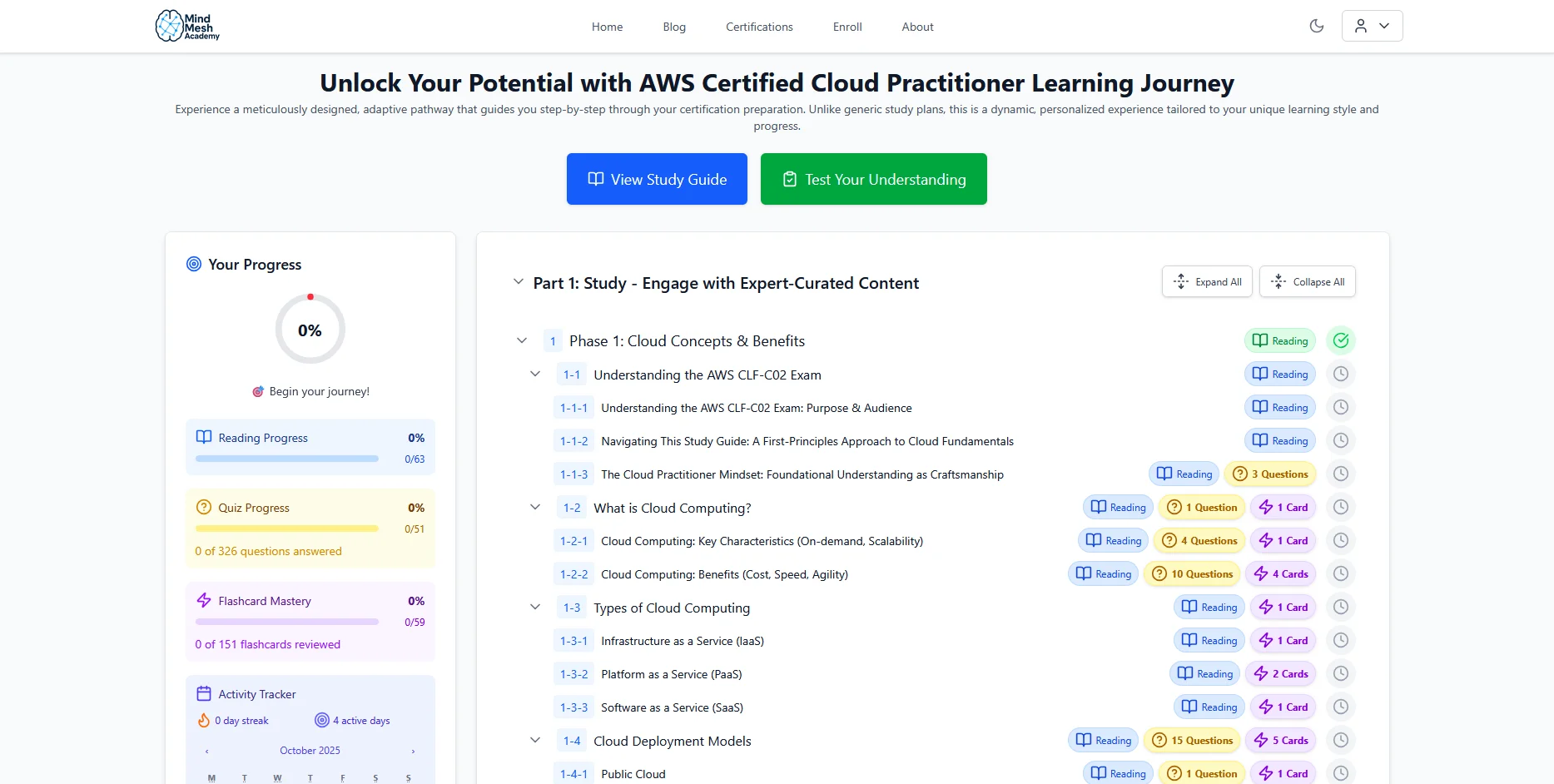 MindMesh Academy emphasizes strategic, evidence-based learning for the AWS Certified Cloud Practitioner exam.
MindMesh Academy doesn’t treat practice exams as the end of your preparation — it treats them as part of a structured, evidence-based learning journey. At the heart of its approach is first-principles learning: breaking down concepts to their foundations, rebuilding understanding from the ground up, and ensuring knowledge isn’t just memorized but mastered.
You begin with a free study guide, which gives you a structured roadmap through the exam domains. From there, the platform integrates realistic exam simulators designed to mirror AWS’s interface and timing. The experience is engineered not only to test your knowledge but also to reduce anxiety by replicating test-day pressure.
What makes MindMesh unique is its memory-first approach. Using Spaced Repetition and Active Recall, the platform pushes concepts from short-term memory into long-term retention. That means you’re not just cramming to pass — you’re building a knowledge foundation that will carry into future certifications and real-world projects.
Why Choose MindMesh Academy?
If you’re serious about building durable understanding, not just scraping a passing score, MindMesh is the way forward. It’s ideal for learners who want clarity, strategy, and mastery rather than endless question drilling. And because it uses a one-time access model (not subscription), you can invest once and keep preparing without pressure.
Website: MindMesh Academy – AWS Certified Cloud Practitioner
2. AWS Skill Builder (Official AWS)
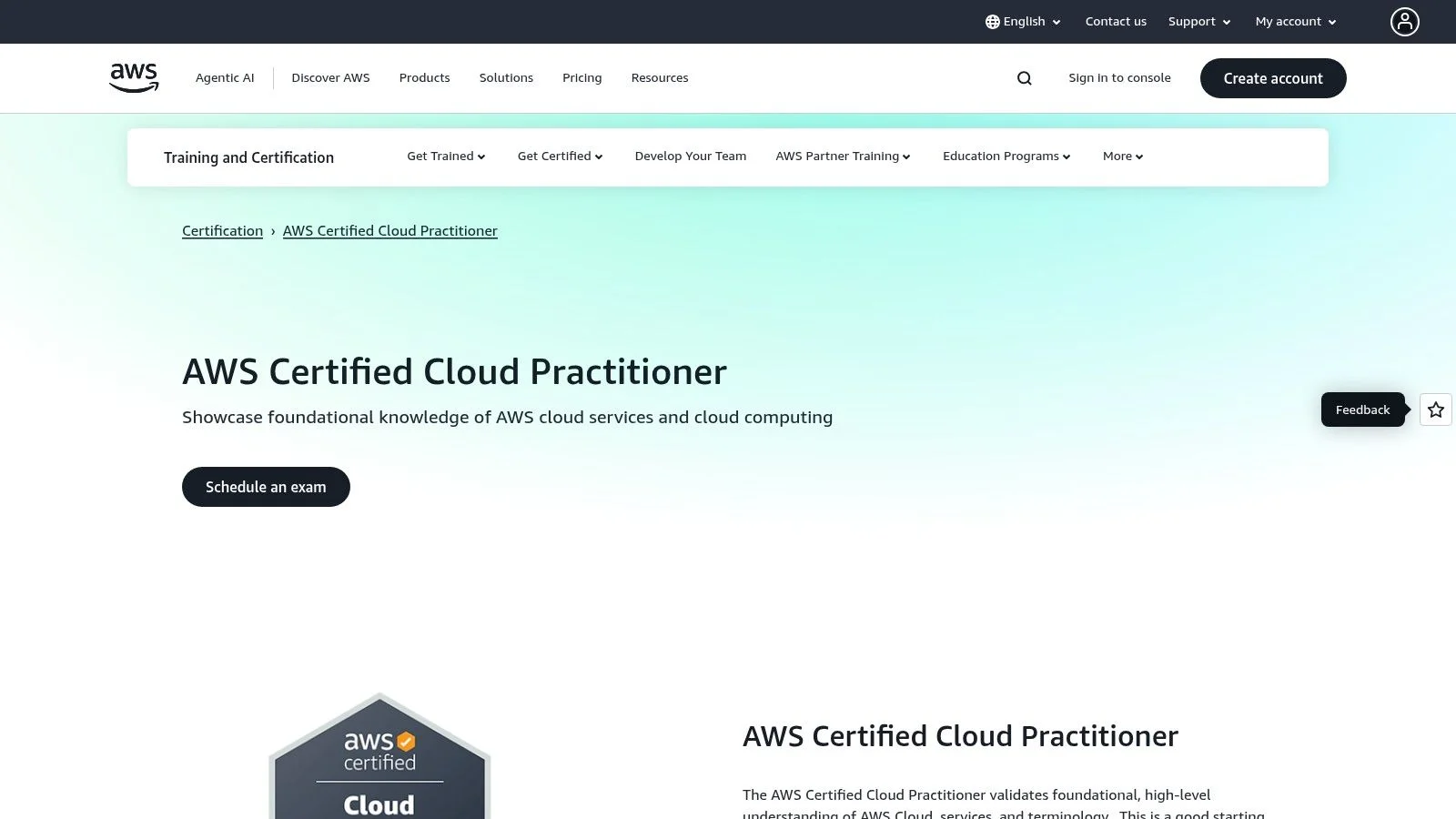 AWS Skill Builder provides official, accurate resources directly from Amazon for CLF-C02 preparation.
When it comes to authenticity, nothing beats going straight to the source. AWS Skill Builder is Amazon’s official training platform, and its greatest strength is alignment. Every question is designed by AWS, mapped directly to the exam blueprint, and free from guesswork about relevance.
The platform offers a free practice question set, perfect for gauging your baseline readiness. If you want more, the paid subscription unlocks full-length practice exams, digital courses, and hands-on labs where you can practice in real AWS environments. The downside? With over 600 courses and labs, Skill Builder can feel overwhelming to new learners, and finding exactly what you need takes some navigation.
Why Choose AWS Skill Builder?
If your priority is accuracy and trust, AWS’s official resource is unmatched. It ensures you’re preparing with the same language, structure, and priorities you’ll see on exam day.
Learn more at: AWS Certified Cloud Practitioner Official Page
3. Tutorials Dojo – Community Favorite
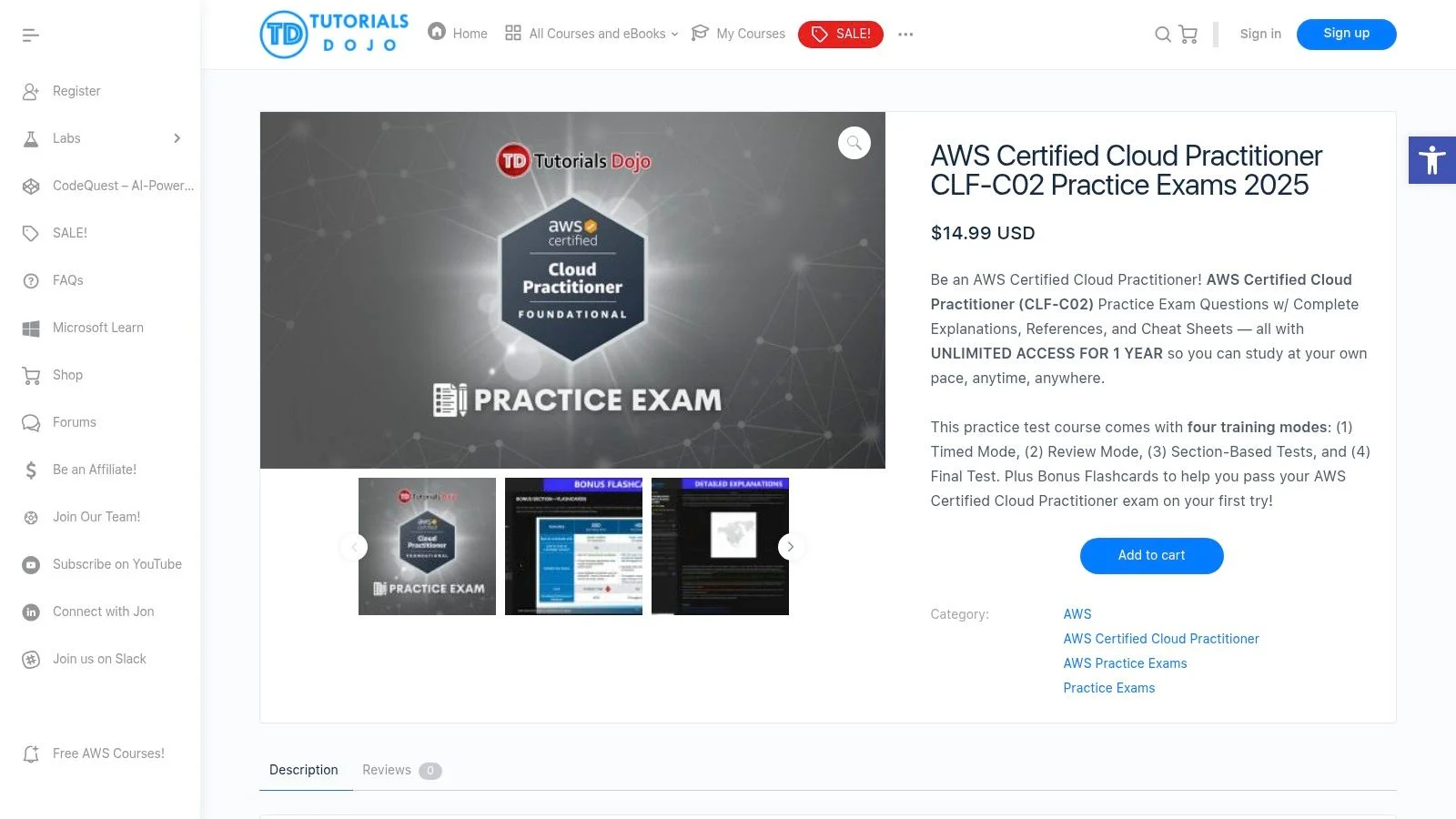 Tutorials Dojo is renowned for its detailed explanations and realistic AWS Cloud Practitioner practice questions.
Tutorials Dojo has earned a devoted following in the AWS community — and for good reason. Its practice exams are known for being tough, realistic, and detailed. If you can score well here, you can walk into the CLF-C02 exam confident.
The real magic lies in the explanations. Every question includes a rationale for the correct answer and, just as importantly, why the other options are wrong. Many explanations also include links to official AWS documentation, giving you a clear path to deeper study.
Why Choose Tutorials Dojo?
This platform is best for learners who want to learn by understanding, not guessing. If you value detailed explanations that connect every question back to AWS’s official guidance, Tutorials Dojo is a powerhouse.
Learn more at: Tutorials Dojo Cloud Practitioner Exams
4. Udemy – Budget-Friendly Variety
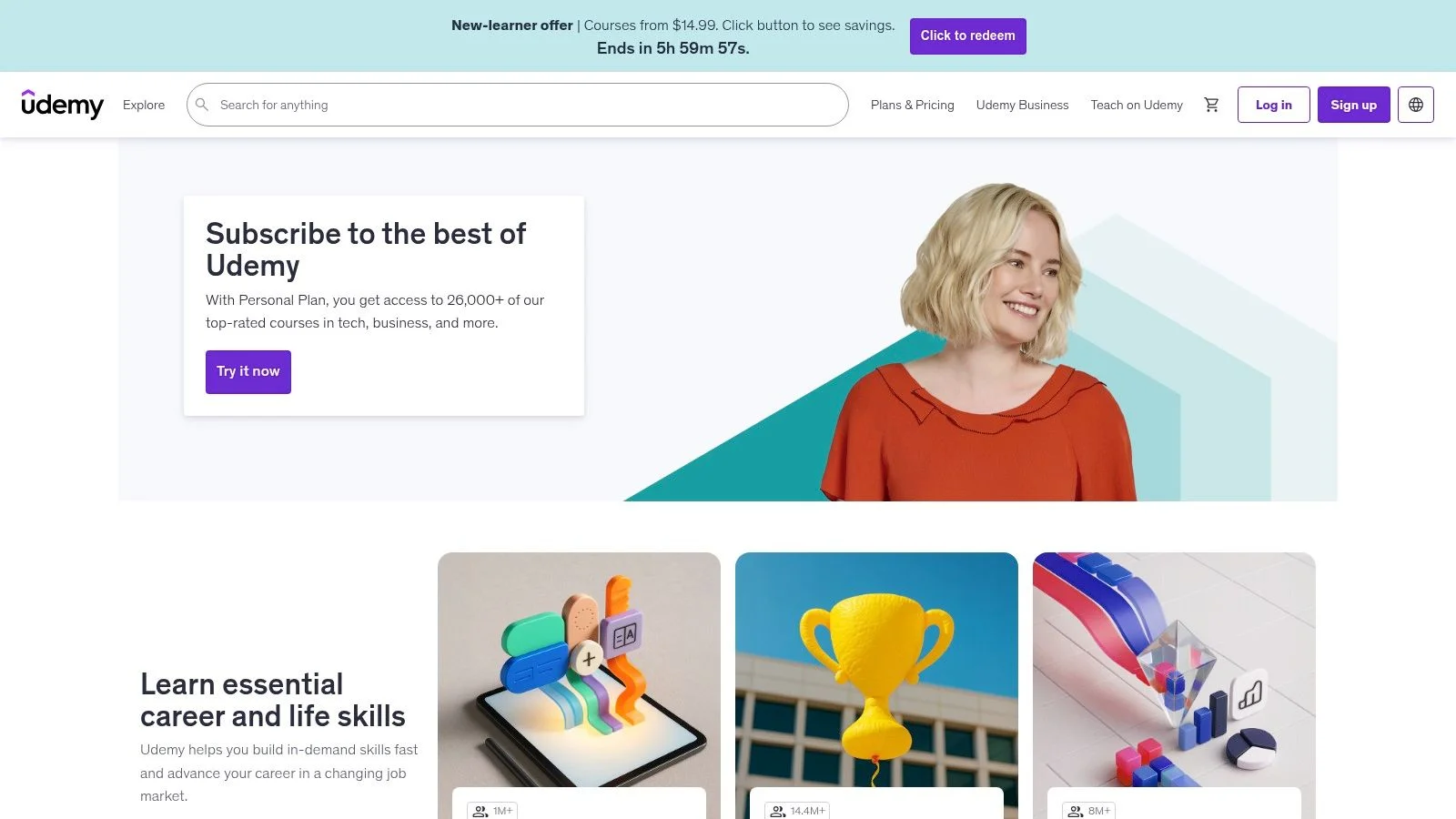
Udemy offers affordable bundles of practice tests from top AWS instructors.
Udemy is a treasure trove of AWS practice exams, but like any marketplace, quality varies by instructor. The good news is that some of the top AWS educators — Jon Bonso (Tutorials Dojo), Stephane Maarek, Neal Davis — all publish their practice test bundles here.
Most bundles include 4–6 full-length exams, making Udemy an affordable way to build test stamina. Another plus: once purchased, you get lifetime access. That means you can return to these exams months or even years later if you pursue additional AWS certifications.
Why Choose Udemy?
If you’re budget-conscious but still want plenty of exam practice, Udemy is hard to beat. Just be selective: choose instructors with high ratings and recent updates to ensure relevance to CLF-C02.
Learn more at: Udemy AWS Practice Exams
5. Amazon Books + Bundled Test Banks
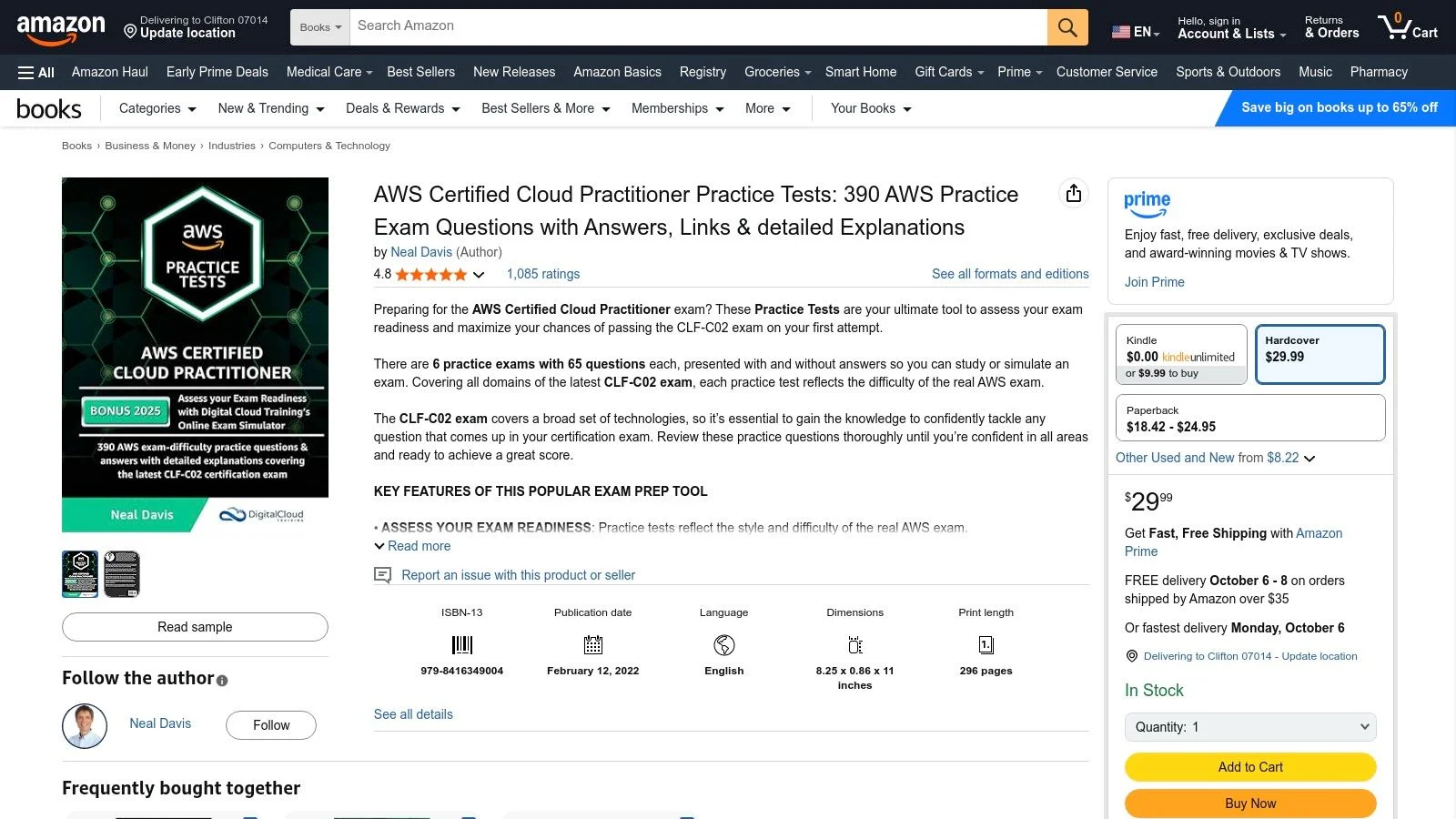 Many AWS Cloud Practitioner study books on Amazon include bundled test banks.
Sometimes the best preparation is still a book. Publishers like Sybex and instructors like Neal Davis offer study guides that include hundreds of practice questions — often with bundled online test banks.
This hybrid approach works well for learners who like a chapter-by-chapter structure leading into practice questions. The only caution: always purchase the most recent edition to ensure alignment with CLF-C02.
Why Choose Amazon Books?
If you’re a book-first learner who likes the discipline of a structured study guide, this is a strong choice. It combines the depth of a textbook with the interactivity of digital practice exams.
Learn more at: Amazon AWS Practitioner Books
6. A Cloud Guru (Pluralsight) – Hands-On Integration
A Cloud Guru combines courses, labs, and practice exams into one guided learning path.
A Cloud Guru, now part of Pluralsight, offers more than practice exams — it’s an all-in-one learning path. You get video courses, quizzes, hands-on labs, and practice exams built into a single curriculum.
This makes ACG a fantastic option if you want to practice what you’re learning in real AWS environments as you prepare for the exam. The only drawback is the subscription model — there’s no one-time purchase option.
Why Choose A Cloud Guru?
Best for learners who thrive in guided, practical learning environments. If you like the idea of blending theory, labs, and exams under one roof, ACG is hard to beat.
Learn more at: A Cloud Guru CLF-C02
7. Digital Cloud Training (Neal Davis) – Comprehensive Ecosystem
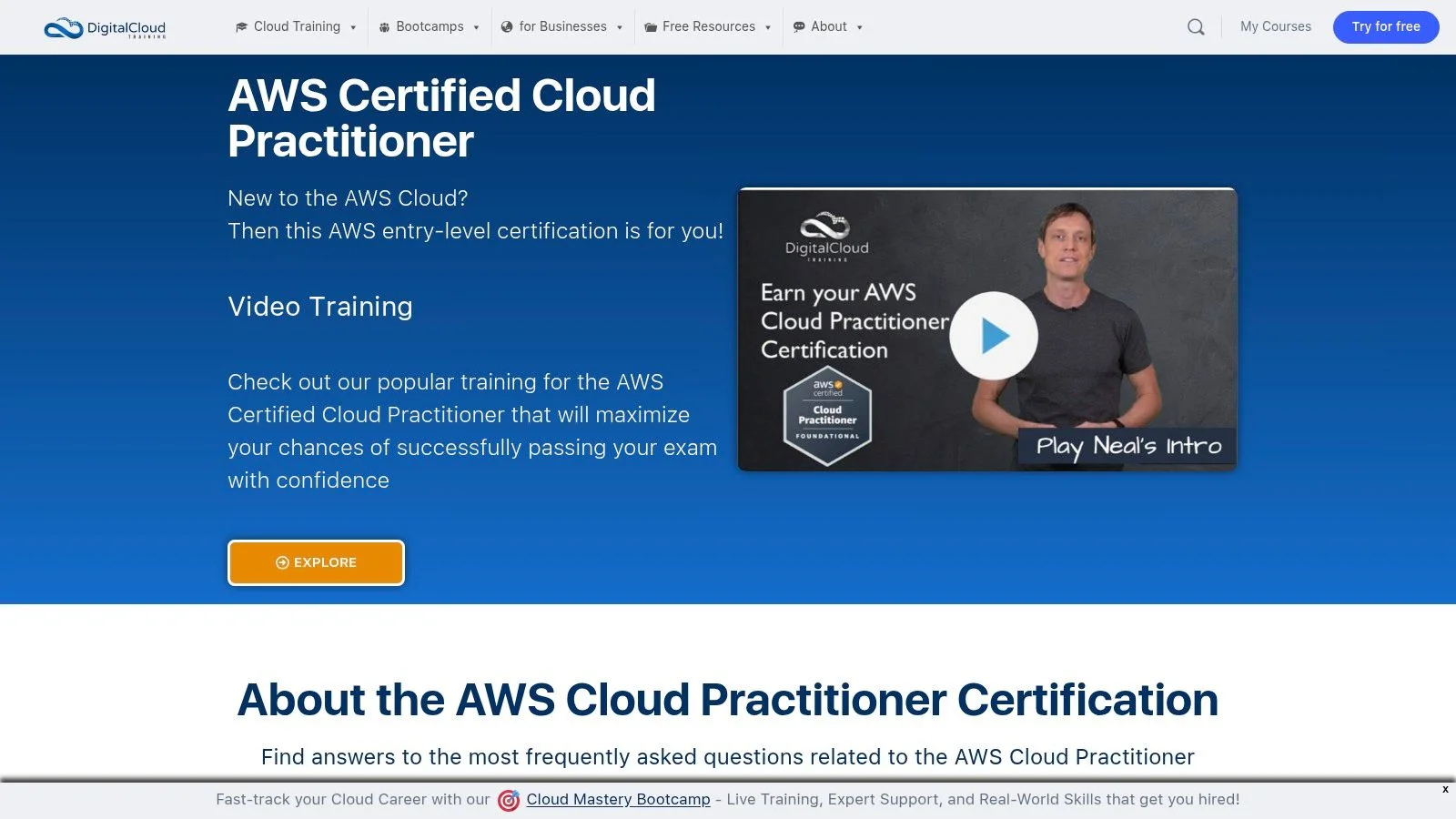 Digital Cloud Training, led by Neal Davis, combines courses, notes, and thousands of practice questions.
Neal Davis has built one of the most comprehensive AWS training ecosystems. His platform offers video lessons, detailed cheat sheets, and a huge practice exam bank with over 3,000 questions.
What makes Digital Cloud Training appealing is its integration. You’re not bouncing between platforms — everything from lessons to notes to practice exams is under one roof. The volume can feel overwhelming at first, but it’s a true one-stop-shop.
Why Choose Digital Cloud Training?
If you’re looking for a complete AWS study ecosystem, this is it. Especially useful for learners who may want to continue beyond CLF-C02 into Associate and Professional certifications.
Learn more at: Digital Cloud Training
Comparison Table – 7 Best AWS Practice Exam Resources
| Resource | Core Features | Access Model | Best For | Distinctive Focus |
|---|---|---|---|---|
| MindMesh Academy | Free study guide, realistic simulators, spaced repetition | One-time | Learners who want mastery, not cramming | 🧠 First-principles, memory-first |
| AWS Skill Builder | Official questions + labs | Subscription | Learners who want authenticity | ✅ Official AWS source |
| Tutorials Dojo | Exam-realistic Qs, deep explanations | One-time | Learners who want detailed rationales | 📘 Explanations + AWS doc links |
| Udemy | 4–6 mock exams, lifetime access | One-time | Budget learners who want variety | 💲 Affordable, high volume |
| Amazon Books | Study guides + bundled online test banks | One-time | Book-first structured learners | 📚 Hybrid book + digital exams |
| A Cloud Guru | Video, labs, exams integrated | Subscription | Hands-on learners needing guidance | 🔬 Practical, all-in-one path |
| Digital Cloud | 3,000+ Qs, courses, notes | Subscription | Comprehensive, multi-cert learners | 📊 Full AWS ecosystem |
Final Thoughts
The AWS Cloud Practitioner exam is your first step into the cloud world, but the right practice exams make the difference between hoping you’ll pass and walking in with confidence.
- If you want to build lasting mastery, choose MindMesh Academy.
- If you want absolute authenticity, start with AWS Skill Builder.
- If you want budget-friendly volume, Tutorials Dojo or Udemy are excellent.
- If you’re a structured book learner, Amazon Books have you covered.
- If you’re hands-on, A Cloud Guru will guide you.
- If you want a comprehensive platform for AWS certs, Digital Cloud Training is a strong bet.
Ready to build AWS knowledge that lasts? MindMesh Academy gives you a free study guide plus practice exams powered by first-principles learning, Spaced Repetition, and Active Recall. This isn’t just exam prep — it’s the foundation for your entire cloud career.
Free CLF-C02 Practice Questions (With Answers)
5 real questions from the CLF-C02 bank, with the full explanation for each answer. No sign-up needed to read them.
- Question 1Cloud Concepts [Benefits]
A startup wants to deploy a new application but is concerned about the large upfront cost of buying and setting up servers. Which benefit of the AWS Cloud directly addresses this concern?
- A.Trade capital expense for variable expense
- B.Go global in minutes
- C.Benefit from massive economies of scale
- D.Stop guessing about capacity
Show answer and explanation
Correct answer: A
Correct. This is a core economic benefit of cloud computing. Instead of a large upfront Capital Expense (CapEx) for physical hardware, the startup can pay for computing resources as an ongoing, variable Operational Expense (OpEx), scaling as needed.
Why the other options are wrong
B. Incorrect. Going global in minutes refers to deploying into new Regions quickly to reduce latency for users worldwide. It addresses reach, not the initial cost of infrastructure.
C. Incorrect. Economies of scale mean AWS achieves lower per-unit costs across its aggregate usage and passes those savings on as lower prices. That lowers the ongoing rate, not the upfront purchase.
D. Incorrect. This benefit removes the need to over- or under-provision hardware ahead of demand. It addresses capacity planning rather than the capital cost of acquiring servers.
- Question 2Cloud Concepts [Economics]
Which of the following is an example of Operational Expenditure (OpEx) in the AWS Cloud?
- A.Buying a multi-year software license for a fixed cost.
- B.Building a new on-premises data center facility.
- C.Paying for the number of hours an Amazon EC2 instance runs.
- D.Purchasing physical servers for a data center.
Show answer and explanation
Correct answer: C
Correct. Paying for services on a consumption basis, such as the hourly or per-second cost of an EC2 instance, is an Operational Expenditure (OpEx). It's a variable cost tied to the ongoing operation of the business.
Why the other options are wrong
A. Incorrect. A large, upfront payment for a multi-year license is typically treated as a Capital Expenditure (CapEx).
B. Incorrect. The cost of constructing a physical facility is a significant Capital Expenditure (CapEx).
D. Incorrect. Purchasing physical hardware is a classic example of a Capital Expenditure (CapEx), as it is a large, upfront investment.
- Question 3Cloud Concepts [Design Principles]Choose all that apply
A finance manager is trying to optimize the company's AWS spending. Which of the following are design principles for cost optimization in the AWS Cloud? (Select TWO)
- A.Stop spending money on undifferentiated heavy lifting.
- B.Use a single, large instance for all workloads.
- C.Go global in minutes.
- D.Adopt a consumption model.
- E.Test systems at production scale.
Show answer and explanation
Correct answer: A, D
Correct. This principle recognizes that AWS handles the undifferentiated work of data center operations - racking, stacking, and powering servers - and that managed services remove the operational burden of running operating systems and applications, letting you focus on your customers and business projects.
Correct. This principle involves paying only for the computing resources you consume and increasing or decreasing usage depending on business requirements, rather than using fixed, over-provisioned resources.
Why the other options are wrong
B. Incorrect. This is the opposite of a best practice. Cost optimization often involves using smaller, right-sized instances and scaling horizontally.
C. Incorrect. This is a general benefit of the cloud, not a specific cost optimization design principle.
E. Incorrect. This is a design principle for reliability, not directly for cost optimization.
- Question 4Cloud Concepts [Benefits]Choose all that apply
A retail company is evaluating moving from its on-premises data center to the AWS Cloud. Which of the following are direct benefits of this move? (Select TWO)
- A.Stopping spending money on running and maintaining data centers.
- B.The ability to deploy globally in minutes.
- C.Eliminating the need to manage application-level permissions.
- D.Guaranteed reduction in total monthly IT spending.
- E.Receiving a free, dedicated Technical Account Manager (TAM).
Show answer and explanation
Correct answer: A, B
Correct. A major benefit of the cloud is that AWS handles the undifferentiated heavy lifting of managing physical data centers, including power, cooling, and physical security, allowing the customer to focus on their own business.
Correct. The AWS global infrastructure allows a customer to deploy their application in multiple geographic regions around the world with just a few clicks, enabling rapid global expansion.
Why the other options are wrong
C. Incorrect. Managing application-level permissions is part of the customer's responsibility for security *in* the cloud.
D. Incorrect. While the cloud offers opportunities for cost savings, it does not guarantee a reduction, especially if resources are not managed efficiently.
E. Incorrect. A designated TAM is a feature of the premium AWS Enterprise Support plan and is not a default benefit.
- Question 5Cloud Concepts [Well-Architected]
A company is using AWS IAM to enforce the principle of least privilege for all users and services. This practice aligns with which pillar of the AWS Well-Architected Framework?
- A.Cost Optimization
- B.Reliability
- C.Security
- D.Performance Efficiency
Show answer and explanation
Correct answer: C
Correct. Implementing a strong identity foundation, which includes using the principle of least privilege, is a core design principle of the Security pillar.
Why the other options are wrong
A. Incorrect. While good security can prevent costly incidents, the principle itself is a security concept.
B. Incorrect. The Reliability pillar is focused on system uptime and recovery.
D. Incorrect. The Performance Efficiency pillar is focused on the efficient use of resources.
Those are 5 of the 40 questions in the free sample exam. Sign up to take the remaining 35 under exam conditions, get scored, and see which topics are holding you back.

Written by
Alvin Varughese
Founder, MindMesh Academy
Alvin Varughese is the founder of MindMesh Academy and holds 20 professional certifications including Microsoft Agentic AI Business Solutions Architect, AWS Solutions Architect Professional, and Azure DevOps Engineer Expert. He's held senior engineering and architecture roles at Humana (Fortune 50) and GE Appliances. He built MindMesh Academy to share the study methods and first-principles approach that helped him pass each exam.