
What Is The First AWS Certification: Your 2026 Guide
The First AWS Certification: A Practical Guide for Beginners
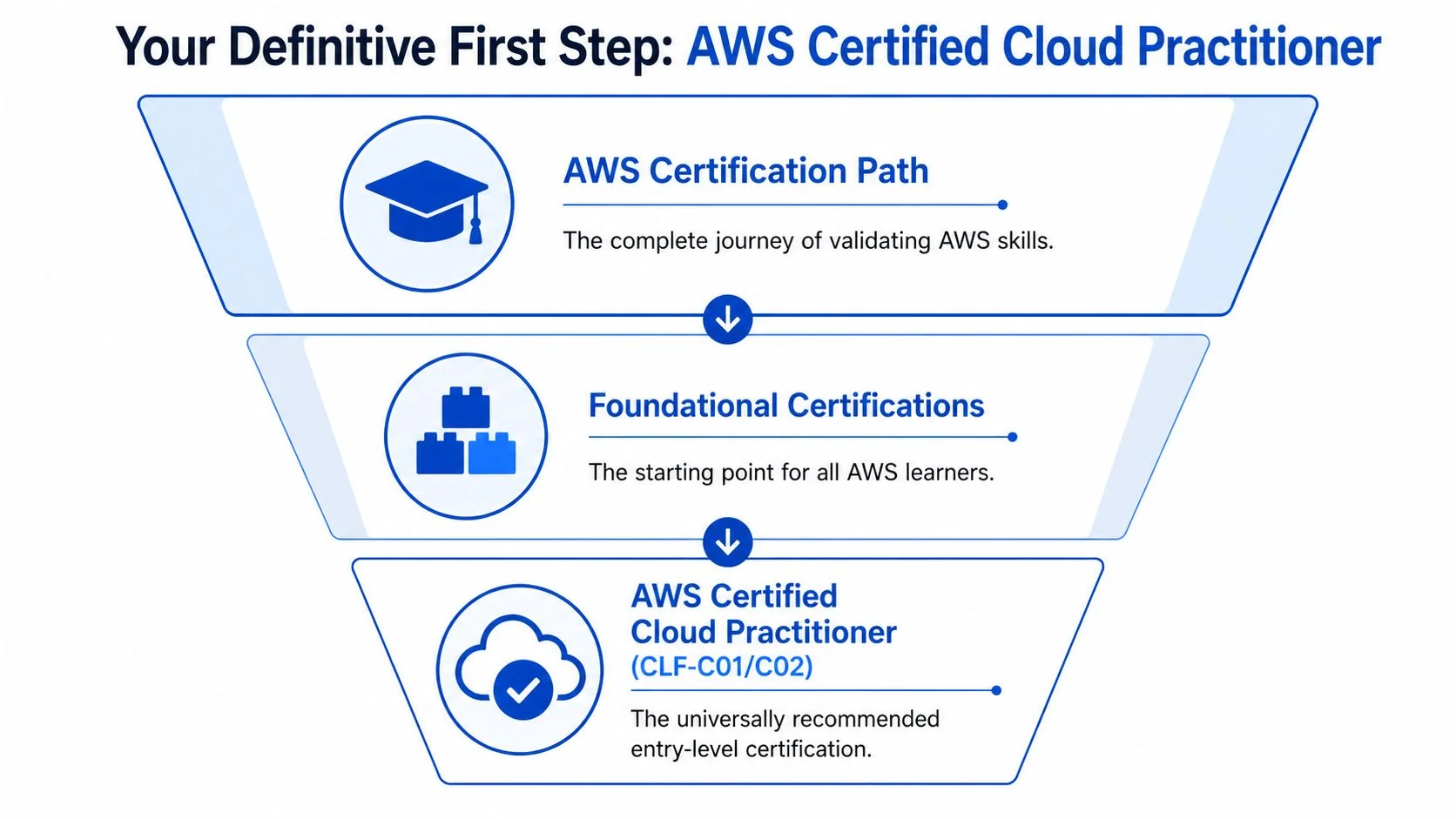
The AWS Certified Cloud Practitioner is typically the first AWS certification beginners pursue. It's the recommended entry point, positioned at the Foundational level to help build cloud literacy before moving to more technical AWS exams.
If you're wondering where to start with AWS certifications, you're likely in a common situation. Perhaps you're new to cloud work, your company is adopting AWS, or higher-level certifications like Solutions Architect Associate seem daunting.
This first step is crucial. A strong initial certification isn't just about passing; it should provide a foundational map of the AWS world, introduce the core terminology, and make your next certification feel achievable, not overwhelming.
The AWS Certified Cloud Practitioner: Your Foundational Step
The AWS Certified Cloud Practitioner is often the first AWS certification newcomers pursue. AWS positions it within the Foundational tier. This tier validates a broad understanding of the AWS Cloud, rather than deep technical specialization. AWS structures its certifications across four main tiers: Foundational, Associate, Professional, and Specialty. Candidates must be 13 years or older to take an exam. While AWS recommends 6 months to 2 years of hands-on AWS exposure for readiness, there are no prior certification prerequisites; AWS removed them from all certifications in 2019. You can find more details in the AWS Certification FAQs.
Who Benefits from the Cloud Practitioner Certification
Many assume an "AWS certification" automatically implies a heavy engineering focus. This assumption often misleads beginners.
The Cloud Practitioner exam covers a broader scope. It suits those moving into technical roles, but also project managers, analysts, sales professionals, support staff, founders, and team leads. Anyone who needs to grasp what AWS is and how cloud services support business decisions will benefit.
Your goal here isn't to architect a full production system. It's to show you understand the basics, can speak the language, and make sense of the AWS platform.
Why Cloud Practitioner Is a Standard Starting Point
The Cloud Practitioner became a standard first certification because it establishes baseline knowledge. This includes cloud concepts, security, architecture, pricing, and core services, preparing you for Associate or Professional certifications. You earn certification credentials only after passing a proctored exam. Registration occurs through the AWS training flow and Pearson VUE, ensuring a consistent process for learners globally.
Practical rule: Your first certification should lower confusion, not raise it. Cloud Practitioner does that by giving you the vocabulary and mental model you'll use everywhere else in AWS.
If you're early in your cloud journey, this clarity is more important than it seems. Beginners often don't struggle due to a lack of ability to learn. Instead, they struggle when they attempt complex architecture decisions before understanding the core services those decisions rely on.
Cloud Practitioner: The Smart Starting Point
Starting with Cloud Practitioner isn't about finding the easiest path; it's about choosing the smartest sequence for your learning.
AWS designed it as a foundational exam requiring no prior experience, focusing on cloud fundamentals and core AWS concepts instead of deep implementation skills. You can see the AWS certification overview for more details. This approach changes how you learn. Instead of juggling detailed service configurations and complex multi-service design tradeoffs, you concentrate on the basics first: terminology, the shared responsibility model, pricing structures, and fundamental architectural thinking.
Reducing Cognitive Overload
Think of learning AWS like navigating a new city.
If someone drops you into the city center and asks you to optimize traffic, you'd be lost. But if you first learn the city map, its neighborhoods, public transit, and main roads, everything else begins to make sense.
Cloud Practitioner provides that initial map. You learn the purpose of common services, the structure of AWS security, and how AWS approaches cloud operations. This significantly lowers the mental load when you encounter scenario-based questions on Associate-level exams later on.
Building Confidence Efficiently
Some learners fear that starting with a foundational certification is a detour. Often, it's quite the opposite.
When you tackle a role-based exam too early, every topic can feel new simultaneously. You're trying to learn service names, architectures, billing logic, permissions, and the exam style all at once. This makes for a challenging start.
Cloud Practitioner breaks this complex learning into manageable pieces:
- Core language first: You learn AWS terminology like regions, availability zones, security models, and managed services.
- Business context next: You grasp why pricing and cloud value are important, beyond just knowing which buttons to click.
- Technical depth later: You reserve detailed design and operational tradeoffs for subsequent stages, once your foundational understanding is solid.
You don't need your first AWS exam to prove mastery. You need it to give you traction.
This is why the certification works particularly well for students, career changers, and teams onboarding individuals who aren't yet full-time cloud specialists. It's a strategic first move that simplifies subsequent steps.
Cloud Practitioner Exam: What to Expect to Learn
The Cloud Practitioner became a standard first AWS certification because it builds a baseline understanding of cloud concepts, security, architecture, pricing, and core services. This prepares learners for higher-level credentials. The exam typically consists of about 65 multiple-choice or multiple-select questions, to be completed in 90 minutes. The certification remains valid for 3 years, after which recertification is required.
Key Learning Domains
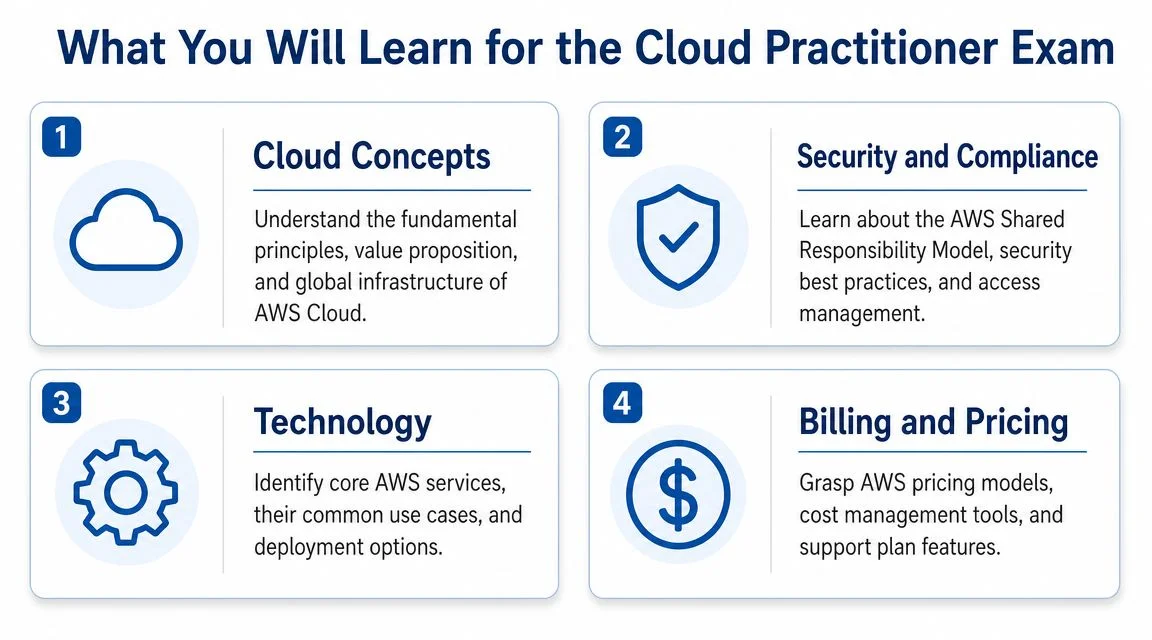
The exam is often easier to understand when you view it as four practical knowledge areas, rather than one large cloud test.
| Domain | What it means in plain English | Why it matters |
|---|---|---|
| Cloud Concepts | How cloud computing works and why organizations use it | You learn the business and operational logic behind AWS |
| Security and Compliance | Who protects what, how access works, and how AWS approaches security | You avoid the classic beginner mistake of treating cloud security as someone else's job |
| Technology | The purpose of core services and where they fit | You build a usable service map instead of memorizing random names |
| Billing and Pricing | How AWS charges for services and how teams think about cost | You learn how cloud decisions affect budgets and support choices |
Practical Application of Concepts
Within Cloud Concepts, you explore the "why" of cloud computing. Why would an organization opt for cloud infrastructure over on-premise hardware? What makes elasticity and global infrastructure so critical for reliability and reach?
For Security and Compliance, the shared responsibility model is a key concept. Newcomers often mistakenly assume AWS manages all security simply because it runs the platform. This isn't the case. You'll learn what AWS secures and what remains under customer control.
In Technology, expect to identify core services and their typical use cases. Services like EC2, S3, IAM, or Lambda should be familiar in terms of their general purpose, even if you're not yet configuring advanced production environments.
Billing and Pricing isn't about memorizing every price point. Instead, you learn AWS's approach to cost, support plans, and general cost management. This knowledge is valuable even if you don't become a finance-focused cloud professional.
For a structured study path that organizes these topics, MindMesh Academy offers Cloud Practitioner study resources to complement AWS documentation, whitepapers, and hands-on practice.
Preparing for Your First AWS Exam
You sit down to study for your first AWS exam and might find yourself with five tabs open: whitepapers, a video course, flashcards, practice questions. After an hour, it can still feel unclear where to start.
This feeling is normal.
Preparing for the Cloud Practitioner exam works best when you study in layers, much like exploring a new city. First, you get the map. Then, you learn the neighborhoods. Finally, you recognize landmarks without needing directions constantly. Your exam preparation should follow this same layered approach.
A Structured Preparation Rhythm
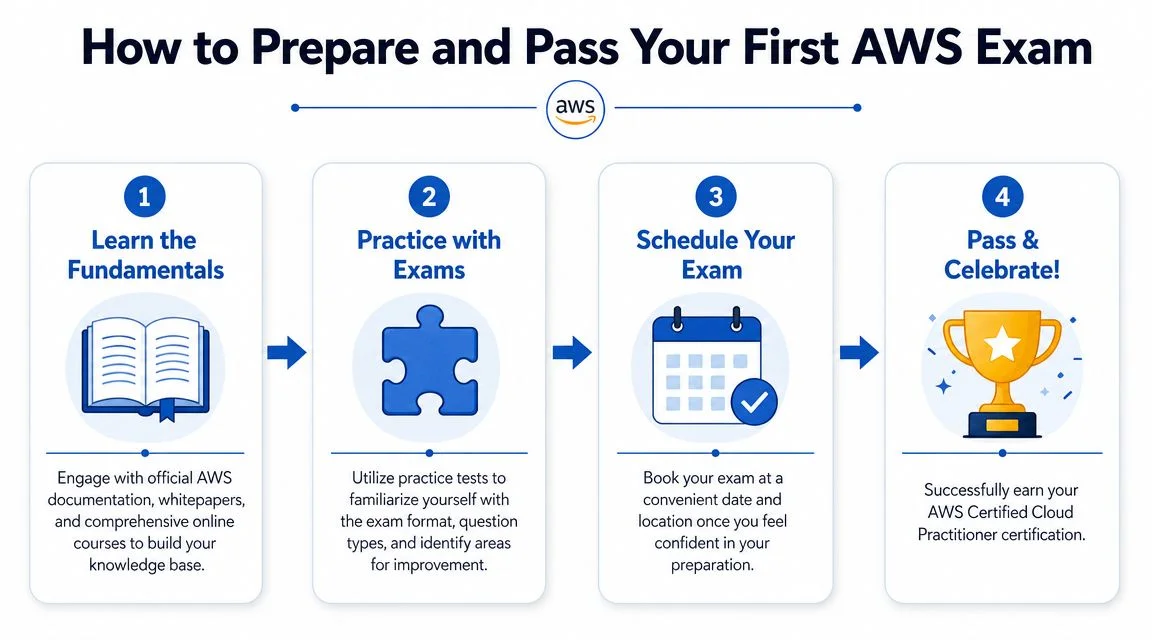
A clear study sequence helps you stay calm and focus your time effectively.
-
Start with the exam guide Always begin by reviewing the official exam guide. This document defines the test's scope, which is essential. Beginners often study too broadly, drifting into Associate-level topics prematurely.
-
Build your concept foundation Utilize resources like AWS Skill Builder, whitepapers, FAQ pages, and introductory videos to grasp core ideas. If concepts like IAM, Availability Zones, support plans, or the shared responsibility model remain unclear, pause. Strengthen your understanding there before moving on.
-
Incorporate light hands-on practice You don't need to build a production system for this exam. However, you do need enough practical exposure for service names to become less abstract. Logging into the AWS console and clicking through services like EC2, S3, IAM, and billing tools helps connect definitions to real-world experience.
-
Use practice questions for feedback Practice exams serve more than just scoring your knowledge. They reveal weaknesses in your mental model. If you miss a question on pricing, security, or service selection, the most valuable step is to review why the correct answer is appropriate.
Here's a walkthrough that can help make the process feel more concrete:
Gauging Your Readiness
The best time to schedule your exam is when you can explain core AWS concepts in plain language, not just recognize them in multiple-choice questions.
A simple checkpoint: Could you explain to a coworker what EC2 does, how S3 differs, what IAM controls, and who is responsible for different aspects of security in AWS? If so, your understanding is becoming truly functional. This matters because Cloud Practitioner is the initial step in a longer learning path, building the foundation your subsequent certifications will rely on.
Set a realistic exam date and plan your study backward. Allocate time for review, several rounds of practice questions, and a final pass through any weak areas. While cramming might help you recall terms, it rarely provides the confidence needed to differentiate between similar answers under exam pressure.
A robust readiness check typically involves:
- Clear explanations of core services: You understand the function of common services without relying on rote memorization.
- Ability to identify incorrect answers: You're comparing options logically, rather than guessing based on keywords.
- Narrowing mistake patterns: Your missed questions concentrate on a few specific topics, indicating exactly where to focus your final review before test day.
For structured question practice, expert AWS certification preparation can help you rehearse the exam style and identify weak spots before you book the official exam.
Treat the first exam as training for your cloud career. Passing matters, but the bigger win is leaving with a foundation strong enough to support whatever certification comes next.
Beyond Cloud Practitioner: Planning Your Next AWS Certification
After passing Cloud Practitioner and logging out of the testing portal, the next question often appears almost immediately: "What's next?"
This is a positive sign. Your first AWS certification isn't merely a checkbox. It marks the point where broad cloud awareness begins to crystallize into a concrete direction. Cloud Practitioner helps you understand the overall map; your next certification helps you select a specific route.
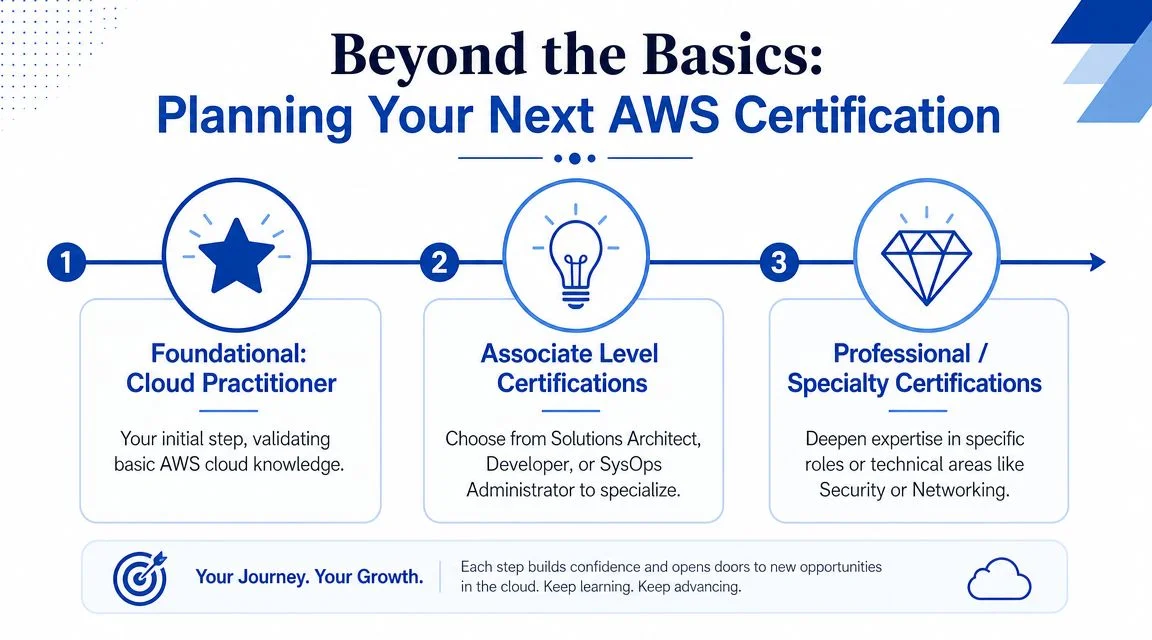
A common next step involves one of the Associate-level certifications: Solutions Architect Associate, Developer Associate, or SysOps Administrator Associate. The best choice depends less on perceived prestige and more on the type of work you want to excel in. As discussed, Cloud Practitioner provides the shared vocabulary and service awareness that makes these role-based paths more accessible.
Choosing Your Associate Path
You don't need your entire career planned out today, just a logical next target.
| Certification path | Best fit for | Main focus |
|---|---|---|
| Solutions Architect Associate | Individuals interested in designing systems | Selecting AWS services to meet reliability, security, and architectural requirements |
| Developer Associate | Individuals building applications | Interacting with AWS services from a development and application perspective |
| SysOps Administrator Associate | Individuals managing cloud environments | Monitoring, administering, and supporting AWS workloads in operational settings |
Here’s a simple way to choose: Consider the problems that capture your attention most.
- You enjoy system design and evaluating tradeoffs: Solutions Architect Associate is often the most logical choice.
- You like coding and understanding application behavior: Developer Associate is usually a better fit.
- You're interested in operations, support, and environment management: SysOps Administrator Associate deserves strong consideration.
Your second certification should align with your daily interests. When you select a path that resonates with the work you aspire to do, studying becomes less about memorization and more about practical preparation for the role itself.
Cost is also a factor. Exam fees, study resources, and timing significantly influence your plan, especially if you're paying out of pocket. These strategies for affordable AWS certification can help you compare options before committing.
For those learning within a startup environment, there's another practical consideration. Your team might be exploring AWS while also managing expenses. Understanding available support programs, like startup cloud credits, can be very beneficial.
Passing Cloud Practitioner opens a path. Choosing the next certification turns that path into a career plan.
This highlights the value of starting with your first AWS certification. It provides sufficient structure to make your next career move with clear purpose, eliminating guesswork.
Begin Your Cloud Path with Confidence
By now, the answer to the question "What is the first AWS certification?" should feel clear and practical, not vague. The initial certification to pursue is the AWS Certified Cloud Practitioner, and you understand why this choice is logical.
It provides a solid foundation for beginners, introducing the language of AWS. It helps you grasp cloud concepts, security basics, core services, and pricing logic before you transition into more specialized, role-based work. This structured sequence fosters confidence, which is crucial when entering a field that can appear overwhelming.
If you're part of a startup team, it's also wise to consider the broader AWS ecosystem beyond the exam itself. Explore programs that can help early-stage companies manage cloud spend. For instance, this guide to startup cloud credits is a valuable resource if your employer or project is adopting AWS while aiming to control costs.
Your first certification isn't meant to make you an expert instantly. Its purpose is to get you moving in the right direction with a robust foundation. That's precisely what Cloud Practitioner aims to achieve.
Maintain a simple goal: learn the foundations thoroughly. Take the exam when your understanding feels secure. Then, select your next certification based on the type of cloud work you aspire to grow into.
Ready to put your knowledge to the test and prepare for exam day? Explore MindMesh Academy's AWS Certified Cloud Practitioner practice exams to build your confidence and validate your understanding.

Written by
Alvin Varughese
Founder, MindMesh Academy
Alvin Varughese is the founder of MindMesh Academy and an enterprise architecture leader. An electrical engineer by training, he moved from factory automation in South Africa to cloud architecture at GE Appliances and Humana (Fortune 50), and holds 20 professional certifications including AWS Solutions Architect Professional, Azure DevOps Engineer Expert, and Microsoft Agentic AI Business Solutions Architect. He built MindMesh Academy after interviewing too many highly certified candidates who couldn't answer basic questions: the goal is prep that makes you better at the job, not just able to pass the exam.