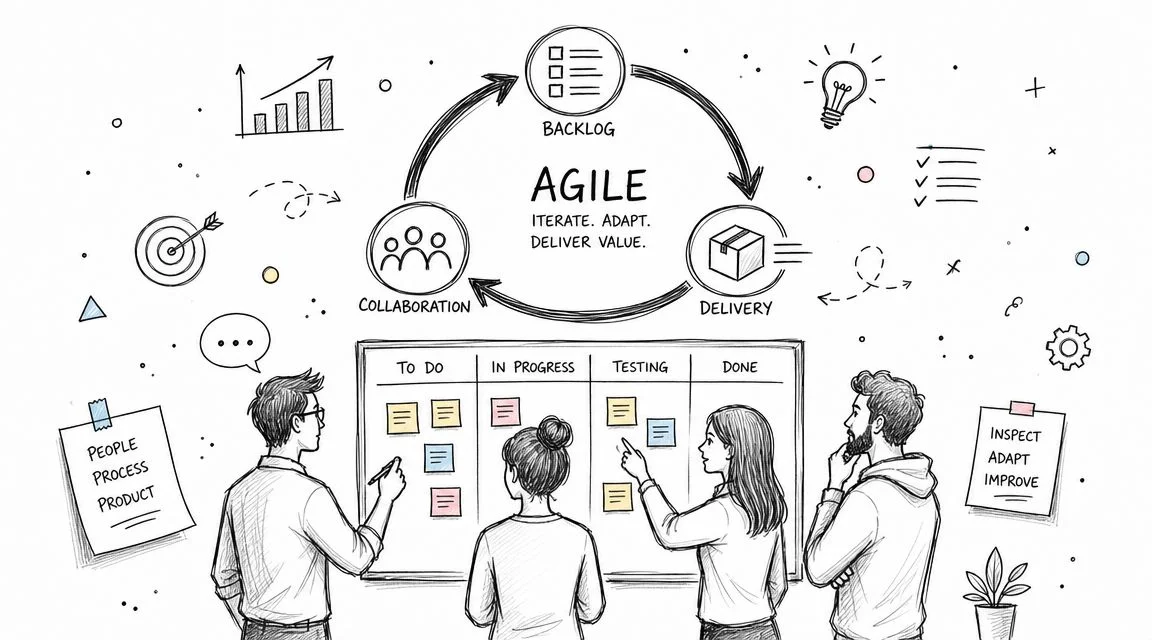
What Is Agile Project Management? 2026 Guide
What Is Agile Project Management? The MindMesh Academy Perspective
You're likely in one of two situations right now. Perhaps you're looking at a certification outline that lists Agile, Scrum, Kanban, and iterative delivery, or you've joined a team that claims to be "doing Agile" and you're trying to understand what that actually means.
This confusion is common.
Many people first hear "Agile" as a buzzword. They soon discover it isn't just one tool, one meeting, or one template. Instead, it's a way to manage work when the complete path isn't clear from the start. If you're studying for the PMP or stepping into your first project role, this distinction is crucial. Certification exams test your ability to recognize when Agile methods are appropriate, when they aren't, and how their practices support decision-making under uncertainty.
From Rigid Plans to Responsive Teams
Traditional projects often begin with a reassuring promise: define everything up front, approve the full plan, then execute step by step. This works well when the work is stable and predictable. It breaks down when customers only realize what they want after seeing early results.
Consider building a house from an approved blueprint. You want the structure, permits, materials, and sequence firmly established before construction begins. Now, compare that to creating a new application for users whose needs will evolve once they start interacting with the screens. In the latter case, a rigid plan can restrict the team.
A common early-career error is assuming that project control means freezing scope and defending the original baseline at all costs. In uncertain work, this can create expensive waste. A team might spend weeks documenting features that users later reject.
That's the problem Agile aims to solve.
Agile project management emerged as a formal response to the limitations of heavyweight software development methods. Its modern foundation is usually traced to the 2001 Agile Manifesto. This manifesto was created by 17 software practitioners who met in Snowbird, Utah. It distilled their shared principles into 12 values and principles focused on customer collaboration, iterative delivery, and adapting to change (Businessmap).
What Changed in Practice
Instead of managing one giant delivery, Agile breaks work into small slices that can be planned, built, reviewed, and adjusted. Teams don't wait until the very end to discover whether they built the right product. They learn as they go.
For students, this is the simplest answer to what is Agile project management: it's a way of delivering work in short feedback loops, allowing the team to adapt before problems become significant.
If you want a practical product perspective on this, Aakash Gupta's explanation of the agile product development process offers a useful companion, connecting the mindset to the actual delivery flow.
Exam lens: When a PMP question describes changing requirements, frequent stakeholder feedback, or uncertainty about features, Agile is often the better fit.
If you're studying systematically, these comprehensive PMP certification resources can help you link Agile concepts to the scenario-based questions that appear on the exam.
Understanding the Four Values and Twelve Principles
The Agile Manifesto is easy to memorize but often misunderstood. Students frequently interpret the four values as if Agile rejects process, planning, or documentation. It doesn't. Agile simply states that the items on the left side of its declarations are valued more when tradeoffs become necessary.
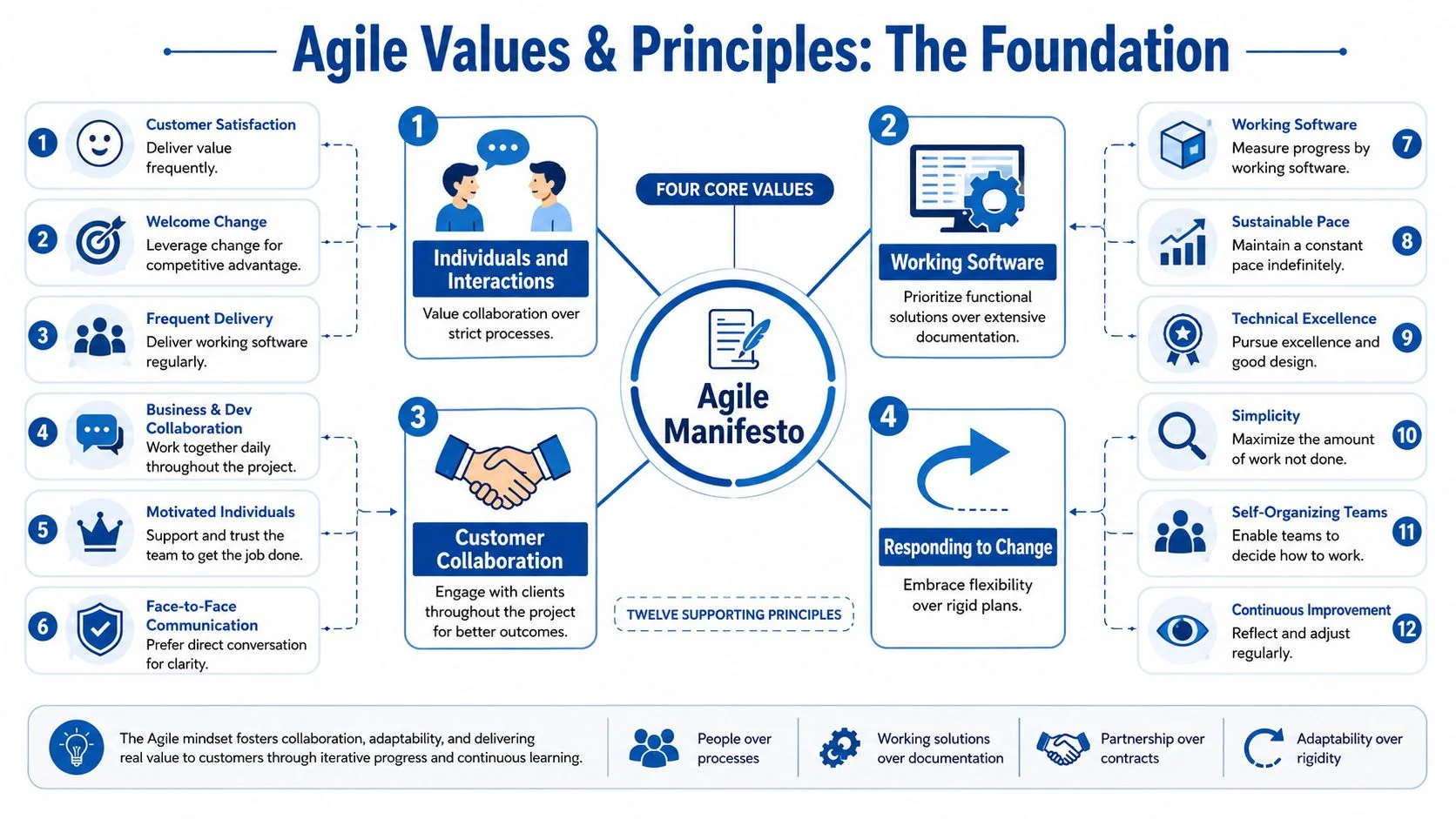
The Four Values in Plain English
Individuals and interactions over processes and tools means people solve problems faster when they communicate early and often. A ticketing system is helpful, but it can't replace a quick conversation between a developer, tester, and product owner when a requirement is unclear.
Working software over extensive documentation doesn't mean "skip documents." It means a working increment provides stronger evidence of progress than a polished requirements file that no one has validated against reality.
Customer collaboration over contract negotiation means the customer isn't just present at kickoff and sign-off. They remain engaged, clarify priorities, and react to what the team learns.
Responding to change over following a plan means the plan serves the product's evolving needs, not the other way around.
Why the Principles Matter on Real Projects
The principles underpinning these values translate the mindset into daily behavior. Teams deliver in small pieces, welcome changing requirements, work closely with business stakeholders, reflect regularly, and maintain focus on usable outcomes.
This is why Agile is often described as an iterative system rather than a one-time design exercise. Agile project management is technically defined by short, timeboxed iterations that convert large scope into inspectable increments. This allows teams to optimize for feedback latency instead of upfront plan completeness. This iterative structure creates a closed-loop control system where each sprint provides empirical data to re-prioritize the backlog and reduce wasted effort (CompTIA).
A practical example illustrates this more clearly:
- Old habit: The team continues building because the signed requirements document instructed them to.
- Agile habit: The team reviews a working increment, learns that the customer's priority has shifted, and updates the backlog before more low-value work is built.
How Exam Questions Usually Frame This
PMP-style questions rarely ask you to recite all twelve principles from memory. They usually test whether you recognize the appropriate Agile response to a situation.
For instance, if stakeholders discover a better direction mid-project, the Agile answer isn't "reject all change requests." It's "inspect the new information, reprioritize the backlog, and deliver the highest-value next increment."
In Agile, control comes from fast feedback and visible work, not from pretending the original plan was perfect.
If you need a terminology refresher during your studies, this Agile methodology guide can help clarify the language that often gets mixed together during early exam preparation.
Choosing Between Agile and Waterfall
The most useful question isn't "Which method is better?" It's "Which method fits this work?"
Agile and Waterfall solve different problems. Waterfall is stronger when you can define the work clearly at the start, and changes are costly or tightly controlled. Agile is stronger when requirements are likely to shift, and stakeholder feedback needs to shape the outcome.
A simple analogy helps. Waterfall is like assembling furniture from a kit with a fixed design. Agile is like cooking a new dish for guests, tasting as you go, adjusting seasoning, and changing based on feedback before the meal is finished.
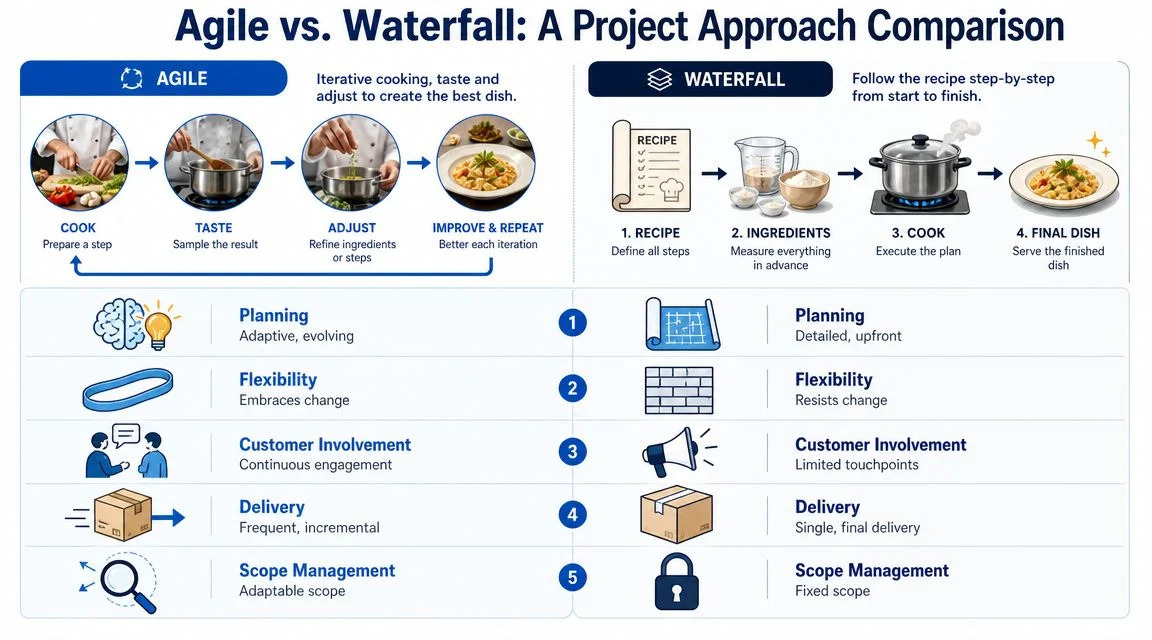
Agile vs. Waterfall at a Glance
| Dimension | Agile | Waterfall (Traditional) |
|---|---|---|
| Planning | Adaptive and revisited often | Detailed up front |
| Scope | Evolves through feedback | Defined early and controlled tightly |
| Customer involvement | Frequent | Limited to major checkpoints |
| Delivery | Incremental | Usually final delivery at the end |
| Risk handling | Exposes issues earlier through small increments | Can hide problems until later phases |
| Best fit | Uncertain, changing work | Stable, predictable work |
PMI's guidance on this is especially important. Agile is best suited to dynamic environments with rapid change and unclear features, while more stable or highly regulated work may require stronger upfront definition and controls. A key decision criterion is the level of requirement volatility and stakeholder availability for frequent feedback (PMI).
When Agile Is the Wrong Choice
Introductory articles often skip this part, but your exam likely won't.
Agile may be the wrong primary approach when:
- Requirements are stable: The work is already well understood and unlikely to change.
- Compliance drives the sequence: Approval gates, traceability rules, or regulatory controls require stronger upfront documentation and formal sign-offs.
- Stakeholders aren't available: Agile depends on regular feedback. If decision-makers are absent for long stretches, the team loses one of Agile's core advantages.
- The contract fixes scope tightly: If scope, cost, and acceptance are locked in at the start, the room for iterative reprioritization is limited.
Here's a quick explainer before our next comparison.
A Practical Decision Framework
Ask these questions before choosing Agile:
- How often will requirements change?
- Can stakeholders review working results frequently?
- Will the team benefit from learning by doing?
- Do governance rules allow iterative delivery?
If you work in Microsoft-heavy delivery environments, the AZ-400 certification study guide is useful because DevOps and Agile decisions often intersect in real project teams.
Scrum, Kanban, and XP Explained
Agile is the mindset. Scrum, Kanban, and Extreme Programming (XP) are methods to put that mindset into action. New learners often conflate them, then get confused when one team uses sprints and another uses a pull-based board.
They are distinct approaches.
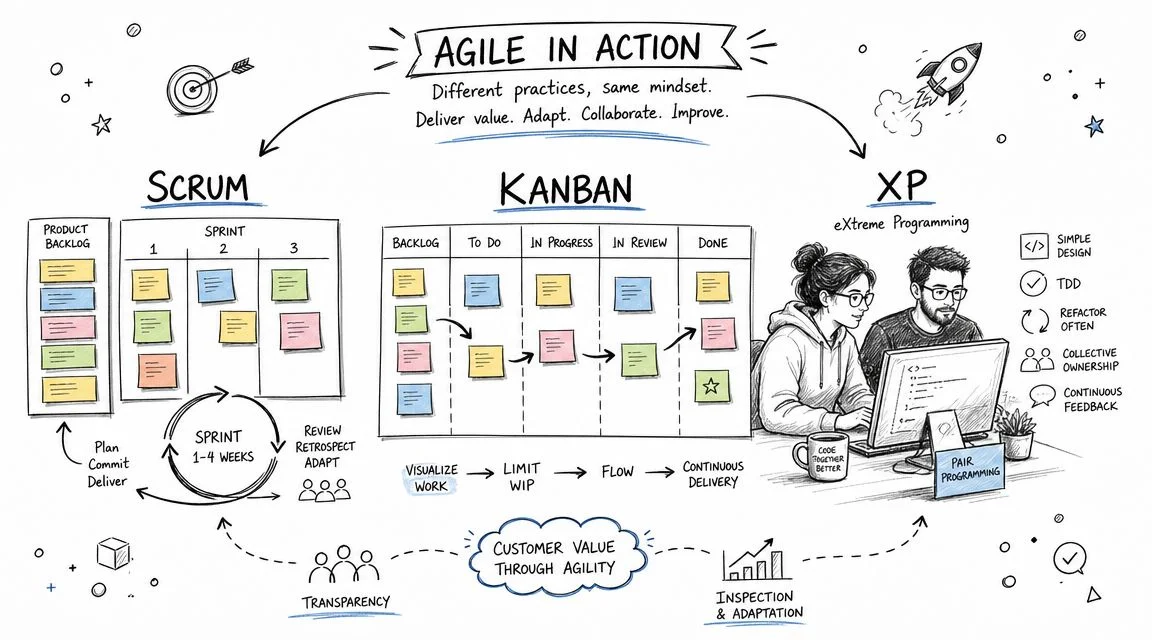
Scrum for Structured Iteration
Scrum is for work that benefits from a repeating cycle of planning, building, reviewing, and improving. It uses timeboxed sprints, a product backlog, defined roles, and regular ceremonies.
In practice, a Scrum team might plan a sprint, commit to a small set of backlog items, build them during the sprint, show the result to stakeholders, then reflect on how to improve their process next time. Scrum provides teams with a rhythm.
Use Scrum when:
- The work is complex: Teams need regular checkpoints.
- Priorities can change between cycles: The backlog can be reordered.
- A team needs structure: Scrum provides clear roles and events.
Kanban for Continuous Flow
Kanban is better understood as a flow system rather than a sprint system. Teams visualize work on a board, limit how much work is in progress, and focus on moving items smoothly from start to finish.
A support team handling incoming defects is a good example. New issues appear continuously, and forcing them into fixed sprints can create friction. Kanban helps the team identify bottlenecks and manage flow without waiting for the next sprint boundary.
Kanban usually looks like this in practice:
- Visual workflow: Columns such as To Do, In Progress, Review, Done.
- Work-in-progress limits: Fewer half-finished tasks, more completed work.
- Flow focus: Teams observe where work gets stuck and improve that part of the system.
Practical rule: If work arrives continuously and priorities shift daily, Kanban often feels more natural than Scrum.
XP for Technical Excellence
XP is especially useful when software quality and engineering discipline must remain very high while requirements evolve. It emphasizes practices such as pair programming, test-driven development (TDD), continuous integration, and frequent feedback.
If Scrum answers "How do we organize delivery?", XP often answers "How do we build software in a way that remains clean and safe to change?"
This distinction matters because Agile can fail when teams move fast but neglect technical quality. The result is a backlog full of unfinished defects, brittle code, and slower delivery later on.
Which One Should You Choose?
A quick way to differentiate them:
| Framework | Best for | What it looks like |
|---|---|---|
| Scrum | Complex product work | Sprints, backlog, reviews, retrospectives |
| Kanban | Continuous service or support flow | Visual board, WIP limits, steady pull of work |
| XP | Software teams needing strong engineering practices | TDD, pair programming, continuous integration |
For exam preparation, remember this: Scrum is the most commonly tested because its roles and ceremonies are easy to turn into scenarios. Kanban appears in questions about flow and visualization. XP appears when the question focuses on code quality, feedback, and safe change.
The People and Meetings That Drive Agile
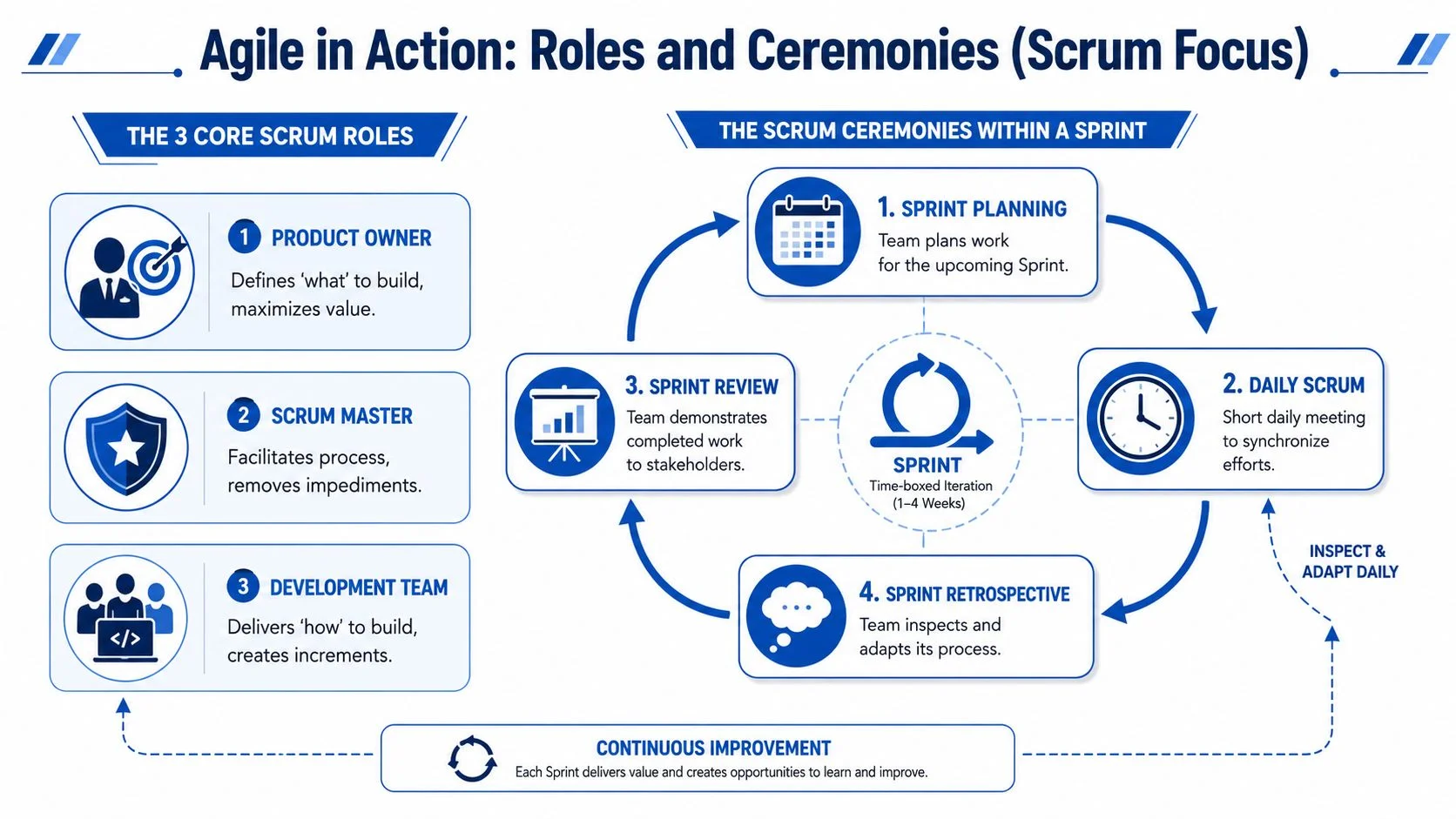
Agile doesn't run on sticky notes. It relies on clear ownership and disciplined feedback loops. Scrum is the easiest place to see this because it explicitly names the roles and ceremonies.
The Three Core Roles
The Product Owner is the keeper of the what. This role prioritizes the backlog, clarifies value, and represents customer needs in daily decisions.
The Scrum Master is the keeper of the process. This person facilitates the framework, removes impediments, and helps the team improve its working methods.
The Development Team is the keeper of the how. These are the people who build the increment and decide how to transform backlog items into working results.
Students often confuse the Scrum Master with a traditional project manager. They are not the same. A Scrum Master does not assign every task or act as the team's boss.
The Main Ceremonies and Why They Exist
Each meeting serves a specific purpose. When teams skip the purpose and keep only the calendar invite, Agile becomes merely procedural.
- Sprint Planning: The team decides what it can commit to next and how the work will be approached.
- Daily Scrum: A short synchronization point. It's not a status report for management.
- Sprint Review: Stakeholders inspect the increment and react to what was built.
- Sprint Retrospective: The team reflects on its process and chooses improvements.
Many beginners treat the retrospective as optional. That's a mistake. It's where continuous improvement becomes a reality instead of just an idea.
The review improves the product. The retrospective improves the team.
If sprint planning still feels abstract, this agile sprint planning guide provides a practical walkthrough of how teams translate backlog items into a realistic near-term plan.
How Agile Teams Measure Progress
One reason Agile feels unfamiliar at first is that progress is measured differently. Traditional teams often ask, "Did we finish the phase?" Agile teams ask, "What working value did we deliver, and what does actual delivery data tell us about what comes next?"
That's a significant shift.
The Core Artifacts
Three artifacts consistently appear in Agile work:
- Product Backlog: The ordered list of desired work.
- Sprint Backlog: In Scrum, this is the subset of the Product Backlog selected for the current iteration.
- User Stories: Short descriptions of needs from the user's point of view.
These aren't just administrative lists. They create visibility. Everyone can see what is currently important, what is waiting, and what has already become working output.
The Metrics That Matter
PMI notes that Agile teams can use iteration delta tables, release and iteration burn-down charts, running tested features, and earned value management to report status. Because work is broken into smaller batches, teams can quantify throughput and forecast completion from actual delivery data, improving predictability (PMI on Agile metrics).
This translates into a few practical signals:
- Velocity: A Scrum team's observed delivery rate across iterations. Teams use it for forecasting, not for competition.
- Burndown charts: Visuals that show remaining work over time.
- Running tested features: Evidence that the product is becoming usable.
- Throughput and cycle-time focused thinking: Useful for understanding how quickly work moves through the system.
Where Readers Get Confused
The common pitfall is treating metrics as performance weapons. This leads teams to game numbers instead of learning from them.
A healthier rule is simple:
- Use metrics to forecast.
- Use metrics to spot bottlenecks.
- Use metrics to adapt scope or process.
If a team's delivery pattern changes, Agile doesn't hide that. It brings it to the surface early enough to respond.
Real-World Challenges and Your Next Steps
A team can hold stand-ups and run sprints without truly being Agile.
This happens when organizations copy the rituals but maintain the old operating model underneath. Leaders still demand rigid annual plans, funding still assumes fixed scope, and decision-making authority still rests far from the people doing the work. The team uses Agile vocabulary, but the system around it resists Agile behavior.
Why Implementations Stall
Atlassian highlights a problem many managers learn the hard way: many companies adopt Agile rituals without changing funding, metrics, or decision rights, which can blunt results. A useful question for managers is: 'What must change outside the team for Agile project management to succeed?' This is especially relevant in enterprise IT, where Agile is often misunderstood as a process template rather than an operating model (Atlassian).
That's why genuine Agile adoption usually requires more than just team training.
- Leadership changes: Managers need to support faster decisions and shorter feedback cycles.
- Governance changes: Reporting has to reflect iterative delivery, not only phase completion.
- Funding changes: Budgets may need to support evolving scope instead of one frozen plan.
What This Means for Exams and Career Growth
On the PMP exam, Agile isn't just a glossary topic. It appears in situational judgment questions. You're asked what a project leader should do when requirements change, when stakeholders disagree, when value needs reprioritization, or when a team is overloaded by process.
The most effective answers usually favor collaboration, inspection, adaptation, and value delivery over rigid enforcement of an outdated plan.
For real projects, your next step is straightforward:
- Study the mindset, not just the terms.
- Learn when Agile fits and when it doesn't.
- Practice reading scenarios, not just definitions.
- Observe how teams use feedback to change direction.
If you're preparing formally, PMP exam preparation should include both predictive and Agile thinking, because modern project environments rarely stay at one extreme.
If you want a structured way to learn these concepts for both exam success and practical use, MindMesh Academy offers certification study materials designed to help learners connect project management theory with real-world decision-making. Start preparing for the PMP exam with our practice tests.

Written by
Alvin Varughese
Founder, MindMesh Academy
Alvin Varughese is the founder of MindMesh Academy and an enterprise architecture leader. An electrical engineer by training, he moved from factory automation in South Africa to cloud architecture at GE Appliances and Humana (Fortune 50), and holds 20 professional certifications including AWS Solutions Architect Professional, Azure DevOps Engineer Expert, and Microsoft Agentic AI Business Solutions Architect. He built MindMesh Academy after interviewing too many highly certified candidates who couldn't answer basic questions: the goal is prep that makes you better at the job, not just able to pass the exam.