
Tips for Reviewing for Exam Day Without Cramming
Tips for Reviewing for Exam Day Without Cramming
If you're looking for strategies to review for exam day without cramming, here's the core idea: your final review should narrow the test, not broaden it. Focus on the exam objectives you consistently miss. Answer questions under timed conditions. Write down why you missed each one, and then review only the facts, steps, and decisions that would lead you to a different answer next time.
For certification exams, the final week isn't the time to reread every chapter or rewatch an entire course. Your goal is to show readiness for each objective, correct recurring errors, and preserve the energy you'll need on test day. The plan below helps you transform scattered review into a structured routine.
Tips for Reviewing for Exam Day in the Final Week
A good final review has a narrow scope, frequent retrieval, and clear stopping points. Cramming often feels productive because you cover a lot of material, but it frequently masks whether you can truly recall and apply that material without assistance.
| Final review habit | What it does | Cramming habit to avoid |
|---|---|---|
| Review missed objectives first | Fixes the areas most likely to cost points | Starting from page one again |
| Answer timed questions | Builds recall under pressure | Reading explanations before choosing |
| Explain why the right answer is right | Improves decision-making | Memorizing answer letters |
| Stop at a planned time | Preserves focus and sleep | Studying until you're exhausted |
The most effective final-week plan is simple enough to follow even when you're tired. If a review step doesn't directly help you answer future questions more accurately, shorten or eliminate it.
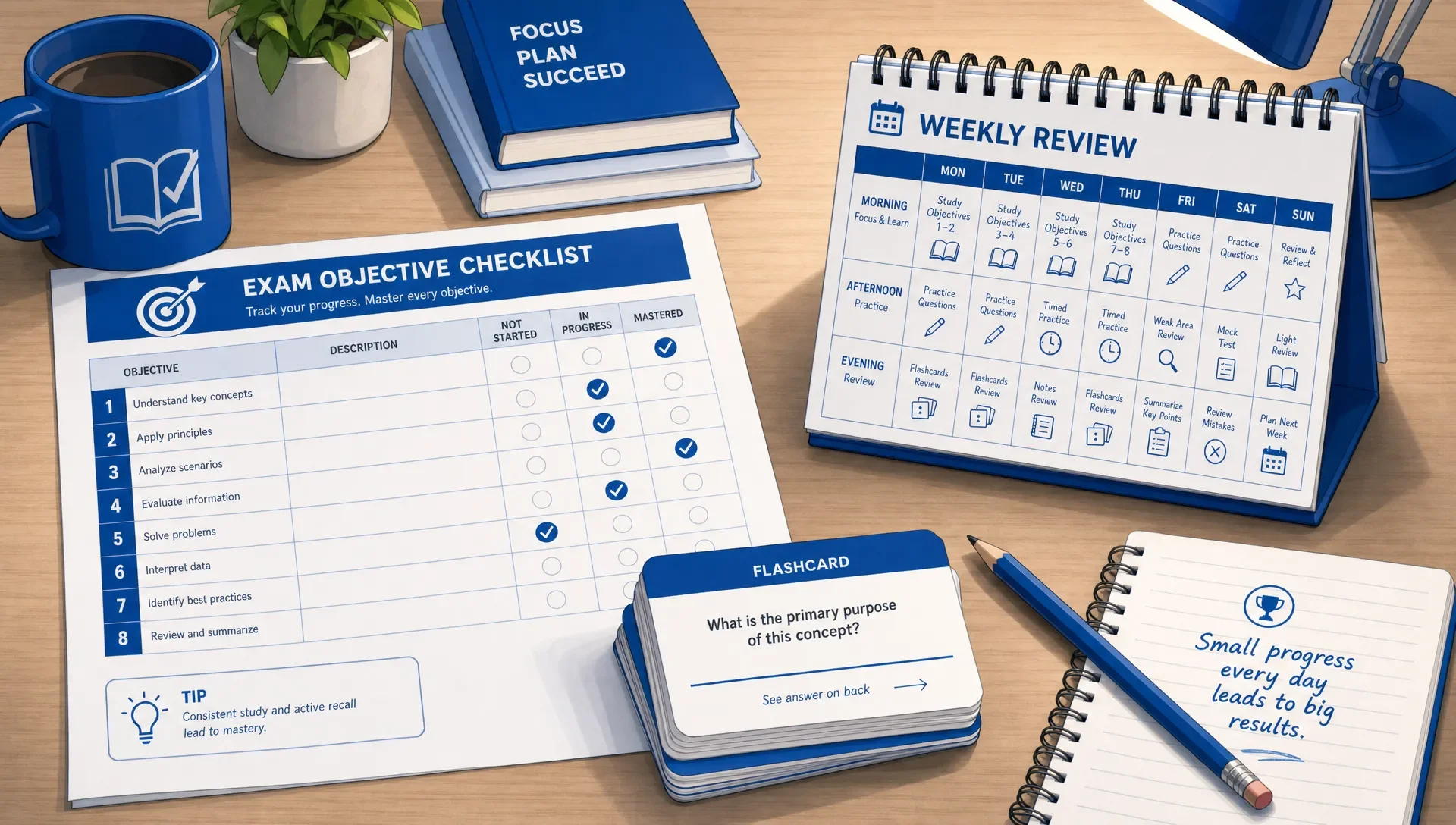
Start With Exam Objectives, Not Your Whole Course
Practical review starts with controlling your scope. Certification exams are built around published objectives, domains, or skills measured. Your review should follow the same organization. If you're preparing for a vendor exam, consult the official exam outline first, then map your notes and practice results to those categories.
This approach prevents two common mistakes. First, you won't waste time perfecting a topic you already understand. Second, you won't overlook a minor but testable objective because it seems less engaging than the tools you use daily.
For each weak objective, a concise review sheet should include only four items: the concept you missed, the rule or command you confused, a brief example, and one practice question that tests it. For those studying cloud fundamentals, a structured resource like the AWS Certified Cloud Practitioner practice exam helps connect your review directly to exam-style decisions, moving beyond scattered notes.
Use Practice Questions as a Diagnostic, Not a Score Hunt
One of the most effective review strategies is to stop treating practice questions like a scoreboard. Your practice score is important, but the reason behind each incorrect answer is even more critical. Before you read an explanation, mark whether you felt confident, unsure, or were guessing. This single detail reveals whether your issue stems from knowledge, question wording, time pressure, or overconfidence.
Retrieval practice is backed by strong evidence. In a Science paper, Jeffrey Karpicke and Henry Roediger demonstrated that repeated retrieval significantly improved long-term retention compared to additional study time in their learning and recall experiments (Science). Simply put, making yourself answer before checking the explanation is a crucial part of learning, not just a way to measure what you know.
| If you missed because of... | Your next review move |
|---|---|
| You didn't know the concept | Return to the objective and make a one-sentence definition |
| You confused two similar options | Build a compare-and-contrast note |
| You knew it but ran out of time | Practice a smaller timed set |
| You misread the scenario | Underline constraints such as cost, availability, risk or scope |
| You guessed correctly | Review it anyway because the score hid a weakness |
For a more thorough process to analyze your incorrect answers, consult this guide on how to review an exam practice test the right way before your next timed practice session.
Build a Seven-Day Review Plan That Prevents Cramming
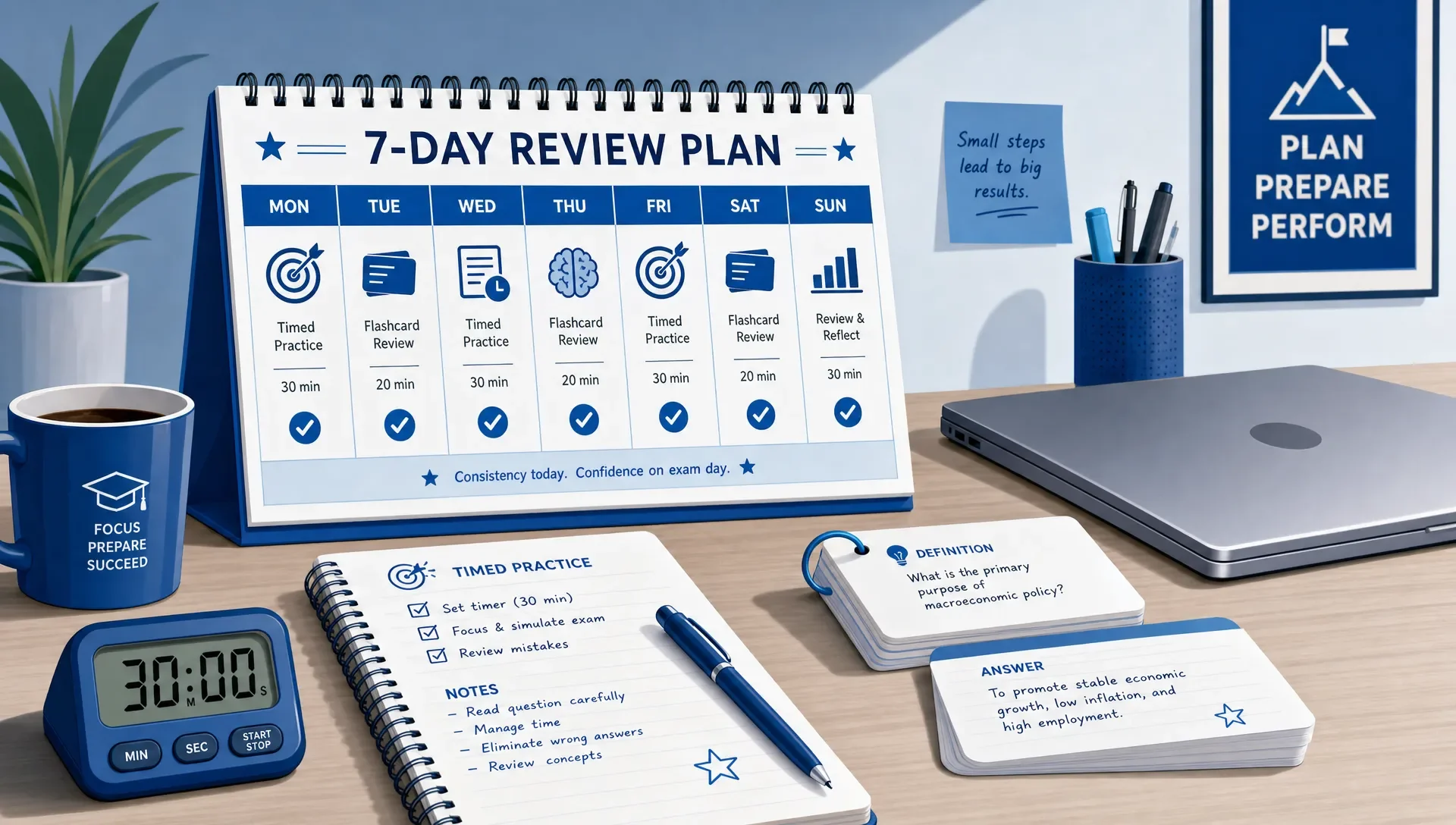
These exam review tips are most effective when distributed throughout your final week. You don't need a complicated calendar; you need a rhythm that alternates testing, correcting, and retesting.
| Day | Main task | Output |
|---|---|---|
| 7 days out | Take a timed mixed set | List weak objectives and timing issues |
| 6 days out | Review the top three weak areas | Create short notes and flashcards |
| 5 days out | Do targeted practice | Retest only those weak areas |
| 4 days out | Mix domains again | Check whether fixes transfer to new questions |
| 3 days out | Practice scenario questions | Explain the clues that drive each answer |
| 2 days out | Light review and flashcards | Focus on recall, not new content |
| 1 day out | Logistics and confidence check | Stop heavy studying early |
The Institute of Education Sciences practice guide, Organizing Instruction and Study to Improve Student Learning, advises spacing out learning over time instead of consolidating it into a single session (IES). This doesn't imply your final week should be easy. Instead, it means hard work should be distributed, giving your brain multiple opportunities to retrieve the material.
Review Flashcards the Right Way in the Last 72 Hours
One straightforward tip for exam review is to use flashcards for recall, not just recognition. If you flip a card and immediately think, 'Yes, I know that,' you might only be recognizing familiar wording. Instead, read the prompt, articulate or write the answer, and then check.
Flashcards work best for items requiring quick recall: ports, commands, formulas, definitions, lifecycle steps, service limits, governance terms, and security principles. They're less effective for extensive scenario reasoning unless you phrase the card as a decision prompt.
For instance, a weak card might ask, "What is encryption at rest?" A stronger card would state: "A company needs to protect stored database files if disks are removed from a server. Which control category applies, and why?" This second version forces you to retrieve the concept in a format closer to how the exam might test it.
MindMesh Academy includes flashcards with spaced repetition, allowing learners to revisit weaker material without manually sorting every card. Combine this with practice questions and topic progress tracking to ensure you're not reviewing everything with the same intensity.
Rehearse Test-Day Decisions, Not Just Definitions
Definitions are important, but many certification questions test your judgment. You might need to select the most secure option, the least operationally complex choice, the best initial troubleshooting step, or the answer that aligns with a specific business constraint.
That's why reviewing scenarios should involve self-explanation. After each question, complete this sentence: "I chose this answer because the scenario says..." If you can't identify the specific clue, you're likely depending on memory rather than active reasoning.
This is particularly useful for exams with performance-based or scenario-heavy formats. For instance, security learners can use a CompTIA Security+ practice exam to practice interpreting risk, controls, and incident response language under timed conditions.
An effective final review also involves analyzing wrong answers. Don't just ask why the correct answer is right. Instead, consider what would need to change in the scenario to make each distractor correct. This approach builds flexibility, which is helpful when the actual exam phrases a topic differently than your practice materials.
What To Do the Night Before and Morning of the Exam
The final tips for exam day are straightforward: stop intense studying early, prepare your logistics, and prioritize sleep. The night before isn't the time to start a new domain, take a marathon practice exam, or completely overhaul your study plan. If you uncover a new weakness that late, make a brief note and review only the highest-impact rule.
Sleep is essential for learning. The National Institute of Neurological Disorders and Stroke explains that sleep supports crucial brain functions, including learning and memory (NINDS). You don't need perfect sleep to pass an exam, but sacrificing rest for one more late-night study session can impair recall and attention when you need them most.
Use the morning for a brief warm-up, not a panicked review. Go through five to ten easy recall flashcards, quickly scan your checklist of common mistakes, and then stop. Confirm your identification, review testing rules, verify your appointment time, plan your route, or check your online testing setup. The goal is to arrive with minimal last-minute decisions.
How To Know You're Ready Without Chasing Perfection
As you implement these review tips, avoid waiting until you feel like you know absolutely everything. Readiness isn't about perfection. It's about consistent performance across objectives, stable timing, and fewer repeated errors.
Look for three key readiness signals. First, your missed questions should be distributed across various topics, not concentrated in the same weak domain. Second, you should be able to explain most correct answers without needing to read the provided explanation first. Third, your timing should allow enough buffer to review flagged questions without rushing the final section.
If your review platform offers mastery and readiness tracking, use that data to make your final days calmer. MindMesh Academy integrates study guides aligned with exam objectives, practice questions with explanations, flashcards, adaptive weakness-based practice, and readiness tracking across certification paths. This integrated workflow helps keep your final review focused on areas that still require work, rather than just what feels familiar.
Frequently Asked Questions
How many hours should I review the day before an exam? For most learners who've studied consistently, one to three focused hours is sufficient the day before. Use this time for light recall, reviewing common mistakes, and logistics. Avoid taking a full new practice exam unless your test is still several days away.
What are the best tips for reviewing for exam day if I'm behind? Prioritize high-weight objectives, frequently missed topics, and common scenario patterns. Skip extensive rereading. Instead, take a small timed practice set, categorize your misses, address the top two or three underlying causes, and then retest those specific areas.
Should I review notes or practice questions first? Start with practice questions if you have a foundational understanding. Questions reveal what you can truly recall and apply. Use notes afterward to fill knowledge gaps, rather than making them your default first step.
Is it bad to study on the morning of the exam? A brief warm-up is acceptable. Review a few flashcards, quickly skim your mistake checklist, and stop before you induce anxiety. The morning of the exam is generally a poor time to absorb new material.
How do I avoid forgetting what I reviewed earlier in the week? Implement spaced repetition and mixed practice. Revisit weaker topics briefly on multiple days instead of dedicating one long session. Force yourself to answer before checking notes to keep recall active.
Turn Your Final Review Into a Readiness Check
You don't need a frantic final week to pass a certification exam. What you need is a review plan that reveals what you know, highlights what still falters under pressure, and provides time to address those weaknesses.
If you're ready to solidify your final review, MindMesh Academy offers objective-based study guides, comprehensive practice questions with explanations, and readiness tracking for your certification path. Build confidence for exam day with our AWS Certified Cloud Practitioner study guide.

Written by
Alvin Varughese
Founder, MindMesh Academy
Alvin Varughese is the founder of MindMesh Academy and an enterprise architecture leader. An electrical engineer by training, he moved from factory automation in South Africa to cloud architecture at GE Appliances and Humana (Fortune 50), and holds 20 professional certifications including AWS Solutions Architect Professional, Azure DevOps Engineer Expert, and Microsoft Agentic AI Business Solutions Architect. He built MindMesh Academy after interviewing too many highly certified candidates who couldn't answer basic questions: the goal is prep that makes you better at the job, not just able to pass the exam.