SHRM Certification Exam Prep: Your Ultimate 2026 Guide
Preparing for the SHRM Certification Exam: A Structured Approach
You've probably had this moment already. You open the SHRM BASK materials, start flipping through domains, competencies, and practice items, and realize this isn't the kind of exam you can ace on professional instinct alone. You know HR. You solve people problems every week. But the test still feels bigger than your daily job because it asks you to translate experience into SHRM's decision-making logic under pressure.
That gap is where most candidates get stuck.
I've mentored strong HR generalists, business partners, and people managers through SHRM certification exam prep, and the same pattern shows up every time. The people who pass don't necessarily study the longest. They study with structure. They stop treating the exam like a giant reading assignment and start treating it like a professional project with a timeline, a feedback loop, and a method.
That matters even more if you're balancing a full-time role, family obligations, and the mental fatigue that comes with being “on” for employees all day. You don't need a prettier binder or a longer checklist. You need a plan that tells you what to review, how to retain it, and how to answer the exam the way SHRM expects.
I also tell people to protect their broader professional judgment while they study. Good HR leaders don't just memorize policy language. They build perspective. If you want a short reset between study blocks, this collection of advice for HR teams is worth your time because it sharpens the human side of the work that the credential is meant to validate.
Your Path to Passing the SHRM Certification Exam
Most candidates start in one of two unhelpful places. They either overestimate their work experience and assume they can “review a little and pass,” or they panic, buy every prep tool they can find, and drown in content. Neither approach works well.
The exam rewards disciplined preparation. It doesn't reward random effort.
What strong candidates do differently
The best study plans I've seen share a few traits:
- They begin with diagnosis: Candidates identify where they're weak before they commit to a schedule.
- They study actively: They test themselves, explain concepts out loud, and work through decision scenarios.
- They train for the exam format: They don't just read HR content. They practice answering SHRM-style questions.
- They protect consistency: They'd rather complete solid study sessions every week than binge on weekends and burn out.
Practical rule: Treat your prep calendar like a live work deliverable. If it isn't scheduled, it usually doesn't happen.
What this process should feel like
Done right, SHRM certification exam prep should feel focused, not frantic. You're building two things at once: content mastery and pattern recognition. The first helps with knowledge-based questions. The second helps with the tougher judgment calls where two answers look reasonable and only one fits SHRM's logic.
That's why this guide goes beyond resource lists. A stack of books won't teach you how to retrieve information under time pressure. A giant question bank won't help much if you keep missing the same kind of decision trap. You need a repeatable way to learn, review, and adjust.
If you approach this like a capable HR leader running a practical project, the exam becomes manageable. Demanding, yes. But manageable.
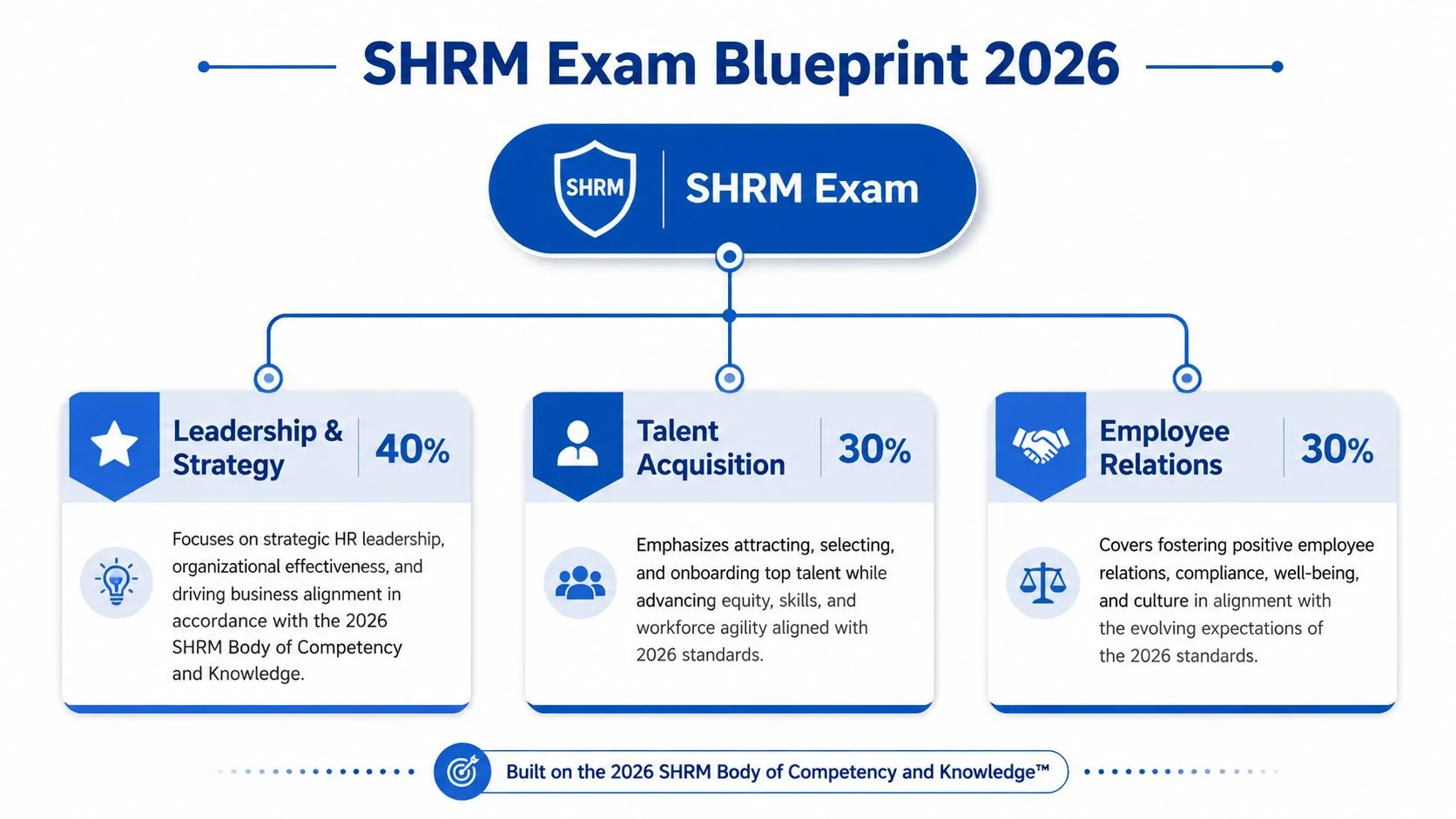
Understanding the SHRM Exam Blueprint
A week into prep, a lot of capable HR professionals make the same mistake. They open three different resources, start reading wherever the content feels familiar, and end the night with plenty of effort but no real control over the exam. The blueprint fixes that problem. It tells you what the test asks you to do, how long you have to do it, and where your study time will pay off.
SHRM's exam information shows the structure in plain terms: 134 multiple-choice questions, with 80 knowledge items and 54 situational judgment items, delivered in two 110-minute sections for a total testing time of 3 hours and 40 minutes. SHRM also reports scaled scores from 120 to 200, with 200 as the passing score, and recent global pass-rate ranges of 67% to 71% for SHRM-CP and 50% to 56% for SHRM-SCP (official SHRM exam options and fees information).
What the question mix means for your prep
That split matters because the exam measures two different kinds of competence.
Knowledge items check whether you can recall and apply HR content accurately. Situational judgment items check whether you can choose the best HR response in context, often when two options sound reasonable. I have seen strong practitioners miss those scenario questions because they answered from personal preference, company habit, or a manager-first instinct instead of SHRM's broader HR logic.
Use the blueprint to match method to task.
| Exam element | What it tests | Best prep approach |
|---|---|---|
| Knowledge-based items | HR facts, concepts, and applied understanding | Active recall, brief concept summaries, targeted quizzes |
| Situational judgment items | Decision quality in HR scenarios | Scenario drills, answer comparison, reasoning review |
| Timed exam format | Accuracy under pressure | Timed sets, pacing practice, disciplined review |
This is also where learning science applies. Active recall strengthens memory for the knowledge side. Spaced repetition keeps weaker topics from disappearing between study sessions. A platform that supports recurring review cycles, such as Mindmesh Academy, can help turn the blueprint into an actual system instead of a stack of good intentions.
What the pass rates should tell you
Treat the pass rates as a calibration tool, not a scare tactic.
The SHRM-CP and SHRM-SCP are both manageable for prepared candidates, but they do not ask for the same level of judgment. SHRM-CP usually fits professionals working close to day-to-day HR execution. SHRM-SCP expects stronger strategic thinking, broader organizational judgment, and more comfort with leadership-level trade-offs. If your current role is heavily operational, skipping straight to SCP can create avoidable friction.
Be honest about the level you practice at now. That honesty saves time, money, and retest frustration.
Why the BASK matters
SHRM builds the exam around the Body of Applied Skills and Knowledge (BASK). SHRM describes it as covering 14 functional areas and 8 behavioral competencies. That matters because the BASK is not a reading checklist. It is a diagnostic tool.
Use it to sort topics into three buckets: strong enough to retain, familiar but shaky, and weak under pressure. That distinction matters more than total reading volume. If employee relations is second nature for you, maintenance review may be enough. If business acumen or consultation questions consistently slow you down, those domains need repeated retrieval practice across several weeks.
That is the difference between reviewing content and training for the exam.
Candidates who struggle with consistency or sustained attention should also build their study around shorter, repeatable blocks. For some people, focus improves more from structure than from motivation. If that is an issue for you, improving focus with Sachs Center strategies offers practical ideas you can adapt to your prep routine.
A good blueprint read should leave you with a simple conclusion. Do not study every topic the same way. Study according to the kind of thinking the exam requires, then build your 12-week plan around repeated retrieval, spaced review, and realistic scenario practice.
Study Smarter Not Harder for the SHRM Exam
Most adults prepare for certification exams the way they used to prepare for school. They reread chapters, highlight aggressively, and feel good after a long session because they touched a lot of pages. The problem is simple. Recognition isn't recall.
If your study method doesn't force you to retrieve information from memory, you're not training for the actual job of the exam.
Replace passive review with active recall
Active recall means pulling information out of your memory without looking at the answer first. For HR professionals, that can be practical and fast.
If you just read a section on employee discipline, don't reread it again immediately. Close the book and ask yourself:
- What issue triggers corrective action here?
- What should an HR partner do first?
- What response protects fairness and consistency?
- Where could a manager overreact or skip process?
You can do this in a notebook, with flashcards, or verbally on a walk after work. What matters is the retrieval effort. That effort strengthens memory and exposes gaps quickly.
Use spaced repetition so you stop relearning the same material
Spaced repetition fixes a common problem in SHRM certification exam prep. Candidates learn something once, move on, and then realize two weeks later they barely remember it. A better approach is to revisit the same concept on a schedule before it fades.
That doesn't mean endless review. It means brief, deliberate touchpoints. Review a topic, test yourself, leave it alone, then come back later and try again. Over time, your retention gets sturdier and your review sessions get shorter.
A simple version looks like this:
- Learn the concept once: Read, summarize, and answer a few questions.
- Review after a short gap: Test yourself without notes.
- Review again later: Focus only on what you missed or hesitated on.
- Bring it into mixed practice: Combine it with unrelated topics so recall becomes more flexible.
If you can explain a concept cold after a gap, you know it. If you can only recognize it while reading, you don't.
Teach it back like a manager briefing a leader
The Feynman Technique sounds academic, but it works beautifully in HR prep. Pretend you have to explain a topic to a new HR team member or a non-HR executive. Use plain language. No jargon shield.
For example, explain “why a reasonable HR response in a conflict case starts with fact-finding rather than taking sides.” If your explanation gets fuzzy, your understanding is still shaky.
This matters for the exam because situational questions often punish vague thinking. Clear thinking produces clearer answer choices.
If focus is your real obstacle, not motivation, it also helps to borrow practical attention tools from outside the HR world. These strategies on improving focus with Sachs Center strategies are useful even if you don't identify with ADHD, because the advice is grounded in study mechanics like environmental control, session design, and distraction management.
What doesn't work well
Some habits look serious but don't deliver much:
- Highlighting everything: You haven't prioritized anything if the whole page is yellow.
- Reading without retrieval: Familiarity gives false confidence.
- Only doing random question banks: Volume without review turns mistakes into habits.
- Studying by mood: Consistency beats enthusiasm.
A good method should make you uncomfortable in the right way. You should catch yourself forgetting, mixing up concepts, and correcting them. That's not failure. That's training.
Creating Your 12-Week SHRM Exam Prep Schedule
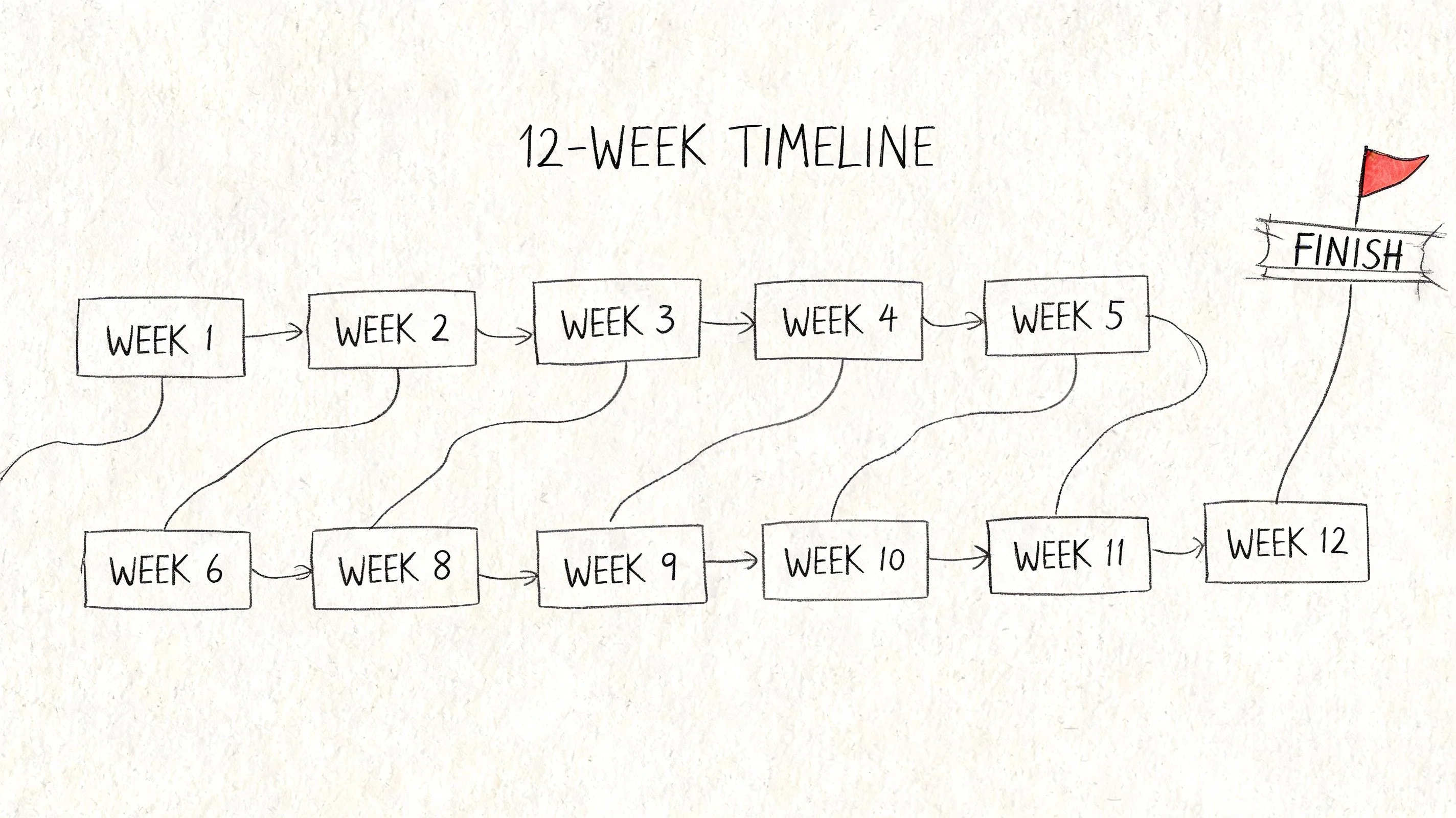
Monday gets away from you. By Thursday, you are tired, still have a full employee relations caseload, and the SHRM books are staring at you from the corner of the desk. That is why a 12-week plan works so well. It gives you enough time to study like a working HR professional, not like a full-time student.
The goal is not to cram more hours into your life. The goal is to make each session do a specific job. A commonly cited SHRM-CP pass rate analysis reports that first-time test-takers studying 81 to 120 hours over 12 to 16 weeks had the strongest outcomes, while going beyond 200 hours correlated with weaker performance. In practice, that tracks. Steady work, retrieval practice, and planned review produce better results than long, exhausting study binges.
A good schedule also respects how adults learn. You study a topic, forget part of it, retrieve it again, and strengthen the memory. That is not a flaw in the process. That is the process. If you use a platform like Mindmesh Academy, it can help by turning active recall and spaced repetition into a routine instead of leaving you to manage every review cycle by hand.
Weeks 1 to 4 build the system
The first month is for setting up a study rhythm you can maintain. Candidates often make the mistake of treating week one like week ten. They jump straight into hard question sets before they know their weak areas, then confuse frustration with progress.
Use the first four weeks to do four things:
- Benchmark your starting point: Sort BASK areas into strong, moderate, and weak.
- Choose fixed study windows: Put them on your calendar around real work demands, not ideal ones.
- Build retrieval tools as you go: Turn notes into flashcards, self-quiz prompts, or short written explanations.
- Start spaced review early: Revisit earlier material every week so knowledge does not disappear after one pass.
Here is a workable rhythm:
| Week | Main focus | What to produce |
|---|---|---|
| 1 | Baseline review and diagnostic | A list of strong, moderate, and weak topics |
| 2 | First content block | Recall questions and short summaries |
| 3 | Second content block | Mixed self-testing and error notes |
| 4 | Consolidation | Review log showing repeated weak points |
Keep the output simple. If your notes are polished but you cannot answer a question without looking, the notes are not helping enough.
Weeks 5 to 9 turn study into exam performance
This is the middle stretch, and it decides a lot. By now, reading should take less time than retrieval, application, and review. Candidates who keep rereading at this stage usually feel busy but improve slowly.
A strong study block has three parts:
- Review older material from prior weeks
- Study one current topic in focused detail
- Work practice questions, then analyze the misses
The analysis matters more than the score. I tell people to keep an error log with categories, not just wrong answers. Did you miss the legal issue? Did you choose the answer that sounded humane but skipped process? Did you pick the most decisive option when SHRM wanted the most informed next step? Those patterns repeat.
That is where learning science stops being theory and starts helping your score. Active recall shows you what you cannot yet retrieve. Spaced repetition makes sure weak material comes back before it disappears. Mindmesh Academy is useful here because it can structure those review intervals and keep weaker topics in front of you without forcing you to manually rebuild the plan every week.
Study your wrong answers harder than your right ones.
Start timed work during this phase, but keep it measured. Full-length practice exams every weekend are too much for many working professionals. Short timed sets are usually enough to build pacing without draining your focus.
A practical weekly split looks like this:
- One session for weak-topic repair
- One session for mixed-domain practice
- One session for slower situational analysis
- One lighter session for flashcards, audio review, or verbal teaching
This is also a good point to watch a concise walkthrough and compare your current plan against another structured approach.
Weeks 10 to 12 sharpen execution
The last three weeks should feel tighter, not heavier. If candidates suddenly add hours here, they usually get more anxious, not more prepared.
Use each week differently.
Week 10
Run a serious timed set under realistic conditions. Review pacing, identify repeated judgment errors, and mark the few topics that still break down under pressure.
Week 11
Shift into targeted repair. Keep recall high, keep notes short, and review the concepts that still cause hesitation. This is a good week for mixed quizzes that force rapid switching between content areas.
Week 12
Taper your workload. Review your error log, run light recall sessions, and protect sleep, meals, and routine. A tired brain reads familiar material and mistakes that feeling for mastery.
A few rules help in the final stretch:
- Keep your review narrow: Focus on missed patterns and unstable topics.
- Practice timing on purpose: Set limits and move on when a question starts eating time.
- Avoid late resource collecting: New books, new courses, and new note systems usually create noise at this point.
- Protect consistency: Four clean sessions beat one panicked cram day.
If you miss a week, adjust the plan and continue. I have never seen a busy HR professional follow a perfect 12-week calendar. I have seen plenty pass by sticking to a realistic one.
How to Conquer Tricky Situational Judgment Questions
You are 40 questions into a timed practice set, and a scenario appears that could happen in any HR department. A manager wants quick action. An employee says the process was unfair. Two answer choices look responsible, one sounds decisive, and one sounds compassionate. This is the point where strong candidates start reading their own workplace into the question and lose the exam's logic.
Situational judgment items reward disciplined reasoning rather than personal preference. Based on my experience coaching candidates, many prep plans fall short in this specific area. They suggest doing more practice questions, but they do not provide a repeatable method for choosing between plausible answers. The fix is simple. Use the same decision process every time, then train that process with active recall and spaced repetition until it becomes automatic under time pressure.
Use a repeatable decision filter
Start by naming the issue before you look for the answer. Ask what SHRM is testing in the scenario. Is the core problem ethical judgment, employee relations, communication, leadership, risk management, or business alignment? Candidates who misread the competency usually talk themselves into a distractor.
Then sort the answer choices by sequence. SHRM questions often reward the best next step, not the most complete long-term solution. A response can sound wise in real life and still be wrong if it skips fact-finding, bypasses the right stakeholder, or escalates too early.
That trade-off matters.
HR leaders make judgment calls in context. The exam has less patience for local habits, executive preferences, or "what my company would want." It favors fair process, sound judgment, and action that moves the situation forward without creating unnecessary risk.
Use a four-question screen
I teach candidates to run each option through four questions:
- Is it ethical and fair?
- Is it consistent with sound HR practice?
- Is it the right action at this stage?
- Does it improve the situation instead of inflaming it?
An answer can feel compassionate and still avoid accountability. Another can feel decisive and still be premature. The strongest option usually balances people, process, and organizational judgment.
Prefer measured action over dramatic action
A common mistake is choosing the answer that feels strongest emotionally. On the SHRM exam, the best response is often measured. It gathers facts, clarifies expectations, involves the appropriate party, and preserves working relationships where possible.
That does not mean "always investigate first" or "always coach before escalating." Some scenarios involve clear misconduct, legal risk, or immediate harm. In those cases, faster escalation makes sense. The point is to match the response to the level of risk and the amount of information you have.
Watch for these distractor patterns
| Trap answer style | Why it tempts candidates | Why it often loses |
|---|---|---|
| Immediate escalation | Feels decisive and protective | Skips ownership or fact-finding |
| Overly soft response | Sounds supportive | Leaves the core issue unresolved |
| Policy-only answer | Feels safe and compliant | Ignores judgment, context, or communication |
| Manager deference | Mirrors many real workplaces | Fails independent HR reasoning |
| Big-picture fix too early | Sounds strategic | Solves the wrong problem before diagnosing the current one |
Train judgment the same way you train knowledge
Do not just review why the correct answer won. Cover the options and explain, out loud or in writing, why each wrong answer failed. That is active recall applied to decision-making, and it is one of the fastest ways to sharpen judgment. Then revisit those missed scenarios a few days later and again the next week. Spaced repetition works for application questions too, not just definitions and acronyms.
A platform like Mindmesh Academy can help here because it turns weak areas into repeat practice instead of letting them disappear into old notes. That matters with situational judgment items. Patterns repeat, even when the facts change.
One final rule. Ask, "What is the best general HR judgment here?" That question keeps you anchored to the exam standard instead of your company's habits.
Your Toolkit for SHRM Exam Prep Success
A candidate can spend twelve weeks studying and still feel shaky if every tool does the same job. I see this all the time. They buy another book, add another quiz bank, and mistake more material for better preparation. A strong toolkit is smaller and more disciplined. Each resource needs a clear role in your system.
The official SHRM Learning System is still a strong anchor for many candidates because it stays close to the blueprint, offers a customized study plan, includes more than 2,700 practice questions, and SHRM reports higher pass rates among users of the system for both the SHRM-CP and SHRM-SCP exams (SHRM Learning System information). The trade-off is predictable. Candidates can spend hours reading and clicking through modules without proving they can retrieve or apply the material under pressure.

What each tool should do for you
Choose tools by function.
Official content source
Use one primary source of truth for policies, frameworks, and exam-domain coverage. For many people, that will be the SHRM Learning System. Its value is alignment and structure. Its weakness is passive familiarity. Reading a strong explanation of workforce planning is not the same as recalling the steps cold two days later.
Active recall tool
Build a system that forces retrieval. That can be flashcards, a handwritten question bank, or a digital platform that serves up prompts by topic and difficulty. Mindmesh Academy is useful here because it can turn weak areas into repeated retrieval practice instead of leaving them buried in old notes. That supports the study approach that actually improves retention. Review, test yourself, miss, correct, and revisit on a schedule.
Spaced repetition tracker
Your study plan should tell you when to come back to a concept, not just what to cover once. This is where many candidates lose ground. They review employee relations in week 3, do reasonably well, and never return to it until the exam. A simple spaced repetition setup fixes that. Revisit shaky topics after a few days, then a week later, then again after mixed practice.
Error log
Keep one document with missed questions, near misses, and patterns in your decision-making. Write the lesson in plain language. I prefer notes like “answered from company habit, not SHRM logic” or “picked the policy answer before identifying the business risk.” By the final two weeks, that log is far more useful than rereading highlights.
How to evaluate any prep resource
Use four filters before you add anything new:
- Alignment: Does it reflect the SHRM exam's wording, logic, and level of judgment?
- Retrieval: Does it force you to answer from memory instead of rereading?
- Repetition: Does it bring weak areas back at the right intervals?
- Feedback: Does it show exactly why you missed the question?
If a tool gives you content but no retrieval, it leaves retention to chance. If it gives you questions but weak explanations, it limits learning after each miss.
Build a stack that works together
A practical toolkit usually includes four parts:
- One primary study system for accurate content and blueprint coverage
- One question source for timed sets and mixed-topic practice
- One recall method for active recall and spaced repetition
- One error log for pattern tracking and course correction
That is enough for a strong 12-week plan.
Adding more tools rarely fixes uncertainty. Better use of the right tools does. The candidates who improve fastest are usually the ones who stop collecting resources and start running a repeatable study cycle. Read the concept, retrieve it without notes, answer questions on it, log the miss, then revisit it later. That is how a toolkit becomes a passing system.
Final Exam Tips and Frequently Asked Questions
The final week is about execution. Don't try to become a different candidate at the last minute.
Use a short checklist:
- Tighten your schedule: Keep study sessions shorter and more focused.
- Review patterns, not everything: Revisit your error log and your weakest concepts.
- Protect sleep: A tired brain misreads questions and overcomplicates answer choices.
- Plan exam logistics: Know your timing, materials, and commute or testing setup.
- Practice calm pacing: If a question feels messy, mark it mentally, make the best choice you can, and move on.
The day before the exam, your job is confidence maintenance. You are not trying to learn the entire field of HR in one evening.
Frequently asked questions
Should SHRM-CP and SHRM-SCP prep look the same?
No. The structure of disciplined prep is similar, but the SHRM-SCP demands more strategic judgment. Your study choices should reflect the level of decision-making the exam expects.
How many hours per week should I study?
Your exact schedule depends on work and family demands, but consistency matters more than heroic sessions. A steady weekly rhythm over the full study window is more effective than sporadic cramming.
What if I fail the first attempt?
Treat the result like a diagnostic, not a verdict on your HR capability. Go back to your weak areas, review your study method, and rebuild around your actual gaps instead of just doing more of the same.
What matters most in the final days?
Clarity, pacing, and restraint. Don't overload yourself with new materials. Trust the plan you've already built and focus on making your thinking clean under pressure.
If you want a structured way to turn all of this into daily action, Mindmesh Academy is built for exactly that kind of disciplined prep. It uses evidence-based methods like spaced repetition, adaptive learning paths, and progress dashboards to help you identify weak spots early, review them at the right time, and stay consistent without drowning in material. Explore our offerings and build a strong foundation for your certification journey at MindMesh Academy.

Written by
Alvin Varughese
Founder, MindMesh Academy
Alvin Varughese is the founder of MindMesh Academy and an enterprise architecture leader. An electrical engineer by training, he moved from factory automation in South Africa to cloud architecture at GE Appliances and Humana (Fortune 50), and holds 20 professional certifications including AWS Solutions Architect Professional, Azure DevOps Engineer Expert, and Microsoft Agentic AI Business Solutions Architect. He built MindMesh Academy after interviewing too many highly certified candidates who couldn't answer basic questions: the goal is prep that makes you better at the job, not just able to pass the exam.