ServiceNow Certification Courses Your 2026 Career Guide
ServiceNow is a massive platform, and learning it can feel overwhelming. You likely want career advancement and better technical skills, but the available training paths often seem confusing. Targeted ServiceNow certification courses provide a direct way to reach your professional goals. This 2026 guide, created by MindMesh Academy, replaces that uncertainty with a clear, actionable plan for IT professionals who want to build their skills and stay competitive in this specific sector.
Your ServiceNow Certification Path
Consider the ServiceNow environment a massive technical infrastructure. Earning a certification is like obtaining a specialized credential that provides access to the most rewarding professional opportunities within that space. It serves as an official endorsement. It signals to employers that you have a verifiable command of the platform and can manage critical tasks effectively.
This guide serves as a manual for your professional development. We want to help you map a direct route from your current skills to the status of a ServiceNow expert. We start with the core knowledge required by every professional. Then, we look at specialized tracks that match your specific goals. You will find that these steps are logical and build upon one another to create a strong technical background. Professionals who follow this structure often find it easier to adapt to platform updates and new feature releases.
Why Do These Certifications Actually Matter?
In a competitive tech market, certifications provide more than just extra lines on a resume. They offer concrete proof of your commitment and technical proficiency gained through structured study and hands-on work. This evidence leads to better roles, more responsibility, and higher pay. Hiring managers see it as a clear signal that you are serious about your work. It functions much like the Project Management Professional (PMP) or an AWS Certified Solutions Architect credential in other technical fields. These certifications prove you have met a standard of excellence recognized by the industry. They provide a common language for teams and ensure that everyone understands the best practices for implementation and maintenance.
A certification is similar to a pilot's license. It shows you understand flight principles and can safely operate an aircraft. However, true skill comes from practice and real-world experience. You must solve problems under pressure and handle various conditions to truly excel. This guide helps you earn that license and build the technical background needed to direct your career with ServiceNow.
Reflection Prompt: Think about a time when a certification or specific skill validated your expertise for a new opportunity. How did it impact your career trajectory?
What You'll Learn
This guide explains the current ServiceNow certification framework. You will see which credentials hold the most value and how they stack together. You will also learn how to choose a starting point that fits your current experience level. We look at the requirements for each level and what you can expect during the testing process.
We break down the different types of ServiceNow certification courses, including:
- Foundational Courses: These are the required starting points for almost everyone. The Certified System Administrator (CSA) is the prime example. These courses build the base for all future learning on the platform.
- Specialist Tracks: These courses focus on specific areas for those ready to go further. Examples include IT Service Management (ITSM), Application Development (CAD), or Security Operations (SecOps). They allow you to become a specialist in one area.
- Advanced Credentials: These are for experienced professionals. They validate your status as an expert in technical and complex parts of the platform. These often require significant prior experience and multiple lower-level certifications.
After reading this, you will have an actionable strategy to get certified. To see the credentials we discuss and look at various options, you can explore the different certification paths. We want to give you a plan to pass your exams and build a long-lasting career.
Getting to Know the ServiceNow Certification Hierarchy
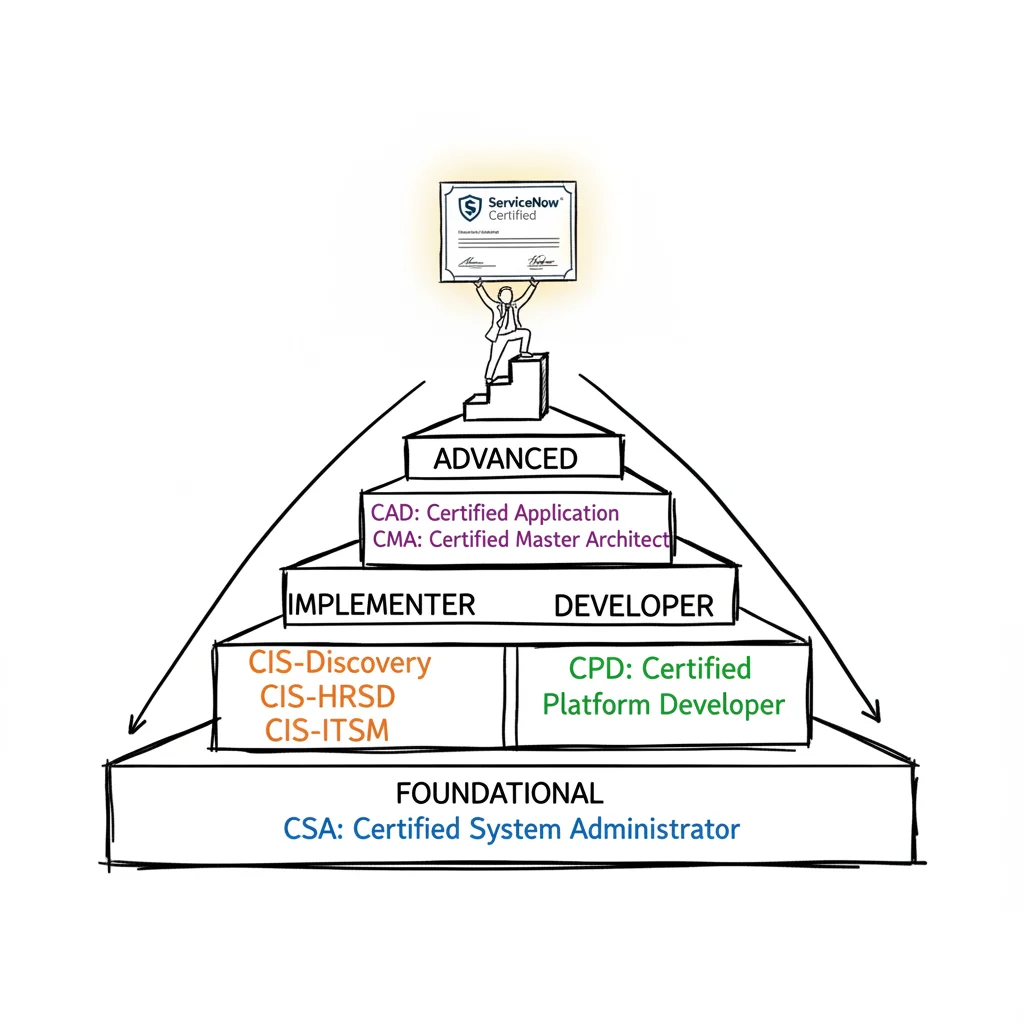
Before starting any specific ServiceNow course, you must understand the architecture of the certification program. This system is not a random collection of exams. Instead, it is a structured career path designed to take you from basic platform knowledge to highly specialized technical expertise.
To visualize this structure, compare the program to building a house. This comparison shows how each certification level provides the support necessary for the next, resulting in a stable and detailed framework for your professional skills.
The Foundation: The Certified System Administrator (CSA)
A durable house requires a solid base. In the ServiceNow world, that base is the Certified System Administrator (CSA) certification. This credential serves as the starting point for nearly every career path on the platform. It is mandatory for anyone looking to advance.
The CSA exam tests your command of core platform mechanics. You must demonstrate how to handle configuration, navigate the user interface, and manage the database structure. The exam also covers the daily administrative tasks required to keep an instance running smoothly. Attempting to specialize without this knowledge is like trying to build a second story on top of loose soil. It is unstable and difficult to maintain. The CSA is also a requirement for most advanced certifications. A system administrator handles user access, basic reporting, and platform health. These tasks are the primary support for any organization that uses ServiceNow.
The Main Structure: Mainline Certifications
Once the base is set, you can begin framing the core structure of your professional career. In this hierarchy, these are known as Mainline Certifications. These credentials focus on broad, cross-functional skill sets that form the central framework of your expertise. They allow you to build significant capabilities that apply across the entire platform.
The Certified Application Developer (CAD) is a key example in this category. This certification confirms that you can build, customize, and expand applications on the Now Platform. It is essential for IT professionals who want to use ServiceNow for more than its standard, out-of-the-box features. With a CAD, you can create custom solutions tailored to specific business requirements. In the house analogy, this is like putting up the walls and the roof. It defines the shape, purpose, and utility of your work. A professional with a CAD might write custom scripts, develop unique workflows for specific departments, or connect ServiceNow to other enterprise software systems.
The Specialized Rooms: Certified Implementation Specialist (CIS)
After the main frame is finished, you focus on the interior and individual, specialized rooms. This is the purpose of the Certified Implementation Specialist (CIS) certifications. Each CIS credential focuses on a specific ServiceNow product or module. Earning one identifies you as an expert in that specific business function.
These certifications are like designing a modern kitchen or a specialized home office. They prove you have deep, practical knowledge in a specific area, such as setting up an IT service desk or handling security threats. Organizations look for these certifications to ensure their complex modules are configured correctly. Some of the most common CIS certifications include:
- CIS – IT Service Management (ITSM): This covers incident, problem, change, and request management. These workflows are the primary support for IT operations. This certification is vital for those managing help desks or setting up service catalogs.
- CIS – Security Operations (SecOps): This focus involves configuring security incident response and vulnerability management within the platform. It is a critical path for cybersecurity professionals who need to automate threat responses.
- CIS – Human Resources (HR): This is for setting up HR Service Delivery applications. These tools help organizations simplify HR processes and improve how employees interact with the company.
ServiceNow regularly adds new certifications to this list. For instance, the Certified Implementation Specialist – Data Foundations (CIS-DF) focuses on the Configuration Management Database (CMDB) and the Common Service Data Model (CSDM). This expansion shows that the company values specialized knowledge. The investment in these certifications usually pays off. Statistics indicate that companies with certified staff see 55% higher platform adoption and achieve 38% better service delivery. You can see how ServiceNow organizes these roles by looking at their official certification achievement map.
The career path graphic below shows how these different levels connect and build upon each other.
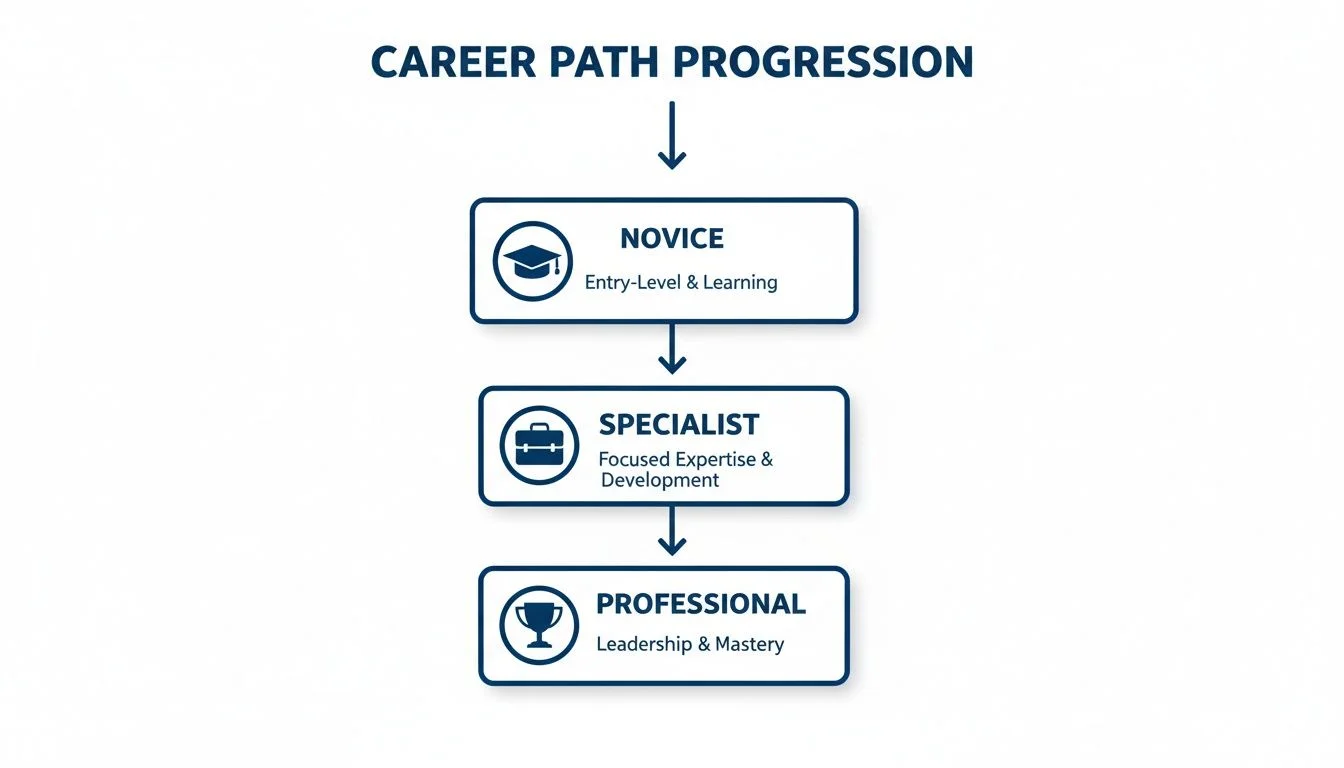
As the diagram suggests, learning the basics is the first step. From there, you move toward becoming a specialist and then a professional leader within the ServiceNow platform.
The Finishing Touches: Micro-Certifications
A house is finished with specific details like lighting or smart home features. In this platform, those details are the Micro-Certifications. These are shorter, more focused credentials that validate your skill in a specific feature.
Micro-Certifications confirm your proficiency in a narrow area. They are smaller than mainline exams and focus on practical tasks. They are useful for showing you can use specific tools like Performance Analytics, Virtual Agent, or Predictive Intelligence.
These credentials add specific, hands-on skills to your resume. They show that you can handle the exact tools businesses use to solve real problems. Because they focus on niche features, they make you a more versatile professional. Understanding this total blueprint is essential for anyone wanting to build a long-term career using ServiceNow certifications. By moving from the foundation to the specialized details, you ensure your skills are both broad and deep.
Reflection Prompt: Which specialized "room" or "finishing touch" in the ServiceNow "house" excites you the most, and how do you see it impacting your career?
Mapping ServiceNow Courses To Key Certifications
At first, figuring out which training course leads to a specific certification can feel difficult. You likely know the credential you want, but the official training catalog is large and full of similar-sounding titles. We can simplify this process by looking at how the classes actually connect to the exams.
The main point is simple: for almost every major ServiceNow certification, there is one specific training course you must finish. This is usually a one-to-one requirement. Understanding this early helps you plan your education. It prevents you from spending time and money on classes that do not lead to your desired exam voucher.
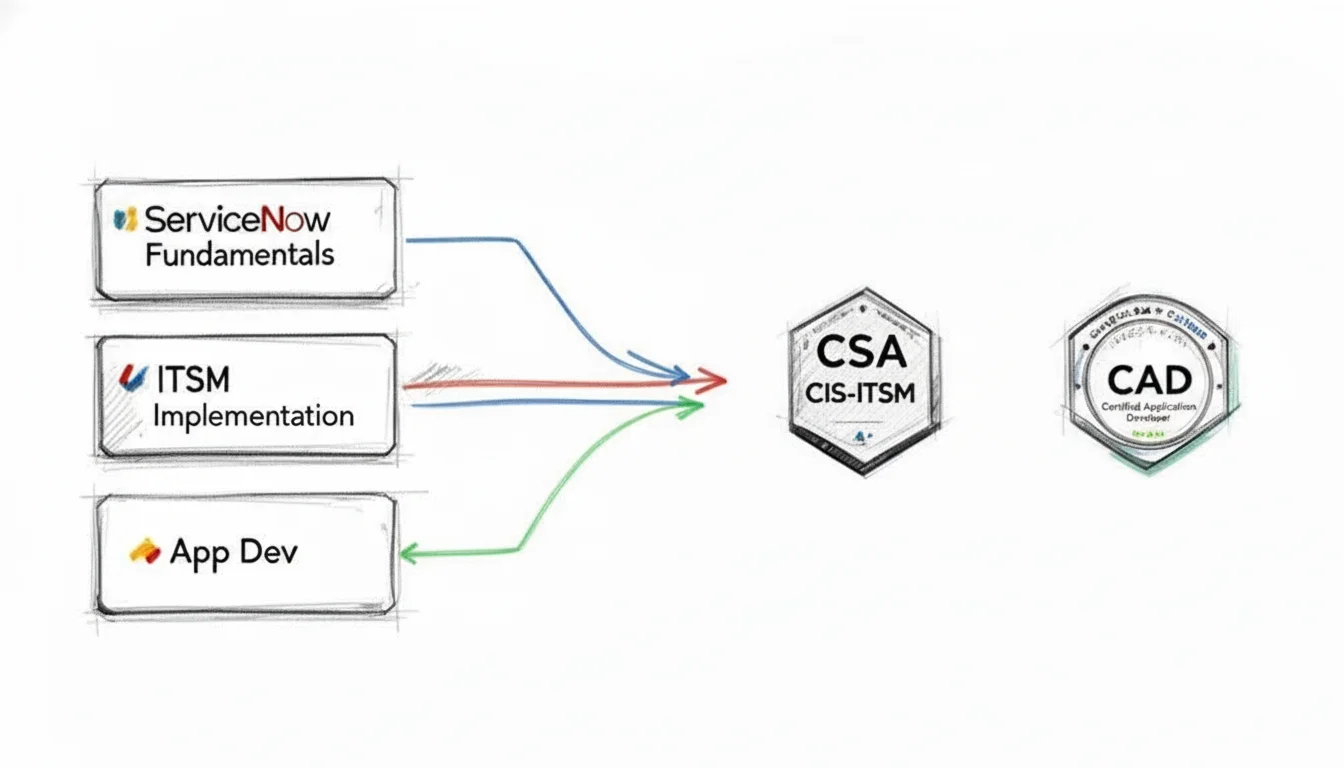
Taking the official course does more than just give you theory. You practice the exact skills the exam tests. This direct method is the most efficient way to prepare for the test. You will work on the specific technical domains and settings that appear in the exam questions.
Your Foundational Starting Point
If you are new to the platform or want to verify your basic skills, your path starts at one specific place. There is no way to reach the professional tiers without first mastering the basics of how the system operates.
The ServiceNow Fundamentals On-Demand course is the requirement for taking the Certified System Administrator (CSA) exam. No shortcuts exist. This class introduces platform administration, the user interface, and data management. You learn to manage and configure an instance for an organization. This includes learning how lists and forms work, how to brand the instance, and how to manage the users who will use the system every day. It also covers the basics of data structure, which is vital for any work you do later in your career.
Key Insight: The CSA is the base for almost all other certification paths. You cannot register for the CSA exam without finishing the Fundamentals course. This means advanced topics stay out of reach until you finish this step. In the Now Learning portal, you will see that the certification path remains locked until the system confirms you have completed the prerequisite training.
This step is required. If you are preparing for this milestone, our comprehensive ServiceNow Certified System Administrator study guide provides details on exam topics and ways to prepare. It provides a breakdown of what to expect when you finally sit for the test.
Pathways To Specialization
After you earn the CSA, you can pick a specialty. Each advanced certification has its own "implementation" or "fundamentals" course. These classes provide specific training for that role. You move beyond general platform knowledge and start working with specific business modules.
These classes are not general overviews. They focus on how to install, configure, and fix the software in a live environment. You learn to deploy and optimize specific apps, such as ITSM or HR Service Delivery (HRSD). This training prepares you to solve actual business problems, like automating a request process or setting up a service catalog that employees actually enjoy using.
Here is how the most popular specialization paths work:
- For Aspiring Developers: To get the Certified Application Developer (CAD) credential, you must finish the Application Development Fundamentals course. This training focuses on building scoped applications. You will learn about server-side and client-side scripts, UI Actions, and business rules. You also learn how to use the Flow Designer and Integration Hub to connect ServiceNow to other software. This is for people who want to build new things rather than just manage what is already there.
- For IT Service Management Experts: The IT Service Management (ITSM) Implementation course leads to the CIS-ITSM certification. You will work on configuring incident, problem, change, and request management. This involves setting up the lifecycle for a ticket from the moment a user reports an issue until it is resolved. You also learn about service catalogs and the basics of the Configuration Management Database (CMDB).
- For Security Professionals: To become a CIS-Security Operations professional, you must take the Security Operations Fundamentals course. You will learn about vulnerability response and security incident management. This path shows you how to connect the platform to other security tools like scanners or firewalls. You will learn to use the Security Incident Response (SIR) module to manage threats efficiently.
This pattern continues for all Certified Implementation Specialist (CIS) exams. If you want to work in Field Service Management (FSM) or Customer Service Management (CSM), there is a specific "Implementation" course for that exam. These courses provide the technical depth needed to pass the current exam and do the work in a real job.
Key ServiceNow Certification Courses And Their Pathways
This table provides a reference that maps popular ServiceNow certification courses to their credentials and professional roles.
| Certification | Required Course | Key Topics Covered | Ideal For Role |
|---|---|---|---|
| Certified System Administrator (CSA) | ServiceNow Fundamentals | Platform Navigation, User Management, Data Structure (Tables, Fields), Update Sets, Basic Reporting, Service Catalog basics | ServiceNow Administrators, Junior Developers, Platform Owners |
| Certified Application Developer (CAD) | Application Development Fundamentals | Scoped Applications, Server-Side & Client-Side Scripting, Access Control Lists (ACLs), Flow Designer, Integration Hub basics | Application Developers, System Administrators looking to upskill, Solutions Architects |
| CIS-IT Service Management (ITSM) | ITSM Implementation | Incident, Problem, Change, and Request Management Configuration; Service Catalog; CMDB Foundations; Event Management integration | ITSM Implementers, ServiceNow Consultants, Process Owners, Service Desk Managers |
| CIS-Discovery | Discovery Fundamentals | MID Server Setup, IP Ranges, Discovery Probes and Sensors, Pattern Development, Troubleshooting, CMDB population | CMDB Managers, IT Operations Specialists, Platform Administrators, IT Asset Managers |
| CIS-Security Operations (SecOps) | Security Operations Fundamentals | Vulnerability Response, Security Incident Response (SIR), Threat Intelligence, Integration with SIEM, GRC fundamentals | Security Analysts, SOC Managers, SecOps Implementers, IT Risk Managers |
By understanding these direct course-to-certification links, you can build your career plan. Always start with the CSA. After that, pick the specialty that fits your goals and the type of work you enjoy. This focused approach ensures you spend your time on the skills that have the most impact on your career. Many professionals find that once they have the CSA and one CIS certification, they are much more competitive in the hiring market. Focusing on one path at a time allows you to master the material before moving to the next level of the platform.
Choosing Your Ideal Learning Path And Format
After you understand the certification structure, you must decide how to gain the required knowledge. Getting ServiceNow certified depends as much on your study method as it does on the technical content. People learn in different ways. A strategy that works for a colleague might not fit your specific needs or daily routine.
The first choice is between studying at your own speed (self-paced) or joining a live class with a teacher (instructor-led). There is no single correct approach. The best option is the one that fits your current work schedule, budget, and learning habits. You should select the path that allows you to absorb the material without burning out.
The Self-Paced On-Demand Model
Self-paced training functions like a private ServiceNow library and lab environment that stays open all day and night. You get full access to video lectures, manuals, and hands-on lab environments to use whenever you have free time. This model works well for people with busy or shifting work hours. It also suits disciplined students who want to move through the syllabus at their own speed rather than waiting for a group.
The trade-off is accountability. You are in charge of your own progress, which means you must stay motivated without a set class schedule to keep you on track. For professionals who already know the basics and just need to add a specific skill, this flexibility is very useful. You can skip familiar sections and spend your energy on the parts that are actually new to you. Accessing the lab environment on your own schedule also means you can repeat a configuration exercise multiple times until it becomes second nature.
Key Insight: Self-paced study is a strong choice for motivated people who can create and follow a personal study plan. It gives you control over your education and lets you customize the process to fit your life.
When looking at options outside the official ServiceNow site, an online course platforms comparison can help. This comparison shows how different providers stack up so you can find a platform that matches your budget and study habits. Using third-party resources can often provide a different perspective on the same technical requirements.
The Instructor-Led Training Experience
Instructor-led training (ILT) is a more traditional classroom experience, whether it happens in a physical room or a virtual meeting. You get set class times and direct access to an expert who can answer questions on the spot. You also learn with a group of other students, which provides different perspectives on how the software is used in various industries.
This format helps if you are new to the platform or a specific application. Getting immediate answers and hearing questions from other students often makes it easier to understand difficult technical points. ILT provides a set schedule and built-in pressure to finish the work. The downsides are the rigid timetable and the higher price point, which covers the instructor's time and the interactive tools. ServiceNow provides foundational courses like Platform Analytics Fundamentals as both a 2-day instructor-led class and an on-demand version. This shows they recognize that different students require different levels of support.
How To Choose Your Format
The decision comes down to a few specific factors. Use this breakdown to help choose the right path for your current career stage.
| Factor | Self-Paced (On-Demand) | Instructor-Led Training (ILT) |
|---|---|---|
| Flexibility | High – You decide when and where to work based on your specific schedule. | Low – You must follow a specific, pre-set schedule. |
| Cost | Generally lower; often part of a company subscription or sold as a cheaper standalone option. | Higher; the price covers live instruction and a structured environment. |
| Pacing | Self-directed. You need discipline to keep moving forward without a teacher. | Structured. The teacher sets the speed to cover the full syllabus in a set time. |
| Interaction | Minimal. Communication happens through forums, Q&A sections, or support tickets. | High. You get real-time access to the instructor and talk with other students. |
| Best For | Disciplined professionals, experienced users, and those on a budget. | Beginners, people who need a set schedule, and students who want immediate answers. |
This is a strategic choice based on your situation. If you prefer the focus of a live class, want answers right away, and need deadlines to stay productive, ILT is the better path. If you have a busy life and need to study late at night or on weekends, the on-demand format provides the flexibility you need. Both options lead to the same result: a ServiceNow certification that improves your resume and proves your technical skills to employers. Focusing on the method that helps you retain the most information will lead to better results on exam day.
Crafting Your Study Plan For Exam Success
Completing one of the official ServiceNow certification courses is a significant achievement. It provides the foundation you need to move forward in your career. However, do not assume that finishing the curriculum automatically makes you ready for the exam. Many candidates fail because they view the course as the finish line rather than the starting block. Finishing the modules is similar to gathering all the parts for a machine; you still need to understand how those parts interact under pressure to make the system work.
A structured study plan provides the roadmap you need. It changes your approach from chaotic, last-minute review sessions to a steady, organized progression toward your goal. This section explains how to build a schedule that moves you from being a student to a certified professional.
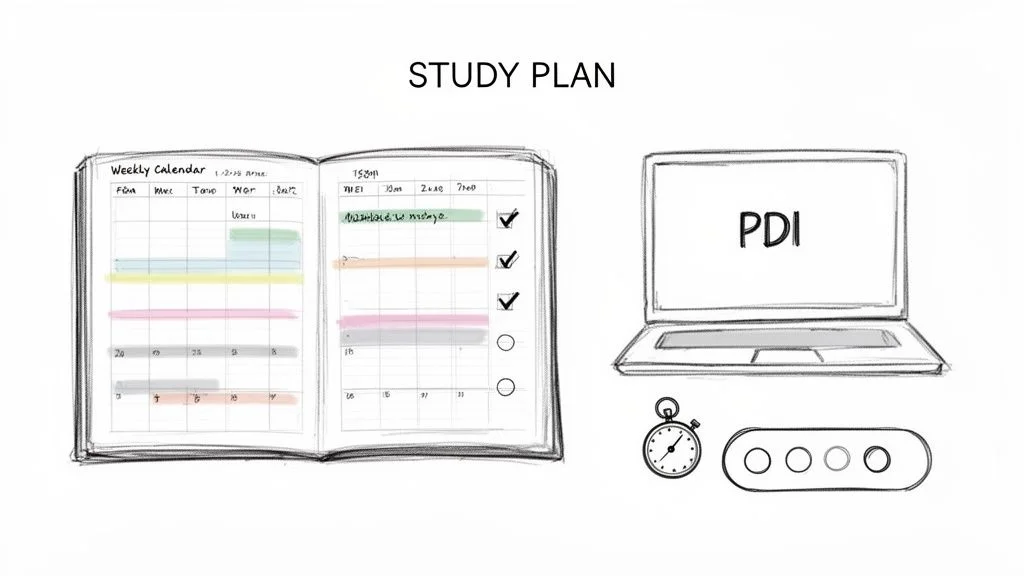
Creating this plan requires honesty about your current skill level. You must identify what you know well and where you struggle. By following a clear process, you can ensure that every hour of study brings you closer to a passing score.
Start With The Official Exam Blueprint
The first step in your preparation is to download the official exam blueprint from the ServiceNow learning portal. This document is a guide created by the people who design the exam questions. It tells you exactly what topics will appear on the test and how much weight each section carries. Without this information, you are essentially guessing which subjects matter most.
The blueprint allows for targeted study. For example, if a domain such as "Core Configuration and User Interface" represents 30% of the exam, you should spend a significant portion of your time on that area. If another section is only 5%, you can review it quickly and move on to higher-impact topics. Studying without this document often leads to spending too much time on minor details while ignoring the concepts that determine whether you pass or fail.
- Prioritize Domain Weighting: Look at the percentages assigned to each category. If "Data Management and Reporting" has a high percentage, make sure you can explain the difference between a table, a record, and a field without hesitation. Use these percentages to divide your study hours.
- Review Learning Objectives: Each section of the blueprint lists specific skills you must demonstrate. Use these as a checklist. If the blueprint says you must be able to "configure a UI Policy," do not stop studying until you can perform that task in a live environment.
- Track Your Progress: Mark off sections as you master them. This provides a visual sense of progress and ensures you do not overlook any minor requirements that could show up as questions.
Do not treat every topic as equally important. The blueprint shows you where to focus your mental energy. By prioritizing the heavily weighted domains, you ensure that your study time has the greatest possible effect on your final score. This is a strategic way to improve your chances of success.
Go Hands-On In Your PDI (Personal Developer Instance)
Reading manuals and watching videos is passive learning. While these methods help you acquire information, they do not help you apply it. To pass a ServiceNow exam, you need to use the platform. ServiceNow certifications involve scenario-based questions that test your ability to solve problems, not just your ability to remember facts. This is similar to how other major cloud provider exams function.
The Personal Developer Instance (PDI) is a free environment where you can practice without fear of damaging a production system. You should spend a large part of your preparation time working inside this instance. Here are three ways to use your PDI:
- Rebuild Lab Exercises: Go back to the labs you completed during your course. Try to build them again from scratch without looking at the step-by-step instructions. If you can complete the lab using only your knowledge of the platform, you have mastered that concept. If you get stuck, you have found a gap in your knowledge that requires more review.
- Break and Fix Systems: Experiment with the settings to see what happens when things go wrong. Deactivate an important business rule or change an Access Control List (ACL) to see how it affects user permissions. When the system stops working as expected, try to fix it using the platform's diagnostic tools. Understanding why a process failed is one of the most effective ways to learn how it is supposed to function.
- Create Custom Scenarios: Go beyond the standard course material. Build a small application that solves a simple problem, like a basic equipment tracker. Design a service catalog item with multiple variables and an approval workflow. This practice forces you to think through the logic of the platform and use different tools together.
Working in a PDI builds muscle memory. During the exam, you will encounter questions that ask for the specific navigation path to a module or the result of a specific configuration. If you have done these tasks dozens of times in your PDI, you will know the answer immediately. This practical experience is the difference between guessing and knowing.
Master Proven Test-Taking Tactics
Understanding the technical content is the foundation, but you also need to know how to handle the exam format. ServiceNow tests are usually multiple-choice, but the wording is often very specific. One word can change the entire meaning of a question. Having a plan for the exam day is necessary to stay calm and focused.
- Process of Elimination: This is a basic but effective strategy. When you see a question, immediately look for answers that are clearly wrong. Most questions have one or two options that do not make sense in the context of the platform. By removing those, you increase your chances of picking the right answer from the remaining choices.
- Keywords and Qualifiers: Look for words that define the scope of the question. Pay attention to "always," "never," "best," "most likely," or "least likely." If a question asks for the "best" way to do something, it means several answers might technically work, but only one follows the recommended practices for the platform.
- Flag and Review Strategy: Do not let a single difficult question waste your time. If you do not know an answer within a minute, flag the question and move to the next one. This ensures you have enough time to answer all the questions you do know. Once you have finished the rest of the exam, go back to the flagged questions. You might find that a later question provides a clue to an earlier one.
If you are preparing for the CSA, using a ServiceNow Certified System Administrator practice exam can help. Practice tests show you the format and help you get used to the timing. This helps reduce anxiety on the day of the actual test.
Sample Question Deconstruction
Breaking down a sample question helps you see how to apply these tactics. This logic works for most technical certifications.
Question: A user reports they cannot see a specific module in the application navigator. Which of the following is the MOST LIKELY reason? A. The user's browser cache needs to be cleared. B. The module is part of an inactive application. C. The user does not have the required role for the module. D. The system is undergoing maintenance.
Here is how to analyze this question like an experienced administrator:
- Analyze the Keywords: The phrase "MOST LIKELY" is the most important part. It suggests that while several answers might be possible, one is the standard cause for this problem in a typical environment.
- Eliminate Unlikely Options: Option A (browser cache) and Option D (system maintenance) are broad issues. If the system were down for maintenance, the user likely could not log in at all, or they would see errors across the entire site. Browser cache issues usually cause visual glitches, but they rarely hide a specific module while leaving the rest of the interface intact.
- Compare Specific Options: Now you are left with B (inactive application) and C (missing role). An inactive application would hide the module from every user on the system. While this is possible, it is less common than a single user having the wrong permissions.
- Select the Best Answer: Role-based access control is the primary way ServiceNow manages what people can see and do. If one specific person cannot see one specific thing, it is almost always because they lack the necessary role. Therefore, C. The user does not have the required role for the module is the correct choice.
This logical process helps you avoid common traps. Instead of picking the first answer that looks acceptable, you compare all options against the context provided. This method of eliminating general answers to find the most direct cause will help you pass with confidence. Consistent practice is the only way to get comfortable with this logic. Every day, spend time reading the documentation, working in your PDI, and practicing these test-taking methods. This three-part approach—blueprint study, hands-on practice, and exam strategy—provides the most reliable path to earning your certification.
Your Questions About ServiceNow Courses, Answered
Deciding to get ServiceNow certified often brings up several questions. Most IT professionals who start this process share similar concerns. Based on years of talking with candidates, I have compiled straightforward answers to the most frequently asked questions.
How Much Do I Need to Invest in a ServiceNow Course?
The cost of training depends on how you prefer to learn and the level of support you need. If you learn best in a structured environment, instructor-led training is the top-tier choice. These classes, which can be held virtually or in person, typically cost between $2,400 and $4,000 USD (verify current pricing on the vendor site). While the price is higher, it covers direct access to an instructor, live Q&A sessions, and networking with other students.
Self-starters can save money by using on-demand courses. Many large companies provide a corporate Now Learning subscription, which gives employees access to official training materials at no personal cost. Usually, the course fee includes a voucher for your first attempt at the certification exam. This adds significant value to the purchase and simplifies the registration process.
How Long Does It Realistically Take to Get Certified?
If you are pursuing your first badge, the Certified System Administrator (CSA), plan for a timeline of 2 to 4 months. This estimate assumes you can maintain a consistent study schedule without long interruptions. You should break your preparation into three distinct phases:
- Course Completion: Finish the required "ServiceNow Fundamentals" course first. Most students complete this in two to three weeks, depending on their work schedule and technical background.
- Hands-On Practice (Crucial): This is the most critical part of learning. You must spend 5-10 hours per week working inside a Personal Developer Instance (PDI). Building features and fixing errors in a live environment is the only way to truly understand how the platform operates.
- Exam-Focused Study: Use the final weeks to study the official exam blueprint. You should take practice tests to find your weak spots and review specific topics that the exam weights heavily.
Moving at this pace ensures you understand how the platform functions rather than just memorizing facts for a test. You will find that advanced CIS certifications require a similar time commitment. These higher-level exams build directly on the foundational knowledge you gain during the CSA process.
Are ServiceNow Certifications Worth It in 2026?
Yes. Organizations continue to integrate ServiceNow into their IT operations, business processes, and internal workflows. This creates a constant demand for administrators and developers who can customize the platform to meet specific business needs. A certification proves your expertise to hiring managers. It helps your resume pass through automated filters, leads to more senior roles, and usually results in higher pay. In the current market, these credentials identify you as a skilled professional ready to manage enterprise software.
Ready to stop wondering and start doing? MindMesh Academy provides study guides and practice exams built by experts to help you pass with confidence. Review our resources and start your ServiceNow career at MindMesh Academy.

Written by
Alvin Varughese
Founder, MindMesh Academy
Alvin Varughese is the founder of MindMesh Academy and an enterprise architecture leader. An electrical engineer by training, he moved from factory automation in South Africa to cloud architecture at GE Appliances and Humana (Fortune 50), and holds 20 professional certifications including AWS Solutions Architect Professional, Azure DevOps Engineer Expert, and Microsoft Agentic AI Business Solutions Architect. He built MindMesh Academy after interviewing too many highly certified candidates who couldn't answer basic questions: the goal is prep that makes you better at the job, not just able to pass the exam.