Your Guide to ServiceNow Administrator Certification
The ServiceNow Administrator Certification is a vital credential for IT professionals managing enterprise service systems. At MindMesh Academy, we recognize how this qualification proves your ability to manage, configure, and maintain the ServiceNow platform. Formally titled the Certified System Administrator (CSA), this exam validates foundational capabilities, akin to an AWS Solutions Architect Associate or PMP certification laying groundwork in those respective domains. This credential confirms your current technical skills and serves as a required prerequisite for advanced ServiceNow specializations, helping you build a clear path toward significant career growth.
What Is the ServiceNow Administrator Certification?
 Caption: A ServiceNow Administrator efficiently manages the platform, much like a city manager overseeing urban operations.
The ServiceNow platform functions as the operational center for a modern business. It is a high-tech environment with specialized areas for IT Service Management (ITSM), Human Resources (HR), and Customer Service Management (CSM). This environment relies on a complex infrastructure of databases, logic-driven workflows, and a wide variety of users with specific requirements. Within this digital city, the ServiceNow Administrator acts as the city manager. These professionals ensure every part of the system operates without interruption. They handle everything from basic user permissions to the deployment of critical system patches.
The ServiceNow Administrator Certification serves as your verified license to manage this environment. This foundational credential provides a baseline of knowledge, similar to how the ITIL Foundation certificate establishes a standard for service management or a CompTIA A+ (220-1101/220-1102) certification confirms essential hardware and software skills. For organizations, having the CSA badge on your resume confirms a specific level of proficiency that is recognized across the industry. This helps companies reduce the risks associated with hiring and shortens the time it takes for a new administrator to become productive.
This certification is more than a line item on a resume. It is a mandatory requirement for almost every advanced or specialized certification within the platform's catalog. If you plan to build a career in the ServiceNow market, the CSA is the starting point you cannot skip.
The Core Purpose of the CSA Certification
The Certified System Administrator (CSA) certification confirms that an IT professional has practical, hands-on experience. It is designed to verify that a candidate can move through the platform with confidence, manage data structures, and create the business rules that drive automation. This exam does not reward simple memorization. Instead, it requires you to show that you can apply your knowledge to real-world administrative tasks from your first day on the job.
When a company hires a CSA-certified professional, they are hiring someone who understands the architecture of the platform. This leads to clear organizational advantages. Training times are shorter because the administrator already knows the terminology and the interface. Furthermore, the business faces fewer risks from configuration mistakes that might otherwise take down a production instance or corrupt important data.
This certification acts as a common language for the industry. When an employer sees the "CSA" designation, they know the candidate can handle user administration, data management, and automation without needing to re-evaluate their basic skills.
Reflection Prompt: Consider a past project where a lack of foundational knowledge led to delays or errors. How would a CSA certification in your team mitigate such risks in a ServiceNow implementation?
What the Certification Covers
The CSA exam is organized to test a wide range of administrative skills. It ensures that every certified professional understands the most important functions of the platform. The questions focus on how you would solve problems in a real environment rather than testing your ability to recite definitions.
The following table provides a summary of the exam requirements to help you plan your study schedule:
ServiceNow CSA Exam At a Glance
| Exam Feature | Detail |
|---|---|
| Exam Name | ServiceNow Certified System Administrator (CSA) |
| Question Count | 60 multiple-choice, multiple-select questions |
| Exam Duration | 90 minutes |
| Passing Score | 70% or higher |
| Exam Fee | $450 USD (verify current pricing on the vendor site) |
| Delivery Method | Proctored exam via Kryterion testing centers or online |
The exam is demanding. You must answer 60 questions in 90 minutes, which leaves little time for hesitation. You must know the material well enough to answer quickly and accurately.
The content of the exam is divided into specific domains. Database administration accounts for 30% of the total score. This high percentage reflects the fact that ServiceNow is built on a complex relational data model. Another 30% of the exam focuses on service automation. This is where you prove you can use the platform to make business processes more efficient. The rest of the exam covers the user interface, collaboration tools, and basic development concepts. These sections ensure you can manage the day-to-day needs of your users. For those looking for a more granular look at the topics, Knowlathon.com offers a breakdown of the current exam structure.
Passing the exam proves you have the skills to handle these specific administrative duties:
- User and Group Management: You will need to show that you can create, update, and remove user accounts. You must also know how to assign specific roles, such as the
itilrole for technical staff orhr_adminfor human resources. Proper group management is vital for maintaining security and following the principle of least privilege. This is especially important for companies that must follow strict data privacy laws like HIPAA or GDPR. - Data Management: You must be able to move data into the system using transform maps. This area also covers the maintenance of tables and fields. You might be asked to extend the
cmdb_citable to track specific types of company assets. Managing the data properly ensures that incident records and inventory lists remain accurate and useful for the business. - Platform Configuration: This involves changing the way the platform looks and feels to improve the user experience. You will configure forms by adding or removing fields and change the layout of lists. You will also apply corporate branding to the instance so that it matches the company’s identity, much like you would customize a portal in a cloud environment like Azure.
- Workflow and Automation: You will use Flow Designer or older workflow tools to automate tasks. This includes setting up business rules that trigger when a record is updated. For example, you might create a rule that automatically moves a high-priority incident to a specific support team. You will also configure email notifications to keep users informed about the status of their requests.
The ServiceNow Administrator Certification is the most effective way to start a career in one of the most profitable sectors of the enterprise software market. It provides you with a set of skills that are in high demand and makes you a valuable contributor to any company using ServiceNow for its digital operations. By earning this credential, you prove that you have the technical ability to manage a platform that keeps a modern business running.
How This Certification Can Seriously Boost Your Career
Earning your ServiceNow Administrator Certification is more than an addition to your resume. It is a tool for career growth. This credential proves your practical abilities and turns claims of expertise into something you can show with evidence. In a crowded IT field, this certification shows you can apply ServiceNow concepts to fix actual business problems. This validation provides weight similar to a PMP certification for project managers or an AWS Certified Solutions Architect Associate for cloud experts. It is a recognized mark of quality within the industry.
This credential sends a clear signal to recruiters. The IT job market is competitive, and having the badge proves you have the hands-on skill needed to manage a complex enterprise platform. Companies see the CSA badge as proof of a standard skill set. This lowers the risk of hiring someone who cannot do the work and helps new staff start contributing much faster. When a hiring manager sees this certification, they know you have already met the baseline requirements for the role.
Better Pay and Rock-Solid Job Security
Financial gain is a primary reason people seek certification. Demand for ServiceNow experts remains high because many different industries use the platform to run their businesses. This high demand leads to better pay. The ServiceNow Administrator Certification makes you more visible during interviews and gives you more room to negotiate your salary. You are showing the concrete value you bring to an organization, which justifies a higher rate.
Data backs up these claims. One industry survey found that 69% of certified workers saw their careers move forward within a year of passing the exam. Also, 91% of employers say that IT certifications are a major factor when they decide who to hire. The average global salary for a ServiceNow System Administrator is approximately $82,495 USD (verify current salary trends on sites like Glassdoor or Payscale). This figure shows how much companies value these specific skills. Investing in the exam pays off through higher earnings over time.
Reflection Prompt: How might validating your skills through certification impact your current career trajectory and future earning potential, compared to relying solely on experience?
High demand for these skills also leads to better job security. Organizations are moving more of their core work—like IT services, human resources, and customer service—onto the ServiceNow platform. They need skilled administrators to keep these systems running and efficient. When you become the expert for such a vital system, you become a necessary part of the team. As long as the company relies on the platform to function, they will need someone with your skills to maintain it.
A Launchpad for Your Future
The CSA is a starting point rather than an end. It is the fundamental building block for many advanced specializations. You can use it to steer your career toward specific interests or roles that pay even more. Once you have your CSA, you can move into roles that are more specialized and often more lucrative. It provides the base knowledge you need before you can master more difficult parts of the platform.
Here are a few high-demand career paths that you can pursue once you have earned your ServiceNow Administrator Certification:
- Implementation Specialist: Instead of just maintaining a system, you focus on setting up specific applications like IT Service Management (ITSM), IT Operations Management (ITOM), or Customer Service Management (CSM) for new clients. This job requires you to understand business needs and turn them into platform settings.
- Application Developer: This path goes beyond basic administration. You use what you know to create custom apps, build complicated workflows, and add new features to the platform. You will likely use JavaScript and other tools to meet specific business goals.
- Solution Architect: This is a high-level role focused on strategy. You design how the whole platform will work across an entire company. You make sure the platform helps meet business goals, set the technical standards, and lead large projects. This requires knowing many different parts of the ServiceNow platform.
The CSA certification is the key that opens the entire ServiceNow career path. It is the most important step to move from a general IT role into a specialized, high-growth field. These skills work in almost any industry. Organizations in finance, healthcare, technology, and retail all seek experts to improve their services. This steady demand keeps your skills useful even when the economy changes. By earning the CSA first, you build a solid base that lets you explore different ServiceNow career paths and specializations and grow throughout your career.
Cracking the Code: The ServiceNow CSA Exam Blueprint
To pass the ServiceNow Certified System Administrator exam, you need a plan based on the official blueprint. This document acts as your specific guide, identifying the knowledge domains you must study to achieve the best results. A cloud architect relies on reference architectures to build systems; similarly, you should use this blueprint to organize your preparation.
Studying without understanding this blueprint is like building a software application without requirements or technical specifications. You might finish the work eventually, but you will likely waste time on secondary features while missing the core functions the system requires. The blueprint ensures your energy focuses on high-impact topics, allowing you to enter the testing center with confidence in your preparation. It removes the guesswork from your study sessions and provides a clear metric for readiness.
The Core Learning Domains: A Breakdown
The exam structure consists of five core learning domains. Each domain has a specific percentage weighting that indicates its importance in the final score. These weights are not random; they represent the actual tasks a ServiceNow administrator performs on the job every day. A combined 60% of the exam covers database administration and service automation. This tells you that ServiceNow views these two areas as the primary skills for any effective administrator. If you understand how the database stores data and how the automation engine processes that data, you have mastered the most significant portion of the platform.
Here is a look at the practical details of these five domains:
- Database Administration (30%): This is the most weighted section because ServiceNow is essentially a specialized database with a web interface. To succeed here, you must understand how the platform organizes data into tables and fields. You will need to identify common tables like the
incidenttable for support tickets, thesys_usertable for account information, and thecmdb_citable for tracking assets. Mastery of relationships is also required, specifically how reference fields link different tables together or how many-to-many tables facilitate complex data structures. You must also be proficient in data management tools. This includes using import sets to bring in external data and creating transform maps to ensure that data lands in the correct fields without errors. For instance, you might be asked how to import a spreadsheet of five hundred new servers into the Configuration Management Database (CMDB) while maintaining data integrity. - Service Automation (30%): This domain is equal in weight to database administration because it focuses on business value and efficiency. You will learn to use Flow Designer to create logic-based workflows that replace manual email chains and spreadsheets. The exam tests your ability to implement business rules, which are server-side scripts that run when a record is displayed, inserted, updated, or deleted. You must also understand client scripts, which handle interactions within the user's browser, such as hiding a field based on a selection. Another major component is the Service Catalog. You will need to know how to build catalog items, define variables for user input, and set up the fulfillment tasks that occur after a user clicks "Order." An example of this in practice is a "New Laptop Request" that automatically notifies the manager for approval and assigns a setup task to the hardware team.
- UI & Navigation (20%): This section focuses on the user experience and how people interact with the instance. You must know how to modify forms to include necessary fields and how to configure lists to show the most relevant data at a glance. The exam covers the creation of different "views" for the same form, which allows you to show a simplified version to a basic user while showing a detailed version to a technician. You will also learn about instance branding, such as applying company logos and color schemes to the header. Navigation management is another key topic; you must be able to configure application menus and modules to ensure users can find the tools they need quickly without searching through unnecessary options.
- Collaboration (10%): This domain covers the tools that help teams communicate and share information. You will need to understand the Knowledge Management application, which involves creating, categorizing, and publishing articles to help users solve their own problems. Reporting and dashboards are also central here. You should be able to create bar charts, pie charts, and list reports to track metrics like open incidents or average resolution time. These reports are often grouped into dashboards to give executives a high-level view of performance. Additionally, you will be tested on system notifications. You must know how to configure the system to send an email or SMS when specific conditions are met, such as when an incident is assigned to a new group.
- Instance Management & Security (10%): The final domain covers the technical maintenance and protection of the environment. You will manage user accounts, groups, and roles to ensure people have the correct permissions. A key concept here is the Access Control List (ACL). You must understand how ACLs define who can create, read, write, or delete data at both the table and field levels. This domain also includes update sets, which are the containers used to move configurations from a development instance to a production instance. You will need to know how to create, record, and "complete" an update set to ensure your changes move through the environment safely. Maintenance tasks, such as checking system logs for errors or managing the upgrade process to a new ServiceNow version, also fall under this category.
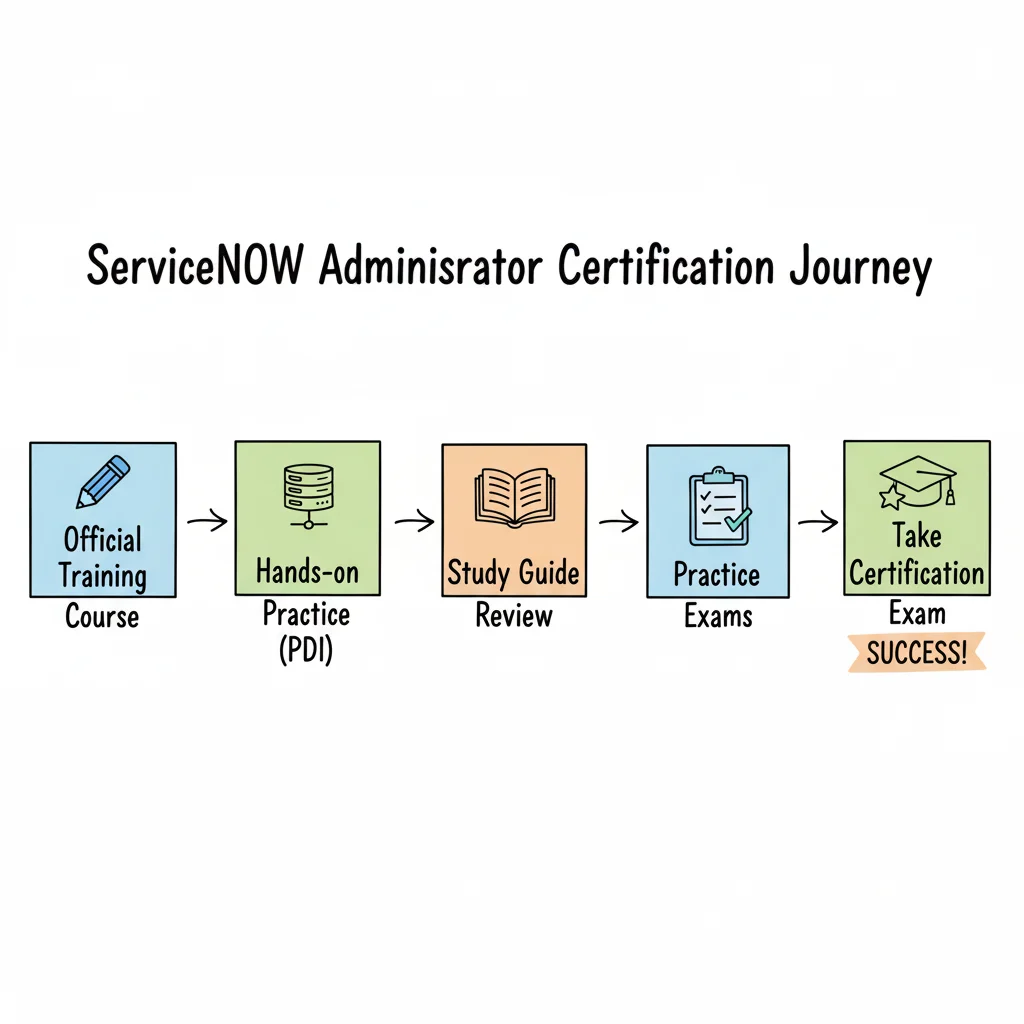 Caption: The ServiceNow Administrator Certification demonstrates key skills that directly translate to career growth and increased earning potential.
The pursuit of this certification is a strategic investment in your professional skills. It proves you have the technical ability to manage an instance and the practical knowledge to solve business problems using the platform's native tools.
A Detailed Examination of Blueprint Topics
Focusing only on the percentages is not enough to pass. You must focus on the practical, demonstrable skills that ServiceNow assesses. The exam is designed to test your ability to handle realistic scenarios rather than your ability to memorize a glossary of terms. This approach is similar to the requirements for an Azure Administrator; it is more important to know how to solve a configuration problem than it is to simply know what a specific service is called.
For example, a question in the Database Administration domain will not ask for a dictionary definition of a "reference field." Instead, it will describe a situation where a technician needs to see a user's phone number on an incident form. The question will ask which technical method—such as a dot-walk or a specific field type—is the best way to make that information visible. This requires you to understand how the underlying data structures work in a real environment.
The exam blueprint is essentially a job description. Every topic listed corresponds to a task you will perform as a working administrator. If you master the blueprint, you are preparing for your future daily responsibilities, not just a test.
With this practical mindset, we can look at the core domains again with more detail. This table breaks down the specific skills you need to demonstrate for each segment of the exam, including examples of how those skills appear in a production instance:
ServiceNow CSA Exam Blueprint Learning Domains
| Learning Domain | Exam Weighting (%) | Key Topics Covered |
|---|---|---|
| Database Administration | 30% | Managing tables such as sys_user and cmdb_ci; configuring field types like strings, references, and booleans; securing data with Access Control Lists (ACLs); and using import sets and transform maps to migrate data. |
| Service Automation | 30% | Creating automated processes with Flow Designer; building service catalog items with specific variables; using business rules for server-side logic; and using client scripts for browser-based UI changes. |
| UI & Navigation | 20% | Organizing forms and lists to improve the user experience; configuring specific views for different roles; applying corporate branding to the instance; and managing application menus for better navigation. |
| Collaboration | 10% | Creating and managing knowledge base articles; building reports and dashboards to visualize system performance; and setting up automated email or SMS notifications for important system events. |
| Instance Management & Security | 10% | Using update sets to move changes between environments; managing user accounts, groups, and roles; and performing maintenance tasks like reviewing system logs and managing version upgrades. |
Understanding this detailed breakdown is the first step in creating a study schedule that works. By spending more time on the domains with higher weightings, you ensure your preparation is efficient and targeted. This method helps you avoid spending hours on small topics while neglecting the foundational database and automation skills that make up the majority of the exam. Use this breakdown to audit your current knowledge and identify which areas require more hands-on practice in a personal developer instance.
Your Step-by-Step Study Roadmap to Success
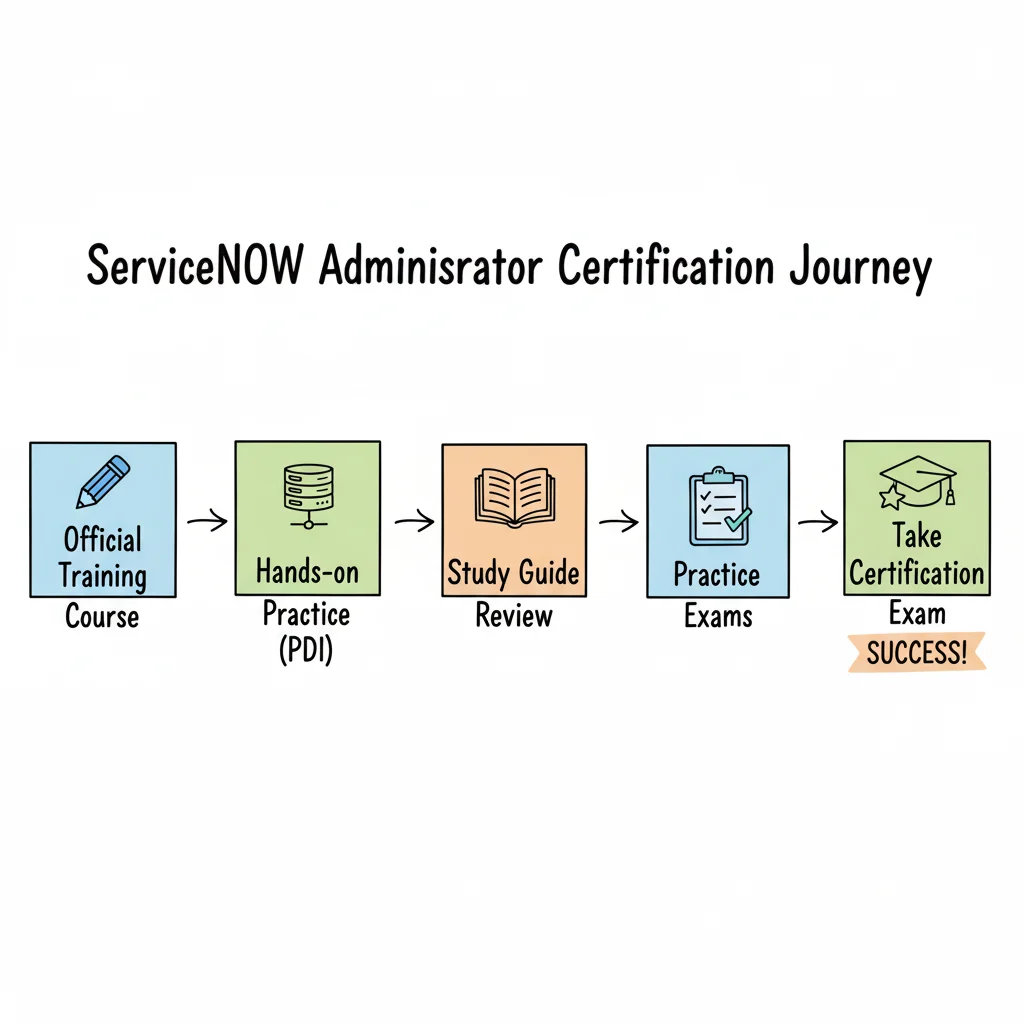 Caption: Dedicated study, particularly with hands-on practice, is key to acing the ServiceNow Administrator Certification exam.
Understanding the specific topics covered in the ServiceNow Administrator certification exam is only one part of the process. You also need a clear, practical plan to prepare. A well-organized study roadmap prevents you from feeling lost in the many features of the platform. It helps you build the skills you actually need for a job rather than focusing on simple memorization.
The best way to master ServiceNow is not through passive reading or watching videos. You must get involved with the platform. This means you need to build configurations, test new features, and even try to fix things when they do not work as expected. This active approach turns theoretical ideas into practical knowledge. This experience will help you on the day of the test and throughout your career.
Phase 1: Get Your Hands Dirty with a PDI
The first step in your preparation is to get a Personal Developer Instance (PDI). This is a free, fully functional version of ServiceNow that you can use as a private sandbox. It allows you to experiment and learn without the risk of changing anything in a real work environment. It is a vital tool for practice, similar to a virtual lab used for other technical certifications.
Getting a PDI is easy. Go to the ServiceNow Developer site and create a free account. After you register, you can request your own instance. The developer portal will serve as your main workspace. You can find learning paths there, read technical documents, and manage your instance.
Once your instance is ready, start exploring it. Do not worry about making mistakes; that is why you have a sandbox. Click on different application modules. Open forms for Incident Management, Problem Management, and Change Management. Look at how they are organized. Try to repeat the steps you see in training materials or online tutorials. This active exploration helps you remember where things are and how the platform functions. You will start to understand the logic behind the layout, which makes the learning process much faster.
Phase 2: Follow the Official Learning Path
After you have spent some time exploring your instance, you should start a structured study program. ServiceNow provides official courses created specifically to help people prepare for the exam. The ServiceNow Fundamentals course is the most recognized option for this purpose.
This course serves as a guide through the most important features of the platform. It is designed to match the CSA exam blueprint (verify current blueprint versions on the ServiceNow website). This ensures you study the right topics at the right level of detail. Usually, you must complete this course before you are allowed to register for the exam. This makes it a mandatory part of your study plan.
The official training provides the foundational rules and shows you how the different parts of the system work together. Your PDI is the place where you practice those skills until they become natural. Using both together is the most efficient way to learn.
Phase 3: Deepen Your Understanding with Hands-On Practice
Once you finish the formal training, you should focus on practical application. This is when the things you learned in the course become clear. Your goal is to understand not just what a feature is, but why and how to use it to solve a business problem. This is similar to how a practitioner uses ITIL principles to improve service delivery within an organization.
To get the most out of this phase, follow this practical plan:
- Rebuild From Scratch: Pick a topic from the exam blueprint, such as making a new Service Catalog item, setting up a business rule, or creating a user group. Try to build it from start to finish in your instance. Try to do this without looking at your notes. Only check the documentation if you get stuck. Repeating this process will help you remember the steps.
- Solve Mini-Problems: Give yourself small tasks to complete. For example, you could try to create a workflow that automatically approves a request if a manager signs off on it, but sends it to the IT team if they do not. Or, try to create a UI Policy that hides a specific field based on the value in another field. These small projects require you to use several different skills at once.
- Explore Community Solutions: Look at the ServiceNow Community forums or sites like Stack Overflow. Read about the problems other users are having. Try to build a solution for those problems in your own instance before you read the answers provided by others. This helps you develop your ability to solve problems.
This phase is about using the software. If you want a more detailed list of topics and exercises, the MindMesh Academy offers a ServiceNow Certified System Administrator study guide. It provides more structure and detail for your study sessions.
Phase 4: Test Your Knowledge with Practice Exams
The final step before your exam is to take practice tests. You should try to make these sessions feel as much like the real exam as possible. This is not just about checking what you know. It is also about getting ready for the pressure of the testing environment.
Practice exams help you in several ways:
- Identify Weak Areas: They show you exactly which topics you do not understand well. This lets you spend more time studying those specific areas before you take the actual test.
- Master Time Management: The exam has 60 questions and a time limit of 90 minutes. This gives you about one and a half minutes for each question. Practice exams help you learn how to manage your time so you do not run out of it.
- Get Used to Question Formats: You will see how ServiceNow phrases its questions. You will get used to multiple-choice and multiple-select formats. This helps reduce the stress you might feel on the day of the test. Many other certifications, like those from AWS or the Project Management Institute, use similar formats.
You should aim for a score that is higher than the 70% passing mark on your practice tests (verify current passing scores on the official certification site). Scoring well consistently will give you the confidence you need when you go to the testing center. By following this roadmap, you are doing more than just studying for a test. You are building the skills you need for a career as a ServiceNow administrator.
The exam environment can be strict, whether you take it at a testing center or online with a proctor. Using practice tests helps you get into the right mindset. You learn to read each question carefully and look for keywords that change the meaning of the requirement. This attention to detail is what helps candidates pass on their first attempt. Focus on the logic of the platform, and the answers will become much clearer. Regular practice in your instance combined with these mock exams is the most reliable path to certification.
Navigating Your Exam Day Experience
Mastery of the ServiceNow platform covers only half of what you need to succeed. The remaining half involves physical and mental readiness for the actual test. Success requires managing your time, environment, and expectations during the 90-minute window. By understanding the logistics before you sit down, you can focus on the technical questions instead of worrying about software issues or proctoring rules. Being prepared for the mechanics of the day helps reduce anxiety and ensures your hard work pays off.
All logistical aspects, from initial registration to the final submission of your answers, are managed through Webassessor. This is the official testing partner for ServiceNow. Through this dedicated portal, you will create a profile, link it to your training history, and register for the CSA exam. The system allows you to choose between an online proctored session or an in-person testing center. Secure your desired testing slot well in advance. Popular times and dates often fill up quickly, particularly during the weeks following major platform updates or at the end of the year. When you register, you will pay the exam fee, which is typically $300 (verify current pricing on the vendor site), or use a voucher provided by your employer or a training program.
Choosing Your Testing Environment
Selecting your testing environment is a major decision that affects your comfort and performance. This choice typically depends on your home setup and how you handle high-pressure situations.
Opting for an online proctored exam from your home or office offers flexibility. You can test in a familiar space without commuting. However, this convenience requires you to meet strict technical and environmental standards. You must be in a completely private and quiet room with a closed door. Your desk must be clear of all papers, books, and external electronics. Most candidates must use an external webcam capable of providing a 360-degree view of the workspace. If the proctor sees anyone else enter the room or hears talking, they may terminate the session immediately. You must also download and install the Sentinel software from Kryterion to lock down your browser during the test.
Conversely, an in-person testing center provides a controlled environment with minimal distractions. For many IT professionals, this option is better because it eliminates technical stressors. You do not have to worry about your home Wi-Fi dropping or a delivery driver ringing your doorbell. The center provides the hardware and a stable connection. You show your ID, place your belongings in a secure locker, and sit at a dedicated workstation. Consider which environment allows you to focus 100% of your mental energy on the questions.
Time Management Strategies for Success
The exam gives you 90 minutes to answer 60 questions. This works out to exactly 90 seconds per question. While some questions are short, others require you to analyze a scenario or a list of configuration options. Efficient execution is necessary to ensure you finish every section.
Here is a time management strategy to help you maintain a steady pace:
- The First Sweep: Systematically go through the entire exam and answer all questions where you are confident. If you recognize a definition or a standard UI element immediately, record your answer and move to the next item. This builds momentum and secures easy points early in the session.
- Flag and Advance: If a question regarding Access Control Lists (ACLs) or complex business rules takes more than a minute to parse, do not dwell on it. Use the "Mark for Review" feature and move on. Avoid getting stuck on a single difficult problem that could drain your clock and prevent you from reaching easier questions later.
- The Second Pass: Once you have answered all the straightforward questions, return to your flagged items. With the bulk of the work finished, you can dedicate focused attention to these tougher problems. Often, a question later in the exam might provide a subtle hint that helps you solve a previously flagged item.
- The Final Check: If time permits, perform a quick review of your choices. Scan for simple mistakes, such as clicking the wrong radio button or misinterpreting a "choose two" instruction.
The best way to master this pacing is through practice with a realistic ServiceNow Certified System Administrator practice exam, like the ones available from MindMesh Academy. These simulations help you get used to the 90-minute pressure.
After You Click Submit
The moment you finalize your submission, your result—a pass or fail—will appear on the screen. While this provides immediate closure, ServiceNow does not provide a granular score report. You will not see your percentage or a list of which questions you missed.
This lack of detailed feedback is a common topic within the CSA exam scoring on the ServiceNow Community forums. Because you only get a pass/fail result, you must prepare for every domain in the exam blueprint. If you do not pass, the system will allow you to retake the exam after a waiting period, though you will have to pay a retake fee.
Once you pass, you will receive an email with instructions on how to claim your official e-certificate and digital badge. You can display this badge on LinkedIn and share it with your employer to prove your achievement.
Keeping Your Certification Current
Earning your ServiceNow administrator certification is a major career step, but it is not a permanent credential. The platform evolves rapidly, and you must maintain your status through Delta exams.
ServiceNow releases major platform upgrades twice a year. Following these releases, you must complete a Delta exam via the Now Learning portal to keep your certification active. These assessments are usually short, non-proctored, and open-book. They focus specifically on new features and changes introduced in the latest version. You usually have a 90-day window to complete these after they are released. If you miss this window, your certification will expire. You would then be forced to take the full, proctored CSA exam again at the full price to regain your status. Staying current with these updates shows that you are keeping up with the platform as it changes.
Answering Your Top Questions About the ServiceNow Certification
Even with a solid study plan, IT professionals often have specific questions about the ServiceNow Certified System Administrator (CSA) exam. Addressing these common concerns now provides clarity and helps you focus on what matters during your preparation.
How Long Should I Plan to Study?
The time you need to prepare is a personal metric that depends on your current skills. Most IT workers who understand the basics of IT Service Management (ITSM) find that four to six weeks of focused effort is a realistic window. This duration usually allows you to finish the official "ServiceNow Fundamentals" course and spend enough time practicing in a Personal Developer Instance (PDI).
Your specific timeline will depend on several factors:
- Your Starting Point: If you are new to the ITSM field or have never worked with large enterprise platforms, you should plan for a longer study period to get comfortable with the interface.
- Study Cadence: You will remember more if you study for one or two hours every day. Consistent daily work is much more effective for long-term retention than trying to learn everything in a single weekend.
- PDI Engagement: The quality of the time you spend building, configuring, and fixing issues in your PDI determines how fast you learn. Instead of just clicking through menus, try to build a custom service catalog item or set up a notification from scratch. These specific tasks help solidify your knowledge. Practical application is a requirement for success.
Keep in mind that your goal is to do more than pass a test. You want to be comfortable enough with the platform to handle a real administrative role. You should be ready to contribute to a team from the moment you are hired.
Just How Hard is the ServiceNow Certification Exam?
The CSA exam is a difficult test of your knowledge. It is a serious evaluation of how well you understand the platform. You cannot pass by just memorizing definitions. The exam requires you to understand how different ServiceNow tools work together to solve actual business problems. The passing score is 70% (verify current passing requirements on the ServiceNow site), which leaves very little room for mistakes.
The real secret to passing this exam is getting comfortable with scenario-based questions. Many candidates struggle here. These questions test how you apply knowledge in a specific situation, not just whether you can remember a fact. This is why using a PDI is so important.
While the exam is hard, you can succeed if you prepare the right way. A clear study plan, daily practice in the platform, and high-quality practice exams will help you reach the finish line. The difficulty is what makes the certification valuable. It proves to employers that you have the functional skills to do the work.
What If I Don't Pass on the First Try?
Many professionals do not pass on their first attempt. While it is frustrating, it does not mean your progress has stopped. ServiceNow has a specific retake policy. You can take the exam up to three times within a set period. If you fail, there is a mandatory waiting period before you can try again. This is a good time to stop and look at which topics were the most difficult for you.
ServiceNow provides a performance report after the exam. While it does not show you which specific questions you missed, it does break down your score by category. Use these percentages to prioritize your study time. You must pay the full exam fee for each retake (verify current pricing on the vendor site). Because of this cost, it is best to be as prepared as possible before your first attempt.
If you do fail, use the result as a diagnostic tool. Identify the specific areas where you lost points and focus your next study sessions on those gaps. This targeted approach is a much better strategy than simply reading the same material again.
Are you ready to build the skills and confidence to pass your ServiceNow Administrator Certification exam? At MindMesh Academy, we provide study materials, hands-on labs, and practice exams to help you learn core concepts. We want to help you pass the exam on your first attempt. Start your work with MindMesh Academy today and improve your career options. Start your journey with MindMesh Academy today.

Written by
Alvin Varughese
Founder, MindMesh Academy
Alvin Varughese is the founder of MindMesh Academy and an enterprise architecture leader. An electrical engineer by training, he moved from factory automation in South Africa to cloud architecture at GE Appliances and Humana (Fortune 50), and holds 20 professional certifications including AWS Solutions Architect Professional, Azure DevOps Engineer Expert, and Microsoft Agentic AI Business Solutions Architect. He built MindMesh Academy after interviewing too many highly certified candidates who couldn't answer basic questions: the goal is prep that makes you better at the job, not just able to pass the exam.