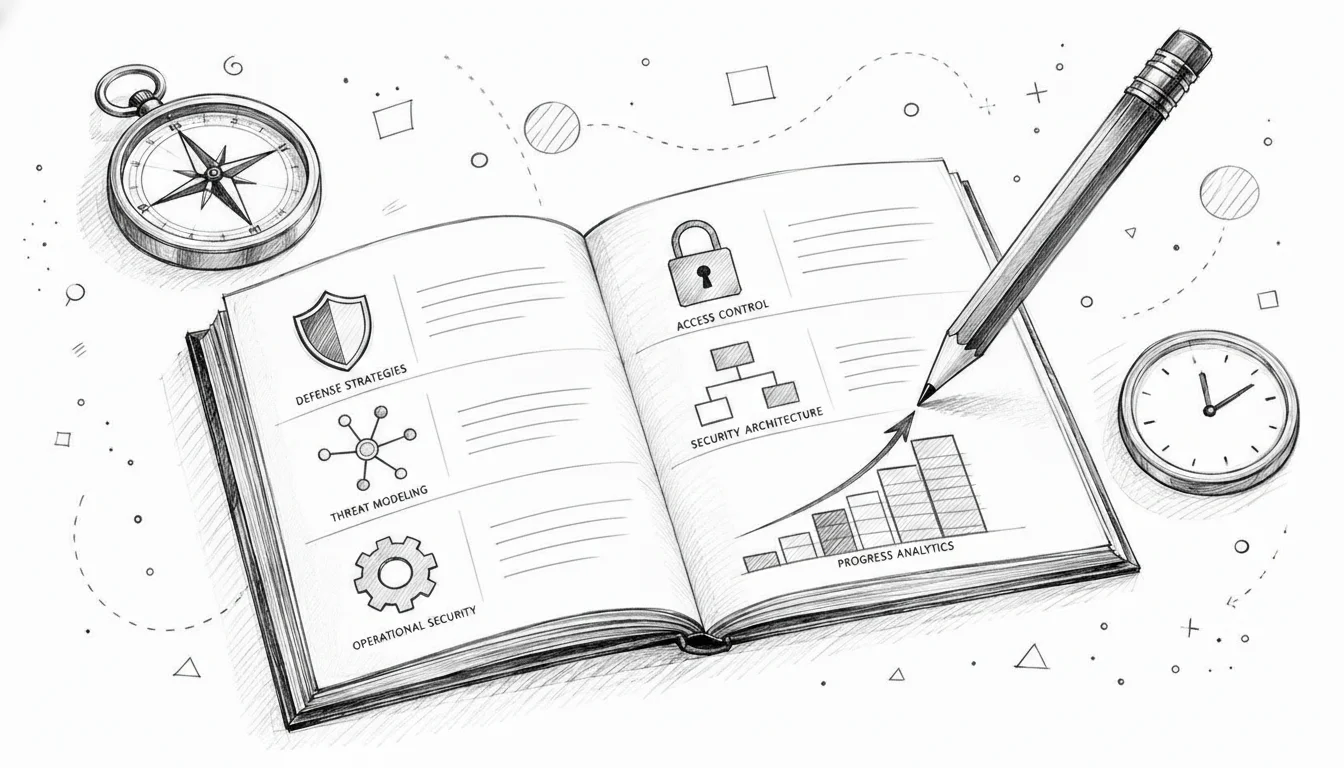
Effective Security Study Guides: Pass Your Exam in 2026
Effective Security Study Guides: Prepare for Your Certification Exam
You're probably in one of two places right now. Either you've picked a security certification and opened the exam objectives, only to feel like every line introduces another topic you only partly know. Or you've already bought a book, watched a few videos, maybe done some quizzes, and you still don't feel exam-ready.
That's normal.
I've seen this with system admins moving into security, help desk professionals trying to level up, cloud engineers adding a security credential, and career changers who are smart and motivated but don't yet have a study system. The problem usually isn't effort. It's that they treat all security study guides like they do the same job.
They don't.
Some guides are strong references but weak teaching tools. Some are easy to read but don't prepare you for scenario-based questions. Some look modern and interactive but skip the practical work that turns a definition into something you can use under pressure. The right move isn't just choosing a guide. It's matching the guide to the way you learn, the exam you're taking, and the study methods that help information stick.
Your Starting Point on the Certification Path
A common student story goes like this. You decide a security cert will open doors. You search for exam objectives, see cryptography, access control, governance, threat analysis, incident response, and network security all piled together, and your confidence drops a little. You know these topics matter. You just don't know where to begin.
That's where security study guides earn their place.
A good guide gives shape to a messy starting point. Instead of staring at a long list of objectives, you get a path. It breaks the material into chapters, concepts, examples, review questions, and practice tasks. For many learners, that's the first moment the exam starts to feel manageable.
Why the first guide matters
Your first guide often sets your study habits. If it's too shallow, you'll underestimate the exam. If it's too dense, you'll read passively and forget most of it a week later. If it's well designed, it helps you do three things at once:
- See the whole map so you know what the exam expects
- Build daily momentum because each study session has a clear target
- Connect ideas together instead of memorizing isolated facts
That's also why many learners start by browsing structured IT certification programs. Seeing certifications organized by path and role often reduces the anxiety that comes from trying to figure everything out alone.
Security certifications don't usually defeat people because the material is impossible. They defeat people because the study process is unstructured.
What most learners get wrong early
Many people assume the best study guide is the thickest one. That's not always true. The most useful guide is the one you can study consistently and actively. If you read ten pages and can't explain what you learned in your own words, the guide isn't doing enough for you, or you're not using it the right way.
Start with this mindset. A security study guide is not just a book to finish. It's a tool to help you think like the exam expects you to think.
What Makes a Security Study Guide Effective
A student reads a chapter on access control, highlights half the page, and feels productive. Two days later, they miss a practice question that asks which control fits a real workplace scenario. The problem usually is not effort. The problem is that the guide taught vocabulary without teaching judgment.

An effective security study guide helps you do three jobs at once. It shows what the exam covers, explains why each concept matters, and gives you a way to practice using that concept under pressure. That mix matters because security exams rarely reward memorization by itself. They ask you to choose the best control, spot the safer response, or identify the risk hidden inside a short scenario.
Coverage should match the exam blueprint
Start with alignment. If the guide does not clearly map its chapters to the exam objectives, you are studying with gaps whether you realize it or not.
For Security+ SY0-701, that means the material should track the tested domains and treat them as connected topics, not isolated chapters. A good guide helps you see how threat types affect architecture choices, how implementation decisions influence operations, and how governance shapes all of them. Security work functions the same way in real environments. You are rarely solving one topic at a time.
This is the first place where study method and guide type connect. If you like to study by checking off tasks, choose a guide with objective maps, chapter goals, and short knowledge checks. If you learn by building mental models, choose one that explains how domains relate to each other. Both can work. What matters is that the guide gives structure you will use.
Good explanations turn terms into decisions
Students often ask me whether a guide needs to be long to be useful. Usually, no. A shorter guide with clear teaching can beat a dense book that leaves you rereading the same paragraph.
The test is simple. Can the guide move from a definition to a realistic decision?
Take AAA. A weak guide says Authentication, Authorization, and Accounting, then stops. A strong guide shows the sequence. A user signs in with a password and token. The system checks what resources that user can access. The logs record what happened after access was granted. Now the concept has a workflow, and workflows are easier to remember than isolated terms.
That kind of explanation helps with more than recall. It prepares you for scenario questions, because the exam often describes actions and outcomes rather than asking for a plain definition.
Practice should begin early, not at the end
Many learners make the same mistake with study guides. They read first, then save practice for later, as if application is a separate phase. In security study, that is like reading a driver's manual for weeks and waiting until the night before the test to touch the steering wheel.
A useful guide builds retrieval and application into the learning process from the first chapters. Look for features like these:
- Review questions that force you to recall ideas without looking back at the page
- Scenario questions that ask what you would do, not just what a term means
- Timed practice sets that train pacing and help you stay calm under exam pressure
- Labs or simulations that let you configure, inspect, or troubleshoot
- Examples from real security work such as phishing review, access control choices, or incident response steps
Notice the pattern. Each feature supports a different study method. Review questions help with memory. Scenario questions build decision-making. Labs build transfer from theory to hands-on work. The best guide is rarely just a reading resource. It is part textbook, part coach, part practice field.
Structure and updates affect how well you can review
Security exams change over time. So do the examples and priorities that appear in study materials. A guide should be current, but it also needs to be easy to use on a tired weeknight when you only have 25 minutes and need to fix one weak area.
That means clean chapter organization, helpful summaries, and a layout that lets you return to one topic without hunting through the whole book. Good structure reduces friction. Even better, it makes spaced review realistic. Students are far more likely to revisit encryption, logging, or risk management if they can find the right section quickly.
Here is a practical checklist I give students before they commit to a guide:
| What to check | What good looks like |
|---|---|
| Objective alignment | Chapters map clearly to exam domains |
| Teaching quality | Concepts are explained in plain language with workplace examples |
| Practice design | Questions include recall, scenarios, and timed sets |
| Skill building | Labs, simulations, or task-based exercises are available |
| Review usability | Weak topics are easy to revisit quickly |
A strong security study guide does more than help you finish chapters. It helps you build the kind of judgment the exam expects and the kind of thinking security work requires.
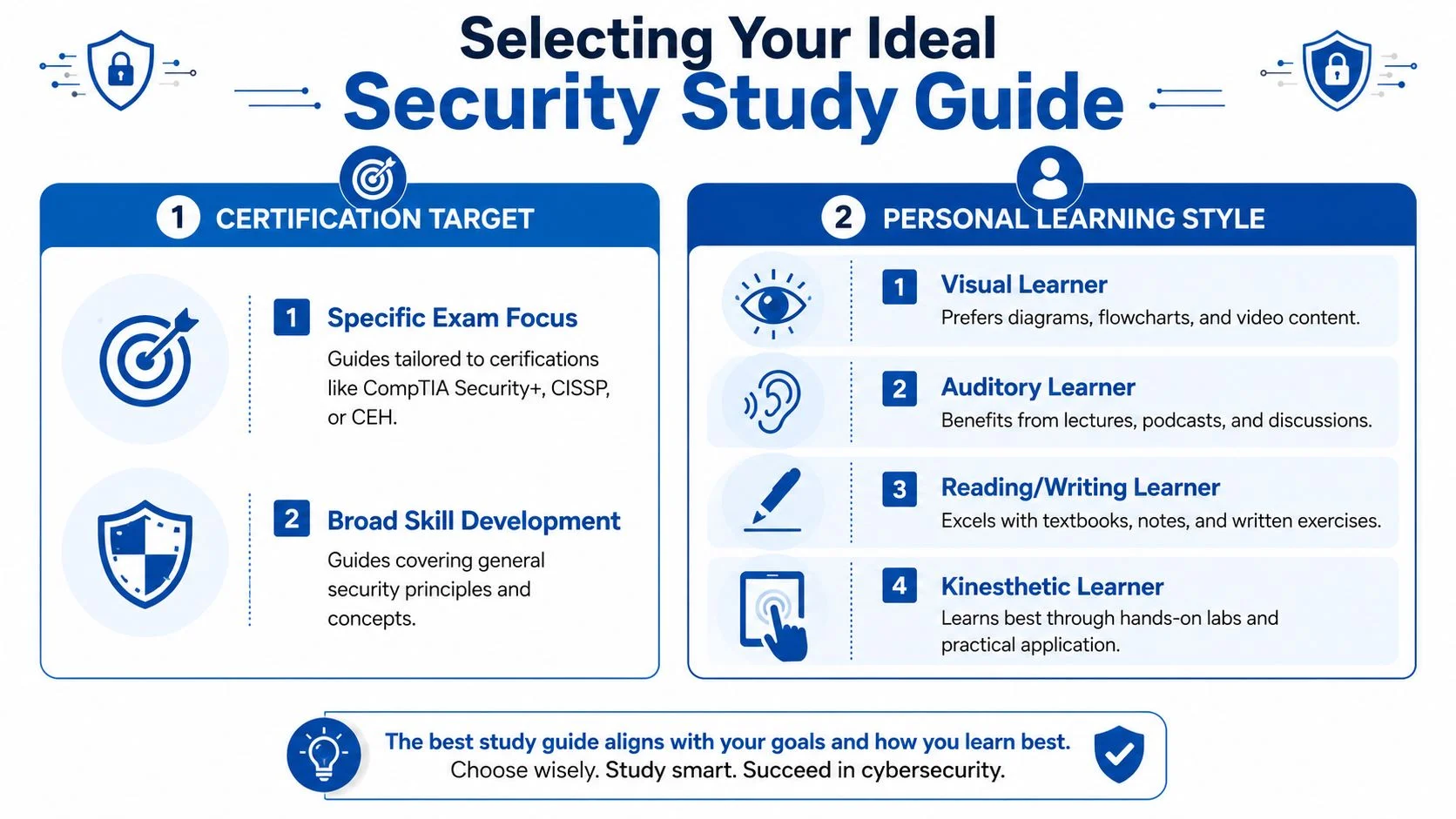
Choosing Your Guide for Certification and Learning Style
You sit down after work with a Security+ book open, a video course queued up, and a lab platform asking you to launch a virtual machine. Twenty minutes later, you have touched all three and learned very little. That is a guide-matching problem, not a motivation problem.
Students pass faster when their study method fits both the exam and the way they absorb information. I have seen strong readers stall on performance-based questions because they never practiced under pressure. I have also seen hands-on learners waste weeks forcing themselves through dense chapters when a lab-first approach would have helped them understand the same material in half the time.
Start with the exam, then choose the format
A security guide is a training tool. The exam tells you what that tool needs to do.
For CompTIA Security+, the test includes both multiple-choice items and performance-based questions. That means your guide should prepare you for two different jobs. First, you need to recall facts cleanly. Second, you need to apply those facts in short scenarios, often with limited time to think.
That distinction matters. A reading-only guide can help you learn terminology such as hashing, segmentation, or least privilege. It does less for you if the exam asks you to choose the best control in a messy situation. In the classroom, I compare this to learning road signs versus driving in traffic. Both matter, but they train different skills.
The same logic applies to other certifications. If you are preparing for a cloud security exam, a domain-based resource such as expert-curated AWS security exam preparation makes more sense than a broad, entry-level guide because the exam expects cloud-specific decisions, not just general security vocabulary.
Match the guide to how you actually learn
A lot of students answer this question based on what sounds disciplined. Use what works instead.
Textbooks for readers who like structure
Textbooks fit learners who understand best by reading carefully, annotating, and building their own notes. They usually explain why a control exists, how parts connect, and where similar ideas differ. That helps with topics students often confuse, such as authorization versus authentication or risk reduction versus risk transfer.
A textbook is usually a good fit if you:
- Prefer one main resource instead of jumping across tabs
- Learn by writing summaries in your own words
- Need fuller explanations before practice questions make sense
The catch is simple. Reading can feel productive even when recall is weak. If you choose a book as your main guide, pair it with self-testing and some kind of hands-on practice.
Video courses for learners who need explanation first
Video helps students who need to hear a concept explained step by step before the pieces connect. A good instructor can turn an abstract topic into something concrete with diagrams, stories, and worked examples.
Video tends to work well if you:
- Lose focus during long reading sessions
- Remember spoken explanations better than static text
- Want to see processes demonstrated, not just described
But video has a trap. Recognition is not mastery. If an instructor explains zero trust clearly, it can feel familiar by the end of the lesson. Familiar is not the same as exam-ready. Pause often, answer from memory, and write down what you can explain without replaying the clip.
Interactive platforms and labs for applied learners
Labs and interactive platforms fit students who learn by doing. They are especially helpful when a concept stays fuzzy until you configure, test, or troubleshoot something yourself.
This format usually helps if you:
- Retain more after active practice
- Struggle with performance-based questions
- Need quick feedback through quizzes, flashcards, or simulations
Labs work like flight simulators for security study. You are not just hearing what the control does. You are practicing the decision the exam will ask you to make.
Build a guide stack, not a single perfect resource
Many students look for one guide that does everything. That search wastes time.
A better approach is to build a small stack with clear roles. One resource teaches. One resource checks recall. One resource develops applied skill. For example, a textbook can explain IAM concepts, a flashcard tool can help you remember protocols and ports, and a lab platform can train you to recognize misconfigurations in context.
That is the system many successful students end up building anyway. Choosing it on purpose from the start saves weeks.
Use your habits as a filter
Be honest here. Your study guide has to fit your real week, not your ideal week.
- If you rarely finish technical books, do not make a 900-page text your only plan.
- If you learn best by talking through ideas, add video lessons or a study partner.
- If scenario questions slow you down, choose guides with labs and decision-based drills.
- If you need visible milestones, use a platform that tracks progress by domain.
The best guide is the one you will return to consistently and use actively. Good content still matters, but fit matters too. When the method matches the learner and the guide matches the exam, study time starts producing results.
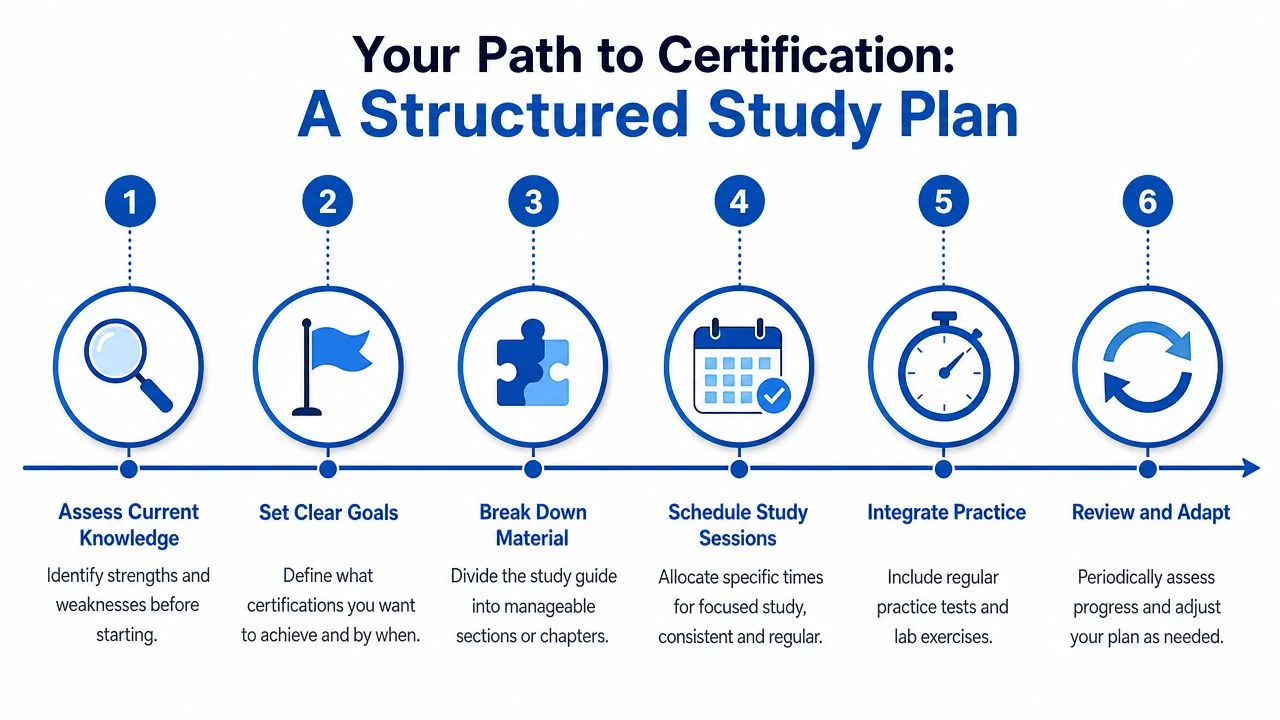
Building Your Personalized Security Study Plan
Monday night, a student opens a study guide, reads for an hour, closes the tab, and still cannot answer a simple scenario question about least privilege on Friday. That gap is usually not an effort problem. It is a planning problem.
A useful security study plan does more than assign pages. It connects three things that need to work together. The certification objective tells you what to cover, your guide determines how the material is presented, and your study method determines whether any of it sticks under exam pressure.
Build around a realistic timeline
A calendar works like a network diagram. If everything depends on one overloaded node, the whole system slows down. Many students make that mistake by stacking all reading in the first half of their plan and all practice at the end.
A better structure is a 12-week study plan with topic groups, scheduled review, practice exams, and performance-based question work built in from the start, as outlined in this CompTIA Security+ study planning reference.
That timeline gives you room to learn, forget a little, review, and correct mistakes before exam day. It also helps you match the guide to the credential. For a cloud security exam, domain-based prep matters because the exam expects you to make judgment calls, not just define terms. A resource like expert-curated AWS security exam preparation shows how to organize that kind of domain-by-domain work.
Give each week a job
Students often write “Chapter 3” on Tuesday and “Chapter 4” on Thursday, then wonder why the material blurs together. Chapters are content units. Your plan needs learning actions.
A practical study week usually has four parts:
-
Learn the core idea
Read the guide section or complete the lesson. Slow down enough to understand what problem the control solves. -
Translate it into plain language
Write a short explanation in your own words. If RTO, risk transfer, or zero trust still sounds like the book, the concept is not stable yet. -
Use it in context
Complete the related lab, scenario set, or hands-on exercise. Security exams reward recognition in context. -
Test recall
End the week with mixed questions that include both new and older topics.
That pattern works because it mirrors how security knowledge is used on the job. You learn a concept, explain it to someone else, apply it to a situation, then recall it later without notes.
Set rules for review and catch-up
A personalized plan should survive real life. Work projects appear. Family schedules change. Energy drops.
Instead of treating a missed session like failure, build in a recovery rule. If you miss one study block, shorten the next task and keep the weekly cycle intact. If you miss several, cut low-value rereading first and protect practice questions, review, and labs. Those activities usually reveal more than passive reading.
One sentence can keep students from spiraling. “Resume at the next scheduled block.” That prevents the common mistake of restarting the whole plan every time a week goes badly.
Use a readiness score, not a finishing date
Finishing a guide is a milestone. It is not proof that you can pass.
Book the exam when your practice performance is consistent across domains, your weak areas are getting narrower, and scenario questions no longer feel like a different language. Reading completion measures exposure. Readiness measures recall, judgment, and error patterns.
A finished book is not proof of readiness. Consistent practice performance is.
Track what actually predicts improvement
Many students track hours studied because it feels concrete. Hours can be useful, but they are a weak signal on their own. Two focused hours of retrieval practice and lab work often beat five distracted hours of reading.
Use a simple tracker like this:
| Study element | What to track |
|---|---|
| Reading or lesson progress | Domains completed and topics still unclear |
| Lab work | Which tasks felt easy versus confusing |
| Practice questions | Patterns in mistakes, not just final score |
| Review cycles | Whether older topics still feel familiar |
If you keep seeing the same mistake pattern, the plan needs adjustment. For example, repeated misses on access control questions may mean you need a better explanation source. Repeated misses on scenario items may mean your guide is fine, but your method needs more labs and applied practice.
That is the core goal of a personalized plan. You are not building a reading schedule. You are building a study system that fits the exam, fits your learning style, and keeps producing evidence that you are getting closer to certification.
Mastering Concepts with Advanced Study Techniques
A lot of struggling students think they need more discipline. Often, they need better learning mechanics.
Reading the same chapter three times feels responsible, but it's a weak method for retaining dense security material. You may recognize the page. That doesn't mean you can recall the concept under exam pressure or apply it in a scenario.
Use spaced repetition to stop forgetting
The adoption of Spaced Repetition and adaptive learning paths in modern study guide platforms is increasingly recognized as a better method for long-term retention than cramming, according to this library guide on Security+ study resources.
Here's why this matters in plain English. Your brain keeps information better when you revisit it just as it starts to fade. That effort to recall strengthens memory. Cramming does the opposite. It gives you short bursts of familiarity that disappear quickly.
A simple way to use spaced repetition with security study guides:
- Day 1 learn a concept such as hashing vs. encryption
- Day 2 or 3 test yourself without looking
- Later in the week answer practice questions on it
- Next week revisit it in mixed review
This works especially well for terms students often confuse, such as SLE and ALE, symmetric and asymmetric encryption, or authentication factors.
Active recall beats passive review
If I ask a student, “What is a playbook?” and they say, “I know it when I see it,” that's a warning sign. Recognition isn't recall.
Active recall means pulling the answer from memory before you check the page. That can happen through flashcards, short quizzes, whiteboard explanations, or speaking an answer out loud. It feels harder because it is harder. That's the point.
The study sessions that feel slightly uncomfortable are often the ones doing the most memory work.
Try this with your guide. Close the chapter and answer three questions from memory:
- What problem does this control solve?
- When would I use it?
- What related term do students commonly confuse with it?
If you can answer those cleanly, you're learning. If not, review with purpose.
Let adaptive tools narrow your focus
Not every weak area deserves equal time. Some gaps are small and disappear after one review. Others keep showing up across quizzes, labs, and scenarios.
Adaptive learning helps by pushing more questions from those problem areas. Instead of treating every domain the same, it targets where you're losing points. That saves time and lowers the odds of false confidence.
Use advanced techniques for what they do best. They don't replace a good guide. They help you squeeze more value out of the guide you already have.
From Theory to Practice Turning Knowledge into Skills
Many candidates can define a term and still miss the question. That happens when they've studied security as vocabulary instead of decision-making.
Modern certification exams don't reward memorization alone. They ask whether you can interpret a situation, choose a control, spot a weakness, or respond to an incident with the least wrong answer.
Why passive study breaks down
One of the biggest problems with published security study guides is that fewer than 20% include hands-on labs or scenario rewrites, according to this analysis from ITU Online.
That gap shows up fast in questions like these:
- A user needs access to one system but not another. What access principle applies?
- A log entry suggests suspicious behavior. What's the most likely indicator of compromise?
- A business continuity scenario gives downtime and recovery requirements. Which metric matters most?
If you've only memorized definitions, each question feels slippery. If you've practiced applying those definitions, the logic becomes much clearer.
Turn every term into an action
A technique I teach often is scenario rewriting. Take a dry definition and force it into a workplace situation.
For example:
| Term | Rewrite it as an operational scenario |
|---|---|
| Least privilege | A new intern needs access to one dashboard and nothing else |
| Separation of duties | One employee approves purchases, another releases payment |
| RPO | The business decides how much data loss is acceptable after an outage |
| SIEM | An analyst reviews logs to spot suspicious login behavior |
That small shift changes how your brain stores the concept. It's no longer just a sentence in a chapter. It becomes a decision you can recognize.
Labs matter because security is operational
If your guide includes labs, use them. If it doesn't, build practical work around it. Home lab setups, guided simulations, and task-based practice help close the gap between “I've heard this term” and “I know what to do.”
Good practical work might involve:
- Reviewing phishing indicators in a suspicious message
- Analyzing SIEM output in tools such as Splunk or ELK
- Hardening a system based on common security principles
- Working through governance scenarios where policy, risk, and operations intersect
That last point is often overlooked. Security isn't only about tools. It also lives in process. If you want a grounded explanation of how operational workflows support risk and compliance, this overview of ITSM integration for cyber governance is useful because it connects security decisions to service management and governance practice.
For learners who need exam-style repetition around cloud security topics, a focused practice environment such as Mindmesh Academy's AWS exam preparation can complement a textbook by giving you more retrieval and scenario work.
Knowing the definition is the starting line. Using the concept in context is what gets you over the finish line.
Tracking Your Progress and Achieving Certification
Most learners lose confidence in the middle. Early on, motivation is high. Near exam day, urgency takes over. The hard part is the stretch in between, when you're studying regularly but can't always tell whether it's working.
A progress view changes that.

When students can see domain progress, quiz history, and weak-topic patterns, they stop guessing. Instead of saying, “I think I'm getting better,” they can point to where scores are rising and where mistakes still repeat. That kind of visibility is especially helpful when your study plan includes reading, labs, flashcards, and mixed review. Without some central tracking, it's easy to over-study what feels comfortable and avoid what needs work.
What to monitor before exam day
Track more than your last test score. Look for patterns.
- Domain confidence tells you which topic clusters still slow you down
- Question type trends show whether you struggle more with scenario items than direct recall
- Review consistency reveals whether you're maintaining older material
- Readiness signals appear when strong performance repeats across several sessions, not just one good day
That same mindset matters after you pass. Security certifications often come with renewal expectations, and many professionals eventually need continuing education. If you're new to that side of the certification lifecycle, this explanation of what is CPE credit is a practical starting point.
A short walkthrough can also help you think about how your prep system should support day-to-day execution, not just theory.
The strongest preparation systems do one thing very well. They make progress visible enough that you can adjust early. That's how you avoid the classic mistake of spending weeks “studying hard” while the same weak areas keep dragging down your score.
If you want a more structured way to prepare, MindMesh Academy offers certification study resources designed around guided practice, progress tracking, and evidence-based learning methods. Start building your CompTIA Security+ foundation with our practice exam and measure how your readiness is improving.

Written by
Alvin Varughese
Founder, MindMesh Academy
Alvin Varughese is the founder of MindMesh Academy and an enterprise architecture leader. An electrical engineer by training, he moved from factory automation in South Africa to cloud architecture at GE Appliances and Humana (Fortune 50), and holds 20 professional certifications including AWS Solutions Architect Professional, Azure DevOps Engineer Expert, and Microsoft Agentic AI Business Solutions Architect. He built MindMesh Academy after interviewing too many highly certified candidates who couldn't answer basic questions: the goal is prep that makes you better at the job, not just able to pass the exam.