
Top 10 SAS Certification Exam Practice Questions for 2026
Top 10 SAS Certification Exam Practice Questions
You already know SAS syntax. You've written DATA steps, cleaned ugly files, and probably used PROC SQL enough to stop looking up basic joins. Then you start searching for SAS certification exam practice questions and often run into the usual mess: a few official samples, scattered quizzes, old forum posts, and third-party test banks that may or may not reflect how SAS tests.
That's the frustrating part. The exam doesn't reward answer memorization nearly as much as people hope. For the SAS A00-231 exam, you're working against a fixed structure of 65 questions in 110 minutes, and the passing score is 70 percent, which means at least 46 correct answers are required (SAS certification details summarized here). That changes how you should practice. Pacing matters. Format familiarity matters. Hands-on coding judgment matters.
The bigger issue is that many prep resources still treat SAS certification like a generic multiple-choice exam. SAS's own sample-question guidance makes it clear that sample items illustrate question types rather than exhaust the exam, and official practice exams exist only for some credentials with a 180-day access window after activation (SAS sample-question guidance). In practice, that means smart prep combines official materials, realistic timed work, and repetition methods like spaced review.
Below are the resources I'd use, split mentally into official options first and third-party supplements after that. If you use them in the right order, they work far better than random drilling.
1. SAS Practice Exams
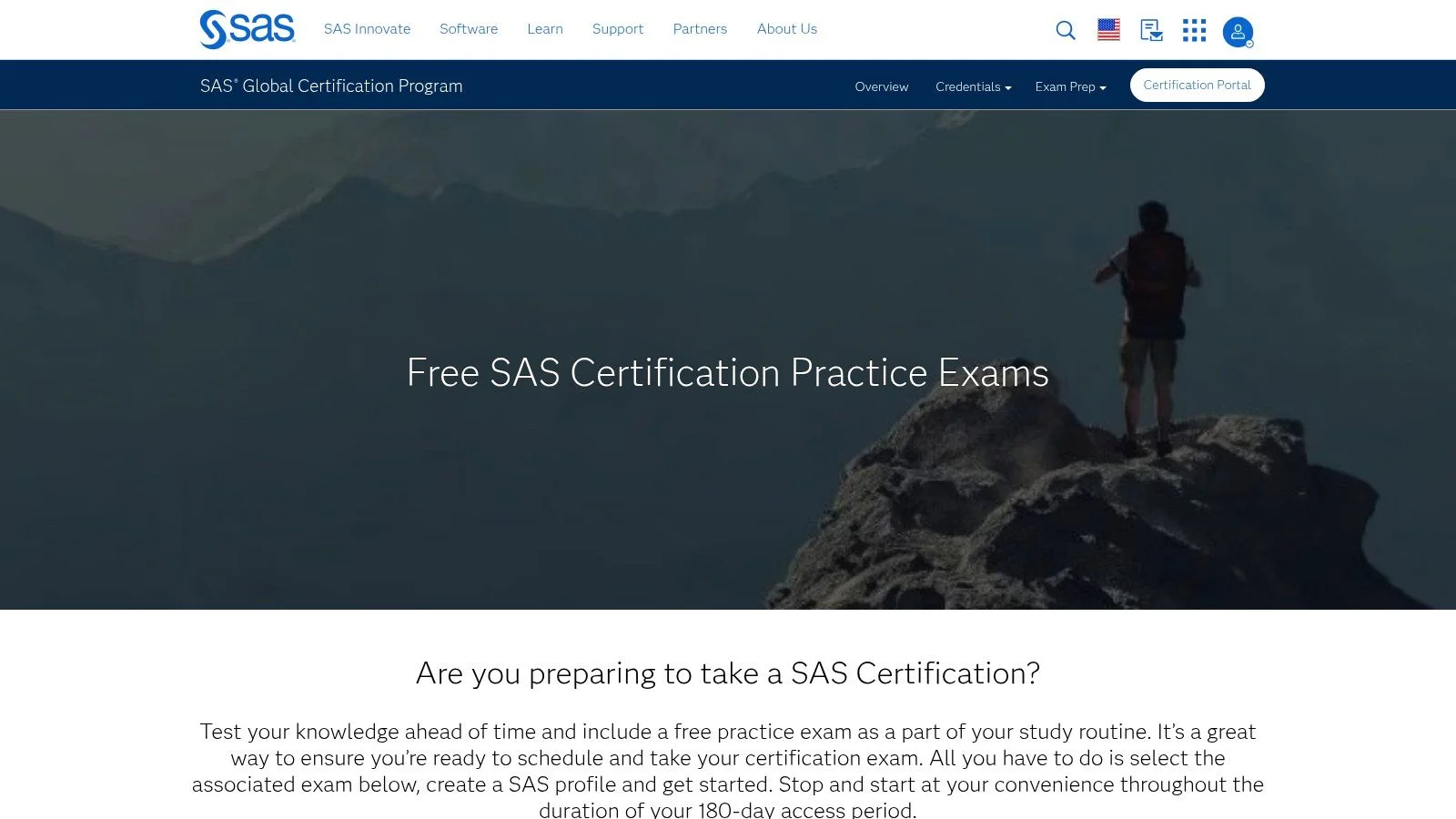
You open an official SAS practice exam, hit the first few items, and realize the problem isn't raw syntax. It's speed, question interpretation, and staying accurate when the exam mixes programming tasks with standard multiple-choice items. That is why I treat the official practice exam as a starting diagnostic, not a last-week confidence check.
Its real value is the feedback loop. You can use it early, review where your reasoning broke down, then come back after targeted study instead of guessing whether your prep is working.
Why this belongs at the front of your plan
For A00-231, this resource is the closest match to the exam experience you will get before test day. It gives you format familiarity and a cleaner read on weak areas than scattered quiz sites usually provide.
Use the first attempt cold.
That first run should tell you three things: which topics you know, which ones collapse under time pressure, and whether your mistakes come from SAS concepts or from reading too fast. Those are different problems, and they need different fixes. Concept gaps call for course work or hands-on coding. Pacing issues usually improve with timed sets and spaced repetition using missed-question notes or flashcards.
Here is the practical way to use it:
- First attempt: Take it without notes or pauses. Treat it like a baseline, not a score to protect.
- Review pass: Sort misses into buckets such as DATA step logic, PROC behavior, output interpretation, and careless reading.
- Study cycle: Rebuild weak areas with official training or focused drills from third-party banks.
- Second pass later: Return after a few study sessions to check whether you fixed the weakness or just recognized the question.
That sequence works well for SAS and for other career-boosting tech certifications for IT pros, especially when exam results depend on pacing as much as topic knowledge.
There is one limitation. Official practice exams usually do a better job with realism than volume. If you rely on this resource alone, you may understand the test style but still fall short on repetition. That is why I use official material for diagnosis first, then add third-party question sets for extra reps, then finish with one more official-style review before the exam.
2. SAS Certified Specialist Base Programming Using SAS 9.4
You finish a practice set feeling confident, then miss questions on RETAIN behavior, BY-group processing, or which PROC gets the result fastest. That pattern usually means you don't need more random questions. You need guided correction tied to the A00-231 blueprint.
The SAS Certified Specialist Base Programming Using SAS 9.4 course fills that role well. It is the official e-learning path for candidates who want structured prep, labs, and checkpoint exercises instead of relying on large banks of mixed-quality practice items. I recommend it most often for people who have written SAS on the job but learned it in fragments.
That distinction matters. Work experience builds familiarity. Certification prep tests whether your habits hold up across the full objective set, including areas you may rarely touch in day-to-day reporting or data prep.
Where it earns its keep
Its main value is coverage with context. You are not only checking whether an answer is right. You are working through why a DATA step behaves one way, why a sort is required before a merge, or why one procedure fits the question better than another. That kind of correction is more useful than seeing another recycled multiple-choice item.
I have seen this course help three groups in particular:
- Working SAS users with uneven coverage: Good coders often have blind spots in formats, dates, output delivery, or data validation.
- Self-taught learners: The structure helps clean up habits picked up from one-off job tasks.
- Candidates who want official objective alignment: The course keeps study time focused on exam-relevant topics instead of side material.
There is a trade-off. Official guided prep usually gives you better instruction and cleaner alignment, but less repetition than third-party test banks. That makes it a poor choice as your only exam resource if speed and pattern recognition are still weak.
Use it strategically. Start here if your assessment showed conceptual gaps. Work the labs carefully, keep notes on mistakes that came from logic rather than misreading, and turn those recurring misses into spaced-repetition cards for syntax rules, PROC behavior, and common output traps. After that, add a higher-volume question source for timed drilling.
If your goal is simple, this resource is for understanding and correction, not for maximum question count. As noted earlier, it is part of the official SAS learning path.
3. SAS Certified Associate Programming Fundamentals Using SAS 9.4
You sit down to your first serious SAS study session, open a specialist-level practice set, and realize the problem isn't the timer. It's the foundation. If PROC steps, data step flow, and SAS syntax still feel unfamiliar, the Associate track is the cleaner entry point.
This resource fits candidates who are early in the process and need ordered skill-building before they start grinding exam-style questions. It is especially useful for career changers who already know data work in SQL, Excel, or Python but have not yet built SAS habits around libraries, permanent data sets, step boundaries, and program structure.
The main advantage is pacing. Associate-level prep gives you a way to assess what you know, close obvious gaps, and build enough fluency to make later practice exams productive instead of frustrating. That makes it a good first-stage resource in a broader study plan, not the whole plan by itself.
Best use case: build baseline fluency before timed drilling
I would use the Associate material at the front of the plan, after an initial self-check. If simple tasks still take too long, or if mistakes come from syntax and execution order rather than question wording, start here. Work through the lessons in sequence, then write a few small programs from memory. That exposes weak spots faster than passive review.
A practical approach:
- Use it for initial assessment: Identify whether your gaps are in reading data, creating variables, filtering, sorting, or basic reporting.
- Use it for skill transfer: Candidates coming from other tools often know the logic but miss SAS-specific rules and workflow details.
- Use it with spaced repetition: Turn repeated misses into short review cards for functions, statement order, missing-value handling, and common procedure behavior.
- Do not rely on it alone for exam readiness: Once the basics are stable, add timed question practice from a separate source.
The trade-off is straightforward. Associate-level prep is better for building competence than for building test speed. If you already write Base SAS code comfortably and can diagnose your own errors, this will probably feel too introductory. In that case, spend your time on higher-volume practice questions and targeted review instead.
As noted earlier, this course is part of the official SAS learning path.
4. SAS Certification Guides
You finish a timed set, review the misses, and notice the same pattern again. The problem isn't pacing. It is usually a weak mental model of how SAS executes code, especially around the DATA step, input methods, and procedure side effects. That is the point where certification guides start paying off.
I use the SAS Press guides as the explanation layer in a broader prep plan. Earlier in the article, the official guide page was referenced already, so I will not repeat the link here. What matters is how to use the books well. They are slower than practice banks, but they do a better job of fixing errors that keep coming back under slightly different wording.
Best use case: diagnose recurring misses and rebuild the concept underneath
These guides work well after an initial assessment and before the final round of timed drills. If a candidate keeps missing questions on reading raw data, variable attributes, sort behavior, BY-group processing, or report output, the right move is usually to stop chasing more question volume for a day or two and study the underlying chapter closely.
That trade-off matters. Books improve understanding and transfer. They do less for test rhythm.
A practical way to use them:
- Map chapters to your misses: Do not read cover to cover unless your fundamentals are shaky across the board.
- Write code after each chapter: Recreate examples from memory, then change one condition or option to see what breaks.
- Build spaced-repetition prompts: Turn repeated mistakes into short cards on execution order, function behavior, missing values, informats, and common PROC rules.
- Pair with timed practice later: Once the concept is stable, return to mixed question sets and check whether the error pattern is gone.
This is the same study discipline I recommend in other certification tracks. A resource can be strong on explanation and still be inefficient for late-stage exam prep. The same trade-off shows up in comprehensive CCNA preparation for IT professionals, where candidates need both concept depth and timed repetition, just in a different technical domain.
One caution from experience. Candidates who rely only on recycled practice questions often get comfortable with pattern recognition instead of reasoning. The certification guides help prevent that. If the exam rewrites a familiar concept in a less familiar way, deeper understanding holds up better than memorized answer shapes.
5. Coursera Preparing for the SAS Programming Certification Exam
You are two weeks from test day, your practice scores are decent, and the misses are no longer random. They cluster around the same SAS details: DATA step processing order, formats versus informats, BY-group behavior, and small PROC syntax rules. That is the point where the SAS certification-prep course on Coursera tends to help most.
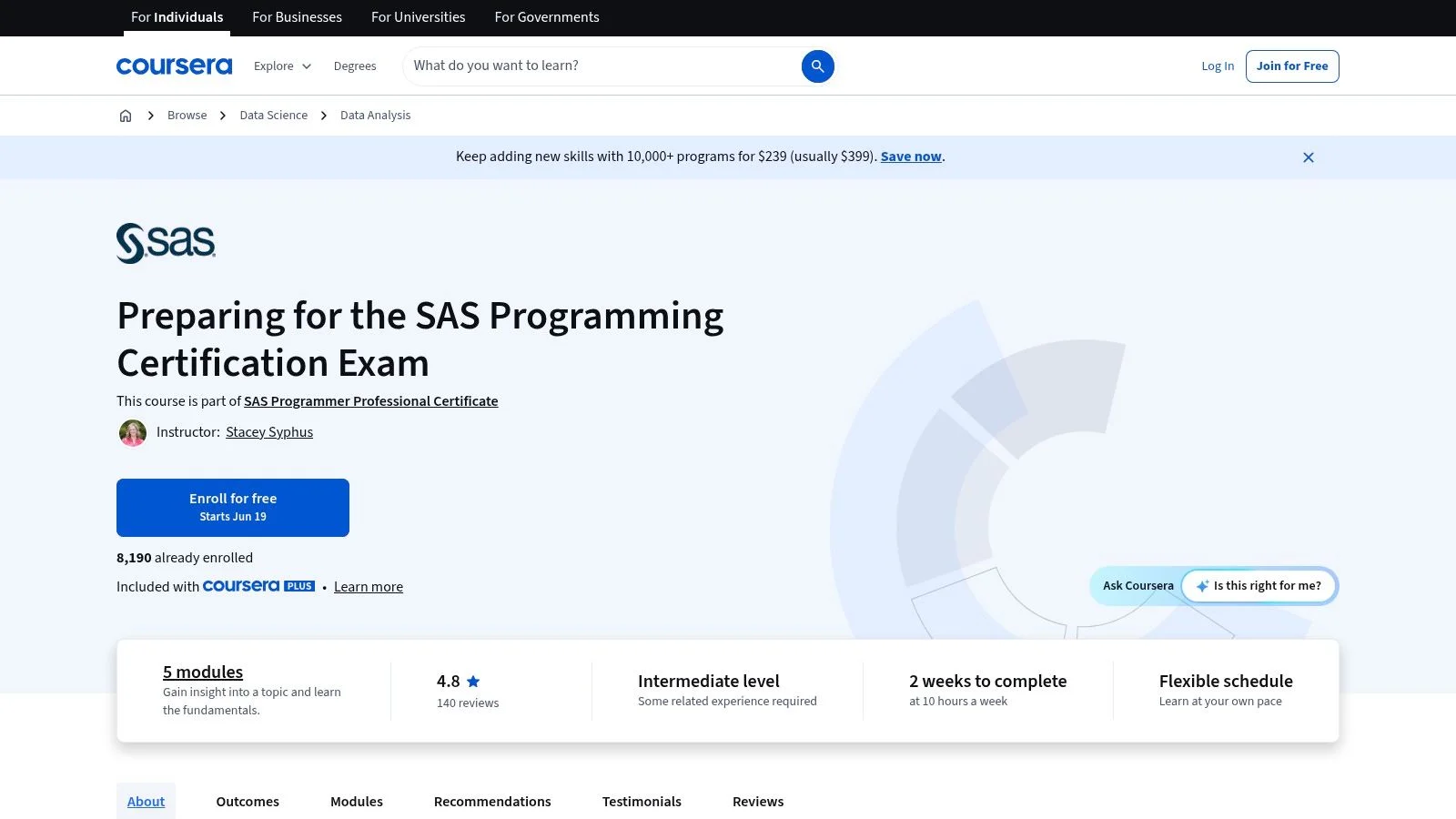
I do not use this as an entry-point resource. I use it as an official review layer after an initial assessment and after enough question practice to know where the weak spots are. That distinction matters because this course is organized and well aligned to SAS exam objectives, but it does not give the volume or time pressure you need from a primary bank of SAS certification exam practice questions.
What it does well is tighten recall. The quizzes and guided review push you back through the areas that often slip late in prep, especially for candidates who understand the concept in a book chapter but hesitate when the same idea shows up in exam wording. Official material also helps reduce one common late-stage problem: overfitting to recycled third-party questions.
Used strategically, it fits a simple study sequence:
- Start with diagnostics: Use a timed set first so you know whether your problem is knowledge gaps or pacing.
- Use this course for targeted repair: Work the modules that match your error clusters instead of completing everything in order by default.
- Capture misses in spaced repetition: Turn wrong answers and shaky concepts into short review cards. Focus on rules, defaults, and exceptions.
- Return to timed mixed sets: Check whether the weakness is fixed under exam conditions.
That mix is more effective than relying on one format. I have seen candidates do well with official review content, but only when they pair it with harder retrieval practice outside the platform. The same study logic shows up in comprehensive CCNA preparation for IT professionals. Build the base, isolate weak domains, then test under time.
The main trade-off is efficiency. If you already know exactly what you miss, a focused question bank may move faster. If your prep has become messy and inconsistent, this course adds structure without sending you back through a full multi-course program.
As noted earlier, this Coursera course is the official short-form review option from SAS. Use it to clean up weak areas and sharpen recognition near the end of your study plan, not as your only source of exam practice.
6. Coursera SAS Programmer Professional Certificate
You start studying with good intentions, then your prep splits in three directions. A question bank for speed, a guide for syntax, a video course for the topics you keep forgetting. The full Coursera certificate suits that kind of candidate because it puts the work into one sequence and keeps you practicing in context.
As noted earlier, this is the longer official Coursera path from SAS. I recommend it for candidates who are still building coverage across the exam, not just cleaning up a few weak areas before test day.
Best for building consistency across domains
The main advantage is repetition across related skills. You do not just answer isolated practice questions. You write code, move through graded assignments, and revisit concepts across multiple courses. That matters for candidates who can solve a PROC problem one day and then miss a basic data step detail the next.
I have seen this path work well for two groups. Career switchers who need structure. Working analysts who know some SAS already but learned it in fragments and have uneven recall under pressure.
A few trade-offs are clear:
- Strong fit for early to mid-stage prep: It helps build broad coverage before you rely on timed exam sets.
- Useful for learners who need a study system: The course order reduces decision fatigue and makes it easier to stay on schedule.
- Less efficient for final-stage prep: If you already score well on mixed practice sets, the full program can take more time than you need.
Use it as the backbone of a study plan, not the whole plan.
A practical approach is to start with a short diagnostic set from another source, then use the certificate to strengthen the domains where your performance is inconsistent. Keep a spaced-repetition list while you work through the courses. Focus on syntax rules, default behaviors, common traps, and procedures you confuse under time pressure. In the last stretch, shift to timed mixed practice so you can check recall speed, not just understanding.
Website: SAS Programmer Professional Certificate on Coursera
7. LinkedIn Learning Prepare for the SAS 9.4 Base Programming A00-231 Learning Path
You finish a practice set after work, miss several questions in the same content area, and realize the problem isn't effort. It is recall. You know the topic when you see it in context, but not well enough to answer quickly under exam conditions. That is the role LinkedIn Learning can fill.
I do not treat this learning path as a primary prep resource for A00-231. I use it as a repair tool after a diagnostic shows clear weak spots. Short lessons are useful when you need to revisit one topic, write a few lines of code, and move on without committing to another full course.
That matters for working analysts with limited study time. If you already have access through your employer or library, it is an efficient way to patch gaps in areas like PROC steps, data import basics, or reporting tasks that have gone rusty.
The trade-off is straightforward. The platform is built for learning and review, not for exam realism.
- Best use: Targeted refreshers after you have identified weak domains.
- Useful for: Candidates who study in short blocks and need structured review.
- Weak point: Limited value for timed, exam-style pressure and mixed-question pacing.
Use it inside a study system, not beside one. Start with a short practice set from an official or high-quality third-party source. Tag every miss by topic. Then use the learning path only for the topics that repeatedly cost you points. After each module, create a few flashcards on syntax, defaults, and common traps, then revisit them with spaced repetition over the next several days.
That approach keeps LinkedIn Learning in the right lane. It helps fix knowledge gaps, but it should not be the resource that tells you whether you are ready for test day.
Website: LinkedIn Learning
8. Udemy SAS Base Programming A00-231 Practice Tests
You finish a timed set, feel good about your score, then review the misses and realize the questions were testing trivia instead of the kind of SAS decisions the exam cares about. That is the Udemy risk in one sentence.
Udemy can still earn a place in a serious study plan. I use it for volume after I already know where the candidate stands from official materials or a stronger third-party benchmark. Cheap question volume helps with pacing, attention, and recall under time pressure. It does not guarantee exam alignment.
The instructor is the product here. Platform reputation does not tell you much.
What separates a useful Udemy practice bank from a throwaway one is fairly practical. Check whether the course has recent updates, explanations that show why each option is right or wrong, and questions that force you to read code, outputs, and procedure behavior carefully. If the bank relies on obvious keyword matching or thin answer keys, skip it.
A good way to use Udemy is in the middle phase of prep, after diagnosis and before final review. Run a set under timed conditions. Tag misses by topic, such as DATA step processing, PROC SORT behavior, informats versus formats, or output delivery details. Then review only the patterns that repeat. That same mistake-log approach works well in CCNA certification exam preparation, and it translates cleanly to SAS because both exams reward pattern recognition built over repeated review.
I would rate Udemy as a conditioning resource, not a calibration resource. It is useful for rebuilding speed and keeping study sessions active when you need more reps than official sources provide. The trade-off is straightforward. You must screen for quality, and you must verify any questionable explanation against SAS documentation or your main prep text.
- Best use: Mid-stage drilling once you already have an official baseline.
- Helps with: Pacing, repetition, and identifying recurring weak spots.
- Main limitation: Question quality varies a lot, so readiness signals are inconsistent.
Use spaced repetition here, not just repeated test attempts. Turn misses and near-misses into flashcards on syntax rules, defaults, and common traps. Review them over several days, then come back to another timed set. That workflow gets real value out of a low-cost question bank without letting weak items shape your understanding.
Website: Udemy
9. CertificationPractice.com Free SAS Base Programming Specialist A00-231 Practice Tests
You finish a 20-minute set on a free question site, score well enough to feel better, then miss basic PROC SORT behavior the next time you work through an official-style item. That is a significant risk with free banks. They can keep your hands on the material, but they can also give false comfort if you treat them as a score predictor.
CertificationPractice.com fits one narrow role in a SAS study plan. Use it for low-cost repetition after you already know the exam objectives and have checked yourself against stronger material. I would not use it to judge readiness, but I would use it to keep recall active between heavier study sessions.
What makes it useful is speed. You can run short sets, spot whether you still hesitate on DATA step flow, variable attributes, date handling, or simple output questions, and then move straight into targeted review. That matters in the middle stretch of prep, when volume helps but official questions are limited.
The trade-off is quality control. Free third-party sites rarely show how items were written, reviewed, or updated, so every doubtful explanation needs a second check against SAS documentation or a trusted certification guide.
A practical way to use a site like this is simple:
- Best use: Short reinforcement sessions after you have built an official baseline.
- Helps with: Recall, study consistency, and quick checks on narrow topics.
- Main limitation: Scores here do not reliably map to exam readiness.
I recommend treating each session like an error-harvesting exercise. Save misses, guessed answers, and even correct answers that took too long. Turn those into flashcards or a mistake log, then review them with spaced repetition over the next few days. The same habit shows up in CCNA certification exam preparation, and it works well for SAS because both exams reward clean recall under time pressure.
Website: CertificationPractice.com
10. Study4Exam SAS A00-231 Practice Tests
You are two weeks from test day, your official questions are nearly used up, and you still want timed reps on PROC steps, DATA step logic, and output behavior. That is the lane where a vendor-style bank like Study4Exam can fit. It gives you more question volume, flexible session lengths, and offline-friendly formats, which can help late in prep if you already have a solid baseline.
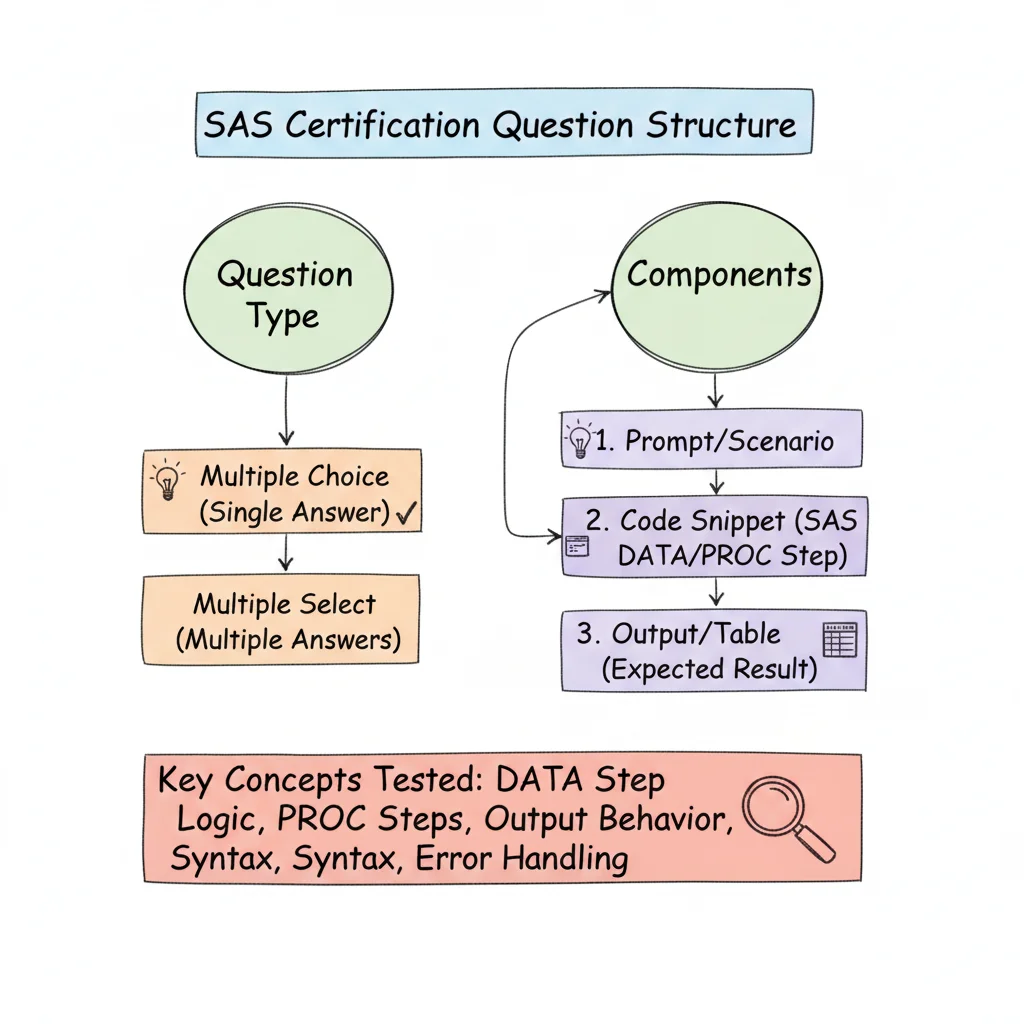
I would treat it as a third-party drill source, not a score predictor. The practical value is session control. You can run 15 to 20 questions under time pressure, review weak spots quickly, and keep momentum without reopening a full course.
The trade-off is trust. With any vendor bank, the key question is not whether you can get a high score there. The fundamental question is whether the misses expose gaps you can verify against SAS documentation, SAS Press material, or official training. That distinction matters because third-party banks vary in wording, explanation quality, and update discipline.
A better use case is targeted pressure-testing. If you keep missing questions on reading raw data, temporary versus permanent datasets, informats and formats, or BY-group processing, use those misses to drive your next review block. Then convert error patterns into flashcards and revisit them with spaced repetition over the next few days. That is how these banks become useful. They support recall and timing, while your official resources handle accuracy and exam alignment.
My advice is simple. Use Study4Exam late in the study cycle, after you have already worked through the official blueprint and stronger reference material. If an item looks questionable, do not memorize it. Verify it, correct your notes, and move on.
Website: Study4Exam SAS A00-231 Practice Tests
Top 10 SAS Exam Practice Resources Comparison
| Resource | Core features | Best for (Target audience) | Key benefits / USP | Cost / Access |
|---|---|---|---|---|
| SAS Practice Exams (Official, free) | Official practice items, aligned to exam blueprints, virtual lab option, immediate feedback | Test-takers seeking authentic exam-style practice and diagnosis | Closest-to-real exam format; free; includes SAS Studio for coding practice | Free, online via SAS |
| SAS Certified Specialist: Base Programming (official e-learning) | Instructor-led e-learning, hands-on labs, embedded quizzes, A00-231 mapping | Candidates preparing specifically for Specialist (performance-based) tasks | Authoritative coverage, guided performance-based practice and tips | Paid subscription/purchase |
| SAS Certified Associate: Programming Fundamentals (official e-learning) | Foundational course, frequent knowledge checks, free practice exam, SAS OnDemand labs | Beginners building core SAS programming skills | Beginner-friendly, official alignment, includes a free practice exam | Course purchase/subscription; free practice exam included |
| SAS Certification Guides (SAS Press) | Prep books with chapter quizzes, programming scenarios and datasets | Learners wanting deep conceptual mastery and hands-on reading-based study | In-depth coverage, trusted authorship, printable practice datasets | Paid (ebook/print) |
| Coursera: Preparing for the SAS Programming Certification (by SAS) | Short review modules, graded quizzes, capstone-style assessments | Candidates seeking focused, timed review in an LMS | SAS-built review, flexible audit option, timed practice | Audit free; paid for graded access/certificate |
| Coursera: SAS Programmer Professional Certificate (by SAS) | Multi-course pathway, many auto-graded quizzes, hands-on labs, certification review | Beginners → intermediate learners wanting structured, progressive prep | High volume of practice across topics, progressive skill building | Subscription-based (monthly) |
| LinkedIn Learning: Prepare for SAS 9.4 Base Programming (A00-231) | Curated video courses, short assessments, learning path aligned to objectives | Learners needing bite-size refreshers or employer-provided access | Modular, concise lessons; shareable completion certificates | Subscription (often via employer/library) |
| Udemy: SAS Base Programming A00-231 Practice Tests (various) | Large mock exams, timed mode, detailed explanations, lifetime access | Test-takers who want high-volume, low-cost practice | Large question volume, one-time purchase, frequent discounts | One-time paid (varies by course) |
| CertificationPractice.com: Free SAS Base Practice Tests | Timed practice sets, question review mode, solution explanations | Supplementary drilling for quick weak-spot identification | Zero-cost rapid practice; easy supplementary resource | Free, online |
| Study4Exam: SAS A00-231 Practice Tests | Multiple formats (web/PDF/desktop), progress tracking, larger item counts | Learners wanting flexible on/offline practice and extra volume | Flexible study formats; extensive question banks | Paid (site license/purchase) |
Your Next Step Towards SAS Certification
The best way to use SAS certification exam practice questions isn't to collect as many as possible. It's to use each resource for the job it does well.
Start with the official SAS practice exam. That gives you the cleanest baseline and the most honest view of your current readiness. Because official practice exams are free and available for a fixed access period with repeat attempts, they work well as both a starting point and a checkpoint later in your prep. Don't waste that by waiting until the end. Use it early, review every miss, and sort your weak areas into a short list.
After that, move into skill repair. If your gaps are conceptual, use SAS Press guides or an official SAS learning course. If your gaps are foundational, the Associate path is a better investment than hammering specialist mocks too early. If your issue is stamina or pacing, that's where Udemy or another third-party bank can earn its keep. They're not as authoritative, but they can give you repetition that official resources often don't provide at scale.
For the final stretch, switch your study pattern. Stop broad review and start cycling weak topics with spaced repetition. Revisit missed concepts after short intervals, then retest them under time pressure. Keep your review notes focused on decision points, not just facts. Which PROC fits the task. What SAS will do by default. Where sort order matters. Which mistakes you make when you rush.
That's also the right mindset for performance-oriented SAS exams. Public prep advice often treats practice questions like predictors, when they're better used as diagnostics. A question bank can show you patterns in your thinking. It can't guarantee what the live exam will feel like. That's why combining official materials with selected third-party practice is usually stronger than staying loyal to one source.
If you work in training or team enablement, there's a useful parallel in developing effective certification programs. The strongest programs don't rely on one test format alone. They mix assessment, feedback, skill application, and repetition. Your own SAS prep should work the same way.
If you already use a broader certification platform such as MindMesh Academy for study guides or practice workflows in other IT tracks, the same habits apply here. Track your misses, revisit them deliberately, and keep practice tied to actual skill. That's what builds exam confidence that holds up under pressure.
Ready to organize your exam prep and identify weak areas for any IT certification? Explore MindMesh Academy's range of resources and start building consistent study momentum.

Written by
Alvin Varughese
Founder, MindMesh Academy
Alvin Varughese is the founder of MindMesh Academy and an enterprise architecture leader. An electrical engineer by training, he moved from factory automation in South Africa to cloud architecture at GE Appliances and Humana (Fortune 50), and holds 20 professional certifications including AWS Solutions Architect Professional, Azure DevOps Engineer Expert, and Microsoft Agentic AI Business Solutions Architect. He built MindMesh Academy after interviewing too many highly certified candidates who couldn't answer basic questions: the goal is prep that makes you better at the job, not just able to pass the exam.