Questions Practice Routines for Better Retention
Questions Practice Routines for Better Retention
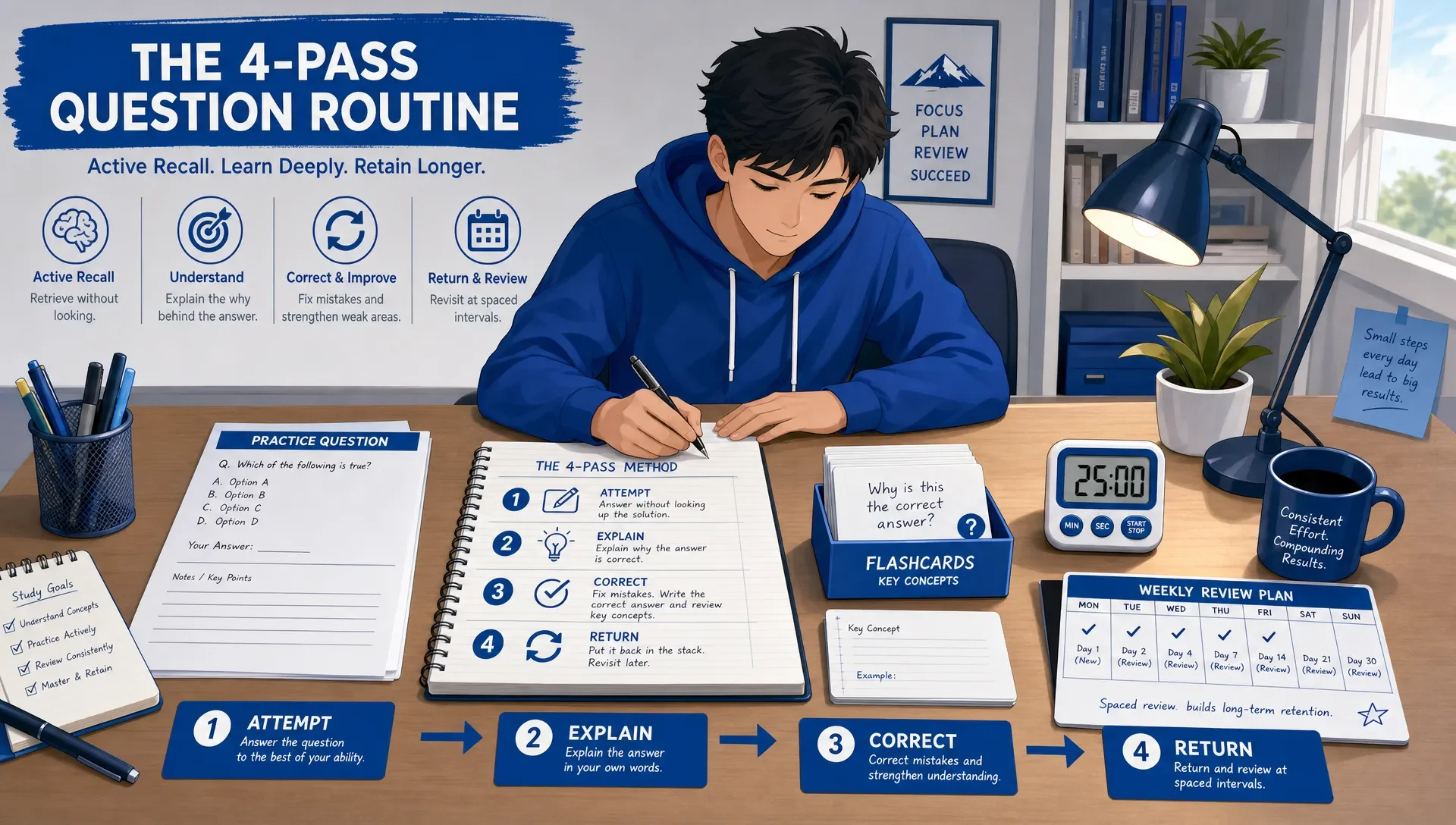
Use practice questions in four passes: attempt, explain, correct, and return. If your questions practice is just a streak of 40 or 50 items followed by quick answer checking, you're training recognition more than retention. A better routine forces you to retrieve the idea, prove your reasoning, fix the gap, and see the same concept again after time has passed.
Start with a small daily block, then add a weekly mixed session. For most certification learners, 20 focused minutes beats a long, unfocused question binge. The goal isn't to finish the largest bank possible. The goal is to remember the objective, recognize how it appears in scenarios, and avoid repeating the same mistake under exam pressure.
Why Practice Questions Improve Retention Better Than Rereading
Practice questions work because they make your brain retrieve information before it gets help. That retrieval attempt matters. In a classic experiment, Roediger and Karpicke found that testing improved long-term retention compared with repeated studying, even when learners felt less fluent at first.
That last part is important. Good question practice can feel slower than rereading notes because you're working harder. But that effort is the point. When you choose an answer, explain your reasoning, and compare it with a high-quality explanation, you're building a stronger memory route than you get from highlighting a paragraph.
A major review by Dunlosky and colleagues rated practice testing and distributed practice as high-utility learning techniques. For certification prep, that combination is strong: answer questions now, review missed concepts later, and keep returning to weak objectives until recall becomes reliable.
| Study habit | What it feels like | What it usually trains | Better retention move |
|---|---|---|---|
| Rereading a study guide | Smooth and familiar | Recognition | Close the notes and answer a question |
| Watching an explanation first | Comfortable | Understanding in the moment | Attempt the question before seeing help |
| Doing many questions once | Productive | Short-term familiarity | Revisit missed and guessed items later |
| Reviewing only the score | Fast | Score awareness | Track the objective and reason for each miss |
The 4-Pass Questions Practice Routine
A retention-focused routine doesn't need to be complicated. It needs to be repeatable. Use the same four passes whether you're studying cloud fundamentals, networking, security, ITIL, or project management.
- Attempt the question closed-book: Read the full stem, choose an answer, and mark your confidence before checking feedback. Confidence matters because a lucky guess shouldn't count as mastery.
- Explain your answer before reading the explanation: Say why your choice is right and why the strongest distractor is wrong. If you can't explain both, the concept isn't stable yet.
- Review the explanation and map the miss to an objective: Don't stop at the correct letter. Connect the explanation to the exam objective, service, command, process, or concept being tested.
- Schedule a return pass: Any missed, guessed, or slow question goes back into review. Revisit the concept after a delay so you're testing memory, not just immediate correction.
This routine helps you avoid one of the most common traps in certification prep: memorizing answer patterns instead of understanding the underlying objective. If you can explain the rule behind the answer, you can handle new wording on exam day.
A Daily 20-Minute Practice Questions Routine
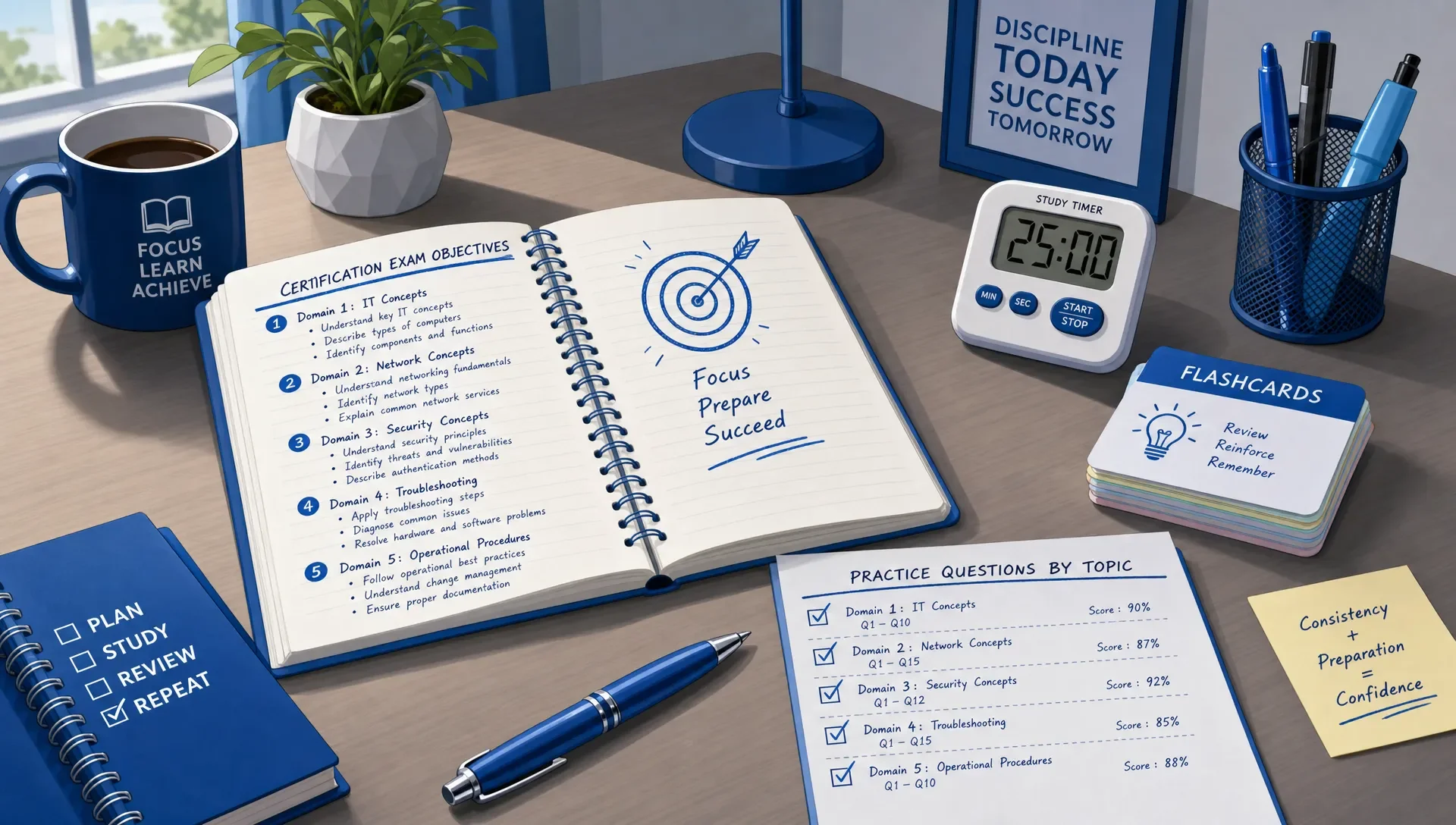
A daily routine should be short enough that you can actually do it after work, class, or family responsibilities. Twenty minutes is enough if you protect the quality of each rep.
Use the first few minutes to pick one objective or weak topic. If you're studying Microsoft fundamentals, for example, an objective-based resource like the AZ-900 Microsoft Azure Fundamentals study guide can keep your practice aligned with the exam instead of drifting into random trivia.
| Time | Activity | Retention purpose |
|---|---|---|
| 2 minutes | Pick one objective or weak topic | Narrows attention and reduces random practice |
| 8 minutes | Answer 5 to 8 questions closed-book | Builds retrieval strength |
| 5 minutes | Review explanations and tag misses | Turns errors into study targets |
| 3 minutes | Create or update flashcards | Prepares spaced review |
| 2 minutes | Write one takeaway in your own words | Converts feedback into usable memory |
Keep the question count modest. If you rush through 30 items and barely review them, you've practiced speed more than understanding. If you answer 6 questions carefully, explain your misses, and schedule follow-up, you're building retention.
Weekly Mixed Practice Routine for Long-Term Retention
Daily practice should be targeted. Weekly practice should be mixed. Mixed practice forces you to decide which concept applies before you solve the question, which is closer to the real exam experience.
Spacing also matters. A meta-analysis by Cepeda and colleagues found benefits for distributed practice, meaning learners tend to retain more when study is spread out over time instead of compressed into one session. For certification exams, that means you shouldn't wait until the weekend to do all your questions.
A weekly rhythm might look like this:
| Day | Question routine | Review focus |
|---|---|---|
| Monday | 10 new questions from one objective | Identify new weak areas |
| Tuesday | 10 questions from missed or guessed items | Repair recent gaps |
| Wednesday | 10 mixed questions from older objectives | Strengthen delayed recall |
| Thursday | 5 to 10 scenario-based questions | Practice applying concepts |
| Friday | 10 weak-topic questions | Reduce repeated errors |
| Saturday | Timed mini-set or practice exam section | Build pacing and stamina |
| Sunday | Light flashcard review and mistake log cleanup | Consolidate before the next week |
If you're preparing for a broad exam, a structured question set can help you mix domains without losing focus. For example, an AWS Certified Cloud Practitioner practice exam can be used for timed weekly checks after you've done targeted daily practice.
How to Review Missed Practice Questions Without Memorizing Answers
The review is where most of the learning happens. But not all review is equal. Reading the explanation and nodding along is too passive. You need to diagnose the miss.
A simple mistake log helps you see patterns across sessions. You don't need a complex spreadsheet. You need enough detail to know what to practice next. If you're taking longer mock exams, use a deeper review process like the one in MindMesh Academy's guide on how to review an exam practice test the right way.
| Mistake type | What it means | Best next step |
|---|---|---|
| Knowledge gap | You didn't know the concept | Revisit the study guide and make a flashcard |
| Concept confusion | You mixed up two similar ideas | Compare them side by side in your notes |
| Misread stem | You missed a qualifier or constraint | Slow down and underline key conditions mentally |
| Distractor trap | A tempting answer sounded familiar | Explain why the distractor is wrong |
| Timing issue | You knew it but took too long | Redo similar questions under a short timer |
| Overconfidence | You guessed correctly but couldn't explain it | Treat it as not mastered yet |
The key is to tag guessed answers, not just wrong ones. A guessed correct answer is useful data. It tells you the topic needs another retrieval rep before you trust it on exam day.
Spaced Repetition Schedule for Missed and Guessed Questions
Spaced repetition works best when it responds to performance. Easy concepts can wait longer. Weak concepts should return sooner. The schedule below is a practical starting point, not a fixed rule.
| Question result | What to do next | Suggested return interval |
|---|---|---|
| Correct and confident | Move it into mixed review | 3 to 7 days |
| Correct but guessed | Review explanation and retest | 1 day |
| Wrong due to knowledge gap | Study the objective, then retest | Same day and 2 days later |
| Wrong due to confusion | Compare similar concepts, then retest | 1 to 2 days |
| Wrong twice | Rebuild the topic with notes, flashcards, and examples | Next day, then 3 days later |
Flashcards are useful here, especially for definitions, service limits, command meanings, process steps, formulas, and key distinctions. But flashcards shouldn't replace exam-style questions. Use flashcards to strengthen recall, then use questions to test application.
Use Exam-Style Question Formats for Better Transfer
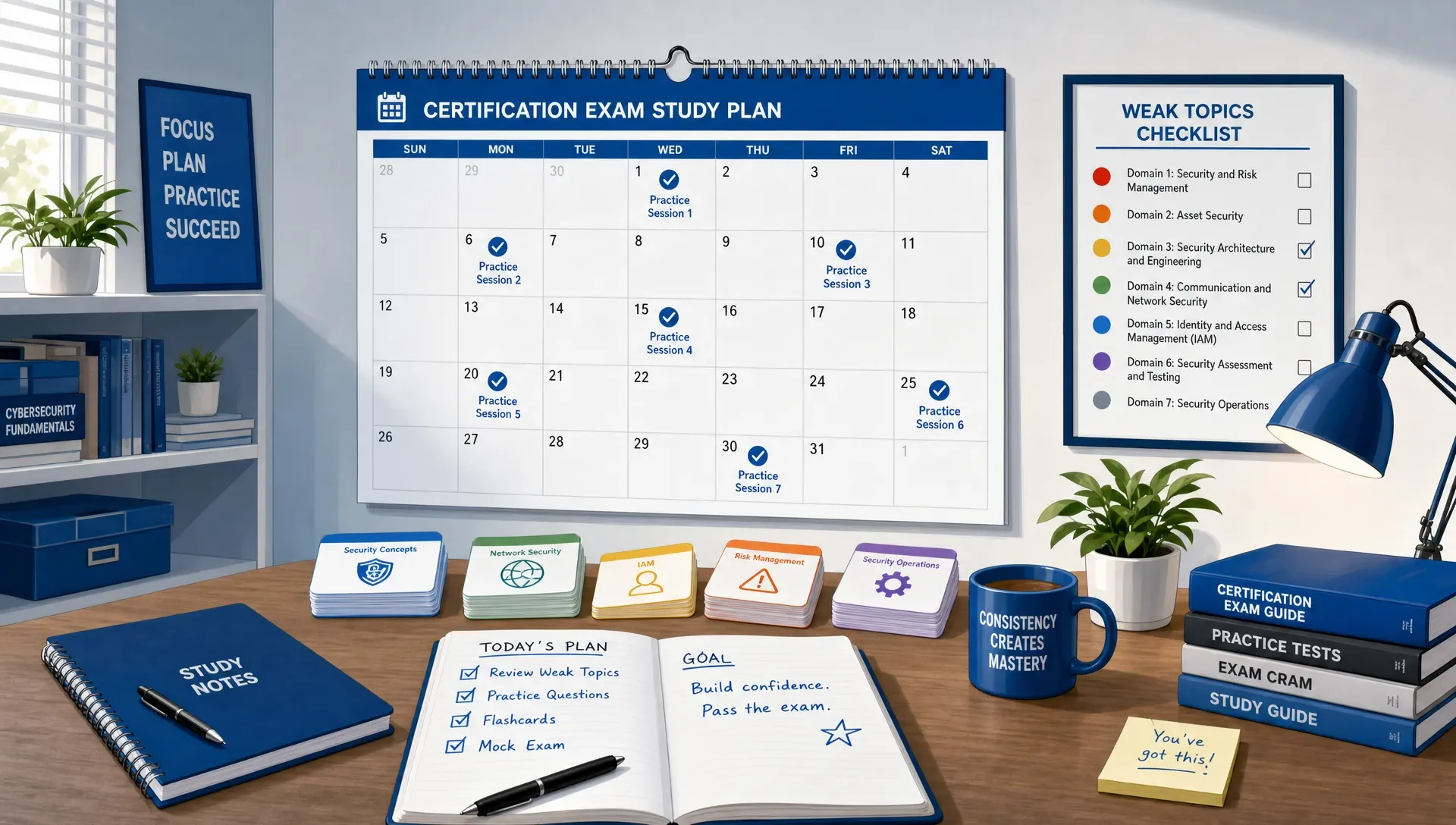
Retention isn't only about remembering facts. You also need to transfer what you know to the way the exam asks. That means your routine should include different question types as you get closer to test day.
For IT certifications, that may include scenario questions, multi-step reasoning, matching, ordering, command interpretation, or performance-based formats. The point is to practice applying concepts under constraints, not just recalling definitions.
If you're studying security topics, for example, a CompTIA Security+ practice exam can help you practice explanations, distractor analysis, and timed decision-making across objectives. Pair that with flashcards for weak terms and a mistake log for repeated misses.
A good progression looks like this:
| Prep stage | Best question format | Why it helps |
|---|---|---|
| Early study | Objective-focused short sets | Builds basic recall |
| Middle study | Mixed topic sets | Improves concept selection |
| Late study | Timed exam-style sets | Builds pacing and confidence |
| Final review | Missed, guessed, and weak-topic sets | Protects against repeated errors |
Don't jump straight into full-length testing if you haven't built the foundation. Full practice exams are valuable, but they can be inefficient early on because they expose gaps faster than you can repair them. Use them when you need pacing data, readiness checks, and cross-domain review.
How to Know Your Question Practice Is Working
Scores matter, but they aren't the only signal. A rising score can hide fragile retention if you're repeating familiar items too often. Track a few performance indicators that show whether knowledge is becoming durable.
| Metric | What improvement looks like | What to do if it stalls |
|---|---|---|
| First-pass accuracy by objective | Weak domains rise over time | Return to the study guide and retest smaller sets |
| Delayed recall | You still answer correctly after several days | Increase spacing gradually |
| Confidence calibration | High confidence matches correct reasoning | Tag lucky guesses and review them sooner |
| Explanation quality | You can explain why distractors are wrong | Compare similar concepts side by side |
| Timing | Correct answers come faster without rushing | Add short timed sets |
| Repeat error rate | The same mistake appears less often | Rewrite the flashcard or rebuild the concept |
This is where a connected study workflow helps. MindMesh Academy combines study guides by exam objectives, practice questions with explanations, flashcards with spaced repetition, adaptive weakness-based practice, progress tracking by topic, and readiness tracking. That lets you study from the objective, test the concept, review the miss, and return to it later without treating each tool as a separate island.
Frequently Asked Questions
How many practice questions should I do per day for better retention? Start with 5 to 15 well-reviewed questions per day. The exact number matters less than the quality of your review. If you can explain each answer, tag misses, and schedule follow-up, you're doing it right.
Should I repeat the same practice questions? Yes, but don't repeat them immediately just to get a higher score. Revisit missed and guessed questions after a delay, then focus on explaining the concept behind the answer so you don't memorize the option order.
Is it better to read explanations before or after answering? Answer first whenever possible. Reading the explanation first turns the session into passive study. Attempting the question first creates the retrieval effort that improves retention.
How do I stop memorizing practice question answers? Rotate topics, increase the spacing between repeats, explain why each distractor is wrong, and use new mixed sets when available. If you recognize the answer but can't explain it, mark it as not mastered.
When should I take a full practice exam? Take a full practice exam after you've completed most objectives and have done several mixed question sessions. Use it to check pacing, endurance, and readiness, not as your only learning method.
What should I do with questions I got right by guessing? Treat them like missed questions. Review the explanation, create a flashcard or note if needed, and schedule a return pass within a day or two.
Build a Question Practice Routine You Can Trust
Better retention comes from a routine you can repeat: answer closed-book, explain your reasoning, review the objective, and return after a delay. Do that daily in small sets, then add weekly mixed practice so your knowledge holds up outside the topic you just studied.
To help you connect these steps and build a dependable study system, MindMesh Academy offers structured study guides, practice questions with detailed explanations, and adaptive weakness-based practice. Get ready for your next certification by exploring our resources, like the AZ-900 practice exam.

Written by
Alvin Varughese
Founder, MindMesh Academy
Alvin Varughese is the founder of MindMesh Academy and an enterprise architecture leader. An electrical engineer by training, he moved from factory automation in South Africa to cloud architecture at GE Appliances and Humana (Fortune 50), and holds 20 professional certifications including AWS Solutions Architect Professional, Azure DevOps Engineer Expert, and Microsoft Agentic AI Business Solutions Architect. He built MindMesh Academy after interviewing too many highly certified candidates who couldn't answer basic questions: the goal is prep that makes you better at the job, not just able to pass the exam.