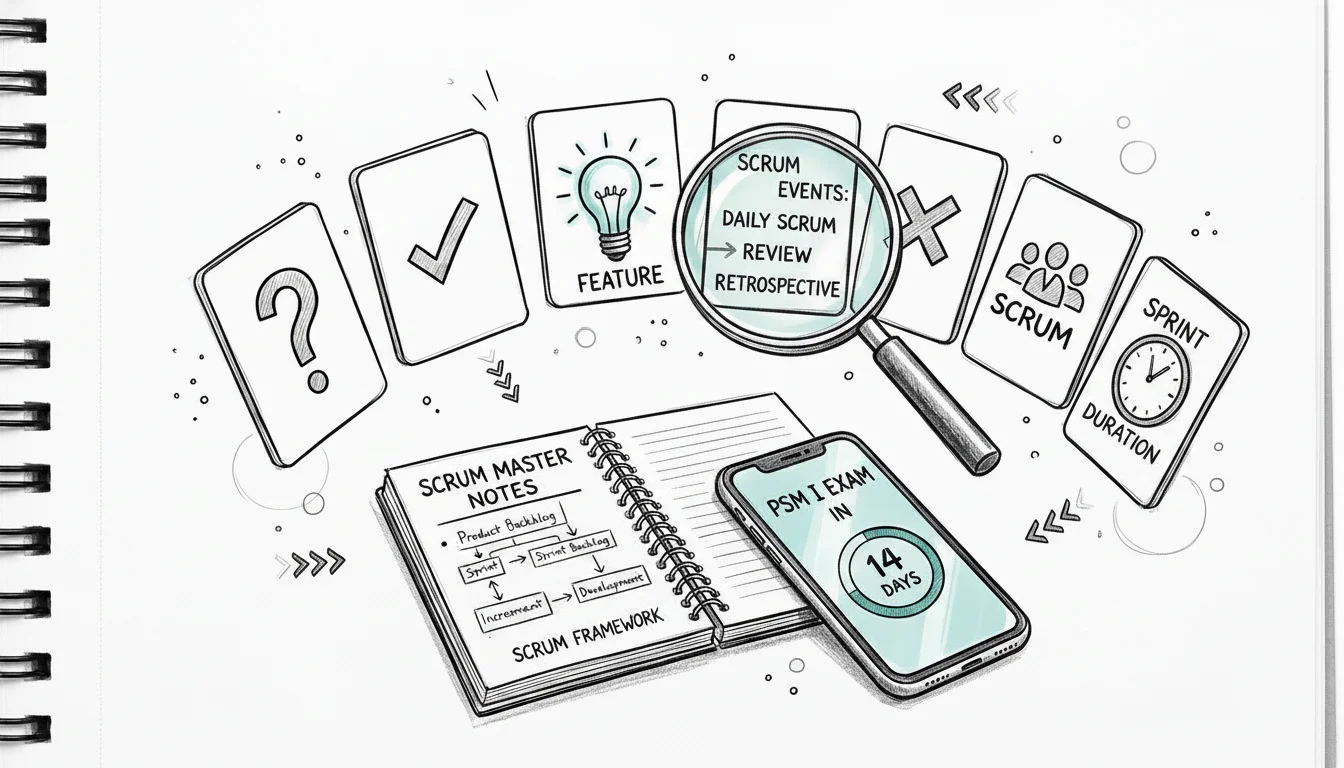
Top 7 PSM 1 Exam Questions Resources for 2026
Seven PSM I Exam Question Resources
Wondering why so many people spend weeks collecting PSM I exam questions and still walk into the assessment underprepared? They focus on volume before they master wording, pacing, and Scrum Guide precision. That's the mistake.
The PSM I is a 70-question exam with an 85% passing score, which means you need at least 60 correct answers. That threshold leaves little room for sloppy reading or half-right Scrum knowledge. If your prep plan is just “do a bunch of quizzes,” you're studying hard in the wrong order.
Use a path instead. Start with official wording. Then move to broader question banks to expose weak spots. Finish with realistic, timed simulations so you can answer fast without second-guessing. That sequence is how you turn practice into exam-ready judgment.
If you want a visual reminder of your target date, set up an iPhone exam countdown widget. Then stop browsing and start drilling with intent.
1. Scrum.org Open Assessments
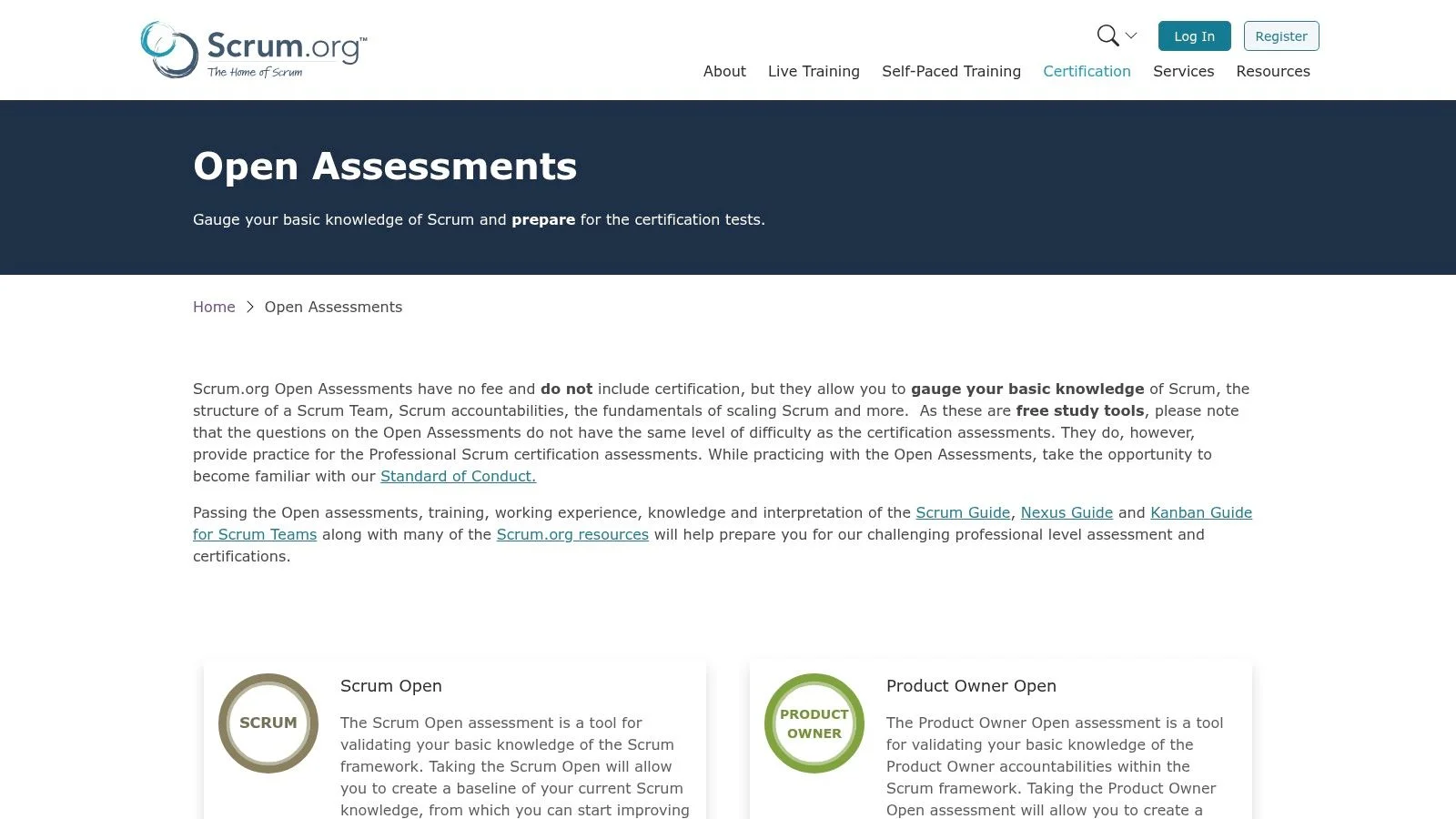
Start here. Not later. Not after three random mock-test sites. If you're serious about passing PSM I, the Scrum.org Open Assessments are your baseline because they reflect the wording, logic, and framing you'll face on the actual assessment.
Most candidates waste time on third-party banks before they've calibrated to official language. That's backwards. The official open quizzes teach you how Scrum.org asks, not just what Scrum means.
How to use it
Use Scrum Open as your daily benchmark. Then add Product Owner Open and Developer Open to widen your exposure to Scrum accountabilities, artifact ownership, and practical team dynamics. Independent prep discussions repeatedly point candidates back to official-style practice and repeated review of the Scrum Guide because the exam is scenario-based and closely aligned to that style.
Practical rule: Don't move on from the official quizzes until the wording feels routine and the wrong answers look obviously wrong.
The biggest advantage is simple. You can retake them freely and tighten your pattern recognition every day. The biggest weakness is also simple. The pool is limited, so after enough attempts you'll start recognizing questions instead of reasoning through them.
Use this resource for:
- Daily calibration: Run one open assessment before any other study so your brain stays aligned to Scrum.org language.
- Error logging: Write down every miss by topic, such as Sprint Goal, accountabilities, or artifact transparency.
- Cross-role reinforcement: Use Product Owner Open and Developer Open when Scrum Open alone starts to feel too familiar.
If you already know how disciplined exam prep works in another certification track, the same logic applies to Project Management Professional exam prep. You master the source framework first, then you expand.
2. Mikhail Lapshin Scrum Quizzes
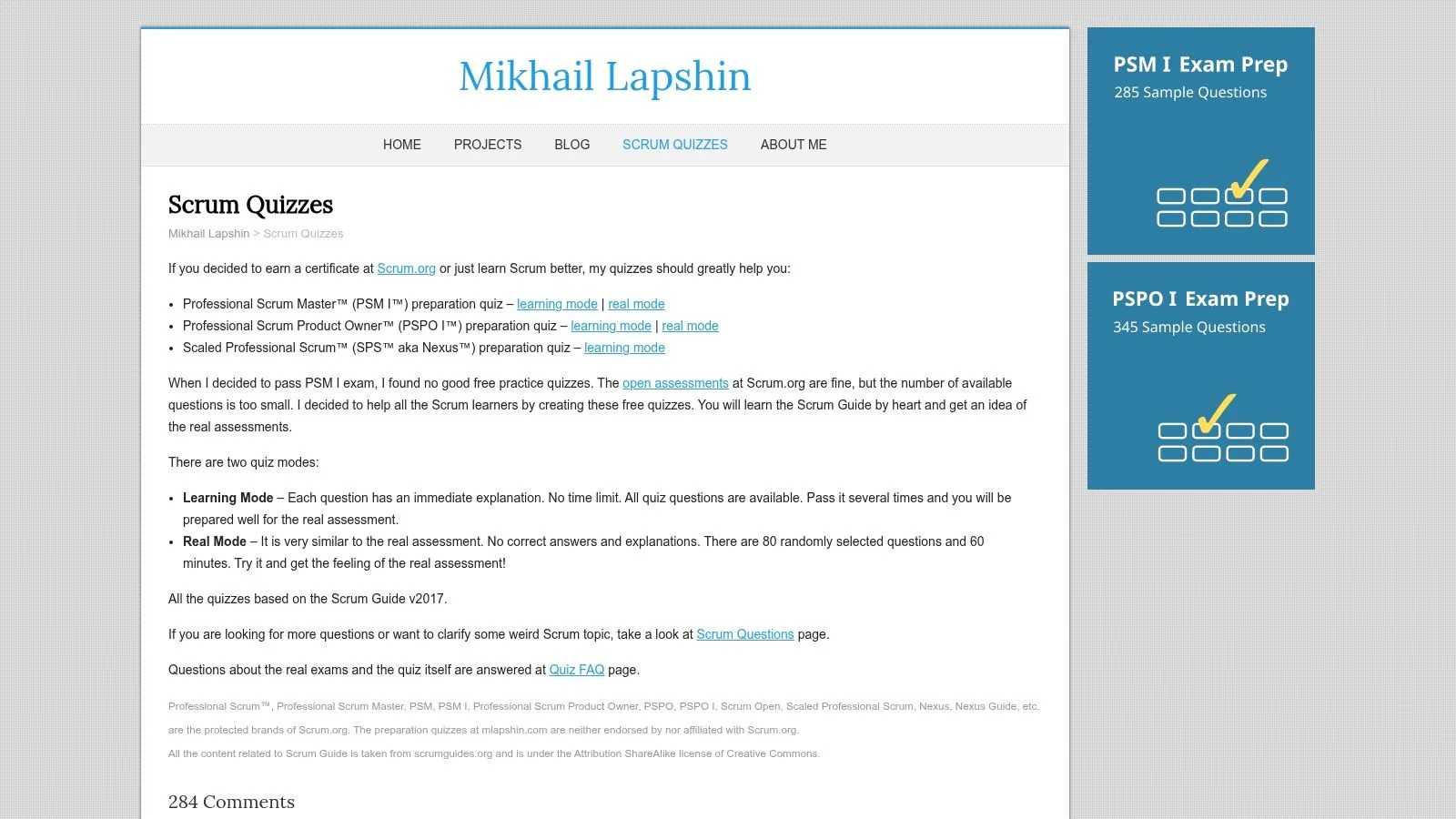
Once the official wording is familiar, shift to Mikhail Lapshin Scrum Quizzes to build volume and uncover blind spots fast. It's especially useful for catching confusion around accountabilities, events, and artifact boundaries.
One of the strongest public indicators of the question-bank approach appears in Lapshin's learning mode, which offers 80+ questions. That matters because PSM I exam questions reward fast recognition of precise Scrum terms. Passive reading won't build that skill nearly as well as repeated retrieval.
Where it helps most
Lapshin works best in the middle of your prep cycle. Use learning mode first when you're still correcting concepts. Switch to the timed mode once your mistakes are less about knowledge and more about speed or careless reading.
You do need to stay sharp here. Some candidates have reported that a few items may feel dated or imperfect, so cross-check anything questionable against the 2020 Scrum Guide instead of blindly trusting the answer key.
If a third-party explanation conflicts with the Scrum Guide, the Scrum Guide wins. Every time.
Use it strategically:
- Learning mode first: Read explanations and classify mistakes by concept, not by question.
- Timed mode second: Re-run only after you can explain why the distractors are wrong.
- Guide verification: For any doubtful item, open the Scrum Guide immediately and settle it on the spot.
This resource is not your final simulator. It's your drill field. That's why it's so useful. You can go broad, identify weak areas quickly, and build the kind of rule-based recall that makes PSM I exam questions feel manageable instead of slippery.
3. Udemy PSM I Practice Tests: 5 Full Exams
When you've done enough drilling to know the framework, you need pressure. That's where Udemy's PSM I Practice Tests for the current exam (5 Full Exams) earns its place.
This format is useful because it pushes you to sit down, commit, and answer continuously. That's different from casual quiz hopping. Full mocks force pacing discipline and expose whether your knowledge holds up once fatigue sets in.
How to run these mocks
Treat each exam like a dress rehearsal. No notes. No stopping midway. No checking the Scrum Guide after every uncertain question. Finish first, then review in batches by topic.
A practical pacing benchmark comes from official-style practice formats that commonly use 20 questions in 20 minutes with an 85% pass mark. That points to about one minute per question. You need that mindset during longer mocks too, because lingering on one item burns time you won't get back.
Exam discipline: If you can't eliminate distractors quickly, your issue usually isn't speed. It's weak concept clarity.
Use this course when you need:
- Stamina practice: Sit through a full run and notice when your accuracy drops.
- Pacing control: Train yourself to decide, mark mentally, and keep moving.
- Post-test analysis: Review patterns, especially multi-select errors and questions you changed from right to wrong.
If you're comparing structured mock-based prep across certifications, Project Management Professional exam preparation follows the same principle. Full simulations expose weakness better than fragmented study ever will.
4. Udemy Scrum Training, PSM I Certification Prep & Practice Tests
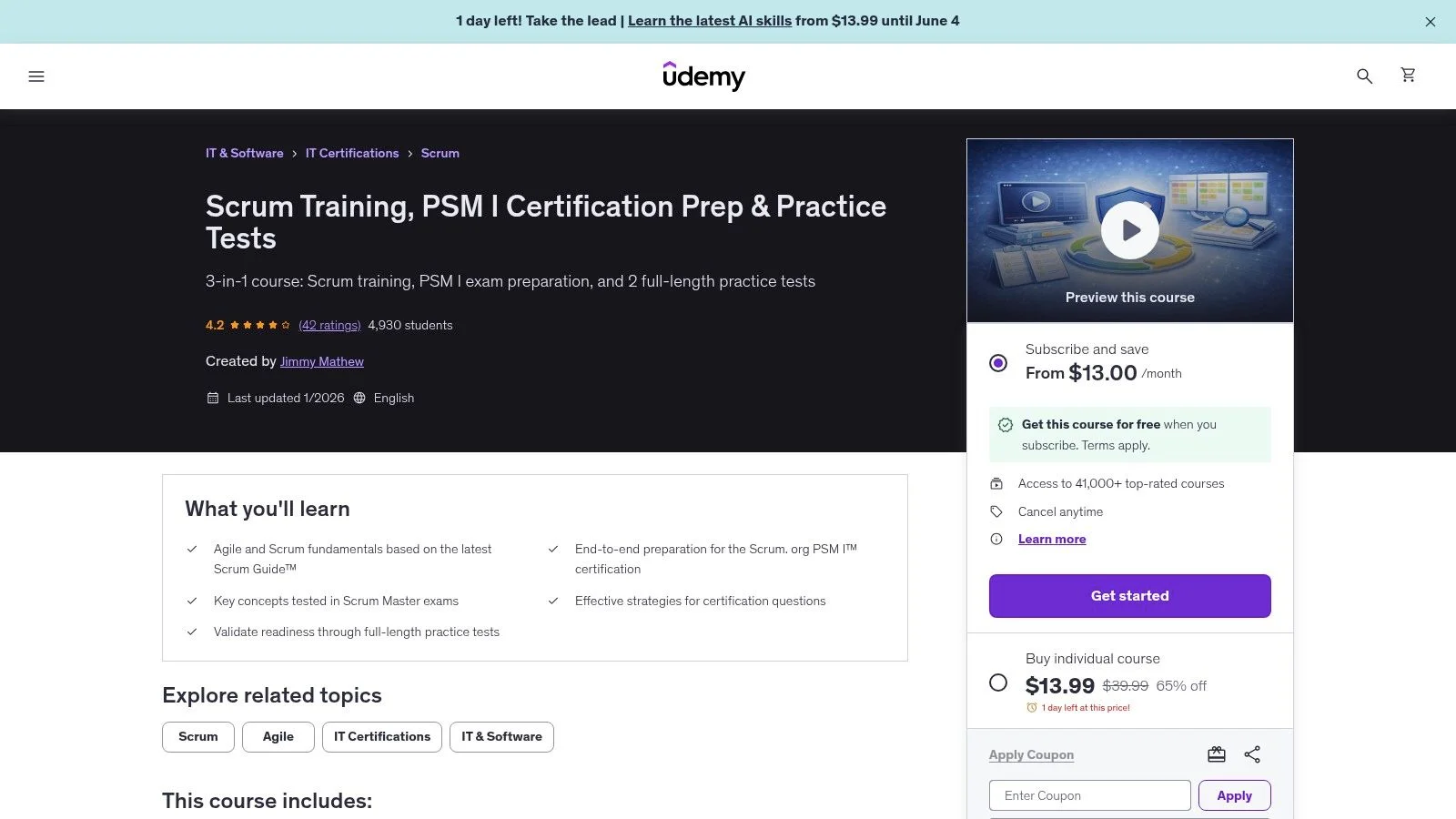
Some people don't need another giant bank of PSM I exam questions. They need a quick reset on Scrum fundamentals before they start drilling again. That's where Udemy's Scrum Training, PSM I Certification Prep & Practice Tests fits.
This one is efficient if your knowledge is patchy. Maybe you understand events but keep mixing up accountabilities. Maybe you've worked around Scrum teams but never locked the official language into memory. A bundled course can clean that up faster than jumping straight into more mocks.
Best use case
Use this after a weak diagnostic, not at the very beginning and not right before exam day. Watch the refresher content selectively. Don't sit through every lesson just because it's there. Target the sections tied to your missed questions, then go straight back into timed practice.
This resource is better for candidates who want structure than for candidates who already know the Scrum Guide cold. If you're already scoring well on official-style quizzes, a content-heavy bundle can become a time sink.
A smart pattern is:
- Patch weak fundamentals: Watch only the lessons tied to recurring misses.
- Validate immediately: Take a practice test right after the refresher, while the concept is fresh.
- Avoid passive study: If you're only watching videos and not answering questions, you're not preparing for the exam.
If you're building a broader long-term credential plan beyond Scrum, professional certification programs make more sense than treating each exam as a one-off project.
5. Mastery Exam Prep (PM Mastery) PSM I Practice Test and Simulator
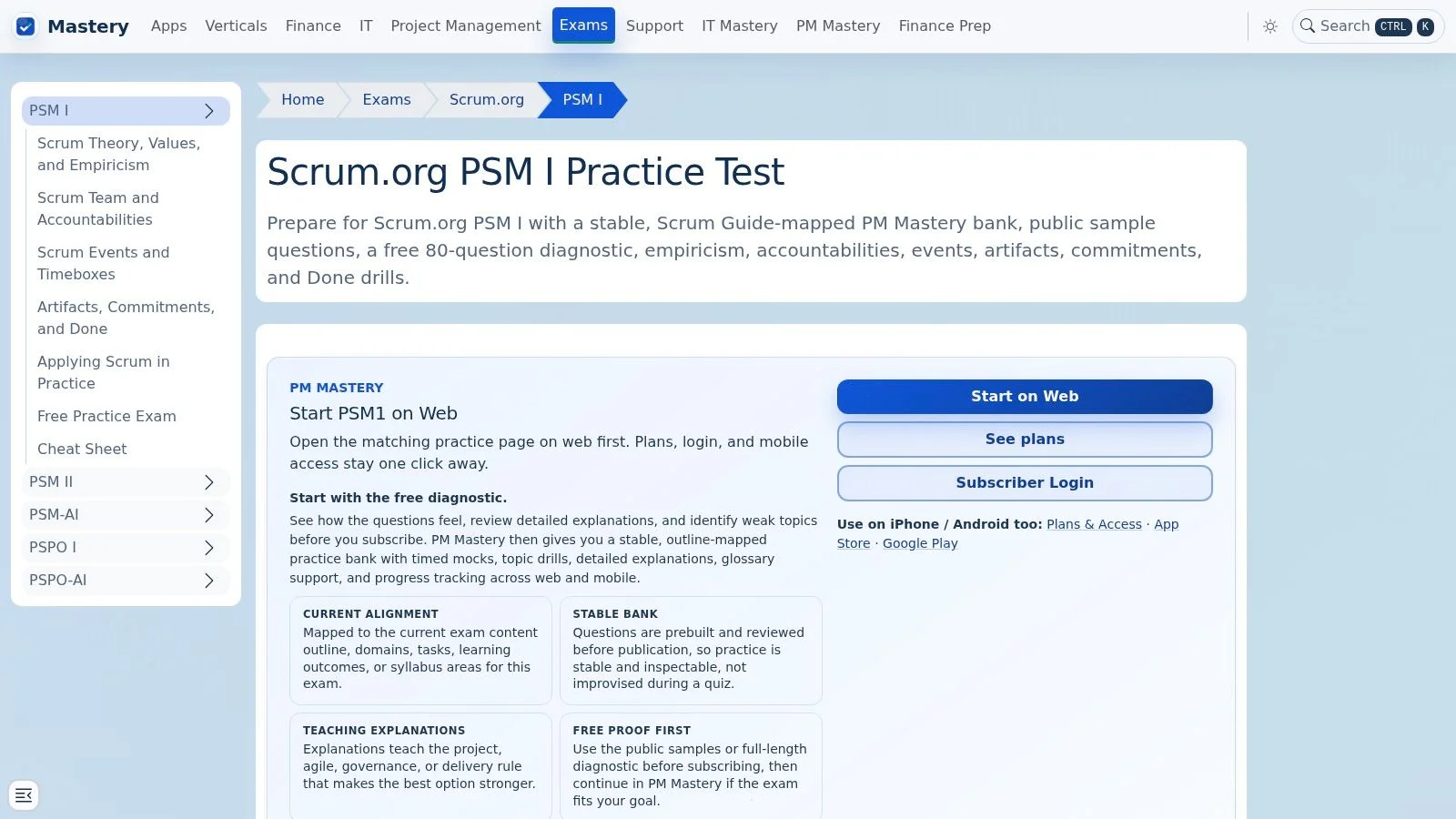
If you want a cleaner simulator experience than scattered web quizzes, Mastery Exam Prep for PSM I is a good option. It's built more like a modern exam tool than a hobby site, and that matters when you're trying to study efficiently.
The useful part isn't just the question delivery. It's the structure. Topic drills, mixed sets, and explanations make it easier to isolate whether you're missing questions because of one weak area or because your overall recall is unstable.
How to fit it into your study path
Use the diagnostic first. Then stop treating every miss the same. A wrong answer on Sprint Review purpose is different from a wrong answer caused by rushing through a multi-select item. Good simulators help you separate knowledge gaps from execution mistakes.
Independent prep commentary consistently points toward structured simulation plus review, including revisiting bookmarked items and practicing until scores stabilize, rather than one-off quiz exposure. That trend matches how serious candidates should use a tool like this.
“Realistic” practice matters only if you review your reasoning, not just your score.
This platform works best for:
- Targeted repair: Drill one domain repeatedly until the concept becomes automatic.
- Mixed-condition practice: Alternate topic sets with timed sessions so you don't become too comfortable.
- Explanation-driven learning: Study why an answer is right in Scrum terms, not because the platform says so.
It's not official, and full access requires payment. That's fine. By this stage, you're paying for structure and efficiency, not just more questions.
6. FluentScrum PSM I Preparation Quiz
FluentScrum is the extra bank you use to avoid overfitting. That's its value. Once you've spent too much time with the same official and near-official pools, your score can look better than your real readiness. A separate bank helps break that illusion.
This resource is web-based and simple, which is exactly why it works well as a supplemental tool. You can jump in quickly, answer a set, and test whether your reasoning transfers to unfamiliar wording.
Where to place it
Don't make FluentScrum your main engine. Use it after your core resources are already in place. Its job is to diversify exposure, not define your preparation strategy.
The site advertises up to 240 questions and multiple difficulty levels, which gives you enough variation to challenge recall without rebuilding your whole routine around one platform. Use that variety to check whether you still understand Scrum when the phrasing changes.
Try this pattern:
- Use short bursts: Run compact sessions when you have limited time and want fresh wording.
- Stress-test confidence: If your scores collapse outside your favorite bank, you've been memorizing.
- Review by concept family: Group misses into roles, events, artifacts, commitments, and empiricism.
This is the kind of tool that becomes valuable late in prep. Early on, it can distract you. Late in prep, it keeps your thinking honest.
7. PSMJourney Online Simulator and Flashcards
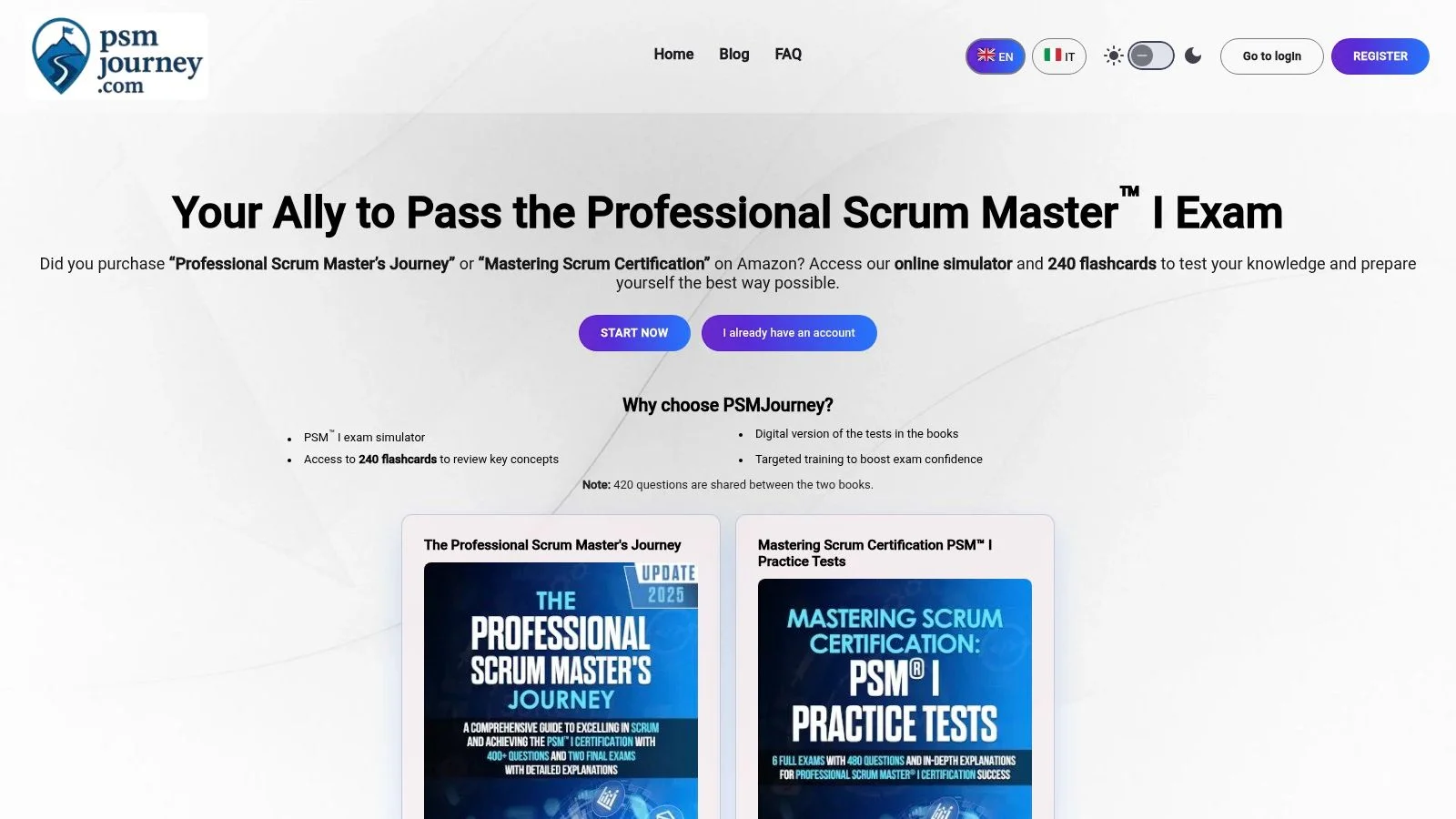
If you learn best through a guided path instead of scattered online practice, PSMJourney is worth considering. It combines an online simulator with flashcards and companion books, which gives you a more deliberate study flow.
That combination suits people who remember better through repeated written reinforcement. Flashcards won't replace scenario practice, but they can sharpen exact terminology and help lock in distinctions that PSM I loves to test.
Best for structured learners
PSMJourney is strongest when you already know you prefer reading plus repetition. If books help you organize concepts and online practice helps you test them, this setup can work well. If you hate book-based study, skip it and use a simulator-first tool instead.
A documented pass discussion on Scrum.org described one successful candidate finishing in 45 minutes and another recommendation to keep practicing open assessments until scores reach 95 to 100 percent. That kind of benchmark matters because it shows how prepared strong candidates aim to be before they sit the exam.
Use PSMJourney like this:
- Read for clarity: Use the books to settle concepts you keep missing in question banks.
- Use flashcards for precision: Drill definitions, commitments, and accountability distinctions.
- Finish with simulator runs: Move from recall to exam-style application before test day.
For some candidates, this is the missing piece because it turns study into a routine instead of a random collection of tabs.
PSM I: Top 7 Practice Exam Comparison
| Product | Implementation complexity | Resource requirements | Expected outcomes | Ideal use cases | Key advantages |
|---|---|---|---|---|---|
| Scrum.org Open Assessments (official) | Very low, simple web quizzes | Free web access; Scrum Guide familiarity | Calibrate to PSM I style; quick readiness checks | Daily warm-ups, timing practice, final calibration | Official question style, free, immediate scoring |
| Mikhail Lapshin Scrum Quizzes | Low, web-based question bank | Free web access; self-study time | Volume practice; identify weak areas and traps | Drill fundamentals and common exam pitfalls | Large bank, learning & timed modes, instant explanations |
| Udemy PSM I Practice Tests: 5 Full Exams | Low–medium, purchase then use Udemy test engine | One-time paid purchase; Udemy account; device | Realistic full-length simulation; build timing and stamina | Rehearse exam pacing and endurance with multiple mocks | Five 80‑question exams, current content, realistic pacing |
| Udemy Scrum Training, PSM I Certification Prep & Practice Tests | Low–medium, video plus tests on Udemy | Paid course; video time investment | Content refresh plus practice; basic exam preparedness | Newcomers needing a concise review plus practice tests | Combines fundamentals training with timed exams |
| Mastery Exam Prep (PM Mastery) – PSM I Simulator | Low–medium, web/mobile platform with analytics | Free diagnostic; subscription for full access; apps | Detailed explanations, analytics, targeted improvement | Track progress, target weak domains, mixed drills | Deep explanations, domain mapping, cross‑platform access |
| FluentScrum – PSM I Preparation Quiz | Very low, lightweight web quiz interface | Web access; small question bank (up to 240 Qs) | Broaden question exposure; quick practice sessions | Supplemental practice to diversify prep sources | Simple UI, multiple difficulty levels, quick to start |
| PSMJourney – Online Simulator and Flashcards | Low–medium, simulator tied to books | Purchase companion books or simulator access; flashcards | Structured book-plus-simulator learning; concept reinforcement | Learners who prefer guided reading with online practice | Book-aligned study path, 240 flashcards, multiple simulations |
Your Next Steps to PSM I Certification
You don't need more random resources. You need the right sequence.
Start with Scrum.org Open Assessments because they tune your brain to official wording. Then move to a high-volume bank like Mikhail Lapshin or a supplemental option like FluentScrum to expose weak areas and stop yourself from relying on memory. After that, run full simulations through a Udemy mock package, Mastery Exam Prep, or a structured path like PSMJourney so you can answer under time pressure without losing accuracy.
The public prep conversation points in a clear direction. Candidates increasingly focus on timing, answer elimination, repeated rehearsal, and realistic mock conditions instead of passive reading alone, as noted in this discussion of realistic PSM I practice behavior. That's the right shift. PSM I doesn't reward vague familiarity. It rewards precise understanding applied quickly.
Here's the no-nonsense version of the plan:
- Phase one: Read the Scrum Guide repeatedly and use official open assessments until the language feels natural.
- Phase two: Add broader question banks and track every miss by concept.
- Phase three: Run realistic timed mocks and review wrong answers in clusters, not one by one in isolation.
- Phase four: Sit the exam only when your performance is stable, not when you “feel ready.”
If you want a more organized way to study across Scrum and other certifications, a platform with progress tracking, structured review, and adaptive study flow can save you time. That's where MindMesh Academy fits. It's useful if you want one place to manage preparation instead of juggling documents, notes, and quiz sites.
Pass the exam, yes. But more vital still, learn Scrum well enough that the right answer is obvious before you even read the options twice.
If you want a smarter way to prepare for certifications without wasting time on scattered resources, MindMesh Academy offers structured study paths, progress tracking, and concept-first exam prep designed to help you pass and retain what you learn. Discover how MindMesh Academy can support your journey to professional certification on our certifications page.

Written by
Alvin Varughese
Founder, MindMesh Academy
Alvin Varughese is the founder of MindMesh Academy and an enterprise architecture leader. An electrical engineer by training, he moved from factory automation in South Africa to cloud architecture at GE Appliances and Humana (Fortune 50), and holds 20 professional certifications including AWS Solutions Architect Professional, Azure DevOps Engineer Expert, and Microsoft Agentic AI Business Solutions Architect. He built MindMesh Academy after interviewing too many highly certified candidates who couldn't answer basic questions: the goal is prep that makes you better at the job, not just able to pass the exam.