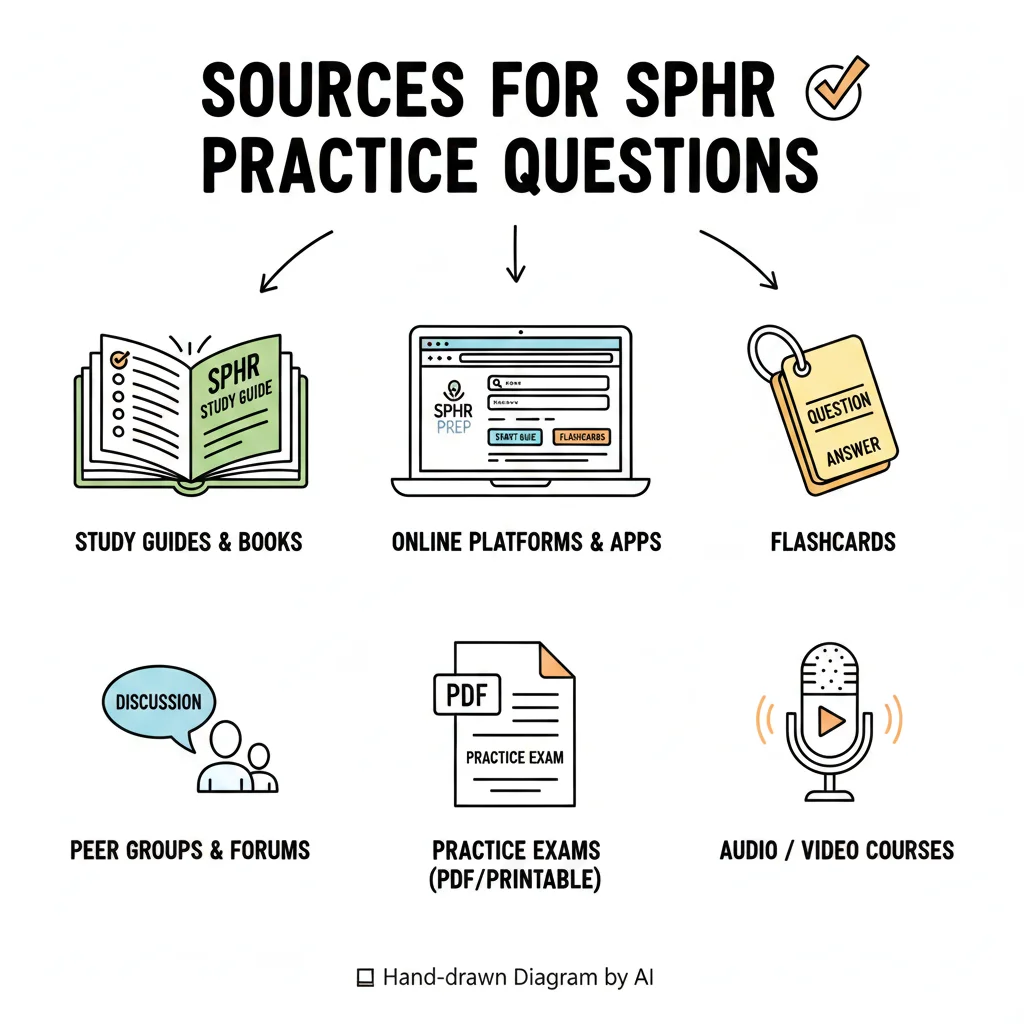
Top 7 Sources for Practice SPHR Questions (2026)
Top 7 Sources for SPHR Practice Questions
You're staring at a question with four plausible answers. None of them are obviously wrong. The prompt isn't asking for a definition or a legal citation. It's asking for the best next move in a messy business situation where talent, risk, leadership, and organizational goals all collide.
That's the SPHR exam in a sentence.
Practice SPHR questions matter most when they train judgment, not recall. The exam rewards senior-level thinking. You need to decide what an HR leader should do first, what issue carries the biggest organizational risk, and which answer aligns with strategy rather than just policy. The official exam format also sets the bar for pacing and endurance. HRCI's SPHR exam contains 140 total questions, including 25 unscored pretest items, with 2.5 hours to complete the exam and a passing score of 500 on a 100 to 700 scaled score. Good practice materials should prepare you for that kind of time pressure and decision quality.
The sources below aren't just ranked by popularity. They're ranked by use case. Some are better for stamina. Some sharpen strategic reasoning. Some are best saved for the final reality check before test day.
1. HRCI Official SPHR Practice Exams
If you want the closest thing to exam-day logic, start with the HRCI Official SPHR practice exams. This is the source I'd treat as calibration, not volume training. You use it to learn how HRCI frames trade-offs, what “best” looks like in their wording, and how aggressive you need to be with pacing.
The timed mode matters because SPHR questions can look simple until you notice two answers are both technically defensible. That's where official wording helps. It trains you to see what the exam writer thinks is most strategic, not just compliant.
Best use case
Use the official set late in your prep cycle, not at the beginning. If you burn through it too early, you lose your cleanest benchmark.
A practical sequence looks like this:
- Use untimed mode first: Review rationales slowly and identify whether your misses come from content gaps or decision-order mistakes.
- Save timed mode for a final readiness check: Take it when you're close enough to test day that the result will influence your plan.
- Study the phrasing: HRCI's style often rewards the answer that protects the business while still reflecting sound HR practice.
Practical rule: If a third-party bank makes you feel smart but the official set feels harder, trust the official set.
The trade-off is obvious. You won't get endless repetition here. You're paying for fidelity, not sheer quantity. That's why I like pairing this with broader drilling from other providers, then using the official exams as the final filter. If you already use MindMesh Academy's certification prep resources for other exam workflows, bring the same discipline here: track misses by pattern, not just by topic.
2. HRCP SPHR and PHR Program
HRCP's SPHR program is for the candidate who doesn't need motivation but does need structure. If your biggest risk is inconsistency, this platform solves that better than most. The study schedules and built-in progression make it easier to keep moving when work gets busy.
What separates HRCP from lighter question banks is density. The material feels traditional, sometimes even heavy, but that's not always a drawback. For senior HR professionals, the challenge usually isn't finding more content. It's forcing yourself to work through enough nuanced questions to build pattern recognition.
Where HRCP earns its place
HRCP is strong when you need to do two things at once: review content and pressure-test judgment. I wouldn't call it the sleekest experience, but I would call it useful.
- For disciplined prep: The structured schedules help if you want a set path instead of building your own.
- For harder-than-comfortable practice: Dense explanation style can help you slow down and understand why a seemingly reasonable answer still isn't the best one.
- For domain cleanup: Progress tracking helps when you know you're weaker in one part of the blueprint but keep avoiding it.
It's not the cheapest route, and the interface won't win points for modern design. Still, a lot of SPHR prep fails because candidates mistake casual repetition for real readiness. HRCP pushes you past that. If you like to prepare for various IT certifications with a mapped study plan rather than random quizzes, you'll probably appreciate this format.
Don't use HRCP as background reading. Use it as assigned work. That's when it pays off.
3. Distinctive HR SPHR Certification Preparation
Distinctive HR has long been part of SPHR prep conversations for a reason. Its value isn't that every question perfectly mirrors the official exam. Its value is that it pushes you to think like a senior HR leader making business calls under pressure.
That distinction matters. Some practice SPHR questions are good because they resemble the exam. Others are good because they strengthen the muscle the exam tests. Distinctive HR leans into the second category.
Best for strategic reasoning
If your instinct is to answer from a compliance-first perspective, this program can help rebalance your thinking. SPHR often asks you to prioritize organizational impact, leadership alignment, risk management, and long-term consequences. Distinctive HR tends to support that kind of reasoning.
I especially like it for candidates who say things like, “I know the content, but I keep choosing the second-best answer.” That usually means the problem isn't recall. It's executive judgment under test conditions.
A few tactical ways to use it well:
- Review explanations out loud: Force yourself to explain why the right answer is best, not merely acceptable.
- Flag recurring logic traps: Watch for patterns such as acting too quickly, solving too narrowly, or choosing tactical fixes when the scenario calls for strategic intervention.
- Use live instruction if you need pressure: Some people improve faster when they can hear someone walk through the hierarchy of decision-making.
The downside is cost, especially if you're already paying for another major prep tool. And because it isn't the exam maker, you still need a final alignment check elsewhere. But as a reasoning tool, it's one of the stronger complements to official material.
4. Pocket Prep SPHR Question Bank
Pocket Prep is the tool I'd recommend for consistency. Not because mobile questions are magically better, but because the best question bank is often the one you'll open every day. For busy HR leaders, convenience is a real study feature.
This platform works well when your schedule is fragmented. You can answer a short set between meetings, during a commute, or while waiting for a call to start. That makes it useful for keeping the exam active in your head without needing a full study block.
What it does well
Pocket Prep is habit-forming. That's its edge.
- Short sessions stay productive: Quick drills help reinforce concepts and expose weak areas before they solidify.
- Analytics support targeted review: If one domain keeps dragging down performance, you can stop pretending the issue will fix itself.
- Explanations encourage immediate correction: You don't have to wait until the weekend to understand why you missed something.
The limitation is depth. Mobile-first practice can become too transactional if you let it. Some questions may feel more direct and less layered than the most challenging SPHR scenarios. That doesn't make the tool weak. It just means you shouldn't rely on it alone for advanced decision-making practice.
Use Pocket Prep for frequency, not for your final confidence signal.
I like it in the middle of a prep plan. Build your daily streak there, then use a heavier source for long-form reasoning and a more official-style source before exam day.
5. Mometrix SPHR Online Course and Free Practice Test
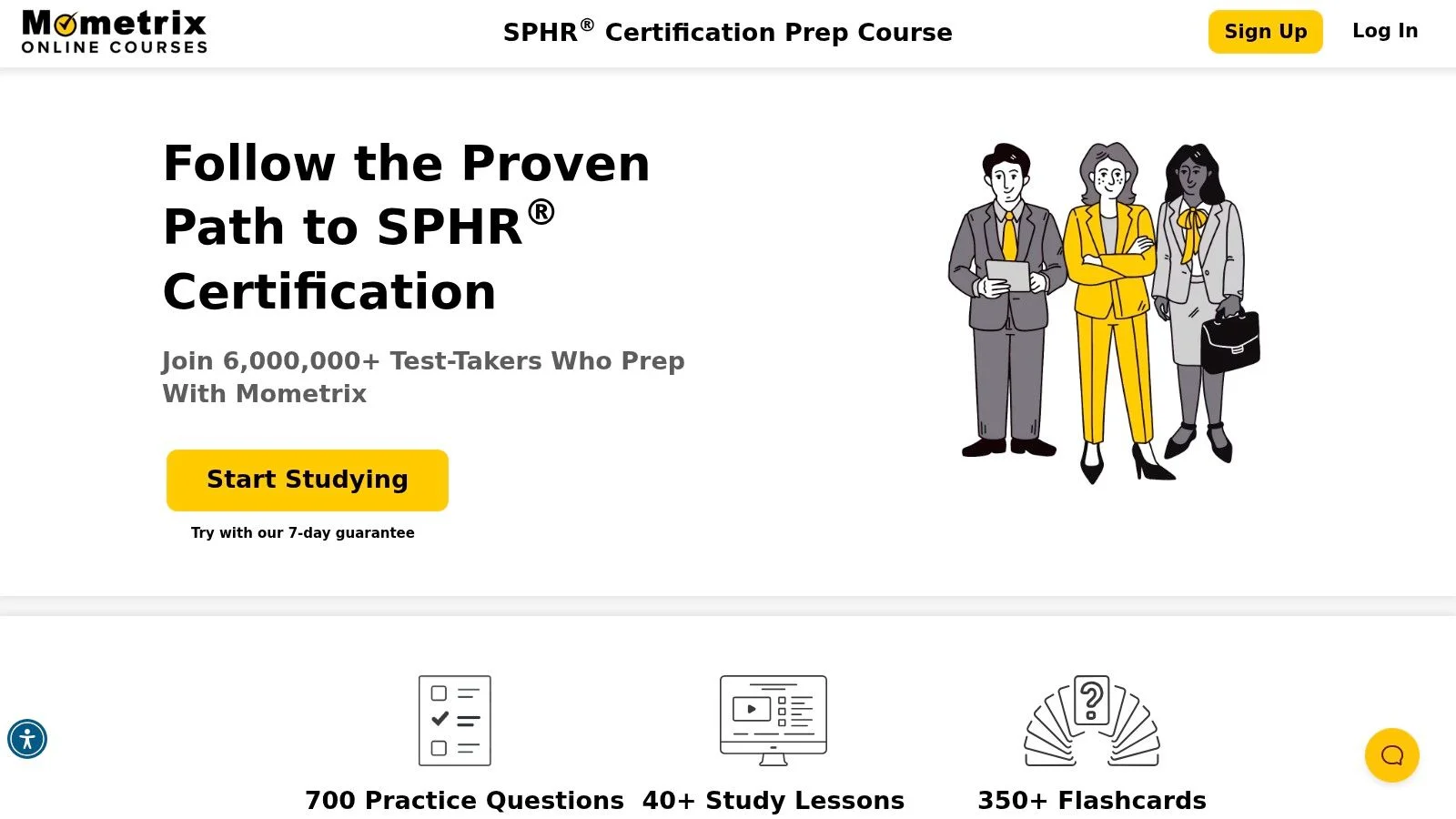
Mometrix's SPHR course is a practical middle-ground option. It gives you both review material and a healthy amount of practice, which is useful if you don't want to patch together separate products immediately. I tend to recommend it for candidates who still need structured content refresh, not just question repetition.
Its free practice test is also useful for a low-friction start. Before spending heavily, it helps to see whether the tone and difficulty feel right for you.
Best for blended review
Mometrix works best when your prep problem is mixed. Maybe you know employee relations well but feel rusty on broader strategic topics. Maybe you've been away from formal testing for years and want explanations alongside practice. This kind of all-in-one setup handles that transition better than a pure question app.
It's also the source tied to the exam-format benchmark already noted earlier, which makes it a helpful reminder that pacing is part of the test, not an afterthought.
A smart way to use it:
- Start here if you need re-entry: Lessons plus questions reduce the friction of getting back into study mode.
- Use full-length exams to rehearse pacing: Don't only do topic quizzes.
- Validate your readiness elsewhere: Third-party style can still drift from official phrasing, so confirm with a more exam-authentic set near the end.
If you're used to certification workflows that combine guides and practice tests, the same logic applies here. Content review helps, but the primary value comes from using practice questions to expose how you think.
6. Exam Edge SPHR Practice Test Bundles
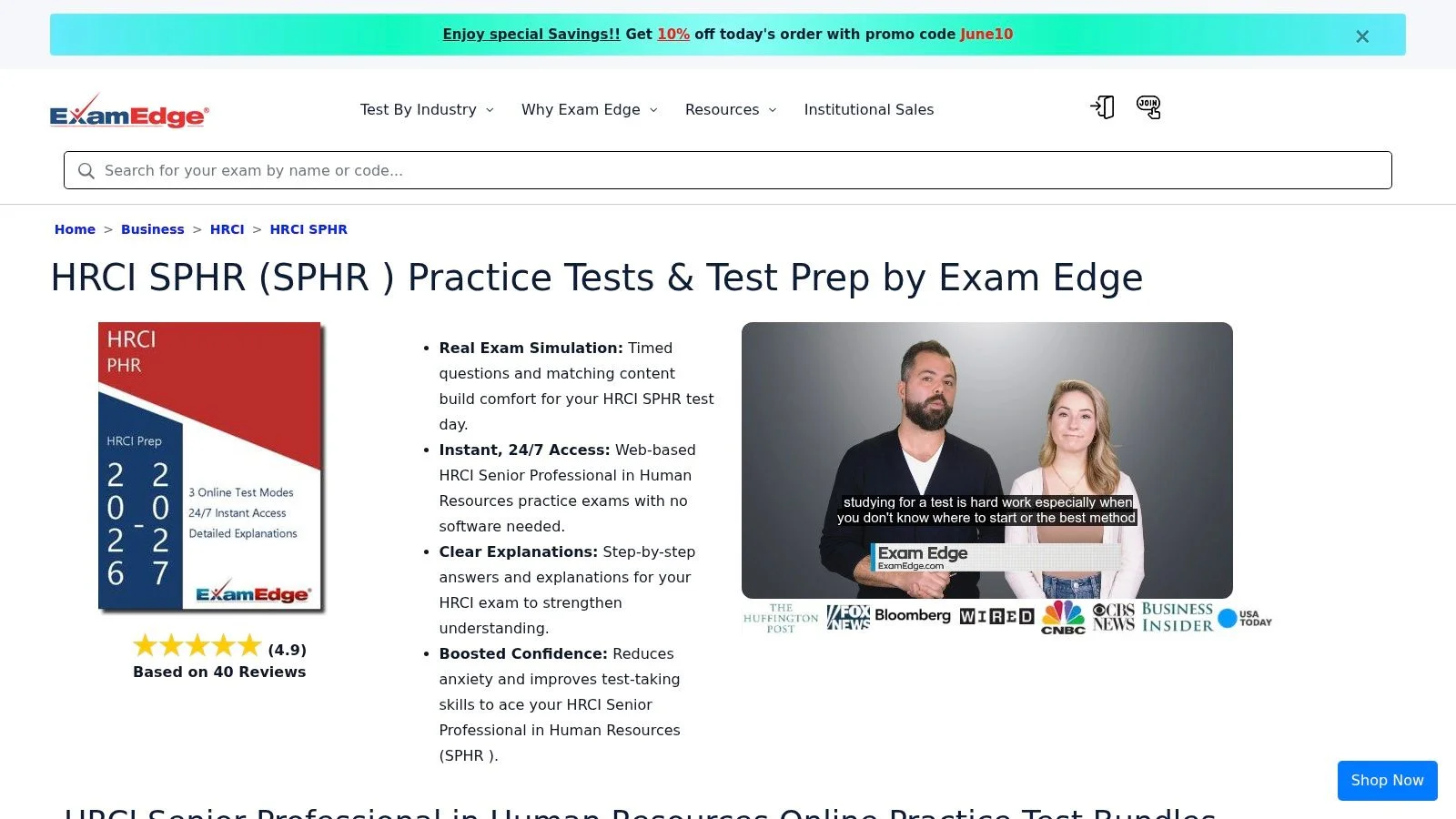
If your main issue is endurance, Exam Edge deserves attention. This is the volume play. You use it when you need repeated exposure to full-test conditions, not when you're chasing the most polished interface.
That sounds less exciting than strategy coaching, but stamina is a real part of SPHR performance. Late-question fatigue changes how people read. They miss qualifiers. They rush past the business context. They pick the first defensible answer instead of the best one.
Best for pacing and repetition
Exam Edge is useful when you need to train timing discipline into your process. That means practicing how long you'll stay with a tricky question, when you'll mark and move, and how you'll protect focus through an extended session.
Here's where it shines:
- Repeated full-test exposure: Good for learning how your concentration holds up over time.
- Timed and untimed flexibility: Useful if you want one pass for reasoning and another for pacing.
- Domain analytics: Helpful for spotting whether fatigue hits certain areas harder than others.
The trade-off is alignment. High-volume banks often vary more in wording and feel than official products. That's normal. I wouldn't reject the tool for that reason. I'd just pair it with something more exam-authentic once your stamina is built.
When a candidate says, “I knew the material but ran out of sharpness,” I think about tools like Exam Edge before I think about more notes.
7. HRStudyPro SPHR Practice Exams and Question Bank
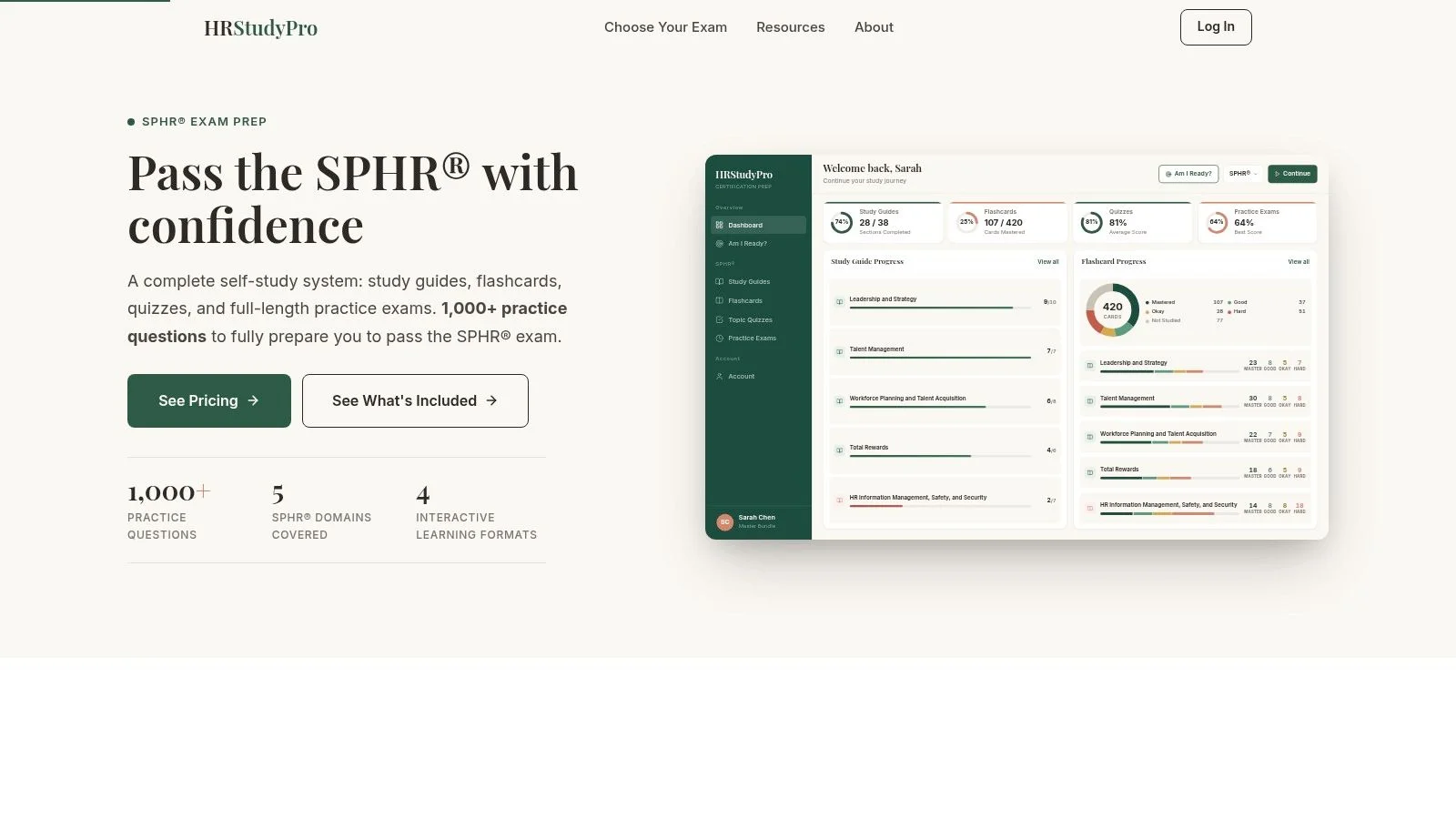
HRStudyPro is one of the more focused options if what you want is a dedicated bank of practice SPHR questions without paying for a lot of extra teaching content you may not need. That makes it attractive for experienced HR professionals who already know the subject matter and need more scenario work.
Its positioning around scenario-heavy questions is the right instinct for SPHR prep. The exam rewards candidates who can sort through competing priorities and choose the strongest first move. A bank that keeps bringing you back to “best action first” logic can be valuable if you've already covered the basics elsewhere.
Who should use it
HRStudyPro makes the most sense for the self-directed candidate. If you can build your own study rhythm and don't need much hand-holding, a focused question bank can be efficient.
A few situations where it fits well:
- You already have a textbook or course: Add a question-heavy platform instead of buying duplicate lessons.
- You want more SPHR-specific drilling: General HR prep often feels too broad or too junior.
- You prefer long-term access: Some candidates study in waves around work obligations and don't want a tight clock on usage.
The caution here is brand maturity. Established providers usually have more market visibility and community feedback. That doesn't automatically make a newer platform weaker, but it does mean you should evaluate the explanations carefully and compare your performance against at least one other source.
Top 7 SPHR Practice Question Providers Comparison
| Product | Implementation Complexity | Resource Requirements | Expected Outcomes | Ideal Use Cases | Key Advantages |
|---|---|---|---|---|---|
| HRCI Official SPHR Practice Exams (Timed + Untimed Bundle) | Low, simple timed/untimed use | Moderate cost, web access, limited question count | High fidelity readiness; familiarity with official phrasing and domain weight | Final “vibe check” and calibration before test day | Official content; closest match to real exam style and scoring |
| HRCP – SPHR/PHR Program | Moderate, structured curriculum and schedules | Higher cost, multi-week time commitment, progress tracking tools | Thorough mastery; often tougher coverage than exam (over-prep) | Working professionals needing schedule and pass guarantee | Deep coverage, structured study plans, documented pass-guarantee |
| Distinctive HR (David Siler) – SPHR Prep | Moderate, self‑study or live class options | Higher cost (live adds schedule), mix of lectures and quizzes | Strong strategic reasoning and decision-making practice | Candidates seeking instructor guidance and strategy focus | Veteran instructor, emphasis on strategic reasoning |
| Pocket Prep – SPHR Question Bank | Low, mobile-first, quick sessions | Subscription cost, mobile/web access, large question volume | Improved recall, habit formation; rapid domain practice | On‑the‑go drilling and daily micro‑study | Large bank (~1,200 Qs), convenient app features and analytics |
| Mometrix – SPHR Online Course & Free Test | Low–Moderate, lessons plus practice exams | Monthly subscription, course lessons, sample free test | Balanced content review and sizable practice | Try-before-buy learners and moderate-depth review | Mix of lessons and practice; free practice test to sample quality |
| Exam Edge – SPHR Practice Test Bundles | Low, buy and take full-length tests | Low per-test cost, many full exams, no expiration | Build endurance, pacing and timing discipline | Stamina training and high-volume timed practice | High-volume full-length tests, flexible timing, competitive price |
| HRStudyPro – SPHR Question Bank | Low–Moderate, web platform focused on SPHR | One-time or bundle pricing, lifetime access on some tiers, web-only | Domain-weighted, scenario-heavy practice aligned to SPHR outline | Candidates wanting large, exam-focused bank with lifetime access | Large SPHR-specific bank, domain weighting, strong value per Q |
Creating Your Winning SPHR Practice Routine
The best practice plan doesn't come from finding one perfect source. It comes from matching each source to a distinct job. That's the shift most candidates need to make. Don't ask, “Which bank has the most questions?” Ask, “Which source sharpens the skill I'm weak in right now?”
Start with honest diagnosis. If you're inconsistent and keep skipping study sessions, use something frictionless like Pocket Prep to build daily repetition. If your issue is heavier reasoning, use HRCP or Distinctive HR to work through more strategic scenarios and explanations. If you need to build pacing and mental endurance, Exam Edge is a practical way to rehearse longer sessions. Then use the official HRCI practice exams near the end as your reality check.
That sequence matters. Third-party tools are great for volume and skill-building, but they can create false confidence if you never calibrate against the exam maker's style. The official set tells you whether your thinking is aligned where it counts most.
I'd also keep a simple miss log. Don't just record topics. Record error types. Did you choose the legally safe answer instead of the strategically best answer? Did you jump to implementation before diagnosis? Did you solve the manager's problem while ignoring business risk? Those patterns are often more predictive than domain labels.
For SPHR specifically, the same discipline applies. Measure, adjust, and keep your practice intentional.
Pass rates don't improve because someone answered more questions casually. They improve when candidates use practice questions to refine judgment, pacing, and decision order. That's how you turn studying into exam readiness.
Ready to solidify your certification prep? Explore MindMesh Academy's full range of certification resources and practice exams to build a strong foundation for your exam success.

Written by
Alvin Varughese
Founder, MindMesh Academy
Alvin Varughese is the founder of MindMesh Academy and an enterprise architecture leader. An electrical engineer by training, he moved from factory automation in South Africa to cloud architecture at GE Appliances and Humana (Fortune 50), and holds 20 professional certifications including AWS Solutions Architect Professional, Azure DevOps Engineer Expert, and Microsoft Agentic AI Business Solutions Architect. He built MindMesh Academy after interviewing too many highly certified candidates who couldn't answer basic questions: the goal is prep that makes you better at the job, not just able to pass the exam.