Pass Your Exam: Pharmacy Tech Certification Study Guide 2026
Your Study System for the Pharmacy Technician Certification Exam
You've probably done some version of this already. You open a browser tab for the PTCE, another for flashcards, another for pharmacy math, and within minutes, the task feels bigger than it did before. Drug names blur together. Federal rules feel dry. Math feels risky. If you're working full-time, the problem gets worse because your study plan has to compete with shifts, family, errands, and plain old fatigue.
That feeling doesn't mean you're behind. It means you need a system.
Many test-takers don't fail a certification exam because they're incapable of learning the material. They struggle because they study in a way that doesn't match how memory works. They reread. They highlight. They tell themselves they'll “study more this weekend.” Then the exam gets closer and the stress gets louder.
An effective pharmacy tech certification study guide should do something more useful. It should help you decide what matters most, how to practice it, and where to put your energy when your schedule is messy. If you're comparing options and trying to find your certification path, keep that standard in mind. The best guide isn't the one with the most pages. It's the one you can use consistently.
Your Starting Point on the Path to Certification
A learner came to me once with a binder full of notes, a phone packed with flashcard apps, and no clear plan. She'd been “studying” for weeks, but what she really had was scattered effort. One night she focused on drug suffixes. Another night she watched videos. Then she spent a lunch break trying random practice questions and got discouraged by the score.
That pattern is common.
What most candidates need first isn't more material. They need a way to reduce noise. The PTCE rewards organized thinking. Your prep should do the same. For official details, review the PTCB exam blueprint. That means using a study guide that matches the exam blueprint, gives you repeated question practice, and helps you spot weak areas instead of guessing.
What overwhelm usually means
When readers say, “I don't know where to start,” they usually mean one of three things:
- There's too much content: You're treating all topics as equally important, which makes every session feel unfinished.
- You're short on time: You can't sit for long study blocks, so progress feels fragmented.
- You don't trust your memory: You review something today and feel like it's gone tomorrow.
None of those problems are solved by cramming harder.
Practical rule: Don't start by asking, “How do I cover everything?” Start by asking, “What does this exam reward, and how can I train for that?”
A serious pharmacy tech certification study guide should help you build recall, not just recognition. It should push you to retrieve information from memory, answer timed questions, and review mistakes with purpose. That's how you turn a giant pile of topics into a manageable routine.
What your prep should feel like
Good exam prep feels structured, not dramatic. You should know what you're studying this week, why it matters, and how you'll check whether it's sticking. Some sessions will be short. Some will feel easy. Some will expose gaps. That's normal.
What matters is that your system keeps working even on busy days.
Decoding the Pharmacy Tech Certification Exam
You get home after a shift, open your study guide, and freeze for a second. Drug names, law, safety, processing, math. It can feel like you are staring at a warehouse shelf with no labels. The first job is not to memorize faster. The first job is to identify the bins.
The PTCE is a standardized national exam, which gives you an advantage. A local manager can value broad experience or personal judgment. A standardized test rewards alignment with a defined blueprint, steady retrieval practice, and consistent review. That makes exam prep less like guessing what a supervisor might ask and more like training for a route you can map.
According to Mometrix's summary of PTCE exam facts, the PTCE uses a passing scaled score of 1,400 on a 1,000 to 1,600 scale. That number matters for a simple reason. Your goal is performance at a defined level, not a vague feeling of “I think I know this.”
Why exam structure should shape your study system
Busy learners often lose time because they study by mood. On Monday they read about top 200 drugs. On Tuesday they skim law. On Thursday they do ten random questions. That feels productive, but it rarely builds retention.
A better approach treats the exam blueprint like a floor plan. You do not wander the building and hope you saw the right rooms. You assign time based on what is tested, return to those topics on purpose, and check recall under mild pressure.
That is also why good prep materials include lots of practice items and guided review resources. Strong candidates read, retrieve, correct, and revisit. If you want a quick example of how a focused reference can highlight what deserves repeated attention, look at Mindmesh Academy's study guide. The subject is different, but the study principle is the same. High-frequency content should appear again and again in your plan.
Where learners misread the exam
Workplace knowledge helps, but exam knowledge has sharper edges.
A technician may know how a pharmacy runs day to day and still miss questions because the test asks for precise recall, not general comfort. That gap creates a lot of frustration. You recognize the topic, but under timed conditions you cannot pull up the exact rule, term, or next step.
Three mistakes cause that problem over and over:
- Studying from familiarity: Rereading notes can make material feel known before it is actually retrievable.
- Using random practice too late: If you wait until the final week to test yourself, weak spots show up when there is little time to fix them.
- Ignoring patterns in missed questions: One wrong answer is a miss. Five wrong answers in the same area are a signal.
The PTCE rewards accurate recall under structure and time pressure.
That is why your study guide should function like a training system, not just a reference book. If you are balancing work, family, or inconsistent study windows, this matters even more. Short sessions can still work well when they are organized around retrieval, spaced repetition, and review of recent errors.
What to clarify before you study harder
Before you add more hours, make sure you are aiming those hours correctly.
| What to clarify | Why it matters |
|---|---|
| Exam blueprint | It shows which content areas are tested so you can assign time with purpose |
| Passing score scale | It gives you a defined target instead of relying on a vague sense of readiness |
| Practice format | It helps you train for timed recall, not just untimed recognition |
| Error review method | It turns missed questions into a list of skills to revisit in later sessions |
If this section clears up one thing, let it be this: the exam becomes easier to handle once you stop viewing it as a giant pile of facts. It is a defined target. Your job is to build a repeatable study system that fits real life and keeps bringing the right material back before you forget it.
Focusing on High-Yield Exam Topics
You finish a long shift, sit down to study for 30 minutes, and stare at a giant list of topics. Drug names. Math. Laws. Safety. Order processing. If all of it feels equally urgent, it becomes hard to decide what to do first. That is how busy learners lose time. The answer is not to study harder. It is to study in proportion to how the exam is built.
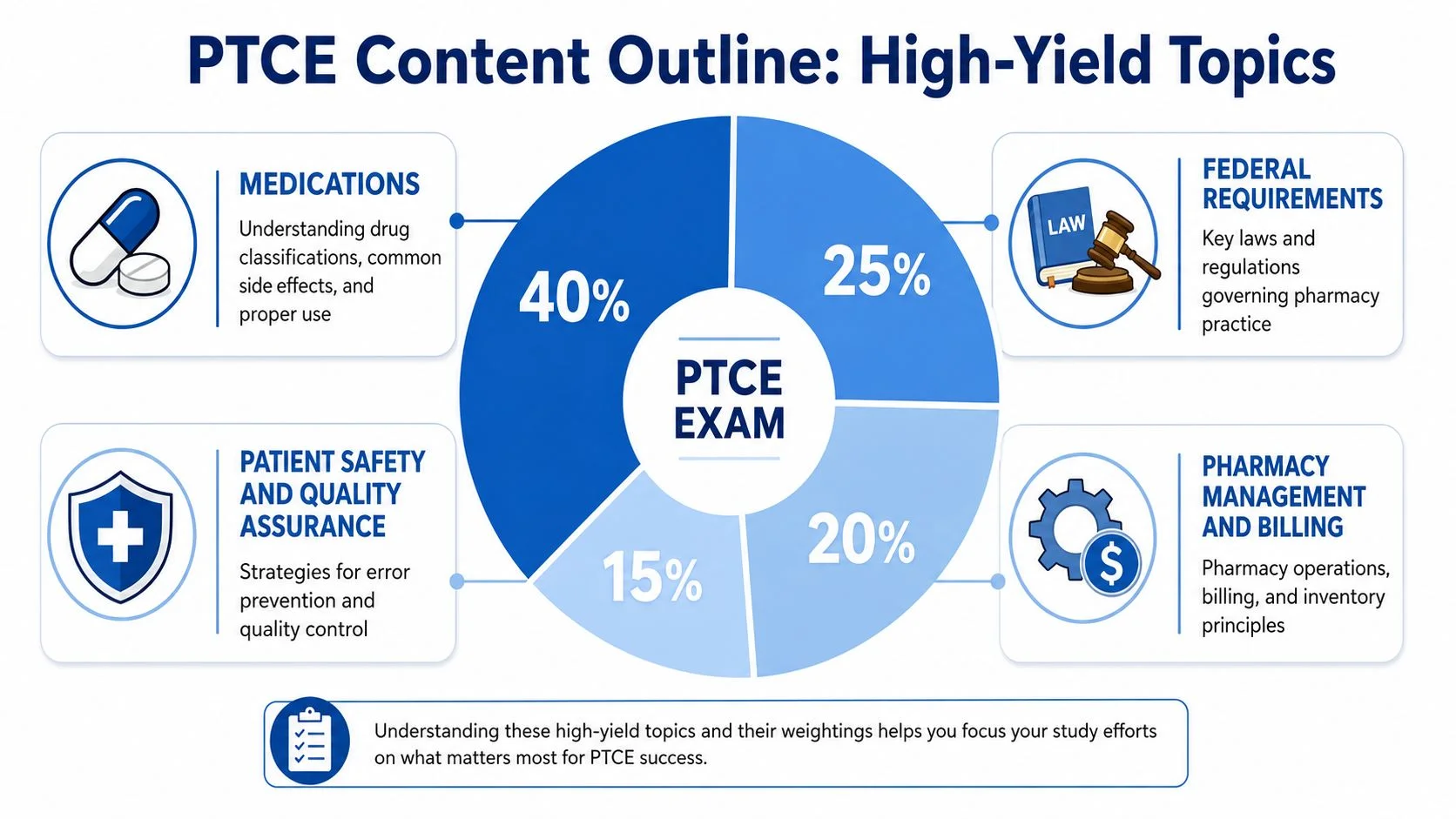
Independent PTCE prep coverage breaks the exam into four domains: Medications, Patient Safety and Quality Assurance, Order Entry and Processing, and Federal Requirements. It also notes that Medications accounts for 40% of the exam, as outlined in this PTCE domain guide from Pharmacy Tech Scholar. That weighting gives you a clear rule. Topics that appear more often on the exam should appear more often in your study rotation.
The domain that deserves the most attention
Medications should be part of your plan every week, and for many learners, every study day. Treat it like the main highway in your prep. Other topics branch off it, but this is the route you will travel most often.
That does not mean memorizing isolated lists until your eyes blur. It means building connected knowledge. A strong medication flashcard or note set ties together:
- Generic and brand names
- Drug class
- Common use
- Dosage form or route
- One safety clue or common warning
Those links matter because the exam rarely rewards a fact in isolation. It often asks whether you can recognize a medication in context. If you know metoprolol only as a name, your recall is fragile. If you connect it to class, use, and common safety concerns, retrieval becomes faster and more reliable.
Pharmacy math needs repetition, not panic
Math is another high-yield area because it tests process under pressure. Many learners avoid it until late in prep because it feels uncomfortable. That is a mistake. Short, frequent practice works better than occasional long sessions.
As noted earlier from the same PTCE prep source, pharmacy math review should include areas such as conversions, alligation, IV flow rates, BMI, BSA, and pediatric dose calculations. The list can look intimidating at first. What helps is treating math like skill practice, not reading material. You improve by writing setups, labeling units, and checking whether your answer makes sense before you calculate.
A useful rule for math is simple: if you cannot set up the problem, you do not know the problem yet.
The lower-weight domains still decide points
Patient safety, order entry, and federal requirements may take up less space than medications, but they are not side topics. They often test judgment. You may know a definition and still miss the question if you cannot identify what the situation is asking you to do.
For example, a law question may really be a classification question. A workflow question may test safety. A patient safety item may depend on catching the one detail that makes the prescription risky. That is why scenario practice matters here more than rereading notes.
A practical way to prioritize content
Use three study buckets so your limited time has structure.
| Priority bucket | What goes in it | How to study it |
|---|---|---|
| Daily rotation | Medications and pharmacy math | Spaced repetition cards, short calculation drills, mixed recall questions |
| Frequent review | Patient safety and order entry | Scenario questions, error logs, quick case analysis |
| Steady reinforcement | Federal requirements | Rule comparisons, self-quizzing, short review sets |
This approach works well for busy schedules because it removes the daily decision of what to study. You are not rebuilding the plan each night. You are running a system. Daily rotation keeps the biggest and stickiest topics active in memory. Frequent review strengthens applied reasoning. Steady reinforcement prevents law content from fading between sessions.
For a model of blueprint-based prioritization in another certification setting, see Mindmesh Academy's study guide. Different exam, same study principle. High-frequency topics need repeated contact over time.
What strong prioritization looks like in practice
A weak study guide gives every topic the same visual weight, so learners treat all content as equally testable. A stronger guide helps you separate three questions:
- What shows up most often?
- What do I keep missing?
- What requires repeated retrieval to stick?
That is the shift from collecting information to training for recall. If your schedule is tight, this matters even more. Fifteen focused minutes on medication patterns or math setup will usually help more than fifteen scattered minutes flipping through random pages.
The goal is not to cover everything with equal intensity. The goal is to give the most tested and most forgettable material the most deliberate repetition.
Crafting Your 4 to 12-Week Study Plan
A study plan should be realistic enough to survive your actual life. If the schedule only works in a perfect week, it isn't a plan. It's a fantasy.
One practical recommendation is to study for 100–150 hours over 8–12 weeks, with time allocated to mirror the exam blueprint: about 40% on medications, 26.25% on patient safety and quality assurance, 21.25% on order entry and processing, and 12.5% on federal requirements, based on CCI Training's PTCE study plan guidance. That approach is useful because it gives you a way to divide time according to exam emphasis instead of personal preference.
Choosing your timeline
Your best timeline depends on your baseline, your work schedule, and how much focused time you can protect.
Here's a practical way to think about the options:
- 4-week plan: Best if you already have a strong foundation and can study intensely.
- 8-week plan: Best for most working learners because it leaves room for repetition.
- 12-week plan: Best if you're rebuilding confidence, especially in math or medication knowledge.
If you're unsure, choose the slower plan. Most learners overestimate what they can retain in a short burst and underestimate the value of review.
How to divide your study time
If a domain carries more weight, it should appear more often in your schedule. That doesn't mean ignoring the others. It means you plan your week around uneven emphasis.
A simple weekly structure might include:
- Medication-heavy sessions several times each week
- Math practice in short, repeated drills
- Scenario-based review for safety and order processing
- Rule review for federal requirements
- One mixed practice block to train switching between topics
Build the week around repeatable actions, not motivation. Motivation comes and goes. A calendar stays put.
Sample 8-Week Pharmacy Tech Study Schedule
| Week | Primary Focus (Domain) | Secondary Topics | Weekly Goal |
|---|---|---|---|
| 1 | Medications | Light math review, study setup | Build your notes, flashcards, and baseline routine |
| 2 | Medications | Patient safety | Learn major classes and begin short recall drills |
| 3 | Patient Safety and Quality Assurance | Medications, math | Practice safety scenarios and review missed concepts |
| 4 | Order Entry and Processing | Math, medications | Translate sigs, work through workflow tasks, tighten calculation setup |
| 5 | Federal Requirements | Patient safety | Organize rule-based notes and practice classification questions |
| 6 | Medications | Mixed review | Strengthen weak drug classes and connect them to scenarios |
| 7 | Mixed Practice | Math, weak areas | Increase timed practice and clean up recurring misses |
| 8 | Final Review | All domains | Review weak areas, keep sessions lighter, protect sleep |
What an actual week can look like
Many readers think a study schedule has to mean long nightly sessions. It doesn't. A better plan uses different session types.
For example:
- Short session: flashcards, one math drill set, or federal rule recall
- Medium session: medication review plus practice questions
- Deep-focus session: mixed timed set and full mistake review
That matters because your brain doesn't perform the same way at all times of day. Matching the task to your energy helps you stay consistent.
If you want a broader example of planning principles that transfer well across certification exams, Mindmesh Academy certification prep shows the same core idea. The best schedule isn't the prettiest. It's the one that makes review, retrieval, and feedback unavoidable.
Don't make these planning mistakes
A few habits subtly ruin good plans:
- Front-loading everything: You study hard for one week and then fade.
- Skipping mixed review: You practice topics in isolation and get thrown off when they appear together.
- Leaving weak areas vague: “Need to review math” is too broad to act on.
Replace vague notes with specific repair tasks. “Review conversions” is better. “Redo conversion questions I missed and write the setup step first” is better still.
Smarter Study Techniques for Busy Schedules
This is the part most guides skip. They tell you what to study, then assume you have long, predictable blocks of time. Many learners don't. They study before a shift, after dinner, in a parking lot, on a lunch break, or when the house finally gets quiet.
That doesn't mean your prep has to be weak. It means your method has to be resilient.
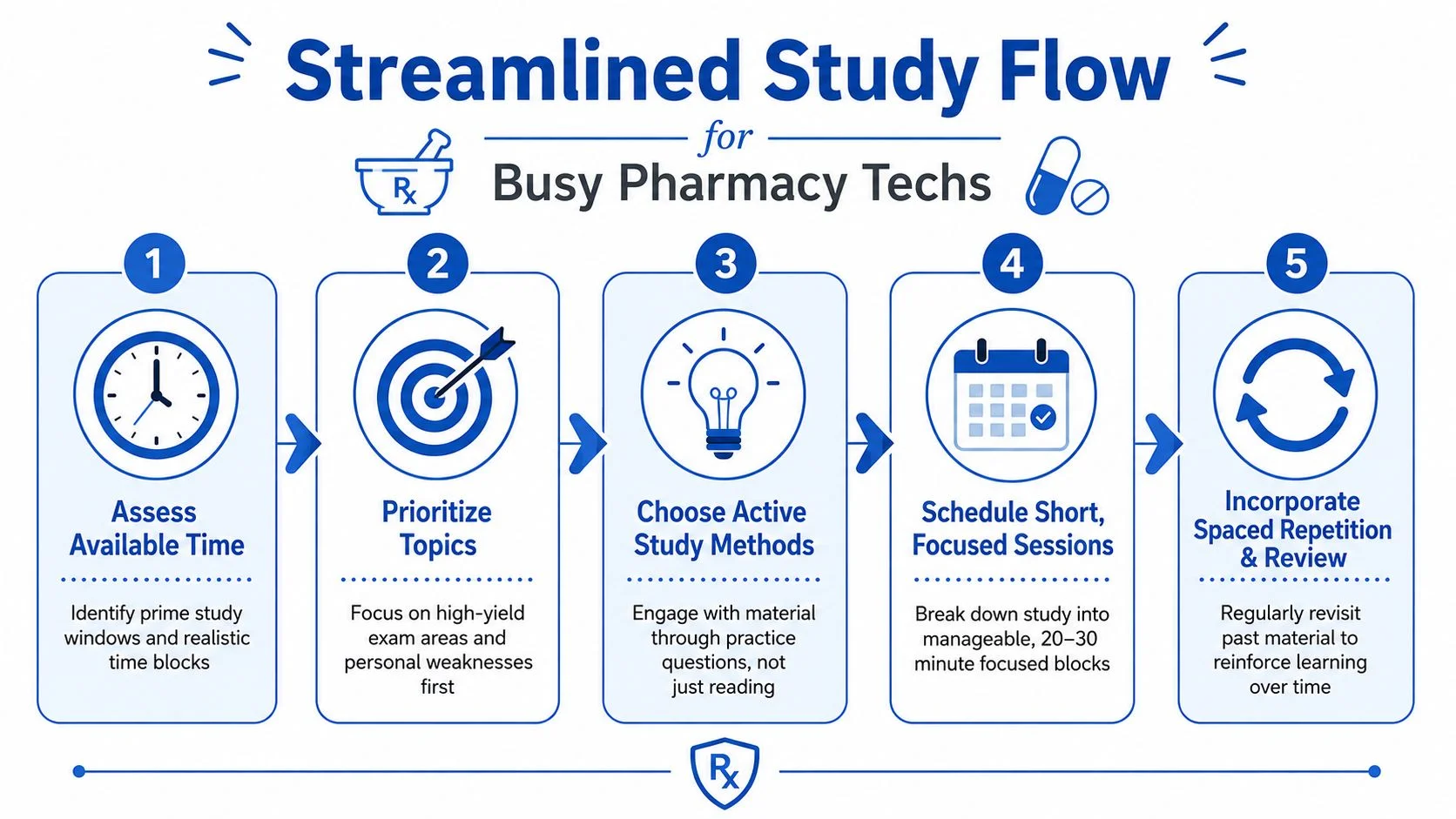
A better approach for learners with full-time jobs or irregular schedules is to use spaced repetition and short retrieval practice drills so retention can build even when study time is fragmented, as discussed in this medical certification study guide review from Medical Prep.
Use short sessions for the right kind of work
A tired brain can still do useful study. It just shouldn't be asked to do the hardest tasks.
Try splitting your prep this way:
- Low-energy windows: Review flashcards, recall federal rules, or redo familiar math setups.
- High-focus windows: Learn new medication classes, work multi-step calculations, or review missed mixed questions.
- In-between windows: Do a short quiz, then explain the answers out loud in plain language.
Learners often waste short sessions by trying to do deep work when they're drained. They then conclude the session “didn't count.” It counted. You just need to match the task to the moment.
Active Recall
Active recall means you pull information out of memory before looking at the answer. That's very different from rereading.
Instead of reading a card that says “What class is lisinopril?” and nodding when you see the answer, cover it and force yourself to answer first. If you miss it, then correct it. The struggle is part of learning.
Spaced Repetition
Spaced repetition means you revisit material over time instead of once in a large block. A drug class reviewed today, then revisited later, sticks better than one marathon session.
This is why short repeated sessions work so well for busy people. A few focused reviews spread across your week can outperform one exhausted cram session.
Teach-Back
If you can explain a concept clearly, you usually understand it better. If you can't, you've found a gap.
Try saying, out loud, “This medication matters because…” or “This law question is really asking me to identify…” That kind of plain-language explanation exposes weak understanding fast.
A topic isn't mastered when it looks familiar. It's mastered when you can retrieve it, apply it, and explain it.
A quick video can help reinforce that shift from passive review to active learning:
A study system for irregular shifts
If your schedule changes each week, stop trying to force a rigid daily plan. Use a menu system instead.
| Time available | Best task type | Example |
|---|---|---|
| Very short pocket of time | Recall drill | Review medication cards or one rule list |
| Moderate window | Practice and correction | Solve a few questions, then write why misses happened |
| Best focus window | Hardest material | New math, weak domains, timed mixed questions |
This gives you something to do no matter what kind of day you're having.
If you want a broader perspective on preparing for healthcare certifications, that resource is useful because it reinforces a simple truth: consistency beats drama. You don't need perfect conditions. You need repeatable habits.
What to do when you miss questions repeatedly
Repeated misses usually point to one of four issues:
- You don't know the fact yet
- You misread the question
- You know the fact but can't apply it
- You rushed and skipped a step
Write down which one happened. That turns frustration into a next action. “I'm bad at this” is not useful. “I keep missing law questions because I don't classify the rule before choosing an answer” is useful.
That's how a busy learner studies smarter. Not by finding more hours, but by making each hour teach something specific.
Approaching Test Day with Confidence
By the time test day arrives, your job isn't to become smarter overnight. Your job is to show what you already know without creating unnecessary friction.
That starts before the exam itself. The final stretch should feel calm and practical, not frantic.
In the final stretch
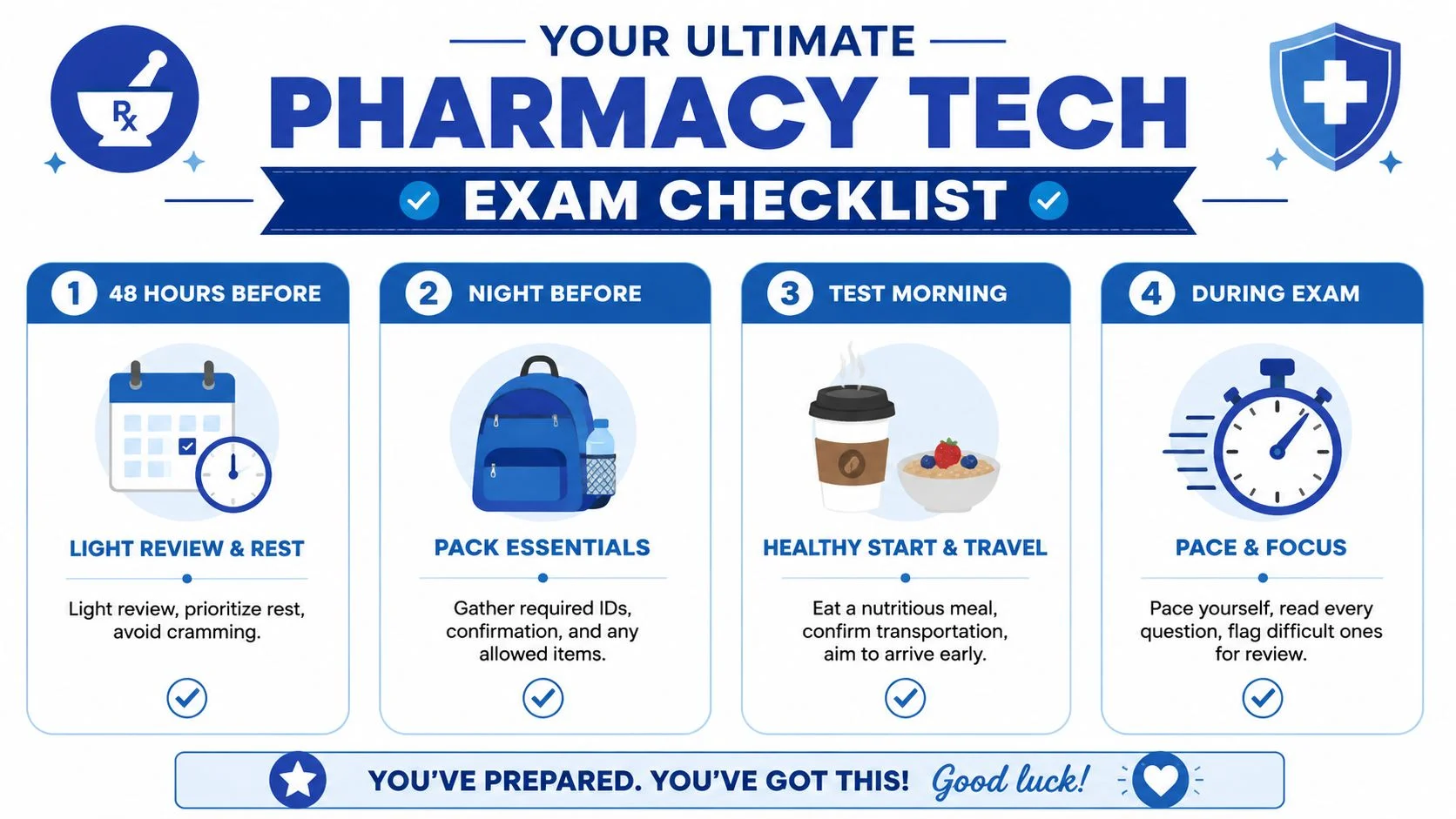
The last couple of days are for light review, not panic. You want your brain alert, not overloaded.
Use this checklist:
- Keep review light: Focus on familiar notes, not new material.
- Pack early: Gather identification and anything else you need the night before.
- Protect sleep: A tired brain makes avoidable reading mistakes.
- Plan your travel: Remove uncertainty about timing and arrival.
A lot of candidates hurt their performance by treating the final evening like a rescue mission. It rarely helps.
During the exam
When nerves rise, structure helps. Read carefully. Pace yourself. If a question feels sticky, don't let it drain your momentum.
A useful pattern is:
- Read the full question slowly.
- Identify what it's really asking.
- Eliminate wrong choices.
- Choose your best answer.
- Flag and move on if needed.
You do not need to feel calm to perform well. You need a repeatable process for what to do when you feel tense.
Common mistakes to avoid
| Mistake | Better move |
|---|---|
| Last-minute cramming | Do a brief review, then rest |
| Second-guessing every answer | Change only when you can name a clear reason |
| Getting stuck too long | Flag difficult items and return later |
| Rushing through easy questions | Slow down enough to catch wording traps |
One more point matters. If you hit a hard question early, don't turn it into a prediction about your whole exam. Hard questions happen. They don't mean you're failing.
Stay in the question in front of you. That skill alone protects a lot of points.
Your Path Forward to Certification
A strong pharmacy tech certification study guide does more than hand you a topic list. It gives you a way to work. That's the difference between anxious review and deliberate preparation.
The big ideas are simple. Learn the exam on its own terms. Put more time into high-yield content. Build a schedule that matches real life, not an ideal week. Use active recall and spaced repetition so your studying sticks. Review mistakes like they matter, because they do.
If you've felt overwhelmed, that doesn't mean you can't pass. It usually means you've been trying to carry too much at once without a system. Once you switch to a smarter process, the exam becomes more manageable. Still challenging, yes. But manageable.
Certification is not just a test of memory. It's a test of preparation, judgment, and consistency. If you approach it that way, you give yourself a much better chance to walk in prepared and achieve a passing result.
You don't need a perfect week to make progress. You need the next good study session, then another one after that.
If you're ready for structured exam prep, adaptive review, and retention-focused learning methods, explore how MindMesh Academy supports your certification goals. Our platform helps you study with purpose, track weak areas, and build a system you can stick with. Find your next certification path at MindMesh Academy.

Written by
Alvin Varughese
Founder, MindMesh Academy
Alvin Varughese is the founder of MindMesh Academy and an enterprise architecture leader. An electrical engineer by training, he moved from factory automation in South Africa to cloud architecture at GE Appliances and Humana (Fortune 50), and holds 20 professional certifications including AWS Solutions Architect Professional, Azure DevOps Engineer Expert, and Microsoft Agentic AI Business Solutions Architect. He built MindMesh Academy after interviewing too many highly certified candidates who couldn't answer basic questions: the goal is prep that makes you better at the job, not just able to pass the exam.