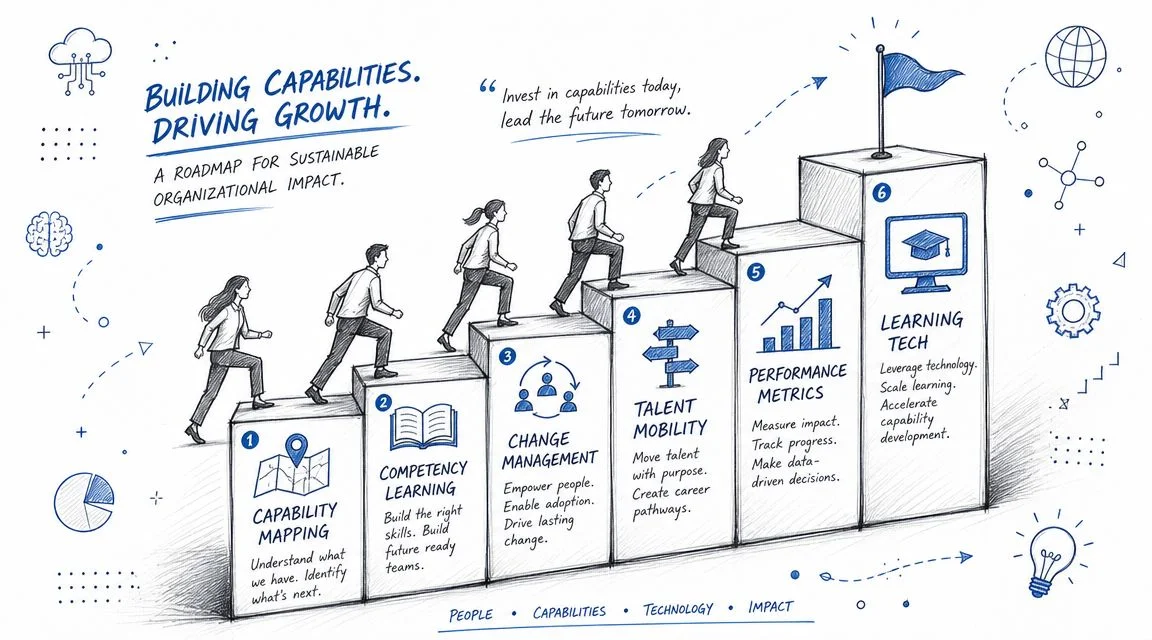
10 Organizational Development Strategies for Tech in 2026
10 Organizational Development Strategies for Tech Today
Your tech company adds engineers every quarter, rolls out new platforms every six months, yet still faces the same bottlenecks. Senior staff become accidental managers. Certification budgets get approved but remain unused. Teams ship fast, then stall because skills, structure, and leadership haven't scaled with the roadmap.
This is where organizational development strategies move beyond HR theory and become operating discipline. Organizational development, or OD, grew into a formal field built around planned, evidence-based change rather than ad hoc management fixes. Warren Bennis's 1969 framing of OD as a long-range effort to improve organizational problem-solving and renewal remains a widely cited milestone. Modern practice still follows a cycle of diagnosis, intervention, and evaluation, as outlined in this overview of OD's evolution and structure.
In tech companies, this matters because human challenges are often system problems. Burnout frequently traces back to unclear role design. Missed delivery targets often come from manager inconsistency. Low internal mobility usually means nobody built a visible path from junior admin to cloud engineer, or from a strong individual contributor to a team lead.
The good news: strong organizational development strategies are practical. You can map skills to roles, connect certifications to promotion criteria, build manager habits that support learning, and measure whether any of it changes engagement, retention, and performance. If you're trying to build a resilient technical workforce instead of just patching gaps as they appear, these ten strategies are where I'd start.
1. Competency-Based Development
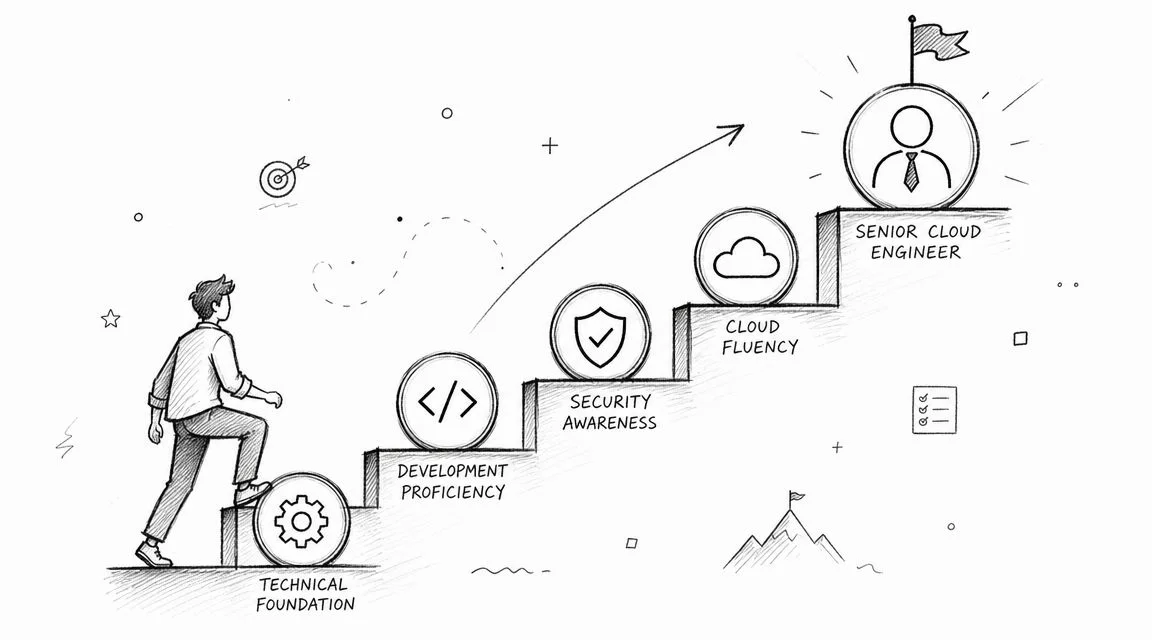
Competency-based development works because it replaces vague growth language with specific capability expectations. In tech, this means defining what a help desk analyst, cloud administrator, security engineer, or platform owner needs to know, then tying learning directly to those requirements.
Too many companies start with course catalogs. Better teams start with role architecture. They identify the work, the decisions, the tools, and the failure points in each role, then build development around those realities.
What this looks like in practice
An AWS path makes sense when it maps to cloud architecture responsibilities. CompTIA A+, Network+, and Security+ make sense when they support progression from entry-level support into infrastructure or cybersecurity work. ServiceNow training works best when admins and developers know which platform skills lead to broader ownership.
For technical learning, structured IT certifications can support that path when tied to real job expectations rather than treated as résumé decoration.
What works and what fails
What works is brutal clarity.
- Define observable skills: List the tasks and decisions that show competence in the role.
- Tie learning to advancement: Show employees what changes when they gain the skill.
- Assess regularly: Don't wait for annual review season to discover capability gaps.
What fails is using certifications as a proxy for capability without checking application on the job. Passing an exam can validate knowledge. It doesn't automatically prove someone can lead an incident, design a secure environment, or coach others through a migration.
Practical rule: If a certification can't be tied to a role, a project, or a promotion discussion, it probably won't change organizational performance.
2. Continuous Learning Culture
A learning culture isn't built by uploading courses into an LMS and sending reminder emails. In tech, it shows up in how teams plan work, how managers allocate time, and whether learning is treated as part of delivery or as an extracurricular effort after hours.
This matters more now because digital change is common, not exceptional. An estimated 90% of organizations are undergoing some form of digital transformation, which means tech organizations can't rely on static skill sets.
Turn learning into part of the operating rhythm
The best teams I've seen do three things consistently. They protect learning time, normalize peer teaching, and reward visible progress. That might mean study blocks before sprint close, internal Slack channels for exam prep, or short demos where newly certified staff explain how a concept applies to current systems.

A platform like MindMesh Academy fits best when it supports ongoing access to updated materials, visible progress tracking, and adaptive paths for learners who aren't all starting from the same baseline.
The trade-off leaders have to accept
Continuous learning slows people down in the short term. That's real. If you give engineers protected time to build cloud, security, or ITSM capability, some delivery work moves more slowly.
But the opposite choice has a cost too. Teams stay dependent on a few experts, adoption drags during platform changes, and managers keep solving the same skill problem with hiring requests. A learning culture is expensive if you measure only this sprint. It's efficient if you measure execution resilience over time.
3. Mentorship and Coaching Programs
Certification prep closes only part of the gap. The rest gets closed when someone explains how the knowledge appears under pressure, inside your systems, with your customers and your constraints.
That's why mentorship matters in organizational development strategies for tech. A junior admin studying Azure or ServiceNow needs more than content. They need context from someone who has already handled escalations, messy configurations, and the politics of cross-team delivery.
Build structure, not just good intentions
Informal mentoring sounds nice and usually fails. People get busy, meetings drift, and nobody knows what success looks like. Structured mentorship works better when the match has a purpose. Exam readiness, a first promotion, architecture exposure, or transition into leadership are all valid anchors.
Use a simple rhythm:
- Match for direction: Pair people based on target role and current gap.
- Set a cadence: Weekly or bi-weekly touchpoints keep momentum alive.
- Review application: Discuss how learning connects to live projects, not just exam domains.

Where companies get this wrong
They promote top performers into mentor roles without teaching coaching basics. Deep technical skill doesn't automatically produce good developmental conversations. Mentors need guidance on feedback, listening, and how to help someone think through trade-offs rather than just handing over answers.
Good mentoring translates knowledge into judgment. That's the part most learning programs miss.
4. Organizational Learning Systems
If your company can't capture what it learns, it keeps paying tuition on the same mistakes. Organizational learning systems solve that problem by turning scattered know-how into usable infrastructure.
OD moves beyond courses and into institutional memory. GitHub documentation, Atlassian knowledge bases, and integrated LMS environments are useful because they make expertise visible, searchable, and reusable.
Build a system people will actually use
The mistake is building a giant repository nobody trusts. Teams won't use stale pages, unclear ownership, or generic training records that say someone “completed” something without showing whether they can apply it.
Better systems include clear version control, progress dashboards, role-based learning records, and feedback loops from people closest to the work. If a certification exam changes, the content should change quickly. If learners keep getting stuck in the same domain, someone should see that pattern early.
A short explainer on how learning systems support development is worth watching before you redesign your stack:
What to track
A strong learning system should answer practical questions.
- Who is progressing: Managers need visibility into movement, not just enrollment.
- Where learners stall: Repeated gaps often point to content or coaching problems.
- Which paths align to business needs: Learning investment should mirror the roadmap.
The point isn't surveillance. It's operational feedback. Organizational development is increasingly run as a structured, continuous improvement process with KPIs and feedback loops. A contemporary five-stage model includes entering and contracting, diagnosing, intervening, evaluating and feedback, and termination or exit, as described in AIHR's overview of organizational development.
5. Leadership Development Programs
Most tech companies say they want leaders who understand the business and the technology. Then they promote the strongest engineer and hope the rest sorts itself out.
It rarely does.
Leadership development has to be intentional, especially when your future managers come from highly specialized technical tracks. The strongest programs don't force people to choose between technical depth and leadership growth. They combine them.
Build leadership on top of technical credibility
A future infrastructure lead may need cloud expertise, stakeholder management, prioritization, and coaching skill. A future program manager may need delivery discipline plus influence across engineering, security, and operations. That's why blended pathways work better than generic management workshops.
A practical example is pairing formal project leadership development with a PMP certification study guide for professionals moving into delivery-heavy technical leadership roles.
Where to invest first
Start with the people already acting like informal leaders. They mentor peers, unblock work, translate complexity, and calm teams during change. Give them stretch assignments, coaching, and cross-functional projects before they receive a manager title.
What doesn't work is waiting until promotion day to teach management. By then the person is already carrying team risk. Strong organizational development strategies prepare leaders before the organizational chart forces the transition.
6. Performance Management and Feedback Systems
A release slips twice in one quarter. The root cause is not technical ability. One engineer keeps missing handoffs, another avoids raising risks, and the manager saves the conversation for review season. By then, the sprint context is gone and the team has repeated the same mistakes.
Performance management in tech has to run closer to the work. Strong systems tie expectations to delivery, collaboration, and skill growth in real time. They track what someone shipped, how they worked, and whether new capabilities showed up on the job.
Make feedback specific enough to change behavior
Useful feedback names the behavior, the impact, and the next action. “Improve communication” does nothing. “Flag platform risks in the sprint channel within 24 hours and summarize likely customer impact in writing” gives someone a standard they can apply this week.
The same rule applies to technical development. If a team member is studying Security+, AWS, ServiceNow, or ITIL 4 Foundation exam preparation, the manager should connect that effort to current responsibilities. Otherwise certification work becomes a side activity, not capability building.
A practical system usually includes:
- Visible milestones: Break role growth and learning goals into checkpoints tied to actual work.
- Frequent check-ins: Short manager conversations catch drift earlier than annual reviews.
- Evidence of application: Credit matters more when someone uses new knowledge to reduce incidents, improve handoffs, or speed delivery.
Measure what the organization is trying to build
This is one of the few OD mechanisms employees feel every month, so design choices matter. If the system rewards output alone, teams hide risk, skip documentation, and treat coaching as optional. If it includes capability growth, cross-team contribution, and feedback quality, behavior starts to shift in a useful direction.
The trade-off is real. More frequent check-ins create better course correction, but they also ask more of managers. In my experience, the answer is not adding heavier forms. It is training managers to give sharper feedback, keeping the cadence light, and using a simple rubric that technical leads can apply consistently.
Performance management becomes credible when employees can see the connection between feedback, learning paths, and advancement. That is how OD turns from HR process into operating discipline.
7. Organizational Change Management
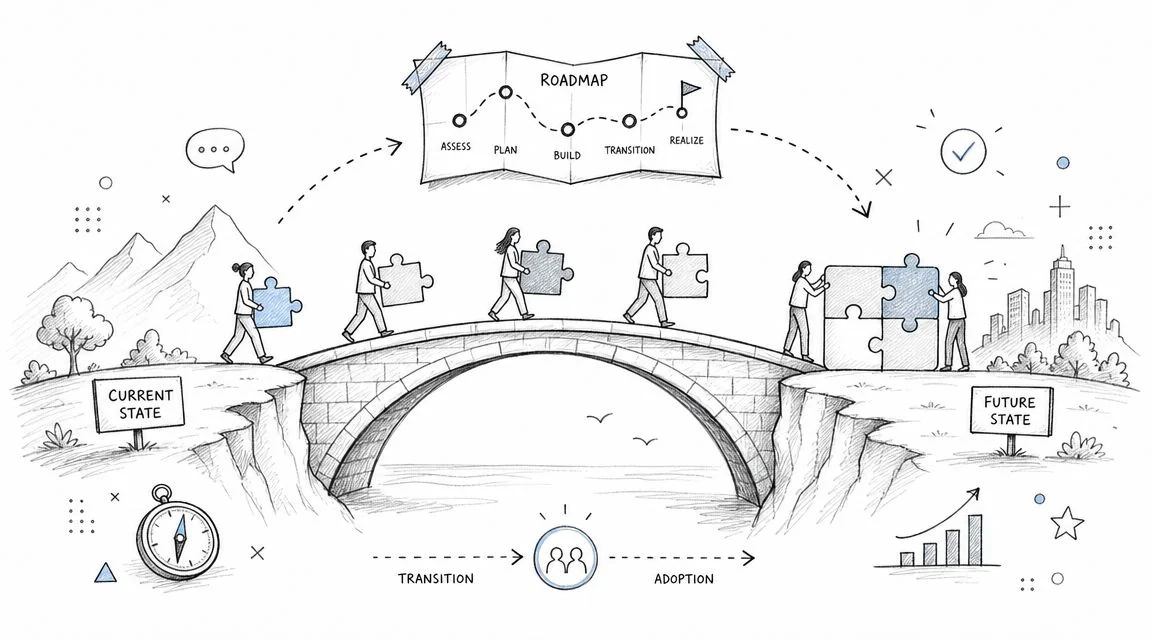
Tech organizations change constantly. Cloud migrations, security policy shifts, platform standardization, AI tool rollouts, ITSM redesign. The problem usually isn't announcing the change. The problem is helping people adopt it without dropping delivery quality.
OD and change management require each other. Change management handles the rollout mechanics. Organizational development strategies ensure the organization has the capability and habits to sustain the new reality.
Sequence the capability shift
If you're implementing new service workflows or operational processes, training has to arrive before the launch pain hits. For service management transitions, structured ITIL 4 Foundation exam preparation can help teams build a shared vocabulary and operating model before the process goes live.
The same logic applies to cloud and security transitions. You don't want learning to trail the migration. You want learning embedded in the transition plan.
What actually reduces resistance
Resistance usually isn't irrational. People resist when the reason is unclear, the workflow gets harder, or support disappears after launch.
Field note: Early adopters matter less than frontline managers who can explain the change in local, practical terms.
That means every major change effort should include manager briefings, change champions, support channels, and visible early wins. Companies that skip those layers often mistake compliance for adoption.
8. Employee Engagement and Retention Programs
Engagement and retention improve when employees can see a future with you. In tech, that future often depends on growth. If people can't tell how to move from support to cloud, from analyst to engineer, or from engineer to lead, they start building that path somewhere else.
That's why learning opportunities belong inside retention strategy, not next to it. Certification reimbursement, study time, role-based pathways, and internal mobility all send the same message: growth is possible here.
Development is a retention lever when it's visible
A reimbursement policy buried in a handbook doesn't change much. A visible path does. Employees stay more engaged when they know which skills matter, who has already made the move, and what support is available.
A practical program often includes public recognition for completed certifications, internal job eligibility tied to demonstrated skills, and peer communities that keep momentum alive. If you want a broader view of related people practices, this guide on employee retention strategies is a useful companion.
Avoid the common trap
Don't invest in development and then block internal movement. That's one of the fastest ways to turn training into attrition fuel. If someone gains a real capability and no role design, compensation path, or project opportunity changes, they'll take that capability to the market.
9. Strategic Workforce Planning
The board approves a cloud migration. Product commits to an AI roadmap. Security tightens control requirements. Then the delivery plan hits a wall because the org chart looks fine, but the capability map does not.
That is the core job of strategic workforce planning in a tech company. It connects business bets to the skills, roles, and bench strength required to deliver them.
Start with capability demand, not headcount
Headcount plans fail when they treat engineers, analysts, admins, and managers as interchangeable units. They are not. A team of ten people without cloud architecture depth, platform automation skills, or service management expertise will still miss the target.
Start with the work. List the initiatives that matter over the next 12 to 24 months, then identify the capabilities each one depends on. In practice, that means naming specific skills and credentials, not broad labels. Kubernetes administration, AWS security, ITIL practice design, ServiceNow configuration, data engineering, or engineering management are more useful planning inputs than "IT support" or "developer."
I have seen this work best when OD and department leaders review capability demand together, quarter by quarter. The conversation gets sharper fast. You stop arguing about whether a team feels understaffed and start deciding whether to build certification paths, hire specialists, use contractors for a fixed period, or delay lower-value work.
Make build, buy, or borrow a real decision
A workable workforce plan compares talent options against cost, speed, and long-term value.
- Build internally when the team already has adjacent skills and the timeline allows for training, stretch assignments, and certification prep.
- Hire externally when the need is immediate, the skill is scarce internally, or the role requires prior experience that cannot be simulated quickly.
- Borrow capability through contractors, consultants, or implementation partners when demand is temporary or you need specialist input during a transition.
Each option has a trade-off. External hiring can close a gap quickly, but it is expensive and often slower than leaders expect in competitive technical markets. Internal development improves retention and institutional knowledge, but it only works when managers protect time for learning and assign real work that uses the new skill.
For tech organizations, the strongest plans usually mix all three. A company might hire one senior cloud architect, certify existing infrastructure staff through a structured path, and use a partner for the first migration wave. Learning systems matter here. Platforms such as MindMesh Academy can support role-based learning paths and certification tracking, but the platform is only useful if it is tied to actual workforce decisions.
Plan for role transitions, not just openings
Good workforce planning also looks one move ahead. If you promote your best engineer into leadership, who picks up their technical scope? If you automate part of service operations, which employees can move into higher-value platform or security work?
OD demonstrates practical influence. Build transition maps for critical roles. Identify feeder positions. Define what "ready in 6 months" or "ready in 12 months" looks like. The U.S. Office of Personnel Management outlines workforce planning as a process of aligning talent requirements with business direction, a useful baseline even outside government settings. See the OPM Strategic Workforce Planning Guide for more details.
A workforce plan is only credible if it changes decisions. It should shape hiring requests, learning budgets, certification support, project staffing, and succession discussions before capability gaps turn into delivery failures.
10. Knowledge Transfer and Cross-Functional Collaboration
When one senior engineer holds the architecture story in their head, you don't have expertise. You have a dependency.
Knowledge transfer matters because tech work is interconnected. Security depends on infrastructure decisions. Service teams depend on platform documentation. Delivery teams depend on shared patterns. If people don't exchange knowledge across boundaries, every function optimizes locally and the organization gets slower.
Create repeatable sharing habits
Communities of practice work well here. So do internal tech talks, certification study groups, architecture reviews, and peer-led sessions after major project milestones. The goal isn't more meetings. It's more reusable understanding.
A strong pattern is simple. Someone learns a concept, applies it, documents what changed, and teaches others where it matters. Recently certified AWS, CompTIA, ServiceNow, or ITIL professionals are often perfect anchors for that cycle because they can connect fresh formal learning with active operational work.
Don't leave collaboration to culture alone
Cross-functional collaboration fails when it depends on goodwill only. It improves when you assign owners, document decisions, and reward people who teach others.
A tech organization scales when expertise moves faster than the problems it's solving.
Knowledge transfer also reduces the risk that learning investments stay individual. When one person learns, the team should get smarter too.
10-Point Organizational Development Strategy Comparison
| Approach | Implementation complexity | Resource requirements | Expected outcomes | Ideal use cases | Key advantages |
|---|---|---|---|---|---|
| Competency-Based Development | High, framework design and ongoing maintenance | SMEs, assessment tools, analytics, time for job analysis | Measurable proficiency improvements; reduced skill gaps | Aligning certifications to job roles; structured career paths | Targeted skill growth; data-driven talent decisions |
| Continuous Learning Culture | Medium, cultural change and policy alignment | Continuous content updates, platform access, leadership buy-in | Workforce stays current; higher engagement and retention | Rapidly evolving tech areas; long-term upskilling | Sustained competency; attracts and retains talent |
| Mentorship and Coaching Programs | Medium, program design and matching logistics | Trained mentors, coordination, time commitment | Accelerated skill transfer; personalized development | Onboarding, bridging theory to practice, high-potential development | Personalized guidance; higher retention and leadership readiness |
| Organizational Learning Systems | High, tech integration and KM processes | LMS, knowledge repositories, analytics, IT support | Institutional memory; measurable training ROI; faster onboarding | Scaling training across the org; tracking learning outcomes | Scalable knowledge retention; data-driven improvement |
| Leadership Development Programs | High, customized curricula and long timelines | Executive coaches, cross-functional projects, budget | Strong leadership pipeline; improved strategic decision-making | Succession planning; developing technical leaders into managers | Builds leadership capacity; aligns leaders to strategy |
| Performance Management & Feedback Systems | Medium, process redesign and manager training | Feedback tools, dashboards, manager time | Clear goals, timely interventions, improved alignment | Ongoing development, certification progress monitoring | Real-time visibility; ties learning to performance goals |
| Organizational Change Management | High, stakeholder engagement and communications | Change leads, communication plans, training resources | Faster adoption of new tools/processes; reduced disruption | Platform rollouts, cloud migrations, major process changes | Smoother transitions; higher adoption and ROI realization |
| Employee Engagement & Retention Programs | Medium, program mix and sustained effort | Benefits budget, development programs, recognition systems | Lower turnover; higher productivity and morale | Retaining certified talent; employer branding initiatives | Increases loyalty; improves recruitment and retention |
| Strategic Workforce Planning | High, forecasting and cross-functional coordination | Workforce analytics, HR/business input, planning tools | Aligned capabilities; optimized hiring vs. development | Long-term capability building; addressing future skill gaps | Proactive skill alignment; efficient training investments |
| Knowledge Transfer & Cross-Functional Collaboration | Medium, coordination and community building | Collaboration platforms, scheduled time, moderators | Faster problem-solving; reduced duplication of effort | Complex projects requiring diverse expertise; communities of practice | Encourages innovation; leverages collective expertise |
Building Your Organization's Future, One Strategy at a Time
A CTO approves a cloud migration, the hiring plan is behind, and managers are already stretched. At that point, organizational development stops being an HR concept and becomes an execution problem.
The strongest OD work starts with the constraint currently slowing the business down. Sometimes that is fuzzy role expectations in engineering. Sometimes it is a manager group that can ship code but cannot coach performance. Sometimes it is a learning budget spread across certifications that look useful but do not map to the capabilities the company needs in six to twelve months.
Sequence matters because every intervention has a cost. If role clarity is weak, start with competency-based development and define what good looks like by level and function. If teams have no time to build new skills, protect learning time and make completion visible through systems people already use. If strategy is clear but execution quality is inconsistent across teams, fix manager coaching and feedback loops before launching another planning cycle.
In tech organizations, the trade-offs are concrete. Training hours reduce delivery capacity in the short term. Coaching asks managers to build a skill set many were never taught. Workforce planning forces decisions about whether to hire for scarce expertise, build it through internal certification paths, or change the roadmap to fit available talent. Knowledge sharing takes longer than asking the senior architect to solve the same problem again. The cost of avoiding those choices is familiar: fragile teams, uneven quality, low mobility, and too much risk concentrated in a few people.
Good OD also needs operating discipline. Each strategy in this article should tie to a business outcome you can observe. Faster onboarding for new engineers. Higher internal fill rates for team leads. Better adoption of a new platform. Stronger retention in high-demand technical roles. If a program cannot be tied to behavior change and team performance, it is probably too vague to scale.
Manager capability deserves special attention because managers convert OD plans into day-to-day team habits. In software and infrastructure teams, they decide whether learning time is protected, whether feedback is specific, and whether change efforts feel organized or chaotic. I have seen solid learning platforms fail under weak management, and modest programs produce results under disciplined managers who set expectations clearly and follow through.
Start smaller than you think. Pick the bottleneck with the highest operational cost, define the behaviors that need to change, and measure the result over one or two planning cycles. Then build outward. In tech settings, that often means connecting OD strategy to practical tools such as role-based certification paths, skills tracking, and learning systems that show progress at the team level. Platforms like MindMesh Academy can support that work with certification exam preparation, adaptive study paths, and progress tracking that fit into a broader capability plan instead of sitting off to the side.
Ready to put these strategies into practice? Explore the CompTIA A+ Core 1 practice exam to build foundational IT skills for your team.

Written by
Alvin Varughese
Founder, MindMesh Academy
Alvin Varughese is the founder of MindMesh Academy and an enterprise architecture leader. An electrical engineer by training, he moved from factory automation in South Africa to cloud architecture at GE Appliances and Humana (Fortune 50), and holds 20 professional certifications including AWS Solutions Architect Professional, Azure DevOps Engineer Expert, and Microsoft Agentic AI Business Solutions Architect. He built MindMesh Academy after interviewing too many highly certified candidates who couldn't answer basic questions: the goal is prep that makes you better at the job, not just able to pass the exam.