Organizational Culture: A Guide for High-Performing Teams
Organizational Culture: A Guide for High-Performing Teams
A database alert hits at 2:07 a.m. On one team, people rush to protect themselves, logs get hidden, and the outage drags on. On another, the lead says, “State what you know, state what you need.” The team then restores service because no one is wasting energy on blame.
That difference isn't luck. It's organizational culture.
The Unseen Force Behind Every Tech Team
Most tech professionals first hear “organizational culture” in an HR presentation, right next to words like values, mission, and engagement. That's why many engineers tune it out. If you spend your day in Azure, AWS, Jira, GitHub, or ServiceNow, culture can sound soft compared with architecture decisions, certification preparation, incident response, and delivery deadlines.
But in real teams, culture behaves more like a hidden operating layer. It shapes who speaks first in a war room, whether junior staff ask for help before a change fails, whether project managers raise risks early, and whether people can protect focused study time for hard exams like PMP, AWS, or Azure certifications.
Charles Handy's 1976 work helped popularize the idea that organizations develop distinct culture types rather than one universal model. That idea still matters because culture isn't one thing. A consulting team, a startup platform team, and an enterprise PMO can all be competent, yet run on very different norms.
Gallup describes culture as the way an organization turns purpose into action and sustains its brand promise in its workplace research on building better company culture. In plain language, culture is how the place works in practice when the slide deck is closed.
What tech professionals usually miss
People often assume culture is about perks: free coffee, Slack emojis, a nice offsite. Those things may affect mood, but they don't define how work gets done under pressure.
A stronger definition is simpler:
- Culture is what people reward.
- Culture is what leaders tolerate.
- Culture is what teams repeat.
- Culture is what employees expect will happen if they speak up, fail, learn, or push back.
A team's culture becomes visible fastest during outages, deadlines, and exam season.
If you're ambitious in tech, this matters for two reasons. First, culture affects project performance. Second, it affects learning capacity. A team that creates clarity, trust, and disciplined routines gives people the mental room to master difficult concepts. A team that runs on fear, interruption, and constant reactivity makes even smart professionals feel stuck.
What Is Organizational Culture Really?
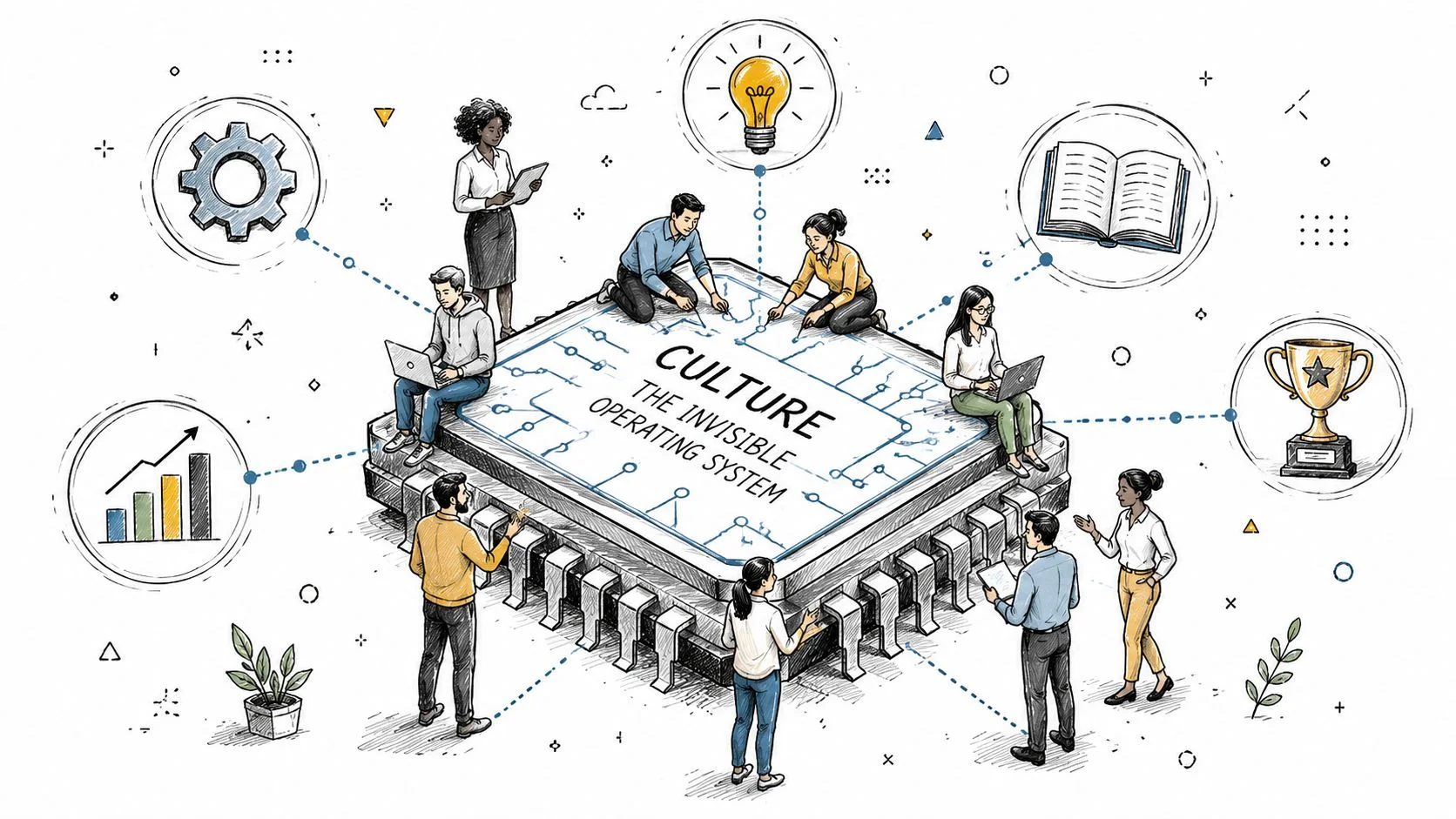
If you want a practical definition, think of organizational culture as the operating system running beneath the visible applications of work. Your ticketing system, cloud platform, sprint board, and certification plan are the apps. Culture is the background layer deciding how those apps are used, who gets trusted, what gets escalated, and whether people work in panic or with purpose.
That's why two teams can use the same tools and still produce very different results.
The operating system analogy
In IT, an operating system controls permissions, priorities, communication between processes, and behavior under load. Organizational culture does something similar.
It influences:
- Decision flow. Who can decide, and how fast.
- Error handling. Whether mistakes become learning or finger-pointing.
- Resource allocation. Whether study time, mentoring, and documentation are protected.
- Security of communication. Whether people feel safe enough to say “I don't know.”
A useful historical marker comes from Charles Handy's work in 1976, which helped shift thinking away from a one-size-fits-all view of organizations. That legacy still holds. There isn't one ideal culture for every company. There is only the question of whether your culture supports the work you say matters.
To sharpen your eye, it helps to study patterns and examples such as these improving team culture with key facts, especially if you're trying to compare what your team says with what it repeatedly does.
Schein's three levels made practical
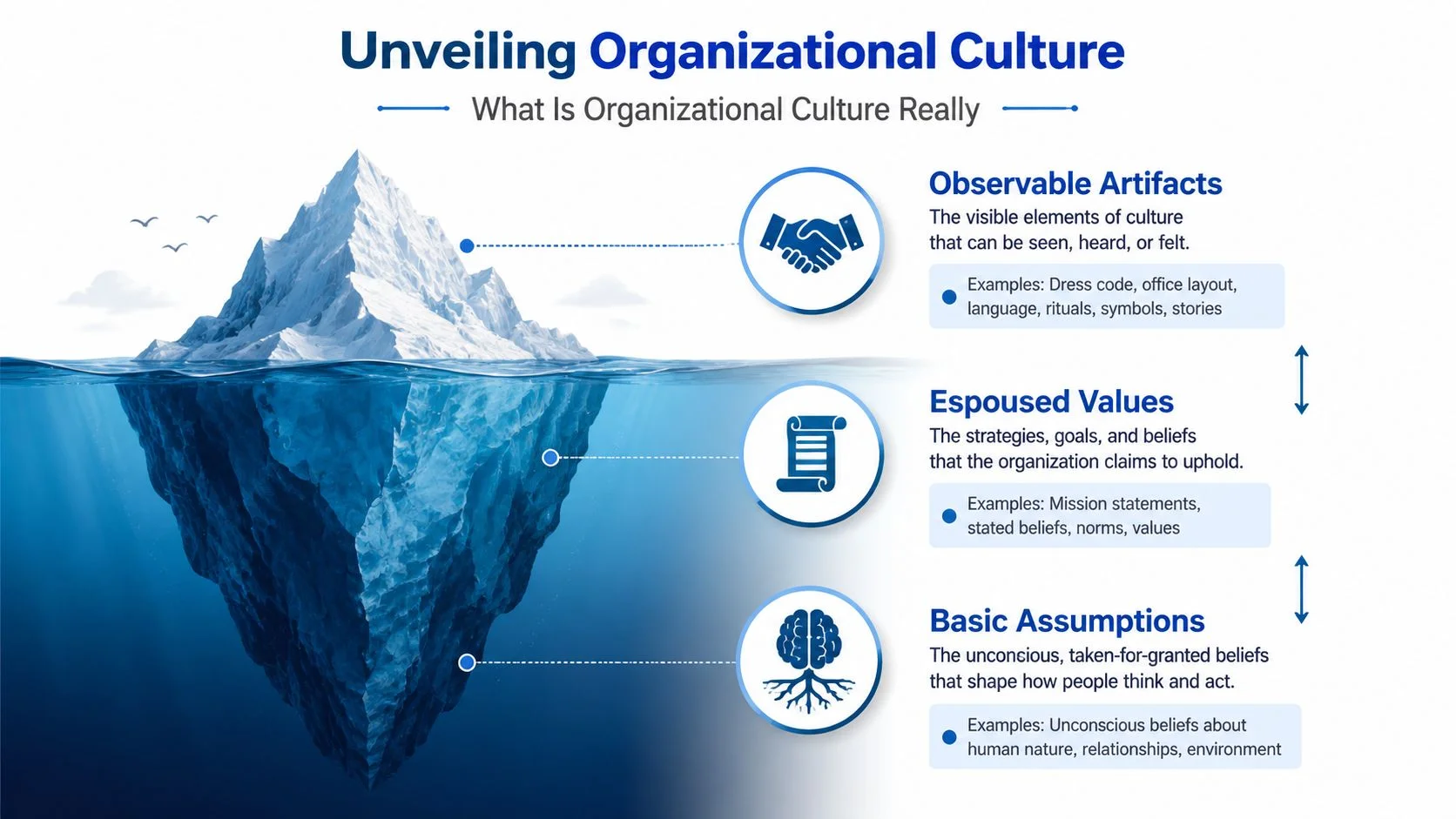
One of the clearest frameworks comes from Edgar Schein's three-level model, explained in Ninety's overview of Schein's organizational culture framework.
Here's the model in plain language:
| Level | What it includes | Tech team example |
|---|---|---|
| Artifacts | Visible structures, tools, rituals | Standups, postmortems, certification budgets, Slack norms |
| Espoused values | Stated principles and policies | “We value learning,” “We support innovation,” “People first” |
| Underlying assumptions | Deep, often unstated norms | “Don't admit uncertainty,” “Speed matters more than quality,” “Only outages get attention” |
Most confusion happens because people judge culture only by artifacts or slogans. They see a learning portal and assume the company supports learning. They see “fail fast” on a wall and assume experimentation is safe.
That's not enough.
Where teams get fooled
A company may say it values development, but if managers interrupt study blocks, reward only urgent work, and treat training as optional, culture is reactive, not developmental.
Schein's model matters because it shows why changing posters rarely changes behavior. If leaders want a culture of learning, they have to change visible routines too. That means meeting norms, escalation habits, recognition patterns, and manager behavior.
Practical rule: If the artifacts and the incentives don't support the stated values, employees will trust the artifacts and incentives.
For tech professionals, this is liberating. It gives you a diagnostic lens. Instead of asking, “Is this company's culture good or bad?” ask better questions:
- What behaviors are visible every week?
- What values are stated in policy?
- What assumptions drive choices under pressure?
That's how you stop treating organizational culture like a vague mood and start reading it like a system.
Why Culture Is a Performance Multiplier
A few years ago, I watched two infrastructure teams prepare for the same cloud migration. They had similar budgets, similar tooling, and engineers with comparable skills. One team hit its milestones, shared knowledge freely, and had two staff members pass AWS exams during the project. The other missed handoffs, hid risks until late, and treated study time like a luxury. The difference was not talent. It was culture.
Culture changes performance because it shapes what people do under pressure. In technical work, that matters more than slogans, town halls, or values posters. A team's real culture decides whether engineers raise a concern early, whether project managers get honest status updates, and whether learning survives a busy sprint.
MIT Sloan Management Review found that toxic culture was the strongest predictor of attrition during the Great Resignation, and stronger than compensation in explaining why employees left, in its research on toxic culture and the Great Resignation. However, the daily work environment is a frequent driver of attrition. For IT leaders, that has direct operational consequences. Every departure takes system knowledge, project context, and mentoring capacity with it.
The business case in hard terms
Culture works like an invisible operating system. You do not see it directly in a dashboard, but you see its output everywhere.
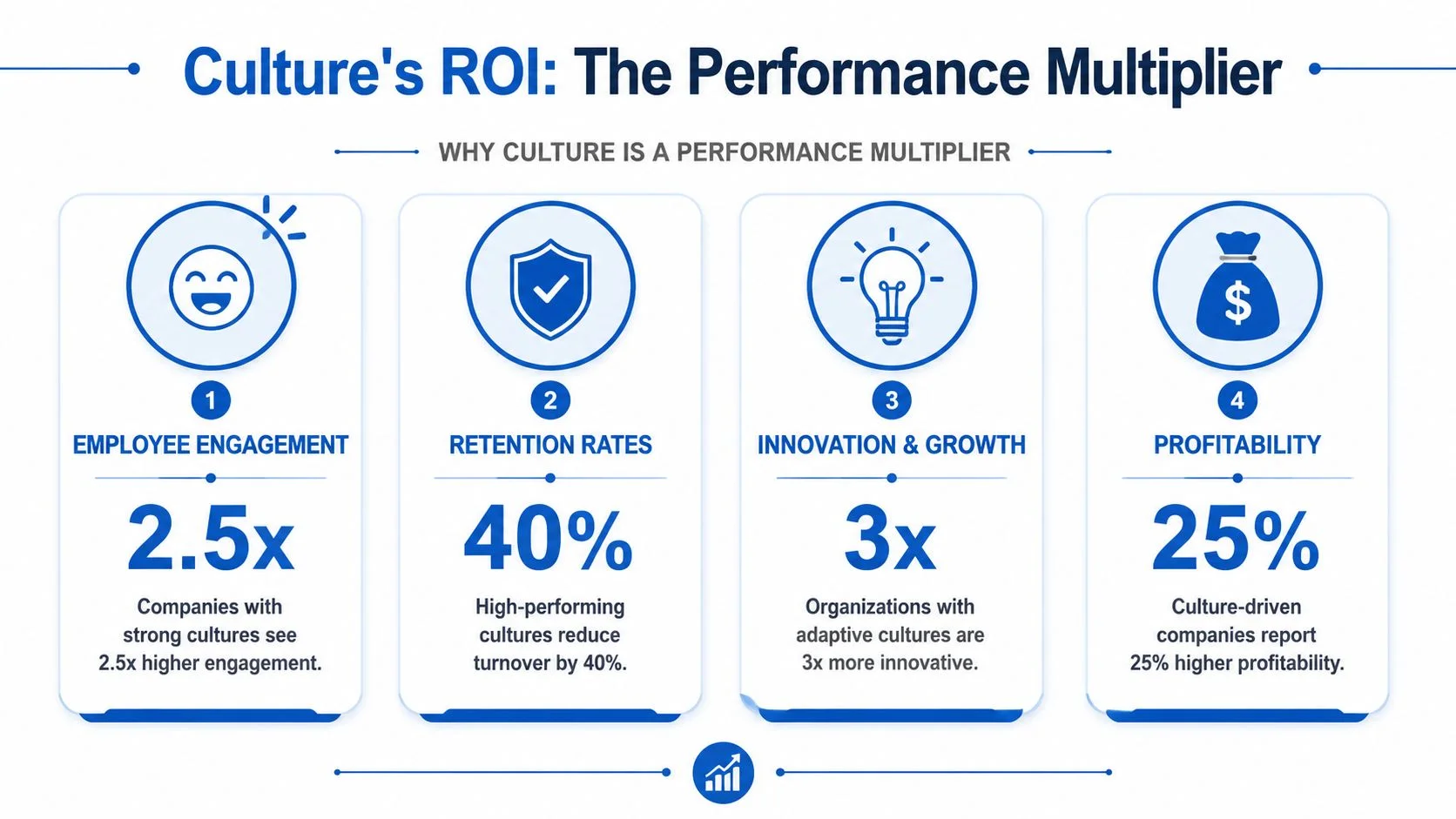
Deloitte's analysis of organizational culture notes that culture influences performance, innovation, and retention because it shapes behavior at scale in daily work, not in isolated events, as explained in its piece on the organization of the future and culture. That is why culture belongs in the same discussion as delivery risk, staffing plans, and budget control.
For technical teams, the multiplier effect usually shows up in four places:
- Incident response gets faster because people escalate facts instead of managing appearances.
- Projects become more predictable because risks surface before they turn into rework.
- Knowledge spreads more reliably because senior staff teach and document instead of guarding expertise.
- Certification progress improves because study time is treated as planned capability building, not personal indulgence.
That last point gets ignored too often.
If a company says it wants more AWS-certified engineers, stronger project managers, or better security practice, culture determines whether that goal is realistic. A supportive culture protects focus time, rewards preparation, and treats learning as part of the job. A reactive culture does the opposite. It praises growth in theory, then fills every calendar gap with urgent work. The result is predictable: Certifications stall, skills stay uneven, and teams remain dependent on a few overstretched experts.
What poor culture looks like in operations
Poor culture rarely arrives with a warning label. It shows up in ordinary habits that look harmless until they repeat for months.
- Meetings reward confidence over accuracy. Engineers stop admitting uncertainty.
- Managers celebrate rescue work more than prevention. Teams learn that avoidable fires get more recognition than disciplined planning.
- Training exists only in policy. Study blocks disappear the moment a ticket queue grows.
- Retrospectives assign blame. People protect themselves instead of improving the system.
Each of those behaviors reduces performance. They also drain cognitive bandwidth. An engineer who is busy avoiding embarrassment has less attention left for architecture decisions, root cause analysis, or exam preparation.
That is why pressure alone does not create strong teams. Good teams handle pressure because trust and discipline are already in place.
Why technical groups feel the effect faster
In many business functions, individual output can hide cultural problems for a while. In IT, weak culture becomes visible quickly because the work is interconnected. Cloud migrations, ERP rollouts, security remediation, and PMP-governed delivery all depend on clear handoffs, accurate status reporting, and shared standards.
A single strong engineer cannot compensate for a team that withholds bad news, skips documentation, or treats questions as weakness.
Culture also changes how people use their mental energy. In a low-trust environment, staff spend time reading politics, wording updates defensively, and guessing what leaders really want. In a healthy environment, that same effort goes into solving problems, learning new systems, and preparing for higher-level responsibilities.
That is the multiplier. Culture does not replace technical skill. It increases or reduces the return your team gets from the skill it already has.
How to Read and Measure Your Current Culture
A team lead I worked with once told me his group had a “learning culture.” On paper, he was right. The training budget existed, certification goals were listed in development plans, and managers said the right things in review meetings. Then a cloud migration hit trouble. Study blocks disappeared, mentoring sessions got bumped, and every conversation shifted to short-term fire drills. By the end of the quarter, the team had missed project milestones and pushed back two AWS exam dates.
That is how culture usually shows itself: not in posters or value statements, but in the repeated choices people make under pressure.
If you want to read culture accurately, use the same mindset you would use for a production issue. Start with observable behavior. Check whether patterns repeat. Then compare those patterns with the standards the organization claims to hold. Analysts at Gallup found in its State of the Global Workplace report that employee engagement remains low globally. For a technical team, that kind of disconnect often appears as missed handoffs, weak documentation, avoidable rework, and stalled professional development.
Start with the work, not the wording
Culture leaves fingerprints in routine moments. A normal week will tell you more than a branded values deck.
Watch for patterns in four places:
- Meetings. Who speaks with confidence, who stays guarded, and whether questions are welcomed or punished.
- Escalations. Whether risks surface early enough to be useful or arrive after options have narrowed.
- Feedback. Whether correction improves performance or merely teaches people to stay quiet.
- Learning time. Whether certification study, labs, and mentoring survive busy periods or get treated as optional.
For IT teams, that last point matters more than leaders often realize. If your team says growth matters but PMP preparation, AWS labs, or architecture reading always lose to reactive work, your real culture is teaching people that development is secondary. That affects both exam outcomes and delivery quality.
A short checklist makes this easier to assess:
| Question | Healthy sign | Warning sign |
|---|---|---|
| Do people raise risks early? | Risks show up while the team still has choices | Risks appear only after deadlines or budgets are already in trouble |
| Are mistakes examined clearly? | Teams review decisions, process gaps, and safeguards | Teams focus on who to fault |
| Is learning visible in team routines? | Managers ask about skill growth, practice time, and progress toward certifications | Learning happens only after hours, if at all |
| Can people protect focus time? | Engineers get uninterrupted blocks for deep work, documentation, and study | Constant context switching breaks concentration |
| Do priorities stay stable long enough to execute? | Teams can finish work without weekly goal changes | Urgent work keeps replacing important work |
Use surveys to measure the gap between stated values and daily reality
Observation shows behavior. Surveys show distribution. They help you learn whether a problem is isolated to one manager, one team, or the wider organization.
The best survey questions are concrete. They ask about conditions people can recognize from daily work. If you need a practical starting point, these questions for employee experience surveys are useful because they focus on behavior and support, not vague morale language.
Good prompts include:
- I can raise a concern without negative consequences.
- My manager supports my professional development.
- I have enough uninterrupted time for deep work.
- My team learns from mistakes instead of hiding them.
- I understand how my work connects to team goals.
- I can protect time for certification study or technical skill development when it is planned.
That last question is often missing. It should not be. For ambitious IT professionals, culture becomes visible in whether the environment helps people build capability over time. A team that cannot protect learning time will struggle to maintain certifications, adopt new platforms, and prepare people for larger project roles.
Add context with conversations and operating data
Survey scores alone can flatten the story. Two teams may give the same low rating for “support for development,” but for different reasons. One may lack budget. Another may have budget but no protected time. The fix is different.
Use a mix of sources:
- One-on-ones to hear what people avoid saying in group settings.
- Small focus groups to test whether concerns repeat across teams.
- Exit interviews to spot patterns in why strong people leave.
- Internal operating data such as attrition, certification completion rates, missed retrospectives, project slippage, incident repeat rates, and unused training budgets.
This works like triangulating a network problem. A single signal can mislead you. Several signals pointing in the same direction usually identify the underlying issue.
When employees describe the same obstacle in different words, pay attention. “I never get study time.” “Everything is urgent.” “I don't want to ask basic questions.” Those may sound separate, but they often point to one culture pattern: Short-term pressure is crowding out learning and honest communication.
The clearest read comes from comparing three things side by side. What leaders say matters. What managers reward matters more. What employees experience every week matters most. When those line up, culture supports execution. When they conflict, technical performance and certification progress both suffer.
Actionable Strategies for Building a Better Culture
Once you can read your current culture, the next step is engineering better defaults. That word matters. Strong organizational culture doesn't depend on motivational speeches. It depends on repeatable defaults that shape behavior every week.
Mid-level leaders have unusual influence here. MIT Sloan Review identifies mid-level leaders as the “critical” force in fostering healthy culture in its article on building culture from the middle out. That fits what many of us have seen in IT shops. Executives may define intent, but managers and team leads ultimately determine what happens in calendars, projects, handoffs, and reviews.
Start with leadership behavior, not slogans
If leaders want accountability, they have to model it first. If they want learning, they have to protect time for it. If they want transparency, they have to respond well to bad news.
A manager can start changing culture with a few visible habits:
- Run blameless postmortems. Focus on signals, decisions, and safeguards.
- Reward early escalation. Thank people for surfacing risk before it turns expensive.
- Protect focus blocks. Don't let every chat notification become an emergency.
- Ask learning questions. “What did you learn?” often changes a team more than “Why isn't this done?”
A useful example comes from AI transformation teams. Leaders who want experimentation cannot rely on announcing innovation goals. They need routines that support structured learning, cross-functional coordination, and clearer ownership. If that's part of your world, it helps to explore the Microsoft AI concepts because the technical ecosystem itself often forces cultural decisions about governance, collaboration, and adoption.
Build rituals that reinforce the right behavior
Culture gets stronger when teams attach values to recurring rituals.
Consider these examples:
- Standups should expose blockers, not become performance theater.
- Retrospectives should produce one or two behavior changes, not a long complaint list.
- Recognition should point to actions worth repeating, like documenting a fix or mentoring a junior analyst.
- Weekly planning should include development time, not just delivery time.
Here's a simple manager playbook:
| Ritual | Weak version | Strong version |
|---|---|---|
| Postmortem | “Who made the mistake?” | “What conditions made this likely?” |
| One-on-one | Status update only | Status plus workload, growth, and blockers |
| Sprint planning | Task allocation only | Task allocation plus risk and learning capacity |
| Recognition | Praising heroics | Praising prevention, clarity, mentoring, and follow-through |
Change what people experience daily
Most cultural change fails because leaders aim too high and too vaguely. “Be creative” won't help a support engineer drowning in urgent requests. Daily work has to feel different.
Three practical interventions work well:
-
Clarify essential behaviors. Define two or three behaviors that matter in every team. Examples include respectful escalation, documented handoffs, and protected study time.
-
Reduce contradiction. Don't say learning matters while scheduling over every training block. Don't say psychological safety matters while punishing people for honest mistakes.
-
Make progress visible. Use recurring check-ins, short pulse surveys, and manager reviews to see whether behaviors are sticking.
Healthy culture spreads when managers turn values into routines that survive busy weeks.
For ambitious tech professionals, this is encouraging. You don't need to become Chief People Officer to influence culture. If you run projects, lead standups, mentor others, or manage delivery flow, you already shape what your team treats as normal.
Culture's Hidden Impact on Tech Certification Success
Many professionals fail to connect organizational culture with exam performance because one topic sounds “soft” and the other sounds technical. In practice, they're tightly connected.
An engineer preparing for AWS Solutions Architect, Azure architecture exams, PMP, or ITIL needs sustained concentration, memory consolidation, repetition, and time to connect abstract concepts. That kind of learning doesn't happen well in a workplace that trains people to stay tense all day.
Why stress steals study capacity
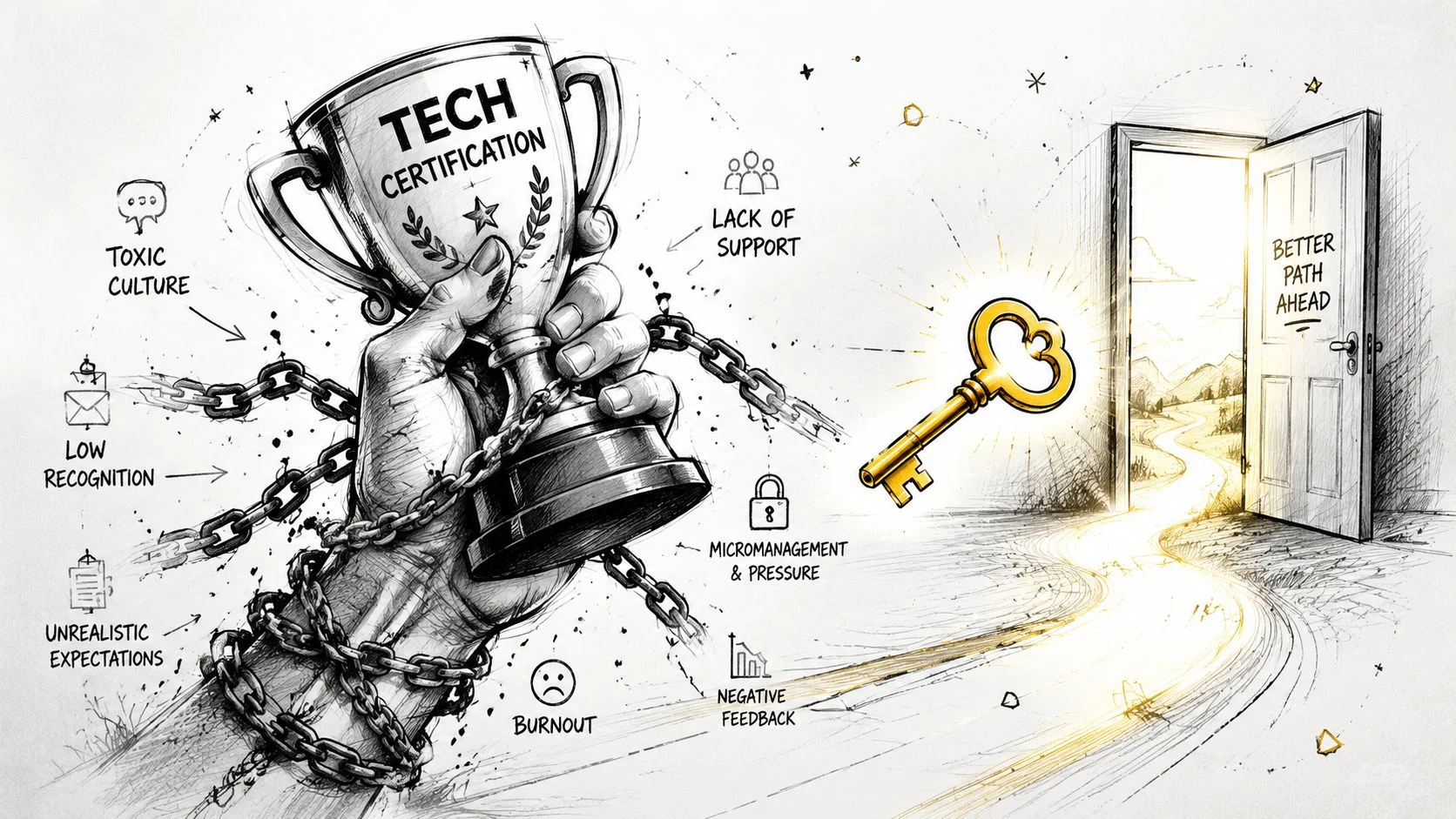
StatPearls notes that organizational culture significantly impacts job commitment and career fulfillment in its overview of organizational culture. A key practical takeaway for tech professionals is that culture-induced stress can degrade the cognitive capacity needed for mastering complex material, which can lower success in demanding certification environments.
That shows up in familiar ways:
- Constant interruption breaks deep study cycles.
- Fear-based management keeps your brain in self-protection mode.
- Reactive workdays destroy the consistency required for spaced repetition.
- Lack of support makes training feel selfish instead of strategic.
This isn't about motivation alone. A stressed professional may still care greatly about passing. The problem is bandwidth.
A realistic scenario from IT operations
Take a systems engineer studying for an AWS certification. They plan four focused sessions each week, review flashcards during lunch, and reserve part of Saturday for architecture diagrams.
Then the actual culture kicks in.
Their manager sends late-night messages. Every priority is urgent. Incidents that should be distributed get dumped on the same reliable people. Training time disappears first because it has no immediate ticket number attached to it. By the end of the week, the engineer hasn't forgotten how to study. They've lost the mental conditions that make studying effective.
That's why I tell teams this: a certification plan is not just a personal productivity problem. It's often a cultural systems problem.
A good resource for project-oriented professionals juggling work and exam preparation is the MindMesh Academy PMP study materials, especially when your day job already demands structured thinking, prioritization, and disciplined review.
What supportive culture looks like for learners
A culture that supports certification success usually has a few recognizable traits:
- Managers treat learning as part of the job.
- Teams protect uninterrupted blocks for deep work.
- Colleagues share notes, explain concepts, and reduce isolation.
- Leaders avoid creating permanent urgency.
Here's a quick comparison:
| Environment | Likely study experience |
|---|---|
| Blame-heavy, interrupt-driven team | Inconsistent study, fragmented recall, avoidance |
| Structured, supportive team | Better consistency, stronger retention, calmer execution |
Later in the learning journey, mindset also matters. This short video is useful because it connects discipline and long-term growth to daily habits:
What managers can do without causing burnout
Many managers want to support training but make the mistake of piling “development” on top of an already overloaded schedule. That backfires.
A better approach looks like this:
-
Protect recurring study windows. Put them on the calendar and defend them like customer meetings.
-
Reduce avoidable interruption. Rotate on-call pressure fairly. Don't let one reliable person absorb everything.
-
Normalize learning conversations. Ask what topic someone is working through, not just whether they passed yet.
-
Tie learning to real work. A cloud governance module lands better when the team is actively discussing cloud governance.
When organizational culture supports learning, certification preparation becomes steady instead of heroic. That's the difference between cramming under stress and building professional mastery that endures.
How Modern Learning Platforms Drive Culture Change
Tools don't create organizational culture by themselves. But they can reinforce it powerfully when the tool matches the behavior a team wants to normalize.
Schein's idea of artifacts is once again useful. A learning platform is an artifact. It's a visible part of the environment. It signals what the organization takes seriously. If training lives in a forgotten folder, employees read one message. If learning is structured, visible, and built into workflow, they read another.
From training content to cultural signal
A modern platform can support a culture of learning in several practical ways:
- Spaced repetition reinforces consistency over cramming.
- Adaptive paths respect different starting points and skill gaps.
- Progress dashboards make growth visible to the learner and, when used carefully, to the team.
- Structured study guides reduce friction at the point where motivation usually drops.
For teams comparing delivery formats and choosing how to embed learning into work, VideoLearningAI's L&D methods guide is useful because it frames training methods as operational choices rather than abstract HR preferences.

Why visibility changes behavior
When people can see progress, learning stops feeling vague. That matters in technical teams because engineers and project professionals respond well to feedback loops.
A dashboard can help in three ways:
| Feature | Cultural effect |
|---|---|
| Visible progress tracking | Signals that learning effort counts |
| Personalized study flow | Supports autonomy and efficiency |
| Regular review prompts | Builds disciplined habits over last-minute effort |
The key is how leaders use the tool. If they use it to micromanage, trust drops. If they use it to support cadence, celebrate persistence, and remove blockers, the platform becomes part of a healthier learning culture.
That's especially relevant in emerging fields where skills, governance, and collaboration need to mature together. Teams working on AI initiatives often discover that technical capability alone isn't enough. They also need shared routines, cross-functional trust, and a clear development path. In that context, studying topics like building an AI Center of Excellence can support both technical readiness and cultural alignment.
The best learning platforms don't just prepare people for exams. They help teams make learning normal, visible, and repeatable.
A strong organizational culture doesn't happen because people want it. It happens when leaders, managers, systems, and tools all point in the same direction.
To build that kind of learning culture while preparing for high-stakes certifications, explore MindMesh Academy. We provide structured study guides, adaptive learning paths, and spaced repetition tools designed to help knowledge stick. If you're ready to solidify your project management skills, test your knowledge with our PMP practice exam.

Written by
Alvin Varughese
Founder, MindMesh Academy
Alvin Varughese is the founder of MindMesh Academy and an enterprise architecture leader. An electrical engineer by training, he moved from factory automation in South Africa to cloud architecture at GE Appliances and Humana (Fortune 50), and holds 20 professional certifications including AWS Solutions Architect Professional, Azure DevOps Engineer Expert, and Microsoft Agentic AI Business Solutions Architect. He built MindMesh Academy after interviewing too many highly certified candidates who couldn't answer basic questions: the goal is prep that makes you better at the job, not just able to pass the exam.