Monitoring & Controlling: Your PMP Exam Success Guide
Monitoring & Controlling: Your PMP Exam Success Guide
You're likely in a spot where monitoring and controlling concepts feel tricky for the PMP exam.
Imagine a scenario: the project is late, a stakeholder wants a change, quality issues surface, and the team has already overspent. Then the question asks, "What should the project manager do next?" Many candidates freeze here. They know the terms, but they haven't yet internalized the sequence PMI expects.
That's the core challenge with monitoring and controlling. It's not just a list of processes to memorize. It's a disciplined way of reading a situation, identifying the gap between the plan and reality, and choosing the best response without skipping critical steps. Once this approach clicks, many PMP questions become much clearer.
What Is Monitoring and Controlling in Project Management?
A project rarely fails all at once. Instead, it slips gradually.
A task takes longer than expected. A vendor misses a deadline. A stakeholder requests "one small addition." A defect appears during testing. None of these events automatically mean the project is doomed. The real danger starts when the project manager doesn't detect the drift early or doesn't respond systematically.
This is where monitoring and controlling come into play.
Monitoring means checking where the project really is
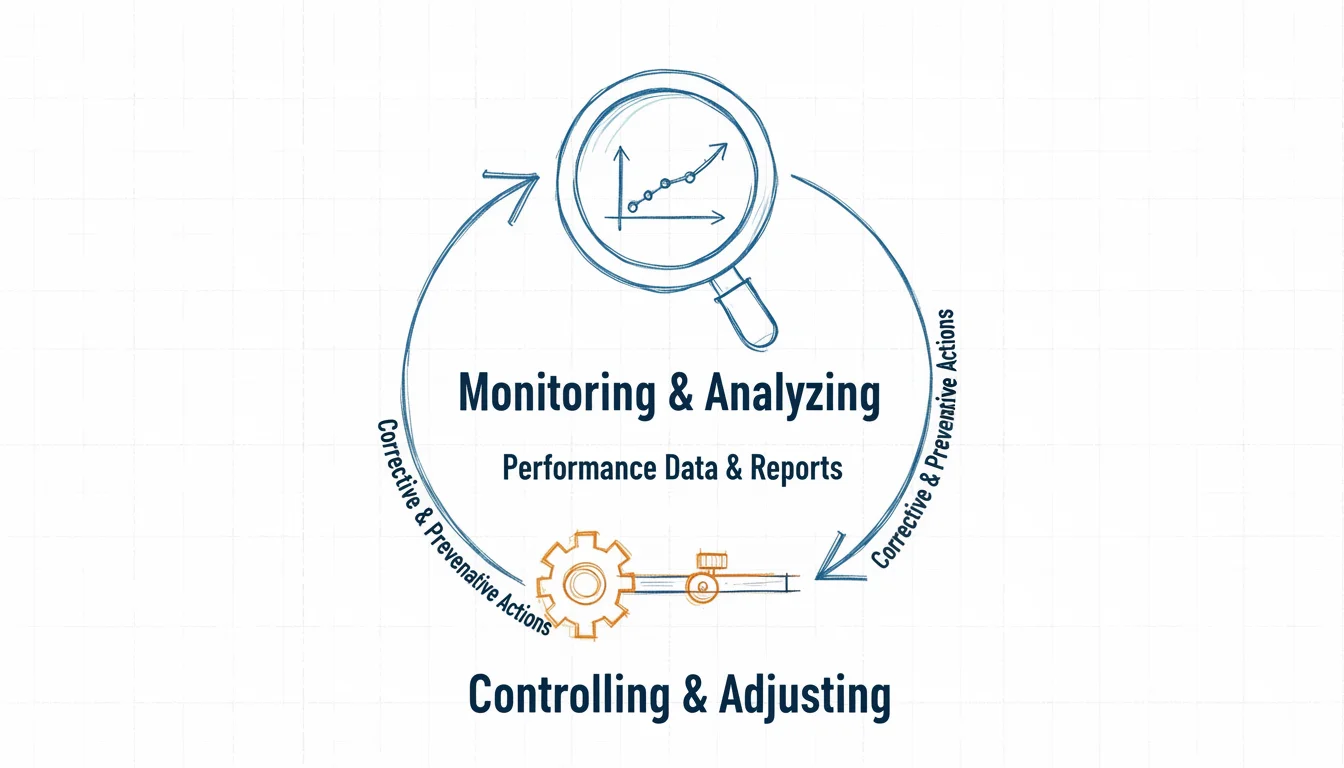
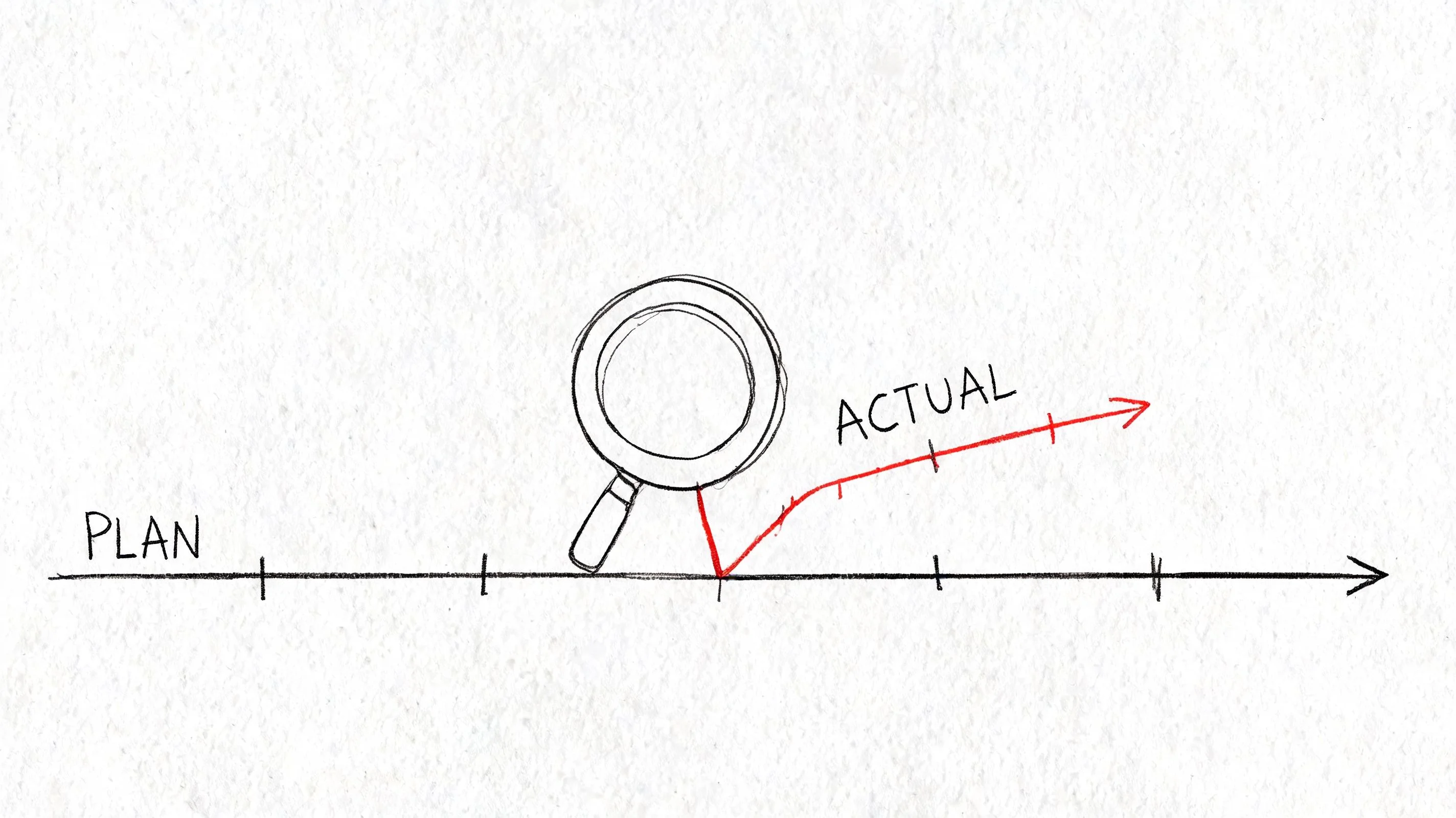
Monitoring is the ongoing act of collecting and reviewing project data. You examine schedule status, costs, risks, quality results, resource usage, stakeholder feedback, and deliverable progress. Simply put, monitoring answers one key question:
Where are we right now?
PMI treats this as a disciplined activity, not casual observation. In project management, monitoring involves systematically collecting performance data. Controlling, then, means analyzing variances and taking corrective action. This approach can improve project visibility, stakeholder communication, issue resolution, and forecasting accuracy. Six Sigma's overview of monitoring and controlling notes these benefits in practice.
Controlling means deciding what to do about the gap
Controlling begins after you compare actual performance to the project baseline. If the project remains aligned, you maintain the current course. If it's drifting, you analyze the root cause and choose an appropriate response.
Think of a ship's captain. The map shows the planned route. The instruments show the ship's actual position. Monitoring is reading the instruments. Controlling is adjusting the rudder.
Practical rule: Monitoring gathers evidence. Controlling turns that evidence into action.
On the PMP exam, students often merge the two. Resist this. If a question focuses on status collection, measurement, reporting, or identifying variance, you're usually in monitoring territory. If it focuses on corrective action, preventive action, change evaluation, or bringing performance back in line, you're in controlling territory.
Why this matters for exam thinking
Monitoring and controlling isn't a one-time phase at the end of a project. It runs throughout the entire project lifecycle. This is why so many exam questions center here. PMI wants you to think like a project manager who stays alert, uses data effectively, and acts through the correct process.
For a broader perspective on how this responsibility fits into a PM's daily work, this breakdown of 7 core IT project management duties offers useful context.
The Core Objectives of Monitoring and Controlling
Students sometimes reduce monitoring and controlling to merely "checking status." This perspective is too narrow. This process group safeguards the entire project.
If planning establishes a project's baseline, monitoring and controlling protects that baseline from gradual erosion. It's the difference between actively leading the project and simply watching it unfold.
Keeping scope, schedule, and cost aligned
The first objective is maintaining alignment with the approved plan. This includes managing scope, schedule, and cost.
When a project manager fails to monitor these aspects together, problems can remain hidden in plain sight. A team might report strong progress while quietly overspending. Or costs may appear stable because scope was informally cut. Or the schedule might still seem feasible because delays in low-priority work haven't been acknowledged.
Unchecked variance typically creates a chain reaction:
- Scope drift can generate more work than the team initially planned to deliver.
- Schedule slippage can trigger resource conflicts and compressed testing periods.
- Cost overruns can force tradeoffs that negatively impact quality or stakeholder trust.
Consider this as operational discipline. Frameworks for efficiency often emphasize that teams need consistent visibility, clear priorities, and feedback loops to act before small problems escalate. This is one reason many project leaders find value in Cyndra's efficiency framework as a practical complement to PMBOK thinking.
Finding risks before they become issues
The second objective is early detection.
A risk remains manageable when it's a signal. It becomes expensive when it's a full-blown issue. Monitoring helps the project manager notice trend changes, repeated blockers, rising defect patterns, unclear ownership, or growing stakeholder frustration before these harden into significant project damage.
A strong project manager doesn't wait for failure to become obvious. They look for evidence while the project is still recoverable.
This is a major PMP mindset point. If an exam question offers a choice between reacting emotionally and analyzing data first, PMI usually expects the measured, data-driven response.
Preserving stakeholder confidence
Stakeholders don't expect a project to be completely frictionless. They do, however, expect clarity.
Monitoring and controlling provides this clarity by producing accurate status information, surfacing tradeoffs, and documenting decisions. When teams report inconsistently, confidence quickly erodes. People start forming their own versions of project reality, which often leads to an increase in escalations.
Effective control doesn't eliminate bad news. It makes bad news actionable.
Protecting quality and decision quality
Quality isn't just about the final deliverable. It also depends on whether the project manager uses reliable information. If the data is stale, incomplete, or inconsistent, every decision made becomes weaker.
This is why monitoring and controlling also protects the quality of management itself. It prevents the team from making decisions based on assumptions, guesses, or pressure from the loudest stakeholder.
A project can survive bad news. It usually struggles more with unclear news.
Key Processes in the Monitoring and Controlling Group
Many PMP candidates feel overwhelmed because the PMBOK lists several processes, and they try to memorize them as isolated terms. This often fails under exam pressure.
A better approach is to group them by their purpose. Once you recognize the pattern, the process names become easier to position.
Performance and status processes
Some processes exist to answer, "How is the project performing against the plan?"
Monitor and Control Project Work serves as the broad umbrella. It compares actual performance with the project management plan and various project documents, prompting the project manager to consider the entire system rather than focusing on just one knowledge area.
Other control processes focus on a specific constraint or domain. Examples include controlling schedule, cost, resources, communications, risks, procurements, and stakeholder engagement. These are narrower in scope, but all serve the same larger purpose: helping the PM detect variance and decide if action is necessary.
In practice, this work relies on structured data. Monitoring and evaluation specialists often build indicator matrices and tracking plans using tools like Excel, STATA, and SPSS. They then produce performance reports that reveal cause and effect, such as how resource misallocation can lead to cost overruns or delayed milestones. This is noted in Eval Community's overview of M&E specialist work. PMP questions won't test specific software, but they do test the underlying mindset: collect clean data, analyze it, then decide.
Change and integration processes
This area frequently presents exam traps.
When performance data reveals a problem, many candidates want to jump directly into action. PMI, however, emphasizes discipline. If the proposed response would alter a baseline, approved plan, or controlled document, the project manager needs to follow formal change handling procedures.
Perform Integrated Change Control is central to this logic. It evaluates requested changes within their broader context, not in isolation. A schedule fix might affect cost. A scope expansion could impact quality, procurement, and risks.
If this area still feels abstract, a practical guide to integration management can help connect change decisions back to the project manager's central coordination role.
Exam lens: When a proposed fix changes the plan, don't implement first and document later. Evaluate the impact through change control.
Validation and verification processes
Students often confuse customer acceptance with internal quality checks.
Validate Scope is about formal acceptance of completed deliverables. The key actor is typically the customer or sponsor. The question is, "Does the stakeholder accept this completed work?"
Control Quality is different. It checks whether deliverables meet required standards and specifications. The question is, "Does this output conform to quality requirements?"
This distinction matters because exam questions often present answers that sound responsible but belong to the wrong process.
Key Monitoring & Controlling Processes at a Glance
| Process Name | Primary Goal | Example Key Output |
|---|---|---|
| Monitor and Control Project Work | Compare actual performance with the plan across the project | Work performance reports |
| Perform Integrated Change Control | Review and decide on change requests in a coordinated way | Approved or rejected change requests |
| Validate Scope | Obtain formal acceptance of completed deliverables | Accepted deliverables |
| Control Scope | Manage changes to scope baseline and prevent uncontrolled expansion | Scope performance information |
| Control Schedule | Track schedule status and manage schedule variance | Schedule forecasts |
| Control Costs | Track spending and manage cost variance | Cost forecasts |
| Control Quality | Verify deliverables meet quality requirements | Quality control measurements |
| Monitor Risks | Track identified risks and evaluate response effectiveness | Risk register updates |
Essential Tools and Techniques You Must Know
You don't need to love formulas to pass the PMP. But you do need to understand what the tools are telling you.
Most monitoring and controlling questions come down to one practical skill: can you assess the health of the project from the evidence in front of you? This is why tools matter; they convert raw data into a decision point.
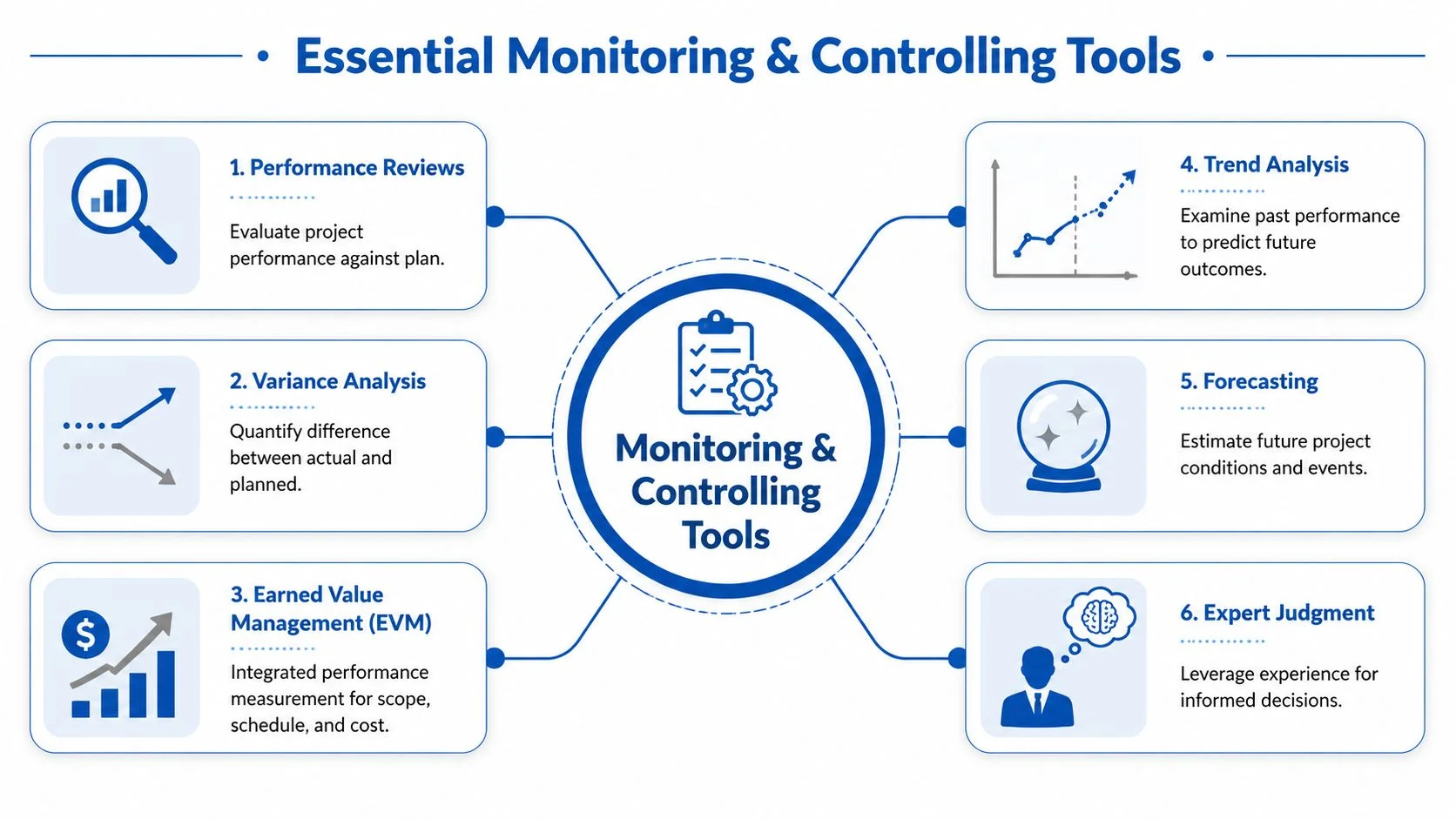
Earned Value Management in plain language
Let's use a fence-building example.
Suppose your project is to build a fence around a property. By today, the plan says half the fence should be finished. That planned amount of work is Planned Value (PV).
Now, check reality. Maybe only a third of the fence is complete. The value of the work finished is Earned Value (EV).
Then, look at the money spent so far. That is Actual Cost (AC).
These three numbers allow you to evaluate both schedule and cost performance.
- Schedule Performance Index (SPI) = EV / PV
- Cost Performance Index (CPI) = EV / AC
Here's how to interpret them for the exam:
- SPI greater than 1 means the project is ahead of schedule.
- SPI less than 1 means the project is behind schedule.
- CPI greater than 1 means the project is spending efficiently.
- CPI less than 1 means the project is experiencing cost overrun pressure.
What matters most is interpretation. If EV is lower than PV, the project has completed less work than planned. If EV is lower than AC, the project has paid more than the value earned.
Variance analysis and trend analysis
Variance analysis asks a simpler question than students might expect: What is the difference between what was planned and what actually happened?
This difference might appear in cost, schedule, scope, quality, or resource use. The PMP exam often tests your next step after noticing variance. Don't stop at "there is a variance." Ask whether it is small, explainable, and manageable, or if it requires escalation or change control.
Trend analysis looks at direction over time. One bad week may not matter, but a repeated pattern matters significantly. If defects are climbing each reporting cycle, or if team velocity consistently falls, the project manager should investigate before the project reaches a visible crisis.
Past variance explains today. Trend analysis helps you anticipate tomorrow.
Performance reports and expert judgment
Performance reporting transforms raw numbers into usable information for stakeholders. A status report that lists activities without interpretation isn't very helpful. A stronger report highlights variance, its likely impact, and the recommended response.
Expert judgment is also crucial here. PMI does not treat data and experience as opposing forces. A seasoned engineer, financial analyst, or quality lead may spot a pattern in the data that a dashboard alone won't explain.
Control charts and statistical thinking
Some PMP candidates overlook statistical quality tools because they seem more manufacturing-focused. Don't dismiss them.
Statistical Process Control, pioneered by Walter A. Shewhart in 1924, uses control charts to monitor process variability in real time. It shifted quality management from post-facto inspection to prevention during the process. This Wikipedia reference notes that its implementation can reduce scrap and rework by 50% to 70% in manufacturing contexts.
For PMP purposes, the lesson is broader than the chart itself: Stable processes are easier to predict. Unstable processes require investigation before their output quality can be trusted.
A quick memory shortcut
When you encounter a tool-related question, ask these three things:
- What is being measured?
- Compared to what baseline?
- What decision should follow?
This approach connects tools directly to management action, which is how PMI typically frames them.
Tracking Performance with KPIs and Metrics
A dashboard full of numbers can still leave a project manager feeling blind.
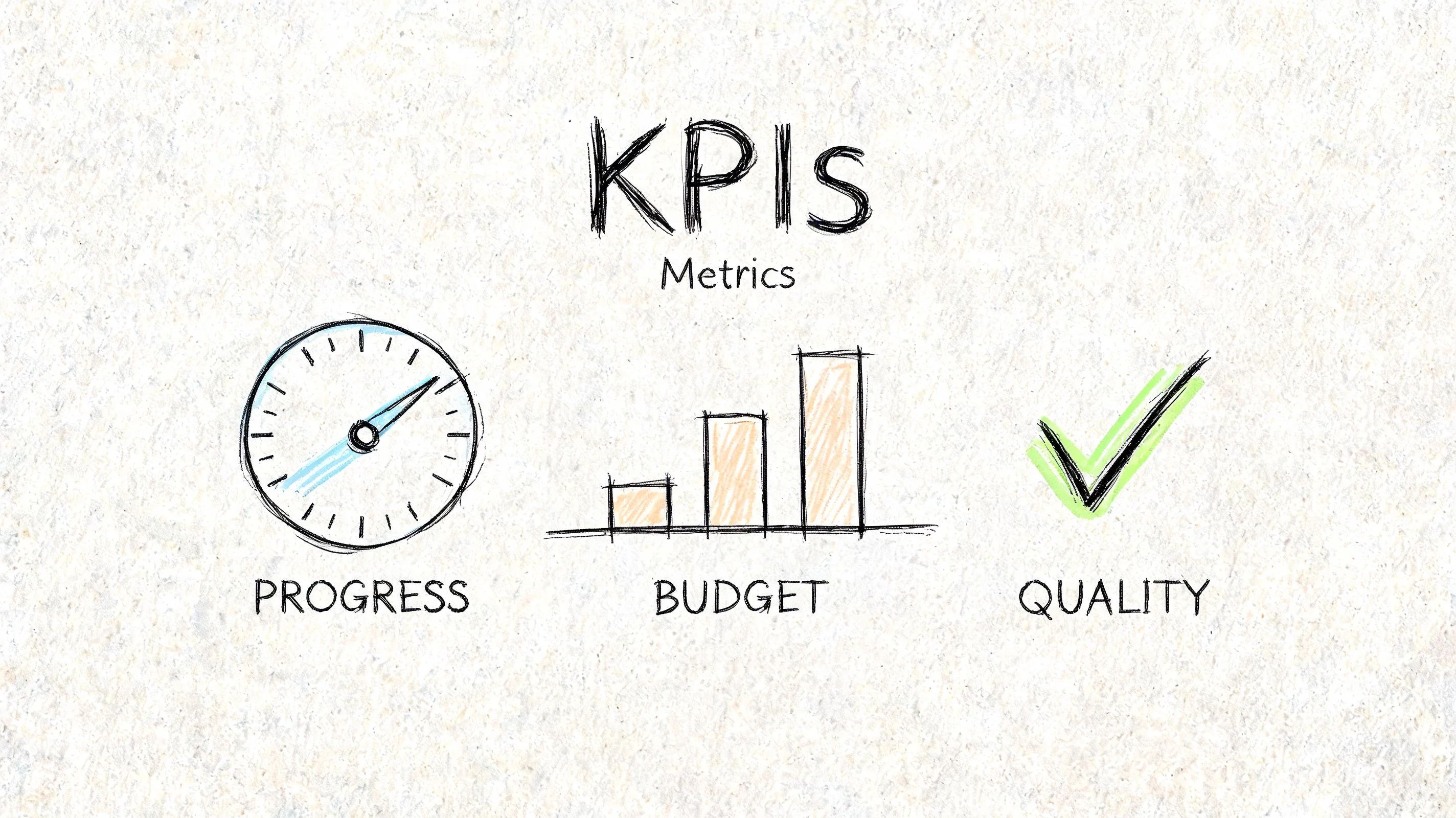
The problem isn't a lack of metrics. It's choosing metrics that don't lead to a decision. On the PMP exam, and in real projects, a useful metric answers one question: What action does this number help me take?
Vanity metrics versus actionable KPIs
A vanity metric might look impressive but doesn't help manage the project. An actionable KPI helps the project manager decide whether to intervene, escalate, replan, or stay the course.
For example:
- A vanity metric might be the number of meetings held.
- An actionable KPI might be unresolved blockers that are delaying critical-path work.
This distinction matters because some projects collect lots of activity data but very little decision-driving data.
For examples of practical reporting approaches, this article on how teams track project progress is a useful supplement.
Leading indicators and lagging indicators
A strong set of KPIs usually includes both.
Lagging indicators tell you what has already happened. Budget spent, completed milestones, and accepted deliverables fall into this category.
Leading indicators hint at what may happen next. Open defects, aging risks, unresolved dependencies, and repeated requirement clarifications often signal future trouble before schedule or cost numbers fully reflect it.
This distinction helps with scenario questions. If PMI asks what the project manager should monitor to avoid future slippage, the better answer is often a leading indicator, not just a report of damage already done.
A decision-based metric filter
Use this quick filter when choosing a KPI:
- If this number changes, what decision changes?
- Who needs to act on it?
- How often should it be reviewed?
- Does it reflect project objectives or just activity?
Useful test: If nobody would act differently after seeing the metric, it probably isn't a KPI worth highlighting.
Why rigor matters
Sometimes project teams rely on impressions instead of evidence. That's risky.
In monitoring and evaluation, inferential statistics like t-tests help determine whether a change is likely meaningful rather than random. One example compares disease incidence rates of 15% before a program and 8% after. A t-test can determine whether that drop is statistically significant (e.g., at p<0.05), helping decision-makers confirm effectiveness and allocate resources, as described by Eval Community's summary of statistical methods.
You won't need to run t-tests on the PMP exam. But the lesson remains relevant. Good monitoring doesn't just collect numbers; it verifies whether those numbers support a real decision.
Common Exam Pitfalls and How to Avoid Them
Monitoring and controlling questions are dangerous because the wrong answer often sounds responsible.
Candidates miss them because they pick the answer that feels active, fast, or helpful, instead of the answer that follows PMI's logic.
Trap one: Confusing Validate Scope with Control Quality
These two are similar enough to fool people under pressure.
Control Quality asks whether the deliverable meets quality standards. This is an internal verification activity.
Validate Scope asks whether the customer or sponsor formally accepts the deliverable. This is an external acceptance activity.
If the question mentions inspection, conformance, defects, measurements, or standards, think quality. If it mentions sign-off, acceptance, approval of completed deliverables, or customer review, think scope validation.
Trap two: Implementing the fix before change control
A project falls behind. A stakeholder proposes adding staff, changing requirements, or adjusting the timeline. The tempting answer is to act immediately.
PMI usually prioritizes discipline first. If the action changes a baseline, assess the impact and process the change properly before implementation.
Trap three: Reading CPI and SPI backward
This is a common error under exam pressure.
Students often remember that "higher is better" but forget what each index represents. Keep it simple:
- SPI is about schedule efficiency.
- CPI is about cost efficiency.
If SPI is below 1, the project is behind schedule. If CPI is below 1, the project is spending inefficiently.
This short walkthrough is worth watching if you want another explanation of common PMP monitoring mistakes and how scenario questions are framed.
Trap four: Solving the symptom, not the cause
A defect appears. A milestone slips. A stakeholder complains. The weak answer only addresses the visible problem. The better answer investigates the underlying reason, reviews the impact, then chooses the right corrective path.
On the PMP exam, the best answer often feels slower than your instinct, because PMI values process discipline over impulsive action.
If you remember one rule from this section, use this one: analyze first, then act through the proper process.
Your Study Strategy for Mastering Monitoring and Controlling
Monitoring and controlling becomes easier when you stop trying to memorize disconnected terms and start practicing decision patterns.
First, learn the pairs that students frequently confuse: Validate Scope versus Control Quality. Monitoring versus controlling. Corrective action versus change request. If you can separate these cleanly, many questions will lose their ambiguity.
Next, drill Earned Value Management (EVM) until the formulas feel familiar enough that you can focus on interpretation. Spaced repetition works well here because the goal isn't just recall; it's speed under pressure. You want CPI and SPI interpretations to feel automatic.
Then, study through scenarios, not isolated definitions. Monitoring and controlling is where PMI tests judgment. Read questions by asking:
- What evidence do I have?
- Is this a variance, a defect, a risk, or a requested change?
- Does the project manager need to analyze, escalate, report, or process a change?
Finally, track your weak spots instead of restudying everything evenly. If Perform Integrated Change Control keeps tripping you up, spend more time there than on areas you already answer consistently. That kind of targeted review is why many candidates pair concept work in the MindMesh Academy PMP study guide with spaced repetition and visible progress tracking — so the next session targets the gaps your last attempt actually exposed.
The PMP exam rewards calm, structured thinking. Monitoring and controlling is where that mindset shows up most clearly.
Reading about variance is one thing. Recognizing it under timed pressure, in a scenario question that feels deliberately ambiguous, is what actually separates candidates who pass from those who retake. When you're ready to test your monitoring-and-controlling instincts under real exam conditions, run a session on the PMP practice exam and let your error log decide where the next study block goes.

Written by
Alvin Varughese
Founder, MindMesh Academy
Alvin Varughese is the founder of MindMesh Academy and an enterprise architecture leader. An electrical engineer by training, he moved from factory automation in South Africa to cloud architecture at GE Appliances and Humana (Fortune 50), and holds 20 professional certifications including AWS Solutions Architect Professional, Azure DevOps Engineer Expert, and Microsoft Agentic AI Business Solutions Architect. He built MindMesh Academy after interviewing too many highly certified candidates who couldn't answer basic questions: the goal is prep that makes you better at the job, not just able to pass the exam.