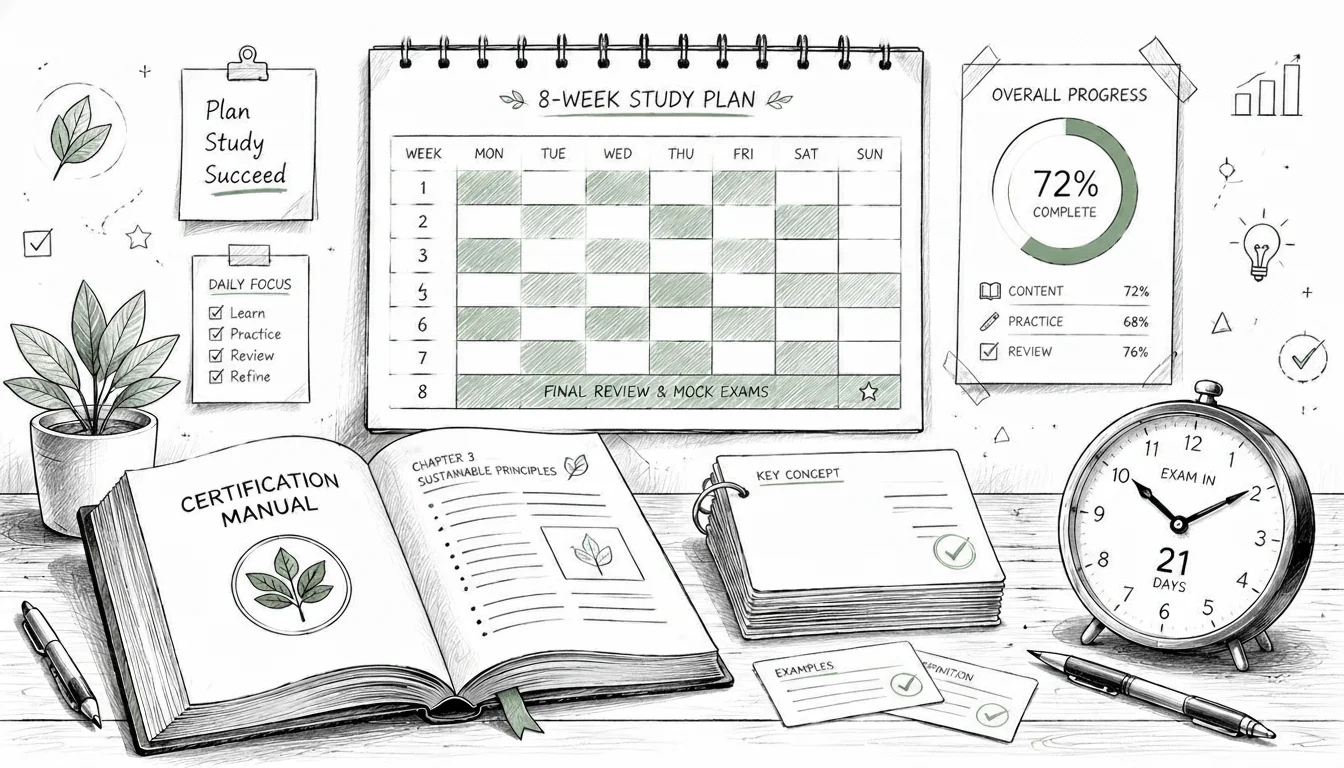
LEED Certification Exam Prep: Ultimate Guide 2026
A Strategic Approach to LEED Exam Preparation
Many LEED candidates start their preparation the same way. You open one study guide, then another, then a stack of flashcards, and a folder of practice questions. Within an hour, it can feel like you're preparing for five different exams instead of just one.
This overwhelm often comes from studying without a clear system. Preparing for the LEED certification exam is more effective when you treat it like a managed project. You need a clear sequence, a way to measure progress, and methods to recall concepts under time pressure. The fastest-improving candidates usually don't just read more. They review content effectively, practice under realistic conditions, and adjust their strategy based on their performance.
Your Strategic Approach to LEED Exam Prep
An effective LEED study plan begins by eliminating passive work. Rereading highlighted notes for the third time might feel productive, but it rarely prepares you for application-heavy questions. The exam rewards recognition, judgment, and the ability to distinguish the best answer from several plausible options.
That's why effective LEED certification exam preparation involves three key steps:
- Build a narrow source stack. Choose one primary study guide, one reliable practice question source, and a single note-taking system.
- Study in loops, not marathons. Learn a topic, quiz yourself on it, then revisit it later to reinforce retention.
- Track misses by pattern. Don't just record that you answered incorrectly. Understand why you got it wrong.
What Actually Works
Candidates typically make progress when they study in short, deliberate sessions. An effective session produces a clear output: you summarize a concept in your own words, answer questions without referring to notes, or review incorrect answers until you can explain the logic clearly.
Practical rule: If a study session ends with “I read a lot,” that session probably didn't significantly improve your score.
Consider preparation this way:
- Content first: Understand the vocabulary, categories, and the intent behind green building decisions.
- Application second: Use practice questions to practice recall and judgment.
- Repair third: Return to weak areas for targeted review instead of rereading all your materials.
What Wastes Time
Some habits appear disciplined but yield little progress:
- Cramming entire weekends: You might cover material, but retention quickly declines.
- Collecting too many resources: More PDFs often lead to confusion rather than clarity.
- Chasing memorization alone: Rote study methods leave candidates vulnerable when questions test trade-offs and nuanced understanding.
If you're looking for a structured platform that organizes study materials and tracks progress in one place, MindMesh Academy's exam preparation resources offer systems that support effective certification study. The right format matters because consistency drives results.
First, Understand the Battlefield: A LEED Exam Breakdown
Before you finalize a study plan, clarify the exam's mechanics. Many candidates experience anxiety because the exam appears vague. It isn't vague; it's demanding in specific ways.
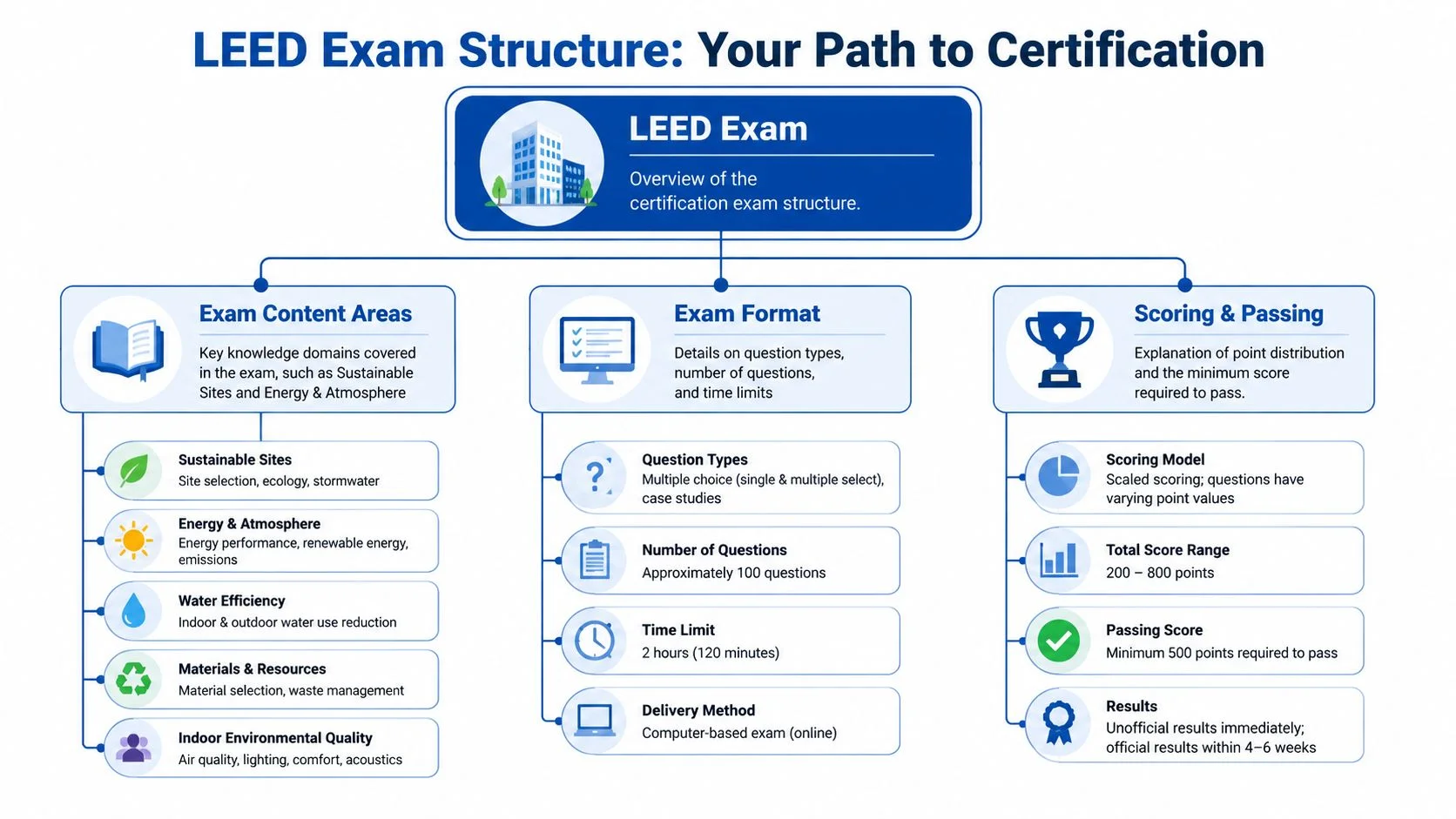
Early in your preparation, visualizing the exam structure can be helpful.
The Format Shapes the Strategy
The LEED Green Associate exam consists of 100 questions, is computer-based, and has a 2-hour time limit. Candidates need a scaled score of 170 out of 200 to pass. There is no penalty for wrong answers, so educated guessing is a better strategy than leaving questions blank.
These facts inform much of your strategy. This isn't an exam where you can linger. It's tightly paced, rewarding clear recognition more than slow reflection.
A helpful companion to your LEED reading is a broader guide on sustainable building practices from Facility Management Insights. It helps candidates connect exam concepts to the real-world project decisions those concepts address.
What the Exam Is Really Testing
Candidates often focus on studying specific “credits” or “categories.” However, the exam primarily tests your understanding of intent and relationships within green building principles.
This means you must prepare for questions that require distinguishing between several plausible choices. Incorrect answers aren't usually absurd; they're often closely related ideas, partial truths, or options that align with a different sustainability objective.
Many candidates don't fail because they never encountered a term before. They fail because they chose the second-best answer.
Real project understanding also helps significantly. If you know how green building strategies influence design, operations, materials, site planning, and occupant outcomes, you'll approach these questions more effectively than someone who only memorized definitions.
Later in your preparation, this video can reinforce the exam's structure and expectations:
Your 8-Week LEED Exam Prep Roadmap
While many candidates pass in a shorter timeframe, a longer preparation period allows more room to absorb concepts, revisit them, and build confidence without cramming. Many successful candidates report studying for 2 to 4 weeks at 2 to 3 hours per day. Readiness is often indicated by scoring 85% or higher on multiple full-length mock exams. An 8-week plan spreads this work out more safely.
A Flexible Weekly Plan
Use this framework as a guide, not a rigid script. If you already work in sustainability, you might move faster through foundational material and spend more time on question review.
| Week | Focus Topics | Study Method |
|---|---|---|
| Week 1 | LEED structure, terminology, core green building principles | Read primary guide, create concise notes, build first flashcards |
| Week 2 | Sustainable sites, water-related concepts, integrative thinking | Active recall sessions, short untimed quizzes, concept mapping |
| Week 3 | Energy-related ideas, materials, indoor environmental themes | Topic blocks followed by self-testing without notes |
| Week 4 | Review all covered domains and begin mixed-question practice | Timed question sets, wrong-answer log, flashcard revision |
| Week 5 | Scenario-based questions and weak-area repair | Focused drills by topic, rewrite notes only for missed concepts |
| Week 6 | First full mock exam and detailed review | Full timed simulation, categorize misses by concept and wording |
| Week 7 | Second and third mock exams, pacing improvement | Exam-condition practice, flag-and-return strategy, light review |
| Week 8 | Final consolidation and confidence building | Short recall sessions, one final mock if needed, rest and reset |
Why This Sequence Works
Many people want to start with numerous practice questions immediately. This approach is only useful once you've built sufficient conceptual understanding to learn from them. If you start too early, every wrong answer feels random. If you begin too late, your exam pacing will suffer.
A more effective order is:
- Weeks 1 to 3: Build your foundational knowledge and translate raw content into usable notes.
- Weeks 4 to 6: Focus on retrieval, timing, and diagnosing your weak areas.
- Weeks 7 to 8: Improve decision speed and minimize avoidable errors.
How to Adapt the Roadmap
Not every candidate requires the same emphasis. Adjust your plan based on your background.
- If you're new to green building: Dedicate more time to explaining concepts aloud in plain language.
- If you work on projects already: Focus less on terminology review and more on challenging answer choices.
- If you struggle under timed conditions: Introduce timed practice sets earlier, even in small blocks.
Your calendar should serve your score. Your score shouldn't serve your calendar.
A simple weekly rhythm often works best: learn new content early in the week, quiz yourself in the middle, and review weak spots at the end. This rhythm moves material from familiarity to active recall.
Benchmarks That Matter
You don't need to 'feel ready.' You need evidence. The clearest signals are consistent performance, not one lucky mock score.
Look for these indicators:
- Stable mock performance: Your scores aren't fluctuating wildly from test to test.
- Clearer reasoning: You can explain why three options are incorrect, not just why one is right.
- Improved recovery: When you miss a question, you address the underlying concept quickly.
If these signals aren't present yet, consider delaying the exam and tightening your study loop. This is often smarter than booking a date and hoping motivation fills the gaps.
Study Smarter with Spaced Repetition and Active Recall
The most common study mistake in LEED preparation is confusing exposure with actual learning. Seeing the same page five times doesn't mean you can recall that idea under pressure. Retrieval is what truly counts.
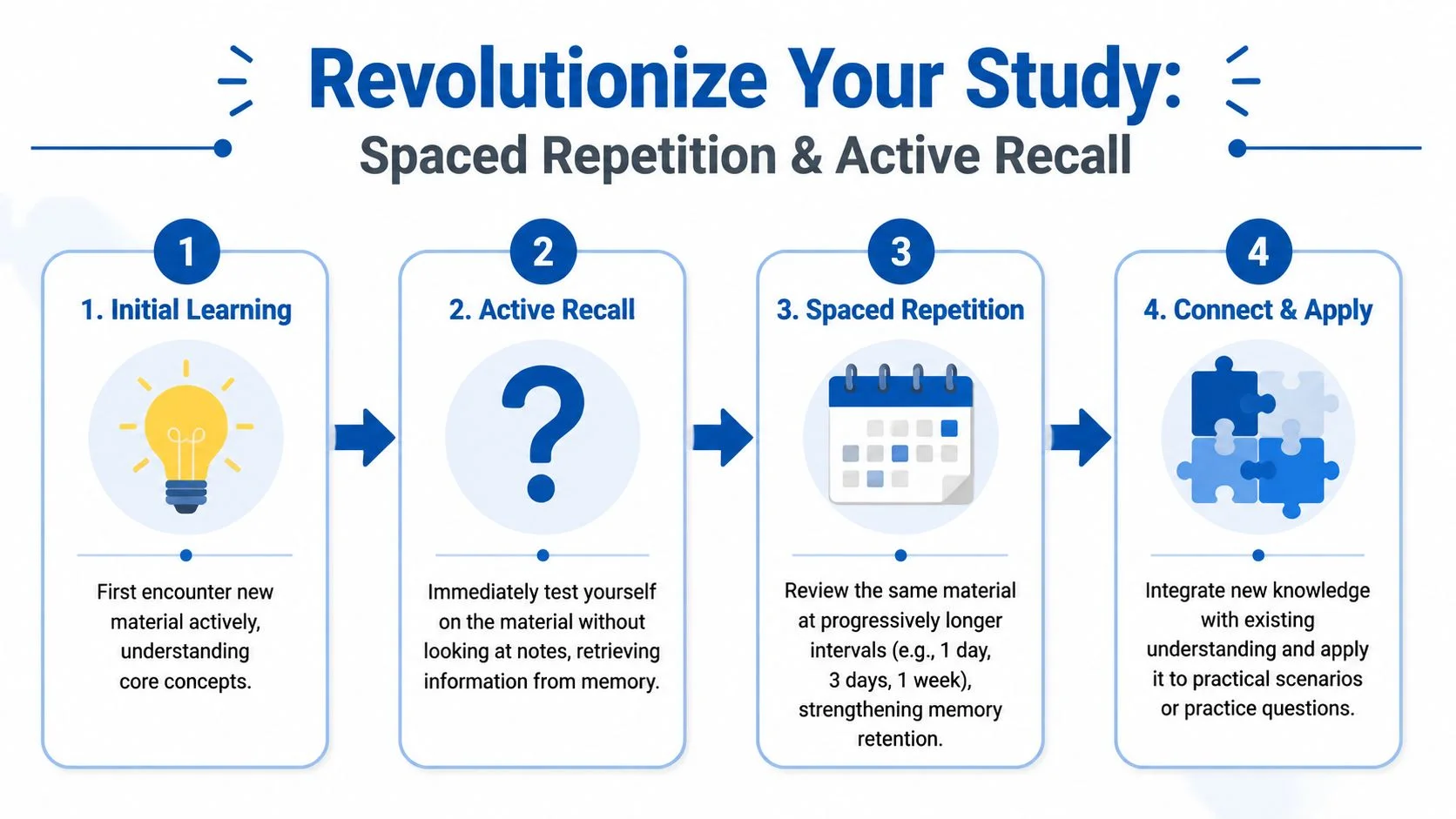
The most efficient preparation systems follow a simple sequence: learn a concept, actively force yourself to recall it, then revisit it before you forget.
Why Passive Reading Falls Short
A common recommendation for LEED preparation suggests a workflow of learning content first, then taking timed practice exams, and finally reviewing weak areas. With 2 hours for 100 questions, you have just over a minute per item. This tight timeframe makes active recall and repeated practice far more useful than passive reading alone.
That time pressure changes everything. On exam day, you won't have the luxury of thinking, “I remember seeing this somewhere.” You'll need immediate recognition and quick elimination.
Active Recall in Real LEED Study
Active recall sounds technical, but it's a simple concept: close your book or notes and try to produce the answer from memory.
For LEED candidates, this can involve:
- Flashcards: One side presents a concept, the other side contains the explanation in your own words.
- Blank-page summaries: Write down everything you recall about a topic before checking your notes.
- Self-quizzing: Ask yourself why one sustainability strategy is more appropriate than another in a given scenario.
The key is effort. If recalling the answer feels slightly uncomfortable, that's usually a good sign: your brain is actively building usable memory.
Field-tested advice: Don't ask, “Do I recognize this?” Ask, “Can I explain it without help?”
How Spaced Repetition Prevents the Usual Forgetting Cycle
Spaced repetition addresses a familiar problem: You study hard on Sunday, feel sharp on Monday, but by Thursday, half of it has faded. The solution isn't longer sessions, but returning to the material at planned intervals.
A practical explanation of this method appears in MasteryMind's advice on spaced repetition, and its logic fits LEED preparation well. Review newer topics sooner, older topics less often, and reactivate concepts before they disappear.
A practical routine could look like this:
- First exposure: Learn the topic actively.
- Short return: Revisit it soon using flashcards or self-test prompts.
- Later return: Review again after a longer interval.
- Application: Use mixed questions to connect that topic with other concepts.
This is also the type of retrieval-centered system discussed in MindMesh Academy's study techniques, where memory aids are tied to active testing rather than simple rereading.
A Better Note-Taking Standard
Most candidates write too much. They create detailed notes that are difficult to review and almost impossible to quiz from. Your notes should be concise enough to serve as prompts for recall.
Focus on keeping only what helps you answer questions:
- Decision rules: Explain why one strategy is preferred in a specific scenario over another.
- Contrast pairs: Define similar concepts that candidates often confuse.
- Trigger words: Identify terms that signal what a question is truly asking.
If a page of notes can't easily convert into flashcards, prompts, or quick oral explanations, then trim it.
Mastering Your Mock Exam Strategy
Practice questions are where preparation becomes honest. Until you start answering under pressure, it's easy to overestimate your knowledge.
Modern preparation materials reflect this shift. Many resources now offer free options, including 10 video modules, 3 full-length practice exams with 300 questions, and support for over 100,000 professionals. This scale indicates something important: serious preparation now centers on rehearsal, not just reading.
Treat Mocks as Diagnostics
A mock exam isn't merely a score report. It's a map of your thought processes under pressure.
After each timed set, categorize your incorrect answers:
- Concept gap: You didn't know the underlying principle.
- Application gap: You understood the concept but couldn't apply it to the given scenario.
- Reading error: You overlooked a keyword or qualifier in the question.
- Judgment error: You narrowed options effectively but chose the weaker final answer.
This categorization marks the difference between useful review and empty repetition. If you only check the answer key and move on, you waste most of the diagnostic value.
How to Review Wrong Answers Properly
An effective review session often takes longer than the test block itself. This surprises many candidates, but it's where most score gains originate.
Follow this review sequence:
- Re-answer the question without assistance. See if you can solve it correctly now.
- Explain each option. Articulate why one is the best choice and why the others are incorrect.
- Write one takeaway sentence. Keep it concise and actionable.
- Tag the issue. Identify if the problem was a concept gap, wording confusion, pacing, or similarity to another term.
Don't celebrate finishing a mock exam. Celebrate extracting lessons from it.
Build Exam Stamina, Not Just Knowledge
A candidate can possess the knowledge but still underperform due to poor timing. That's why full-length mock exams are crucial. They train pacing, concentration, and your ability to recover after difficult questions.
A useful rule is to simulate the testing environment as closely as possible. Sit at a desk, use a timer, avoid interruptions, and don't pause to “quickly check” a concept. Training under easier conditions creates false confidence.
This logic applies to other certification settings as well. The methods behind expert strategies for IT certification transfer surprisingly well because test performance often depends on similar skills: timing, triage, and review discipline.
How to Handle Tricky Answer Choices
LEED questions frequently include several respectable-sounding answers. When this occurs, don't chase the option with the most impressive wording. Instead, look for the answer that best fits the question's intent.
A practical elimination method involves:
- Remove the answer that solves the wrong problem.
- Remove the answer that is too broad or too narrow.
- Compare the final two options based on project logic.
- If still unsure, choose the better fit and move on.
That last step is crucial. Perfectionism wastes time. Strong candidates make informed decisions, flag uncertainty, and keep moving through the exam.
Track Your Progress and Avoid Common Pitfalls
The final phase of preparation isn't about doing more; it's about doing the right next thing. This requires visibility. If your study plan relies solely on gut feeling, you'll likely over-study familiar topics and neglect those that genuinely threaten your score.
A progress dashboard addresses this by converting practice results into actionable patterns.
What a Dashboard Should Show You
A valuable learning dashboard doesn't just provide an overall score. It should help you identify where your performance breaks down.
Look for signals such as:
- Topic weakness: You repeatedly miss questions on the same type of content.
- Question-behavior pattern: You rush through easy items and stall on ambiguous ones.
- Retention decay: Topics you understood last week are now slipping from memory.
- Confidence mismatch: You feel confident, but your results indicate otherwise.
This kind of feedback allows you to adjust your final study days intelligently. Instead of “reviewing everything,” you can target the exact domains and question styles that require more attention.
The Common Mistakes That Stall Candidates
Most LEED candidates don't struggle due to a lack of capability. They struggle because their study habits can hide problems until late in the process.
The most common issues include:
- Cramming instead of cycling: Short-term familiarity with material fades quickly.
- Ignoring answer rationales: If you don't understand why an answer was correct, you miss a crucial learning opportunity.
- Using question volume as a badge: Answering hundreds of questions means little if your review is superficial.
- Sticking with outdated preparation assumptions: The exam environment is continuously evolving.
One current challenge involves adapting to LEED v5. This version emphasizes decarbonization, equity, and resilience. However, much available preparation content still relies on older rote-recall habits, creating a gap for candidates who need to understand conceptual trade-offs in this evolving rating system.
This matters because newer themes don't reward memorization alone. They require you to think in systems. You need to recognize why a particular choice supports carbon reduction, occupant outcomes, or resilience goals, and how those goals can interact.
The next generation of LEED preparation isn't just about “knowing more facts.” It's about “reasoning more clearly about sustainable decisions.”
A Final Adjustment Routine
In the final stretch before the exam, apply a simple decision loop:
- Check your results by category or pattern.
- Select one weak area for focused review.
- Test that area again.
- Move on only when that weakness stops recurring.
This routine prevents the classic last-week mistake of bouncing between resources without actually solving underlying issues.
A solid final checklist includes:
- You can explain core concepts in plain language.
- You've completed full-length timed practice exams.
- You review missed questions for underlying logic, not just correctness.
- You're studying current concepts with attention to LEED v5 themes.
- Your final days of study are targeted, not frantic.
If you want a more structured way to manage certification study, MindMesh Academy offers a dashboard-based approach built around practice, weak-area tracking, and evidence-based study methods. Explore our CompTIA A+ Core 1 practice exams to see how this kind of system can make your certification preparation measurable and effective, rather than improvised.

Written by
Alvin Varughese
Founder, MindMesh Academy
Alvin Varughese is the founder of MindMesh Academy and an enterprise architecture leader. An electrical engineer by training, he moved from factory automation in South Africa to cloud architecture at GE Appliances and Humana (Fortune 50), and holds 20 professional certifications including AWS Solutions Architect Professional, Azure DevOps Engineer Expert, and Microsoft Agentic AI Business Solutions Architect. He built MindMesh Academy after interviewing too many highly certified candidates who couldn't answer basic questions: the goal is prep that makes you better at the job, not just able to pass the exam.