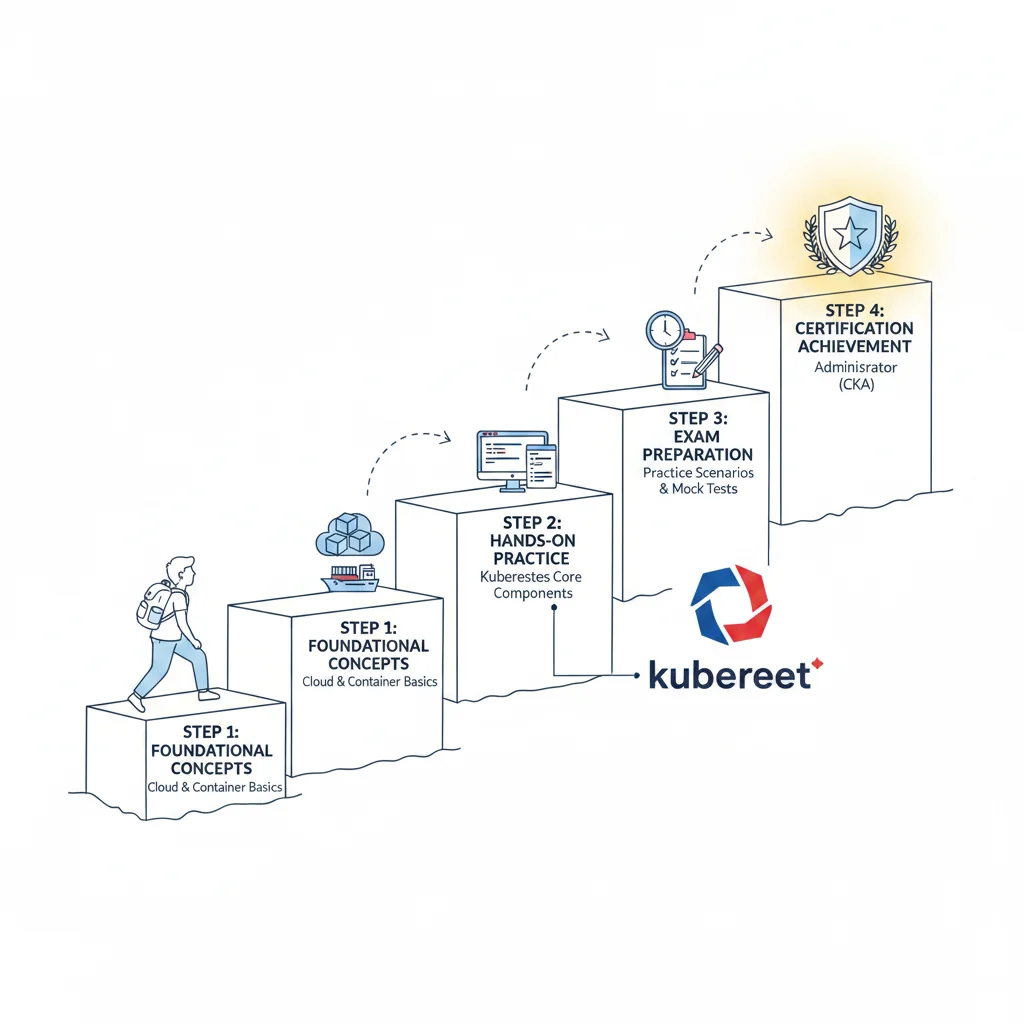
Kubernetes Certification Training Your Ultimate Guide
Kubernetes Certification Training: Your Path to Cloud-Native Expertise
You're probably seeing the same pattern many engineers see. A role looks interesting, the stack sounds familiar, and then one line appears again and again: Kubernetes.
At first, that line feels vague. Do they want someone who can deploy an app? Troubleshoot a broken cluster? Secure workloads? "Learn Kubernetes" sounds like one task, but in practice it covers several different jobs. That's why so many smart people stall before they even start.
The good news is that Kubernetes certification training gives you a structured path. It turns a messy goal into a series of clear decisions: which certification fits your work, what skills matter most, how the exam works, and how to study without wasting weeks on the wrong material.
Your Starting Point on the Cloud Native Path
You open a job post for a platform role. Kubernetes is listed. You open a second post for a DevOps position. Kubernetes is there too. Then a security-focused role mentions it again, and now the core question shows up. Where do you start, and how do you study without wasting time on the wrong path?
That uncertainty is common because Kubernetes sits at the intersection of application delivery, infrastructure, and security. A junior engineer may touch deployments. A platform engineer may care about cluster health. A security engineer may focus on hardening workloads and access controls. The same technology appears in each role, but the day-to-day responsibility is different.
Kubernetes works like an operating model that pulls together skills you may already know from Linux, containers, CI/CD, and cloud platforms. It gives teams a consistent way to run applications, recover from failure, manage updates, and apply standards across environments. If you want business context for why companies keep investing in that direction, this article on cloud computing scalability helps connect the technical work to the broader reason cloud-native systems matter.
Why Certifications Matter Here
Certifications help because they turn a vague goal into a defined skills path. Instead of studying "Kubernetes" as one giant topic, you study for the kind of work you want to do.
That distinction matters more than many learners expect.
The Linux Foundation and CNCF have created a certification path that maps to real responsibilities, which is why these exams carry weight with hiring teams. From your individual perspective, they provide boundaries. Boundaries reduce noise. Once you know which certification matches your target role, you can stop collecting random resources and start building a study system that supports one clear outcome.
What Usually Trips People Up
A lot of capable learners stall because they study by accumulation. They bookmark courses, save labs, watch videos, and keep adding material. After a few weeks, they have a pile of resources but no method for review, practice, or retention.
A better approach starts with your career goal and builds backward from there:
- Match the certification to the job you want next. If your work centers on cluster operations, study for that role. If you build and deploy applications, choose the path that reflects that responsibility.
- Create a repeatable study system. Set a weekly cadence for hands-on labs, short review sessions, and spaced repetition for commands and concepts you need to recall quickly.
- Track weak spots early. Keep a simple error log. If networking tasks, RBAC, or troubleshooting steps keep slowing you down, your plan should reflect that pattern.
- Practice under exam-like pressure. Kubernetes exams reward recall plus execution. You need both.
If you want to compare paths before committing, you can explore certification programs to see how different technical tracks line up with different career goals.
The right certification should reduce uncertainty and give your study time a clear direction.
Decoding the Kubernetes Certification Alphabet
Kubernetes certifications make more sense when you stop seeing them as acronyms and start seeing them as jobs.
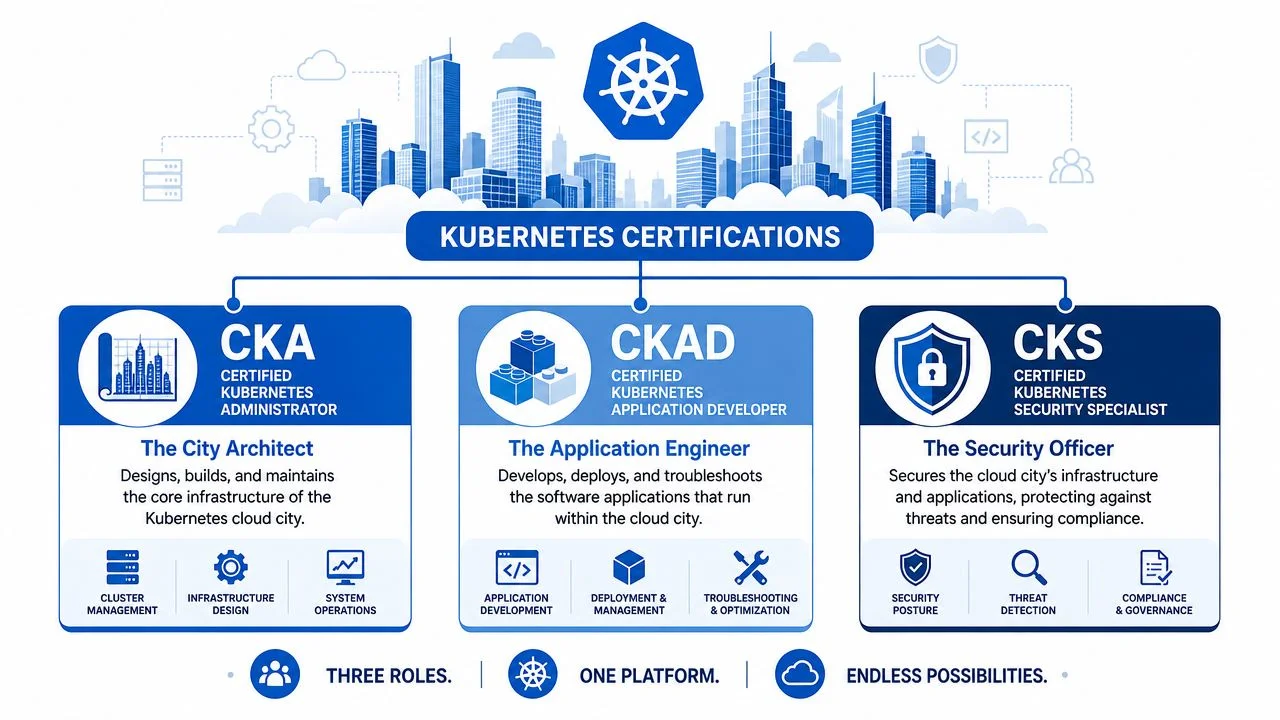
Think of Kubernetes as a cloud city. Applications live there. Traffic moves through it. Security rules shape what can and can't happen. Different people keep that city running.
CKA as the City Planner
The Certified Kubernetes Administrator (CKA) fits the engineer who keeps the platform healthy. This person thinks about cluster operations, resilience, networking behavior, storage behavior, and troubleshooting under pressure.
If a node fails, workloads won't schedule, or a service isn't reachable, the CKA mindset kicks in. You're responsible for the system itself, not just the app inside it.
This role suits:
- System administrators moving into cloud-native operations
- DevOps engineers who already own pipelines and runtime environments
- Platform engineers building reliable shared infrastructure
CKAD as the Application Architect
The Certified Kubernetes Application Developer (CKAD) is for the person who designs and deploys workloads inside the cluster. This role focuses less on the city's plumbing and more on how buildings are constructed and used.
A CKAD candidate spends more time thinking about Pods, Deployments, configuration, rollout patterns, and the behavior of applications once they're scheduled. If your daily work involves packaging services, tuning manifests, and making apps behave correctly in Kubernetes, this path is usually the better fit.
Common matches include:
- Backend developers deploying containerized services
- Application engineers working with YAML, configuration, and release workflows
- DevOps-minded developers who need strong deployment fluency
CKS as the Security Chief
The Certified Kubernetes Security Specialist (CKS) focuses on hardening the environment. This role asks a different question from the others. Not “Can the cluster run?” and not “Can the app deploy?” but “Can this system resist mistakes and abuse?”
That means thinking about access control, secrets handling, runtime protection, and security posture across workloads and cluster components.
Practical rule: Don't choose CKS because it sounds impressive. Choose it when security work is already part of your job, or when you want to specialize after building solid admin skills.
Why Role-Based Training Works Better
CNCF states that its certifications target Kubernetes and cloud-native skills including storage, networks, GitOps, service mesh, and cloud-native security, while CKA, CKAD, and CKS map to administration, application development, and security specializations on the official CNCF certification page.
That's why good Kubernetes certification training is role-specific. If you're an administrator, you need repetition on cluster operations. If you're a developer, you need speed with manifests and workload design. If you're security-focused, you need to see risky patterns early and fix them with confidence.
CKA vs CKAD vs CKS: A Detailed Comparison
When people ask me which certification to take first, I usually answer with another question: what kind of problems do you already solve?
That question matters more than your title. Plenty of developers do platform work. Plenty of DevOps engineers spend most of their day helping teams package and release applications. Your actual responsibilities should drive the choice.
The comparison below makes that easier.
Kubernetes Certification Comparison
| Attribute | CKA (Administrator) | CKAD (Developer) | CKS (Security Specialist) |
|---|---|---|---|
| Primary focus | Cluster administration and operations | Application design and deployment on Kubernetes | Securing Kubernetes clusters and workloads |
| Best fit for | Sysadmins, DevOps engineers, platform engineers | Software engineers, application developers, release-focused engineers | Security engineers, DevSecOps professionals, security-minded platform teams |
| Typical daily concerns | Cluster health, scheduling, networking, storage, troubleshooting | Pods, Deployments, configuration, rollout behavior, app reliability | RBAC, secrets, hardening, security controls, risk reduction |
| Think of this role as | Running the city | Building inside the city | Protecting the city |
| Study style that works best | Repeated operational labs and troubleshooting drills | YAML-heavy workload practice and deployment scenarios | Security-focused scenarios layered on top of admin fluency |
| Good first choice for most learners | Often yes | Sometimes, if you're clearly app-focused | Usually no, unless security is already your lane |
Why CKA is Often the Starting Point
According to DevOps Cube, the Certified Kubernetes Administrator (CKA) had 250,000 enrollments in CNCF's 2024 annual report and accounted for 54% of Kubernetes certifications in job trends, as noted in DevOps Cube's Kubernetes certification analysis.
That popularity doesn't mean everyone should blindly choose CKA. It does tell you something useful, though. For many teams, cluster operations form the baseline. Even developers benefit from understanding how workloads are scheduled, exposed, and debugged.
How to Read the Table for Your Own Career
If you're still unsure, use these filters.
Choose CKA if Your Work Starts with Reliability
You should lean toward CKA if you already touch infrastructure tickets, support environments, CI/CD operations, or cluster troubleshooting. This path gives you the broadest operational foundation.
It's also a strong choice if you want to move into:
- Platform engineering
- Site reliability work
- Cloud operations
- Infrastructure-focused DevOps
Choose CKAD if Your Work Starts with Shipping Software
CKAD makes more sense if your main responsibility is building or deploying applications. You'll care more about writing manifests cleanly, exposing services correctly, and making rollouts behave as expected.
This path fits engineers who ask questions like:
- Why is my Pod failing to start?
- Why didn't the Deployment update the way I expected?
- How should I package config for this app?
Choose CKS if Your Next Move is Specialization
CKS is usually a second-step certification. It rewards people who already understand the platform and now want to secure it thoroughly.
If you still can't decide, start with the certification that matches the incidents you've handled in the last few months. Your recent work is the best clue.
One more practical note. A lot of learners chase the “hardest” cert too early. That usually backfires. The better move is to earn the cert that strengthens your current role, then use that momentum to expand.
Understanding the Exam Experience and Logistics
The fastest way to improve your preparation is to stop imagining a quiz and start imagining a lab under time pressure.

This is a Hands-On Exam
The CKA exam is an online, proctored, performance-based assessment where candidates have 2 hours to solve multiple tasks from a command line running Kubernetes, according to the Linux Foundation CKA exam page.
That one fact changes how you should study.
You aren't preparing to recognize the right answer from four choices. You're preparing to execute tasks correctly, under pressure, in a live shell. That means command recall, YAML fluency, troubleshooting habits, and time management all matter.
What Performance-Based Really Feels Like
A performance-based exam creates a very specific kind of stress. You may know what a Deployment is in theory and still lose time if you can't create or fix it quickly.
The exam rewards engineers who can:
- Read a task carefully and avoid solving the wrong problem
- Move fast in the terminal without second-guessing basic commands
- Validate their changes instead of assuming they worked
- Recover calmly when a first attempt doesn't behave as expected
That's why passive video watching doesn't carry you far enough. Kubernetes certification training has to include repetition in a live environment.
Logistics That Matter Before You Book
People often focus on content and ignore logistics until the last minute. Don't do that. Small planning mistakes create avoidable stress.
Use this checklist:
- Check the purchase window early. The Linux Foundation states candidates have 12 months from purchase to schedule and take the CKA exam.
- Understand the included practice environment. The official training information notes two simulation attempts through the exam portal.
- Budget accurately. The Linux Foundation lists the CKA exam at $445 (verify current pricing on the Linux Foundation site).
Those details are easy to miss when you're eager to start. They matter because they shape your timeline and your prep pace.
If you want a practical framework for building exam habits, this AWS certification study guide is useful even outside AWS. The core study principles transfer well to timed technical exams.
For a quick visual on exam preparation mindset, this walkthrough can help:
What Surprises First-Time Candidates
The biggest surprise isn't difficulty. It's friction.
Typing mistakes cost time. Misreading a task costs more. Searching your memory for a command you “definitely knew yesterday” can eat several minutes. Strong candidates reduce that friction by practicing under constraints, not just by learning more theory.
Treat every practice lab like a timed drill. The exam rewards clean execution more than broad but shallow familiarity.
Building Your Personalized Study Plan and Timeline
Individuals don't need more resources. They need a study system they can sustain.
That system should match your current level, your available hours, and the certification you chose. A strong plan doesn't try to do everything every day. It rotates focus so you build recall, hands-on fluency, and exam stamina at the same time.
Start with Your Real Schedule
Some learners are brand new to Kubernetes. Others already use kubectl at work but need exam discipline. Those are different situations, so don't force yourself into someone else's timeline.
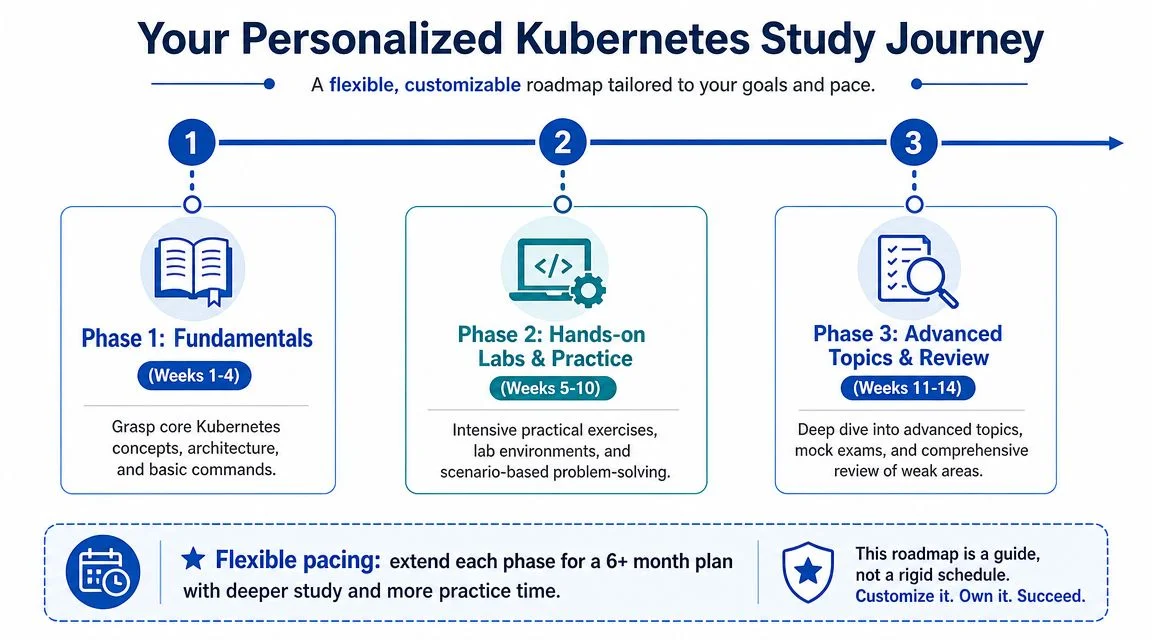
A personalized system usually includes three phases:
-
Foundations Learn the concepts behind the commands. Focus on core objects, how Kubernetes thinks about desired state, and what common resources do.
-
Hands-on repetition Spend most of your time in labs. Build, break, fix, and repeat. Such repetition builds confidence.
-
Exam simulation and review Practice under time limits. Track where you hesitate. Clean up those weak spots.
Use Spaced Repetition for Command Memory
For a performance-based exam, spaced repetition is practical, not academic. It helps you remember commands, object relationships, and troubleshooting patterns when the clock is running.
Use it for things like:
- common
kubectlpatterns - YAML fields you regularly forget
- differences between similar resource types
- troubleshooting sequences you want to perform automatically
A simple method works well. Keep short prompts in a flashcard tool or notes system. Review them briefly each day. Don't write paragraphs. Write triggers.
Examples:
- “Need to inspect why a Pod won't become Ready. What do I check first?”
- “Need to create a resource quickly from the CLI. What generation pattern do I use?”
- “Need to confirm rollout behavior. Which command helps me verify progress?”
Daily Labs Beat Weekend Cramming
Kubernetes skill grows through repetition. A shorter daily lab session usually beats a single giant weekend session because the terminal workflows stay fresh.
Try this rhythm:
- Short weekday sessions for command speed and focused topics
- One longer session for scenario work and troubleshooting
- One review block to revisit mistakes and weak areas
“Study until you can explain it” isn't enough for Kubernetes. Study until you can do it quickly without guessing.
A Sample Weekly Study Pattern
Here's a flexible model you can adapt.
| Day | Focus |
|---|---|
| Monday | Review core concepts and last week's mistakes |
| Tuesday | Hands-on lab on one topic such as workloads or networking |
| Wednesday | Spaced repetition review and short CLI drills |
| Thursday | Another lab, but solve from memory before checking notes |
| Friday | Light review and YAML cleanup practice |
| Saturday | Timed scenario session that mixes several topics |
| Sunday | Rest or brief weak-area recap |
How to Know Your Plan is Working
Your study system is healthy if you notice these changes:
- You spend less time searching for basic commands
- You can read a task and translate it into actions quickly
- You recover from mistakes faster
- You know exactly which topics still slow you down
If those things aren't happening, don't add more content. Tighten the system. Reduce the topic load, increase lab time, and review errors more deliberately.
Essential Resources for Your Training Arsenal
A good Kubernetes study stack isn't one course. It's a set of resource types that each do a different job.
Too many learners overload one category. They watch videos for weeks and skip labs. Or they grind labs without understanding what the resources mean. Kubernetes certification training works best when you combine conceptual learning, reference material, practice environments, and progress tracking.
Official Documentation as Your Reference Muscle
The official Kubernetes documentation isn't just for learning. It's also the habit-building tool that teaches you where to find exact syntax, object behavior, and examples when your memory is fuzzy.
Use the docs with intent:
- Look up one concept at a time. Don't read randomly.
- Turn examples into small labs. If a page shows a manifest, apply it and inspect the result.
- Summarize patterns in your own words. This helps you retain the why, not just the syntax.
The goal isn't to memorize every page. The goal is to become fast at finding and applying the right information.
Labs Are Non-Negotiable
Interactive labs are where theory turns into exam skill. You need a place to create resources, inspect failures, and repeat tasks until they become familiar.
A useful lab setup should let you:
- deploy and modify workloads
- inspect events and object state
- troubleshoot misconfigurations
- practice command-line workflows without fear of breaking production
If your current prep doesn't include repeated live practice, your study plan has a major gap.
Courses Explain Structure
Structured courses are still useful. They give you sequence. A solid course helps you learn in an order that makes technical sense instead of bouncing between random topics.
Look for courses that do three things well:
- explain concepts clearly
- map lessons to realistic tasks
- include opportunities to apply what you just learned
Practice Exams Reveal the Truth
Practice exams aren't only for scoring yourself. They reveal friction. They show where you freeze, where you misread, and where your workflow falls apart.
That's why I tell learners to track not just wrong answers, but slow answers.
- Fast and correct means the topic is stable.
- Correct but slow means you need more repetition.
- Wrong and slow means you likely have a conceptual gap.
Here's an example of a visual learning environment many learners find helpful when tracking progress across study tasks:
If you're comparing broader DevOps learning workflows, these MindMesh Academy DevOps Engineer Professional resources show how structured study guides can support exam prep across adjacent domains.
Build a Balanced Toolkit
A practical training arsenal usually includes:
- One primary course for structure
- One lab environment for daily repetition
- Official docs for reference discipline
- A review system for commands and weak areas
- Timed practice to simulate pressure
If one category is missing, the system becomes lopsided. Videos without labs create false confidence. Labs without review create repeated mistakes. Practice exams without concept repair just measure frustration.
Exam Day Strategy and Your Career Beyond Certification
You sit down for the exam, the timer starts, and the first task looks familiar. Then the second one is worded in a way that slows you down. By the third, your hands want to move faster than your brain. That is the moment your study system either holds you steady or falls apart.
Exam day rewards trained habits more than last-minute effort. The goal is simple. Make good decisions under time pressure.
A Practical Exam-Day Approach
Start by protecting your attention.
Prepare Your Environment Early
Set up your desk, your identification, your machine, and your internet connection well before the exam window. A proctored exam already creates enough tension. You do not want basic setup problems taking mental energy away from the tasks that matter.
Read Tasks Twice, Then Mark the Target
Many candidates lose points because they solve a nearby problem instead of the assigned one. Slow down long enough to identify the object, namespace, resource state, or output the task asks for. Kubernetes work is often like following a runbook during an incident. Precision beats speed when speed is built on a wrong assumption.
Use the Clock to Make Decisions
If a question becomes sticky, leave yourself a marker and move on. A timed performance exam is partly a triage exercise. The engineers who score well are usually the ones who protect momentum, collect the straightforward points first, and return with a clearer head.
Validate Every Change
Do not trust a command just because it ran without obvious errors. Check the resource. Check the namespace. Check the status. Check the output the task cares about. In practice, Kubernetes often punishes small misses such as the wrong context, the wrong label, or a manifest applied in the wrong place. Exam conditions do the same.
One calm verification habit can save more points than one extra memorized command.
Turn Your Study System into an Exam System
How you prepare for the exam is important. If your study plan only helped you consume material, it stops helping on exam day. If it trained recall, repetition, and recovery, it keeps working under pressure.
A good final-week system usually includes three parts:
- Short daily labs to keep commands and workflows fresh
- Spaced review for weak topics, common flags, and troubleshooting steps
- Timed practice blocks so you learn when to continue, when to verify, and when to skip
That structure matters because certification prep is not only about what you know. It is about how reliably you can retrieve and apply it. Spaced repetition helps facts stick. Timed labs teach pace. Error review teaches judgment.
What the Certification Changes, and What It Does Not
A Kubernetes certification does not replace hands-on experience. It does give your experience a clearer signal.
That signal helps in practical ways:
- Resume clarity, because employers can quickly see your technical direction
- Stronger interviews, because your explanations tend to become more structured
- Better role fit, especially for platform, DevOps, SRE, and cloud operations paths
- More trust at work, if your team wants evidence that you can handle cluster-related tasks
The stronger story is never the badge by itself. The stronger story is the badge plus evidence. Show the lab work, the home projects, the incident fixes, the deployment pipelines, or the security hardening steps you can now explain with confidence.
Think Beyond the Badge
Certification works best as a milestone inside a longer system of growth. If CKA supports your move into cluster administration, let it lead to real ownership of deployments, upgrades, and troubleshooting. If CKAD fits your application path, use it to get better at shipping resilient workloads. If CKS matches your security goals, build a follow-up plan around policy, scanning, and runtime defense.
That is the part many learners miss. Passing the exam is one event. Building a repeatable way to learn, practice, and close skill gaps is what keeps paying off after the result email arrives.
If you're looking for a study platform built around retention, progress tracking, and exam-focused preparation, MindMesh Academy offers many resources to help you achieve your certification goals. Find your next challenge and prepare for success with our certification programs.

Written by
Alvin Varughese
Founder, MindMesh Academy
Alvin Varughese is the founder of MindMesh Academy and an enterprise architecture leader. An electrical engineer by training, he moved from factory automation in South Africa to cloud architecture at GE Appliances and Humana (Fortune 50), and holds 20 professional certifications including AWS Solutions Architect Professional, Azure DevOps Engineer Expert, and Microsoft Agentic AI Business Solutions Architect. He built MindMesh Academy after interviewing too many highly certified candidates who couldn't answer basic questions: the goal is prep that makes you better at the job, not just able to pass the exam.